Weekly Digest Number 15 - April 13, 2021 |
|
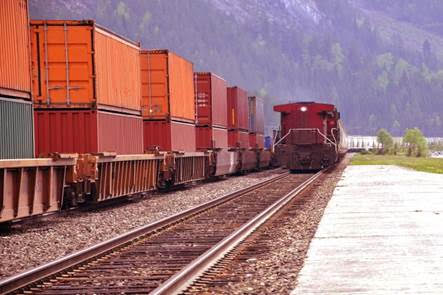
THE RULE OF 2: The crew aboard a freight train is there for a reason — safety. But big railroad companies in the U.S. think that they can boost their profits by cutting the personnel in the locomotive, putting efficient and safe rail operations at risk throughout the country. |
|
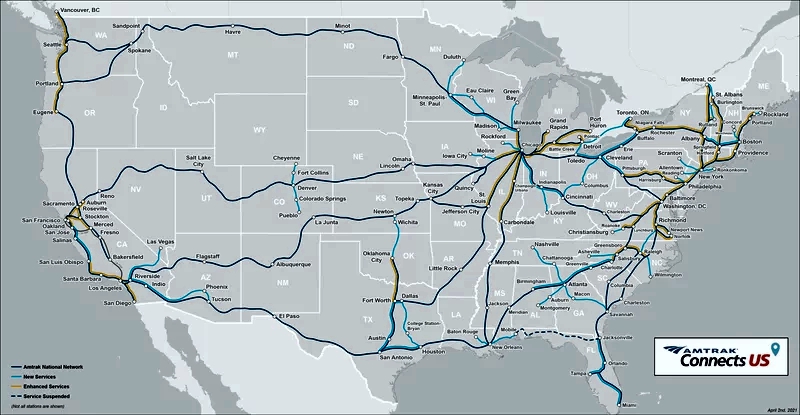
As Biden Pushes Major Rail Investments, Amtrak's 2035 Map Has People Talking |
|
When President Biden unveiled his major new infrastructure plan last week, the proposal included much more than fixing crumbling bridges. And for those who wish America had a more robust passenger train network, it gave them something new: hope.
Biden's $2 trillion infrastructure package has two provisions involving passenger rail: $85 billion to modernize public transit (commuter rail, buses, stations, etc.) and $80 billion to improve and expand the nation's passenger and freight rail network.
"You and your family could travel coast to coast without a single tank of gas onboard a high-speed train," Biden said at the plan's unveiling.
|
|
NTSB issues preliminary report on investigation of railway employee fatality |
|
“The National Transportation Safety Board issued Thursday (April 1) the preliminary report for its ongoing investigation of the March 3, 2021, death of a Burlington Northern Santa Fe Railway conductor in the La Mirada, California, railyard.
“Information in the report is preliminary and subject to change as the investigation progresses, as such, no conclusions about the cause of the accident should be drawn from the report.
“The conductor was riding a boxcar’s ladder and communicating position and distance information as the 48-car train moved through the yard at about 8 mph. The boxcar on which the conductor was riding collided with the side of a stationary locomotive, pinning and killing the conductor. Another conductor riding on a ladder on the opposite side of the same boxcar was uninjured.”
|
|
Canadian construction firm picked for $1B Mexico-Canada rail link project |
|
Engage Construction Management and Consulting Inc. has been selected for the Canadian piece of a $1 billion infrastructure project connecting Mexico’s Pacific Coast to Winnipeg, Canada.
The United States-Mexico-Canada Agreement (USMCA) Corridor, also known as the Northern Corridor project or TMEC Corridor, is an infrastructure project aimed at allowing Mexico to integrate into the rail and logistics systems of Canada and the United States.
Mexico-based Caxxor Group, the project developer, said Engage Construction was selected for its track record throughout Canada.
The project would also require the construction of 54 miles of rail lines in Mexico to go with the more than 146,000 miles of existing railroad infrastructure that runs through the U.S., Mexico and Canada.
|
|
Now US intermodal rail yards clog up as port congestion and delays continue
|
|
US shippers and importers that rely on rail are bracing themselves for a long slog through a period of congestion and delays.
Some have lost patience and shifted traffic to truck.
The Los Angeles-Long Beach port complex has become synonymous with congestion for months, and problems are expected to continue at least into June, with imports projected to remain at elevated levels.
However, other parts of the country are also struggling with delays.
Containers headed for the Midwest have been stuck at the New York/New Jersey port complex because of congestion on the rail network in the Chicago area, where several intermodal rail yards have been clogged up as a result of a combination of factors.
The problems began in February, when the terminals in New York and New Jersey were closed for five days because of weather conditions. According to some reports, Norfolk Southern is still working through the backlogs.
|
|
Scabby: The Law of the Rat |
|
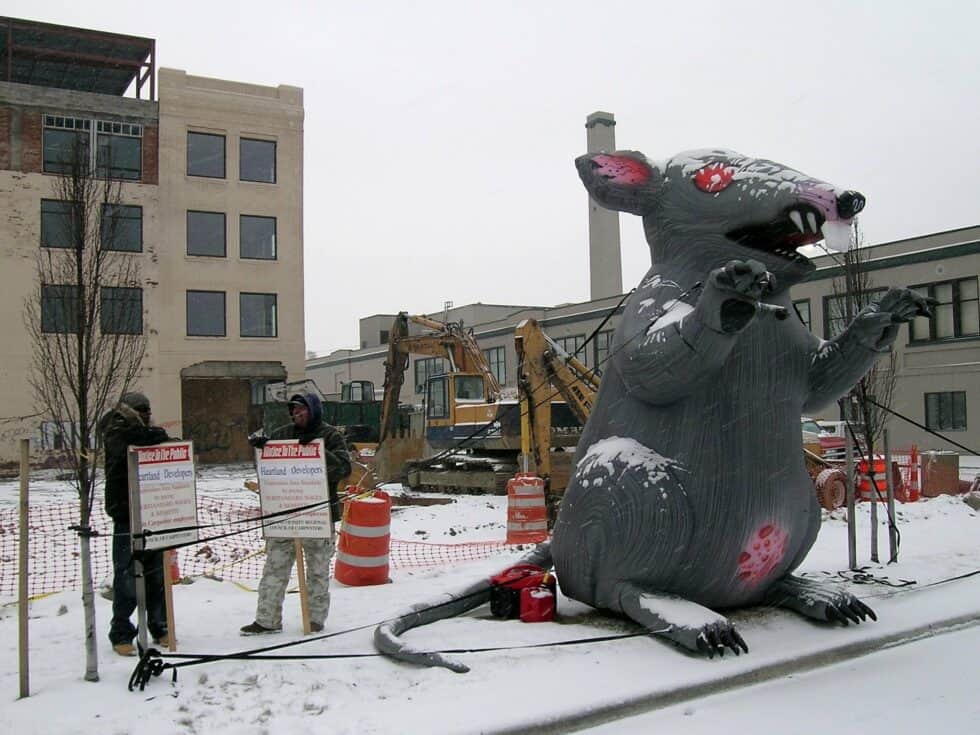
What has sharp teeth, blood-shot eyes, festering nails, looms twelve feet tall, but doesn’t look mean enough to be threatening? Though it might seem like an unlikely subject of cutting-edge labor and constitutional law, the union’s inflatable rat balloon called Scabby has been at the center of these disputes for over a decade. Scabby has survived lawsuits, injunctions, unfair labor practice accusations, and even friendly fire. But Scabby faced its biggest threat yet when President Trump’s General Counsel Peter Robb set his sights on the rat in 2017. Though Robb allegedly “wanted the rat dead,” Scabby managed to stay alive. How has Scabby survived the anti-union legal climate for so long? And who cares?
Unions have been using inflatables as protest tools since the 1970s, but the Scabby that we know and love wasn’t born until 1990. A Chicago bricklayers union asked a local balloon-making company, Big Sky Balloons, to design a large inflatable rat. Peggy O’Connor, the owner of Big Sky Balloons, remembers that the bricklayers specifically requested that the rat look “mean…with festering nails and teeth,” in order to “send a strong message during protests.” Ms. O’Connor’s first attempt “wasn’t mean enough,” so she added red bloodshot eyes and a scabbed pink belly. The bricklayers loved it, and Scabby was an instant hit. Unions all over the country started requesting Scabby’s from Big Sky. Today, Big Sky sells around 40-50 Scabby balloons a year, ranging from six feet to 25 feet high, priced from $2,585 to $9,295, sold with a blower and an extension cord.
|
|
New York's high-speed rail project faces lengthy new delay |
|
It's not clear what exactly is delaying the arrival of high-speed rail in New York state.
But on Thursday, the Federal Railroad Administration said a major step — completion of the final environmental impact statement, scheduled for Friday — would take another nine months to complete.
The study would identify which of a half-dozen alternatives to pursue.
The high-speed rail project, launched in 2009 with a series of events to gather public comment, has faced numerous delays over the past decade.
The alternatives range from increasing top speeds to 90 mph — the current top speed on the route between Schenectady and western New York is 79 mph — to as much as 125 mph, the most expensive choice, requiring entirely new tracks. One alternative is to do nothing.
|
|
Biden defends his infrastructure plans |
|
Yesterday, President Biden defended his infrastructure plans and stated his willingness to negotiate and debate his economic agenda. What Biden isn’t open to is doing nothing. Details of the proposed infrastructure package include a plan to raise $2.5 trillion in revenue over the next 15 years through corporate tax hikes.
Biden seeks to crack down on companies’ balance sheet strategy of shifting profits between countries in order to escape paying taxes. Under the new plan, there will be a new strict global minimum tax and harsh penalties on companies that try to evade paying U.S. taxes. The corporate income tax rate will be raised from 21% to 28%, and tax subsidies for fossil fuel companies will be eliminated.
In its place will be tax incentives for renewable energy investments and production. The Biden administration is also focused on spending funds on transit, the electric grid, water pipes, and broadband internet to maintain America’s competitiveness on a global scale.
While Biden’s economic plan has drawn backlash from the business community and may face an uphill battle in Congress, the President has stated an openness to compromise and Democrats could use the reconciliation process to their advantage in advancing economic directives.
|
|
Editor's Note: We continue to see various interest groups weigh in on the proposed CP-KCS merger:
|
|
Series review on Taroko derailment: risk, trauma, and collective memory | Apple Daily Taiwan |
|
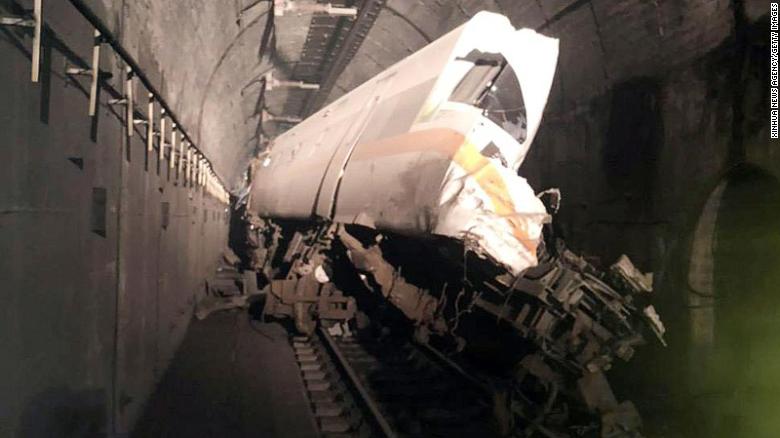
The Taroko Express, a Taiwan Railway train, derailed at the Qingshui Tunnel in Hualien on April 2nd, killing 51 and injuring 187. The accident has plunged the nation into great sadness during the Tomb Sweeping Day holidays. Lin Chia-lung, Taiwan’s transportation minister, has promised to shoulder political responsibility. Many citizens expect him to honor his word.
|
|
NTSB drops PTC from 'Most Wanted' safety list |
|
The National Transportation Safety Board (NTSB) yesterday finalized its latest Most Wanted List of Transportation Safety Improvements, which, for the first time in many years, did not mention positive train control (PTC).
The list for 2021-22 draws attention to more than 100 safety recommendations associated with the 10 mode-specific safety improvements.
Only one specifically addresses rail — "Improve Rail Worker Safety" — but the content for that item remains under development, according to an NTSB press release.
|
|
|
|
|
|
|