| | |
Sylvia Woods Harp Center
October 2026 Newsletter
| | |
In my March 2025 newsletter, I featured an amazing article by Nancy Thym about her trip to China to record a video with other players of ancient harps from around the world. The video was aired during the Chinese Lunar New Year. She provided information about many types of harps.
This year, she has been working with a group of experts to examine all aspects of the ancient Greek harp. I'm pleased to present the fascinating article that she wrote for this newsletter about her experience and what they have learned.
Nancy is also announcing her upcoming “Discover the ancient Greek harp" course, which will take place November 23-26 in Matera, Italy. You'll find the information near the end of her article below.
Thank you, Nancy, for sharing this harp history with us.
-- Sylvia
| | |
by Nancy Thym
When we think of the music of ancient Greece, we usually imagine a man singing or reciting to a large lyre called a kithara, or Apollo playing a lyre made from a tortoise shell called a chelys, or Arion riding a dolphin and playing either a short-armed phorminx or a long-armed barbiton.
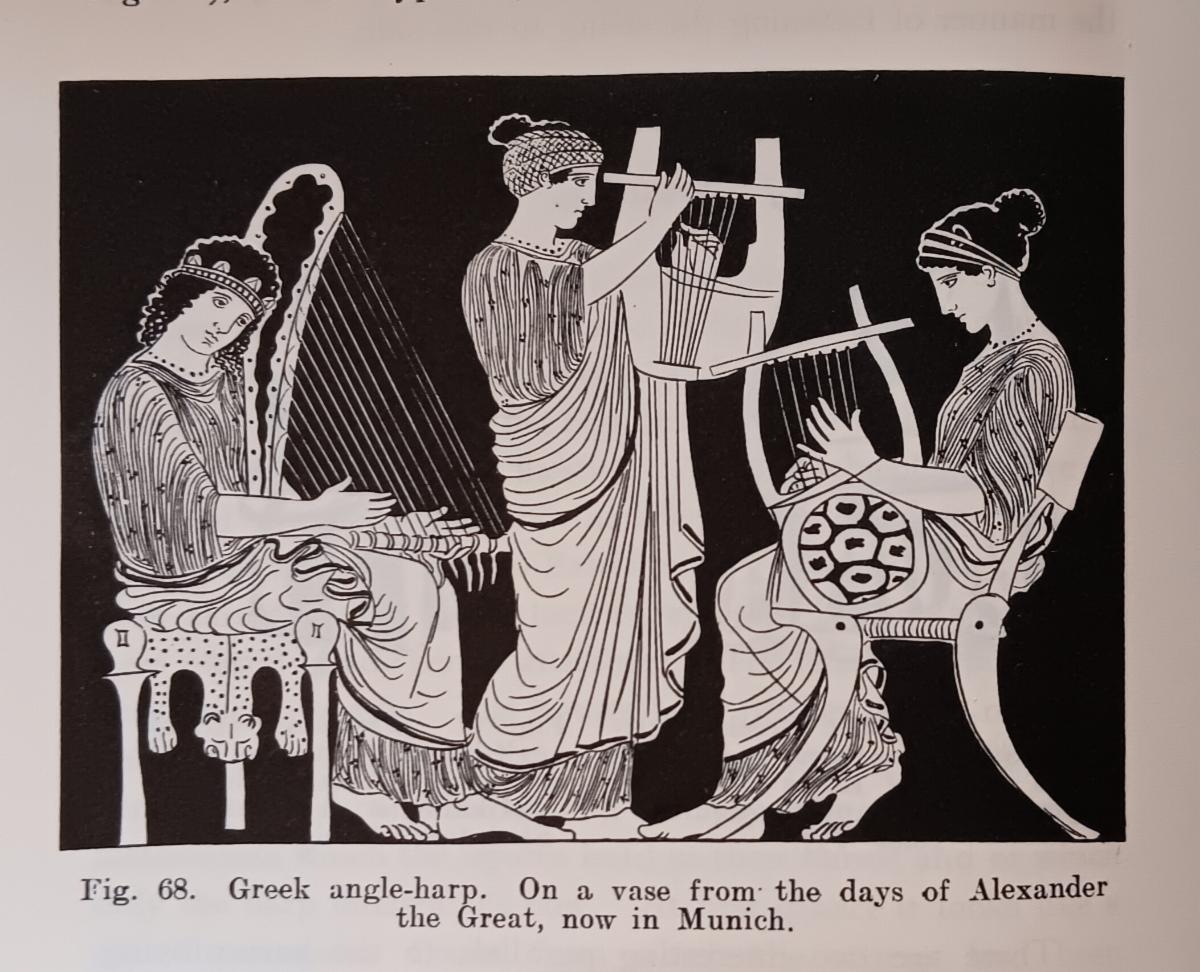
Figure 1: From Hortense Panum, "Stringed Instruments of the Middle Ages", 1940
Images of harps, though not as prevalent, do exist but, for some reason, have not been studied as intensively as the Greek lyre and have even been misrepresented in the literature on early musical instruments. Part of this is due to an entry in the book “Stringed Instruments of the Middle Ages” by Hortense Panum (1940). Providing no photographs but only sketches, she states that the Greek harp had no forepillar and that the bird-like pillar seen in some images was only decoration and not structurally important.
| |
Figure 2: Scene with Muses, Volute Krater from Apulia, Southeastern Italy, ca. 420 BCE. The original of Figure 1.
A photo of the original vase shows that the harp does indeed have a pillar! Panum’s mistake has led to the 80-year misconception that Greek harps had no forepillars, repeated continually in literature on the history of the harp.
Barnaby Brown, director of lotos-lab in England, has brought together a group of specialists, consisting of philologists, musicologists, music archaeologists, iconography specialists, folklorists, historical harpists and performers, to examine all aspects of the Greek harp. Our first meeting took place in Matera, Italy in February 2026. Matera is one of the most ancient cities in the world and is located in Apulia in Southeastern Italy, which was important during the Magna Graecia period – the Greek period of Italian history. The Hotel ΜΟΥΣΕΙΟΝ, where our meeting and course took place, is a full-Immersion hotel where the rooms are decorated in the style of different periods during the Magna Graecia and visitors are transported to ancient times.
| |
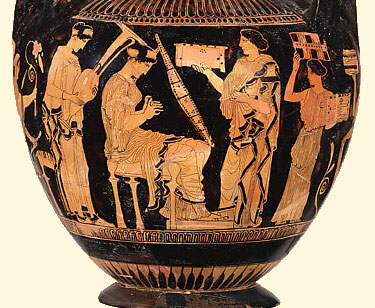
Figure 3: Wedding scene with a trigonon player from an Attic vase, ca. 430-420 BCE.
So far, we have been able to differentiate between three types of Greek harps as depicted on pottery vases.
Harp #1. The triangular trigonon, with a straight soundbox held away from the player.
Depictions of the trigonon are found on Attic (the entire ancient city-state of Athens located on the Attic peninsula) vases from ca. 430-420 BCE. Actual archaeological finds are scarce, so it is fortunate that the remains of a trigonon from 430-410 BCE have been discovered in Daphnē, Greece. This find has been documented and reconstructed by Chrēstos Terzēs. (The Daphnē Harp 2013).
| |
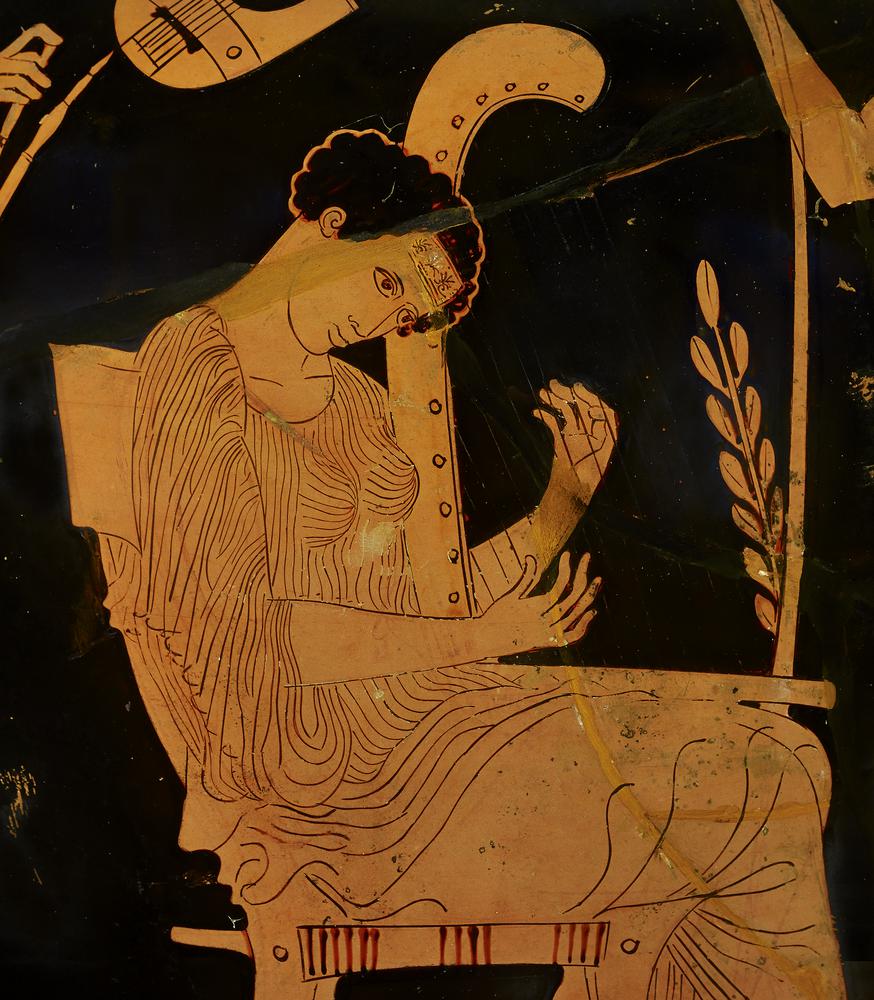
Figure 4: The muse Terpsichore with an open frame harp, Melousa with aulos and phorminx and Mousaius with a chelys, Attic vase, 430-420 BCE
Harp #2. An open-frame angular harp with an arched body similar to those found in Persia and China.
There are very few depictions of the open-frame harp on Greek pottery. One of them may even be damaged in the place where the pillar would be, making the harp appear to have no pillar. These appear on Attic vases from 430-420 BCE.
| |
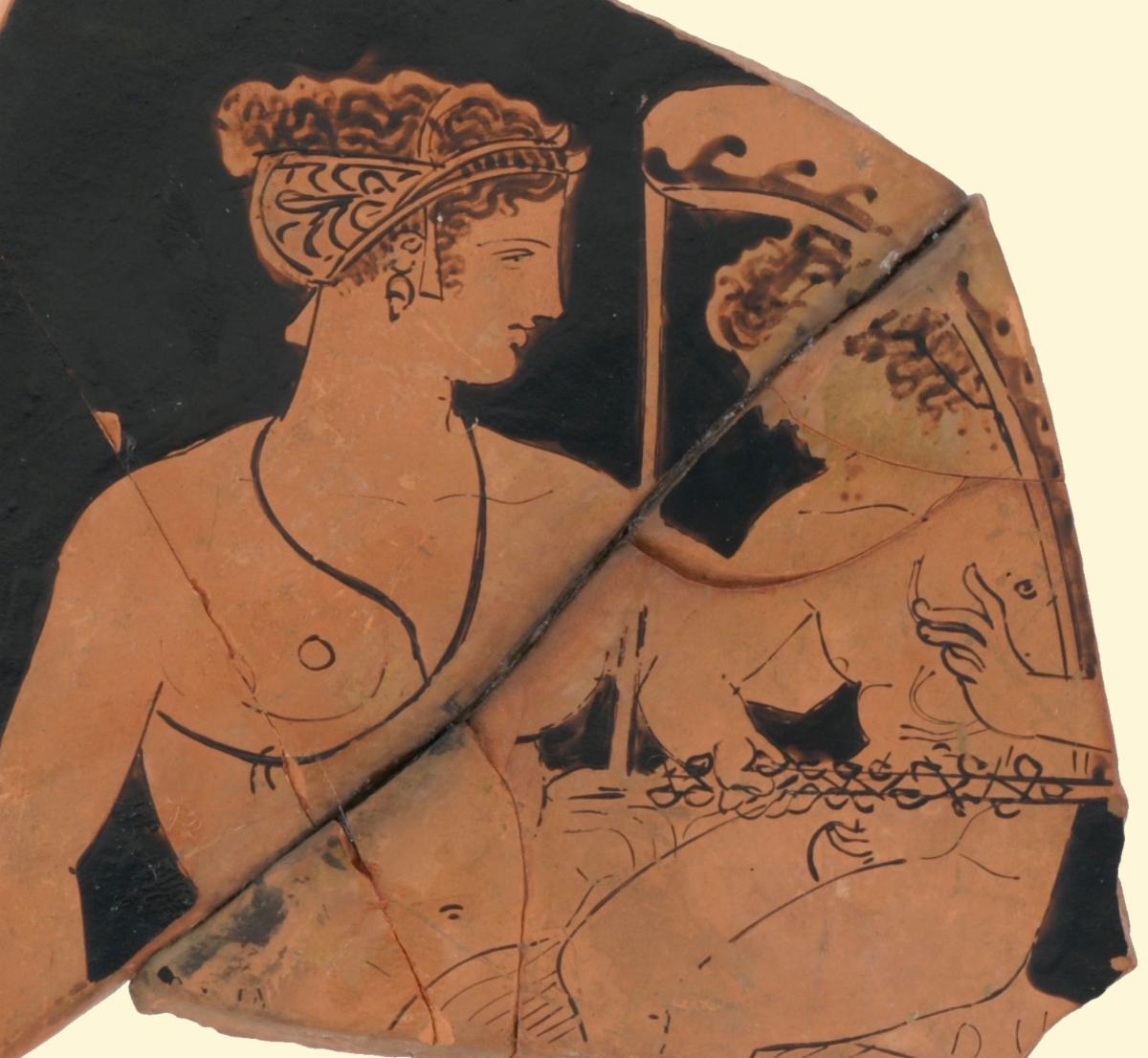
Figure 5: Eros playing a closed-frame harp for his mother Aphrodite, Attic fragment, 400-300 BCE.
Harp #3. A harp similar in shape to the open-frame harp but with a support pillar.
Harps with an arched soundbox and a pillar are definitely the most prevalent images on Greek pottery. Those from the Greek mainland date from ca. 475-350 BCE.
| |
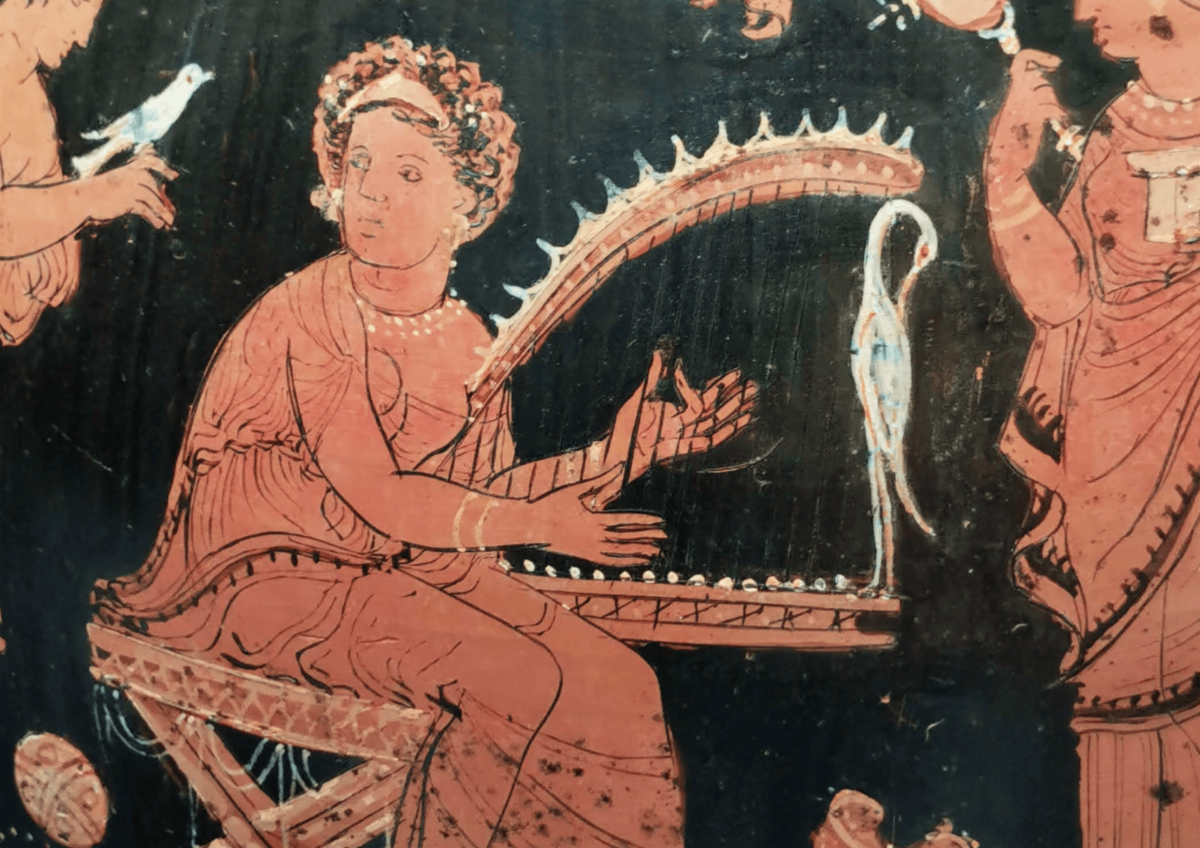
Figure 6: Woman playing a typical Apulian harp with spikes at the top of the soundbox, the forepillar in the shape of a waterfowl, and an extra board underneath the string arm, c. 340-310 BCE.
Because our project is based in Matera in Apulia, our studies have focused on a very specific type of Greek harp, which seems to be depicted only on vases from Apulia dating from a somewhat later period, ca. 350-300 BCE. This harp is characterized by the spikes running along the top of the soundbox and an extra board under the string arm, presumably to protect the player from the pressure of tuning pins and to keep the pegs or tuning wraps from being bumped and going out of tune. Many of these harps also have a pillar shaped in the form of a waterfowl.
| |
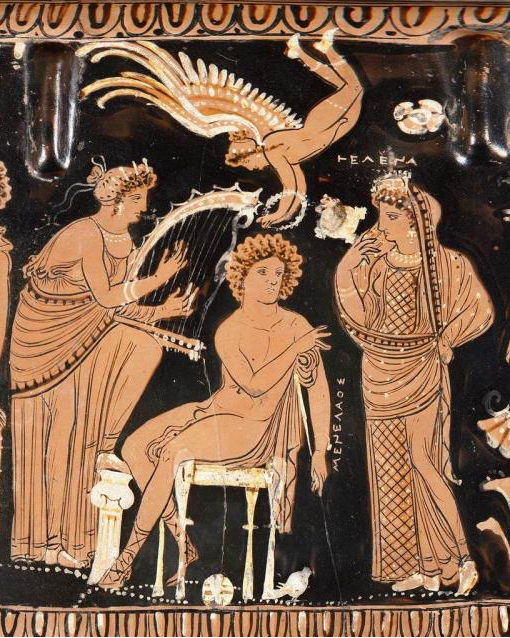
Figure 7: The wedding of Menelaos and Helen, Apulia, ca. 340 BCE.
Whereas the kithara is usually played by men, the harp appears to have been played almost exclusively by women. The only exceptions I have discovered so far are on Attic vases: a harp played by Eros (Figure 5) and one played by a satyr. When played by a woman, she is almost always facing towards the right, with the harp resting on her left thigh. When played by a male, the figure is facing left.
The kithara was the high art instrument of Greek music and recitation. It would have been played in large settings, at competitions and public performances.
The harp appears in more intimate settings, specifically at weddings (Figure 3 and Figure 7), in a woman’s boudoir, in scenes with the muses (Figure 4), or at symposiums, where people met to relax, taste wine and various foods, discuss literature and philosophy, or listen to lectures and music.
| |
Figure 8: Symposium scene, Apulia, ca. 350 BCE.
Formerly, it was assumed that all women portrayed playing the harps were hetaira, often translated as prostitute or courtesan, but perhaps most comparable to a geisha. They were trained in graciousness, entertainment, dance, singing, and playing an instrument. Now scholars are moving away from this assumption, differentiating more clearly and looking more closely at context, clothing, symbolism, and the identity of others in a depiction. Some images do portray hetaira, but many do not and are actually named on the vase. The muse Terpsichore is actually named in Figure 4. Context is extremely important. Eros appears in almost all the scenes with a harp player. Dionysius is often present, along with symbols associated with him.
| |
In these images, the neck or string arm appears to show either tuning pegs (Figures 6-8) or wrapped tuning collars with tassels such as were used on Egyptian harps and are still used on Ethiopian lyres or Burmese harps (Figures 2 and 5). A recent archaeological find of what is presumed to be the wooden neck or string arm of a harp is equipped with wooden tuning pegs. We assume the soundboxes were hollowed from a single piece of wood shaped like a boat, and then wrapped in leather to form the soundboard, like ancient Persian and Egyptian and current African harps.
Hand positions on the Greek harp are extremely varied. Many of you will recognize a technique used for producing harmonics on the modern harp (Figure 6). Figure 3 shows a fairly modern hand position. Most images seem to show the right hand playing the treble strings and the left hand playing the bass strings.
Within the group of harps with pillars, there appear to be two different types – one with a steep soundbox (Figures 7 and 8) and one with a low curving soundbox (Figure 6). For now, we have adopted the terms “high-headed” and “low-headed” from designations for Scottish and Irish harps. Marco Sciascia has built two reconstructions of Greek harps for our project, one high-headed and one low-headed. We must always take into consideration the angle of the photo, the lighting, and whether the image is on a bulging or concave vase. I have found that many images on the internet have been digitally altered to turn an image from a round surface into a flat image. This can quickly transform a "high-headed harp" into a "low-headed harp," so caution is always advised.
| |
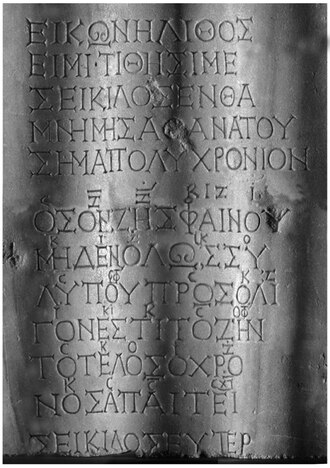
Figure 9: Seikilos Stele with music notation above the words to the song, Tralles, Anatolia,1st-2nd c. AD.
Fortunately, many examples of Greek notation have survived, including the Song of Seikilos carved on a stele from the first or second century AD found in modern-day Anatolia.
Greek music is based on a tetrachord system, or series of four-note scales, which means that the music is nearly chromatic. For example, C and C# or G and G# often appear next to each other within the same piece. Marco has suggested that the high-headed harps, in which the strings are clearly of different lengths, were tuned diatonically whereas the “low-headed harps”, in which the strings are all of similar length, were tuned chromatically. We are currently experimenting with the stringing and playing of each of them: playing the actual chromatic music, developing accompaniments for the melodies, and singing or reciting Greek verse, in which the rhythms are very important.
| |
This is an ongoing project, and there is still much work to do. Every element of imagery on Greek vases has a symbolic meaning, and there is yet much to discover. Transcribing Greek notation is very demanding and open to interpretation.
I hope I have been able to excite your interest in the ancient Greek harp. If so, our next course, “Discover the ancient Greek harp,” with Bill Taylor, Nancy Thym, and Barnaby Brown will take place Monday – Thursday, November 23-26, 2026, at the Hotel ΜΟΥΣΕΙΟΝ in Matera, Italy. For more information, go to https://lotos-lab.com/moyseion-music-making-courses-2026-2027/
I would like to thank our team as well as the curators and directors of the museums and universities I contacted for information on Greek pottery vases, who all responded immediately, sometimes within minutes (!), with the information I requested.
-- Nancy Thym
Acknowledgements:
Figure 2: Public Domain.
Figure 3: Metropolitan Museum, New York, 07.286.35. Public Domain.
Figure 4: British Museum, London, BM1847,0909.7. © The Trustees of the British Museum. Shared under a Creative Commons Attribution- NonCommercial- ShareAlike 4.0 International (CC BYNC-SA 4.0) licence
Figure 5: Antikensammlung University of Jena, S0477, Photo: Klas Winter. Used with permission.
Figure 6: Museo Archeologico Nazionale della Siritide, Policoro, Photo: CC-BY Laura Noviello
Figure 7: Museum of Fine Arts, Boston, MFA 00.360.1. Public Domain.
Figure 8: Chicago Art Institute, 85.2012. Photo: Mark Landon / Wikimedia Commons. https://commons.wikimedia.org/wiki/File: Apulian_redfigure_krater_with_Dionysos_at_a_banquet_(Chicago,_Art_Inst_85.2012).jpg
Figure 9: National Museum of Denmark, 14897. Photo: Lennart Larsen, National Museum Photographer.
| | New Products at Harpcenter.com | | |
This month's sale features two PDFs that include Greek songs. The rest of the sale items will help you get ready for the upcoming Christmas season.
To get the 15% discount, enter the code word Greek in the "Enter Promo Code" box on your shopping cart page and click "Enter Code" by October 31, 2026. See the "How to get the 15% discount" section at the bottom of this newsletter for more information.
| | |
Four Holiday Favorites
Frosty the Snow Man,
Silver Bells, Rudolph the Red-Nosed Reindeer, Let it Snow!
Let it Snow! Let it Snow!
arranged by Sylvia Woods
PDF or Book
15% off with Greek code
------------------------------
| | |
A Charlie Brown Christmas
Christmas Time is Here,
Linus and Lucy
by Vince Guaraldi
arranged by Sylvia Woods
PDF or Sheet
15% off with Greek code
------------------------------
| | |
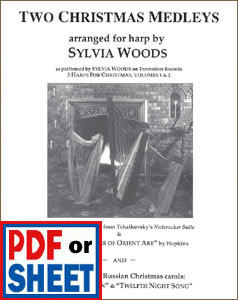
Two Christmas Medleys
Arabian Dance from the Nutcracker / We Three Kings - Angelical Hymn / Twelfth Night Song
arranged by Sylvia Woods
PDF or sheet
15% off with Greek code
------------------------------
| | |
Mary Did You Know
arranged by Sylvia Woods
PDF of Sheet
15% off with Greek code
------------------------------
| | |
That Night in Bethlehem
arranged by Sylvia Woods
PDF of Sheet
15% off with Greek code
------------------------------
| | |
In the Bleak Midwinter
arranged by Sylvia Woods
PDF of Sheet
15% off with Greek code
------------------------------
| |
How to get the 15% discount
| | |
15% off select sale items when you use the code word Greek
Our newsletter promo codes are redeemable online and are only valid for the products listed above in the monthly sale section. They are not valid for phone or email orders. This month's code word is Greek.
Here's how to get your newsletter discount at harpcenter.com:
#1. Put the items you want to purchase in your cart.
#2. On the page where you view the items in your cart, type this month's code word Greek in the "Enter Promo Code" box and click "Apply."
The actual price of the featured sale products on this page will then automatically change to reflect the discount. For example,
Unit Price: $9.95 (the original price)
Total Price: $8.46 (the discounted price)
You'll also see a note below the Promo Code box that shows the name of the promo code you entered and the percentage discount.
REMEMBER: You must enter this month's code word Greek in the Promo Code box and click "Apply" on your shopping cart page by October 31, 2026, to get the discount!
If you forget or have trouble adding it to your order, email Sylvia immediately.
This offer expires at the end of the day on 10/31/26.
| | |
Sylvia Woods Harp Center
Lihue, Kauai, Hawaii
| | | | |