|
November was a mixed month for markets, as concerns about AI caused an early month sell-off. Solid fundamentals and growing expectations for an interest rate cut in December helped support markets later in the month and led to a Thanksgiving week rally that offset some of the earlier losses. Looking ahead, risks remain, but further market appreciation remains the most likely path forward.
1. Beyond the Headlines: Stocks Mixed in November
2. Falling Interest Rates: Rate Cut Expectations Rise
3. Economic Report Updates: Delayed Data Partially Released
4. Looking Ahead: Cautious Optimism Despite Ongoing Risks
Beyond the Headlines: Stocks Mixed in November
November was a mixed month for markets as concerns about the AI boom caused an early month
sell-off. A late-month rally helped offset some of these losses; however, results were still mixed for investors. The S&P 500 gained 0.25 percent during the month while the Dow Jones Industrial Average was up 0.48 percent. The technology-heavy Nasdaq Composite, on the other hand, ended the month down 1.45 percent.
These mixed results came despite improving fundamentals. We recently finished third-quarter earnings season, and the results were better than expected. Per Bloomberg Intelligence, third-quarter earnings growth for the S&P 500 came in at roughly 15 percent, which was more than double analyst estimates of 7.4 percent at the start of earnings season. Over the long run, fundamentals drive performance, so this was an encouraging result for investors.
Technical factors were supportive as well for stocks. All three major indices spent the entire month well above their respective 200-day moving averages. The 200-day moving average is a widely tracked technical signal, as prolonged breaks above or below this level can indicate shifting investor sentiment for an index.
Results were mixed for international equities as well during the month. Developed international markets were able to eke out a modest gain, with the MSCI EAFE Index up 0.62 percent in November. Emerging markets, on the other hand, experienced more volatility, as the MSCI Emerging Markets Index lost 2.38 percent for the month.
Falling Interest Rates: Rate Cut Expectations Rise
Bond returns were positive for the fourth consecutive month in November, driven by falling interest rates. Expectations for a rate cut at the Fed’s December meeting rose notably during the month, which contributed to the falling rate environment. We entered November with markets pricing in a roughly 65 percent chance of a rate cut in December and ended the month at more than 80 percent odds of a cut.
The 10-year Treasury yield fell from 4.13 percent at the start of November to 4.02 percent at the end of the month. The Bloomberg Aggregate Bond Index gained 0.62 percent in November. High-yield fixed income was also up, with the Bloomberg U.S. Corporate High Yield Index gaining 0.58 percent. High-yield credit spreads ended the month slightly higher.
The Takeaway
· Bond returns were positive during the month, supported by falling interest rates.
· Expectations for a December rate cut rose during the month.
Economic Report Updates: Delayed Data Partially Released
There were only a handful of economic updates that were released during the month due to the ongoing impact from the recent government shutdown. While some delayed data releases have since been reported, others are still in limbo.
The delayed September employment report was released mid-month and showed a rebound in hiring in September, following modest job losses in August. The unemployment rate rose to 4.4 percent, which marks the highest level since late 2021 and signals headwinds for the job market and the economy.
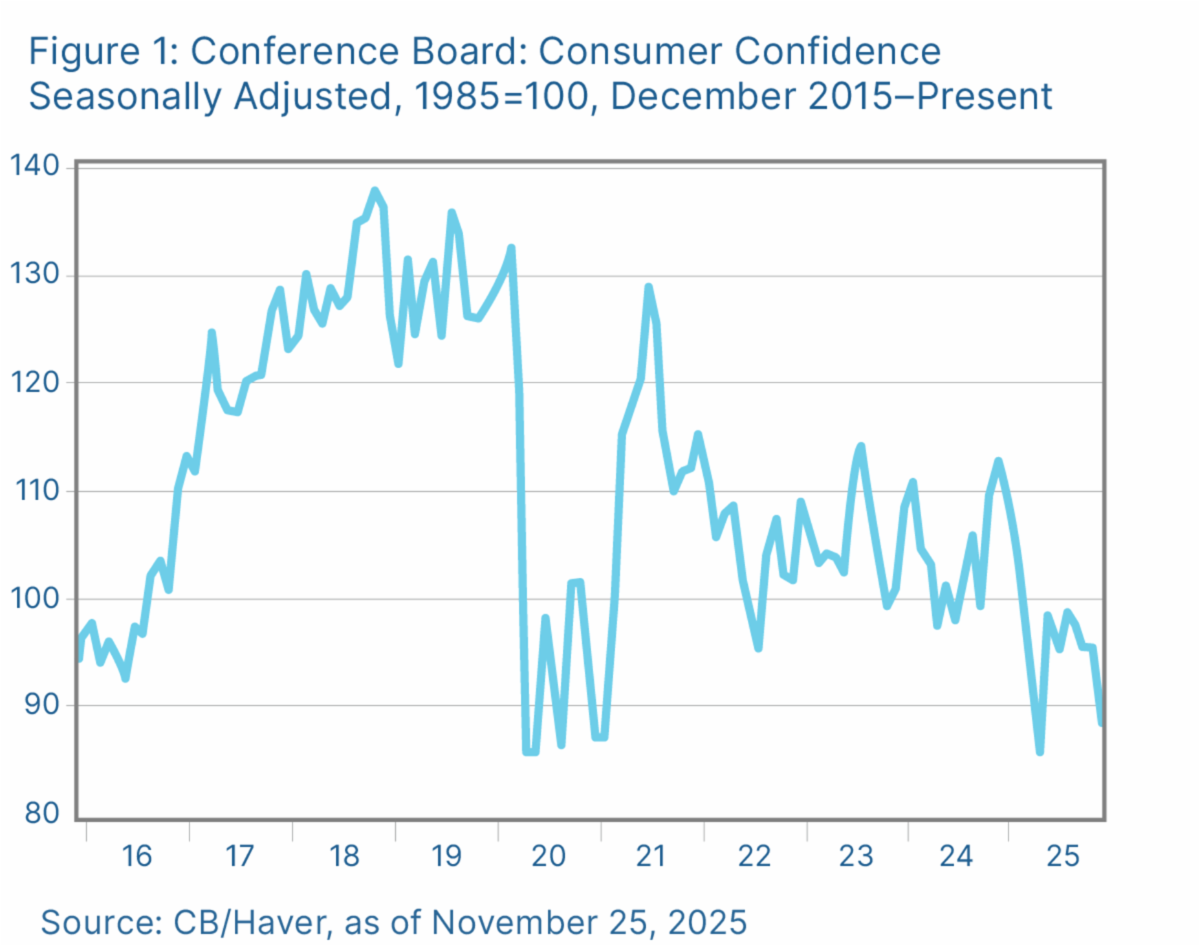
Consumers appear to be noticing these headwinds, as consumer confidence continued to falter in November. The Conference Board’s Consumer Confidence Index fell more than expected in November. As seen in Figure 1, this brought confidence to a seven-month low. The headline drop in consumer confidence was driven by rising concerns about the present economic situation as well as souring expectations for the future. Historically, consumer confidence has been a driver of consumer spending, so this is an important area to keep an eye on in the months ahead.
|