The Question Nobody’s Asking
Two weeks ago, we asked whether AI tools know your business exists. This week, we checked.
We asked ChatGPT, Gemini, and Claude the questions real buyers ask before deciding whom to call. Not “Tell me about this company,” but “Who does X near me?”
The results revealed a sizable gap between established Maine businesses, including one website that received a single AI-referred visit in 30 days while three comparable businesses each received at least 55.
Why the difference? It has less to do with what most businesses are testing and more to do with where AI looks for answers.
If you haven’t checked whether your business appears without naming it first, you may not know whether you’re making the shortlist at all.
| |
Introducing Findable
We built a program around the problem in this issue's lead article. Findable is our managed search and AI visibility service — SEO, answer engine optimization, and generative engine optimization, grounded in Maine Insights Lab research on how decisions actually get made in this market. Every engagement starts with a foundation month that establishes where you currently stand and what you should be known for.
Learn more →
| | | | |
Memories Might Be Enough
People think of marketing as "buy, buy, buy!", but that isn't the only thing it's good for. Even if you don't grab a customer's purchase, you still want to grab their attention. If you can secure that your product is tied to something memorable, the name will pass around. The image will stick in your mind. The thought of the ad can lead to the thought of the product.
Think of the most impressive advertisements of our time: the Apple Computers 1984 ad, the "Time To Make The Donuts" Dunkin' ad, and even many of the ads from insurance companies like Geico or Progressive do not actively show, or need to show, their goods or services in action. They just need the memorable nature of their advertisement to stick with you, so that you can more easily picture a logo or a name, so that you can more easily picture that good or service. That's how you make a market: by making a memory.
| | |
Leadership is teamwork, and teamwork is work
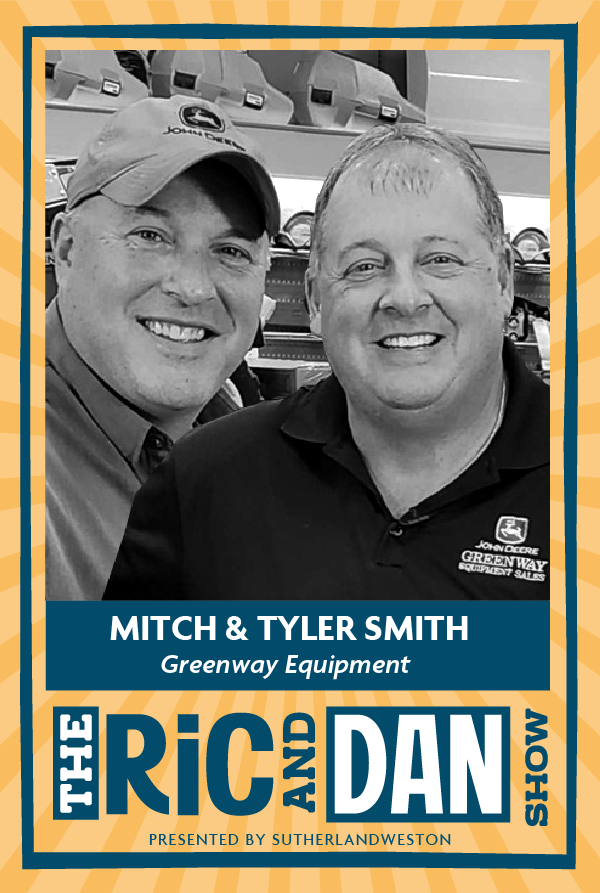
On the latest episode of The Ric and Dan Show, our hosts bring along Tyler and Mitch Smith of Greenway Equipment to chat about tractors, siblings, and the work that goes into being a family business. It's nothing easy, and the Smiths can recall how the business never was: running Greenway ever since they were young men, it was all a blur of early mornings and late nights, work weeks from Monday to Sunday, and the struggle to take it all alongside a sibling who you don't always see eye-to-eye with.
It's no surprise that work is hard. But work is worth it. If you know you are putting in the effort, making the moves, and creating opportunities instead of rejecting them, you can know you're maximizing your potential for success. And when you have the right spot, the right time, the right place, and the right potential, you're the closest you're going to be to a guarantee of success.
| | | |
The Three Emails (Well, Four) Worth Opening
We obviously think The Strategy Brief deserves a place in your inbox. But we also know we are not the only ones sending emails worth reading. Shocking, but true.
Here are three additional newsletters that can help you stay informed, find better ideas, and spend less time wandering around the internet.
Marketing Brew
Best for: Keeping up with marketing and advertising
This weekday newsletter covers brand strategy, social media, advertising, consumer behavior, and marketing technology. The writing is quick and conversational, with enough context to explain why an industry update matters, not simply that it happened.
The Rundown AI
Best for: Understanding AI without needing a translator
The Rundown AI breaks down new tools, product launches, and changes in artificial intelligence in about five minutes. It also shares practical examples of how people are using AI at work, making it more useful than another breathless headline announcing that everything has changed again.
Dense Discovery
Best for: Finding ideas outside your usual bubble
Sent weekly, Dense Discovery curates interesting books, tools, articles, design, technology, culture, and creative work. It is less about breaking news and more about finding something thoughtful that you probably would not have discovered on your own.
And, of course, keep opening The Strategy Brief for practical marketing advice, Maine business insights, useful tools, and the occasional recommendation that earns its place in your inbox.
Bottom line: A newsletter should make you smarter, save you time, or introduce you to something worth exploring. If it does none of those things, unsubscribe. Your inbox has suffered enough.
| | |
Title
Makaila Hickey, SW Digital Specialist
Our rotating team feature continues with Makaila Hickey, who shares how an early love of restaurants grew into a passion for gardening, preserving, experimenting in the kitchen, and finally writing down the recipes.
Growing up in Rockland, Maine, good restaurants were part of the landscape. RIP Café Miranda. At 15, I saved the tips from my first summer job to eat at James Beard Award-winning Primo, which raises a fair question: what kind of 15-year-old even knows what a James Beard Award is? Apparently, this one.
That early interest in restaurants soon widened into curiosity about agriculture, seasonality, and everything that happens before food reaches the table.
A great teacher gave that curiosity direction through a “Food & Water” class I took for two and a half years and the academic cover to write my final paper on the cultural significance of ambrosia salad. At the same time, I spent afternoons with my dad, the electrical contractor for a new restaurant taking shape in Freedom, Maine. There, I watched a then little-known chef transform an old mill into what would become Erin French’s The Lost Kitchen, a dream built deliberately around place, craft, agriculture, and community that reflected an entire way of thinking about food.
Eventually, observation became practice. Gardening led to canning, preserving, and finding uses for whatever the season produced in unreasonable quantities. Life with a skilled hunter added wild Maine game to the mix, so there is almost always something from the garden, the woods, or the freezer waiting to become dinner.
The best part is sharing the abundance. Neighbors might receive pickles, strawberry-rhubarb compote, or enough sage to make everyone question what, exactly, anyone is supposed to do with that much sage.
Most of what I cook begins as an experiment, which works until someone asks for the recipe. After one too many attempts to reverse-engineer from memory, I started a Substack (like everyone else these days!) as a place to record the recipes worth making twice.
For now, that includes slow-cooker strawberry-rhubarb compote and strawberry-rhubarb tiramisu. Consider this my public commitment to keeping better notes, so the next person who asks how I made something gets a more useful answer than a long pause and a vague gesture toward the stove.
| | You’re receiving this newsletter from Sutherland Weston because you’re part of our community of clients, friends, and neighbors who love learning, growing, and celebrating Maine together. | | | | |