Rail Workers Weekly News Digest
Number 29 - July 21st, 2020
|
|
Below is a series of articles compiled over the previous week.
They are of interest to railroad workers and activists.
|
|
ARTICLE #1 - HIGH SPEED RAIL (FREIGHT) NEWS
Making Tracks for High-Speed Freight: What’s Not to Like?!
|
|
(Editor's Note: The idea of more and faster trains - both freight and passenger - is starting to catch on. RWU has been working hand-in-hand with the group Solutionary Rail for five years now to develop a coalition behind the concept of "higher speed", electrified, multiple-tracked passenger and freight rail. This idea is catching the attention of local municipalities along rail routes, environmental organizations, and national politicians. It is time for the rail unions to get on board the movement!)
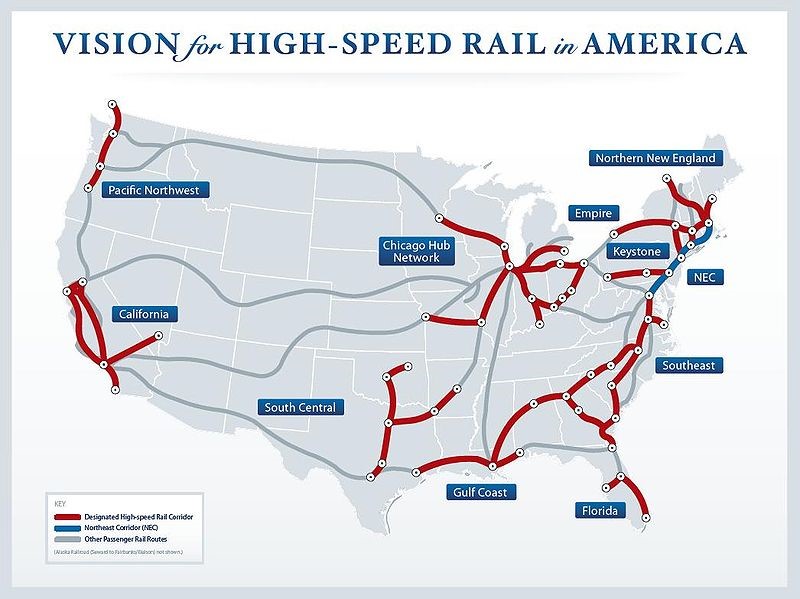
There are those who rail against California’s bullet-train project asserting that the system will require subsidization. They argue that there isn’t enough available capital even to fund construction of 119 miles of line between Shafter and Madera, much less build 520 miles from San Francisco to Los Angeles and Anaheim (the complete Phase 1 portion). These critics, detractors, naysayers would do well to read the May 1, 2019
Project Update Report
.
So, I can’t help but notice all the delivery vehicle goings on throughout the neighborhood, drivers delivering various items to front doors day in and day out and can’t help but wonder how such could translate over to long-distance rails.
For France’s Train a Grande Vitesse (Train of Great Speed or TGV for short), there once was the
La Poste
. What La Poste had to do with were specially equipped high-speed trains to handle parcels and mail operating on specific routes. The trains were liveried in yellow so as to prevent their being mistaken with their passenger train counterparts and they typically ran during the night.
This type of train service is one among a number of ways to bring in added revenue and the type of cargo carried could be expedited (express) freight, meaning being time-sensitive in nature.
So, in the United States, with parts of one bullet-train line already under construction at “
more than 32 active construction sites
” throughout California’s San Joaquin Valley, there are two more high-speed train endeavors proposed and planned for operation, the first between Las Vegas, Nevada, and now San Bernardino with the ultimate aim of making Los Angeles, California the west-end originating/terminating point. Then there is the system right now in the planning process for Dallas-Houston service. It is anticipated that the latter two will commence construction later this year.
At any rate, in elaborating more on the aspect of fast freight, by taking on that capability, such can help pay bills, cover expenses.
|
|
ARTICLE #2 - AMTRAK NEWS
House Appropriations Committee Passes $10 Billion for Amtrak
|
|
The House Appropriations Committee
approved the fiscal year 2021 Transportation bill last night by a vote of 30 to 22
. The legislation would provide $10 billion for Amtrak in FY21—$2 billion through the standard budgeting process, with another $3 billion for the National Network and $5 billion for the Northeast Corridor as part of economic stimulus title. The bill also explicitly prohibits Amtrak from reducing service frequencies.
“Since Amtrak released its service change proposals in its FY2021 supplemental request, our Association been clear that while we strongly support emergency funds for Amtrak, any additional funds need to buy certainty for workers and passengers alike and daily train service must be the very minimum service level,” said Rail Passengers President Jim Mathews
in a letter to appropriators
. “We are grateful that your bill takes into consideration the well-being of all 500 Amtrak-served communities—including many small towns with few transportation alternatives—recognizing the critical role passenger rail and public transit have always played in economic resilience.”
Appropriators emphasized that stimulus title, which includes $26 billion in transportation funding to help the U.S. economy recover from the coronavirus pandemic, is about putting Americans back to work while preserving essential systems in the face of cratering ridership and lost tax revenue.
“The emergency funding in this bill is pivotal to kickstart a strong and equitable recovery from the coronavirus pandemic and the ensuing economic collapse,” said House Appropriations Committee Chairwoman Nita Lowey, who is retiring at the end of this year. “After an unprecedented year of challenges, the investments in this bill lay the foundations for sustained economic growth and expanded opportunity for every American in every corner of our nation.”
|
|
ARTICLE #3 - FREIGHT RAIL TRAFFIC NEWS
Rail Traffic’s Recovery Process Takes Step Back
|
|
The recovery process
we’ve recently been seeing wasn’t evident this week, as total carloads were 201,703 carloads, down 22.7% compared with the same week in 2019, while U.S. weekly intermodal volume—
last week’s darling
—was 247,389 containers and trailers, down 7.4% compared to 2019.
None of the 10 carload commodity groups posted an increase compared with the same week in 2019. Commodity groups that posted decreases compared with the same week in 2019 included commodities such as coal, down 29,221 carloads, to 51,684; metallic ores and metals, down 9,890 carloads, to 13,884; and nonmetallic minerals, down 6,365 carloads, to 30,317.
For the first 28 weeks of 2020, U.S. railroads reported cumulative volume of 5,902,483 carloads, down 16.1% from the same point last year; and 6,684,174 intermodal units, down 9.9% from last year. Total combined U.S. traffic for the first 28 weeks of 2020 was 12,586,657 carloads and intermodal units, a decrease of 12.9% compared to last year.
North American rail volume for the week ended July 11, 2020, on 12 reporting U.S., Canadian and Mexican railroads totaled 289,808 carloads, down 20.4% compared with the same week last year, and 329,191 intermodal units, down 7.8% compared with last year. Total combined weekly rail traffic in North America was 618,999 carloads and intermodal units, down 14.2%. North American rail volume for the first 28 weeks of 2020 was 17,395,055 carloads and intermodal units, down 11.8% compared with 2019.
|
|
ARTICLE #4 - CORONAVIRUS NEWS
Amtrak, Commuter Services Regaining Ridership
|
|
(
Editor's Note: Passenger counts have been devastated by the virus this Spring. As they start to rebound, rail carriers are taking some necessary measures to help ensure safety and security. But many riders are wary returning. It could be months or even year before passenger rail makes a complete comeback to pre-pandemic levels.)
|
|
ARTICLE #5 - RAIL FREIGHT INDUSTRY NEWS
A Majority of Americans Support Freight Rail's Role in U.S. Economy
|
|
(Editor's Note: The American public is smart enough to understand that steel wheel on steel rail is the most efficient, environmentally sound, and safest means of transport. And that such transport is crucial to the U.S. economy and way of life. However, the AAR would have us believe that these basic facts translate into public support for the privately held rail freight industry. However, by surveying those who interface with the rail system - rail employees, shippers, passengers, and trackside communities - one might learn a different story - one of anger and frustration with, and disdain and disrespect for the industry.)
A majority of U.S. adults agree that the freight-rail industry is critically important to the nation's economy, according to a new poll conducted on behalf of the
Association of American Railroads
(AAR).
Conducted by Morning Consult, the poll also found that 75 percent of respondents view the freight-rail industry as safe, AAR officials said in a press release.
The poll results demonstrate bipartisan support for the freight-rail industry, they said.
Among its findings, the poll found that 85 percent of Republicans and 83 percent of Democrats agreed that the private freight-rail industry is important to the economy; 76 percent of respondents said it is safe to move goods by freight trains; 70 percent had favorable opinions of freight railroads; 78 percent agreed that freight railroads play a role in reducing the transportation's impact on climate change; and 58 percent favor moving freight over land by rail as opposed to truck to meet projected growth in freight shipments over the next 20 years.
"While freight railroads have worked quietly behind the scenes during the pandemic, the American people have clearly recognized the hard work and dedication of railroaders has and will continue to help power our economy," said AAR President and Chief Executive Officer Ian Jefferies.
As Congress considers surface transportation legislation, lawmakers should keep the public's support of freight rail in mind and "abandon any efforts that would weaken the industry's ability to serve their customers and the nation," Jefferies added.
|
|
ARTICLE #6 - TRUCKING NEWS
Study Shows Major Diversion of Freight from Rail to Roads if Bigger Trucks Allowed
|
|
A new report commissioned by the
Coalition Against Bigger Trucks
(CABT) highlights how legislation allowing bigger and heavier trucks on the nation's highways would result in a "major diversion" of freight from rail to roads.
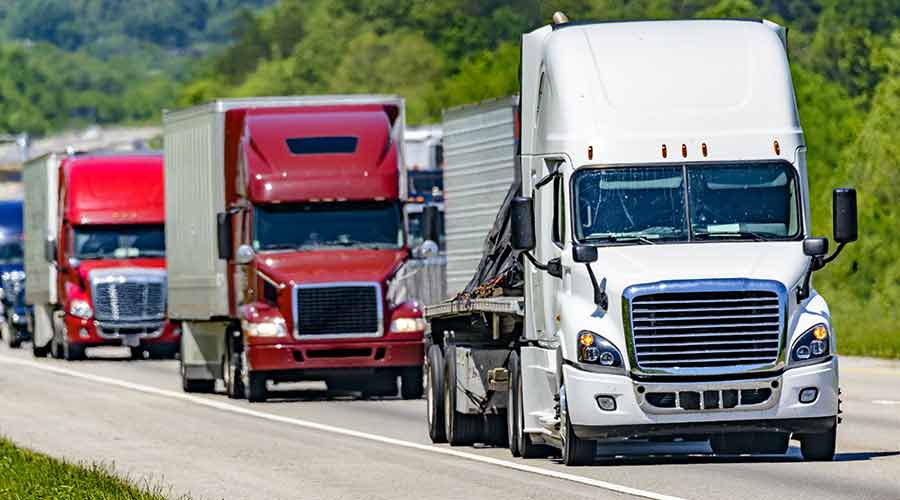
The study shows some scenarios in which intermodal traffic would be reduced by 20 percent to 25 percent and railroad carload traffic by as much as 20 percent. Other scenarios show that both intermodal and certain railroad traffic could be reduced by nearly 60 percent, CABT officials said in a report summary.
Authored by economist Mark Burton of the Appalachian Transportation Institute at Marshall University, the report found that relaxing truck weight and size limits "would also lead to increased crash-related casualties, unaffordable wear and tear on highways and the diversion of freight traffic" from railroads to all-highway truck routes.
Current federal law limits the size of two trailers tethered together, so-called twin trailers, to no more than 28 feet in length per trailer. Federal law limits the weight of any single trailer to no more than 80,000 pounds on interstate highways.
With Congress considering surface transportation legislation this session, CABT officials remain concerned about truck industry efforts to get lawmakers to include legislation that would relax current federal limits on truck size and weight.
"Bigger trucks are a danger on the roads to motorists and they would tear up the nation's already ailing roads and bridges," said CABT Vice President Brad Roseberry in a press release. "But as the report documents, bigger trucks would also be devastating to the rail industry, which provides a more environmentally beneficial form of freight transport than larger trucks."
|
|
ARTICLE #7 - RAIL ENVIRONMENTAL NEWS
BNSF and Wabtec Prepare to Test Battery-Electric Locomotive
|
|
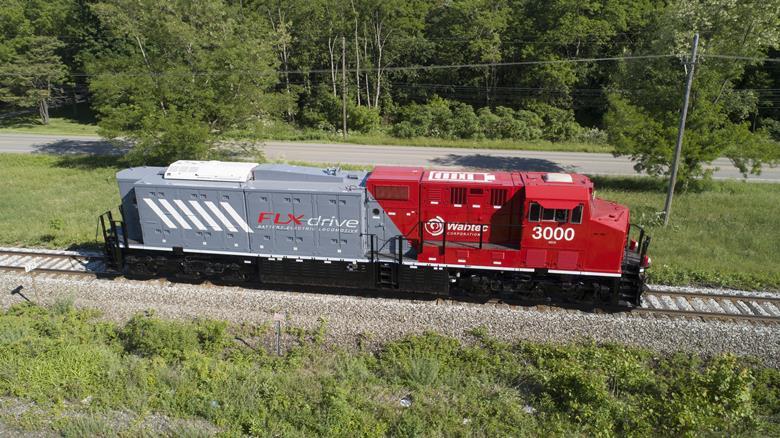
Wabtec has started conducting factory testing at its Erie plant of a prototype 4 400 hp battery locomotive, ahead of trial operations with BNSF that are planned to take place in the final quarter of this year.
BNSF and GE Transportation (now Wabtec) began development of the battery-electric locomotive in 2018, supported by a grant from the California Air Resources Board as part of its Zero & Near Zero-Emission Freight Facilities programme. The BNSF prototype is fitted with a lithium-ion energy storage unit with around 20 000 cells containing a combination of nickel, manganese and cobalt.
While BNSF and Wabtec have previously tested a battery shunting locomotive, this will be their first test of a main line design. Testing is to be undertaken on a 560 km route in California. The battery locomotive will operate in multiple with conventional diesel-electric locomotives between Barstow and Stockton, where a charging station will be installed at BNSF’s Morman Yard.
While the fixed charging station will provide an initial charge, the locomotive has been designed to capture kinetic energy through dynamic braking every time the train slows. The locomotive will use an advanced version of Wabtec’s train energy management software to look at the route ahead and calculate how to best use the available power to reduce the train’s overall fuel consumption. Operation on battery power in yards will also enable the other locomotives to idle or be shut down, reducing local emissions and noise.
|
|
ARTICLE #8 - INTERNATIONAL RAIL NEWS
Trains Worldwide Get Green Light
|
|
The
coronavirus
crisis caused immense damage to international rail schedules.
In the new edition of the European Rail Timetable (ERT), editor Chris Woodcock writes: “As the pandemic swept across Europe, national governments had to prioritise, above all else, the health and well-being of their citizens which resulted in unprecedented restrictions on free movement across the Continent.
In some parts of Europe, trains were refitted with medical facilities so that patients could be moved to areas with spare hospital capacity.
In the UK, a campaign continues to keep leisure passengers off the railways, with no sign of if or when the alliance of government and train operators might ease up on the warnings against rail travel.
But elsewhere in the world, there are promising signs of innovative new services for the Covid-19 era.
Is this the age of the train?
Yes, at least in Europe. From 17 July,
Eurostar
is restoring many more of its services connecting London St Pancras with Amsterdam, Brussels, Lille and Paris. As travel opportunities re-open, fares are falling – with plenty of opportunities to travel to one of these great cities for under £100 return in August.
Elsewhere in Europe, many long-distance services are resuming. The ERT says that domestic trains are gradually getting back to normal in many countries. The move towards greater competition has been delayed by the pandemic, but “open access” operators are now back and giving incumbent train firms a run for the traveller’s money.
|
|
|
|
|
|
|