Newsletter | May 14, 2021 |
|
IN THIS ISSUE
- Seattle police in a “staffing crisis,” chief says
- Growing List of Candidates for Seattle Mayor
- Signature campaign begins to recall Councilmember Sawant
- Seattle initiative to address homelessness
- New chamber leader to focus on economic recovery
- Seattle police popularity slipped only slightly last year, survey finds
|
|
Seattle police in a “staffing crisis,” chief says
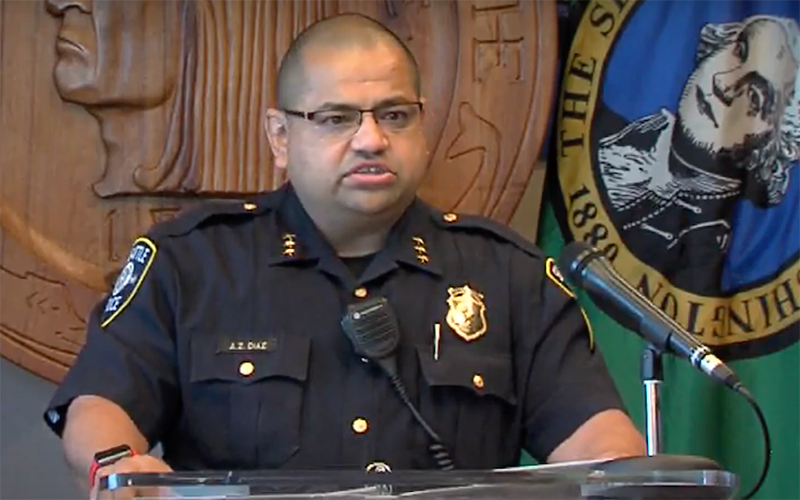
Last year, more than 180 sworn Seattle police officers left the department, according to city police reports. Chief Adrian Diaz has told the City Council that he’s facing a “staffing crisis” now that 66 more officers left their jobs this year.
“We are at record lows in the city right now. I have about 1,080 deployable officers. This is the lowest I've seen our department,” said Diaz, a veteran of more than two decades of service with Seattle police.
Unfortunately, police staffing problems is resulting in fewer officers available to respond to 911 calls and longer response times.
The City Council is considering an additional cut of $2 million to the department budget this year. KING 5 television reports that based on exit interviews, many officers cited the City Council and an anti-police climate either for retiring or seeking opportunities elsewhere.
Councilmember Lisa Herbold, chair of the Public Safety and Human Services Committee, responded that the Council has fully funded SPD’s hiring plan for 2021, including money to hire 114 officers the department is requesting. She’s proposed funding to hire non-sworn employees to address public safety matters.
|
|
Growing List of Candidates for Seattle Mayor
With Mayor Jenny Durkan not seeking re-election, candidates to succeed her at City Hall are lining up to complete in the August 3 primary.
The Seattle Times examined the personal finances of the leading candidates – Andrew Grant Houston, former Councilmember Bruce Harrell, current Council President Lorena Gonzalez, Colleen Echohawk, Lance Randall, and former state legislator Jessyn Farrell.
Two other candidates recently joined the race. Current Seattle Deputy Mayor Casey Sixkiller is the son of former University of Washington star quarterback Sonny Sixkiller. Art Langlie is the grandson of a former Seattle Mayor and Washington Governor Arthur B. Langlie.
Candidates must formally file for election the week of May 17. Primary voters will pick which two candidates will square off in the November 2nd general election to become Seattle’s next mayor.
|
|
Signature campaign begins to recall Councilmember Sawant
An effort to recall Seattle City Councilmember Kshama Sawant, a member of the Socialist Alternative Party, has begun with a mailed signature campaign to qualify the recall measure on a future ballot. On April 1st, the Washington State Supreme Court denied Councilmember Sawant’s legal challenges to the recall, clearing the way for the campaign to move forward.
The campaign has 180 days to collect 10,739 valid signatures from District 3 voters to qualify for the ballot. If the signature drive succeeds, the recall vote would be a simple “yes” or “no” question on the ballot.
Combined, Sawant and the pro-recall campaign have raised nearly $1 million to wage the campaigns for and against her recall. Go here to keep track of the fundraising.
Sawant’s opponents fault her for, among other things, leading a protest march to the home of Mayor Jenny Durkan, whose address is protected under state confidentiality laws and for endangering public health and violating city COVID-19 protocols by admitting hundreds of people into City Hall for an occupation when the building was closed to the public.
|
|
Seattle initiative to address homelessness
A broad coalition of civic and community leaders has launched Compassion Seattle, whose goal is to amend the city charter to require a greater focus on addressing the needs of homelessness. Compassion Seattle intends to accomplish this by placing an initiative on the November 2021 general election ballot. Supporters are now accepting signatures from registered voters to qualify the proposal for a November election to amend the city charter.
Supporters will soon be collecting signatures to qualify the initiative for the ballot. Check this website for information and how you can sign the petition. https://compassionseattle.org/
The outcome of the charter amendment campaign will have a major impact on city policy. The charter amendment would require the City to spend 12% of its general fund on housing and services for the homeless. It would also require:
- Treatment and support for substance use disorders
- Mental health services, including a rapid response team that would be available as an alternative to a police response in some situations
- Connecting services with housing, including enhanced shelters, tiny houses, hotel rooms, and permanent supportive housing
- And after the City has developed the services and housing options, the City would be required to keep public spaces, including parks and sidewalks, open and clear of encampments
- Transparent and frequent public reporting on progress and challenges
|
|
New chamber leader to focus on economic recovery
Rachel Smith, the new President & CEO of the Seattle Metropolitan Chamber of Commerce, hopes to engage the City Council in an economic recovery campaign to overcome damage from the COVID-19 pandemic.
Smith made immediate news by announcing that the Chamber would break with tradition by not making endorsements or campaign contributions to City Council and mayoral candidates in elections later this year.
“Instead, we will focus on elevating – and pushing for – serious civic dialogue on the most pressing issues in our region,” Smith wrote in Publicola.
Downtown Seattle revitalization is necessary after the pandemic contributed to more than 150 businesses closing in the past year.
Highlights of Smith’s ambitious agenda include:
- Addressing housing affordability
- Providing shelter and services for more of the homeless living in Seattle
- Accomplishing police reform while building trust in communities of color
- Maintaining the city’s aging infrastructure and a long-range vision for the future of transit and mobility.
|
|
Seattle police popularity slipped only slightly last year, survey finds
Despite serious criticism of law enforcement following last year’s murder of George Floyd in Minneapolis, the popularity of police here dipped only slightly from prior years in Seattle’s annual public safety survey.
In a tumultuous year that included City Council votes to decrease funding and the sudden retirement of Seattle Police Chief Carmen Best, the police legitimacy score of 59.3 in 2019 slipped slightly to 58.4 in 2020.
“It did surprise me that it didn’t go down more, given all the media attention to police violence and defunding the police,” Jackie Helfgott, the director of Seattle University’s Crime & Justice Research Center and survey leader, told The Seattle Times. “We did expect it to go down more than it did.”
The survey of more than 11,000 people also measured their fear of crime. It compared fear levels in five police precincts within the city. Fear of crime was highest in the West precinct while it was lowest in the East precinct.
|
|
WR diversity statement
WR is committed to the principles of justice, equity, diversity and inclusion. We strive to create a safe, welcoming environment in which these principles can thrive.
We value all people regardless of race, ethnicity, gender, religion, age, identity, sexual orientation, nationality or disability and that is the foundation of our commitment to those we serve.
|
|
Renée Sunde
President/CEO
360.200.6450
|
|
John Engber
Director, Retail Industry Coalition of Seattle
206.850.5517
|
|
|
|
|
|
|