Monthly News & Updates from DFFM's Specialized Forestry Programs | |
Sap Stories: What Trees Are Saying Through Sap
Written by Viri Quinonez, Forest Health Specialist
Trees naturally produce sap, which transports water, nutrients, and sugars through their vascular tissue and is essential to their growth and survival. However, when the flow is excessive and forms thick globs outside of the tree bark, it’s often a sign of stress. Trees flood their wounds with sap, which is also referred to as pitch or resin, for several reasons. The substance covers and helps to seal the wounds. Sap also has antibacterial properties that work to keep the tree's wounds clean as it heals over time.
When insects, like bark beetles, attempt to bore and tunnel into a tree to begin feeding and mating, the tree produces sap to trap or push the insects out. In Arizona, several insect species are known to trigger this sticky defense mechanism. Below are some of the more common offenders behind sap production in Arizona’s pines, junipers, oaks and cottonwood trees.
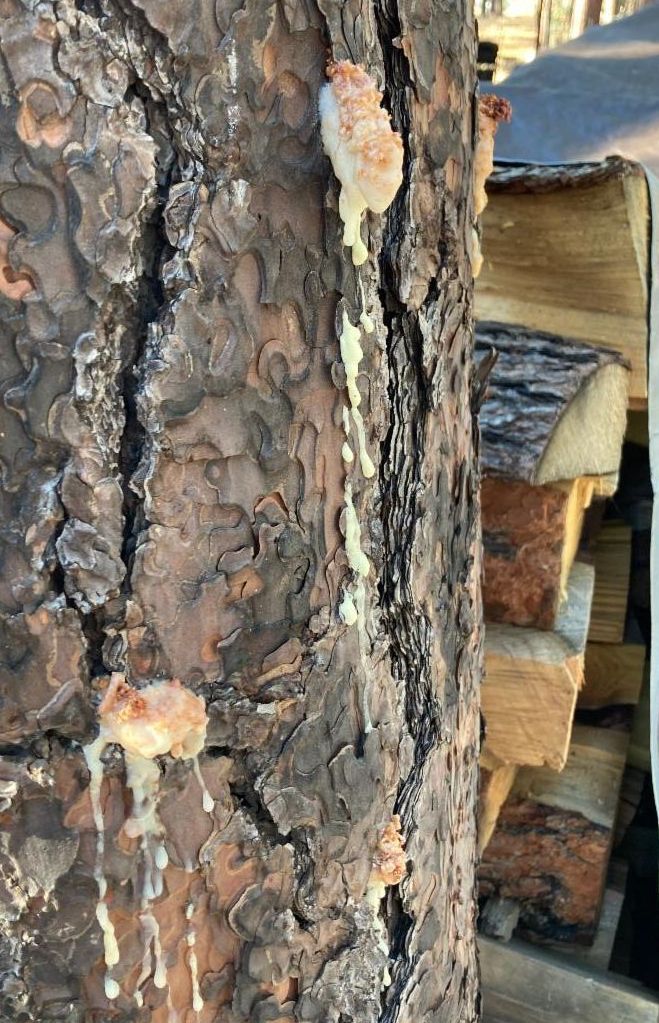
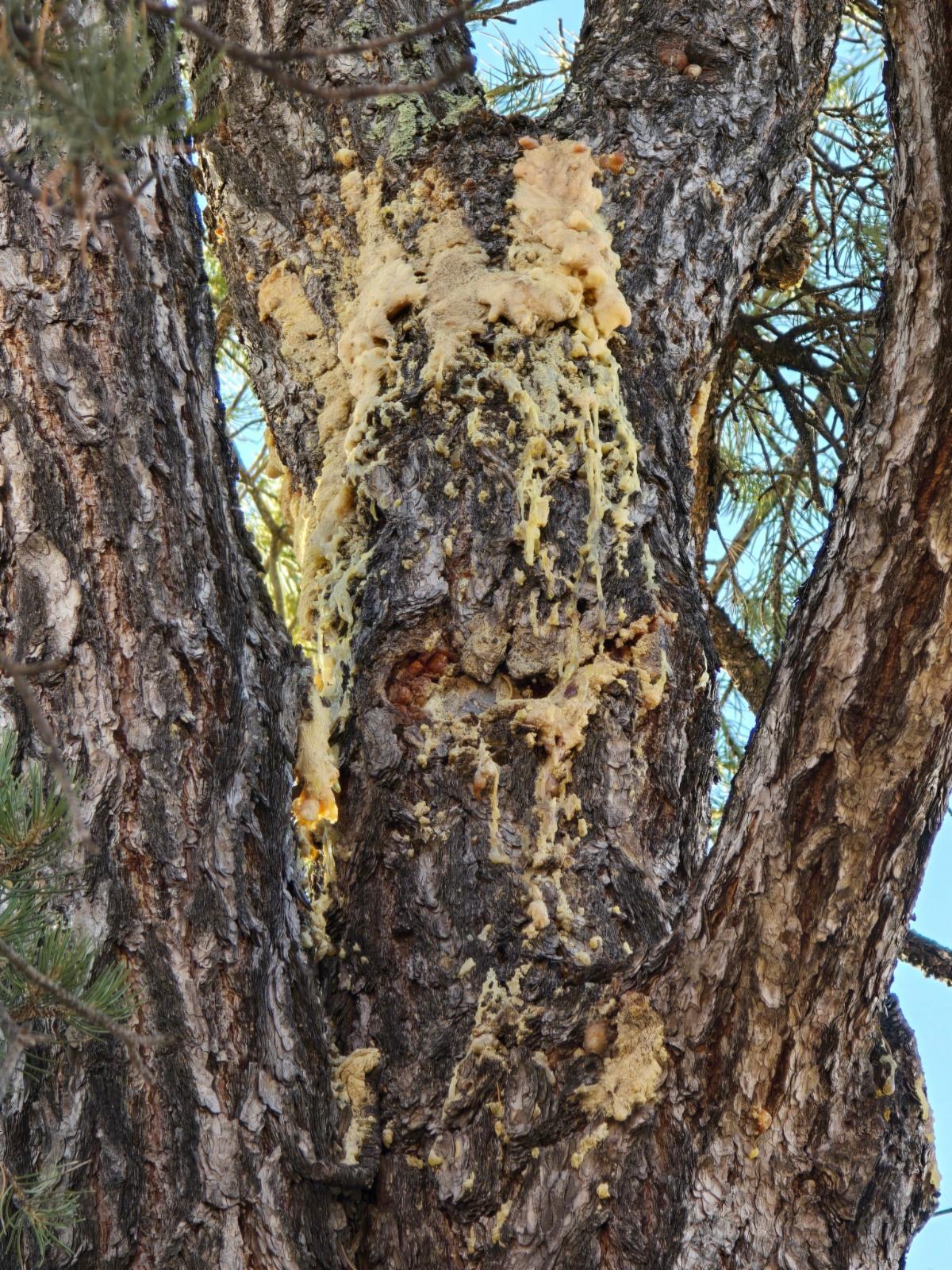
| | | Figure 1: Pinkish white globs of resin from bark beetle activity. | | Note: These descriptions reference the different layers of a tree's anatomy. If you need a refresher, you can reference this Tree Anatomy Guide from Arbor Day Foundation! | Bark beetles bore in through the outer and inner bark to feed and tunnel in the phloem of trees during the adult and larval stages of their lifecycle. Trees respond by exuding pitch in an attempt to push beetles out or trap them. As a result, pitch tubes form and are pinkish, reddish, or white globs of resin around entry holes, often ¼-1/2 inch in diameter (Figure 1). | | Figure 2: Yellow, streaming pitch masses, indicative of Pitch moth larvae. | | Pitch moth larvae bore into the branches or trunks of trees. In response, trees produce large gummy dark yellow to amber pitch masses usually seen at branch crotches, wounds, or near the trunk base. Often, pitch moth larvae boring activity produces much more resin than from bark beetles, creating very large pitch masses. The larvae feed on the sap the tree produces in response to their boring/tunneling. These large pitch masses conceal the larvae and their destructive tunneling. (Figures 2). | | |
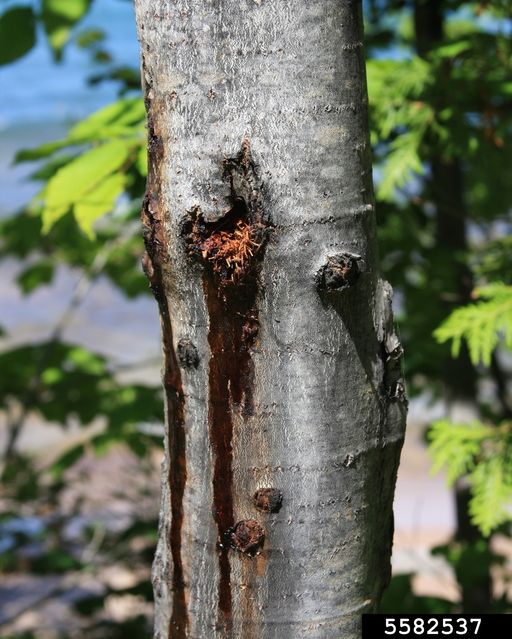
Figure 3: Smaller streams of sap on a tree caused by a poplar borer. | |
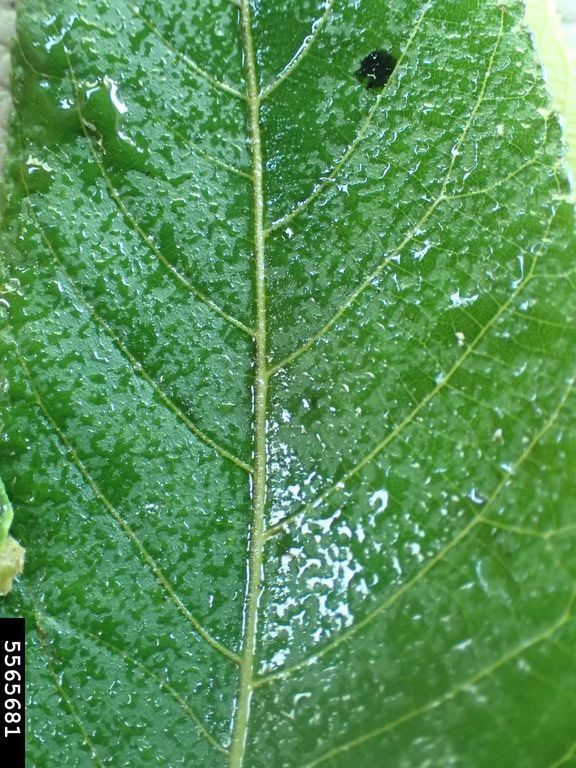
Wood borers bore through the bark layers into the sapwood, and sometimes the heartwood of weakened, recently felled or dead hardwood and conifer trees. These insects can trigger sap production around entry points or wounds but typically to a lesser extent than that of bark beetles, because the tree is already in decline and therefore unable to produce as much sap (Figure 3). | | Figure 4: Clear, sticky residue called "honeydew," produced by sap sucking insects. | | Sap sucking insects use their piercing mouthparts to pierce the vascular tissues of trees and plants. Sap sucking insects like aphids and scale insects do not trigger heavy pitch production; however, through their voracious feeding they produce a sticky residue called “honeydew”. This sticky residue can be confused with sap, but is not sap as it is produced from the insect itself. Honeydew can lead to foliar diseases like sooty mold on shade trees and ornamental plants (Figure 4). | | If you see pitch or sap exuding from a tree, the specific characteristics such as color and pattern of flow (drips, blobs, foam, pitch tubes, masses) can help narrow down the culprit. Our Forest Health team is available to assist in identifying insect activity and other forest health stressors. If you have any questions, feel free to reach out or send pictures to foresthealth@dffm.az.gov. | | | Resources, Reads and Engagement | | |
Video Spotlight: Tamarisk Removal along the Lower Gila River
| The wildfire documentary video series "SW Fire Stories" from the Southwest Fire Science Consortium and AZ Wildfire Initiative raises awareness about the work being done by the Lower Gila River Collaborative to reduce wildfire risk and to inform people about the habitat and importance of restoration on the Lower Gila River. |
Professional Development Opportunity: Tree Equity Coaching Network from American Forests
June 2025 - February 2026
The American Forests National Coaching Network is a community of practice for urban foresters, community advocates, city leaders, and allied professionals to connect, learn, inspire, and cultivate city commitments to advance Tree Equity. Join the network to access monthly webinars, hear case studies from around the country, and connect with peers to advance Tree Equity in your community.
| |
Publication: A Spark of Hope: Boosting Nature's Recovery After Fire
| University of Arizona researchers are exploring how ecosystems recover after wildfires—and how we can bounce back better. Check out this article which explores the relationship between soil health, invasive plants, and wildfire. | | | |
Designed for a diverse audience including fire practitioners, foresters, ecologists, archaeologists, wildlife biologists, land managers, and natural resource managers, the program aims to equip participants with the knowledge to effectively choose the best tools for their specific needs. Through a series of five courses, students will gain insight into the development of tools and technologies that are rapidly changing how we manage landscapes.
Resource practitioners are facing a new world of unmanned aerial systems, lidar and satellite remote sensing technologies, deep learning and artificial intelligence frameworks and fire, weather and climate models. This course will lead students through the forest of emerging innovations, offering a historical perspective on each technology and equipping them with the expertise needed to select the most suitable tools for their unique challenges.
For more information about the course, please contact ContinuingEd@nau.edu directly. We hope that many of our colleagues will take advantage of this unique opportunity!
| | |
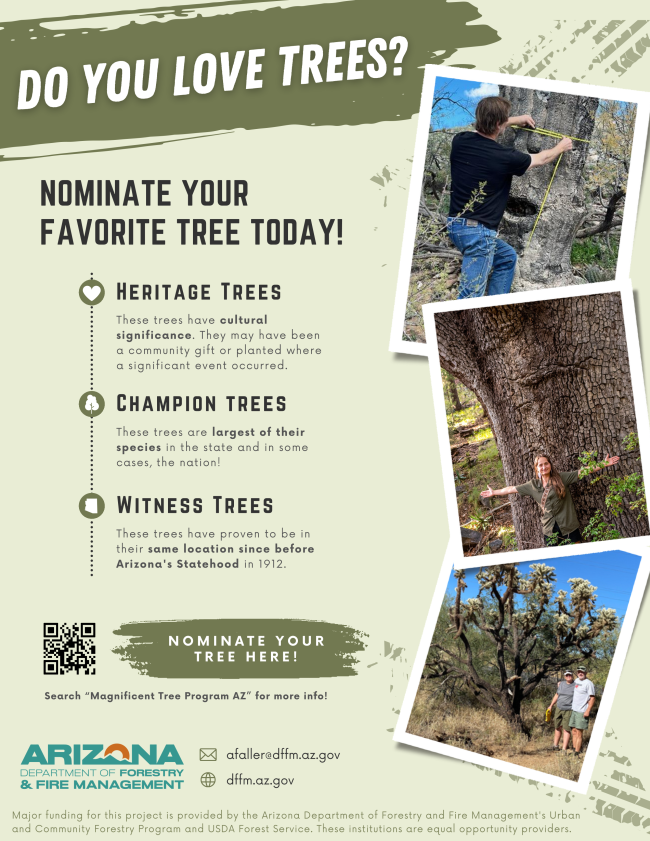
Arizona Magnificent Tree Program
Are you venturing out into the forests this summer to beat the heat? Enjoying the shade of a community tree that holds a special place in your heart? Get involved and nominate your tree for Magnificent Tree status!
| | |
-
Collaborative Capacity Program for Forests & Communities - the National Forest Foundation’s Collaborative Capacity Program provide financial awards to support collaborative activities that increase wildfire resilience, recreation opportunities, forest health, and rural economies - deadline July 25, 2025 for mini-grants, with additional deadlines for standard grants applications
-
Community Planning Assistance for Wildfire - A program that works with communities to reduce wildfire risk through improved land use planning, compelling communication, and applied research - applications accepted throughout the year
| | | July Webinars and Classes | |
-
July 17: Tree Equity is Essential Infrastructure The first session of the Tree Equity Coaching Network from American Forests, this webinar features an interdisciplinary health geographer working with partners to improve health outcomes using nature-based solutions.
| | | We're a little light on the community events this month! If you have any events that you'd like us to share in this newsletter, please don't hesitate to send them to Megan Lasley, Forestry Outreach Coordinator at mlasley@dffm.az.gov. For now, enjoy your local farmers markets, local arboretums and botanical gardens, and venture out to visit some public lands at higher elevations to beat the heat. | | | |
Major funding for the Specialized Forestry Programs is provided by the Arizona Department of Forestry and Fire Management and USDA Forest Service. These institutions are equal opportunity providers and employers.
Suggestions or comments? Contact Megan Lasley, Forestry Outreach Coordinator at mlasley@dffm.az.gov
| | |
John Richardson, Assistant State Forester - Forestry Programs
jrichardson@dffm.az.gov
(602) 771-1420
Cori Dolan, Deputy Assistant State Forester
cdolan@dffm.az.gov
(520) 262-5519
LoriAnne Barnett Warren, Specialized Forestry Program Administrator
lwarren@dffm.az.gov
(602) 399-9447
Madeline Burton, Urban and Community Forestry Program Manager
mburton@dffm.az.gov
(480) 769-4184
Alison Faller, Urban and Community Forestry Specialist
afaller@dffm.az.gov
(602) 739-9763
Timara Crichlow, Urban and Community Forestry Specialist
tcrichlow@dffm.az.gov
(480) 978-6551
| |  | |
Aly McAlexander, Forest Health Program Manager
amcalexander@dffm.az.gov
(602) 290-9644
Viri Quinonez, Forest Health Specialist
vquinonez@dffm.az.gov
(480) 349-7585
Mike Juarez, Forest Health Technician
mjuarez@dffm.az.gov
(623-606-2624)
Jessi Szopinski, Invasive Plant Program Coordinator
jszopinski@dffm.az.gov
(602) 291-4167
Jacob Draper, Invasive Plant Program Specialist
jdraper@dffm.az.gov
(480) 647-4736
Matthew Jewell, Forest Legacy Program Manager
mjewell@dffm.az.gov
(520) 260-0476
Megan Lasley, Forestry Outreach Coordinator
mlasley@dffm.az.gov
(602) 206-9830
Wolfgang Grunberg, GIS & Data Supervisor
wgrunberg@dffm.az.gov
(602) 399-1886
| | | | |