Free Member Benefit: TASBO Template | | As a Coalition member, you get free access to the TASBO Revenue Estimation Template. A new version is available below. | |
TASBO Template Updated
The TASBO template has been updated to include new data. Specifically, it includes:
- The recertified preliminary property values from the comptroller;
- The new TEA methodology for calculating the frozen levy hold harmless;
- Updated state compensatory education counts to match TEA data;
- Updated teacher retention allotment counts to match TEA data;
- Early Ed statewide amount available for redistribution has been updated to match DPE;
- Proration for the new Alternative Methods portion of the Bilingual Allotment has been updated to match TEA DPE;
- Regional Day School For the Deaf - data entry changed from amount to # of students; report created to match TEA; and
- SB1882 calculations synced to reflect TEA update incorporating the new charter facilities formula into SB1882 calculations.
Note that teacher retention allotment counts on your Summary of Finance reports were updated this week by TEA to include the teachers your LEA reported through PEIMS who were coded as TRA eligible and also coded in role 087.
You can access the template in the red box below.
| | | Quarterly Member Briefing Recording | |
Recording
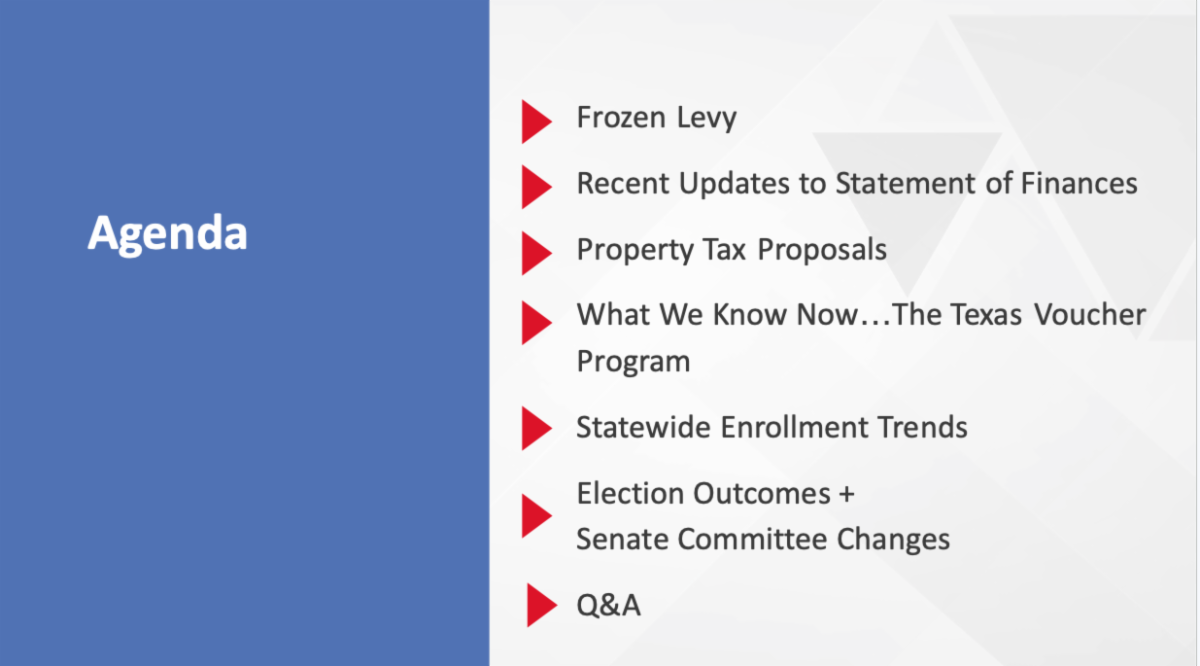
Thank you to all that joined our quarterly virtual member briefing yesterday morning. We appreciated having Amanda Brownson and Dee Carney join us to brief members on several of the topics listed below.
| If you missed the meeting or would like to rewatch parts of the meeting, a link to the meeting recording is provided below. | | |
Meeting Slide Deck
If you would like to access the slides used in the meeting you'll find the set that I used and the set that Dee Carney used below.
| | Texas House Interim Charges | |
School Finance Related Charges
Speaker Dustin Burrows has released interim charges for the Texas House—and while there’s no single “school finance overhaul” study, the issue shows up across several key committees.
We are following the issues that relate to revenue, spending, and cost pressures that are spread across 8 House Committees.
Appropriations Committee
-
Monitoring: Monitor and oversee the implementation of appropriations bills, other legislation passed by the 89th Legislature affecting the allocation or use of funds from the state treasury, and major spending items, including funding for the following:
- Maintaining existing property tax relief and significantly increasing the homestead and business personal property tax exemptions.
Delivery of Government Efficiency
-
Preventing Fraud, Waste, and Abuse: Study methods by which the state can leverage technology, including artificial intelligence, to detect fraud, waste, and abuse of taxpayer resources.
Pensions, Investments, and Financial Services
-
Monitoring: Monitor the implementation and associated rulemaking of all legislation passed by the Committee and enacted by the 89th Legislature to ensure that legislative purposes are properly implemented, including the following:
- HB 3526, relating to fiscal transparency for bonds issued by local governmental entities.
-
Teacher Retirement System of Texas Review: Review the actuarial soundness of the Teacher Retirement System of Texas, including current contribution levels, defined benefit plan assumptions, and projected liabilities to ensure the long-term financial stability of the system. Evaluate the impact of basing employer contributions on total payroll, options to increase parity in the contribution rates for all entities, and the impact of benefit enhancements.
Public Education Committee
-
Monitoring: Monitor the implementation and associated rulemaking of all legislation passed by the Committee and enacted by the 89th Legislature to ensure that legislative purposes are properly implemented, including the following:
- HB 2, relating to public education and public school finance; ...
- SB 2, relating to the establishment of an education savings account program.
-
State of Education: Study the current state of public education in Texas. Examine academic outcomes, enrollment trends pertaining to the stability of the school finance system, school safety, and the role of technology and artificial intelligence.
-
Investment in Special Education: Examine state policies impacting students with special needs and special populations, including the implementation of recent legislation and the impact of increases in state funding. Review trends in special education enrollment over the past several years and evaluate factors contributing to those increases.
Insurance
-
Cost Drivers Impacting Property and Casualty Insurance Premiums: Study cost drivers impacting property and casualty insurance premiums for consumers and their impact on home affordability in Texas. Study rate trends, underwriting practices, and market availability, with particular attention to coastal and catastrophe-exposed regions. Examine strategies used in other states, including those intended to reduce losses, improve property resilience and promote loss mitigation. Examine the need to employ additional strategies or make statutory changes to encourage greater market participation and promote competition. Make recommendations that reduce the cost of insurance and maintain sufficient consumer protection standards and market stability.
State Affairs
-
Public-Private Partnerships: Evaluate state and local public-private partnerships governed by Chapter 2267, Government Code, for effectiveness, competitiveness, and taxpayer transparency. Recommend statutory revisions that encourage public-private partnerships by streamlining and clarifying procedures and obligations.
Ways and Means Committee
-
Monitoring: Monitor the implementation and associated rulemaking of all legislation passed by the Committee and enacted by the 89th Legislature to ensure that legislative purposes are properly implemented, including the following:
- HB 103, relating to the creation and maintenance of a database of taxing unit bond, tax, and bond-related project information.
-
Property Tax Relief: Study and consider methods to build on the property tax relief provided by the 89th Legislature. Review the cost and benefits of compressing school district tax rates and increasing the homestead exemption; whether the property tax appraisal system is working as intended, and opportunities to improve the system to benefit homeowners and businesses; and the economic performance of state tax revenue supporting ongoing property tax relief, including the impact of exemptions.
-
Local Government Spending: Examine local government spending and debt practices, including the use of certificates of obligation, to determine the overall impact on property tax rates. Evaluate other revenue sources, such as fees, utilized by local units of government to facilitate increased spending.
Select Committee on Governmental Oversight
-
Safeguarding Taxpayer Funds: Study how local governments appropriate public funds to, or otherwise, contract with, third-party consultants and nongovernmental organizations for services, including those related to health and human services, public safety, and homelessness policies. Assess trends in third-party services spending and evaluate risks and benefits. Examine the degree of influence third-party consultants and nongovernmental organizations exert on matters of public policy and make recommendations to prevent conflicts of interest and ensure full transparency and accountability in the expenditure of taxpayer funds.
-
Education Foundations: Examine the role and structure of education foundations that are affiliated with Texas public school districts, including the scope and sources of their revenues and the nature of their financial relationships with school districts. Review the practice of public funds being transferred to or used by these foundations.
| | Texas Senate Interim Charges | |
2nd Round of School Finance Interim Charges
Lt. Governor Dan Patrick announced a second round of interim charges for the Texas Senate in advance of the 90th Texas Legislature. Interim charges are assigned to committees, and hearings are held in the interim. Sometimes, a report is generated to summarize the learnings. And sometimes, the learnings turn into legislation.
On January 30, the Lt. Governor released his first round of interim charges. He has indicated that there could be additional rounds of interim charges.
The following summary identifies all of the Senate interim charges, to date, that relate to school finance in some way and cover 4 different Senate Committees.
Economic Development (2nd round)
-
Preparing the Texas Workforce for AI (Artificial Intelligence): Study the impact of AI on the Texas workforce and its implications for economic competitiveness. Evaluate strategies to enhance workforce resiliency, align educational pathways with evolving employer needs, and promote private-sector-led innovation.
Education Committee (2nd round)
-
Improving School Transformation Talent: Evaluate the existing access to and efficacy of experts in improving school academic performance. Develop suggestions to strengthen and expand the current leadership pipeline, including public school training, policies, and practices that accelerate academic progress.
-
Shifting Enrollment, Right-Sizing: Despite the state’s rapid overall population growth, school age enrollment is declining – from 5.54 million to 5.47 million students in the last two years. Examine the impact of student enrollment patterns in Texas public schools. Identify strategies to maximize the efficient use of tax dollars by school districts while maintaining access to high-quality learning programs and student outcomes.
-
Reviewing Historic Pay Increases for Teachers: Review teacher pay increases passed by the Legislature over the last decade, including the historic pay increase in House Bill 2, 89th Legislature. Monitor the implementation of pay increases for teachers and the impacts on teacher incomes, including closing the rural pay gap.
-
Celebrating the Successful Rollout of School Choice: Monitor the nation’s largest school choice launch in history and the ongoing implementation of Senate Bill 2, 89th Legislature, including: record-breaking demand with over 250,000 applications and enrollment by families giving greater flexibility to choose the best education for their child. Provide recommendations on how the Legislature can enhance and expand upon Texas’ historic and successful school choice program for families.
- Monitor:
- Senate Bill 12 relating to parental rights in public education, to certain public school requirements and prohibitions regarding instruction, diversity, equity, and inclusion duties, and social transitioning, and to student clubs at public schools;
- House Bill 2, relating to public education and public school finance
Finance Committee (1st round)
-
Further Property Tax Cuts: The Homestead Exemption has proven overwhelmingly popular with voters. It has eliminated school property taxes for the average senior and reduced school taxes in half for those under 65. Study and report on the effect of the continued increasing of the Homestead Exemption. Assess the impact of reducing the senior homestead exemption from 65 to 55 years of age. This change would freeze home values 10 years sooner for over 3 million homeowners, saving 55 plus homeowners thousands of additional dollars.
Local Government (2nd round)
-
Cutting Property Taxes: Examine Texas property taxes, focusing on homeowners' school property taxes. Make recommendations to cut Texans' property taxes by increasing the homestead exemption for all homesteads. Determine the savings for homestead owners attributable to lowering the age of eligibility for the senior homestead exemption and senior tax ceiling from 65 to 55. Additionally, evaluate options to further reduce property taxes for new homeowners.
-
Examining the Effect of Increasing the Homestead Exemption: Review and report on the effects of Senate Bill 4 and Senate Bill 23, 89th Legislature, Senate Bill 2, 88th Legislature, 2nd Called Session, Senate Bill 1, 87th Legislature, 3rd Called Session, Senate Bill 2, 86th Legislature, and Senate Bill 1, 84th Legislature, which in combination have increased the homeowners’ school tax exemption from $15,000 to $140,000 for those under the age of 65, and from $25,000 to $200,000 for those 65 and older. Identify the percentage of Texas homeowners that no longer pay school property taxes due to these efforts.
-
Ensuring Transparency in Appraisal District Funding: Study the governance, budgeting authority, and cost allocation practices of county appraisal districts. Examine the fiscal impact of appraisal district costs on taxing entities. Evaluate whether additional guardrails are warranted.
| | Thank you to our sponsors | | | | |