SoCo Correspondent delivers the latest news from the County of Sonoma, twice a month, to your email inbox. Subscribe in English or Spanish and share with your friends and neighbors. | | County steps in to keep food flowing during federal shutdown | | |
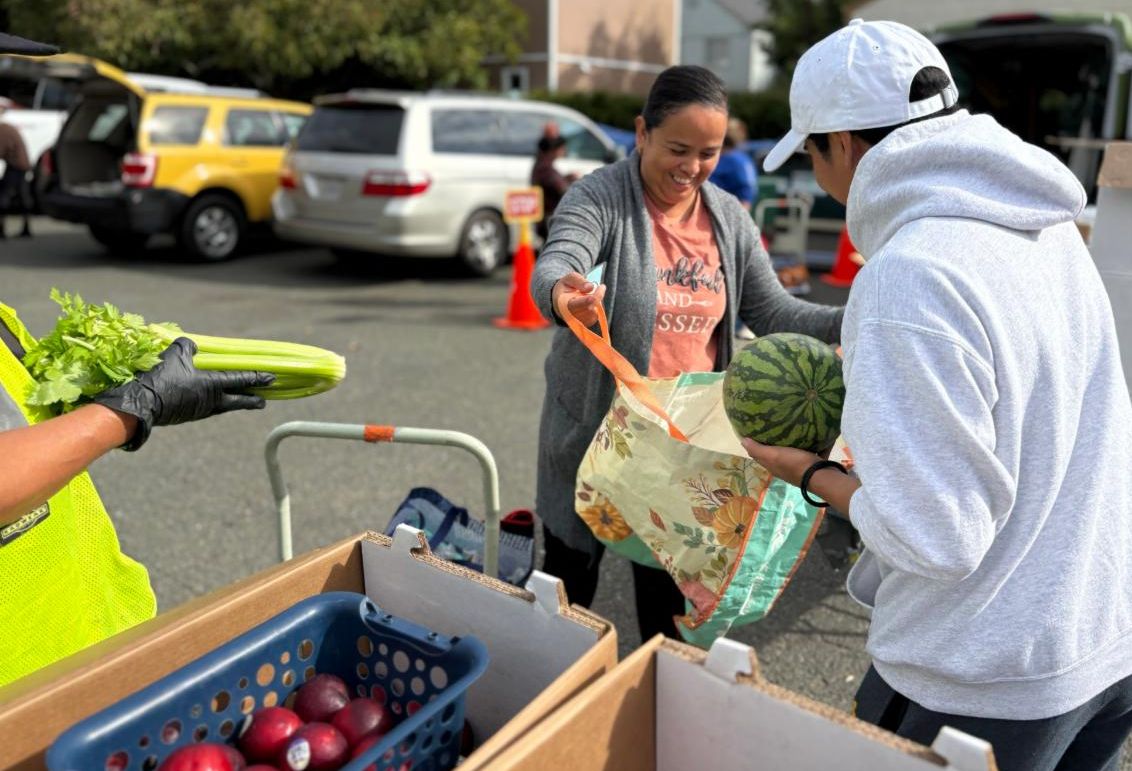
When the federal government cut off funding this month for the nation’s largest anti-hunger program, thousands of Sonoma County families suddenly faced uncertainty about how to put food on the table. On Tuesday, the Board of Supervisors approved up to $1 million in emergency support to help Redwood Empire Food Bank meet rising demand caused by the disruption of CalFresh benefits during the federal government shutdown.
The emergency allocation will allow Redwood Empire Food Bank to expand food distribution while federal benefits remain stalled. County staff estimate that demand for emergency food assistance could surge by 20 to 40 percent this month alone.
“Thousands of Sonoma County families rely on CalFresh to put food on the table,” said Supervisor Lynda Hopkins, chair of the Board of Supervisors. "By allocating funds to the Redwood Empire Food Bank, the County is ensuring families have access to healthy food and no one in our community goes hungry while waiting for federal benefits to resume.”
Nearly 43,000 Sonoma County residents receive more than $8.2 million each month through CalFresh, California’s version of the federal Supplemental Nutrition Assistance Program. The program helps low-income households buy nutritious food at grocery stores, farmers markets and online retailers. The U.S. Department of Agriculture froze SNAP funding on Nov. 1, citing the federal government shutdown. Although two federal judges have ruled that the suspension is unlawful, it remains unclear when the USDA will comply with the court orders. As a result, the timing and amount of CalFresh payments for Sonoma County residents remain uncertain.
“This support from the County comes at a critical moment for thousands of local families,” said Allison Goodwin, chief executive officer of Redwood Empire Food Bank. “The federal shutdown has created an unexpected gap for people who rely on CalFresh. These funds will help us alleviate hunger in our community and keep nutritious food flowing where it’s needed the most.”
Founded in 1987, Redwood Empire Food Bank serves more than 142,000 children, families and seniors across Sonoma, Lake, Mendocino, Humboldt and Del Norte counties. Through over 300 direct distributions and 130 community partners, the Santa Rosa-based nonprofit provides essential nutrition support year-round.
Residents in need of immediate food assistance can find distribution sites at getfood.refb.org or by texting “FOOD” to (707) 353-3882. Additional resources are listed on the County’s Open Doors website at opendoorssc.com/findfood or by calling 2-1-1.
| | Regional Parks offers free parking for veterans and military on Veterans Day | | |
To honor the service of our nation’s veterans and active-duty military, Sonoma County Regional Parks will offer free parking at all County parks on Veterans Day (Nov. 11). No special pass is required; just show proof of military or veteran status, such as an ID card or discharge certificate.
Veterans with a 50 percent or greater disability rating can also apply for a Distinguished Veterans Day-Use Pass, which provides free parking year-round. Learn more at SoCoParks.org/Renew or contact Regional Parks at (707) 565-2041 or parks@sonoma-county.gov.
The free parking program is offered in partnership with the Sonoma County Board of Supervisors as a way to recognize and thank service members and their families.
| | Alaska Airlines adds nonstop flights from Sonoma County to Ontario | | |
Traveling between Sonoma County and Southern California is about to get easier. Alaska Airlines will launch daily nonstop flights between Charles M. Schulz-Sonoma County Airport and Ontario, California, beginning March 18.
The new route expands Alaska’s growing list of nonstop destinations from STS to nine, including San Diego, Los Angeles, Burbank, Orange County, Palm Springs, Las Vegas, Portland and Seattle. The Ontario flights will operate year-round using 76-seat Embraer 175 aircraft.
“It’s wonderful to see that Alaska Airlines has decided to add Ontario,” said Jon Stout, Airport Manager. “It’s such a convenient option for Sonoma County residents heading to the Inland Empire, and a fantastic choice for Alaska’s ninth nonstop destination out of our regional airport.”
Located in the heart of Wine Country, Charles M. Schulz-Sonoma County Airport is the only commercial air service provider in the North Bay, offering travelers a convenient, low-stress alternative to Bay Area airports. For routes, parking, dining and travel information, visit sonomacountyairport.org.
| | County appoints new interim health officer | | |
Dr. Michael Stacey has been named interim health officer for Sonoma County, succeeding Dr. Karen Smith, who has served in the role for the last year.
A physician specializing in family medicine and public health, Dr. Stacey brings decades of experience in community health leadership and clinical care. Most recently, he served as chief medical officer at LifeLong Medical Care in Berkeley. He previously held several senior roles in Solano County, including deputy health officer and deputy director of health and social services, where he oversaw public health programs and federally-qualified health centers.
“We are delighted that Dr. Michael Stacey is coming on board as Sonoma County’s interim health officer,” said Nolan Sullivan, director of the Department of Health Services. “He possesses a wide range of medical experience that is relevant to our county and will serve our residents well.”
As interim health officer, Dr. Stacey will serve as the County’s chief medical officer and top health policy official, advising on public health emergencies and providing medical guidance to local clinicians. His responsibilities also include oversight of vital records, food safety inspections, and programs that advance community health and wellness.
The Board of Supervisors appointed Dr. Stacey to the role at its Oct. 28 meeting. He is scheduled to serve for one year, unless a permanent health officer is hired sooner.
| | Understanding your flood risk: Todd Creek community meeting set for Nov. 13 | | |
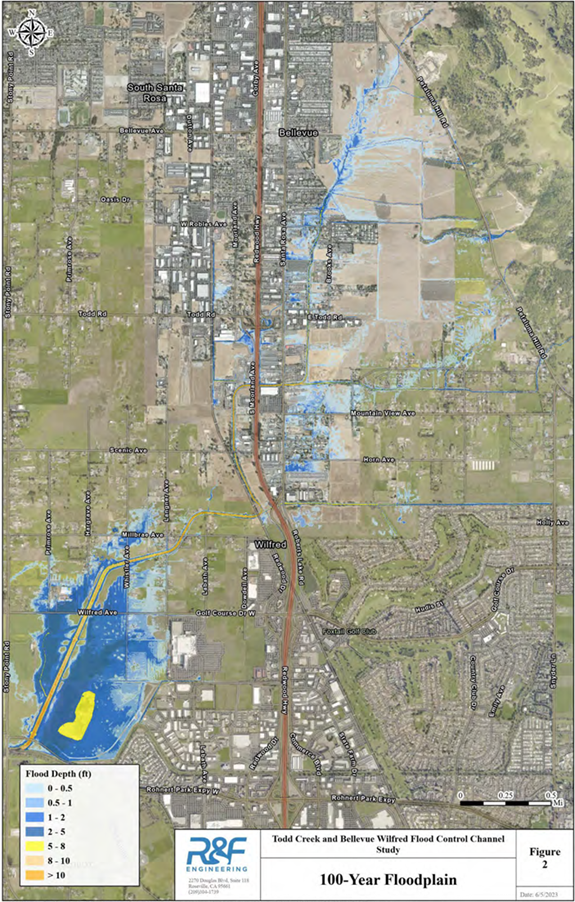
Residents in the Todd Creek watershed are invited to learn more about new federal flood maps that could affect their insurance requirements. The Federal Emergency Management Agency has opened a 90-day public review period for the County-sponsored Todd Creek revised Flood Insurance Study, which includes updated maps showing flood risks for properties in the area between Santa Rosa and Rohnert Park.
To help residents navigate the process, Permit Sonoma will host a community meeting on Thursday, Nov. 13, from 6 to 8 p.m. at 2550 Ventura Ave. in Santa Rosa, with an option to participate online via Zoom. Staff and project engineers will walk participants through the FEMA maps, review the study’s findings, and explain how to submit comments or technical appeals.
“The County completed a locally-funded revised flood study to ensure mapping accuracy and help residents understand flood risk,” said Nathan Quarles, deputy director of engineering & construction for Permit Sonoma. “FEMA’s review offers an important opportunity for property owners and technical professionals to review the maps and, if necessary, submit technically supported appeals. We’re here to help residents through the process.”
| | County shares trusted resources for local immigrants | | |
Rumors about immigration sweeps are causing fear and uncertainty in our community. Accurate information is crucial. Sonoma County has created a webpage with resources you can trust.
Visit the County’s Support for Immigrant Communities webpage to find:
Sonoma County wants all residents to know: local law enforcement does not conduct immigration enforcement and County departments are prohibited from sharing information with federal immigration agents, except as required by law.
The Board of Supervisors remains committed to protecting the civil rights of all residents – regardless of immigration status – and to ensuring everyone can safely access County services, schools and health care.
The Sonoma County Department of Emergency Management and the County’s Safety Net departments are developing coordinated plans to respond to potential federal immigration enforcement. These departments are prepared to assist youth and families affected by ICE actions, including care for children, elders and pets who depend on individuals taken into custody for potential deportation.
Information on County Safety Net services available to all residents can be found at opendoorssc.com or by calling 2-1-1.
| | Sonoma County builds momentum on climate action | | |
A year after adopting its first comprehensive Climate Action Plan, Sonoma County is turning aspirational goals into measurable progress.
The plan sets County government operations on a path to become carbon neutral by 2030 by using energy more efficiently, reducing waste, promoting alternative forms of transportation, and increasing carbon storage in our landscapes. It will also make the entire county more resilient to the effects of climate change, with actions to address wildfires, droughts and rising sea levels.
The initiative advances goals outlined in the Climate Action and Resiliency pillar of the County’s five-year Strategic Plan. It includes 22 near-term measures to be implemented in its first two years, followed by 32 mid- and long-range measures to achieve its ultimate goals. Last week, County staff provided the Board of Supervisors with a report on the progress so far and the challenges ahead. Among the highlights:
- Nearly all County facilities now run on 100 percent renewable, locally-generated power.
- More than 90 percent of County-managed streetlights have been upgraded to energy-efficient LED fixtures.
- More than 1,900 County employees have logged 300,000 clean-commute trips, saving an estimated 1,827 metric tons of carbon dioxide.
- The Transit for Youth program provided over 429,000 free rides, doubling youth ridership.
Much of the progress has been supported by the County’s Climate Resilience Fund, established with money from the PG&E settlement over the 2017 wildfires. Ongoing work is also being funded through allocations approved as part of the Climate Action Plan. However, the plan was developed at a time when federal funding for climate projects was more readily available. Although recent federal grant freezes and program cancellations have slowed some efforts, the County is pursuing new state bond funding and innovative financing to sustain momentum.
“Every day, our County teams are finding practical ways to reduce emissions, strengthen our communities and prepare for the future,” said Supervisor Lynda Hopkins, chair of the Board of Supervisors. “The results are already visible, and they show what our County government can achieve when we all work together.”
| | Board advances plan to create infrastructure financing district in west Sonoma County | | |
The Board of Supervisors has approved a resolution of intent to form the West Sonoma County Enhanced Infrastructure Financing District, a tool to help fund public infrastructure, housing and community improvements across unincorporated areas of west county.
An EIFD allows local governments to dedicate a portion of future property tax growth within a defined area to pay for public projects that serve the community. Importantly, it does not create new taxes or increase existing ones. Instead, it captures a share of the property tax revenue that results when property values rise over time, directing those dollars toward long-term investments such as roads, flood protection, parks, public safety facilities and affordable housing.
Under the plan, the West County EIFD would encompass about 53,000 acres and include Guerneville, Forestville, Graton, Occidental, Sea Ranch and other communities. The district could help advance projects of “communitywide significance,” including infrastructure that improves transportation, supports climate resilience and enhances local quality of life.
A fiscal impact analysis prepared by Kosmont Companies found that allocating between 20 and 25 percent of the County’s share of property tax growth could generate meaningful funding for infrastructure over the next several decades while maintaining protection for the County’s General Fund. The analysis estimated a potential net positive fiscal impact of roughly $26 million over 50 years, assuming the EIFD helps attract new investment in hospitality, commercial and housing development that expands the local tax base.
At the same time, the study noted that the near-term financial benefits are modest, with between $800,000 and $3.8 million projected to accumulate in the first 5 to 10 years. Because of that, County staff emphasized the importance of fiscal caution, noting that the EIFD’s success will depend on its ability to catalyze private investment in projects that would not otherwise occur.
“The Enhanced Infrastructure Financing District (EIFD) is an opportunity to plan for necessary infrastructure improvements in our West County communities without imposing extra tax burdens on residents,” said District 5 Supervisor Lynda Hopkins, who represents the proposed area.
With the Oct. 14 vote, the Board of Supervisors supported the creation of a five-member Public Financing Authority that would guide the creation of an Infrastructure Financing Plan. Over the coming months, the County will engage consultants and surveyors to define precise district boundaries and develop a draft plan for public review. A series of community meetings and public hearings would culminate in a potential final vote to establish the district by next August.
| | County reduces unfunded liability in pension system, seeks legislation to explore targeted COLAs | | |
The pension system for County employees is stronger and more sustainable than it has been in years, according to the seventh annual State of the Retirement System report, which shows the County’s unfunded pension liability has fallen 34 percent since 2021.
The unfunded liability – the gap between the County’s pension assets and what it owes to current and future retirees – declined to $409 million as of June 30, down from $619 million four years ago. The improvement reflects strong investment returns and the Board of Supervisors’ ongoing strategy of making early payments to reduce pension debt and long-term interest costs. This policy is saving taxpayers millions of dollars in interest costs while strengthening a pension system that serves more than 12,000 current, former and retired employees and their families.
“By tackling our pension debt head-on, we’re ensuring that today’s workers and tomorrow’s taxpayers aren’t burdened by yesterday’s obligations,” said Supervisor Chris Coursey, who serves on the Sonoma County Employees’ Retirement Association board of trustees. “This progress is the result of intentional, disciplined choices over many years. It positions us to uphold our commitments to employees and retirees while continuing to deliver County services our residents rely on.”
Sonoma County’s pension plan was 93.7 percent funded at the end of 2024, compared to 79 percent for CalPERS, the state’s retirement system for public employees. The decline in unfunded liability strengthens the pension plan’s ability to meet its long-term obligations without additional County funding, but it does not change benefit levels. Because retirees do not receive cost-of-living adjustments, inflation has eroded the purchasing power of many long-time retirees. To address this, the Board of Supervisors voted Oct. 28 to pursue state legislation exploring how counties may provide targeted COLAs in the future.
The annual State of the Retirement System report, first recommended by the Sonoma County Civil Grand Jury in 2015, is part of the County’s commitment to transparency and accountability in pension oversight. It details the system’s assets, costs and long-term trends, and this year includes a new Pension System Overview explaining how benefits are funded and shared between the County and employees.
| | County bracing for costly changes to state conservatorship laws | | |
Sonoma County is preparing for major changes in state laws that will increase the number of people placed into treatment and long-term care when they can’t safely care for themselves.
A conservatorship is a court-ordered arrangement that appoints someone to make medical, financial and housing decisions for individuals who cannot meet their own basic needs. Senate Bill 43, signed by Gov. Gavin Newsom in 2023, expands eligibility for this type of protection. It updates the state’s definition of “gravely disabled” to include people with a serious mental illness, severe substance use disorder, or both, who are unable to provide for their own food, shelter, personal safety, or medical care. Counties must implement the law by Jan. 1 and begin reporting data to the state on the number of people who are conserved and the outcomes of their treatment.
While designed to strengthen the safety net for people who are repeatedly hospitalized, incarcerated, or experiencing homelessness, the new law is expected to increase local caseloads and costs without any new funding from the state. Sonoma County currently supports about 200 conservatees at an annual cost of $11.7 million. Once SB 43 is implemented, that number could rise by 25 percent, requiring up to $2.9 million in additional placement costs and six new full-time positions across the Department of Health Services and the Human Services Department.
The County is also working to reduce the number of conservatees placed in facilities outside Sonoma County – currently about 65 percent – by expanding local care options. A $67.8 million state grant will fund a new mental health rehabilitation center, expected to open later this decade.
“SB 43 expands our ability to connect people in crisis to treatment, but it also expands our responsibility to provide that care locally and compassionately without any increase in state funding,” said Nolan Sullivan, director of the Department of Health Services, who presented an update on the new law at the Oct. 28 Board of Supervisors meeting. “This will be a challenge, and we are building the partnerships, workforce and facilities needed to meet that moment.”
| | County explores future of Fairgrounds as potential home for professional soccer | | |
The Sonoma County Fairgrounds has been home to festivals, concerts, animal shows, expos and other events for nearly 150 years. Now, County leaders are exploring how the 200-acre site might host a new chapter in community life – one that could include professional soccer and a year-round entertainment district.
Last month, the Board of Supervisors authorized County staff to begin formal discussions with the City of Santa Rosa, the Sonoma County Fair & Exposition Board and the United Soccer League to evaluate the Fairgrounds as a possible location for a multi-purpose soccer stadium and mixed-use development.
“The Fairgrounds has been a gathering place for our community for nearly 150 years,” said Supervisor Lynda Hopkins, chair of the Board of Supervisors. “We now have an opportunity to imagine how this space will evolve into the future. A multi-purpose stadium could bring energy, jobs and investment to the site, and it’s essential that we move forward in a way that reflects community values and keeps the Sonoma County Fair at the heart of it all.”
The United Soccer League identified Santa Rosa as a potential expansion market based on the region’s strong youth soccer programs, growing population and regional accessibility. District 3 Supervisor Chris Coursey, who represents the Fairgrounds area, said the Oct. 17 vote by the Board of Supervisors ensures the County is an active partner in evaluating this opportunity.
“Santa Rosa is a natural fit for professional soccer, and the Fairgrounds could be an incredible home for it,” Supervisor Coursey said. “This process will give us the information we need to decide whether a project of this scope can serve the community’s interests and complement the Fairgrounds’ long-standing role as a public gathering place.”
No commitments have been made. The yearlong feasibility process will examine land use, financing and community impacts before any decisions are considered by the Board of Supervisors or the Fair Board.
| | County advances plan to modernize regulations on cannabis industry | | |
After years of public outreach and environmental review, the Board of Supervisors last week advanced a comprehensive update to policies regulating the cannabis industry in Sonoma County.
The modernized framework would treat cannabis businesses like other agricultural companies while strengthening protections for neighboring homes, aiming to balance agricultural opportunity, environmental protection and neighborhood compatibility. Once finalized, the ordinance will guide cannabis land use permitting, licensing and compliance through a single, streamlined structure.
Under the update, most types of cannabis businesses – including consumption lounges – would be allowed by right in industrial and commercial areas. In agricultural zones, cannabis would be reclassified as a “controlled” crop with right-to-farm protections. Cannabis farms would gain more flexibility to integrate processing and retail activity on a single site.
To protect the quality of life in nearby neighborhoods, the Board of Supervisors approved new distance rules that require cannabis operations to be at least 1,000 feet from residential zones and expand existing buffer areas around homes and property lines.
Supervisors advanced the Cannabis Program update Oct. 28 with a straw vote. Final adoption of the Environmental Impact Report, general plan amendment and ordinances is scheduled for Dec. 9.
| | Meet your new best friend: Attend the Puppy Shower Adoption Event on Friday | | |
Sonoma County Animal Services is throwing a party tomorrow for some of its smallest guests, and you’re invited.
The County’s animal shelter is bursting with three-dozen adorable puppies. To help them find loving homes, Animal Services will host a Puppy Shower Adoption Event from 2 to 4 p.m. on Friday (Nov. 7) at 1247 Century Court in Santa Rosa.
Visitors can meet the puppies, cuddle and play with them, and learn about adoption. Donations of puppy supplies – including training pads, toys, treats, blankets and other essentials – will be accepted. All adopted puppies will go home spayed or neutered, vaccinated and microchipped, ready to begin a lifetime of companionship.
Can’t attend the event? Make a donation online to help keep animals healthy, happy and comfortable while they’re at the shelter.
| | Join the conversation at SoCo Chat | | |
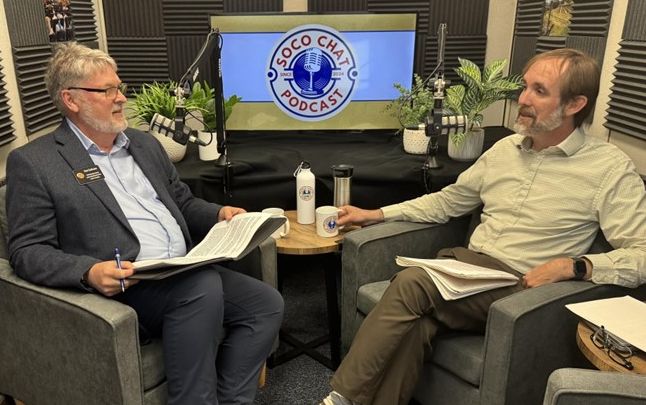
Paul Gullixson, left, County communications manager, speaks with Deputy County Administrator Peter Bruland during a recording of SoCo Chat.
Federal budget cuts could have significant impacts in Sonoma County, affecting everything from housing and health care to infrastructure and social services. Deputy County Administrator Peter Bruland recently sat down with SoCo Chat to explain what’s at stake – and why the County may face some tough choices in the future.
Subscribe to SoCo Chat on Spotify, Apple Music, Amazon Music and YouTube, and check out our growing library of episodes in both English and Spanish (Descubre nuestra creciente selección de episodios en inglés y español). Recent guests and topics of discussion have included:
-
Open Doors is a new initiative that will make it easier than ever for people to get help with food, housing, child care and much more. It’s based on a simple concept: It shouldn’t matter which door you knock on first, whether it’s a County agency or one of the hundreds of local nonprofits that are joining in this effort. Every door should be open, and every door should take you to the services you need. Angela Struckmann, director of the Sonoma County Human Services Department, explains how Open Doors works and why it could transform the way people connect with services in our community.
-
Sonoma County’s Family Justice Center empowers victims to live free from domestic violence and abuse. It is a model of collaboration, uniting government, law enforcement agencies and nonprofits to deliver comprehensive services to victims through a single point of access. Marsha Lucien, its executive director, explains how the Santa Rosa agency protects the vulnerable, stops violence and restores hope.
-
For more than 40 years, La Luz Center has helped Latino families in the Sonoma Valley attain their dreams by connecting them to education, health care and economic opportunity. Leonardo Lobato, executive director of the Sonoma nonprofit, describes the challenges these local families are facing every day – and how La Luz is evolving to help them thrive.
- SMART is changing the way people move through the North Bay, where a record 4,700 riders now take the train every weekday. The regional rail system is poised for even more growth as it prepares to expand north to Healdsburg and Cloverdale. Eddy Cumins, general manager of Sonoma-Marin Area Rail Transit, explores the system’s future, the challenges ahead, and why the rail project matters to everyone in Sonoma and Marin counties — whether you ride the train daily or have yet to hop on board.
| | Find room to grow with a County job | | |
The County currently has more than 40 job openings posted on its website. How can you improve your chances of landing one?
Sign up for the next Start Here! class, which provides an overview of the County of Sonoma’s job application, examination and selection processes. The next two-hour class will be held Dec. 4 at 5:30 p.m. on Zoom.
The free class is intended for the public, whether you are looking for a new position now or planning for a future employment opportunity. Participants will learn how to submit a thorough application, best practices for the interview and examination, and much more.
Contact us at careers@sonoma-county.org to register for the Dec. 4 class or sign up for our mailing list to be notified of future classes.
| | Volunteer and employment opportunities | | |
(stories may require subscriptions)
| | Upcoming meetings and events | | Upcoming meetings and events | | Getting outside and enjoying the county | | Follow us online or contact us via email | | | | |