|
The California Asphalt Pavement Association
Vol. 19, Issue 41 || Oct. 12, 2026
| | |
Greetings!
This weekly report contains news and information of interest to the asphalt pavement industry, customers and agency partners in California. Please feel free to distribute this newsletter to others who may be interested in asphalt pavements. To subscribe to the newsletter click HERE. To provide feedback or story ideas click HERE. Having difficulty viewing this newsletter? View as Webpage
| |
Landmark UC Riverside research refutes previous study on in-place asphalt and emissions | |
A new peer-reviewed study published by air-quality experts at the University of California, Riverside, with support from leading asphalt industry experts, finds emissions from in-place asphalt are miniscule and highly localized. The exhaustive research concludes that a previous report, which garnered widespread attention upon release, overstated emissions by more than 250 times.
Significantly, the new research published in the American Chemical Society Environmental Science & Technology AIR (ACS ES&T AIR) found that measured emissions are a surface-related phenomenon observed under real-world conditions, rather than a bulk material emission.
The UCR study combined controlled laboratory testing with measurements from in-place pavements exposed to environmental conditions. Laboratory testing used representative asphalt pavement samples under realistic temperatures and full-spectrum solar exposure. The researchers also evaluated the formation of secondary organic aerosols (SOAs), particles that can form when emitted chemicals react in the atmosphere. The results showed that measured emissions were primarily associated with the pavement surface rather than the bulk asphalt material.
By evaluating both compacted pavement samples and in-place road surfaces, the researchers examined emissions under conditions designed to better reflect how asphalt pavements behave in service. The findings offer an additional perspective on previous research that estimated substantially higher emissions from asphalt materials. Much of that earlier work relied on laboratory measurements of small, uncompacted asphalt samples rather than real-world, in-place pavement.
“This research brought together academia and industry to better understand potential sources of atmospheric emissions from compacted roadways,” said David Cocker, professor and chair of UCR’s Department of Chemical and Environmental Engineering and lead researcher on the study in an official industry announcement reporting the new findings. “By combining controlled laboratory testing with measurements from in-place pavements, we were able to evaluate emissions using a more comprehensive approach that reflects the conditions pavements experience in the environment.”
The research was conducted through UCR’s Marlan and Rosemary Bourns College of Engineering – Center for Environmental Research and Technology (CE-CERT), which provides advanced capabilities for emissions and environmental research. Cocker’s research focuses on atmospheric chemistry, emissions and air quality and heavily influences regulations by the California Air Resources Board and the South Coast Air Quality Management District.
“This research demonstrates the value of credible, independent science in advancing our understanding of asphalt pavement emissions,” said Reed Ryan, president of the Asphalt Institute. “By supporting rigorous, peer-reviewed research, we can help ensure that discussions about asphalt pavement emissions and air quality are informed by accurate data and real-world conditions.”
The research was commissioned by the Asphalt Institute, National Asphalt Pavement Association (NAPA), Eurobitume, the European Bitumen Association, and State Asphalt Pavement Associations Inc. (SAPA). CalAPA is a member of SAPA and contributes to pooled funds that support asphalt research, earning the association a commendation from NAPA that is proudly displayed at the CalAPA offices.
“Investing in and advancing fact-based, technical research to continuously improve engineering and construction practices is fundamental to NAPA and the asphalt pavement industry. This study adds proof that in-place asphalt pavements do not adversely impact air quality,” said Audrey Copeland, PhD, PE, president and CEO of NAPA. “In partnership with scientists and experts, we are continually seeking to understand our impact and improve our product as well as manufacturing and paving practices. This work advances our understanding and further informs the asphalt pavement industry’s sustainability and emissions goals.”
“These findings provide valuable information for state asphalt pavement associations and the communities they serve,” said Kevin Burke, executive vice president of the Illinois Asphalt Pavement Association and 2026 SAPA chairman. “Our communities deserve straightforward, fact-based answers to important questions about asphalt pavement emissions, and this research helps advance that understanding.”
Eurobitume Director General Hervé Millet said the research reflects the importance of international cooperation in advancing scientific understanding of asphalt and bitumen.
“This study demonstrates the value of international collaboration in advancing our understanding of environmental performance,” said Millet. “By bringing together expertise, advanced technologies and rigorous analytical methods, the industry can continue to strengthen the scientific understanding of bitumen and asphalt and their role in a more sustainable transportation system.”
Taken together, the findings give regulators, researchers, transportation agencies, policymakers and the public a more robust scientific foundation for evaluating asphalt pavement emissions throughout its service life, and reinforce that in-place asphalt pavement should not be characterized as a significant source of urban smog-forming or other chemical atmospheric emissions based on the conditions evaluated in this study.
The full peer-reviewed study can be viewed on-line HERE. Howard Marks, Vice President of Environmental Health & Safety for NAPA, provided an exclusive preview of the research in the most recent environment-themed issue of "California Asphalt," the official magazine of the California Asphalt Pavement Association. In that article, Marks confirmed that the UCR research would "confirm what we expected" that the previous study "overestimated the risk by many orders of magnitude." That interview can be accessed on-line HERE.
| |
Asphalt paving contractor community gathers in Pico Rivera to network, learn & remember | |
Members of the Southern California asphalt pavement community gathered in Pico RIvera last week to learn and socialize, as well as to recognize the contributions of legends who have helped build the industry.
The Southern California Asphalt Contractors Committee dinner was held at the historic Dal Ray restaurant on Wednesday, recently hailed by the Los Angeles Times as one of the area's timeless dining treasures.The Dal Ray is the worst-kept secret in the industry, however. The Southern California Contractors Association, a frequent CalAPA collaborator, held a meeting at the same location the next day.
Earlier in the day on Wednesday, the CalAPA Board of DIrectors, chaired by Frank Costa of Martin Marietta, met to refine association strategy and goals for the coming year.
As always, part of the Contractor Dinner programming is focused on "news you can use," or to put another way, information to help contractors save money and avoid risk. Steve Marvin, P.E., with CalAPA, provided his always entertaining "Technical Tidbit" that included a "greatest hits" of some of his memorable presentations of the past. Marvin, a longtime CalAPA supporter, recently hosted an RV tailgate-style mixer at this year's annual charity golf tournament in Temecula.
Also on the program, Steve Cota with Acrisure provided his timely "insurance tidbit" that actually was several pointers and best practices designed to help contractors avoid risk, accidents and lawsuits. Mike Buckantz with Associates Environmental provided an update on the broad array of complex on-road and off-road equipment emission regulations, plus grant programs, that was far more entertaining than would be expected by the topic title.
Following dinner, the association marked the passing of industry legend Juan Forster, who spoke at the Contractor Dinner last year. He died in Orange County on Aug. 11 after a lengthy illness. The tribute was led by CalAPA Hall of Fame members Len Nawrocki and Jim St. Martin. Others recognized during the event included Kerry Hoover with Construction Marketing Services, which has published CalAPA's official association magazine for 30 years, and Kevin Duong with LIND Safety, which created the handsome customized vests that were handed out at the association's annual charity golf event in Temecula, as well as at June's "Summit at the Summit" Executive Leadership Forum in Lake Tahoe.
As a surprise to Nawrocki, he was presented with a coveted CalAPA-branded ceramic coffee mug with the versatile and thought-provoking slogan, "It's Your Own Asphalt." One was also presented to St. Martin, another industry stalwart and former association executive director. In another surprise, Nawrocki was presented with a copy of his favorite passage from a John Steinbeck novel where the writer, who once worked for a California asphalt company, describes asphalt in lyrical terms. The passage, from the Steinbeck novel "The Wayward Bus," can be viewed HERE.
To read a report and photos in CalAPA's official association magazine, California Asphalt, about last year's year's Contractor Dinner tribute to Forster, click HERE. An Asphalt Insider story about Forster's passing last August is HERE.
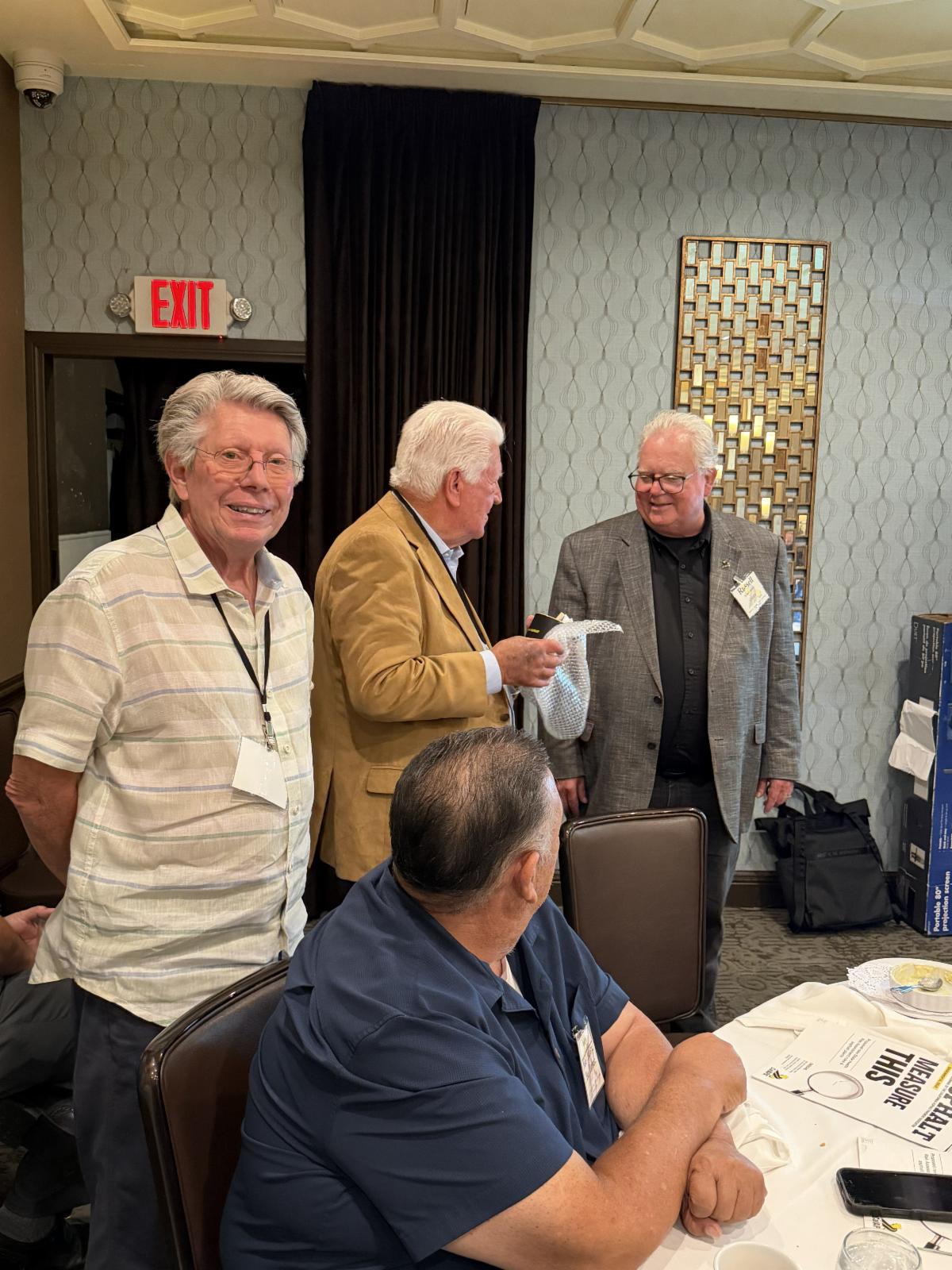
| | Jim St. Martin, Len Nawrocki and Russell Snyder pictured during a presentation at the Southern California Contractors Dinner Oct. 7 at the Dal Rae Restaurant in Pico Rivera. | | The gregarious Steve Marvin with LaBelle-Marvin delivers an informative and entertaining "Technical Tidbit" during the Southern California Contractors Dinner Oct. 7 at the Dal Rae Restaurant in Pico Rivera. | | Mike Buckantz with Associates Environmental delivers an update on on-road and off-road equipment emissions regulations during the Southern California Contractors Dinner Oct. 7 at the Dal Rae Restaurant in Pico Rivera. | |
A partnership for the ages promoting asphalt | |
A tip of the CalAPA hardhat goes out to our colleagues at the Asphalt Institute, who recently paid tribute to the decades-long partnership between the institute and CalAPA with their "Throwback Thursday" feature on social media.
The recognition comes as CalAPA is about to mark its 73rd birthday. The association was founded on Nov. 9, 1953 in Los Angeles, although it doesn't look a day over 40. The Asphalt Institute, meanwhile, is more than 100 years old, and previously this publication has noted their funding of promotional ads in the 1932 Los Angeles Olympics souvenir program.
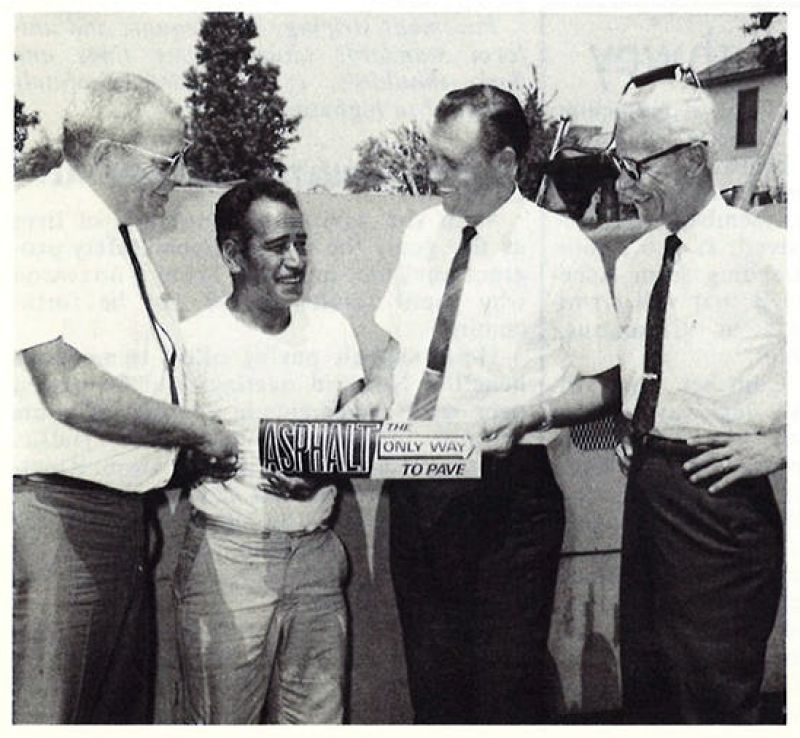
In last week's social media post, the Asphalt Institute shared a photo of the winner of a campaign to develop a bumper sticker to promote asphalt. The 1966 contest was sponsored by the California Asphalt Pavement Association, and the Asphalt Institute's Pacific Coast Division funded the production and distribution of the marketing material. In the photo that accompanied the Asphalt Institute post (pictured at right), roller operator Rudolph Kinney, the winner of the bumper sticker design contest, is presented with the finished product. His winning design stated a universal truth: "Asphalt - The Only Way to Pave." The slogan was soon proudly displayed on bumpers across the state. It seems the message, like asphalt, is durable with engineers, designers and other pavement-type decision-makers. In California today, about 95% of paved surfaces are covered with asphalt. For the history buffs among our readership, a link to an article that was included in the 1932 Los Angeles Summer Olympic Games program, click HERE.
Regular readers of this publication will recall the prominent role regional engineers with the Asphalt Institute have played in asphalt technical education and promotion in California. Previous CalAPA staff Roger D. Smith and Rita Leahy have also served stints as regional engineers for the Asphalt Institute, and recently retired Senior Regional Engineer Bob Humer, P.E., was inducted into the CalAPA Hall of Fame in 2024 as an "Honorary Member." Continuing the tradition, current Asphalt Institute Regional Engineer Jhony Habbouche, P.E., has been a frequent speaker at CalAPA educational events.
To learn more about the Asphalt Institute, and admire their new logo and other updated branding, visit their newly revamped website HERE.
Editor's Note: Historically CalAPA publications have referred to the Asphalt Institute on second reference by the acronym "A.I." However, due to the recent proliferation of another usage of the acronym A.I. to note "Artificial Intelligence" technologies, and to avoid confusion, this publication will from now on refer to the Asphalt Institute on second reference, at their request, as "the Institute."
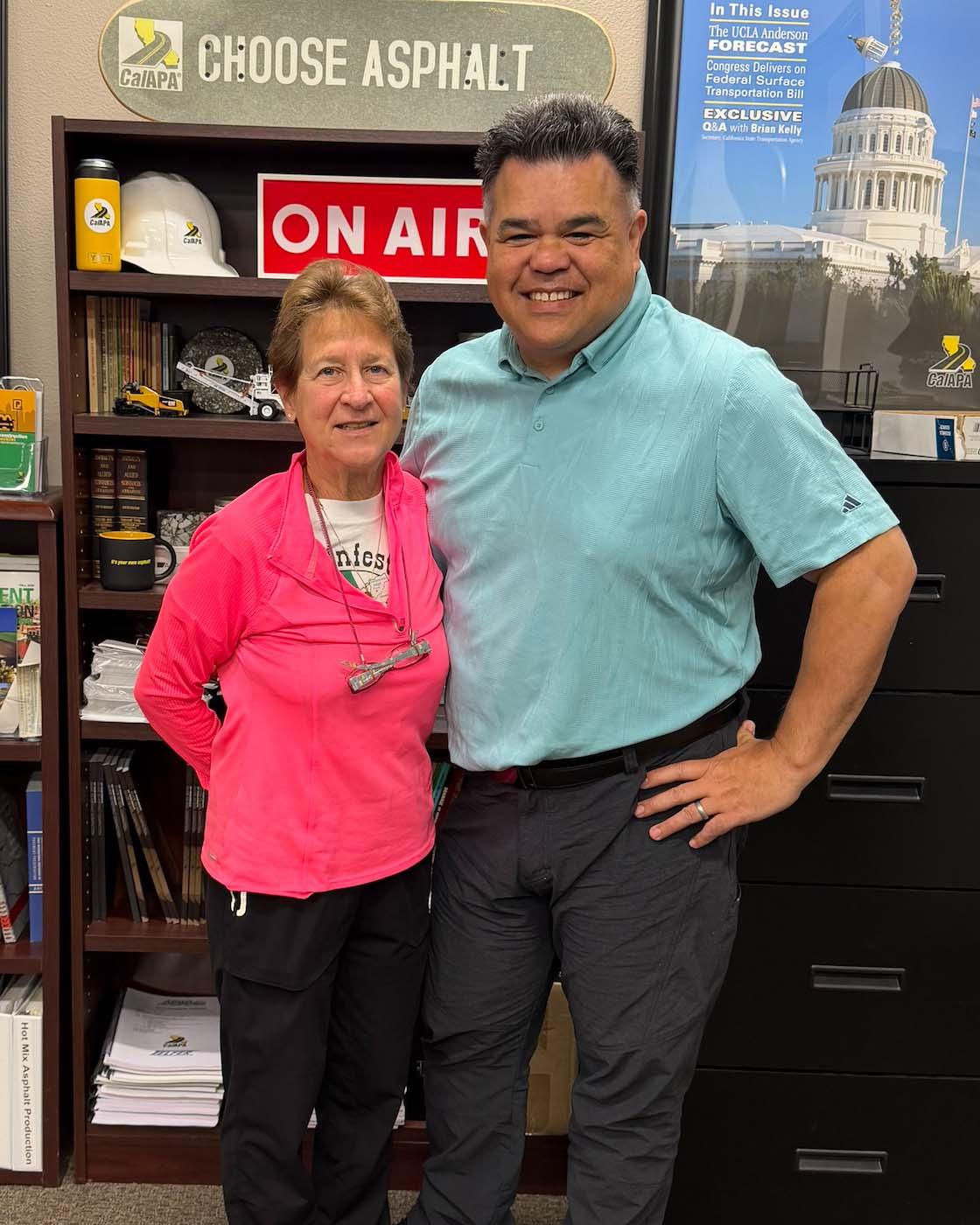
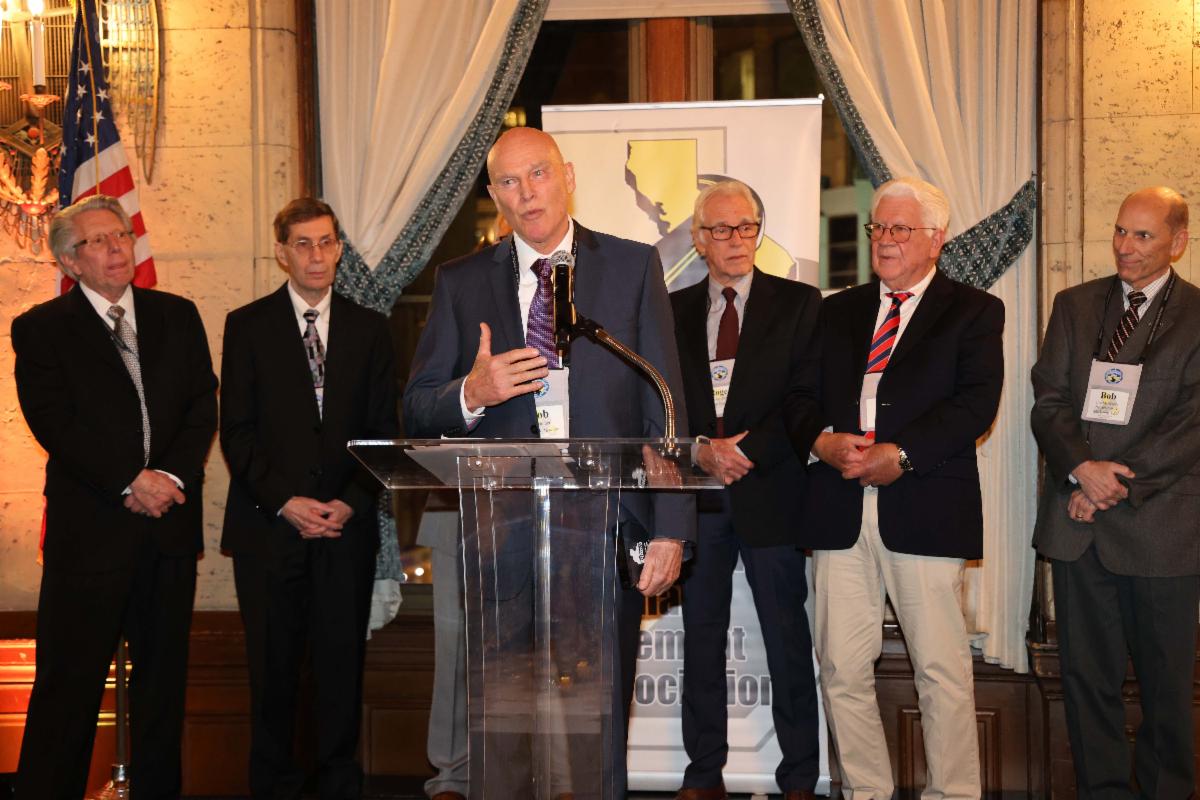
| | Former Asphalt Institute regional engineer Rita Leahy, Ph.D., P.E., who also was a former technical director for CalAPA, stopped by CalAPA offices last month. She is pictured at left with CalAPA Technical Director Brandon Milar, P.E. Among her many accolades, she has been designated as the "Original Woman of Asphalt" by the national Women of Asphalt organization. To learn more about the California branch of the Women of Asphalt organization, click HERE. | | Retired Asphalt Institute Senior Engineer Bob Humer (center) speaks during his installation ceremony in 2024 in Los Angeles into the CalAPA "Hall of Fame" as an "Honorary Member" in recognition of his many years of service to the industry. Also pictured, from left, Jim St. Martin, Don Goss, Roger Smith, Len Nawrocki and Bob McGennis. A story and photos about that event that appeared in "California Asphalt," Journal of the California Asphalt Pavement Association, can be viewed on line HERE. | | Asphalt Institute Regional Engineer Jhony Habbouche, P.E., speaks at a recent CalAPA educational event. Habbouche continues a decades-long partnership between the Institute and CalAPA in asphalt technical education and promotion. His official bio is HERE. | |
In the wake of a series of fatal crashes, Caltrans implores motorists to drive safely in active highway work zones | |
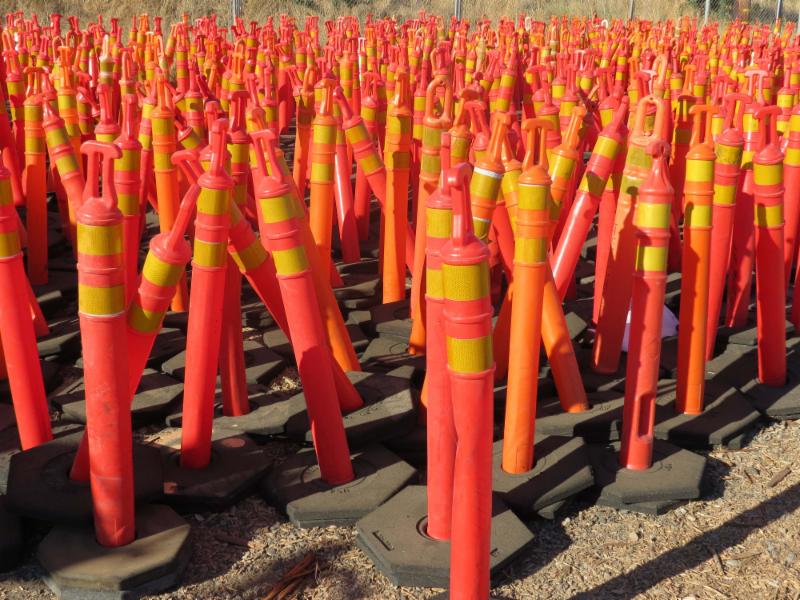
Caltrans and other public safety officials held a rare press conference last week to implore motorists to drive safety in active highway work zone. The unusual appeal came in the wake of six fatalities in the past two months on the state highway system that have shaken industry, agency and union personnel alike.
"Whether they are Caltrans workers, contractors or anyone who works on the state’s transportation system, they deserve attention from all travelers driving through work zones,” said Caltrans Director Dina El-Tawansy in an official Caltrans press release. "Safer driving habits can mean the difference between a family greeting their loved one at the end of a workday or never seeing them again.”
The department announced it was establishing an executive-level safety committee with industry partners to emphasize the shared safety responsibilities on a construction site, propose and investigate opportunities to employ new technology and safety devices in work zones, and review current standards to see where Caltrans contracts can be modified to require additional safety efforts. It is unclear how that effort will be different from the already existing industry-agency safety committee that has spawned numerous safety innovations and best practices over the years. The most recent one is a CalAPA-supported pilot program to install speed enforcement cameras in work zones, which was enabled by legislation, AB289, signed into law last year by the governor. A previous Asphalt Insider article on that law is HERE.
The Oct. 8 press conference in front of the Caltrans Headquarters building in downtown Sacramento featured representatives from Caltrans, the California Highway Patrol and the California Office of Traffic Safety, but notably, no representatives from the contracting community or unions that represent workers most at risk behind cones in an active work zone. No explanation for this omission was received by Asphalt Insider by press time.
More information on highway work zone safety produced by the State of California can be found HERE and HERE. Additional work zone safety information from the National Asphalt Pavement Association, a CalAPA partner, is HERE.
A previous Asphalt Insider article on this topic that appeared in the Sept. 28 newsletter can be viewed HERE.
| |
|
Each week we highlight a word, acronym or other term commonly used in the asphalt pavement industry in California.
DRAINAGE: Structures and facilities for collecting and carrying away water.
| |
Paving Pointer of the Week | |
Each week we highlight a key point or best practice of interest to asphalt paving crews, inspectors and others working in the field. We welcome suggestions. More tips can be found in our "Asphalt Parking Lot Construction Checklist" HERE. Information on the CalAPA "Quality Paving Certificate" program is HERE.
PROJECT REVIEW: Every paving project should start with a detailed review of the project's contract, plans, and specifications. Any questions arising from this review should be directed to the design firm's engineers.
| | |
Each week we highlight a term that is specific to climate-change issues related to the asphalt pavement industry. This feature is intended to raise awareness of the asphalt industry's climate-change initiatives and the specialized terminology that goes with them. More information on "The Road Forward" asphalt industry climate initiative can be found HERE. A recent CalAPA magazine story on the topic is HERE.
CLIMATE CHANGE: Change in temperature, precipitation or wind for longer than 10 years.
| |
Caltrans Statewide Crude Oil Price Index | |
Editor's Note: As a convenience to our readers, Asphalt Insider reports the most current Caltrans "Statewide Crude Oil Price Index" posting. The department posts this monthly on its public website HERE. The index is used to calculate payment adjustments for paving asphalt under special provisions section "Payment Adjustments for Price Index Fluctuations" in those projects containing the section. The department posts the index on or about the first business day of the month using the daily Brent crude oil prices from the previous month as reported by Business Insider. Inquiries about the index should be directed to Caltrans at: Oil.Index@dot.ca.gov .
October 2026: $557.6 ($/ton)
Last month: $481.3.4
1 year ago: $364.5
| |
|
"The obstacle is the way."
– Marcus Aurelius
| | |
We hope you enjoy CalAPA's Asphalt Insider newsletter, widely regarded as the most influential publication of its type in California. We are committed to providing you with the most up-to-date information on technical issues, regulation, news, analysis, people, events and trends in California that is of interest to the asphalt pavement industry and our various agency partners. To subscribe to the newsletter, click HERE. For comments, questions or to suggest a story idea, click HERE. We are committed to promptly notifying our readers of any errors in this publication. Please click on the comment link above to alert the editor of any errors or omissions.
Sincerely,
Russell W. Snyder, CAE
Executive Director
The California Asphalt Pavement Association (CalAPA)®
| | The "Asphalt Insider" is an official publication of the California Asphalt Pavement Association. For more information or to inquire about membership, call (916) 791-5044, or click HERE to contact us. Copyright © 2026 California Asphalt Pavement Association -- All Rights Reserved. The CalAPA name (No. 5,621,794) and logo (No. 5,621,795) are registered trademarks with the U.S. Patent & Trademark Office. | | | | |