|
The American Society of Le Souvenir Français Inc.
Monthly Bulletin - Vol. V, No2 - February 2025
| |
|
The Battle of Savannah
and a special tribute to the
Chasseurs Volontaires de Saint Domingue
| |
|
Cover illustration:
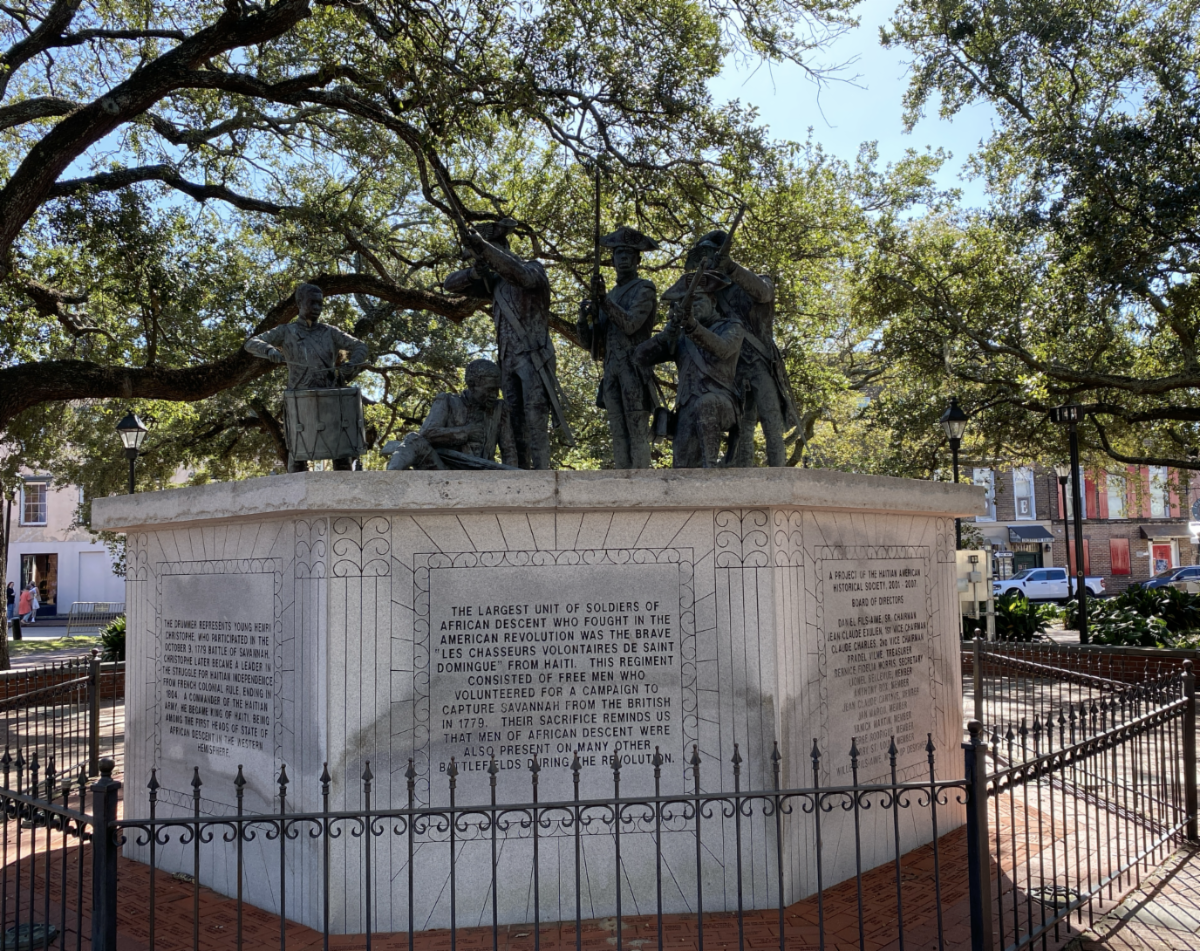
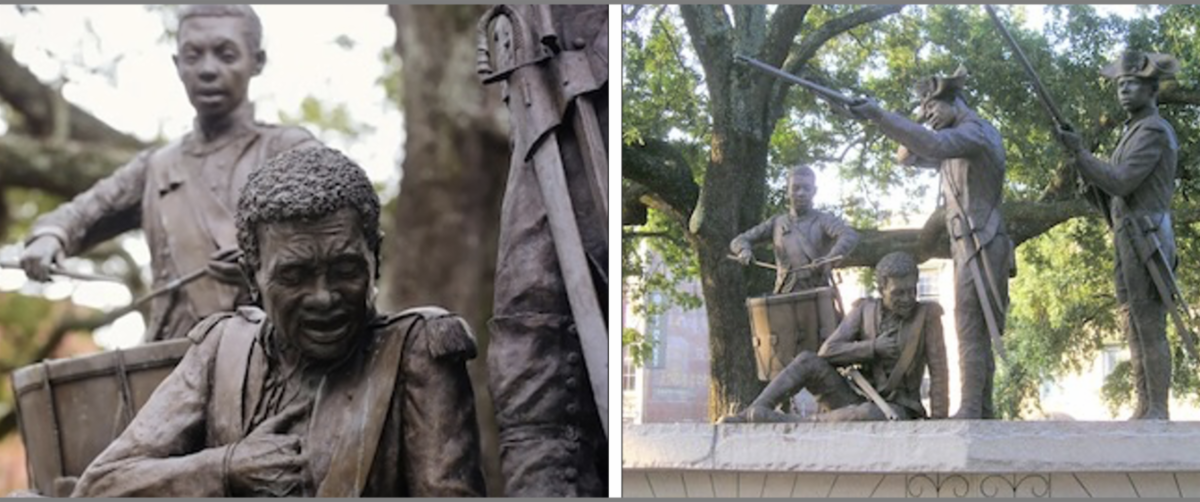
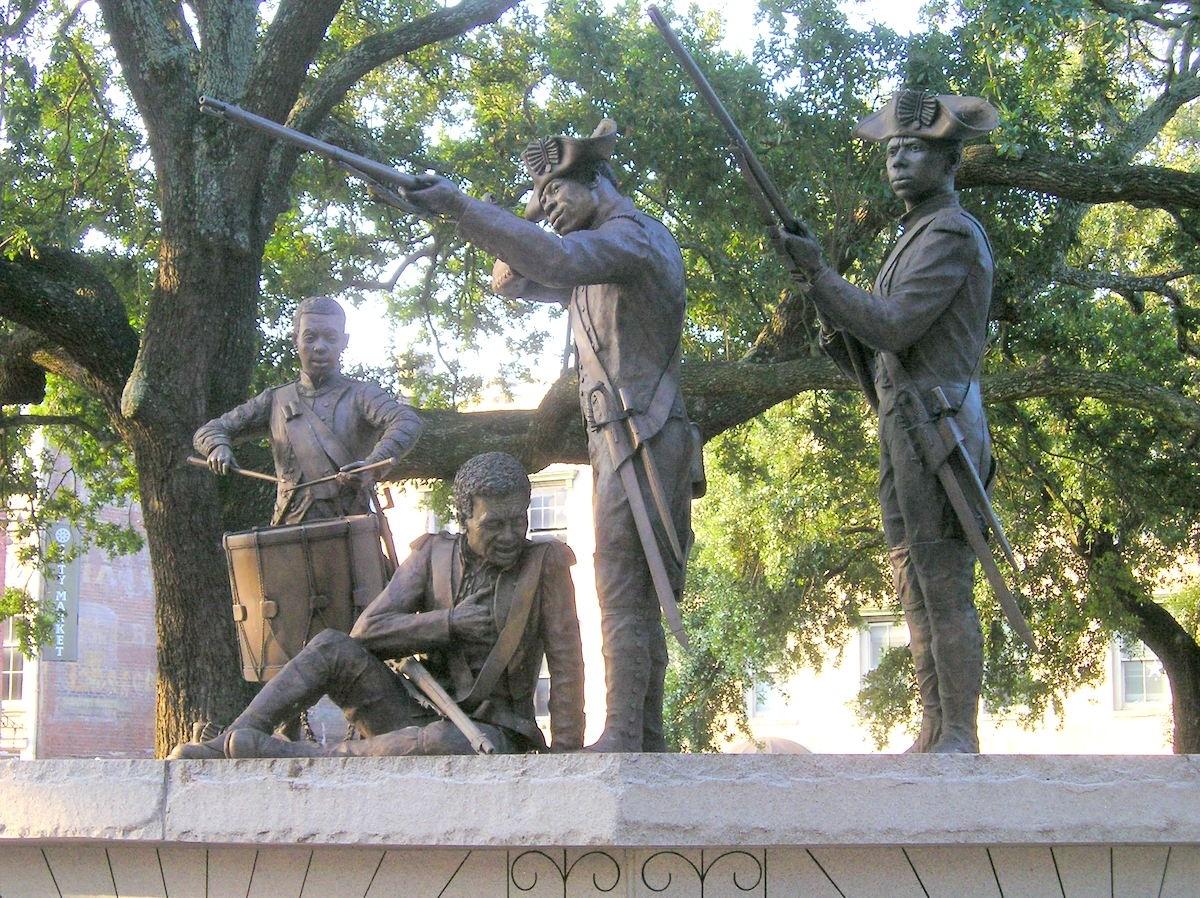
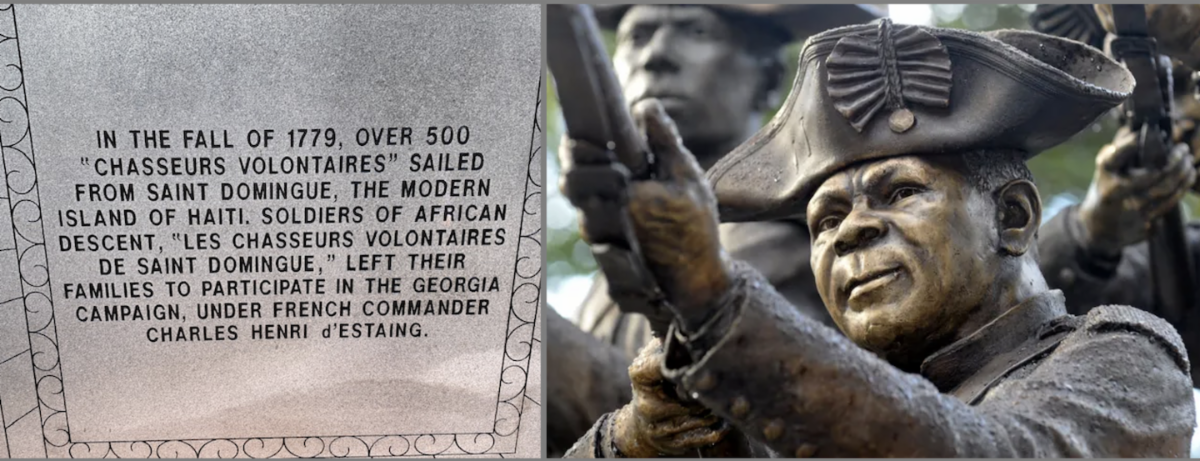
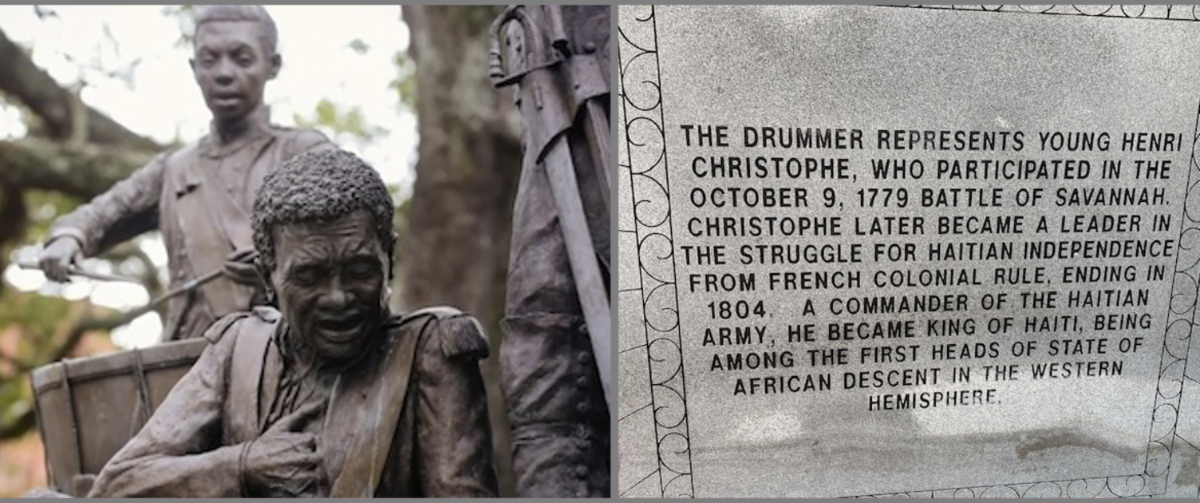
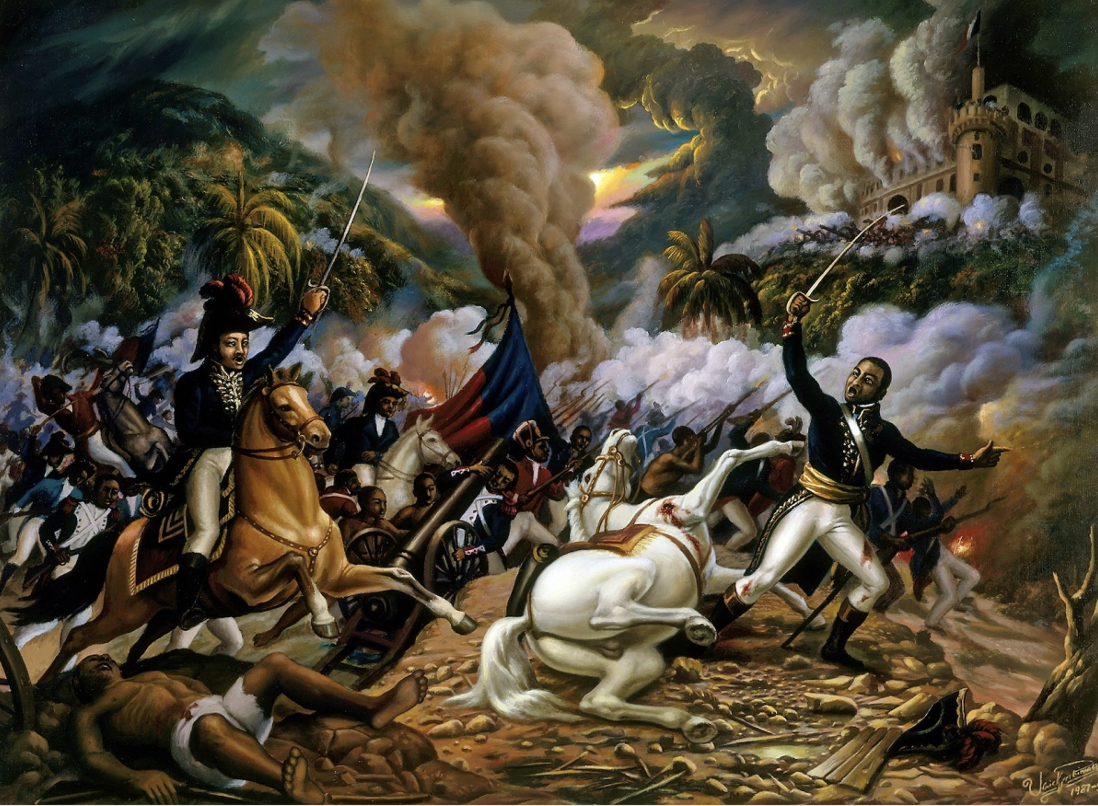
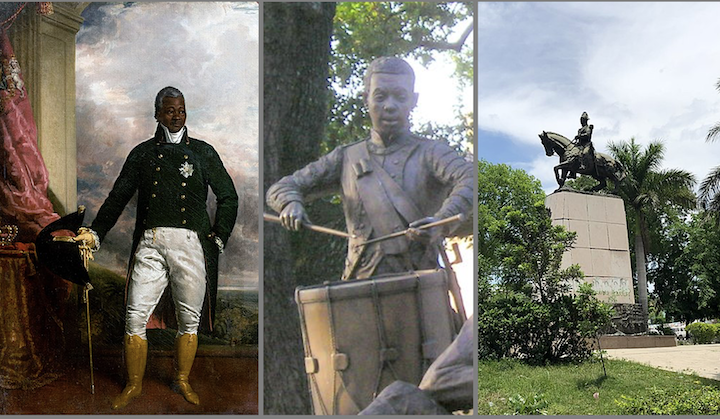
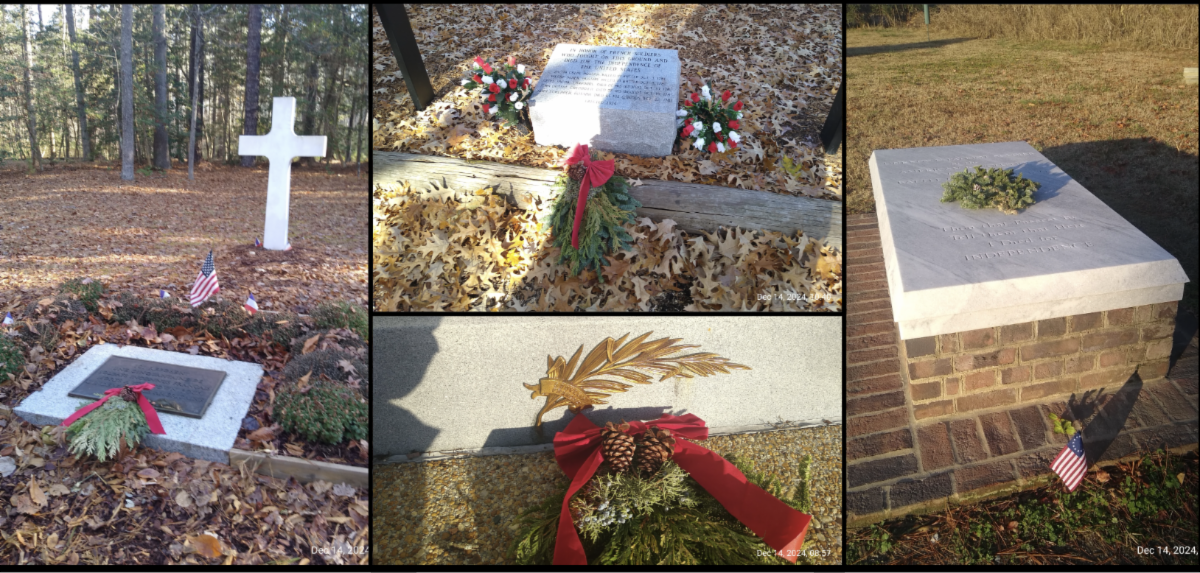
In honor of Black History month, we pay tribute to the largest unit of colored soldiers to fight in the American Revolution, the Chasseurs Volontaires de Saint-Domingue, who distinguished themselves during the Battle of Savannah in 1779. Memorial to the "Chasseurs Volontaires de Saint-Domingue" (today's Haiti), by sculptor James Mastin, dedicated in 2007 in Savannah, GA.
Photos: Courtesy of Ms.Terri Mitchell, National Society Daughters of the American Revolution, National Division Vice Chair - NW, Franco-American Memorial Committee
| |
|
Editorial
Savannah is the quintessential Southern town, lined with elegant homes, public squares at the intersections of tree-lined streets, a historical district and a bustling riverwalk, with several art and history museums.
Yet this charming town was the site of the second bloodiest battle of the Revolutionary War, the first occasion for American and French forces to fight side by side in a major military operation.
We will narrate the ill-fated attempt to capture Savannah from the British, and will focus on the role played by the forces commanded by Vice-Admiral count d'Estaing.
Among the many regiments and ships of the line engaged to assist America in 1779, the role of colored regiments of the French Army, including the "Régiment des Chasseurs Volontaires de Saint Domingue" is often overlooked. And yet, they played an important role, which we will narrate in this month's Bulletin.
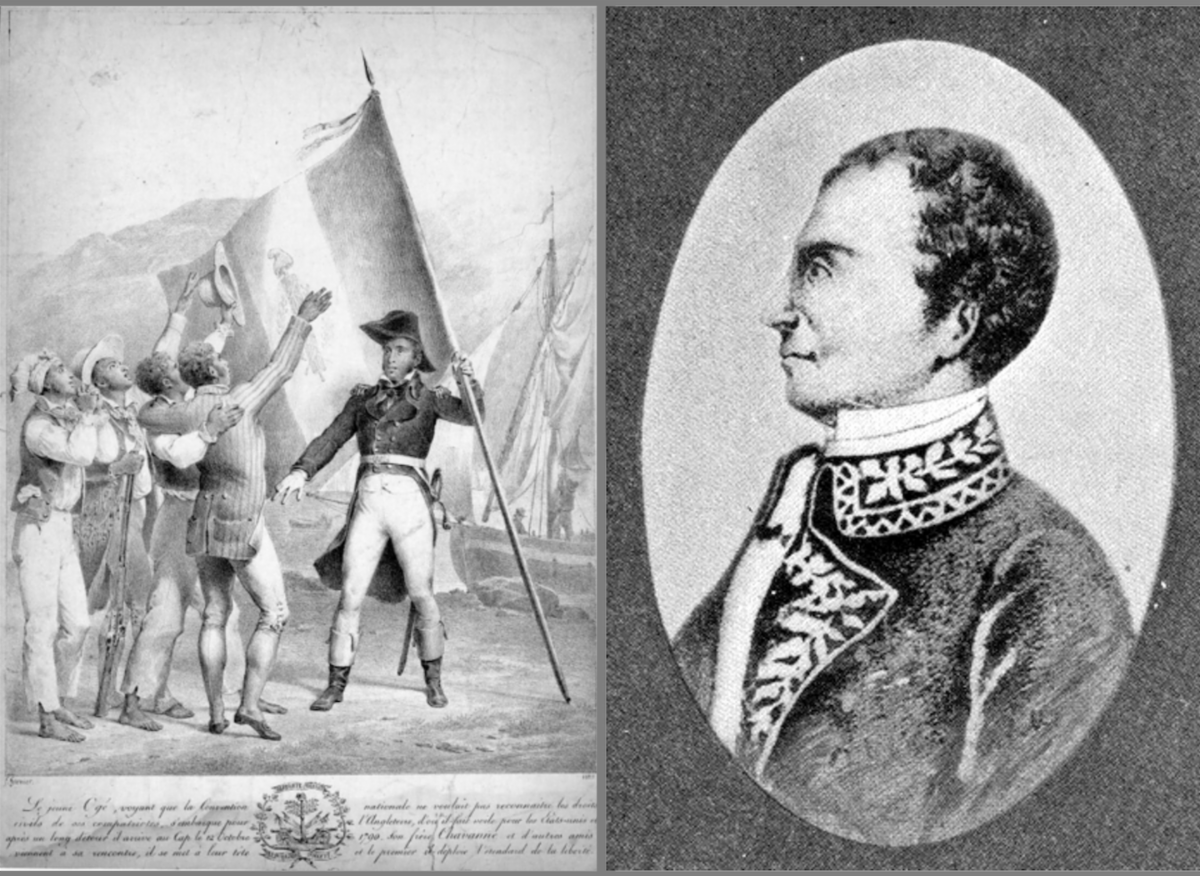
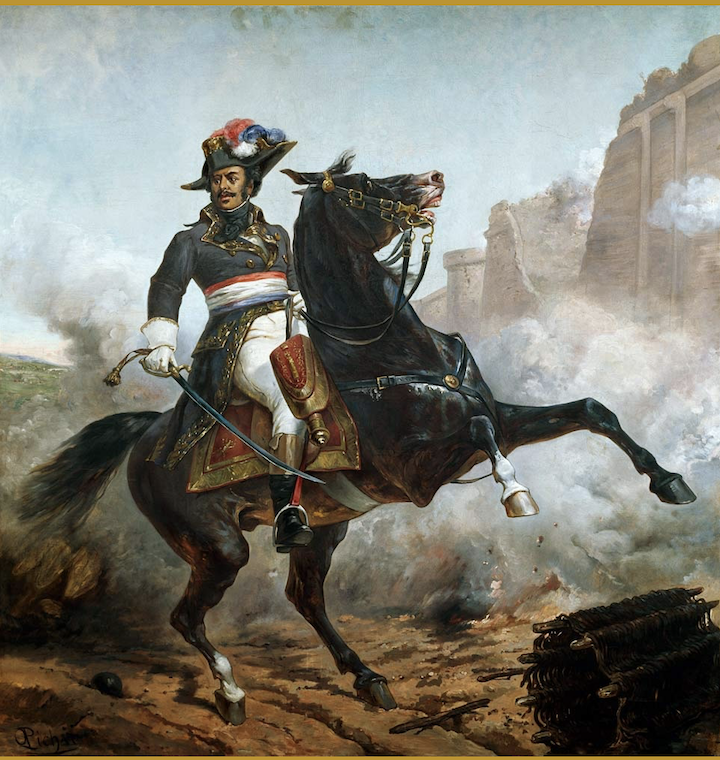
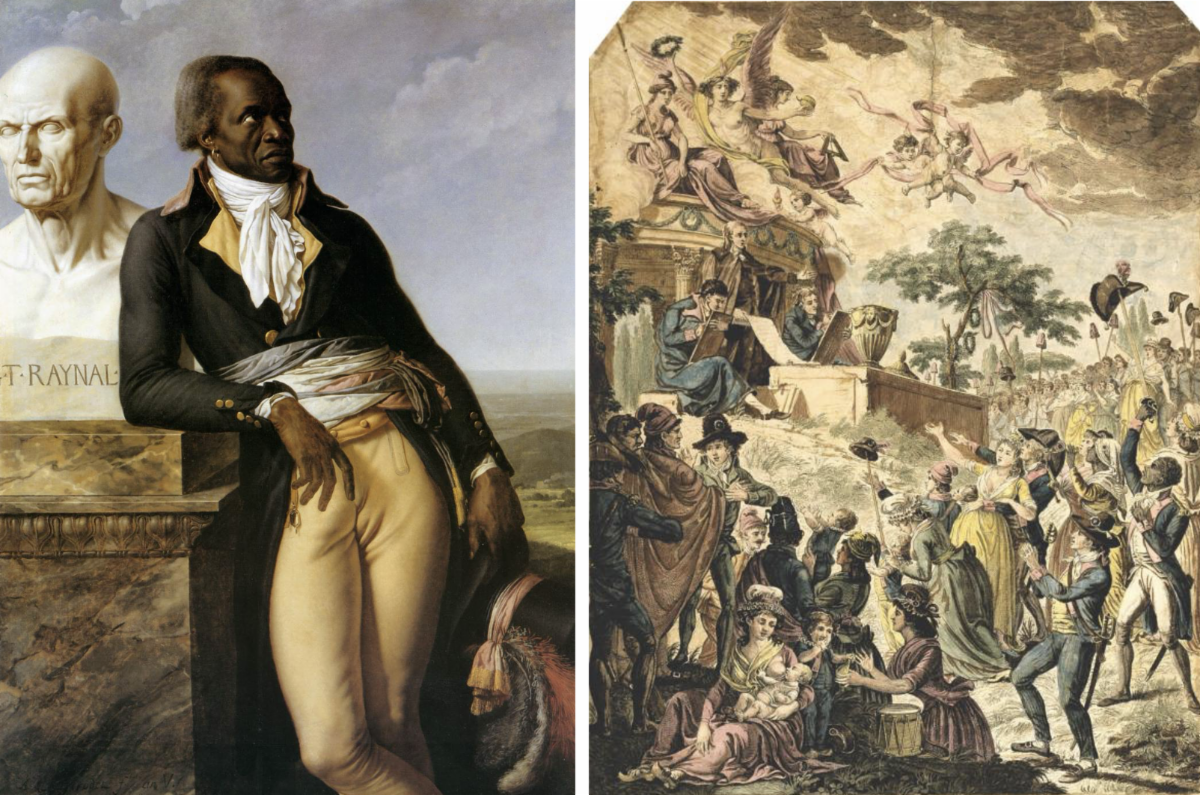
Among those volunteers, several became after the war important figures in Saint Domingue, which became known as Haiti, as well as in France: Henri Christophe, future president and later King of Haiti, André Rigaud, future president of the short-lived republic of South Haiti. Four of them would have a notable military career, becoming black generals of the First French Republic, while others played a role in the French Revolution in Paris, as we will see in the following pages.
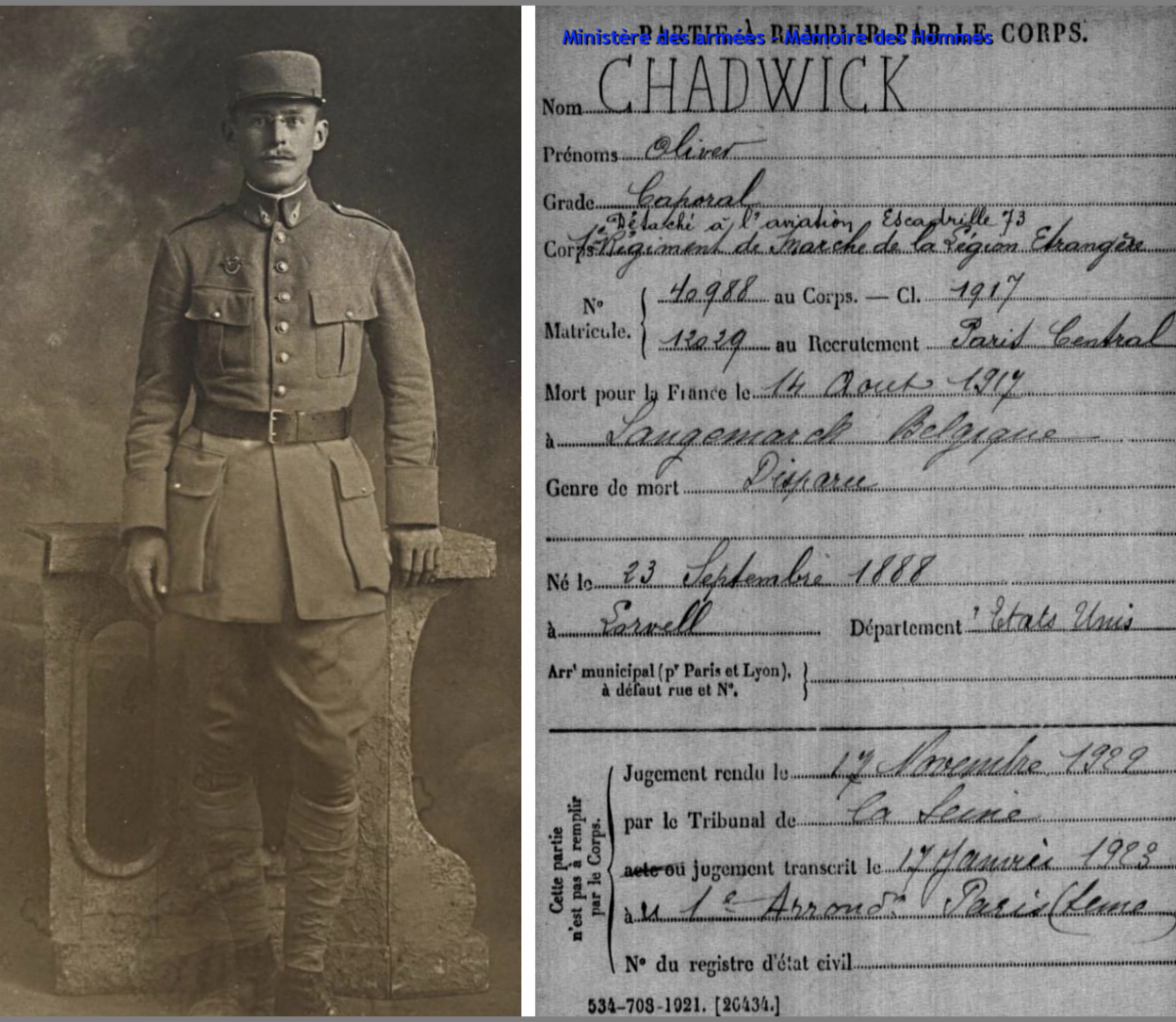
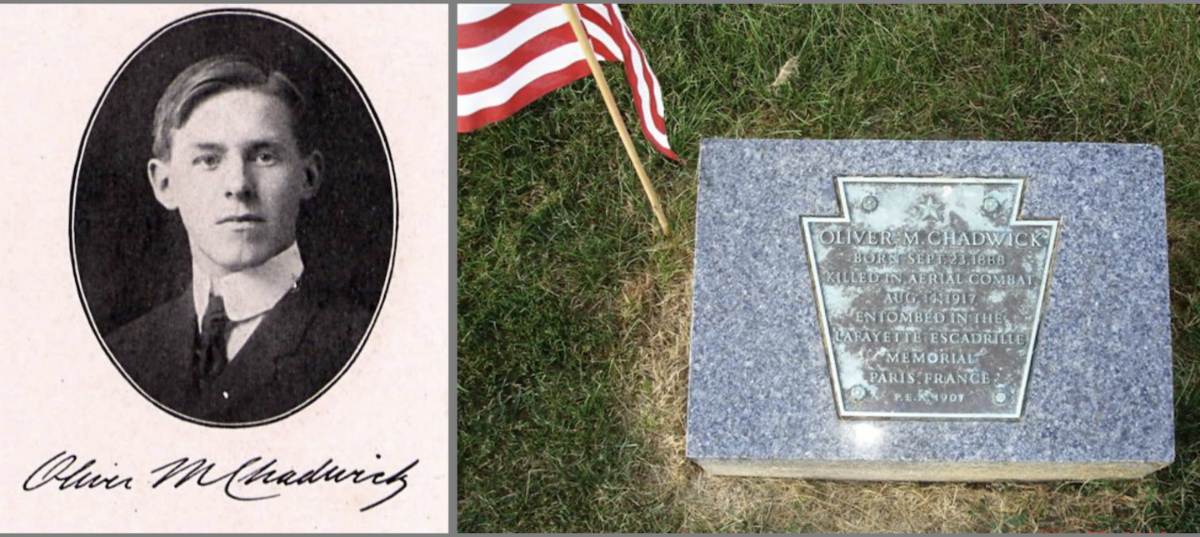
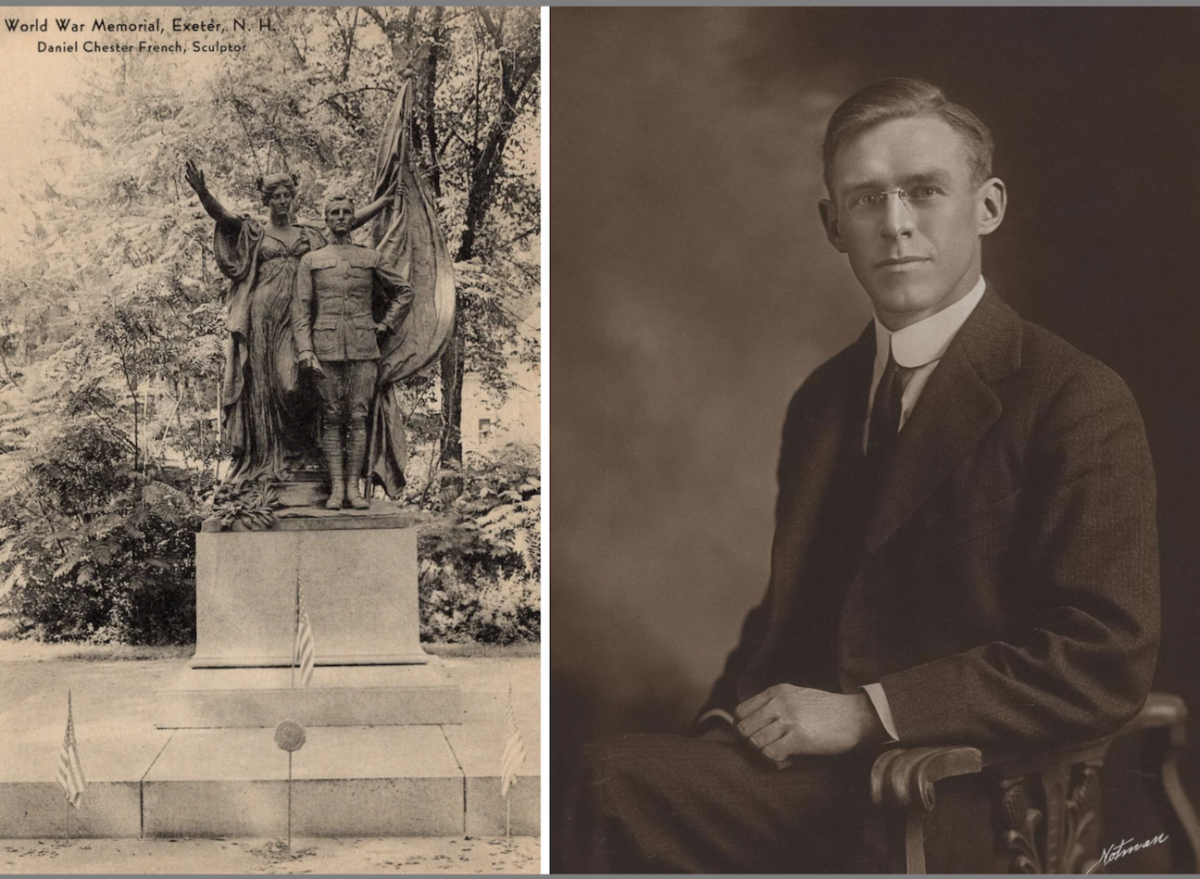
In our second part of our Bulletin, we will pay homage to another volunteer of the Lafayette Air Corps, Corp. Oliver Moulton Chadwick, of Lowell, Massachusetts, who “Died for France" on August 14, 1917 at Langemark-Poelkapelle, Belgium. He too volunteered for a cause, and made the ultimate sacrifice.
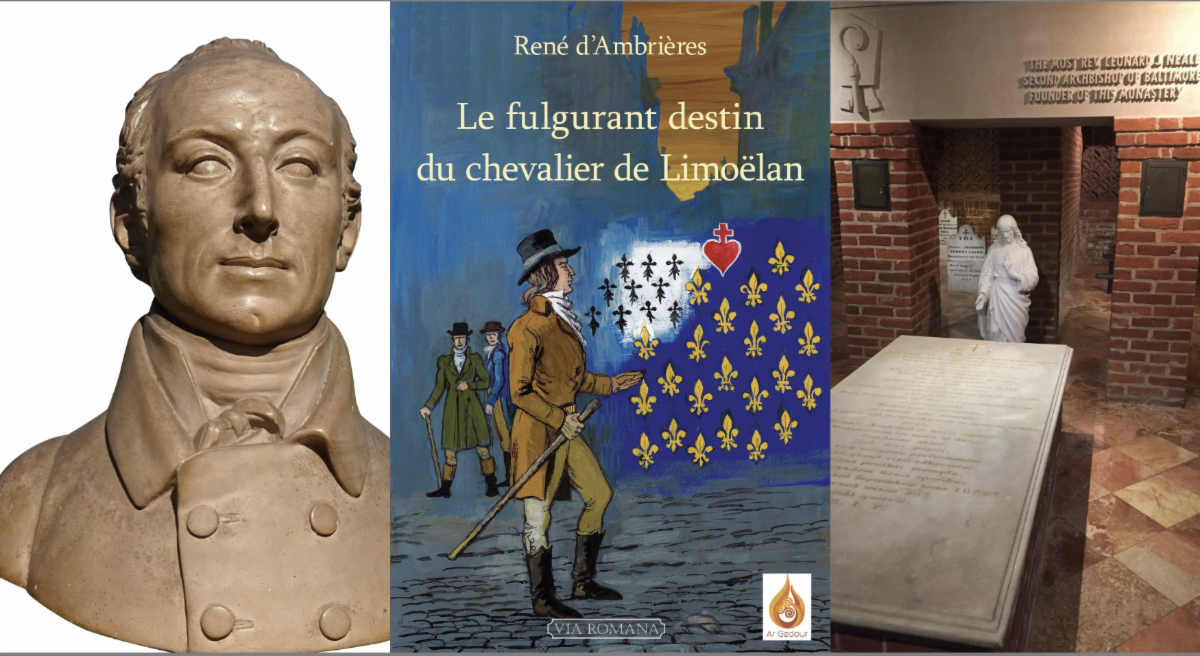
Finally, our third part “News and Save the Dates” will report on events since our last Bulletin, including several commemorations of the ongoing Bicentennial of Lafayette’s Farewell Tour organized by the American Friends of Lafayette. We will also revisit our November 2024 Bulletin and thanks to the remark of one of our esteemed readers, Mr. rené d'Ambrières in France, we will add a paragraph dedicated to the Chevalier de Limoëlan, who became a priest and sought refuge in the United States under the name of Father Clorivière, as the founder of the first free school established in the District of Columbia in 1818.
To those of you who have not yet renewed their membership for 2025, we humbly ask you to not forget about our Society. Our membership drive is ongoing. Please rejoin or join us, so that we can implement the installation of new memorials, markers and plaques! Please, scroll to the end of this Bulletin. We will honor our donors at our upcoming General Assembly.
On behalf of the Board of Directors,
Thierry Chaunu
President, American Society of Le Souvenir Français, Inc.
| |
|
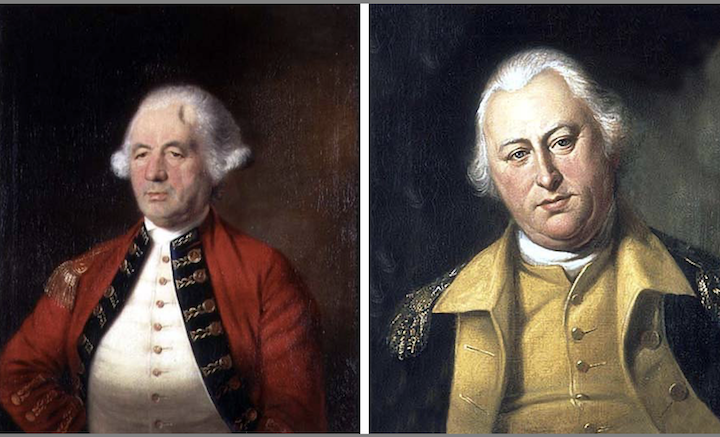
In 1778, British leaders shifted their focus to the southern colonies, believing that a significant Loyalist population would support the crown. To implement this strategy, a British force led by Lieutenant Colonel Archibald Campbell seized Savannah, Georgia on December 29, 1778.
British strategy from that point focused on launching offensives that leveraged the advantages of naval power and the loyalty of many colonists. By the end of January 1779, British troops from New York and St. Augustine, Florida, had taken control of Georgia. British (Swiss-born) General Augustine Prevost, who had previously led forces in Florida, established Savannah as his headquarters.
By the fall of 1779, American forces were eager to reclaim the city.
The American troops in the area, numbering between 5,000 and 7,000, were stationed in Charleston, South Carolina, under General Benjamin Lincoln's command.
Lincoln understood that regaining Savannah would require help from the French military. On September 3, he received word that Charles Hector, Comte d’Estaing, was on his way to Savannah with a fleet of warships and 4,000 French soldiers...
| |
|
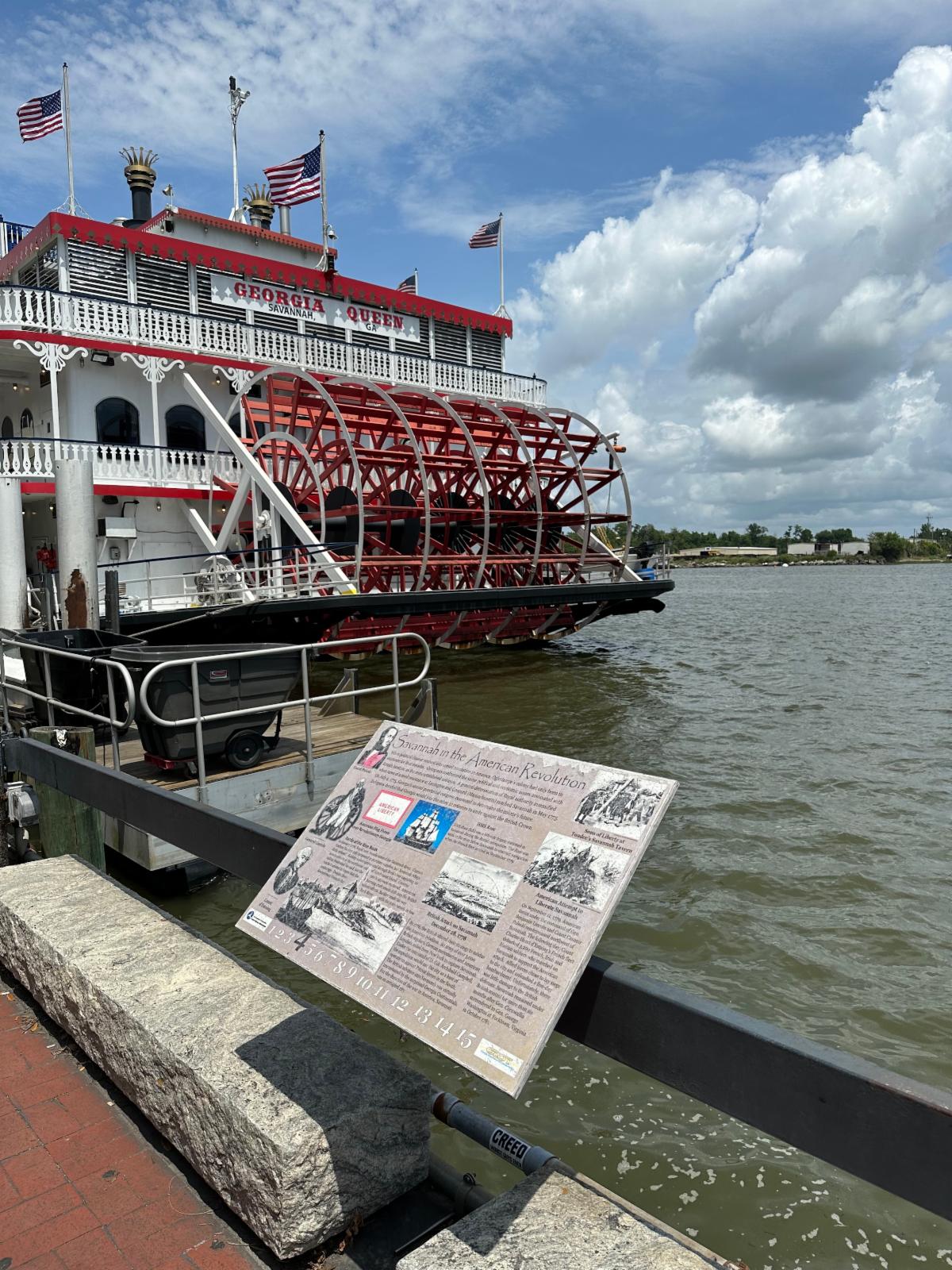
Above: Marker “Savannah and the American Revolution”
John P. Rousakis Riverfront Plaza, Savannah, GA 31401
GPS: 32.075583, -81.099317
Photo: TC © ASSFI 2023
| |
|
An interpretative marker tells a partial story
:
"Savannah in the American Revolution:
"When political dissent evolved into armed revolution in America, Oglethorpe's colony1 had only been in existence for four decades. Georgians confronted the same political and economic issues associated with British taxation as the more established colonies. A general deterioration of Royal authority intensified when news of armed resistance at Lexington and Concord (Massachusetts) reached Savannah in May 1775. On July 4, 1775. Georgia's second provincial congress convened to determine the colony's future.
Delegates decided that Georgia would join the other 12 colonies to unite against the British Crown."
"By 1778, the British altered their strategy to subdue the American rebellion. An army of over 3,000 British regulars, German mercenaries and American Loyalists sailed from New York to capture Savannah.
Under the command of Lt. Col. Archibald Campbell, the expedition would use the city as a base of operations against Patriot forces in the South.
The British advance into Savannah was virtually uncontested by the surprised Georgia Continentals.
For the duration of the war in America, Savannah was an occupied city."
Right inset: "American Attempt to Liberate Savannah:
On September 11, 1779, American forces under the command of Gen.Benjamin Lincoln and Count Casimir Pulaski rendezvoused northwest of Savannah. The following day, Count Charles-Henri d'Estaing's French fleet debarked 3,200 French, Irish and Haitian2 soldiers who marched on Savannah to support the American attack. Allied forces chose to lay siege to the city and unleashed a five-day bombardment. Unfortunately, there was little damage to the British defenses. Savannah remained under British control for more than six months after Gen. Cornwallis: surrendered to Gen. George Washington at Yorktown, Virginia in October 1781."
Notes: 1. Georgia 2. Haiti did not exist then.
Right inset: There is scant description of the battle; the French are mentioned briefly.
| |
|
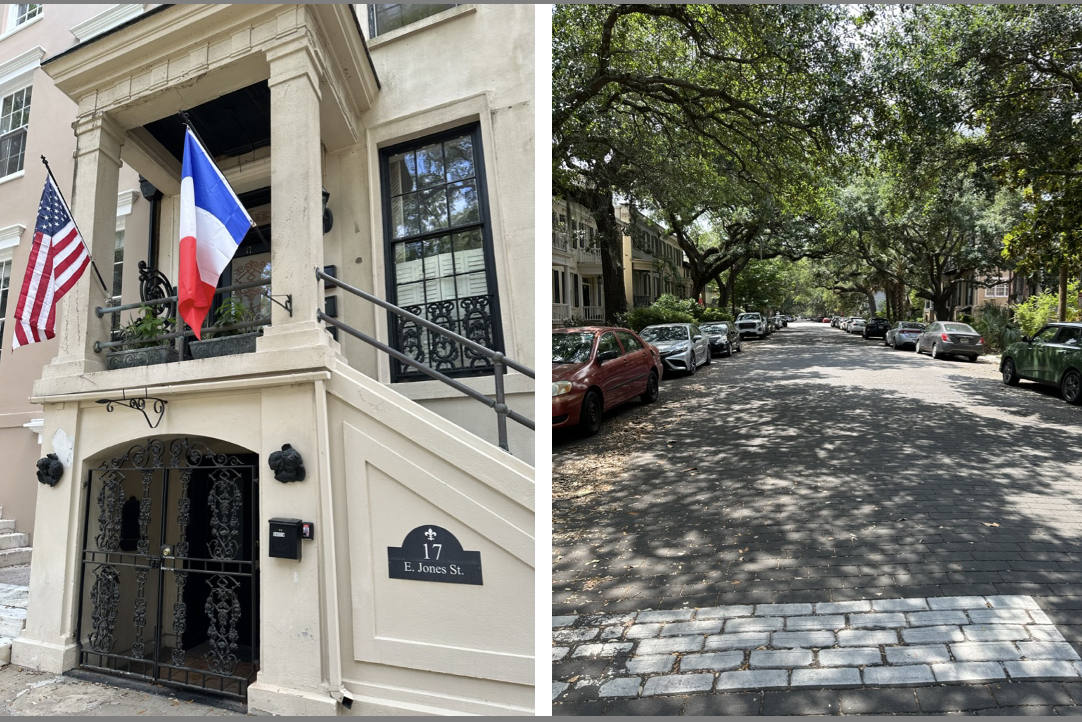
Jones Street, is often referred to as the prettiest streets in Savannah, if not of all America.
Many homes display the Star Spangled banner. This one proudly flies both the American and French flags side by side. Photos: TC © ASSFI 2023
| |
|
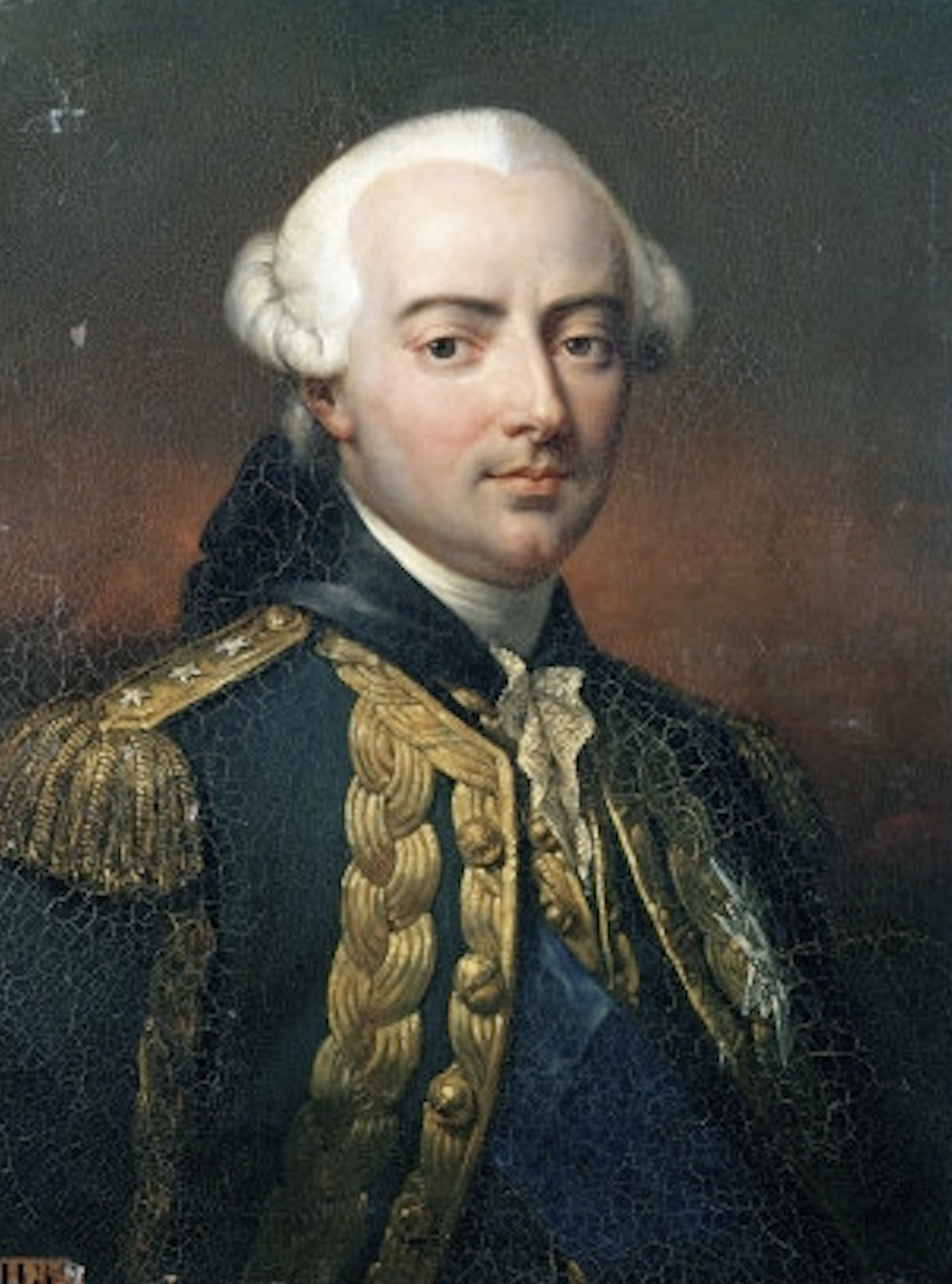
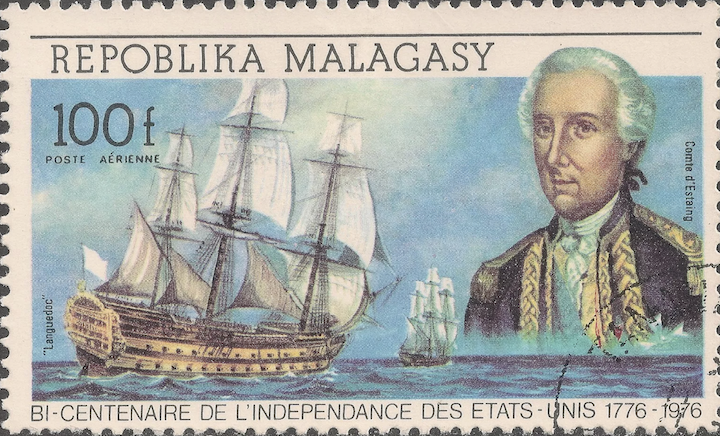
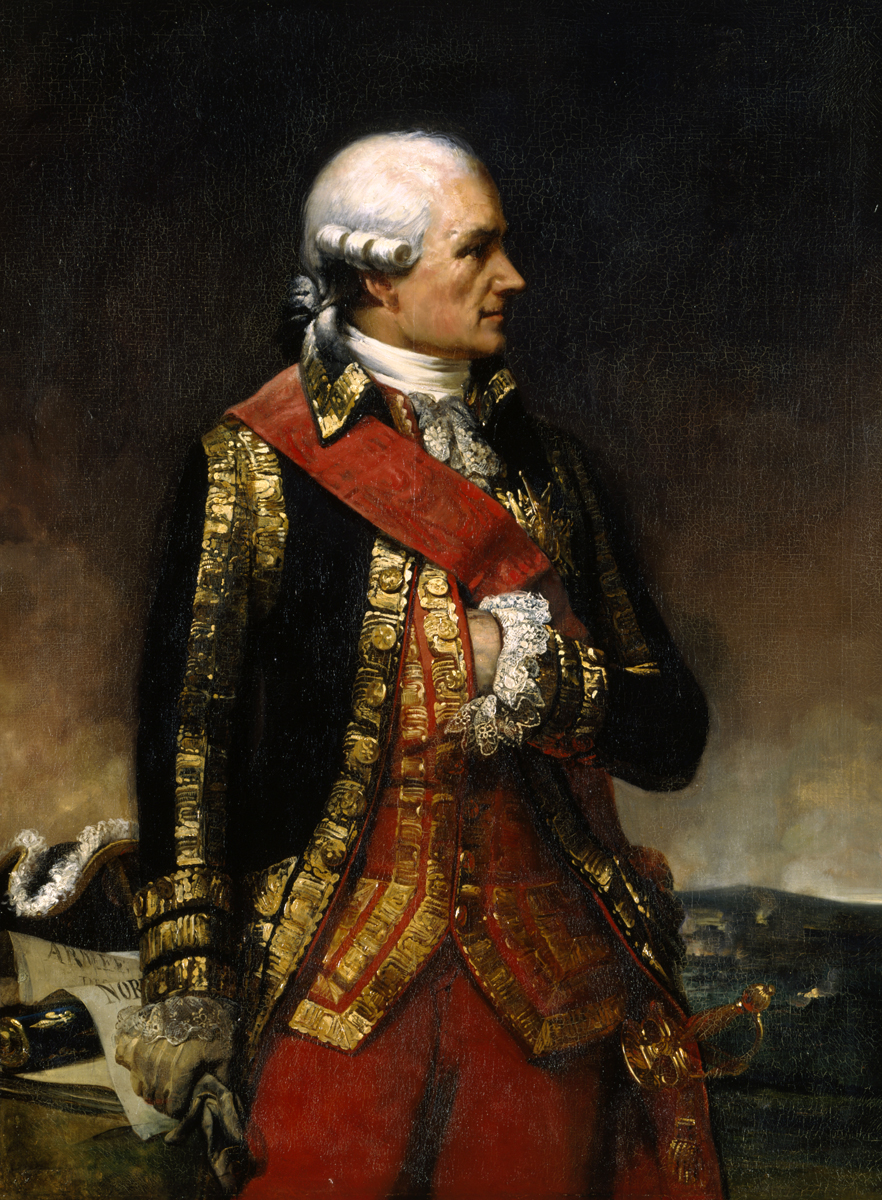
Jean Baptiste Charles Henri Hector, Comte d’Estaing
Amiral de France
| |
|
By way of introduction:
Tourists lining up for a river cruise and reading the "interpretative marker" we described above may ask themselves: who was Count Charles-Henri d'Estaing, and where did he come from? Let us therefore introduce this intrepid, if unlucky, half-forgotten military commander who shed his blood for the independence of the United States.
• Jean Baptiste Charles Henri Hector, Comte d'Estaing (24 November 1729 in Ravel – guillotined in Paris, 28 April 1794), was a French military officer and author. He is often a mere name mentioned in passing in a few plaques, markers, and American history books. However, as we will see, he was an exceptional figure.
• Born into a prominent aristocratic family in the château of Ravel, Auvergne, near Clermont-Ferrand, he joined the musketeers at age 9 and later became a lieutenant in the Regiment of Rouergue at 17. He fought valiantly in many battles, was injured in the war of Austrian Succession during the siege of Maastricht in the Netherlands, and rose to the rank of Colonel.
• During the Seven Years War, he wished to join Montcalm's forces in North America but was persuaded against it by his family.
Instead, he fought in India, where he achieved several victories against the British. He was briefly captured after being wounded but was released on parole. Upon returning to France, d'Estaing was promoted to maréchal de camp, equivalent to Brigadier General, in recognition of his service in the East Indies.
• In 1762 King Louis XV agreed to a transition from the Army to the Navy, and d'Estaing became a Chef d'Escadre (rear Admiral). He became governor of the colony of Saint Domingue from 1762 until 1766.
His role in the early phase of the American War of Independence:
• When France officially decided to support the Insurgents and declared war to Great Britain in 1778, d'Estaing (who had been promoted to Vice-Admiral in 1777) was chosen as the first commander to enter into action. D'Estaing left Toulon on April 13 with a fleet of twelve ships and four frigates. As soon as he arrived in America, he blockaded Lord Howe's smaller British fleet at Sandy Hook, New Jersey, from July 11 to July 22. However, overly cautious, he could not enter New York harbor because his largest ships could not pass the bar at its entrance without local pilots.
• Working with American generals, D'Estaing turned to Newport, Rhode Island, which he planned to attack, forcing the British to scuttle some of their warships in the harbor. However, before the attack could happen, he went out to confront Admiral Howe's fleet. A sudden storm hit, causing the two fleets to break apart before they could fight. Many of his ships were damaged, so he had to go to Boston for repairs, leading to much acrimony among the two allies. He then set sail for the West Indies on November 4.
• He reached the West Indies in December 1778, just after the British started their campaign to take St. Lucia. He attempted to help defend the island but was unsuccessful in both land and sea battles.
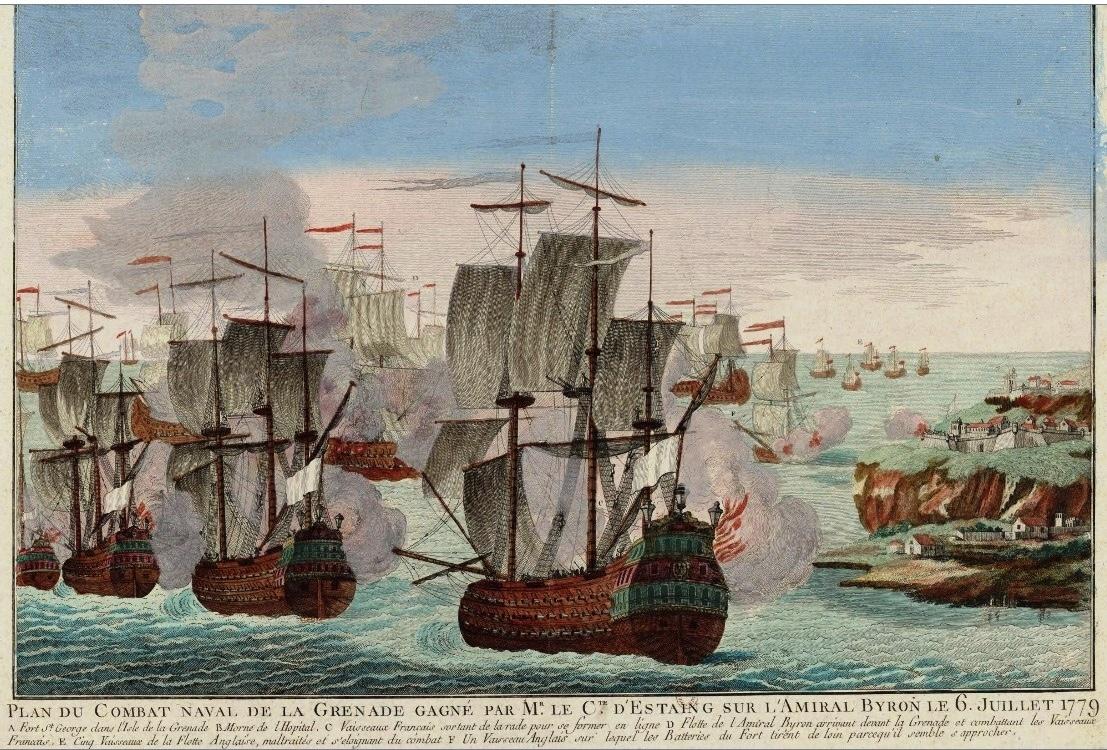
• In June 1779, after receiving ten additional ships led by Comte de Grasse, he sent troops to capture St. Vincent on June 18, then set sail with his full fleet to take Barbados. However, due to strong westerly trade winds, he redirected his efforts to Grenada. He arrived at the island on July 2, and his forces stormed it two days later.
• In August, d'Estaing headed to Savannah, Georgia, to ally with American forces aiming to retake the city from British control. He was alerted by a young
French agent in Charleston, Lt. Col. Charles-François Sévelinges, self-styled marquis de Brétigny, who relayed the message from the Continentals to hurry and help. As we will see in the next pages, the siege was a combined effort by French and American forces to reclaim Savannah from September 16 to October 18, 1779 under the overall command of Continental Army General Lincoln. After several days of unsuccessful shelling, a significant attack on October 9, 1779 against the British defenses did not succeed. During this attack, d'Estaing was injured twice. Following the failure of the assault, d'Estaing ended the siege. The British continued to hold coastal Georgia until they retreated towards the end of the war.
• D'Estaing came back to France in 1780 using crutches. He lost favor at the court and faced harsh criticism from his subordinates. Navy officers never fully accepted him because he was from the Army, not the Navy. While he displayed bravery on land, he tended to be hesitant and overly cautious at sea. He struggled to delegate tasks to capable Navy officers, and was often irrascible. There were many arguments between him and the American leaders because of poor communications and egos. This was an issue that Rochambeau addressed adroitly and promptly resolved when he arrived in America in 1780.
D'Estaing Legacy in the United States:
| |
|
Still, his bravery and gallantry was recognized by all, from George Washington to general Lincoln, and he deserves more recognition for his role during the War of Independence. To our knowledge, there is no US Post office stamp issued in his memory, nor in France. However, for a reason that we haven't elucidated, the Republic of Madagascar issued a stamp in his honor upon the occasion of the Bicentennial of the United States.
• Besides his name being mentioned on the battlefield of Savannah (see below), there are no monuments or bronze plaques in his honor in America. The only tangible sign of recognition for his services occurred on September 28, 1784, when Governor John Houstoun of Georgia granted four 5000-acre tracts of vacant land in Franklin County, Georgia to d'Estaing and his heirs.
• He was the first president of the Society of Cincinnati of France, an order created by George Washington and exclusively reserved to the American and French Officers who fought side by side during the American Revolution.
• French president Valéry Giscard d'Estaing (1974-1981) was very remotely linked to the admiral and not a direct descendant.
• Although initially sympathetic to the French Revolution (he was promoted to the dignity of Amiral de France in 1792), his aristocratic lineage and proximity to the Royal family led him to the guillotine in 1794 during the Terror.
Before his execution, he wrote: "After my head falls off, send it to the English, they will pay a good deal for it!"
| |
|
The Siege of Savannah
September 16 - October 18, 1779
| |
|
Timeline
The Battle of Savannah in Georgia took place from September 16 to October 18, 1779, and was the second bloodiest confrontation in the American Revolutionary War. At that time, British forces had held Savannah, the capital of Georgia, for a year. Savannah was defended by 3,346 troops led by (Swiss-born Augustin) naturalized British General Augustine Prévost. They faced a challenge from 650 Continental troops and 750 militia soldiers under General Benjamin Lincoln, who were backed by 3,524 French soldiers led by Count d’Estaing, which included 750 colored troops from Saint-Domingue and other French Caribbean territories.
• On September 4, the French fleet began to arrive off that coast. On September 11, Continental Army general Benjamin Lincoln departed from Charleston with his own troops, aiming to join forces with d’Estaing.
• Upon arrival, three detachments of the French Army joined Major General Benjamin Lincoln, setting up separate camps along the Savannah River. A significant number of French soldiers, along with 545 Chasseurs, landed on Tybee Island to lay siege to the British outpost there.
Several tactical blunders mired the operation from the onset:
• British reinforcements from Charleston led by Col. John Maitland were not intercepted by general Clinton's forces due to miscommunications with the French.
• D'Estaing's unconcerted ultimatum to general Prevost "to surrender to His Majesty's forces" incensed Lincoln and created a mini diplomatic storm.
• D'Estaing's naïve acceptance of Prévost's request for time to ponder the surrender's proposal allowed the buildup of strong earthworks defenses by British engineer Maj. James Moncrief with the help of Black labor from Savannah. Most military historians believe that Savannah could have been captured swiftly if D'Estaing had attacked right away upon landing.
• From the onset, the French inflicted considerable damage on the British fleet, capturing the warship Experiment with its 50 guns, the frigate Ariel, and two supply ships carrying payroll for the Savannah garrison. They also captured Brigadier General George Garth, who was supposed to take command of the British forces in Georgia upon his arrival.
• On land, the Chasseurs Volontaires de Saint Domingue were used as scouts and surveyed the British fortifications on September 8. A few days later, on the night of September 11, they began unloading cannons and mortars about five miles from the siege site during a heavy rainstorm. The rest of the French troops landed at Beaulieu on the Vernon River that night, bringing more artillery that needed to be transported fifteen miles to their positions.
• Meanwhile, the British continued to strengthen their defenses on the mainland, sinking six of their ships in Savannah harbor to block the French fleet from approaching and bombarding the city.
• The French bombarded Savannah for five straight days, hoping to weaken British defenses, but to no avail.
• As we saw, with a significant increase in forces, Prevost refused to surrender.
American deserters, black slaves fugitives acting as spies, a population largely made of loyalists, and the indiscretions of the American press in Charleston kept him very well informed on the whereabouts of the allied forces.
• In the morning of September 17, Prevost launched a sortie of about 200 regulars to attack the French battery near the barracks. The British were driven back into their own defenses, suffering 53 fatalities, including their commander, Colonel William Campbell, and two other officers. An additional 100 British regulars were wounded. The French also faced losses, with 26 men killed and 84 wounded, including ten officers, mainly due to British cannon fire during the counterattack on the redoubts.
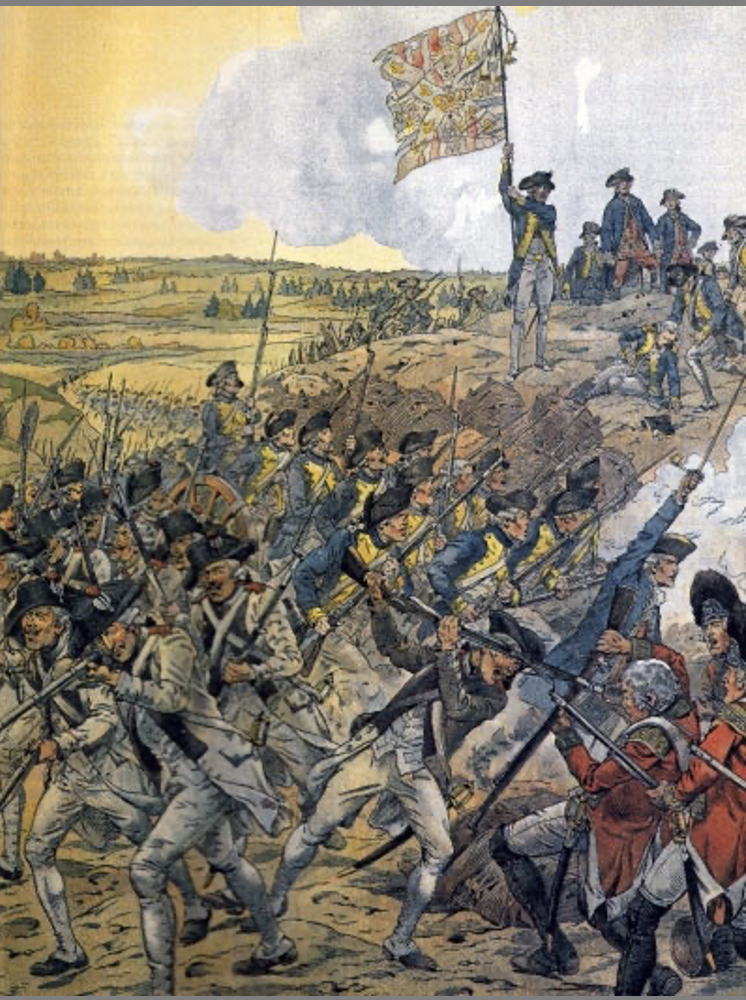
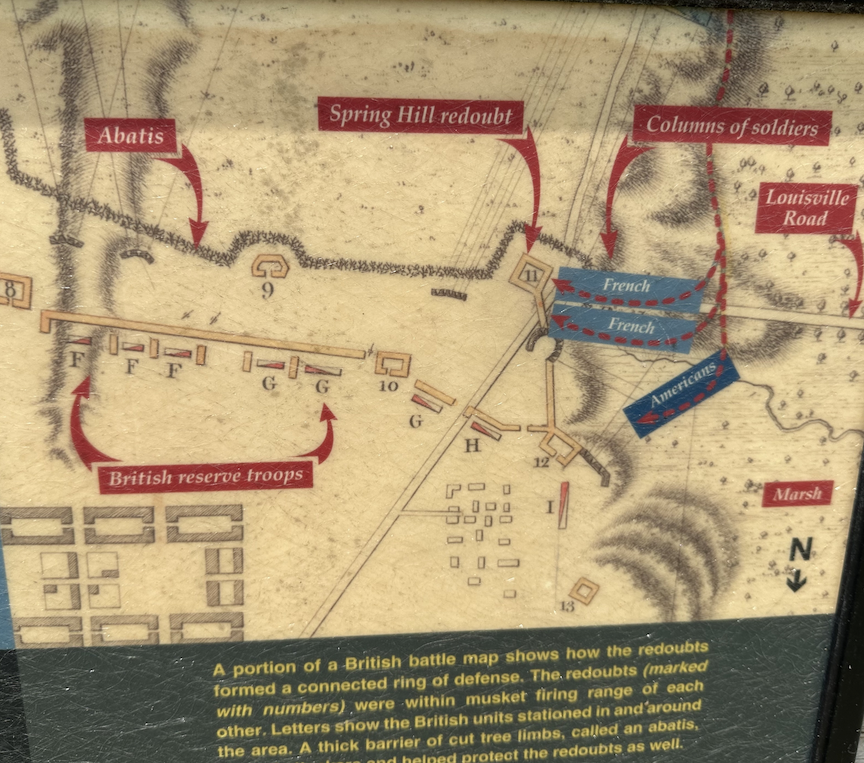
• On the morning of October 9, the Franco-American Allies launched a significant attack. Fog covered the battlefield, making it hard for troops to move forward. Many soldiers got lost in the swamps near the Spring Hill Redoubt, which was their target. D’Estaing chose this location thinking it was weakly defended by local Loyalist militia. However, the Loyalists were supported by experienced British Regulars. When the fog cleared, the French forces were vulnerable and faced heavy fire from the defenders of the redoubt. It was later discovered that the British had prior knowledge of the attack plan due to information leaked by loyalists and deserters.
• Casualties mounted rapidly. Always intrepid, d’Estaing was wounded twice while leading the charge. The Polish cavalry leader, Casimir Pulaski, was mortally wounded during the assault as he tried to guide his cavalry through a gap in the British lines.
In all, the Allies lost about 1,000 men in the attack on the Spring Hill Redoubt, while the British had only 150 casualties.
• After an hour of pushing his troops ahead, d’Estaing, himself badly wounded, decided to stop the attack, realizing it was pointless. A week later, the French commander left, leaving Lincoln behind and putting a strain on the Franco-American Alliance.
• On October 18, Lincoln ended the siege. Savannah would stay under British control until the war was over.
| |
|
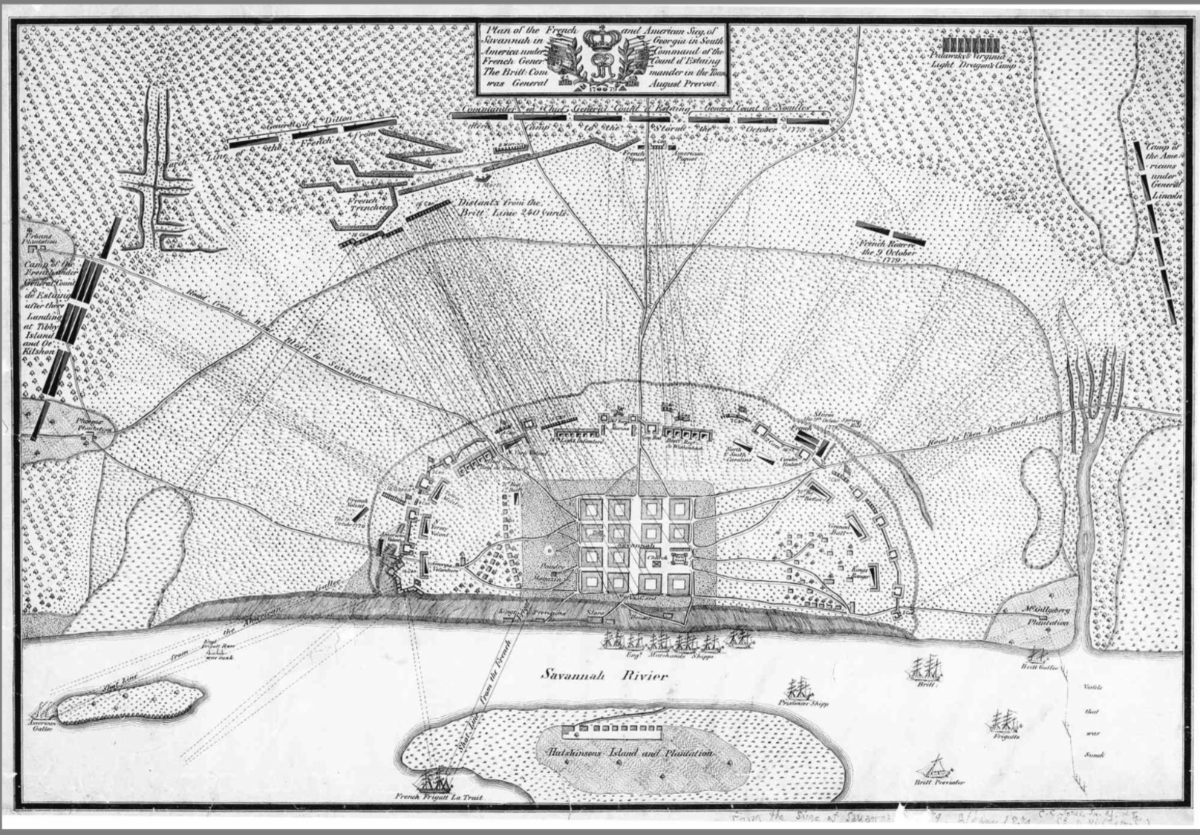
Above:
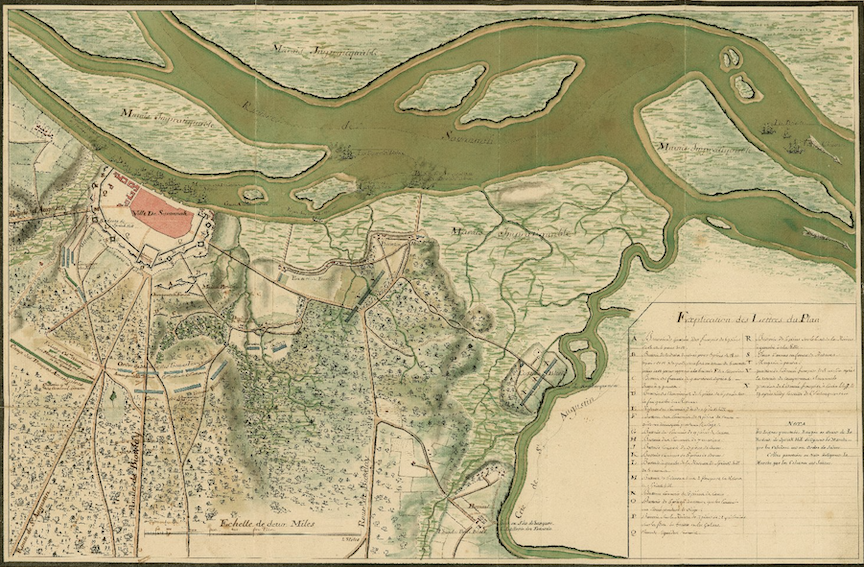
Top: "Journal du siege de Savannah septembre, et Octobre 1779. : Avec des observations de Mr. le C[om]te d'Estaing" [Plan of the Siege of Savannah, 1779] by Antoine François Térence O'Connor, (1750-1781), cartographer of Amiral d'Estaing, John Carter Brown Library
https://www.americanrevolutioninstitute.org/treasures-of-the-american-revolution/revolutionary-war-maps/
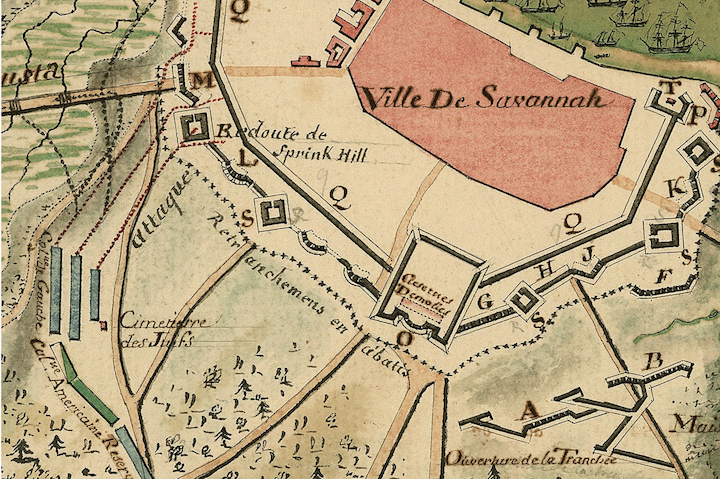
Below: Close-up showing Redoubt Spring Hill. This detailed manuscript map, created by Antoine O’Connor, the chief engineer for Admiral d’Estaing, features beautiful watercolors and was made soon after the Siege of Savannah by French and American forces. The French set up siege works (shown at the lower right) to bombard the town but later changed their strategy to a direct attack on the Spring Hill Redoubt (located at the upper left) on October 9. During this assault, d’Estaing was injured, and Casimir Pulaski, who led the American cavalry, lost his life. Almost one thousand soldiers from both the French and American sides were either killed, injured, or captured. The allies eventually withdrew, allowing the British to maintain control over Savannah.
| |
|
It was the first modern amphibious joint-operation between two armies, unfortunately plagued with many problems due a series of miscommunications and poor decisions.
As always in our Bulletins, we rely in good part on the inscriptions of the different markers and plaques to complete the story:
| |
|
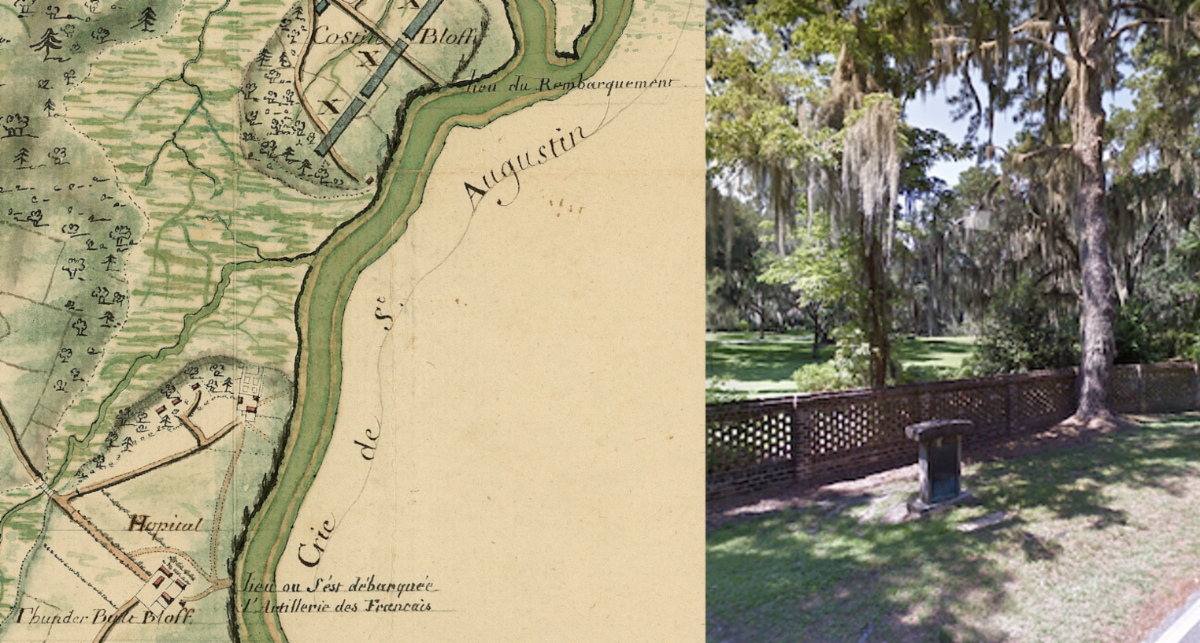
Above:
Top: map of the siege By Jones - Archives américaines, Université de Géorgie., Public Domain, https://commons.wikimedia.org/w/index.php?curid=11296924
Bottom: Close-up of the map of Antoine O'Connor, cartographer of Admiral d'Estaing, showing the place of troops landing ("lieu où s'est débarqué l'Artillerie des Français") and the site of troops embarkation ("Lieu du rembarquement"). Photo of marker "Beaulieu Plantation", TC © ASSFI 2023
Marker, “Beaulieu Plantation”
478 Beaulieu Avenue, Savannah, GA 31406
GPS: 31.934400, -81.111983
• Inscription:
“Here in 1779 under
Count d'Estaing the
French landed to join
the Americans under
General Lincoln in
the Siege Of Savannah
W.P.A. 1936. D.A.R. S.R.”
| |
|
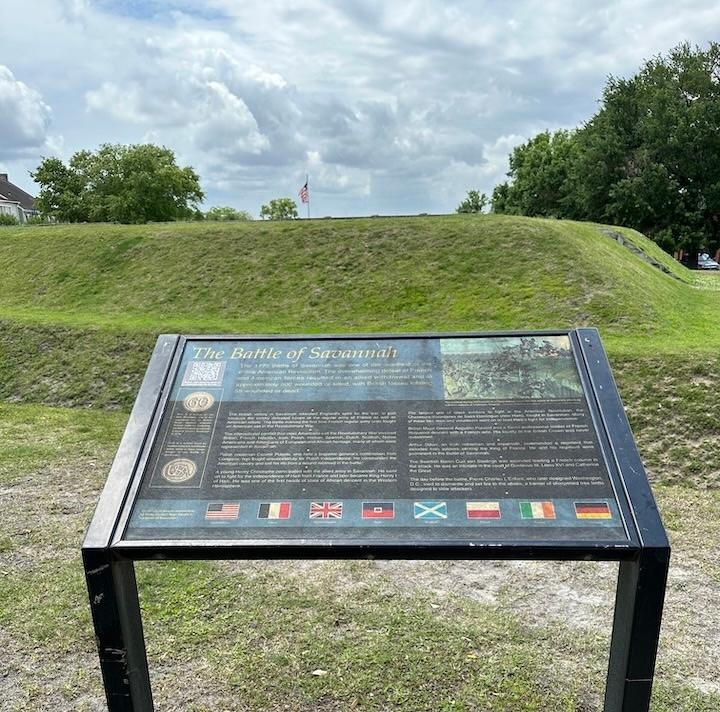
Above: Interpretative marker ,“The Battle of Savannah”
Battlefield Park, W Harris St, Savannah, GA 31401
GPS: 32.075583, -81.099317
Photos: TC © ASSFI 2023
• Inscription (excerpts):
“The 1779 Battle of Savannah was one of the deadliest of the entire American Revolution. The overwhelming defeat of French and American forces resulted in an allied withdrawal and in approximately 800 wounded or killed, with British losses totaling 55 wounded or dead.”....
The international conflict that most Americans call the Revolutionary War involved British, French, Hessian, Irish, Polish, Haitian, Spanish, Dutch, Scottish, Native Americans and Americans of European and African heritage,many of whom were represented in Savannah...
Polish nobleman Casimir Pulaski, who held a brigadier general's commission from Congress, had fought unsuccessfully for Polish independence. He commanded the American cavalry and lost his life from a wound he received in the battle...
A young Henry Christophe participated with the allied army in Savannah. He went on to fight for the independence of Haiti from France and later became King Henry I of Haiti. He was one of the first heads of state of African descent in the Western Hemisphere..
“The largest unit of black soldiers to fight in the American Revolution, the Chasseurs- Volontaires de Saint-Domingue (now Haiti), fought in Savannah. Many of these free men and volunteers went on to lead Haiti's fight for independence.”...
British Major General Augustin Prevost was a Swiss professional soldier of French Huguenot descent with a French wife. His loyalty to the British Crown was never questioned.”...
Arthur Dillon, an Irish nobleman and expatriate, commanded a regiment that included Irish soldiers serving the King of France. He and his regiment were prominent in the Battle of Savannah.
The Swedish Baron Curt von Stedingk was wounded leading a French column in the attack. He was intimate in the court of Gustavus III, Louis XVI and Catherine the Great.
”The day before the battle, Pierre Charles L'Enfant, who later designed Washington, D.C., tried to dismantle and set fire to the abatis, a barrier of sharpened tree limbs designed to slow down the attackers”.
[ Flags: United States, France, United Kingdom, Haiti, Scotland, Poland, Ireland, Germany ]
Erected 2008 by the City of Savannah, Sons of the Revolution in the State of Georgia."
| |
|
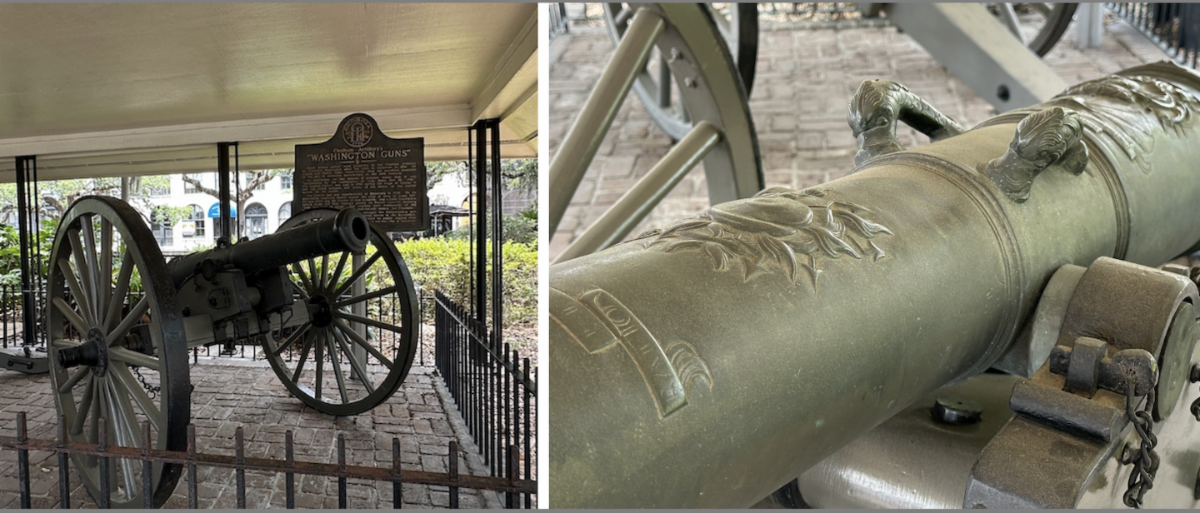
Above: Marker “Chatham Artillery’s - "Washington Guns"
42 E Upper Factors Walk, Savannah, GA 31401
GPS: 32.080933, -81.090450
Photos: TC © ASSFI 2023
• This marker mentions a French cannon offered by George Washington. It may have been a piece of artillery left behind by d'Estaing.
• Inscription (excerpts):
“These bronze cannon were presented to the Chatham Artillery by President Washington after his visit to Savannah in 1791. Of English and French make, respectively, they are excellent examples of the art of ordnance manufacture in the 18th century. [...] The French gun was manufactured at Strasburg in 1756. On its elaborately engraved barrel appear the coat of arms of Louis XIV, the sun which was the emblem of that monarch, and a Latin inscription (which Louis XIV first ordered placed on French cannon) meaning “Last Argument of Kings.” The dolphins were emblematic of the Dauphin of France. The gun was individually named “La Populaire””.
Reminders of America’s hard-won struggle for independence and of the great man who led the Continental forces in the Revolution, the historic “Washington Guns” were placed on public display here through co-operation of the Chatham Artillery and the City of Savannah."
• "D'Estaing orders the Truite, Chimère, and Bricole1 to proceed up the Savannah River as close to the city as possible"...
There is a marker mentioning the bombardment of Savannah by the French fleet, which was positionned on the back river, just behind the Savannah river.
Marker “Old harbor light”
Emmet Park, between Hudson and East Broad Street, Savannah, GA 31401
GPS: 32.079400, -81.084500
• Inscription (excerpts):
"This beacon light was erected by the Federal government in 1858 as an aid to navigation of the Savannah River.
Standing 77 feet above the river level and illuminated by gas, it served for several years as a guide to vessels passing over the hulls of ships that the British scuttled in 1779 to close the harbor to the French naval forces. During the Siege of Savannah that year by the French and Americans, the warship Truite, commanded by the Count de Chastenet de Puysegur, shelled this area of Savannah from her anchorage in Back River opposite this point..."
Note: 1. The French fifth-rate flûte La Bricole, launched in Le Havre in 1764, was ceded to the South Carolina State Navy in 1780 and took the name Bricole. she was sunk in front of Charleston, S.C. to impede the entry of British naval vessels. La Truite, launched in Le Havre in1777, was also ceded to the South Carolina State Navy in 1780 and sunk in the Copper River to prevent a British squadron from sailing up the river. The fifth-rate frigate La Chimère was launched in Toulon in 1757 and sold in 1783 after being loaned as a merchantman.
| |
|
Above:
Memorial, “Spring Hill redoubt”
Battlefield Park, 655 Louisville Rd, Savannah, GA 31401
GPS: 32.076067, -81.100583
Photo by TC © ASSFI 2023
• Inscription:
** Upon this spot stood the Spring Hill Redoubt.**
“Here on October 9, 1779 one of the bloodiest engagements of the Revolution was fought when repeated assaults were made by the allied troops of Georgia, South Carolina and France in an effort to retake Savannah from the British.”
Interpretative marker “Attack on British Lines – Oct 9, 1779”
Savannah Visitors Center, Parking Lot
301 Martin Luther King Jr Boulevard, Savannah GA 31401
GPS: 32.076283, -81.099550
• Inscription:
“Over this ground, hallowed by the valor and the sacrifice of the soldiery of America and of France, was fought October 9, 1779, one of the bloodiest battles of the Revolution when Savannah, which the British had possessed for several months, was attacked by the combined American and French forces.
A short distance west of this marker stood the famous Spring Hill Redoubt and along here ran the line of entrenchments built by the British around Savannah. After a three weeks siege, the Allies stormed the enemy works in this area early on October 9th.
Arrayed in the opposing armies that day were soldiers of many lands -- American Continentals, Grenadiers of Old France, Irishmen in the service of King Louis XVI, Polish Lancers, French Creoles, and Negro volunteers from Haiti, fighting for American Independence against English Redcoats, Scotch Highlanders, Hessians, Royalist provincials from New York, Tory militia, armed slaves, and Cherokee Indians. After an heroic effort to dislodge the British the Allies retired with heavy losses. Thus the siege was lifted, and the French fleet sailed from Georgia, ending a far-reaching significance in the American Revolution.”
Erected 1952 by Georgia Historical Commission. (Marker Number 025-10.)
| |
|
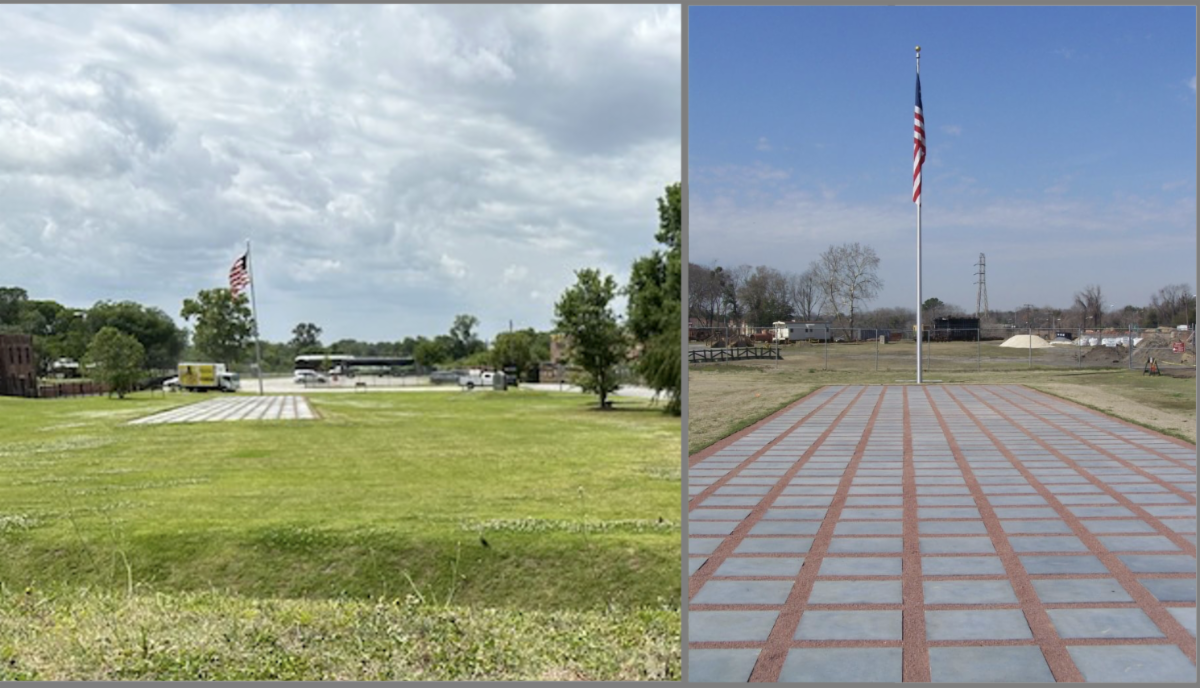
Above: 800 Pavers memorializing the battlefield
Left: photo by TC © ASSFI 2023
Right: photo by Mike Stroud, February 16, 2008, https://www.hmdb.org/m.asp?m=17362
In 2003, Savannah took ownership of the battlefield. The idea for Battlefield Park began when archaeologists from the Coastal Heritage Society found traces of the original Spring Hill Redoubt in August 2005. With support from private donations and the City of Savannah, Battlefield Park was turned into a memorial. Today, a monument that is more than a century old overlooks the remains of the redoubt, and a new earthen fortification allows visitors to imagine what the redoubt used to be like.
Interpretative marker, “To Arms”
Savannah Visitors Center, Parking Lot
315 Martin Luther King Jr Boulevard, Savannah GA 31401
GPS: 32.075800, -81.100800
• Inscription:
“The 800 stones before you have three meanings:
*They represent the approximate number of soldiers killed or wounded in Savannah on the foggy morning of October 9, 1779.
*The stones are arranged as a column, with ten soldiers across. The French and American allies formed five such columns of men to attack the fortified British.
* Inscribed on the stones are names and stories of people throughout the entire Revolutionary struggle from all the states, countries and cultures involved.
To your left stands a granite marker identifying the location of the Spring Hill redoubt, one of 14 British earth fortifications surrounding Savannah in 1779. It was here that the thousands in the French and other allied American columns tried to smash through the hundreds of British and loyalists defending this area. The allied columns were meant to attack simultaneously, in overwhelming force. Due to poor communications, they arrived separately, disoriented and tired from hours of marching in the dark woods. With volunteers leading each column up the foggy slops, the soldiers attacked with fixed bayonets. As the columns advanced, artillery and small arms crossfire killed and maimed commanders and private soldiers alike. The redoubt became a scene of hand-to-hand combat with swords and bayonets clashing.
Families from Virginia to the Carolinas, from Poland to Scotland, from France to Haiti, from Germany to England would mourn the loss and suffering of loved ones who spilled their blood on the ground surrounding the Spring Hill redoubt.”
| |
|
Above:
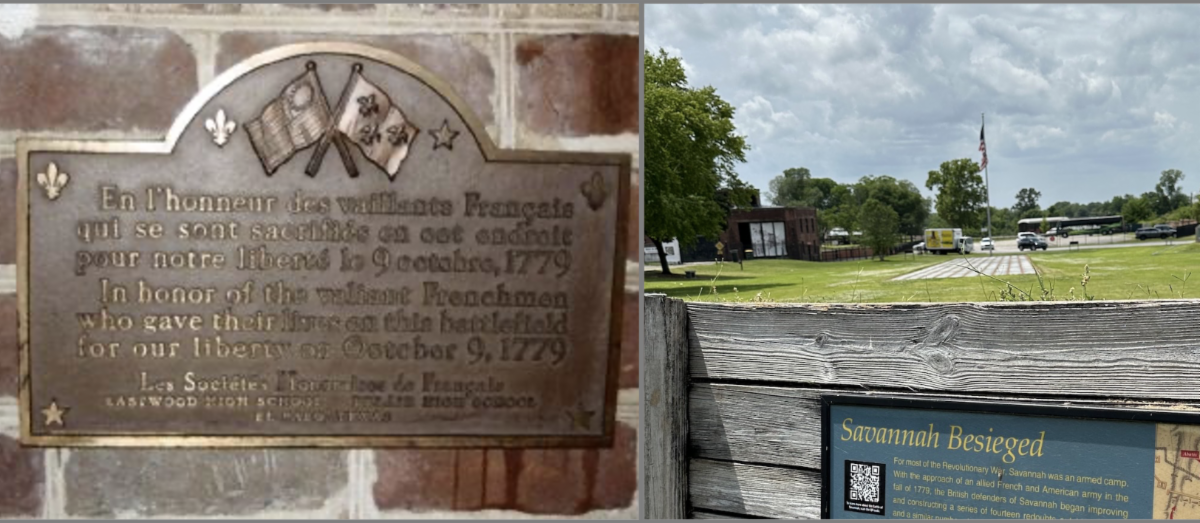
Right: photo by TC © ASSFI 2023
Left: photo by Mike Stroud, April 10, 2009, https://www.hmdb.org/m.asp?m=18455
Plaque, “Battle of Savannah”
Savannah’s Visitors Center,
301 Martin Luther King Jr Blvd, Savannah, GA 31401
GPS: 32.076217, -81.099500
• Inscription (bilingual):
“En l'honneur des vaillants Français
qui se sont sacrifiés en cet endroit
pour notre liberté le 9 Octobre, 1779
In honor of the valiant Frenchmen
who gave their lives on this battlefield
for our freedom on 9 October, 1779
Erected by Les Sociétés Honoraires de Français, Eastwood High School, Belair High School, El Paso, Texas.”
| |
French Regiments at Savannah | |
|
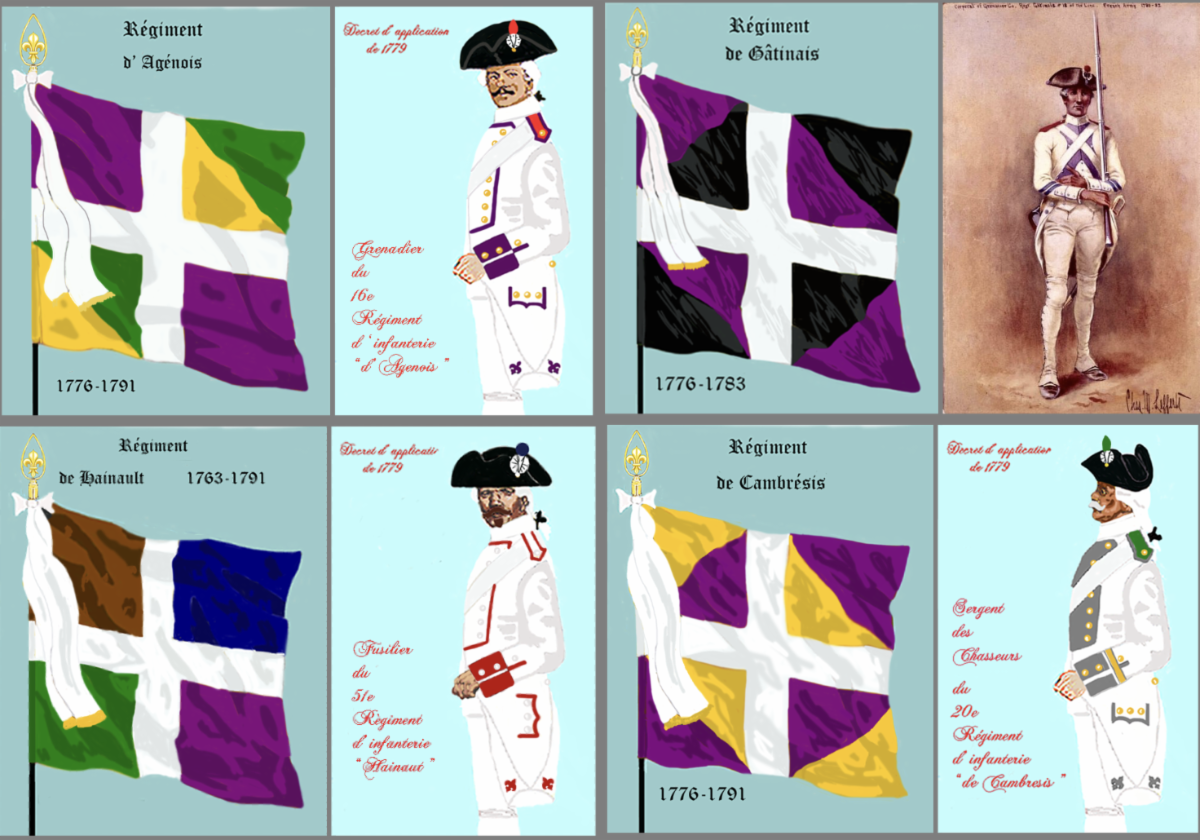
Above:
From Left to right, Top to Bottom:
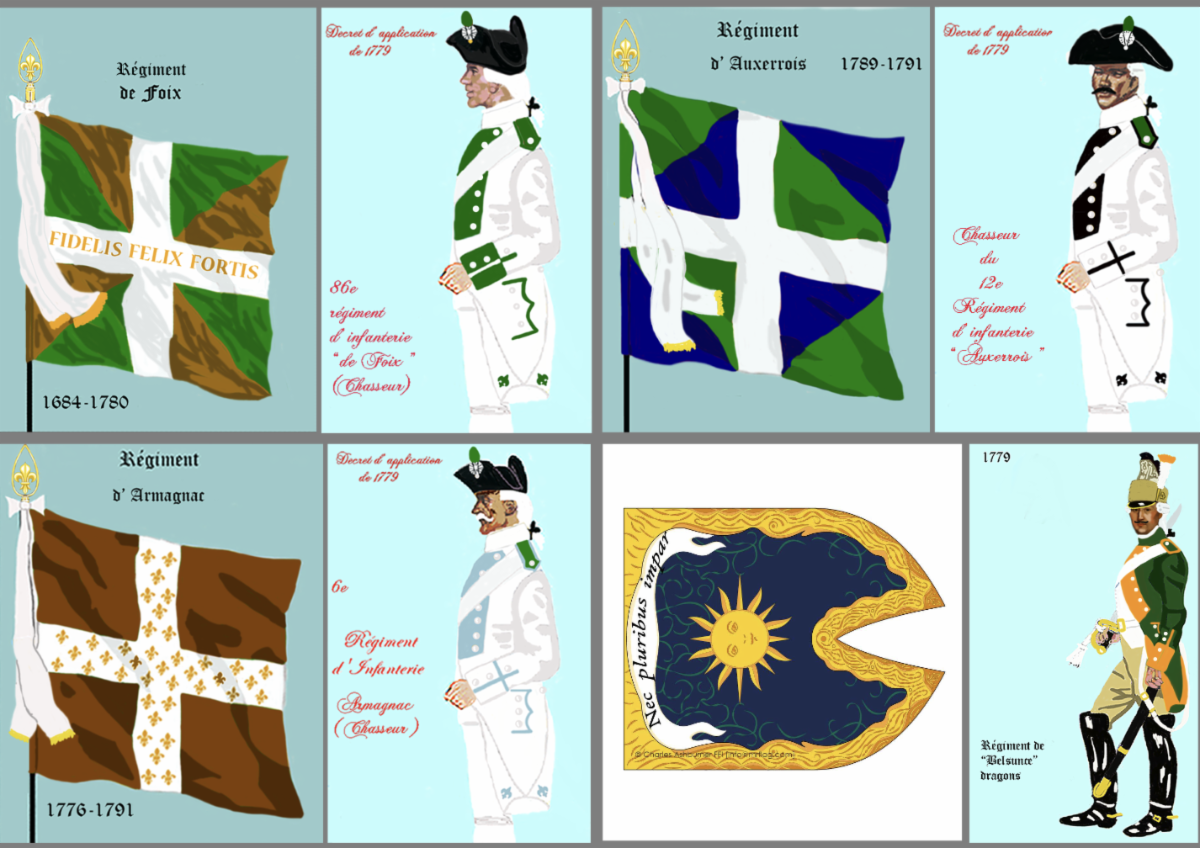
Régiment d'Agenois, Régiment de Gâtinais, Régiment de Hainault, Régiment de Cambresis, Régiment de Foix, Régiment d'Auxerrois, Régiment d'Armagnac, Régiment de Dragons Besunce, Ordonnance flags and regimental colors by Centenier - Own work, Public Domain, via Wikimedia,
Uniforms by Steinbeisser - Own work, Public domain, via Wikimedia (the Gâtinais uniform is by Charles M. Lefferts, Public Domain, also Wikimedia, and the "guidon" of the Dragons is from http://theminiaturespage.com/boards/msg.mv?id=197775
| |
|
Colonial & Foreign Regiments
of the French Royal Army at Savannah
| |
|
Above:
Left to Right, Top to bottom:
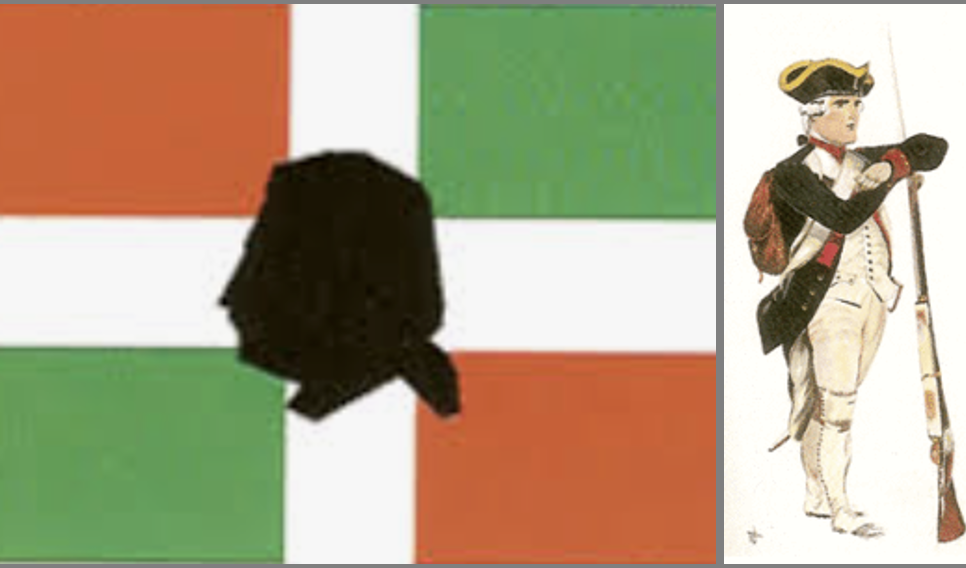
• Flag and Grenadier from the Régiment of Port-au-Prince, 1777 (today's 110e R.I.)
https://anori.fr/les-traditions/infanterie/linfanterie-et-son-histoire/110e-ri-regiment-de-port-au-prince/
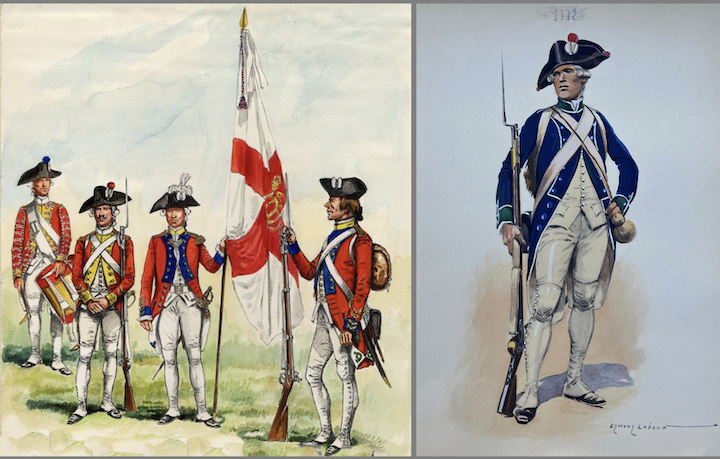
• Irish Regiments in the French army: Dillon and Walsh, during the Siege of Savannah https://www.britishbattles.com/war-of-the-revolution-1775-to-1783/siege-of-savannah/
• Soldier from the Régiment du Cap, (today's 106e R.I.) Les amis du musée des Troupes de marine Association des Amis du Musée des Troupes de Marine
https://www.facebook.com/photo.php?fbid=932660465673962&id=100067900508835&set=a.424111963195484
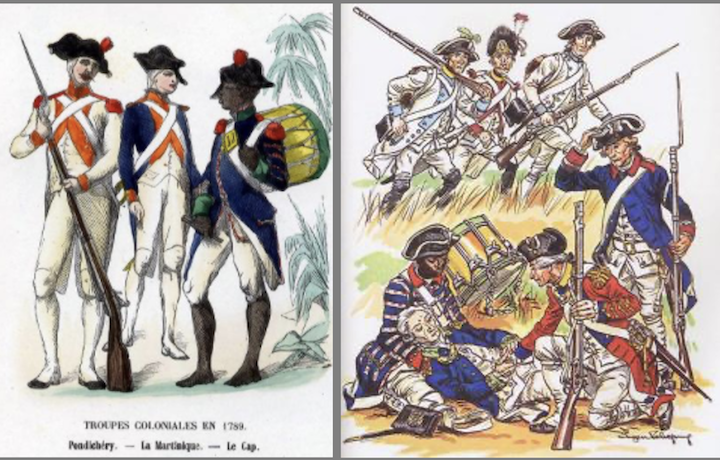
• Colonial Troops, Régiments de Pondichéry, de Martinique, du Cap,
https://military-history.fandom.com/wiki/R%C3%A9giment_du_Cap
• Soldiers from French Regiments at the Siege of Savannah: Armagnac, Hainault, Champagne,
du Cap, Walsh and Guadeloupe: https://www.britishbattles.com/war-of-the-revolution-1775-to-1783/siege-of-savannah/
• John Adams reviews John Paul Jones' marines from the Walsh Regiment 13 May 1779, By Charles Waterhouse - Pritzker Military. Jan. 8, 2023, Public Domain, https://commons.wikimedia.org/w/index.php?curid=127561867
| |
|
The Regiments:
Several corps participated in the battle in the expedition that departed from Cap-Français on August 15, 1779. Viscount François de Fontanges, a landowner from Gonaïves, served as Chief of Staff to the Comte d'Estaing.
It was a composite expedition, made of several parts from different regiments. For instance, only the 1st battalion of the Hainault Regiment was embarked by d'Estaing.
Another example, only a part of the Régiment d'Agénois was embarked by d'Estaing for the Savannah expedition, while the entire regiment later took part at the siege of Yorktown. Likewise for the régiment du Gâtinais. This wide "hodgepodge" of units who never trained together did not facilitate successful executions of orders on the battlefield, nor the coordination with approximately 1,000 Continental troops and 1,100 militia.
The French forces came from detachments from several regiments :
Armagnac: 338, Champagne: 95, Auxerrois: 216, Agenois: 97, Gatinais: 99
Cambresis: 188, Hainault: 360, Foix: 292, Dillon: 373, Walsh: 27, Le Cap: 102
(named after Cap-Français, today Cap-Haïtien, and not Cape Town as often incorrectly reported on several websites), Guadeloupe: 172, Martinique: 87
Port Au Prince: 156, Dragoons: 49, Marines: 359, Artillery: 151
Grenadier volunteers of Saint Domingue: 156
Chasseurs Volontaires de Saint Domingue: (mulatto and blacks) 545
The source of the French strength is taken from a document in the Archives Nationales (Marine), B4 167, page 247
Another classification:
- 1,030 chasseurs-Volontaires from Saint-Domingue (all colored regiment)
- 200 men from the newly formed Grenadiers Volontaires of Saint-Domingue, a unit separate from the Chasseurs.
- 700 men from Martinique
- 850 men from Guadeloupe
- 600 men from the Foix and Hainaut regiments
- 300 men from the Agenais, Gâtinais, and Cambresis regiments stationed in Saint Domingue, as well as detachments from the Auxerrois infantry Regiment.
- 300 men from the Régiment du Cap and the Regiment of Port-au-Prince.
• Régiment du Gâtinais (ex and future Royal Auvergne, who covered itself with glory in taking Redoubt #9 at Yorktown) wrote a particularly glorious chapter of the ill-fated attack of the Spring Hill Redoubt. We quote a very detailed account found on the website of the 11th Pennsylvania Regiment, Inc.:
" The second battalion, which was at la Martinique since November 20, 1775, went to Saint-Domingo in 1777. The fourth battalion, which was at Calais in June, 1776, left at the end of that year for Bordeaux, and there embarked the 25th September, 1777, to rejoin the second battalion. The regiment remained in garrison at the Cape until 1779. That year it was placed on board of vessels of the fleet of Count d'Estaing, and the 15th September to 20th October was at the siege of Savannah. The companies of chasseurs covered themselves with glory, the 9th of October, at the attack on the retrenchments. The sublieutenant Levert was the first to enter the entrenchments, whose defenders, astonished at such audacity, fled, throwing away their arms. The English, nevertheless, returned more numerous, and the brave Gatinois companies, without support, having lost the half of their number, were obliged to retire. They withdrew in good order, carrying off their dead and wounded, among whom the Viscount de Béthizy, colonel en second, with three wounds, in the left hand, the right arm, and in the stomach; Captain Sireuil, wounded with a biscaïen [musket shot] in the side; Captain de Foucault, knocked down by the concussion from a cannon ball; Lieutenant De Justamont, killed outright; Chevalier de la Roche-Negley, who had received a biscaïen shot in the head and was later 'trepanned'; Chevalier de Tourville, wounded by a ball which passed from the right breast (téton) to the shoulder; sublieutenant Levert had his clothes riddled with bullets."
Note: the same Captain Sureuil was again wounded, even more seriously, at Yorktown during the capture of Redoubt #9 two years later almost day for day, on Oct. 14, 1781.
• As we will see further, there were two Foreign regiments of the French Army at Savannah: the 1st Batalion of the Regiment of Dillon and the 2nd Batailon of the Regiment of Walsh-Serrant, both part of the Irish Brigade which had been at the service of the King of France since 1690.
A detachment of the Regiment of Walsh was assigned as marines to John Paul Jones' ship, the Bonhomme Richard. Lt. Edward Stack, commanded the division in the main top of the Bonhomme Richard during her battle with HMS Serapis. A destroyer of the US Navy was named for him, the USS Stack DD-406. The motto of the regiment motto given by the Count de Provence and future King Louis XVIII, "Semper et Ubique Fidelis" may have influenced the subsequent adoption in 1883 of the motto "Semper Fidelis" by the U.S. Marines".
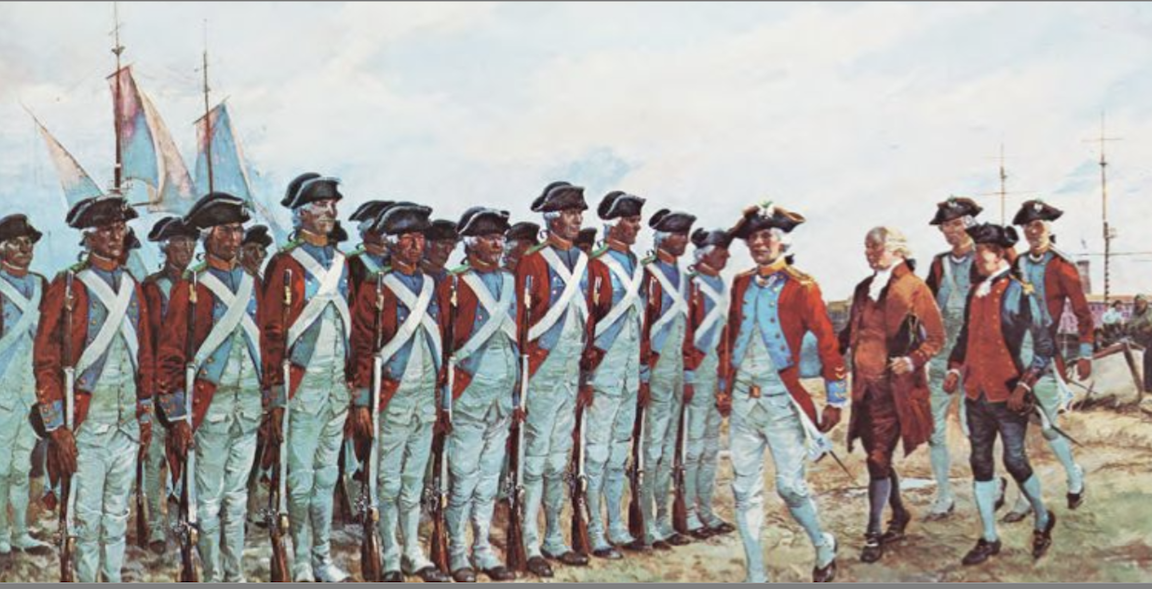
• The illustration above shows a detachment from Régiment de Walsh-Serrant reviewed by John Adams, American Commissioner in 1779, when he arrived to the harbor of Lorient, France on May 13, 1779; he was given a dinner by John Paul Jones and after the dinner he reviewed the ship's marines from the Walsh Regiment. Five months later, drafts from the regiment participated in the Siege of Savannah in 1779. Throughout most of its existence, even in French service, the regiment was issued with red coats with blue facings. Its colors, a Saint George's cross with a central crown surmounted with a crowned lion, reflected its original status as a Guards regiment of the King of England.
• The Belsunce Regiment was a French Dragoons regiment that helped fight in support of the American cause. A detachment of them fought at Savannah in 1779 and at Yorktown with Saint-Simon's division in 1781. The Colonel de dragons, marquis de Belsunce was in Saint Domingue with his regiment in 1776, along with an escadron of Chasseurs de Condé (https://recherche-anom.culture.gouv.fr/ark:/61561/up424tnoqsm/daogrp/0/1)
• D’Estaing’s forces mainly included colonial regiments from places like Guadeloupe, Martinique, and Saint-Domingue. All these troops were "gens de couleurs libres", or free men of color, who chose to join the French colonial army. They were black and mixed-race individuals of African and European descent from Saint-Domingue. They were born free, setting them apart from free slaves or affranchis, who were born into slavery or became enslaved and later gained their freedom.
This difference gave the "gens de couleur" a better social and political standing in the French colonial West Indies. According to the 1685 French Black Code, they had the same rights as the white colonists. However, in reality, they faced significant discrimination from white French colonists, which limited their ability to fully enjoy these rights.
| |
|
The support role of the French Navy:
the first combined allied amphibious operation
| |
|
Above;
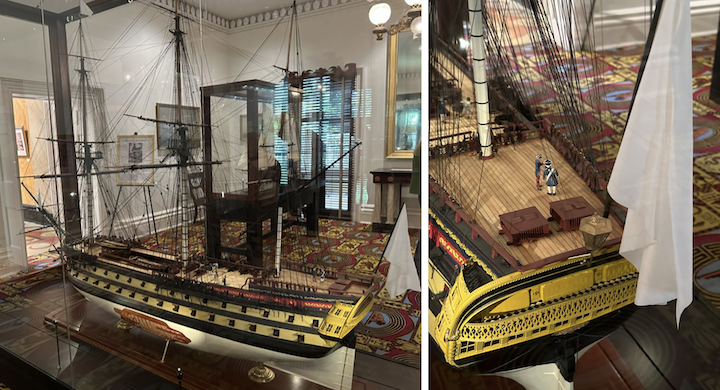
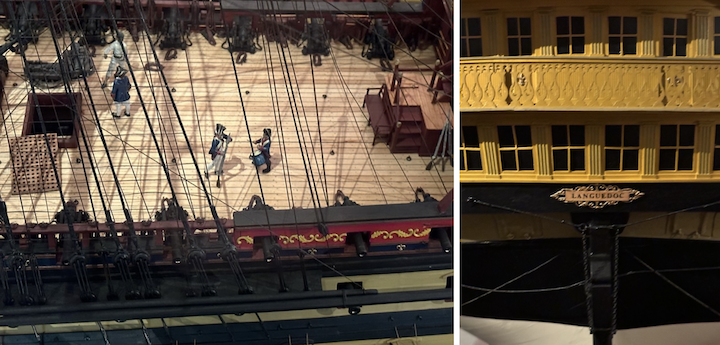
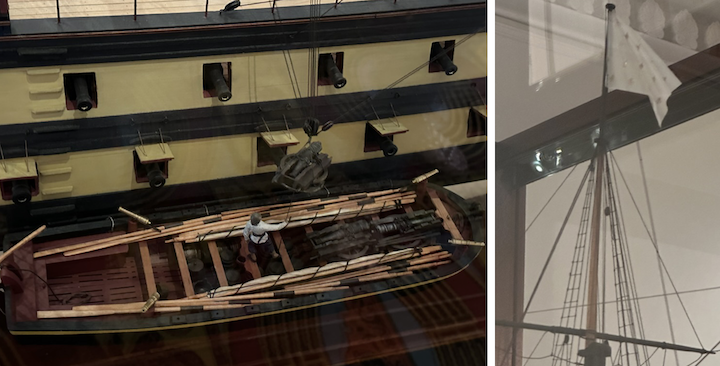
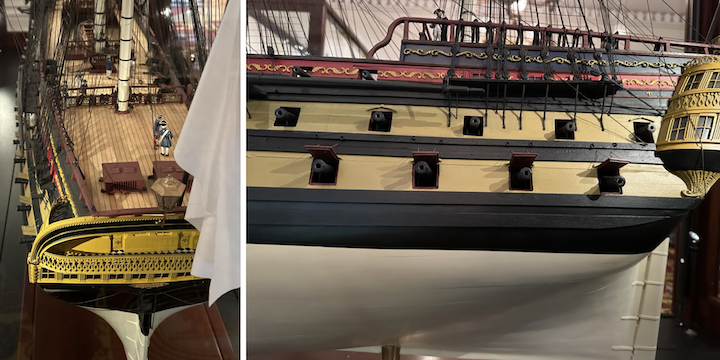
Le Languedoc, model build by William E. Hitchcock, 1992-93, Scale 3/8 inch = 1 foot, on display at the Ships of the Sea Maritime Museum, 41 Martin Luther King Jr Blvd, Savannah, GA.
GPS: 32.0811422, -81.097324
Note the detailed depiction of the unloading of heavy artillery (photo #5).
Photos: TC © ASSFI 2023
• Text of museum label:
"France proved to be a generous ally of the Americans during our Revolution.
The British occupied Savannah during most of the war, but the French attempted once to recapture the city. In September, 1779, twenty-two French warships sailed from the West Indies to the Savannah River. One of these vessels was the magnificent Languedoc, flagship of the French Admiral Charles Henri Comte d'Estaing—184 feet long, 48 feet wide and armed with eighty cannons. The French and Americans surrounded Savannah, then bombed the city for four days, and finally four thousand soldiers attacked. Despite tremendous losses, the siege was a failure, the French and Americans retreated in humiliation, and the British continued to occupy Savannah until the end of the Revolution."
| |
|
This poetic excerpt from Storm over Savannah by Alexander A. Lawrence describes the majestic and powerful sight of 22 ships deployed along the coastline:
"A mighty French armada lay at anchor in the open sea. To the west stood the coast of Georgia, with the low, long shoreline of the Tybees necklaced by the white sand beaches. From the mastheads of the great ships-of-the-line streamed the fleurette banners of the Bourbons. They stretch, wrote [British] General Prevost, from off Beaufort North, as far to the Southward as we could see from Tybee Light. Most of them were two-deckers though some were of the triple deck class. Some were old ships that had fought in the naval battles of the seventeen-fifties. Others were modern and Nelson was to know the thunder of their guns in the days of Napoleon. Like song from the lips roll the names of these giants of the deep: Languedoc, Annibal, Zélé, Vengeur, Fantasque, Guerrier, Tonnant, Robuste, César, Vaillant, Sagittaire, Provence, Magnifique, Fendant, Hector, Fier Rodrigue..."
• Le Languedoc, his flagship, a 80-gun ship of the line. She was offered to King Louis XV by the Estates of Languedoc, as part of the "don des vaisseaux", a national effort to rebuild the navy after the Seven Years' War.
• Annibal, a brand new (1778) 74-gun ship of the line, lead ship of her class
• Le Zélé, a 74-gun ship of the line, funded by a don des vaisseaux donation from the Régisseur général des finances. On 6 July 1779, she participated in the Battle of Grenada as a member of the vanguard. Under Bruyères-Chalabre, she was part of the French blockade during Siege of Savannah in 1779.
• Le Fantasque was a Lion-class 64-gun ship of the line, famous for being captained by the French commander Pierre-André, Bailli de Suffren (his statue graces the harbor of Saint Tropez) . In September 1779, Saint-Antonin was given command of Fantasque. He captained her at the Siege of Savannah.
• Le Tonnant was an 80-gun ship of the line, built in 1743 but refurbished in 1770, and participated in the attack on Newport in 1778 and the Battle of Grenada on 6 July 1779 as well as the siege of Savannah. The ship was broken up in 1780.
• Le Protecteur was a Souverain-class 74-gun ship of the line built in 1760, the only to have borne the name.
• Le Vengeur, a 64-gun ship of the line also under the Bailli de Suffren, took part in the Battle of Rhode Island on 29 August 1778, the Battle of Grenada on 6 July 1779, and the Siege of Savannah in September and October 1779, under Captain Croiset de Retz.
• Le Guerrier, a Magnifique-class, 74-gun ship of the line launched in 1753, was part of Bougainville's squadron for the Naval operations in the American Revolutionary War, and took part in the operations before the Battle of Rhode Island, in the Battle of Grenada, and in the siege of Savannah.
• Hector was a 74-gun ship of the line, launched in 1755 and lead ship of her class, who also fought at the Chesapeake.
• Le Fendant, a new 74-gun ship of the line built in 1776 and designated atBrest to be one of the six ships held ready for immediate departure at all times
• Le César, a 74-gun ship of the line launched in Toulon in 1768, who fought superbly everywhere from Norfolk to the Chesapeake to the West Indies, only to explode at the Battle of the Saintes in 1782. César was one of the twenty ships lost by the French Navy during the American War of Independence.
• Le Fier Rodrigue (ex Hippopotame) was used as a hospital ship anchored in Charleston and supported the siege of Savannah. It was thus named by the famous playwright and early supporter of American independence Pierre Caron de Beaumarchais, as it escorted convoys of his decoy firm Hortalez & Cie to supply the Insurgents with armaments and supplies before war was declared.
Several wounded French soldiers and sailors died onboard this floating hospital. Disappointingly, no memorial stele exists to honor their memory, which we hope to erect in Charleston, GA. in the future.
| |
|
A few notable French officers at Savannah
from the Army:
| |
|
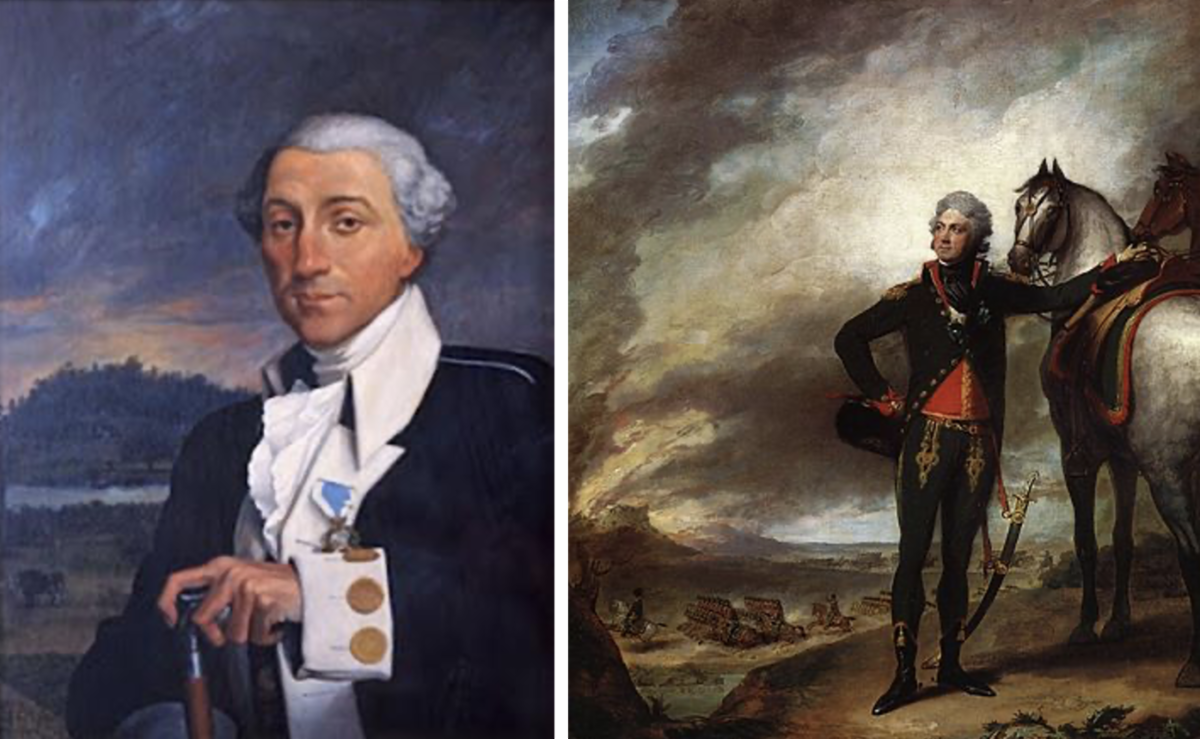
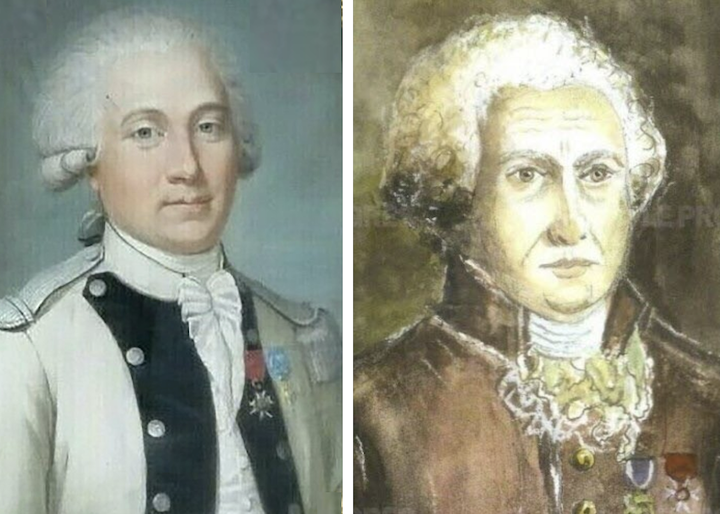
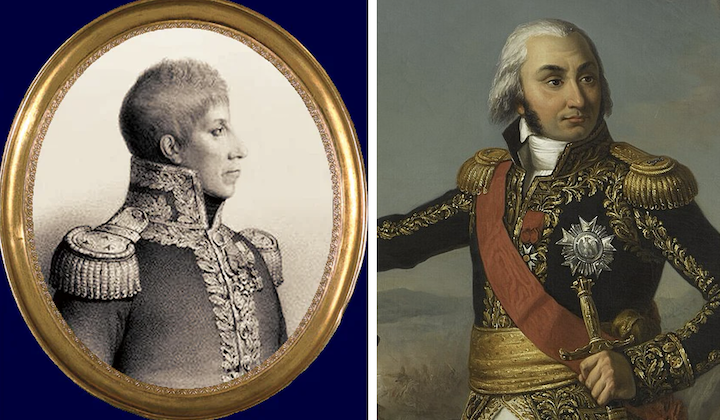
Above: They were all at the siege of Savannah...
First row, Left: Major Pierre Charles L'Enfant, https://alchetron.com/Pierre-Charles-L'Enfant
First row, Right: Louis-Marie, Vicomte de Noailles, painted by Gilbert Stuart 1798. Metropolitan Museum of Art, Public Domain, https://commons.wikimedia.org/w/index.php?curid=10273023
Second row, Left: Philippe-Jacques-François Aupépin de Lamothe, by Charles Thévenin in 1786, was a lieutenant at the Auxerrois regiment who participated at the siege of Savannah. He was promoted to captain the following year and made a Knight of Saint Louis in 1782.
Second row, Right: Colonel Just Antoine Henry Marie Germain, marquis de Rostaing, Colonel of the Régiment du Gâtinais, water color by Mme Chassagne, Le progrès de Lyon, "Un grand forézien oublié" https://www.leprogres.fr/loire-42-edition-forez/2018/05/30/just-de-rostaing-un-grand-forezien-oublie
Third row, Left: Claude d'Allemagne, enlisted as a private in the Régiment Hainaultin the battalion d'Escorbiac (1773), promoted to the rank of sergeant before Savannah, portrayed here as a général of Emperor Napoléon, Public Domain. https://www.frenchempire.net/biographies/dallemagne/
Third row, Right: Jean-Baptiste Jourdan, a corporal of the Régiment Auxerrois at Savannah, portrayed here as a Marshal of Emperor Napoléon, by Joseph-Marie Vien - Public Domain, https://commons.wikimedia.org/w/index.php?curid=29318706
| |
They were all at the Siege of Savannah...
"The roster of highborn officers of la Vieille France reads with the sonorous cadence of Shakespeares catalogue of the French chivalry at Agincourt. Besides Comte d'Estaing, Vicomte de Noailles, Comte Dillon, and the Vicomte de Fontanges, there were the Marquis de Pondevaux, a nephew of the great Vergennes; Comte d'Hervilly; Vicomte de Béthisy; Marquis de Rouvray; Comte de Villeverd; Marquis de la Roche-Fontenilles..." [...]
For one hastens to add that those titled dandies of Old France were no mere carpet-knight warriors. In battle they were bold as lions, ready to die with their men though perhaps not always as willing to share their sufferings". - Alexander A. Lawrence, Storm over Savannah.
All officers came from noble backgrounds, with some hailing from illustrious families. However, several commoners soldiers who fought at Savannah were also destined for greatness.
• The Vicomte Louis Marie de Noailles, (born in Paris 1756, died in Havana in 1804) was a son of Marshal de Mouchy . He had wanted to go as a volunteer with a certain Marquis... After all, he was Lafayette's brother -in-law! However his family's resistance prevented him from doing so.
• He left with his regiment to America a few months later nevertheless, fought in Savannah where he commanded an assault division made up of detachments from the Champagne, Auxerrois, Foix, Guadeloupe, and Martinique regiments. He later was the officer who negotiated the terms of the capitulation of Lord Cornwallis at Yorktown...
At the start of the American Revolution, he was chosen to be part of the Estates-General in 1789. As the French Revolution intensified and posed greater risks for the nobility, he moved to the United States and became a partner at William Bingham's Bank of North America in Philadelphia, where he found success. He took on a military role against the British during the blockade of Saint Domingue, led the defense of Môle-Saint-Nicolas and managed to escape with the garrison to Cuba. However, during the journey, his ship was attacked by a British schooner. After a lengthy battle, he was badly injured and died from his wounds in Havana on January 9, 1804. Louis Marie Antoine de Noailles was a member of the Society of the Cincinnati from France.
• Pierre Charles L'Enfant, major in the Continental Army, one of George Washington's closest French military engineers, designer of Washington D.C., fought and was wounded during the assault of October 9 in Savannah.
We devoted a Bulletin to this great Patriot of both nations:
April 2022 Bulletin: Tribute to Major Pierre Charles L’Enfant
https://conta.cc/3uR5rqO (original version in English)
https://conta.cc/3JPeFIg (version en français)
Our Society installed and dedicated a marker, co-signed with the Daughters of the American Revolution, on June 14, 2022 in front of his Monument at the top of Arlington National Cemetery.
• Among the soldiers from the Régiment d'Auxerrois, let us mention Napoléon's future Maréchal Jean-Baptiste Jourdan, (born in Limoges in 1762 – died in Paris in 1833), son of a surgeon who left him an orphan at a young age. He enlisted as a private on the 2nd April, 1778, and was assigned to the regiment of Auxerrois infantry on December 10th. Less than a year later, he served with the detachment of the same at the siege of Savannah in 1779 and was in the ill-fated assault of October 9th. His meteoric rise to the rank of general during the French Revolution, his victory at Fleurus during the Flanders Campaign is the stuff of legend. One of Napoléon's marshalls, he ended his career as military governor of the Invalides where he is buried.
• Another soldier who fought at Savannah and destined to a high degree of glory was Claude, baron d'Allemagne, from the Hainault Regiment. The time would come when D'Allemagne would become one of Napoleons bravest generals, with his name on the Arc de Triomphe in Paris.
Born in Peyrieu, near Belley (Ain) in 1744, he joined the Hainault regiment at the age of 14. He sailed with his battalion on d'Estaing's fleet and fought in battles at Dominica, Saint Vincent, Grenada, Saint Lucia, where he was injured, and Saint Christopher. He distinguished himself during the assault on Savannah, earning the rank of sergeant. Promoted to sergeant major in 1786, he caught the attention of Marquis de Bouillé during the disturbances in Nancy in 1790, who awarded him officer epaulettes and the Croix de Saint-Louis. Sent to the Italian army, he became a captain, was wounded, and in 1793, during the siege of Toulon, he was promoted to adjutant general and brigade general. He campaigned in Italy with Bonaparte, received from him a sword of honor, and achieved the rank of division general. After falling ill, he returned to France following the peace of Campo-Formio and later rejoined the Mainz army. He was a member of the Legislative Body and a baron of the Empire.
• André de La Barre (not pictured) was born in 1749, in "Le Fort de Missouri" (probably Fort de Chartres) in New France. He joined the colonial forces of France when he was very young. In 1764, he began training as an artillerist but switched to a cavalry unit as a volunteer three years later. By 1772, he became a sous lieutenant in a detachment of the Dragons de Condé and was wounded during the assault of October 9 in Savannah. By 1788, he had risen to the rank of major and served as a staff officer. The War of the First Coalition provided opportunities for quick promotions, and in August 1793, he was made a general of brigade. He fought at Toulon that same year and later distinguished himself at Boulou in May 1794. He was killed in action while leading his cavalry at La Junquera in Spain on June 7, 1794. His name and deeds were inscribed on a column in the Panthéon.
| |
... And from the French Fleet: | |
|
Above: They were all at the siege of Savannah...
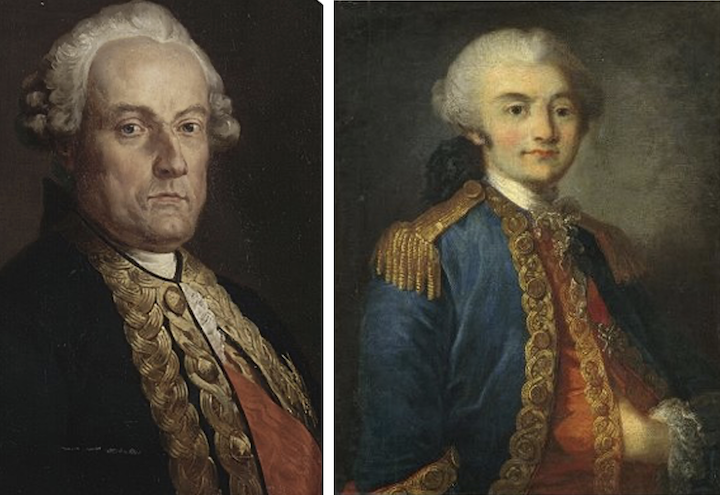
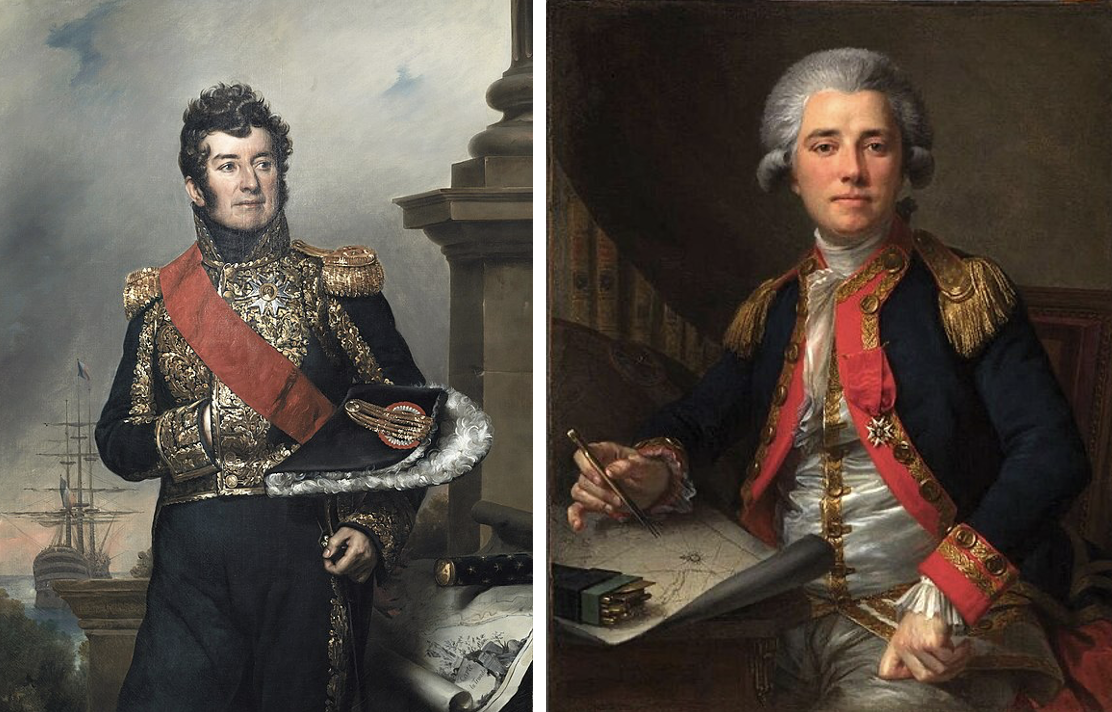
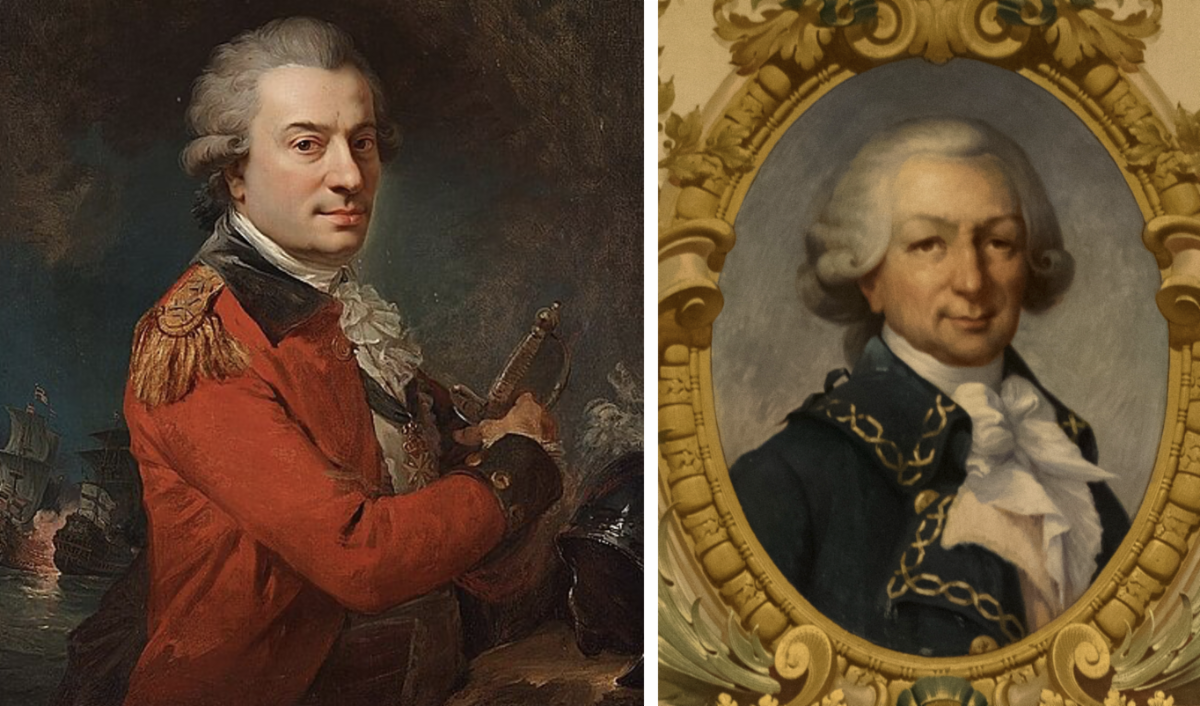
First Row, Left: Toussaint-Guillaume, comte de La Motte-Piquet, By Jean-Pierre Franque - Château de Versailles, Public Domain, https://commons.wikimedia.org/w/index.php?curid=85490029
First Row, Right: Chevalier Charles Marie de Trolong du Rumain (1743 - 1780), captain of the 32-gun Chimère which bombarded Savannah. By Rama, CC BY-SA 3.0 fr, https://commons.wikimedia.org/w/index.php?curid=50765899
Second row, Left: Comte Laurent-Jean-François Truguet, Admiral of France in 1832, was a young Lieutenant at Savannah, by Paulin Guérin, Public Domain, https://commons.wikimedia.org/w/index.php?curid=3583815
Second row, Right: Comte Jean-François de Galaup de La Pérouse, captain of L'Amazone in 1778. By Geneviève Brossard de Beaulieu - Public Domain, https://commons.wikimedia.org/w/index.php?curid=62779249
Third row, Left: Pierre André, marquis de Suffren, bailli de Saint Tropez in the the uniform of the Sovereign Military Order of Malta, by French school 18th Century, Public Domain, https://commons.wikimedia.org/w/index.php?curid=146825803
Third row, Left: Louis-Antoine de Bougainville, captain of Le Guerrier, by Unknown artist — Salon des Amiraux, Hôtel de la Marine, Paris, Photo: TC - ASSFi 2021
| |
|
They were all at the siege of Savannah...
• Jean François de Galaup, comte de La Pérouse, (1741-1788) the future legendary explorer, was the captain of L'Amazone, took part in the Savannah expedition, where he captured the 20-gun HMS Ariel on October 1779.
We narrated his expedition in Hawai'i, Alaska, California,and the American Samoa in our April 2024 Bulletin:
https://conta.cc/3U58W8r (original version in English)
https://conta.cc/3xHEvxn (version en français)
• Laurent-Jean-François, comte de Truguet, was born in Toulon in 1752, and died in the same city in 1839. He had an extraordinary long Navy career up until 1832 when King Louis Philippe made him Amiral de France.
He began his naval career at the age of 13 as a midshipman, became an ensign in 1773.
In 1778, he was part of d'Estaing's squadron on the Hector , became a Lieutenant in 1779 and saved the life of the wounded Count d'Estaing at Savannah on October 9, 1779, for which he was made a knight of Saint Louis. He led an infantry company in the attack on Saint Lucia on November 17. He remained in America throughout the war, became a Lieutenant, fought in the Battle of the Chesapeake, was wounded twice, and participated in the Battle of the Saintes on the Languedoc, becoming a member of the Cincinnati.
He continued to serve in several ships after the war. Appointed Captain, then 6 months later rear admiral in 1792, he was imprisoned during the Reign of Terror. He became a vice admiral in 1794, served as Minister of the Navy from 1795 to 1797 and later an ambassador to Spain. In 1804, he took command of the naval army in Brest and managed maritime administration in Holland. During the Restoration, he was made a grand cross of the Legion of Honor and Saint-Louis, became a count and peer of France. King Louis-Philippe elevated him to Admiral of France. He left behind a Treatise on Practical Navigation and many documents on nautical sciences.
• Toussaint-Guillaume Picquet de la Motte (1720-1791), also called La Motte-Piquet, was a French Navy officer and nobleman. He had a 50-year career serving under Louis XV and Louis XVI, participating in 34 naval battles. In June 1777, he was in charge of the 74-gun ship Robuste.
On February 14, 1778, he honored the USS Ranger with a nine-gun salute, the first time a foreign warship acknowledged the US flag.
He oversaw the landing of troops in Savannah. In 1781, leading a squadron of nine vessels, including three frigates, he captured 26 British ships and seized British Admiral Rodney's prize worth 5 million sterling. A metro station in Paris is named after him.
• Pierre André, marquis de Suffren, bailli de Saint Tropez, (1729-1788) was already a veteran captain when he was assigned to Admiral d'Estaing's fleet, where he led a division that included the 64-gun ship Fantasque, which he commanded, along with the frigates Aimable, Chimère, and Engageante. During the Battle of Rhode Island he attached a British squadron of five frigates anchored in Narragansett Bay near Newport, which included HMS Juno, Flora, Lark, Orpheus, and Cerebus. On August 5, 1778, Suffren entered the Bay and anchored close to the British ships, who then cut their cables and set their vessels on fire to prevent capture. In total, the Royal Navy had to destroy ten of their own ships, including five frigates. In Savannah, On September 7, 1779, d'Estaing instructed Suffren to block the Savannah River to assist the landing of French troops and to stop British ships from fleeing. Suffren commanded the 64-gun ships Artésien and Provence, along with the frigates Fortunée, Blanche, and Chimère. They entered the river, which led the British to sink several of their ships, including HMS Rose. He continued to write some of the most illustrious pages of the french Navy in India and the Indian Ocean. His statue adorns the Quai Suffren, at the heart of the Saint Tropez harbor, next to Sénéquier, in front of the Hotel du Sube.
• In the Navy too, there were exceptions: Louis-Antoine Bougainville, (1729-1811) soldier, explorer, sailor, was not of noble lineage but already a world famous sailor, having completed a circumnavigation of the globe, establishing the first colony in the Malouines (later called the Falklands), popularizing Tahiti and many other exploits related in his book Voyage around the world (published in London in 1772), made him a celebrity...the Bougainvillea plant is named after him.
Part of D'Estaing's fleet in 1779, he was the captain of Le Guerrier during the siege of Savannah and later contributed to the Chesapeake victory under admiral de Grasse in 1781, as captain of the Auguste. After the war he became a scientist and talented horticulturist. Napoleon made him a count of the empire in 1808. His remains rest at the Panthéon in Paris.
| |
Foreign Commanders in the French forces | |
|
An Englishman in the French Army
• Général Arthur, comte de Dillon (September 3, 1750 – April 13, 1794) was an officer in the French Army, a colonial administrator, and a politician. He participated in the American Revolutionary War and the War of the First Coalition. After holding various political positions in the early days of the French Revolution, he was executed in Paris as a royalist during the Reign of Terror in 1794.
• He was born in Bray Wick, Berkshire, England. At 16, on August 25, 1767, he became the colonel of Dillon's Regiment, taking over from his father, who had not been active in the role for twenty years after his uncle Edward's death in 1747. Dillon and his regiment traveled to the Caribbean under Charles Henri Hector d'Estaing. In 1779, they fought in the capture of Grenada against British forces led by George Macartney and the naval Battle of Grenada against admiral Byron which ended in a French victory.
• In September and October 1779, Dillon participated in the siege of Savannah, where he was promoted to brigadier.
• He and his regiment also took part in the invasion of Tobago, the capture of Sint Eustatius, and the siege of Brimstone Hill. Following the victory at Brimstone Hill, Dillon was appointed governor of Saint Kitts and later became governor of Tobago after the Treaty of Paris.
• After the death of his first wife, he married Laure de Girardin de Montgérald, a wealthy widow from Martinique, known as the Comtesse de la Touche. Together, they had six children. He later returned to Paris to represent Martinique in the Estates General of 1789, supporting democratic reforms while being a royalist.
• During the French Revolution, Dillon took on military responsibilities during a challenging period for aristocratic officers. Following the Battle of Valmy, he was summoned to Paris for questioning and was arrested.
He was found guilty of being part of a prison conspiracy and was executed by guillotine on April 13, 1794. In his last moments, he shouted, "Vive le roi!" (Long live the king).
• Another anecdote says much about his gallantry at the scaffold…: "As luck would have it, Fouquier-Tinville [the dreaded "accusateur public"] put them on the same cart, and Lucile Desmoulins was to be executed immediately before her admirer. Legend has it that, despite her energy, the young woman felt her heart fail her and she said to her companion in misfortune:
- Please, my friend, come up before me. It will be easier for me to follow you.
And Dillon obeyed, saying:
- "There's nothing I won't do for a lady, even to go in front of her if she orders me to..."
• Note, Théobald Dillon (1745 – 29 April 1792) was an officer in the French Royal Army who also fought at Savannah, wounded during the assault and cripled for life. He was a distant relative of General Arthur Dillon (who had a brother also named Theobald).
• Also, there is a Colonel Robert-Guillaume Dillon, appointed colonel on 2 June 1779 and became colonel-in-second of the Légion des Volontaires Étrangers de Lauzun on 1 April 1780. His two brothers William-Henry ("Billy") and Franck-Thébald also served in the same unit as second captains and second lieutenants.
They all fought for American independence.
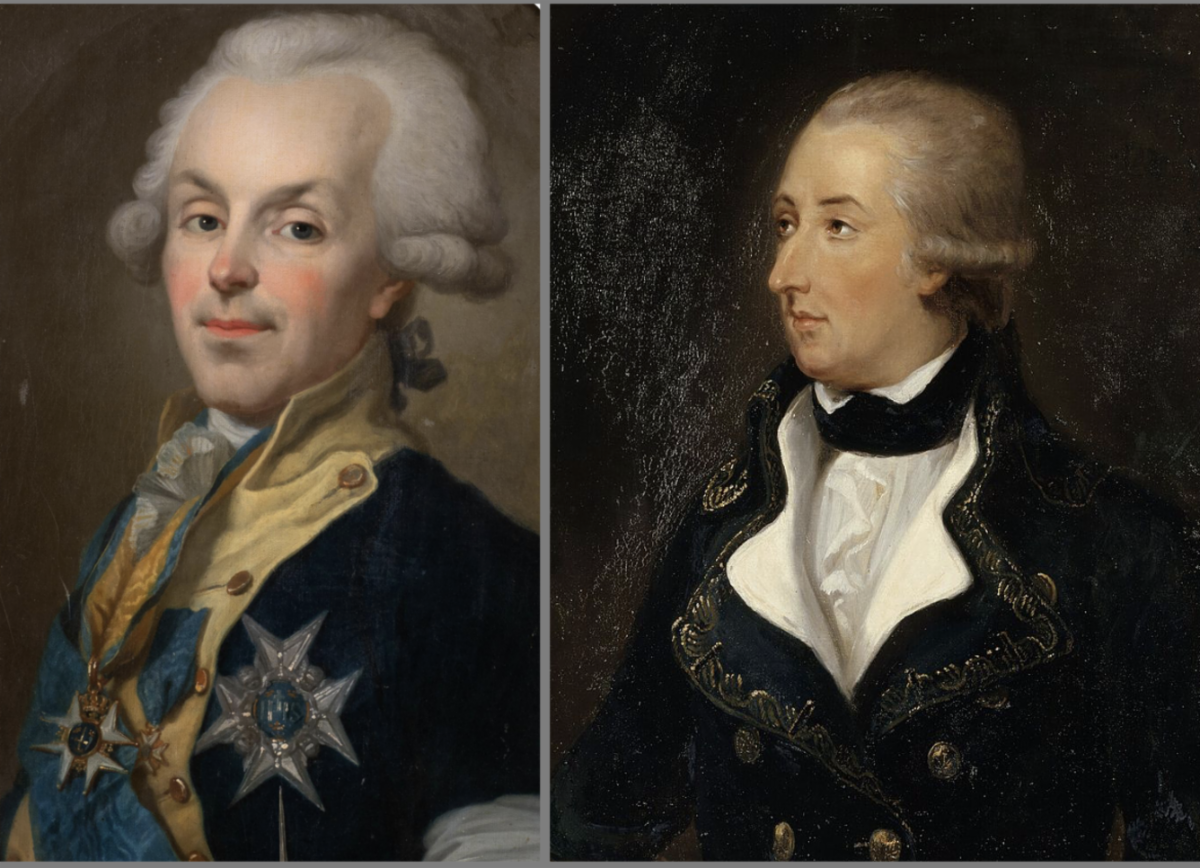
A Swedish baron commanding the Left French assault column:
• Curt Bogislaus Ludvig Kristoffer von Stedingk (26 October 1746 – 7 January 1837) was a notable Swedish army officer and diplomat who significantly influenced Swedish foreign policy for many years. At just 13 years old, during the Seven Years' War when Sweden was at war with Prussia, he served as an ensign in the Crown Prince's personal regiment.
• He quickly advanced in the Royal Suédois regiment in France, which was associated with his friend Count Axel von Fersen. Both von Stedingk and Fersen were close to Louis XVI and Marie Antoinette, spending considerable time at Versailles. By 1778, he had attained the rank of colonel en chef of the regiment. Inspired by Lafayette, von Stedingk volunteered to support the American Insurgents in 1779.
• During the siege of Savannah in October 1779, he led the left column of the attacking forces and raised the American flag on the enemy's last trench line. However, he was wounded by enemy fire and had to retreat with 20 other injured men. For his bravery, he received a decoration from the French and a lifetime pension.
• He was also celebrated for his actions in the naval Battle of Grenada against Vice Admiral John Byron on 6 July 1779. In recognition of his military achievements, George Washington made him a member of the Society of the Cincinnati in 1783.
• His later life is lengthy and beyond the scope of this Bulletin. After returning to Sweden, he served as Ambassador to Russia in St. Petersburg for nearly 20 years in two separate terms. During the Russo-Swedish War of 1808–1809, he was the commander-in-chief in Finland, which was still part of Sweden at that time. Due to his strong relationship with the Russian Imperial Family, he was able to ease the tough conditions of the peace talks after Finland was ceded to Russia. He also led Swedish forces successfully against Napoleon at the Battle of Leipzig in 1813 and was promoted to field marshal. He passed away at the age of 90 in Stockholm in 1837.
Anecdotes from Count de Stedingk:
• "Count von Stedingk always recalled with satisfaction in later years the sayings of two men who served under him in the attack. During the retreat he came upon a badly wounded French soldier who was stretched beside a number of other men. They blocked the way and Colonel Stedingk stopped short so as not to trample upon their feet. Summoning all his strength, the dying man motioned to him to proceed. "Passez, mon commandant", he said, "thirty men like me have made a road for you."
• Another story Stedingk never tired of telling concerned a French soldier who managed to reach an almost impregnable British post during the assault. Asked how he had done it, the hero tersely replied, "C'est que l'ennemi s'y trouvait" [The enemy happened to be there]."
-- Storm Over Savannah by Alexander A. Lawrence, Chapter XIII, p.33
| |
|
Above:
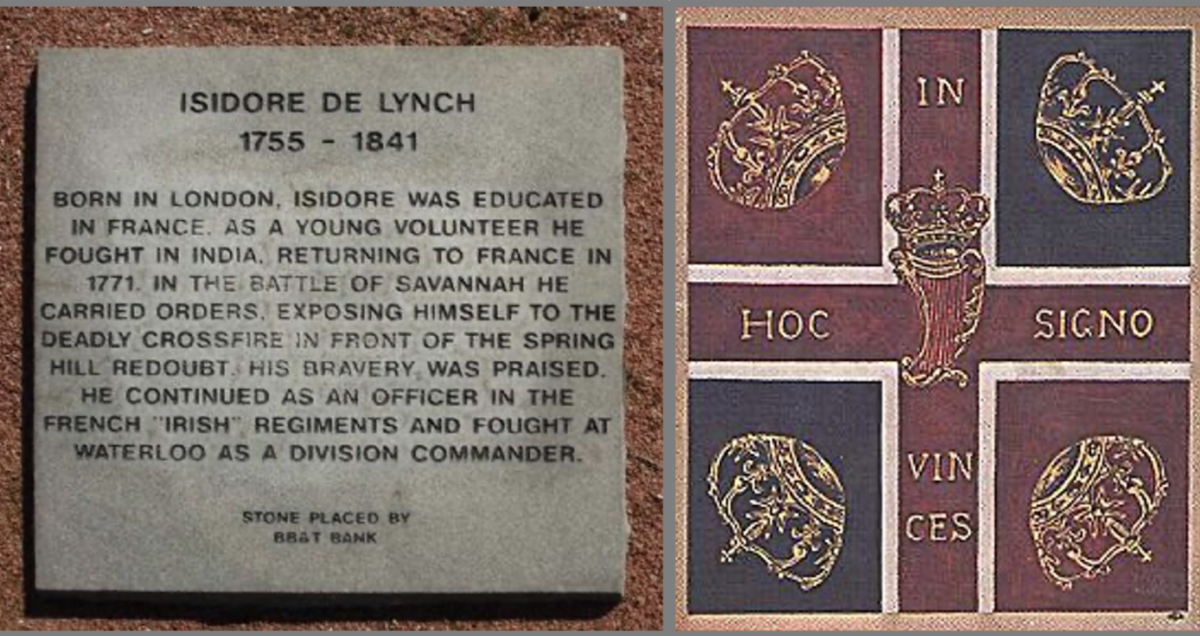
Left, one of the 800 pavers laid on the grounds of the battlefield near Spring Hill redoubt, remembering Isidore de Lynch. Photo: National War Memorial Registry, https://www.nationalwarmemorialregistry.org/memorials/isidore-de-lynch-war-memorial-paver/
Right: "The Color of Dillon’s Irish Regiment was perhaps the most beautiful in the French army as a whole, comprising the maid of Erin harp motif in the centre with four Stuart crowns in the cantons symbolising their allegience to the Jacobite Cause- hoping that the Restoration of the Stuarts, would restore Catholic rights and their confiscated lands back home. Dillon's served in the French Service for one-hundred years and was arguably the finest regiments under the ancien regime.
King Louis XVI once complained to General Arthur Dillon that of all the troops in his service the Irish gave him the most trouble, the story goes that Dillon replied; 'the enemy make the same complaint, your Majesty.' -
Stephen McGarry, author, Irish Brigades Abroad: From the Wild Geese to the Napoleonic Wars.
Photo: Sons of the American Revolution of Virginia, https://srvirginia.org/flag-of-the-de-dillon-regiment/
| |
|
An Irishman who became a French General
• Isidore de Lynch, born in London on June 8, 1755, died on August 3, or 8, 1838 (or August 4, 1841 according to other sources) in Paris, was an Irish officer then French general of the Revolution and the Empire. An Irish officer, he took part in the Indian campaign, then fought alongside the French during the American War of Independence. He was then field marshal on February 6, 1792, then lieutenant general during the Revolution, and divisional inspector under the Consulate and the Empire. Before joining General de Rochambeau's army, he had been part of the expedition under the orders of Count d'Estaing. It was then and at the siege of Savannah that he distinguished himself by the valiant action recounted by the Comte de Ségur. After his participation in the siege of Savannah, Lynch took part in the capture of Yorktown in 1781. He became the following year assistant general of the infantry. General under the Revolution (battle of Valmy) and the Empire (divisional inspector), he was dismissed by Napoleon during the 100 Days, considered unreliable because his brother, mayor of Bordeaux, had opened the city gates to Wellington in 1814. He did not participate in the Battle of Waterloo.
Anecdote about de Lynch:
"In similar vein was the retort Isidore de Lynch is reputed to have made to General dEstaing during the attack. Count de Ségur tells the story in his Memoirs. The Irish-born officer was dispatched in the heat of the battle with an urgent message to the left column. Instead of passing to the rear of the advancing troops the debonair Lynch proceeded straight across the front, through the cross-fire, ignoring shouts to take a safer path. Having delivered the dispatch, he calmly returned the same way. To the amazement of all he arrived safe and sound. “Morbleu!” d’Estaing reprimanded him, you must have the devil in you. Eh! Why have you selected a route along which you should have died a thousand times?” - “Because, replied the happy-go-lucky officer, it was the shortest.”
-- Storm Over Savannah by Alexander A. Lawrence, Chapter XIII, p.33
Plaque, “Isidore de Lynch”
315 Martin Luther King Jr Blvd, Savannah, GA 31401
GPS: 32.075900, -81.100633
• Inscription:
“1755 – 1841”
“Born in London, Isidore was educated in France. As a young volunteer he fought in
India, returning to France in 1771. In the Battle of Savannah he carried orders,
exposing himself to the deadly crossfire in front of the Spring Hill Redoubt. His bravery was praised. He continued as an officer in the French "Irish" regiments and fought at Waterloo as a Division Commander.
Erected by BB&T Bank.”
| |
|
Above:
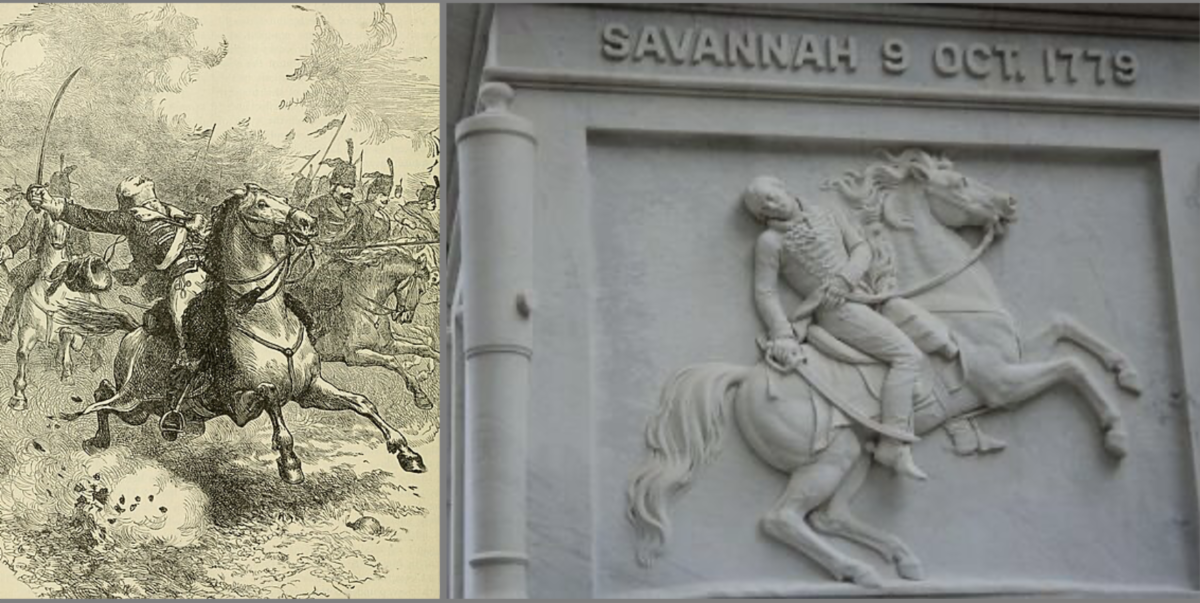
Left: Casimir Pulaski mortally wounded by grapeshot while leading cavalry charge, by Internet Archive Book Images, No restrictions, https://commons.wikimedia.org/w/index.php?curid=42038436. Historian Alexander A. Lawrence pointed out that the commonly held belief is that Pulaski was fatally injured while leading a cavalry charge is questionable. He argued that the battlefield was not suitable for cavalry and that Pulaski was probably hit from a distance away from the British forces, presenting a more precise, albeit less sensational, account of the incident.
Right: the Pulaski Monument at Montery Square in Savannah contains this bas relief depicting his fatal wounding. Photo by Bill Coughlin, August 5, 2013, https://www.hmdb.org/m.asp?m=5483
| |
|
A Polish general serving in the Continental Army:
• Kazimierz Michał Władysław Wiktor Pułaski, known as Casimir Pulaski, was a Polish nobleman and military leader born on March 4 or 6, 1745, who died on October 11, 1779 at the battle of Savannah. He is often referred to as "The Father of American cavalry"
• After a distinguished military career with the Bar Confederation, which aimed to protect Poland from Russian threats but ultimately failed, he fled to France. During this time, thanks to his friend, poet and historian Claude-Carloman de Rulhière, he was recruited by the Marquis de Lafayette and Benjamin Franklin, whom he met in the spring of 1777, to join the fight in the American Revolutionary War. Franklin admired Pulaski and noted, "Count Pulaski of Poland, an officer famous throughout Europe for his bravery and conduct in defence of the liberties of his country against the three great invading powers of Russia, Austria and Prussia ... may be highly useful to our service."
He then suggested that General George Washington accept Pulaski as a volunteer in the Continental Army cavalry.
• Pulaski left France from Nantes in June and reached Marblehead, Massachusetts, near Boston, on July 23, 1777. Upon his arrival, Pulaski wrote to Washington, "I came here, where freedom is being defended, to serve it, and to live or die for it."
• He made significant contributions during the conflict, especially when he saved George Washington's life at the battle of Brandywine. He rose to the rank of general in the Continental Army and, along with his friend Michael Kovats, established the Pulaski Cavalry Legion, improving the American cavalry overall.
In early September 1779, when General Lincoln got ready to try to reclaim Savannah with help from the French, Pulaski's cavalry legion served as the front line for the French troops which were disembarking. During the siege of Savannah, he led all the cavalry, both French and American, in the attack on October 9. He was mortally wounded by grapeshot while leading a cavalry charge against the British and died two days later, never regaining consciousness.
• In March 1825, Lafayette laid the cornerstone for the Casimir Pulaski Monument in Savannah, Georgia, during his Farewell tour of the United States.
• Pulaski is celebrated as a hero for his fight for independence and freedom in both Poland and the United States. Many places and events bear his name, and he is honored through various artworks. He is also one of only eight individuals to receive honorary citizenship in the United States.
Let us turn now our attention to the particular presence on the battlefield of a Colored Regiment, who fought very bravely and en an orderly retreat after admiral d'Estaing lifted the siege of Savannah.
| |
|
In honor of Black History month:
Tribute to the
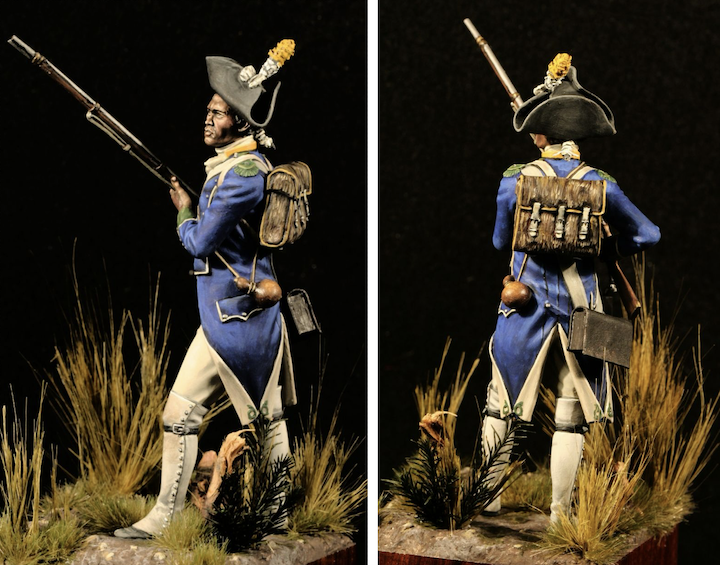
Chasseurs Volontaires de Saint Domingue
| |
|
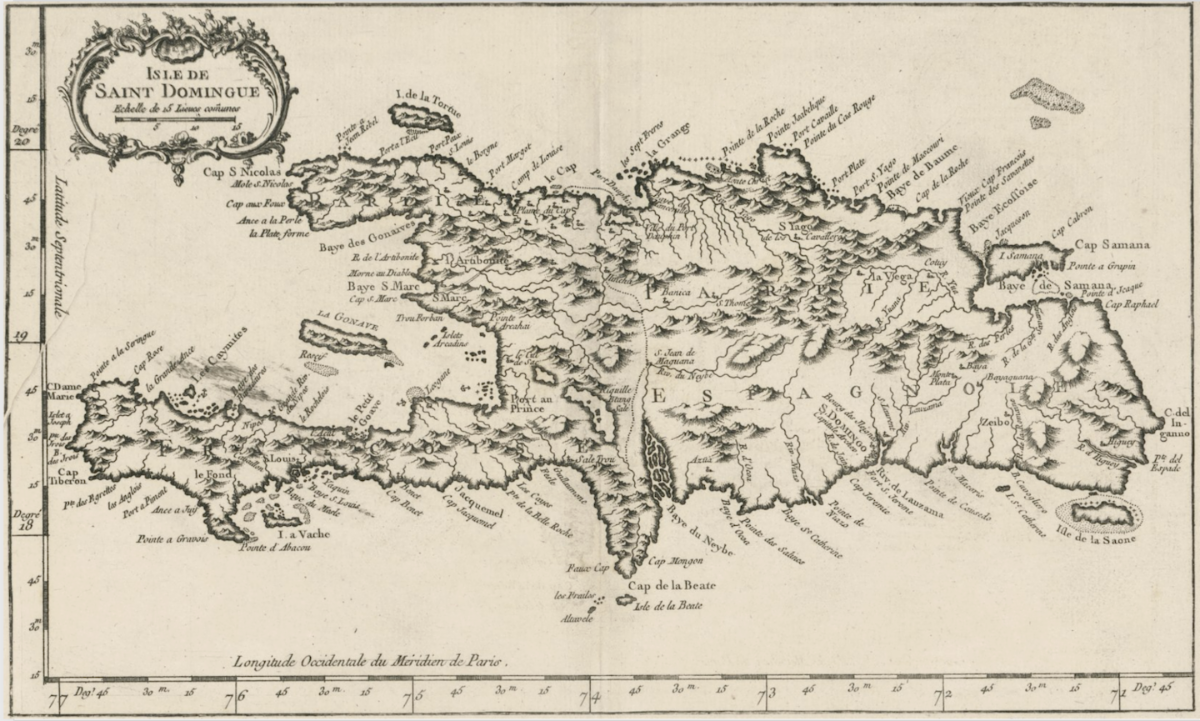
Introduction to Saint Domingue, today's Haiti:
Saint-Domingue was a French colony located in the western part of the Caribbean island of Hispaniola, which is now Haiti, from 1697 to 1804. Its name comes from the Spanish city of Santo Domingo, which originally referred to the Spanish-controlled area that is now the Dominican Republic. The borders between the French and Spanish territories changed over time until they were finalized with Haiti during the Dominican War of Independence in 1844.
The French settled in the western parts of Hispaniola and Tortuga by 1659. In 1697, the Treaty of Ryswick officially recognized French control over Tortuga Island and the western third of Hispaniola.
Nicknamed the "Pearl of the Antilles," Saint-Domingue became the richest and most prosperous French colony in the West Indies. By the year 1789, it comprised approximately 8,000 plantations, which collectively generated half of the sugar and coffee consumed in Europe and the Americas, surpassing the total production of sugar and coffee from all the British West Indies colonies combined.
| |
|
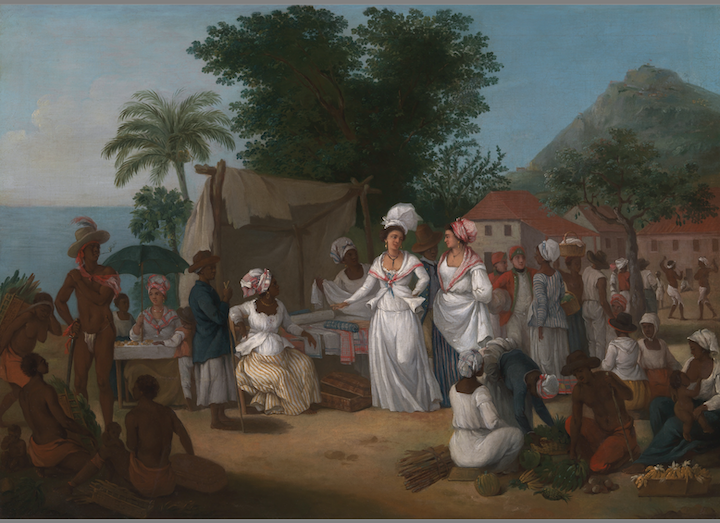
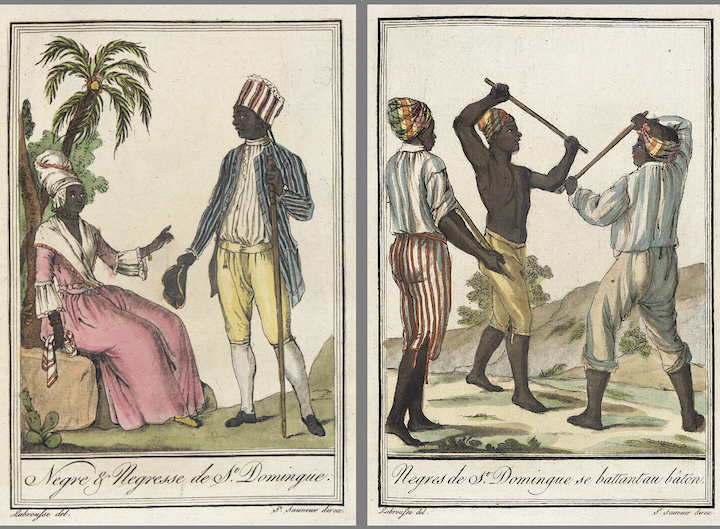
Slaves and Colored People of Saint Domingue
In order to narrate the exploits of the "Chasseurs Volontaires de Saint Domingue" and its contribution to the cause of American Independence, it is important to survey the complex system of colonial slavery in the 18th century.
Creation of a new mixed population:
Efforts by the French Crown to establish a stable European population in the colony continued until the mid-18th century. This was challenging due to a high mortality rate due to disease, as well as the lack of European women. From the 17th century to the mid-18th century, the Crown tried to solve this by sending women from France to Saint-Domingue and Martinique to marry settlers. However, these women were often rumored to be former prostitutes, leading to complaints from settlers. As a result, the system was dropped, and by the late 18th century, it became normal for French men to live with local black women during their stays.
Slavery:
Between 1681 and until the abolition of slavery by the First French Republic in 1794, around 790,000 to 860,000 slaves worked on these plantations. The need to constantly bring in new slaves from Africa meant that most of the enslaved people in the colony were born in Africa (from a multitude of tribes, since they were captured in ethnic wars and resold to slave traders), representing one-third of the total transatlantic slave trade. The terribly harsh conditions of slavery coupled diseases like yellow fever made it hard for the population to grow naturally. The slaves came from numerous African tribes, speaking different languages, and they learned Creole French to communicate with each other.
Free colored People:
Saint-Domingue had the largest and richest free population of color in the Caribbean, known as the "Gens de couleur libres" (Free Colored People). While many of these individuals were freed slaves, most were Creoles of color, meaning they were free-born blacks and mulattoes. A practice called "plaçage" emerged, where white men formed informal marriages with slave or free women, providing them with dowries, sometimes granting freedom, and often ensuring education or apprenticeships for their children. Some descendants of these planters ended up inheriting significant property.
The "Gens de couleur libres" (Free colored people) owned a lot of wealth and land, similar to the “petits blancs“ non-noble planters and civilians. They enjoyed full citizenship and civil rights like other French subjects. By 1789, Free colored people owned one-third of the plantation property and one-quarter of the slaves of Saint-Domingue.
They were the ones to enlist in the "Chasseurs Volontaires de Saint Domingue"
| |
|
The Code Noir
In 1685, Louis XIV established the Code Noir to regulate slavery. This code granted certain rights to slaves and set responsibilities for masters, who had to provide food, clothing, and care for their slaves' well-being, the later stipulation very often ignored in practice.
The Code Noir also granted full citizenship to affranchis (former slaves) and stipulated that they had the same civil rights as other French subjects. It did not prohibit interracial marriage in Saint Domingue and allowed free individuals to give property to affranchis without limits. Creoles of color and affranchis routinely used colonial courts to defend their property and take legal action against white colonists.
While the Code Noir allowed corporal punishment, it included rules to control how punishments were carried out, again, often ignored in practice, as acts of cruel punishments were commonly reported.
Article 59 of the Black Code, which states that ‘freedmen have the same rights, privileges and immunities as those born free’ meant that freed colored people could enlist in the Army.
The Colored population in Saint Domingue was classsified according to the percentage of black ancestors: ⅞ : Sacatra, ¾ : Griffe, ⅝ : Marabou, ½ : Mulâtre (Mulatto), ¼ : Quarteron, ⅛ : Métis, 1/16 : Mamelouk, 1/32 : Quarteronné, 1/64 : Sang-mêlé...
The phrase 'free people of color' describes a legal group created in the French colonies before slavery ended. It first appeared in local and royal laws in the 1720s in Saint-Domingue to differentiate them from 'freed negroes'. This was different from the 1685 Code Noir, which did not separate all freed individuals.
From 1724 onwards, this discrimination led to a policy of social segregation: although free, free people of color could not accede to positions of responsibility (judicial functions, the practice of medicine, military command) or obtain privileges or royal offices, by virtue of ‘color prejudice’. In notarial deeds, four degrees of color were introduced: negro, mulatto, quarteron and white. It was at this time that freemen of color were sometimes pejoratively referred to as ‘sang-mêlés ’ (literally: mixed-blood). The notion of ‘free people of color’ encompassed both mulattoes, who owned slaves, and the ‘intermediate class’ of freed blacks, who could also own slaves.
Often self-employed as artisans, merchants or landowners, people of color frequently became quite prosperous, and many prided themselves on their European culture. They often spoke the French language, unlike the Haitian Creole they despised, spoken by slaves. Most of the coloreds were Catholics, and many denounced the voodoo religion.
Saint-Domingue and the American Revolutionary War:
As we have just described in broad strokes, Saint-Domingue was an important colony with a military infrastructure. It was therefore entirely normal for France to use it, like the rest of the French West Indies, as a base of operations for French support for the American War of Independence (1775-1783). There were also links between the French planters on the island and those in the French colonies to the south of the future United States, particularly those in Louisiana (later sold by France to the United States in 1803).
After the American Revolutionary War
In the pages below we will evoke the destiny of several of these Chasseurs Volontaires, upon their return from America. To understand their actions, it is necessary to take into account the French Revolution and its promises of liberty, equality and fraternity for all men, which brought enormous changes throughout French possessions overseas.
In 1791, enslaved people and some Creoles started planning the Haitian Revolution. The slave uprising later joined forces with Republican French troops after slavery was abolished in the colony, which upset the island's main slave-owning class. France took over Spain and ruled all of Hispaniola from 1795 to 1802, when a new rebellion started.
In 1802, troops sent by Napoléon Bonaparte to suppress the revolt in Saint-Domingue faced yellow fever, resulting in over half of the French expedition forces succumbing to illness, and the indomitable resolve of the insurgents, fighting to keep their recently acquired freedom and determined never to be enslaved again.
The last French soldiers left the western part of the island in late 1803, and the colony declared its independence as Haiti, the Taino (original Arawak indians) name for the island, the next year.
| |
|
The Chasseurs Volontaires de Saint Domingue:
An intrepid light infantry Regiment
| |
|
Above:
Chasseurs-Volontaires de St. Domingue, 1779 converted & painted by Paul Derrick
https://www.puttyandpaint.com/projects/38202
The Chasseurs-Volontaires had a uniform made of blue fabric with a washed canvas lining. It featured green cloth on the front and small white buttons and pockets. They also wore green epaulettes and a simple hat adorned with a white and yellow feather.
| |
|
• The Chasseurs Volontaires de Saint-Domingue was a regiment consisting of "gens de couleurs libres" ('free people of color'), the terminology used at the time. This military unit was created by an order from Count Robert d'Argout, the Governor General, on March 12, 1779, and later expanded in April, raising its numbers from 800 to 1,030.
Eventually, the total number of enlisted black and métis soldiers reached 1,500. It is at times incorrectly called the "Chasseurs Volontaires de San Domingo", which reflects a confusion with the Spanish part of the island, today's the Dominican Republic.
• In the French military, a "chasseur" designates a light infantry soldier, highly mobile, trained for quick strikes and reconnaissance missions. "Volontaires" means volunteer, i.e. who freely enlists.
Commanding Officers:
The Commanding officers were whites. One would have to wait for the French Revolution to see black generals, as we will see below. However, men of color could reach the ranks of superior officers.
The head of the regiment was Viscount de Fontanges, a major-general and a prominent plantation owner in southern Saint-Domingue. He later became a key figure in the French Revolution in the West Indies and was quickly made chief of staff to Admiral d'Estaing. The Chasseurs were nicknamed the "Fontanges Legion".
• Francois, vicomte de Fontanges (born in Gannat, Allier March 21, 1740-died in Montluçon, Allier, June 13, 1822) joined the military at age 16 and was a Veteran of the German campaign in 1757-1763 during the Seven Years War.
• In July 1779, he was appointed Head of Staff of vice-admiral d'Estaing and major general for the colonial troops landing for the attack on Savannah, where he suffered serious injuries in October 1779. He was allowed to return to France on convalescence in November.
• Prior to this, he had been sent to the West Indies as a major and promoted Lieutenant Colonel at the Régiment du Cap in 1778.
• He went back by Louis XVI to Saint Domingue and promoted Colonel on Jan 23, 1780 in the Regiment du Cap in October 1780, and then became a maréchal de camp (Brigadier General) on Jan 16, 1784 effectively serving as military commander of Saint Domingue.
• During the French Revolution, on October 23, 1791, he signed an agreement in La Croix-des-Bouquets with the freed people to grant them civil rights equal to those of the colonists., following the law passed by the Constituent Assembly in Paris in May but the local authorities in Port-au-Prince opposed this. During the signing of this pact, the Viscount de Fontanges criticized the judges of Port-au-Prince for sentencing his former comrade-in-arms, Jean-Baptiste Chavannes, to death. Chavannes was a supporter of equal rights for free individuals. In 1792, he confirmed a second agreement recognizing the rights of the freed people. In response, the authorities in Port-au-Prince began retaliatory actions against him. By 1793, a bounty was placed on his head. The Viscount de Fontanges sought refuge in the Spanish part of the island, then went into exile in Jamaica, and eventually reached Spain, where he served the King of Spain.
• In 1808, he was captured by the French army but was released in Paris and joined the army of the First Empire. After aligning with King Louis XVIII during the Restoration, he was promoted to the rank of lieutenant-general in 1814.
In 1816, King Louis XVIII, recognizing the friendly ties that Viscount de Fontanges had with his former comrades from the Siege of Savannah, sent him on a mission to Haiti. He thus joined the diplomatic delegation tasked with negotiating the restoration of economic relations between France and the new emperor of Haiti, Pétion. However, the negotiations failed and would be taken up again during the reign of Charles X.
During his retirement years in Montluçon, the Viscount de Fontanges passed away on June 13, 1822. He was a member of the Society of Cincinnati.
• The regiment was led by Laurent-François le Noir, Marquis de Rouvray (1743-1798). He organized ten volunteer chasseur (light infantry) companies, with each company made up of three officers, fifteen non-commissioned officers, and sixty privates, forming two battalions for the French army. Recruitment was 49 percent higher than anticipated, leading to an increase in each company to eighty-four men and four corporals just a month later on April 21, 1779.
• He was a non-professional soldier who had served and been injured in Canada while serving under Montcalm. He was not a black man as incorrectly reported on a few websites (maybe because is surname of Le Noir "The Black"). He owned coffee plantations purchased from the Jesuits and had slaves in Saint-Domingue, specifically in Terrier-Rouge and Dondon. He also wrote a report on the creation of a corps of people of color raised in Saint-Domingue in 1779, which is kept in the Ministry of the Colonies' archives.
• In 1781, he was named inspector general of the mulatto militia and free blacks. He supported local autonomy and the laws of 1784 and 1785 regarding slaves.
• At the start of the French Revolution in 1789, he represented Saint-Domingue to the Estates General in Paris, aligning with the Club de l'hôtel de Massiac. • He left for the United States in October 1790, and his letters reflect the conflicts between colonists and the military at that time, as well as the hopes for support from England against the abolitionists. He died in Philadelphia on July 18, 1798. He was a member of the Society of Cincinnati.
• The Corps was also under the command of Capitaine Louis Baury de Bellerive (1753-1807) and Lieutenant Jean-Baptiste Bernard de Vaublanc.
• Capitaine Louis Baury de Bellerive was born in Fort Dauphin, Saint Domingue, on Sept. 16, 1753 and died in Middletown, CT on Sept. 20, 1807).
He was educated at a military school in France and returned to the West Indies in 1771. In 1773, he became a Lieutenant of Militia at Fort Dauphin. By 1779, he was appointed Captain Commandant in the Corps of Chasseurs of Saint Domingue and served during the Savannah campaign in Georgia that year. From 1781 to 1783, he participated in campaigns in the United States and the Windward Islands as a Captain in the grenadiers and disembarkation troops. After the war, Captain Baury married his wife Mary Clark of Middletown, CT in 1784 and settled in Boston, Massachusetts (a bronze plaque honors him and the first Roman Catholic mass in Boston at his home in 1788). There was some doubt about his membership due to his life spent outside the U.S., but he was accepted by the Standing Committee on February 4, 1789, after he swore he was no longer a French Army officer and did not receive pay. In early 1787, he served as Aide de Camp to General Lincoln during Shays’ Rebellion. He owned a plantation in San Domingo and split his time between there and Middletown until 1803, when he moved permanently to Middletown due to the slave rebellion that took his properties. Decades after his death, his widow, Mary, who never remarried, applied for a pension in 1851 and obtained it in 1853, at the age of 85. She passed away 3 years later. An early typical 'franco-american' couple, their two sons served in the US Navy and died at sea.
In 1789 Louis Baury became an Original Member of the Massachusetts Society of the Cincinnati.
• Jean-Baptiste Bernard Viénot, chevalier de Vaublanc (17 September 1761 in Ouanaminthe, Saint Domingue – 19 December 1812 in Lithuania), Chevalier of the Légion of d'honneur. Jean-Baptiste was sent to Paris to study at the Military School. At 16, he went back to Saint-Domingue and served as a Lieutenant in the Chasseurs Volontaires de Saint Domingue on March 12, 1779. He had an exemplary conduct during the Siege of Savannah and the new American government recognized him with a land grant. He was discharged on March 6, 1780, due to health issues.
During the French Revolution he served on the Army of the Rhine and in 1800 was made Inspector of the Revenue for the Armies. He kept being promoted, served in the campaigns of Spain and Portugal, until Napoleon named him in 1812 Revenue Inspector in Chief of the Grande Armée and begins preparations for the invasion of Russia. Compelled to be a part of the Russian invasion, despite protestations form Marshall Berthier and his family, Jean-Baptiste followed the Grande Armée into Russia, despite his failing health. As the retreat from Moscow started, Jean-Baptiste rescued a painting from the fires in Moscow and kept it with him. Soon after, he had to continue on foot, sword in hand, despite having a fever and bleeding feet. Still, he reached Gambinen in Prussia, close to Vilnius, Lithuania (today's Goussev, in the Russian Oblast of Kaliningrad), before finally succumbing to the effects of war. In a letter meant for France, he wrote: "What madness it would be to come this far without the strongest reasons pushing me! " He died without money and left no inheritance, even though he had access to all the treasury of the Emperor's Grande Armée.
| |
|
Role of the Chasseurs during the Siege:
• From the onset, their contribution was valuable as they acted as scouts.
• During the battle, they were seen as one of the most united and effective allied groups, bravely fighting against the British troops.
Whether black, colored or white, they were tasked with digging trenches and performing guard duty. Their guard duty involved lying down in front of the trenches or hiding behind anything available to shield themselves from gunfire. They worked in the cold, wet trenches. These earthworks were meant to support the batteries, which ultimately did not succeed in weakening the British fortifications.
• On September 24, Rouvray led his men in repulsing with their bayonets an assault on the French trenches by Maj. Colin Graham and ninety-seven British light infantry before dawn. Rouvray then made the mistake of pursuing the retreating enemy to within cannon shot of the enemy’s fortifications. Reportedly his men suffered 150 casualties, including 40 men killed running from the cannon fire.
• After the assault of October 9 failed, the Chasseurs-Volontaires acted as a rear guard and saved retreating forces.
• They made up a significant portion of the 378 killed and 411 wounded in the French forces during the entire Savannah campaign, although the exact number is not known, and many archives were destroyed during the Haitan revolution.
Under General Vicomte Louis-Marie Marc Antoine d’Ayen de Noailles (1756-1804), and with the support of two cannons, the Black Haitian soldiers safeguarded the retreat and the French camp as part of a reserve group that included Marines and two white companies from Martinique. The white Grenadier-volunteers battalion, along with some of Rouvray’s troops, participated in a feint attack with the American militia, which did not succeed in diverting British forces from the main attack. It is reported that twenty-five Black Haitian soldiers lost their lives while protecting the fleeing American and French soldiers.
| |
|
Above: Memorial to Les Chasseurs-Volontaires de Saint-Domingue in Franklin Square, Savannah, Georgia: Attack on Savannah on 9th October. The memorial is listed on the National Register of Historic Buildings. Photo: By Jrozwado - Own work, CC BY-SA 4.0,
https://commons.wikimedia.org/w/index.php?curid=82721911
| |
|
On October 8, 2007, a memorial sculpture was revealed in Savannah to honor the Chasseurs-Volontaires de Saint-Domingue from the Battle of Savannah. This memorial recognizes the important role these soldiers played in the Revolutionary War and their support in establishing the United States.
Since it was erected by the Haitian diaspora in the United States, it is named "The Haitian Monument".
“Haitian Monument”
Franklin square, Montgomery St & W. Bryan St., Savannah, GA 31401
GPS: 32.081139, -81.095861
• Inscription:
(West face)
"In its fourth year, the American Revolution had become an international conflict. Rebelling American Colonies and their French allies attempted to capture Savannah from the British in 1779. Haitian soldiers of African descent were part of the Allied forces. Following the battle, many of these Haitians were diverted to other military duties, returning to their homes years later, if at all. Several veterans of the campaign became leaders of the movement that made Haiti the second nation in the Western Hemispere to throw off the yoke of European colonialism."
(Southeast face)
"In the Battle of Savannah on October 9, 1779, "Les Chasseurs Volontaires de Saint Domingue," our forefathers, fought alongside the American Army of General Benjamin Lincoln. Distinguishing themselves by their bravery, as part of the reserve, they provided cover during the retreat of American and French Allies, saving many lives by deterring a fierce counter attack of defending British troops."
(North face)
"The largest unit of soldiers of African descent who fought in the American Revolution was the brave "Les Chasseurs Volontaires de Saint Domingue" from Haiti. This regiment consisted of free men who volunteered for a campaign to capture Savannah from the British in 1779. Their sacrifice reminds us that men of African descent were also present on many other battlefields during the Revolution."
| |
|
(East face)
"In the fall of 1779, over 500 "Chasseurs Volontaires" sailed from Saint Domingue, the modern island of Haiti. soldiers of African descent, "Les Chasseurs Volontaires de Saint Domingue," left their families to participate in the Georgia Campaign, under French commander Charles Henri d'Estaing."
(South face)
"Acknowledging the deeds of "Les Chasseurs Volontaires de Saint Domingue" at Savannah, American Secretary Of State Cordell Hull dedicated a commemorative plaque on April 25, 1944, at the Cathedral in Saint Marc, Haiti, with these words:
"Nous Payons Aujourd'hui Tribut Au Courage Et à L'Esprit des Volontaires Haitiens de 1779 Qui Risquèrent Leurs Vies Pour La Cause de La Liberté Dans Les Amériques."
"Today we pay tribute to the courage and spirit of those Haitian Volunteers who in 1779, risked their lives in the cause of American Liberty."
| |
|
(Northeast face)
"The drummer represents young Henri Christophe, who participated in the October 9, 1779 Battle of Savannah. Christophe later became a leader in the struggle for Haitian Independence from French colonial rule, ending in 1804. A commander of the Haitian army, he became King of Haiti, being among the first heads of state of African descent in the Western Hemisphere."
(Southwest face)
"Although hundreds of other "Chasseurs Volontaires" remain anonymous today, a number of them are documented and listed below.
Pierre Astrel; Louis Jacques Beauvais; Jean-Baptiste Mars Belley; Martial Besse; Guillaume Bleck; Pierre Cange; Jean- Baptiste Chavannes; Henri Christophe; Pierre Faubert; Laurent Férou; Jean-Louis Froumentaine; Barthélemy-Médor Icard; Gédéon Jourdan; Jean-Pierre Lambert; Jean-Baptiste Léveillé; Christophe Mornet; Pierre Obas; Luc-Vincent Oliver; Pierre Pinchinat; Jean Piverger; André Riguad*; Césaire Savary; Pierre Tessier; Jérome Thoby; Jean-Louis Villate*
We Honor All Of Their Collective Sacrifices, Known And Unknown."
*Note: there are a couple of typos on the monument, it should read "Rigaud" and "Villatte"
(Northwest face)
"A Project of the Haitian American Historical Society, 2001- 2007:
Board of Directors
(List of 13 members)
Erected 2007 by Haitian American Historical Society."
| |
|
Additional contributions of
The Chasseurs Volontaires
to the Independence of the United States
| |
|
Above:
A 1783 engraving depicting the exploding magazine by French gunners, by Lausan (artist), Bertaux and Ponce (engravers) - From the New York Public Library Digital Collection and the BNF (Bibliothèque Nationale de France).Digital ID: 808896Record ID: 701671, Public Domain, https://commons.wikimedia.org/w/index.php?curid=6742586
| |
|
Other battles fought by the Chasseurs Volontaires:
A different campaign, which succeeded, involved the indigenous units of St-Domingue two years later in 1781, focusing on Florida.
• Spain, having joined the war in July 1779 as a partner of France and the United States, reclaimed in 1781 a supply base from British forces that were attacking the United States, forcing them to give up their route through the Floridian Peninsula and it removed a supply base for the British fleets. It forced them to abandon the Florida Peninsula, which they had frequently used since the start of hostilities, and disrupted their connection with the southern provinces under British control, such as Georgia after the failure on October 9, 1789, and South Carolina following General Benjamin Lincoln's surrender in Charleston on June 12, 1780.
• During this 1781 campaign, the St. Domingue Expeditionary Corps consisted of 732 men from the regiments of Cap and Port-au-Prince, along with 303 men from the Indigenous Chasseurs Royaux de St-Domingue. They were led by Chevalier François de Monteil, a squadron leader in charge of the naval division detached from the fleet of Count de Guichen, as the colonial troops were considered part of the Marine infantry.
• The Chasseurs Royaux de St-Domingue were established by an ordinance on May 12, 1780, by Chevalier Renaud de Villever, the acting governor of the island after the death of Count d'Argout. This corps was made up of five companies of 101 men each, recruited from people of color and militia companies.
• The St. Domingue division left Havana, coming from Cap-Français, on April 9, 1781, for operations in West Florida. This naval division and the colonial troops played a crucial role in the campaign against Pensacola. French frigates were active from start to finish, pursuing English ships, navigating dangerous passages, and serving as messengers between New Orleans and Cuba, as well as bombarding British fortifications.
• Similarly, the French expeditionary corps excelled in trench construction, reconnaissance, and establishing batteries. In the artillery duel that began on May 6 between the English outer works and the Spanish batteries, the French gunners at salient No. 2 provided key advantages to the besieging forces of Spanish general Bernardo de Calves. On the morning of May 8, the same artillerymen were responsible for the explosion of the Quin Redoubt, which led to the surrender of British general John Campbell.
| |
|
An instructive defeat
When George Washington and Rochambeau met the following year, they were careful to not repeat the same mistakes and made sure there would be no room for miscommunication. The perfect cooperation that ensued between the American and French armed forces paved the way for the final victory at Yorktown.
As for Admiral d'Estaing, we will leave with this assessment from historian Alexander A. Lawrence:
“This defeat was to be attributed to those incidents which in the hand of Omnipotence determine all human events”, President (of the Continental Congress) Samuel Huntington told the new French envoy. Our disappointment is compensated, he added, by reflecting on the perfect harmony that subsisted between the generals and the troops of the two nations.
Publicly the Americans had nothing but praise for d'Estaing. Every effort was made in the press to smooth things over. A contributor to a Philadelphia newspaper declared that the wounds which he has received, the blood which he has shed in our service, will be remembered by us. He has displayed a most heroic valour, tempered with prudence, and the troops under his command have acted with the greatest courage. On all occasions, attested a South Carolinian, the Count d'Estaing shewed himself a brave man, and acted in every respect consistent with the dignity of his character, as a Nobleman of a distinguished family, and as a gentleman whose best wishes were most ardent for the good and protection of the United States.
In the wake of American criticism of Admiral d'Estaing following the Newport affair John Laurens had deplored the absurd anti-French prejudices inherited from the British Nation. Association with the Count at Savannah failed to change Colonel Laurens sentiments. To his father he wrote shortly after the Siege that ‘We are as much indebted as if his efforts had been attended with the most complete success”.
America indeed owed Charles-Henri d'Estaing a great deal. He had responded to her calls at a critical time (...) His own blood had been shed in the common cause. He had sacrificed the lives of many brave Frenchmen in the attempt to take Savannah. Mistakes had been made. But the blame for the failure of the expedition
should by no means be placed solely at his door. And one should always remember that if M. d'Estaing had been a shade luckier his name would be as familiar in America today as Lafayette."
-- Storm Over Savannah by Alexander A. Lawrence, Chapter XIV, p.36
And what happened to the brave soldiers from the Chasseurs volontaires?
A group of sixty-two colored soldiers helped the injured reach Charleston and were among those who surrendered when the British captured the city in May 1780. The remaining members of the Corps served as garrison troops in Grenada and Saint-Dominique for the rest of the war.
Sadly, there are no memorials listing the names of the French soldiers and sailors who died and were buried in the vicinity of the battlefield in Savannah or at remote field hospitals.
It is probable that several French soldiers were buried in a mass grave at the Old Jewish Burial Ground (located at the end of Coyle Street, off Cohen Street, GPS: 32.072363, -81.103415 nearby Spring Hill redoubt during a truce following the assault.
Many others are probably buried near today's Visitors Center, at 301 Martin Luther King Jr Blvd, Savannah, GA 31401, GPS: 32.076202, -81.099337
Several other French soldiers were buried in the ensuing days at a nearby plantation or at the Colonial Park Cemetery, 218 Abercorn St, Savannah, GA 31401, GPS: 32.075100, -81.090917, or at the Beaulieu Plantation, 478 Beaulieu Avenue, Savannah, GA 31406, GPS: 31.934400, -81.111983
We do have an extensive, if not complete (notably the list of the dead from the Chasseurs Volontaires, maybe lost during the Haitian revolution): click on Honor Roll, with their names, city or province of birth, regiments, and the dates of their deaths during the siege.
We hope to be able to erect a memorial near the battlefield in the future.
| |
Savannah Veterans, Future Leaders of Haiti | |
|
It is not within the scope of our Bulletin to narrate the revolution in Haiti in detail. However several of these soldiers who fought bravely at Savannah played an important part in the later revolt against the planters and colons, and after several years of bloody struggle culminated in the independence of the Caribbean island.
Soldiers of the Chasseurs Volontaires at Savannah who became famous:
• Henri Christophe, future president of Hait
• André Rigaud, future president of southern Haiti, leader of a freedmen's revolt in the autumn of 1791
• Jean-Baptiste Chavannes, sentenced to death in 1791 for having called for the equality of mixed-bloods
• Jean-Baptiste l'Eveillé, future black general of the French Republic
• Jean-Louis Villatte, (not to be confused with Eugene-Casimir Villatte, also a general of the French Revolution and of the Empire) became a black general of the French Republic
• Ferrand de Baudières, seneschal of Petit-Goave, beheaded in 1792 for having called for equality of mixed blood.
• Jacques Beauvais, commander of the revolt of 500 blacks and métis in August 1791;
• Laurent Férou, builder of Fort Marfranc ;
• Christophe Mornay, a general of Toussaint Louverture
| |
|
Henri Christophe
President, then King of Haiti
| |
|
• Henri Christophe (October 6, 1767 – October 8, 1820) was a prominent figure in the Haitian Revolution and the sole monarch of the Kingdom of Haiti. Originally named Christophe Henry, he was likely born in Grenada or possibly St Kitts, to a slave mother and a free man named Christophe. He was brought to the northern region of Saint-Domingue as a slave.
• His name is on the monument, although there are no definite proof that he was in Savannah. Some say he was a young drummer, others thathe was signed on as an orderly to a French naval officer.
• Starting with the slave revolt in 1791, he climbed the ranks within the Haitian revolutionary military. The revolution ultimately achieved independence from France in 1804. After the declaration of independence and the establishment of the First Empire of Haiti, Christophe was appointed chief general and took an oath to Jean-Jacques Dessalines, who was now emperor under the name Jacques I.In 1805, he participated alongside Dessalines in the capture of Santo Domingo (present-day Dominican Republic) from French forces, who had taken control of the colony from Spain through the Treaty of Basel.
• After the assassination of Dessalines, Christophe withdrew to the Plaine-du-Nord and established an independent government. On February 17, 1807, he was elected president of the area he called the State of Haiti. Meanwhile, Alexandre Pétion became the president of the Republic of Haiti in the southern region. On March 26, 1811, Christophe declared the northern region a kingdom and was subsequently crowned Henry I, King of Haïti, and commonly named as "Le roi Christophe". He also formed a nobility and appointed his legitimate son, Jacques-Victor Henry, as prince and heir.
• Christophe is recognized for building Citadel Henry, now known as Citadelle Laferrière, along with the Sans-Souci Palace, the royal chapel of Milot, the Palais de la Belle Rivière, and several other palatial structures. His policies of "corvée", which resembled forced labor akin to slavery, generated income from agricultural production, mainly sugar, but this system was met with resentment from the Haitian populace. He negotiated with the United Kingdom to ensure the protection of its Caribbean colonies in return for alerts about any French naval threats to Haiti. In 1820, facing unpopularity, illness, and fears of a coup, he took his own life. Just ten days later, his son and heir, Jacques-Victor, was assassinated. Following these events, General Jean-Pierre Boyer rose to power and unified the two regions of Haiti.
| |
|
André Rigaud
Future president of southern Haiti
Jean-Baptiste Chavannes,
Co-leader of the first Creole revolt
| |
|
Above:
Left: Jean-Baptiste Chavannes welcoming Vincent Ogé on his arrival in Saint-Domingue in 1790, by François Grenier de Saint-Martin/ Jean-François Villain — Domaine public, https://commons.wikimedia.org/w/index.php?curid=146434851
Right: Mulatto leader André Rigaud, Public Domain, https://commons.wikimedia.org/w/index.php?curid=397713
| |
|
• Benoit Joseph André Rigaud (January 17, 1761 – September 18, 1811) was a prominent mulatto military leader in the Haitian Revolution. He mentored notable figures such as Alexandre Pétion and Jean-Pierre Boyer, who would later become presidents of Haiti.
• Rigaud was born in Les Cayes, Saint-Domingue, to André Rigaud, a prosperous French planter, and Rose Bossy Depa, an enslaved woman. His father recognized him as his mixed-race (mulatto) son early on and sent him to Bordeaux for training as a goldsmith.
After returning to Saint-Domingue from France, Rigaud became involved in politics. He succeeded Vincent Ogé and Julien Raimond as a defender of the rights of free people of color. He supported revolutionary France and embraced the Declaration of the Rights of Man and of the Citizen that instituted civil equality for all.
• By the mid-1790s, amidst slave revolts in the North, Rigaud was commanding an army in the Ouest and Sud departments, where he was granted governing authority by the French. Rigaud's strength stemmed from his connections with free black and mulatto planters in the South. They were apprehensive about the large numbers of former slaves, and supported the French commissioners who abolished slavery in Saint-Domingue in 1793. His forces included both black and white soldiers.
• From 1793 to 1798, in the South and the West, Rigaud supported Toussaint Louverture, the prominent general of the former black slaves in the North, and his initiative to revive the plantation economy with paid labor instead of slavery. While Rigaud respected Louverture, he was reluctant to relinquish control in the South. Rigaud maintained a belief in a race-based caste system in Saint-Domingue, placing mulattoes just below whites and relegating blacks to the lowest status, which put the two men in conflict
• In 1800, after his defeat by Toussaint, Rigaud departed from Saint-Domingue for France.
• Rigaud went back to Saint-Domingue in 1802 with General Charles Leclerc's expedition. Leclerc, who was Napoleon Bonaparte's brother-in-law, aimed to remove Toussaint and restore French control and slavery in the region. He managed to capture and exile Toussaint at first, but then faced setbacks from illness and resistance from the Haitians. By November 1803, France had to pull out its remaining 7,000 troops, which was less than a third of the original force. Jean-Jacques Dessalines, a leader from the North, guided Saint-Domingue to victory and independence, renaming the country Haiti and eventually declaring himself emperor.
• After the failed expedition in 1802-1803, Rigaud returned to France. He came back to Haiti for a third time in December 1810, became President of the State of the South, and passed away the next year.
• Jean-Baptiste Chavannes was born around 1748 in Grande-Rivière-du-Nord (Saint-Domingue) and was executed on February 25, 1791, in Cap-Français (now Cap-Haïtien). He was a free man of color from France and Haiti who fought for American independence and for equal rights between whites and free people of color in the French colony of Saint-Domingue.
• Later, in 1790, he supported Vincent Ogé's efforts in Saint-Domingue to achieve equal rights for whites and free people of color. After their revolt failed, they were captured and handed over to the French authorities by the Spanish.
• They were sentenced to death by the wheel and executed on February 25, 1791. Their struggle likely inspired the uprising of enslaved black people.
| |
|
Louis-Jacques Beauvais
Jean-Baptiste L'Eveillé
Jean-Louis Villatte
Martial Besse
Black generals of the French Republic
| |
|
Above:
Since we could not find portraits online of these four black generals, we thought it appropriate to showcase this oil painting of General-in-Chief Thomas-Alexandre Dumas, by Olivier Pichat, Musée Alexandre Dumas, Villers-Cotterêts, France. Public Domain, https://commons.wikimedia.org/w/index.php?curid=94872747
Born in Saint Domingue of a French nobleman and a slave, General Thomas-Alexandre Dumas Davy de la Pailleterie was the father of Alexandre Dumas, the famous author of the Three Musketeers fame and so many other novels such as the Count of Monte Cristo, and grand-father of Alexandre Dumas Fils, the no less immortal author of the Dame aux Camélias. To know more about the fascinating and epic life of this great general of the French Revolution, who followed Bonaparte to Egypt, simply click on the illustration above.
| |
|
• Louis-Jacques Beauvais was born in 1759 in Croix-des-Bouquets, Saint-Domingue, from a white father and a Mulatto mother.
• Beauvais grew up in France, attending the Collège Militaire de La Flèche. He spent most of his career in the colonies, especially on his home island. He fought in the Chasseurs Volontaires de Saint Domingue and his name is listed on the memorial.
• He became a Brigadier General of the French Republic on July 23, 1795.
• In March 1796, he led the western department of Santo Domingo during his country's revolution. However, in 1799, he chose not to get involved in the civil conflict between Toussaint Louverture and André Rigaud.
• He tragically lost his life in a shipwreck while returning to France on September 12, 1799.
• Jean Pierre Baptiste L’Éveillé was born in Africa and died on May 7, 1802, in Cap-Français (Saint-Domingue). He served as a brigade general during the French Revolution.
• In 1778, he joined the Chasseurs Volontaires de Saint-Domingue, participating in the siege of Savannah. His name is listed on the memorial.
• He was arrested in February 1796 by order of General Villatte but was released in March after General Toussaint Louverture intervened.
• On March 20, 1796, he was promoted to provisional Brigadier General by Governor Laveaux, and this appointment was confirmed on August 17. He left the island with General Hédouville and arrived in France on August 31, 1797.
In 1801, he was assigned to General Sahuguet and was recommended for retirement in August of that year.
• On December 27, 1801, he was selected to join the Saint-Domingue Expedition with General Leclerc.
• He passed away on May 7, 1802, in Cap-Français.
• Jean-Louis Villatte was born in 1751 in Saint-Domingue and died on May 7, 1802, in Cap-Français. He was a brigadier general during the French Revolution and a man of color. He joined the army in 1768 as a dragoon in the Queen's regiment.
• Later, he fought with the freed black troops of Saint-Domingue during the Siege of Savannah. His name is listed on the memorial.
He became a lieutenant colonel on September 12, 1793, and was promoted to colonel in 1794. On July 23, 1795, he was made a Brigadier General.
• While in command of the fort at Cap-Français, Villatte viewed the rise of Toussaint Louverture with suspicion, especially since Louverture was favored by Governor Lavaux. In March 1796, frustrated by this situation that hindered his own progress, Villatte had the governor arrested. Toussaint intervened, defeated Villatte, and secured Lavaux's release. In gratitude for his loyalty, Lavaux appointed Villatte as an assistant in the government of the colony of Saint-Domingue.
• Martial Besse, a métis, was born on September 15, 1759, in Terrier-Rouge (Saint-Domingue) and died in 1816 in Cap-Français. He was a French general during the revolution.
• He served in the Chasseurs Volontaires de Saint-Domingue and fought in Savannah. His name is listed on the memorial.
• On February 11, 1794, he was appointed brigade leader in the 2nd Legion of the West and took part in the Battle of Port-Républicain from May 30 to June 5, 1794. He became a Brigadier General on April 11, 1795. In May 1803, he was imprisoned at Château de Joux with generals Toussaint Louverture and André Rigaud, but he escaped with Rigaud after just a few days.
• He was one of the signers of the preliminary declaration for the constitution of Haiti on May 20, 1805.
• "At the siege of Savannah," says Mr. T. G. Steward, quoted by Mr. Benito Sylvain at page 102 of his book (Du sort des Indigènes dans les colonies d'exploitation; Paris, 1901), "the colored militiamen from Saint-Domingue, numbering 800, saved the Franco-American army from total disaster by heroically covering its retreat, which was very near being cut off by Lieutenant-Colonel Maitland." However, some years later one of these militiamen, Martial Besse, then a French general, was not allowed to land at Charleston (South Carolina) without giving bail, on account of his color. The French consul had to interfere in order to secure proper respect for him. (American Historical Association, 1905, Vol. II, p. 1020, Lettre de Létombe, consul à Philadelphia, à Delacroix, Ministre des Relations Extérieures de France.)
• Although he didn't fight in Savannah, we should mention among the black generals of the French republic (and the Empire) Antoine Chanlate, a Mulatto born in 1753 in Saint Domingue at Port-au-Prince.
• He joined the militia of Saint-Domingue as a fusilier in 1776 and became a sergeant in 1777. By 1791, he was part of the national guard in Saint-Marc. He earned his captain's commission in 1792 and was promoted to brigade chief in September 1793.
• On October 5, 1795, he was injured while defending the convention under Bonaparte's command. He was promoted to Brigadier General on October 24, 1795, and was elected as a deputy for Saint-Domingue to the Council of Five Hundred, but he was not allowed to take his seat.
• On October 4, 1799, he was appointed provisional Commissioner of the Republic in Santo Domingo (today the Dominican Republic) which had been ceded to France. which. After returning to France in 1801, he had no assignment for a time.
• Napoléon assigned him to the Ocean Coast Army on August 15, 1805, at the Saint-Omer camp. Later, he was sent to Boulogne to oversee the training of the National guardsmen. When this army was dissolved on September 26, 1809, he was placed in inactive status.
• He officially retired and collected his pension on August 23, 1810, and died on November 16, 1815, in Paris.
| |
|
Jean-Baptiste Belley
Deputy to the National Convention
Council of Five Hundred, First French Republic
| |
|
Above:
Left: Portrait of Jean-Baptiste Belley, Deputy for Saint-Domingue, by Anne-Louis Girodet De Roucy-Trioson 1797. Belley appears with a bust of the abolitionist Abbé Guillaume Raynal - Musée National du Châtaeu de Versailles, Public Domain, https://commons.wikimedia.org/w/index.php?curid=15608995
Right: "Celebrations at the announcement of the abolition of slavery", 30 pluviôse an II. In the cathedral of Notre-Dame de Paris, transformed into a "temple of Reason", celebrating the abolition of slavery in the French colonies on 18 February 1794 of, decreed two weeks earlier by the Convention Nationale. Engraving by Unknown author, Bibliothèque Nationale de France, Public Domain, https://commons.wikimedia.org/w/index.php?curid=100096831
Jean-Baptiste Belley, the first black representative to the Convention (in uniform on the right), and Lucidor Corbin, a black republican Creole (in front of Belley) were present.
| |
|
• Jean-Baptiste Belley, was a French revolutionary. He himself said to be born on July 1, 1746 or 1747 on Gorée Island in Senegal. At the age of 2 he was enslaved and transported to Saint Domingue.
• Around 1758, he managed to buy his freedom with the savings from his own industry, as he himself proudly recounted years later, and was officially recorded as a free black wigmaker in the parish of Cap-Français (now known as Cap-Haïtien) in Saint-Domingue. He was nicknamed "Timbazé".
• In 1779, he joined the auxiliary corps of free blacks from the Régiment du Cap during the American War of Independence, at the siege of Savannah, where he earned the nickname "Mars." His name is on the memorial of the Chasseurs Volontaires. From August 1781, he was listed in the parish records of Cap-Français as a junior officer of the free blacks, and the name "Mars" appeared there as well.
• During the French Revolution, he was a captain of infantry in the colonial troops, when the Legislative Assembly decided that the colonies would elect representatives regardless of color (the law of April 4, 1792 granted civil and political rights to "free men of color").
• On September 24, 1793, he was elected as a member of the National Convention by the colony of Saint-Domingue, following a "unanimous vote by plurality". He was chosen to represent the Northern department of the French colony of Saint-Domingue in the Convention alongside Jean-Baptiste Mills (a Mulatto) and Louis-Pierre Dufay (a white colon).
• Before arriving in France, he stopped in Philadelphia, where he faced hostility from (presumably French) residents who opposed a Black person holding a position of power. He responded, "If one can save and defend the Whites, one can certainly command them," and then he continued on to New York to embark to France.
• In 1794, during a session of the Convention Nationale, he exclaimed: "I was a slave in my youth. For thirty-six years, I have been free through my hard work; I bought my own freedom. Since then, I have felt worthy of being French. I have one thing to say: it is the tricolor flag that called us to freedom; it is under its protection that we regained our liberty, our patriotism, and the wealth of our prosperity; and as long as there is a drop of blood in our veins, I swear, on behalf of my brothers, that this flag will always fly over our shores and mountains."
• He continued to serve in the National Convention until October 26, 1795, and then in the Council of Five Hundred until 1797, although he did not play a prominent role in these assemblies.
• In October 1795, following an obligation for the Representatives to declare their wealth, he stated that he had owned property... and slaves in Cap-Français, but no longer had them and only received his salary as a deputy.
Instead of using the word "slaves", he used the expression "thinking property"; this term, which referred to the slaves owned by both free people of color and whites, reflects the attitudes of that time.
• On June 21, 1797, he was appointed brigade chief and returned to Saint Domingue as the commander of the island's gendarmerie. On July 8, 1802, he received his pension as a gendarmerie captain. On July 16, 1802, General Leclerc, who had strict orders to suppress the rebellion and make no quarters, sent him to Brest and then to Belle-Île-en-Mer. There, he was placed under monitored residence with relaxed conditions. He was admitted at the military hospital in Belle-Île-en-Mer, where he passed away a year later, on August 6, 1805.
| |
|
Above:
Top Left: Front page of Address to the National Assembly by the Société des amis des noirs, February 1790, Domain, https://commons.wikimedia.org/w/index.php?curid=1662734
Top Right: Front page of Société des amis des noirs, March 1791, Public
Public Domain, https://commons.wikimedia.org/w/index.php?curid=1662727
Top Center: Declaration of the Rights of Man and of the Citizen, a portrait by Jean-Jacques-François Le Barbier, Public Domain, https://commons.wikimedia.org/w/index.php?curid=65758
Bottom:
"Mortals are equal, it is not birth, but virtue alone that makes the difference"
By Unknown author - Bibliothèque nationale de France, département Estampes et photographie, Public Domain, https://commons.wikimedia.org/w/index.php?curid=16946796
| |
|
Post-Scriptum
When the French Revolution started 10 years later, the promises inscribed in the Universal Declaration of Human Rights, proclaimed on August 26, 1789, were welcomed with joy everywhere slavery was practiced. Except that the economic forces at play promptly provoked a backlash from planters, regardless of the color of their skin. The abolition of slavery was declared by the National Convention on February 4, 1794. Violent struggles raged throughout the islands' societies and morphed into a war for independence in Saint Domingue, soon to be renamed Haiti. Napoléon re-introduced slavery in sugarcane-growing colonies in 1802. It would take almost 50 years until the Second Republic abolished slavery, on April 27, 1848.
It wasn't until 2008 that a resolution by the United States Congress, introduced by the Democratic representative for Florida's 17th district, Kendrick Meek, aimed at highlighting the participation of hundreds of (now called) Haitian soldiers who died fighting for American independence in Savannah, was passed unanimously.
This concludes our chronicle on the Battle of Savannah, and the unique "story-within-the-story" of all these brave men of color who fought for the ideal of liberty in Savannah, Georgia in 1779, and Pensacola, Florida, in 1781.
| |
|
Tribute to the American Volunteers
who joined the Lafayette Flying Corps:
We continue our series started in October 2023 with individual tributes to members of the Escadrille Lafayette, later part of the Lafayette Flying Corps. To access our Bulletin dedicated to the Escadrille Lafayette, visit:
https://conta.cc/3Qz0Xjl (original version in English)
https://conta.cc/3QCRqYM (version en français)
This month we are paying tribute to another volunteer who fought for freedom and democracy:
Corporal Oliver Moulton Chadwick
"Mort Pour la France"
August 14, 1918
(Langemark-Poelkapelle, Belgium)
Note*: "Mort pour la France" meaning "Died for France," is a legal term in France. It is an honor given to those who lost their lives in conflicts while serving the country. This phrase appears on their death certificates. Both French citizens and foreign volunteers can receive this recognition.
| |
|
Above:
Top Left: Oliver Moulton Chadwick, Source: "The Lafayette Flying Corps: The American Volunteers in the French Air Service in World War One," by Dennis Gordon. Schiffer Military History, Atglen, PA: 2000. Page 93.
Top Right: "Livret Militaire", Mémoires des Hommes, Ministry of Defense, https://www.memoiredeshommes.sga.defense.gouv.fr/fr/ark:/40699/m005239dde44393a/5242bcce3def1
Middle Left: Phillips Exeter Academy 1907 Yearbook, photo added by Richard Weston on 11 Jul 2022, https://www.findagrave.com/memorial/94194442/chadwick#view-photo=254060463
Middle Right: cenotaph at Exeter Cemetery, lot 206, Exeter, N.H., photo by Lorene on 25 Jul 2012, https://www.findagrave.com/memorial/94194442/chadwick#view-photo=64169096 (Corporal Moulton's remains are entombed at the Lafayette Escadrille Memorial, Marnes-la-Coquette, France)
Bottom Left: World War memorial, Exeter, N.H., sculpted by Daniel Chester French, dedicated July 4, 1922. Postcard from the 1940's, Public Domain.
Bottom Right: Oliver Moulton Chadwick, c. 1915, Photo: https://sites.rootsweb.com/~boyerlinks/pdf_files/chadwick_brochure_by_piet_steen.pdf
| |
|
• Oliver Moulton Chadwick was born in Lowell, MA. on September 23, 1888, the only son of Austin Kilham & Julia May (Moulton) Chadwick. His father, Arthur Kilham Chadwick, was the President of the Lowell Five Cents Savings Bank.
• Oliver went to school in Lowell and later attended Phillips Exeter Academy. Although he struggled academically, he was accepted into Harvard University. His grades did not improve at Harvard, but he had a strong passion for sports. At Phillips Exeter, he received the Yale Cup for his athletic achievements. At Harvard, he participated in various sports, especially standing out as the goalie for the hockey team.
• Chadwick graduated from Harvard in 1911 and then entered Harvard Law School, where he earned his degree in 1914. He joined the law department of Stone and Webster afterward.
• When World War I began, he felt compelled to join the fight. He tried to enlist in the fall of 1914, but there were more men than weapons, so he was not accepted. In 1915, he traveled to Canada to enlist but refused to swear allegiance to the King of England.
• By spring 1916, he could no longer wait, so he left his job and applied to the Foreign Legion. He spent the summer of 1916 at Plattsburg for military training and made several unsuccessful attempts to join the military. He was then sent to the Mexican border for four months to engage in the conflict with Pancho Villa.
• Upon his return, he believed that serving as an aviator would be the best way to help the Allies. He enrolled in the Curtiss Flying School in Newport News, Virginia. By the end of 1916, he had become a skilled pilot and sailed to France. He enlisted on January 17, 1917, ready to fight in the trenches with the Foreign Legion if he couldn't serve as an aviator.
• From January 23 to July 25, 1917, he attended various aviation schools, including Buc, Avord, Cazaux, Pau, and G.D.E. (Groupe des Divisions d’Entrainements).
• He was brevetted pilot on May 4, 1917 (Blériot) and was assigned to Escadrille 73, known as one of the “Storks” squadrons, on July 28. Captain Guynemer was the most notable member of this group. On August 14, Oliver flew to assist a British pilot under attack by a German fighter. While chasing the enemy, he was ambushed from behind by two German planes, resulting in his aircraft being shot down north of Bikschote, leading to his death. At that time, he held the rank of corporal. He is thought to be the first person from Lowell to lose his life in World War I.
• He was killed in action on August 14, 1918 over Langemark-Poelkapelle, north of Bixschoote, Belgium.
• In July 1919, the Croix de Guerre with a silver star indicating his citation for bravery in the Army Orders of the Division Aérienne, was presented in person to Chadwick's father by Baron d'Estournelles de Constant, on behalf of the French Minister of War.
The citation reads:
"Chadwick, Oliver Moulton, Corporal - pilot - aviator
A young pilot, who came to the front after a few months in school, showed great bravery, noble character and, in spite of his inexperience of aerial combat, asserted, as soon as he arrived in a French unit (SPA 73), the ardent desire to take part in the fight.
In the course of a mission at low altitude, over enemy lines, during a violent battle, he died like a hero.
The Commanding General of the French Air Force.
M Duval"
To his father, he wrote: Saint-Pol-sur-Mer (Dunkerque) August 3, 1917
Dear Pa,
“I am ‘somewhere’. And I can describe it no more definitely than by saying that I should rather be there than anywhere else. One of the first things I saw when arriving here was Captain Guynemer. I saw him go up, and an hour later come back. In this mean time he had got his 50th official air combat victory – and he must have dropped about as many more out of sight behind the German lines. One of the other things of interest which I saw here was a machine which had been hit by several explosive bullets. They do a thorough job. The men here are a splendid lot. It is the most famous group of escadrilles in the world and has the finest commander. If I don’t learn how to be a good Boche hunter here, it will be my own fault. Wherever the pot boils fastest, there is to be found ‘Groupe de Combat 12’. So if aerial warfare gets hotter at the South Pole than anywhere else, it is from there you may expect to get a letter.”
• In a letter written to Professor Edward Warren of the Harvard Law School during the final fortnight of his life, Oliver Chadwick wrote:
Escadrille N 73 S.P. 15, France, August 2, 1917
Dear Mr. Warren,
Here in a tent, alone, within hearing of the thunder of the guns of the world’s greatest offensive, are two students of yours, of the Class of ’14 in the Law School. The other, Biddle, came here in March and is also a soldier of the Legion, both being aviators.
Here in France on all the public buildings is written “Liberté, Égalité, Fraternité” and the blood of the nation is making them even more sacred.
I spoke of it this afternoon and got a quick response from Biddle. It was your talk to the Class of ’14 at its farewell dinner,
“ The Equality of a Democracy; equality, not in achievement or reward, but in opportunity.”
You meant what you said, you said it well, your words went home, and I think it will please you to know that by some of us, and I believe many, it is and will be remembered.
It is because some of us have found truth in words like yours that we have been unable to “remain neutral in thought and act”, even when so charged by our President.”
Sincerely Yours ,
Oliver M. Chadwick "
| |
|
NEWS, ANNOUNCEMENTS & SAVE THE DATES
Photo Album
Bicentennial Lafayette's Farewell Tour
January & February Events
For a complete recap of all 2024 events on video:
https://www.facebook.com/watch?v=8651422631623327
General Lafayette Returns to Harrisburg & York!
Commemoration of the Bicentennial visit
Saturday February 1, 2025 – Harrisburg, PA.
| |
From our Friends at the AFL: "History came to life as General Lafayette returned to Harrisburg for an exclusive reception at Governor Schulze’s mansion! Guests stepped back in time to honor the Marquis’ 1825 visit, celebrating his enduring legacy in Pennsylvania. Many thanks to all those made this day filled with laughter, smiles, history, celebration and fun!!!! " | |
|
Lafayette in Harrisburg & York
Sunday February 2nd, 2025
| |
|
From our Friends at the AFL: "We had a incredible time welcoming General Lafayette to York on Sunday, February 2, 2025! The event began in Continental Square with a lively procession down Market Street, led by the Central York Middle School Fife and Drums. We then gathered at the Colonial Complex and the History Center, where guests enjoyed a special pop-up display of Lafayette-related artifacts, brief remarks, and a recreation of Lafayette’s 1825 toast.
We packed the house when author Elizabeth discussed Lafayette’s history and legacy!
A huge thank you to the Daughters of the American Revolution, Bobblehead George and the York County History Center for making this event possible. It was an unforgettable celebration of history!" https://www.youtube.com/watch?v=J19ToB_SB2M
| |
|
Ongoing Exhibits
The Tennessee State Museum
“Welcome Lafayette, Friend of Liberty”
Open now through June 15!
| |
|
The Tennessee State Museum have opened their temporary display, “Welcome Lafayette, Friend of Liberty” as part of the nation’s Lafayette 200th Commemoration!
This display is open now through June 15!
| |
|
SAVE THE DATES - February, 2025
Bicentennial Lafayette's Farewell Tour
| |
|
Tallahassee, FL
Marker rededication
Friday, February 21, 2025
Symposium
Saturday, February 22, 2025
Online attendance available
| |
|
Tallahassee, Florida
In gratitude for General Lafayette's generous aid during the American Revolutionary War, the U.S. Congress granted the French hero $200,000 and an entire township (thirty-six square miles) of land to be selected at his discretion. General Lafayette decided upon land near this Tallahassee home of his new friend, Richard K. Call, Florida's delegate to the U.S. Congress. On July 4, 1825, President John Quincy Adams signed a warrant granting to Lafayette the chosen township, which lay adjacent to the new town of Tallahassee. It was bounded on two sides by the recently surveyed prime meridian and base line and was termed Township One North, Range One East.
Lafayette Township Marker Rededication
Friday, February 21, 3:30pm
Lafayette Park, N. Gasden St. @ E. 5th Ave.
Abiaka Chapter, Natina Society Daughters of the American Revolution will unveil this restored historical marker. Partners include the City of Tallahassee, Lafayette Park Neighborhood Association, Ponce de Leon Society, Children of the American Revolution, Leon High School, French National Honor Society and the Army ROTC FAMU Rattler Battalion.
Symposium, "Why Lafayette still matters"
Saturday, February 22nd, 2025 - 1:00 to 4:00pm
St John Episcopal Church, 211 N. Monroe St.
To honor the 200th Anniversary of Lafayette's Farewell Tour, there will be a Symposium held locally with several well-known Lafayette scholars!
Space is limited to attend in person at the historic St. John's Episcopal Church, which is a mere 2 blocks from the Lafayette Township that was given to the Marquis in appreciation for his efforts in the American Revolution.
Sadly, he never visited his property, but his legacy lives on locally.
Register for this symposium on February 22 HERE
Space is limited but virtual option is offered so you can tune in from home!
The discussion, moderated by Rafe Blaufarb of the Department of History at Florida State University (FSU), will feature:
Olga Anna Duhl, Professor of French at Lafayette College
Lloyd Kramer, Professor of History at the University of North Carolina
and Chuck Schwam, Director of the American Friends of Lafayette.
Partners supporting the conference include the American Friends of Lafayette, the Institute dedicated to Napoleon and the French Revolution, the Alliance Française of Tallahassee, the National Society of the Daughters of the American Revolution, FSU's Winthrop-King Institute, the American Society of Le Souvenir Français and the Tallahassee Historical Society.
Cur non?
Thanks to Brigitte van den Hove-Smith, Regional Delegate for the SouthEastern States, the American Society of Le Souvenir Français, Inc. has joined other organizations to help defray the cost of this Symposium.
| |
|
Suffolk, Virginia, welcomes Lafayette
February 23-25, 2025
| |
Welcome ceremony
Sunday, February 23rd 1:00 pm - 4:00 pm
Free and Open to the Public
Venue: Suffolk Visitor Center, 524 North Main Street, Suffolk, Virginia
The Suffolk Visitor Center will welcome General Lafayette at the former site of the Nansemond County Courthouse, where he arrived in 1825. Lafayette will travel down Main Street in a horse-drawn carriage along the same route into town that he traveled 200 years ago. The Southside Community Band will entertain with music that Lafayette knew and loved. The Mayor or his representative will formally welcome Lafayette and read the proclamation of Lafayette Days in Suffolk and Somerton. Lafayette will recall the adventures of his encampment at Sleepy Hole at the beginning of the Virginia Campaign in March 1781. Suffolk Masonic Lodge No. 30 and 7th Virginia Regiment will also join us.This free, family-friendly event includes activities for children too, both under the pavilion and next door at Riddick’s Folly.
Dress: Casual. Period attire admired but not required.
RSVP: By February 15. Registration is preferred.
Lafayette Bicentennial Banquet
Tuesday, February 25, 2025, 6:00 pm - 9:00 pm
Enjoy a festive evening at the Hilton Garden Inn Suffolk Riverfront as we commemorate the return of General Lafayette to Suffolk. This event will echo the banquet at which Lafayette was entertained on February 25, 1825.
Lafayette, portrayed by Colonial Williamsburg's Mark Schneider, will be the guest of honor. He will be formally welcomed during the opening reception, where the Mayor of Suffolk's Proclamation of Lafayette Days will be read.
The dinner begins with the same thirteen toasts given 200 years ago! Music of the Regiment will perform with the instruments and repertoire that Lafayette himself knew. American Friends of Lafayette Vice President Robert Kelly, Director of the Gloucester Museum of History, will deliver the keynote address. Don't miss this unique opportunity to relive history, celebrate the enduring friendship between France and the United States, and meet Lafayette.
Attendees are kindly requested to wear period dress or cocktail/business attire. The presenting sponsor for the evening is TowneBank. Tickets are $75 each, available by cash or check at the Suffolk Visitor Center or the website below.
Please RSVP by January 25, 2025
To register, please click HERE
Wednesday, February 26, 2025 - 11:00 AM - 12:00 PM
Free and Open to the Public
General Lafayette will be welcomed to Historic Somerton, Virginia, with a free reception on the grounds of the Washington Smith Ordinary, the only building still standing in Suffolk where he dined in 1825. Lafayette and his entourage will be escorted to the site by a bagpiper. A city representative will formally welcome Lafayette and read the Mayor’s proclamation of Lafayette Days in Suffolk and Somerton. Lafayette will share stories about his return to the United States, his recent welcome in the town of Suffolk, and the significance of the southern portion of the Farewell Tour. Lafayette will be introduced to members of the Committee of Arrangements from Murfreesboro, North Carolina, just as he was in 1825. Local ladies will provide refreshments to the attendees, who will have the opportunity to meet Lafayette. As Lafayette and his escorts depart for Murfreesboro, the bagpiper will play “Auld Lang Syne.”
Attendees are cordially invited to continue to Murfreesboro to join in celebrating Lafayette’s arrival in North Carolina at the Murfreesboro Town Hall, 105 East Broad Street at 5:00 pm, followed immediately by a reception at Hertford Academy, 200 East Broad Street.
Dress: Casual. Period attire admired but not required. This event will be held outdoors.
Registration is preferred, by February 19th, by clicking HERE
(Events organized by the Lafayette 200 Bicentennial Committee)
| |
|
Lafayette in Fayetteville, NC
March 4th to 6th
Exciting Bicentennial plans in the first city named for
Lafayette and the only namesake city he visited.
| |
|
Several events are exclusive to AFL Members only. To become an American Friends of Lafayette Member, click: https://friendsoflafayette.wildapricot.org/Join-us
For those who cannot travel to Fayetteville, we recommend visiting the website:
https://www.lafayettesociety.org/the-lafayette-trail/
Below are events open to the general public:
Tuesday afternoon, March 4 (Noon)
FREE and open to the public
Welcome Lafayette as he arrives! by horse-drawn carriage!
Lafayette arrives in a horse-drawn carriage accompanied by the Fayetteville Independent Light Infantry – his bodyguard 200 years ago! Reception with Lafayette afterwards with coffee and croissants. 12noon at the Lafayette statue in Cross Creek Park on Ann Street.
Tuesday March 4 or Wednesday March 5:
FREE and open to the public
Discover Historical Gems in Downtown Fayetteville
Visit the Fayetteville History Museum, housed in the fully restored 1890 Cape Fear and Yadkin Valley Railway Station. Explore this area’s history from European settlement to the colonial era to the early 20th-century. Visit the Lafayette exhibit, which includes the original handwritten speech in response to his welcome here, with edits by Lafayette himself. You will even see the bed Lafayette slept in, handed down through the generations of descendants of his host Duncan McRae. Museum hours 10am -4pm daily, no reservation, visit at your liesure.
While you are discovering Fayetteville on your own, check out the free TravelStorys app for North Carolina on your phone. There are 20 Lafayette-related sites on the app and 10 of those are in Fayetteville!
Visit some of the shops in Downtown's Historic District and enjoy lunch at one of many Mom and Pop restaurants. Be sure to use some of those Downtown Dollars!
Tuesday evening, March 4 - (6pm to 9pm) $75
Farewell Tour Ball
Dance Master Charles Steplively of Virginia and the historical musical group Syllabub will help you polish your dance moves at an authentic Regency Period costume ball at the Cape Fear Botanical Garden. Dress in period attire to make this a truly magical experience!
Register by clicking: HERE (please note online registration is being handled by the Fayetteville Chamber of Commerce, so when registering, please look to the right-hand side of the page at NOT A MEMBER and proceed to Click here to continue your event registration.
Wednesday March 5 (8:00am -12:30pm) - $25
A Lafayette Escadrille Experience - AFL EXCLUSIVE EVENT (Not open to the public)
Take a tour bus to nearby Carthage NC for a personal tour of the James Rogers McConnell Air Museum by the museum founder himself, Roland Gilliam. Roland built his museum as a tribute to a hometown hero who flew for the Lafayette Escadrille in WWI. On display are numerous documents and artifacts, but the star of the show is a 7/8 scale replica of McConnell’s biplane, a Nieuport XI. We will stop in downtown Carthage to view a large and most interesting mural dedicated to McConnell. Meet at Fayetteville History Museum on Franklin Street Downtown. Coffee and pastries will be served when we arrive at the air museum. You can register by clicking: HERE
Wednesday March 5 (1:00pm -5:00pm)
The Lafayette Collection at Methodist University's Davis Memorial Library
Open House
The Methodist University Lafayette Collection contains over seventy-five plates, pitchers, snuff boxes, and other memorabilia items that celebrate not only Lafayette’s 1824-1825 visit to the United States as “The Nation’s Guest” but also his later life and legacy. It also includes some original letters written by Lafayette, postage stamps, music scores, medals, several hundred books, over two hundred newspaper and magazine articles.
FREE and no reservations required. Methodist University and Davis Memorial Library is at 5400 Ramsey Street, a 15-minute drive from Downtown. For more information, visit https://libguides.methodist.edu/lafayette
Wednesday evening, March 5 (6pm to 9pm) $95
Farewell Tour Dinner
Enjoy an elegant dinner at the Cape Fear Botanical Garden along with live music and an original dramatic performance staged as theater-in-the-round and directed by Jeremy Fiebig, Founder of Sweet Tea Shakespeare and Director of the Drama Department at Fayetteville State University, an HBCU and North Carolina’s second oldest publicly supported college.
Register by clicking: HERE (please note online registration is being handled by the Fayetteville Chamber of Commerce, so when registering, please look to the right-hand side of the page at NOT A MEMBER and proceed to Click here to continue your event registration.
| |
|
Lafayette in Camden SC
Friday, March 7, 2025
| |
|
Lafayette at Historic
Camden, South Carolina
March 7th to 9th, 2024
BIG THINGS ARE HAPPENING IN CAMDEN, SC MARCH 7th to 10th
Please read all about it from Stacey Ferguson, (the Deputy Director of the Historic Camden Foundation) below...
We’re looking forward to hosting!
We’ve got the events up on our website: HERE
The events are as follows...advance ticketed events are starred:
*Friday, March 7th, 10-4: “Run to the Waxhaws” tour of the following battle sites: Camden, Hobkirk Hill, Fort Rugeley, Hanging Rock, and Waxhaws. Includes a box lunch (will get in contact with participants next month for food preferences) Departs from Historic Camden: 222 Broad St, Camden, SC, 29020. $75 pp
You can register: HERE
Friday, March 7th, 5-close: McCaa’s Tavern Yard Supper featuring Half-Crown Bakehouse’s Provisions Plate. Justin Cherry is the proprietor of Half-Crown Bakehouse and the resident baker at George Washington’s Mount Vernon. Takes place at Historic Camden, admission is free, food and drinks (including 18th C. libations, beer, wine) available for purchase. Will also include live music and cannon firing at dusk.
*Friday, March 7th, 6:45: 1825 Folklore & Legends Lantern Tour at Historic Camden. From our website: "Hear about Lafayette's legendary return to America. Other tales will include the Hopkins vs. Nixon duel, hotheaded James Blair, Barbara Powers and the last witch trial, and the ghost of Dixie Boykin.” $10 pp
You can register: HERE
Saturday, March 8th, 10 am: Lafayette Arrival Ceremony at the Kershaw-Cornwallis House. (Lafayette arrives in open carriage.) We will recreate the speeches given at that location on March 8th, 1825. Free to the public.
Saturday, immediately following the arrival ceremony: parade through Camden (Lafayette in an open carriage) to Bethesda Presbyterian Church. The parade is sanctioned by the city, and there will be multiple participating organizations. We welcome AFL members to walk in the parade if they’re up for it. The distance is about a mile. Free to the public.
Saturday, at the end of the parade, Lafayette and the Freemasons will recreate the laying of the cornerstone for General DeKalb’s monument. (The Freemasons have the ceremonial trowel they used in 1825, as well as a jewel that Lafayette gifted to them.) Free to the public.
Saturday after the parade, until 4 pm: Living History Open House at Historic Camden, which will include living history demonstrations, a book talk and Q&A with Jenny Cote and Libby McNamee and Lafayette, and a musical presentation by the University of South Carolina Graduate Ensemble. There is a $10 entrance fee for the Living History Open House (no advance tickets required), the other events are free to the public. Lunch will be available for purchase from Half-Crown Bakehouse.
*Saturday, March 8th, 1-3 pm at McCaa’s Tavern at Historic Camden: Make & Take Workshop—learn how to dye with indigo and embroider, the number of participants is limited, $25 pp
You can register: HERE
*Saturday, March 8th, 5 pm: 1825 Dinner at McCaa’s Tavern cooked by Chefs Justin Cherry & Hugh China. Justin is curating an elegant dinner featuring South Carolina dishes popular during Lafayette’s visit. Includes wine, port, and nonalcoholic drinks. Tickets for dinner and the Soirée are combined: $150 pp for dinner & soirée.
You can register: HERE
*Saturday, March 8th, 7 pm: 1825 Soirée at the Robert Mills Courthouse (607 Broad Street, two blocks from Historic Camden. Live music, English Country Dancing with Mr. Steplively as the dance caller, cash bar, and refreshments served. Note: right now, the soirée tickets are only available as a combo with the dinner. We will be opening up the Soirée *only* tickets for $50 pp next month.
You can register: HERE
*Sunday, March 9th, 9:30 am: Regency-style breakfast cooked by Chef Justin Cherry at McCaa’s Tavern. During breakfast, we’ll give a talk on the Camden Burials Project, when we exhumed 14 soldiers at the Battlefield and had a big ceremony for them. The latest phase of this program is they’re currently using DNA from two of the soldiers to try and determine their identities. (Cutting edge stuff…there are only two other cases in the world where they’ve done this: King Richard III of England and a noblewoman in Switzerland from the 1790s.) I know AFL members will find it fascinating! Following breakfast, we will offer a tour to visit and walk through some of the beautiful antebellum homes in Camden. Tickets $20 pp.\
Pay at the door.
| |
|
The Orchestre national Auvergne-Rhône-Alpes
The Lafayette Tour
| |
|
The Orchestre national Auvergne-Rhône-Alpes is organizing a United States tour to celebrate the bicentennial of the Marquis de Lafayette’s travels back to America as “Guest of the Nation”, 50 years after his heroic fight for American Independence. Born at the Château de Chavaniac, in Auvergne, the Marquis de Lafayette is an emblematic historical figure who fought and shed his blood for America’s cause. He is a lasting symbol of the strong bond between France & the United States.
The tour will focus on some key cities and landmarks of Lafayette’s visit in 1825 : Washington, Charleston, Nashville, New Orleans, the United States Military Academy at West Point, and Mount Vernon.
Led by conductor Thomas Zehetmair, the Orchestre national Auvergne-Rhône-Alpes will perform a wonderful program related to Lafayette’s story.
For the complete tour, click: https://onauvergne.com/en/
About the Orchestra:
Since it was founded in 1981, the French National Orchestra Auvergne- Rhône-Alpes has always strived to reach a broad audience both regionally and internationally. Nestled in the heart of the French mainland, the ensemble is praised amongst orchestral music lovers for its unique sonority, strength, and quest for absolute perfection.
| |
|
News from the "Merci Train"
| |
|
"Merci train" story: click above or: https://vimeo.com/18495973
• Our November 2022 Bulletin narrated the incredible story and ongoing legacy of the "Train de la Reconnaissance Française", affectionately called "The Merci Train" (November 2022: "The Merci Train, 49 boxcars of French gifts"
https://conta.cc/3OLtgJ3 (original version in English)
https://conta.cc/3VpKzRP (version en français)
• The Merci Train, the 40&8 National Box Car Association and many other local organizations, custodians of the various "Merci train" boxcars in several States are planning various events throughout the year. We invite you to check their respective websites and follow them on social networks. We express our admiration for the fantastic work they are doing and we are honored to help get the word out.
| |
|
Sunday, February 2, 2025
Dedication of the restored Hawai'i boxcar
Ewa Beach (Honolulu)
| |
|
Above: The Hawai'i boxcar, renovated by Mr. Jeff Livingston, Historian, 40 & 8 Project Manager and many volunteers.
Jeff Livingston, Project Director and historian at the Hawaii Railway Society, also Member of our Society at Le Souvenir Français, received the top honor from the Daughters of the American Revolution at the re-dedication of the Hawaii Merci boxcar.
We express to Jeff our gratitude for his dedication and congratulations for this splendid work.
Hawaiian Railway Society, 91-1001 Renton Rd. Ewa Beach, Hawaii 96706
GPS: 21.331976, -158.046023
| |
|
Above: photos from the dedication ceremony, February 2, 2025, courtesy of Laura Ingenluyff
• The picture that states Donor Presentation was left to right: Laura Ingenluyff, Hawai'i Honorary State Regent Jane Mann and Project Manager Jeff Livingston.
• Jeff Livingston Award Presentation is left to right: Aloha Chapter Regent Christine Domhoff, Page to the President General Elizabeth Stevens, President General Pamela Wright is presenting the Historic Preservation Medal to Jeff Livingston and on the far right is me.
• Merci Boxcar is President General Pamela Wright pinning the Historic Preservation medal on Jeff as Aloha Chapter Regent Christine Domhoff and Page (in the white dress) Elizabeth Stevens are looking on.
• Group Picture Left to Right: Page to the President General Elizabeth Stevens, NSDAR America 250 National Chair Kathryn West, NSDAR First Vice President General Virginia Storage, Aloha Chapter Regent Christine Domhoff, NSDAR President General Pamela Wright, Hawai'i Honorary State Regent Jane Mann (she was the one who got the Aloha Chapter involved in the very beginning); Hawai'i State Regent Julene Ignacio, Laura Ingenhuyff, and Page to the First Vice President General Harmony Ingenluyff (Laura's granddaughter).
| |
Merci Train: "Life on a Forty & Eight" | |
Education-historical short documentary: Created for an interactive media unit for the Southern Museum of Civil War & Locomotive History (In Association with the Smithsonian) for their new education wing centered on the "Merci Train," a large box car for each State sent from France, filled with gifts of art, medals, family heirlooms and other tokens of appreciation as a thank you for a large relief effort sent from the U.S. | |
Publications - In the News
Chevalier de Limoëlan
a.k.a. Father Cloriviere
by René d'Ambrières
| |
|
In our recent November 2024 Bulletin, dedicated to the legacy left by French missionaries and priests in the 19th Century, we omitted to include the Chevalier Joseph Pierre Picot de Limoëlan, known here as Father de Cloriviere. A friend in France who had attended a lecture on this forgotten historical figure kindly introduced us to Mr. René d'Ambrières who published a book "The Fulgurant destin du Chevalier de Limoëlan" (in French) available on Amazon.
This incredibly romantic biography is the story of a Breton who, after emigrating and conspiring to the point of planning the famous assassination attempt on Bonaparte's life, took refuge in the United States in 1802 and continued his life there as a miniature painter and then as a priest.
Born in Nantes in 1768, Joseph de Limoëlan chose a military career, but the Revolution forced him to emigrate for six years. In 1793, his father was guillotined. Returning to France in 1797, Joseph de Limoëlan was one of the leaders of the Third "Chouannerie" (The Royalist insurgency in the Vendée region of Western France). Then, despite the pacification proposed by Bonaparte, he decided to take up the fight again with Georges Cadoudal. On 3 Nivôse (24 December 1800), he organised the "Machine Infernale" plot against the First Consul in the rue Saint-Nicaise in Paris. The attempt failed. However, Joseph de Limoëlan managed to leave clandestinely for the United States with his brother-in-law, heir to a vast estate on the island of Sapelo, Georgia. But the inheritance turned out to be burdened with debts and lawsuits, which considerably reduced its value, despite its seemingly immense size.
So for 6 years Joseph had no other resource than his talent as a miniaturist. He painted almost 300 miniatures, which are exhibited in several American museums. In the United States, he is known as Cloriviere, because he took on this other family name to avoid French police informers. He then underwent a profound change in his life: he asked to become a priest in the first diocese in the United States, under Bishop Carroll. His first ministry was in Charleston. Then, in 1819, he became director of the Convent of the Visitation in Georgetown, the first Catholic college for girls in the United States. It was here, until his death in 1826, that he contributed to the particularly rapid development of Catholicism in this country.
| |
|
"La Fayette, un vent de liberté"
by Patrick Giro & Marie Avril
is now published!
| |
|
The only historical "Bande dessinée" (comics book) on the life of the Marquis de Lafayette has been publsihed! Written and drawn by French artists Patrick Giro and Marie Avril. To find out more, discover a summary of the story and see some of the drawings and order your own album (17 euros, about $17), go to: www.patline.fr
Click on the illustration above for more ordering options.
It is in French, however pictures are worth a thousand words. A version in English is planned in the future. It is historically very accurate and complete, with amazing drawings and colors. It is a great read - - a must read - - for fans of all ages.
Two artists with a passion for comics and history. They have published numerous historical works on various towns and characters in the Charente-Maritime region. Brouage, Royan, Marie Mancini, Champlain, Dugua de Mons etc... Graphic designer, author and illustrator, Patrick Giro is an award-winning illustrator of comics, children's books and novel covers in France (from the age of 14) and overseas. Creator and editor of a comic book fanzine. Produces posters, logos and illustrations for retailers, local authorities and magazines. Marie Avril excels in the choice of colors that really set the mood of this comic strip. Their latest comic, “En route pour la Nouvelle-France”, won the Académie de Saintonge prize. And the one on the history of Royan has already been republished.
| |
|
2025: Tricentennial of Rochambeau
Born July 1st, 1725
| |
|
Just as we are in the midst of celebrating the 200th anniversary of General Lafayette's Farewell Tour, it is also high time that we pay proper tributes to Jean-Baptiste-Donatien de Vimeur, comte de Rochambeau, who played a major and decisive role in the war of American Independence.
July 1st, 2025 will be the 300th anniversary of his birth, and our Society will continue, more than ever, to celebrate this great general, commander of the Expédition Particulière sent by King Louis XVI to come to the rescue of a beleaguered Continental Army. An excellent general, beloved by his troops, a keen diplomat who developed a close friendship with General George Washington, Rochambeau (along with Admiral de Grasse) deserve much more attention in history books.
Stay tuned, as we will announce in future Bulletins specific events commemorating this illustrious Frenchman, from Newport, R.I. to Yorktown, VA. and notably in Westchester County, such as the increasingly popular Tribute weekend to Rochambeau and encampment of the French Army in Yorktown, NY spearheaded by Lynn Briggs, Chairman, Yorktown Heritage Preservation Commission / Yorktown 250 and Chair, New York State Washington Rochambeau Revolutionary Route Organization
The Odell House - Rochambeau Headquarters which is entering the last phase of its transformation into a museum is busy making preparations for the installation of our Society's memorial to the four soldiers of the Régiment Royal-Deux-Ponts. We wil share updates soon in our future Bulletins. The dedication is planned for October, 2025.
News from OHRH
Odell House - Rochambeau Headquarters
Future Museum
| |
|
The funding for their exhibits is not included in the restoration budget, so their need to raise funds to create a compelling, interactive museum within the house. The more money raised, the more exciting and informative the exhibits will be.
Please give what you can—and let them know if you have connections to organizations or individuals who could make major donations. Thank you for your support!
Click HERE to donate
Video and photos of Susan Seal and future museum, courtesy Friends of Odell House-Rochambeau Headquarters. Preliminary sketch TC © ASSFI 2021 - Final memorial may be different.
| |
|
Shout-out to P.J. Lambert
Yorktown, Virginia
| |
|
This past December 13, 2024 was
National Wreaths Across America Day
Our Society expresses its gratitude to our Member P.J. Lambert who graciously laid wreaths on the tombs and memorials of American Revolutionary War Patriots as well as French Soldiers and Sailors in Yorktown and Gloucester, Virginia.
National Wreaths Across America is a non-profit organization whose mission is:
"Remember the fallen. Honor those who serve. Teach the next generation the value of freedom". That day on December 13, more than two million volunteers and supporters gathered to Remember, Honor and Teach at more than 4,600 participating locations in all 50 states, at sea and abroad.
From left to right: 1. French Cemetery, Yorktown 2. Memorial to French hussars, Gloucester, VA 3. Wreath in front of the Bronze Palm of the Souvenir Français, at the base of the French Monument, Yorktown, and 4. Tomb of an Unknown American Patriot at Williamsburg, VA. Photos: courtesy Jeff Lambert.
| |
|
OUR PAST MONTHLY BULLETINS
OUR AIM: To turn the spotlight on a famous, or less famous, episode or historical figure during the long shared history between France and the United States, with illustrations and anecdotes.
You can have access to our past monthly Bulletins
(in English and French) at: www.SouvenirFrancaisUSA.org
Click on each photo for further access to sources and references
| |
|
Discover more than 2,000 sites of French presence in today's United States, spanning 5 centuries, and in all 50 States!
This e-book is a unique compilation of statues, monuments, memorials, markers, plaques, tablets, in all 50 States, from 1524 to the turn of the 20th century, as well as a gallery of portraits of famous and less famous Frenchmen who contributed to the exploration and the development of the United States - - many of whom will surprise you.
This comprehensive reference work, grounded entirely in factual information and accompanied by photographs, details 2,230 distinct locations (the first edition in 2022 consisted of "only" 950 sites).
Each site is provided with a precise address, GPS coordinates, a succinct contextual description, and links to further resources.
It stands as the sole publication of its nature.
It is a tribute to French explorers, missionaries, soldiers, adventurers, pioneers, illustrious or unknown, who left their mark in the United States and are recognized, whose memory is honored.
"Kindle" e-book versions can be easily read on any smart phones, tablets and desktops. Simply download the free app, and the e-book is transferred instantly after purchase. Click on cover photo above to learn more.
The French version "Mémoires de France" (20 euros) is available both at Amazon.com for US residents and at Amazon.fr for residents in France.
Buy yours today! Or offer it as a gift!
Price is $19.50 per copy.
Royalties support the activities of the American Society of Le Souvenir Français, Inc.
| |
|
Book Cover :
"Scenes from the American Revolution: The French "Soissonnais" Regiment Being Reviewed at Philadelphia by President Washington and Congress, 1781" By Charles MacKubin Lefferts (American, 1873 – 1923) ca. 1916. Watercolor, gouache, black ink, and graphite on board.
New York Historical Society Museum, Gift of the Estate of Charles M. Lefferts 1923.120 - Reproduced with permission of the New York Historical Society Museum.
| |
OUR MISSIONS:
• To preserve the memory of the French soldiers, sailors and airmen who gave their lives for freedom, and who are buried in the United States.
• To honor French Citizens who did great deeds in the United States, or with a strong connection with the United States,
• To promote the appreciation for French culture and heritage in the United States, and the ideals that unite our two nations, in order to pass the torch of memory to younger generations.
• To strengthen the long-standing traditional bonds of friendship between the American and French peoples, and to this end: erect or maintain memorials and monuments and encourage historical research, public presentations and publications in the media.
The American Society of Le Souvenir Français, Inc. is an independent American corporation, apolitical, established in 1993 in NY, with 501 (c) 3 non-profit status.
| |
|
Board of Directors
American Society of Le Souvenir Français, Inc.
Members (2025):
Françoise Cestac, Honorary President • Thierry Chaunu, President, and General Delegate, Le Souvenir Français in the United States • Yves de Ternay, Treasurer • Patrick du Tertre, 1st Vice President • Henri Dubarry • Francis Dubois • Alain Dupuis, 2nd Vice President & Deputy General Delegate, Le Souvenir Français in the United States • Daniel Falgerho, General Secretary • Clément Mbom, Education Advisor • Jean-Hugues Monier, Auditor • Harriet Saxon • Nicole Yancey
Regional Delegates:
Jacques Besnainou, Great Lakes and Midwest • Bruno Cateni, South
Prof. Norman Desmarais, New England • Alain Leca, Washington D.C. •
Marc Onetto, West Coast • Brigitte Van den Hove – Smith, Southeast • Nicole Yancey, Yorktown & Virginia, former Honorary Consul of France in Virginia
| |
|
Call for 2025 annual membership and donations!
Help us implement several historic commemorative projects!
Your contribution is essential to our activities!
- $ 25 for Veterans and Students
- $ 50 for a membership ($80 for a couple)
- $100 for a Supporting Level membership
- $100 for an civic or patriotic association (US only)
- $150 for a Benefactor Level membership
- We are an IRS-qualified 501(c)3 non-profit organization. Donations are tax deductible.
You can send your donation via PayPal by clicking on:
https://souvenirfrancaisusa.org/donate/
(100% secure - no need to have an account with PayPal - major credit cards accepted)
or
By check, payable to "American Society of Le Souvenir Français, Inc"
Mailing address:
Yves de Ternay, Treasurer
5650 Netherland Avenue #4G Bronx NY 10471
| |
|
The American Society of Le Souvenir Français, Inc. is a registered NY State non-profit corporation and has full IRS tax exempt 501(c)3 status. All donations are tax deductible.
Copyright © 2025 The American Society of Le Souvenir Français, Inc.
All Rights Reserved
Merci de nous contacter si vous souhaitez recevoir ce bulletin dans sa version traduite en français.
Contact: Thierry Chaunu, President
Email: tchaunu@SouvenirFrancaisUSA.org
| | | | |