Rail Workers Weekly News Digest
Number 17 - April 28th, 2020
|
|
Below is a series of articles compiled over the previous week.
They are of interest to railroad workers.
|
|
Article 1 -
CORONAVIRUS NEWS
Railroad Workers United Urges Railroaders to Post Safety Issues
The rail carriers have been slow to respond to the coronavirus pandemic. There are countless reports of filthy locomotives, unsanitary crew facilities, crowded crew vans and more. Meanwhile the carriers had the unmitigated audacity toi request - and receive from FRA - a "waiver" to obtain "relief" from 14 Parts of the Code of Federal Regulations governing rail safety. And this was granted due to the possibility of a labor shortage, while the carriers have furloughed tens of thousands an of workers and continue to do so to this day!
It is important that all rail workers share their experience with others. We ask you to remain anonymous and to be brief and concise. But please report the following:
a -- any failure of the carrier to properly abide by CD regulations and provide a clean, safe and sanitary workplace; and
b -- anytime the carrier ignores CFR Chapter 349 Regulations and proceeds to operate in an unsafe manner.
|
|
Article 2 -
LEGISLATIVE NEWS
Essential Workers Bill of Rights Introduced in the Senate
(Editor's Note: As mentioned last week, the two unions of the Teamster Rail Conference have signed on to this legislation. RWU suggests all rail unions do the same. As "essential workers", railroaders have a golden opportunity to reach out and build solidarity with millions of other essential workers in the fight for better wages, benefits and working conditions. We can help them and they can assist us in the giths that are coming in the months and years ahead).
|
|
Article 3 -
Freight Traffic News
Freight-rail traffic trend reflects uncertain times
U.S. freight-rail traffic fell 23.3 percent to 403,283 carloads and intermodal units during the week ending April 18 compared with traffic during the same week last year, according to the
Association of American Railroads
(AAR).
U.S. railroads posted 189,598 carloads, a 27.5 percent decline, and 213,685 intermodal containers and trailers, a 19.1 percent drop.
None of the 10 carload commodity groups that AAR tracks on a weekly basis posted an increase during the week, association officials said in a press release.
"Rail volumes suffered again last week as extremely difficult times for rail customers and the economy continued," said AAR Senior Vice President John Gray. "Like everyone else, railroads are looking forward to a return to normalcy and an end to the significant challenges associated with the pandemic. Until that happens, railroads will work hard to keep their employees and the communities they serve safe, will continue to deliver the goods needed to sustain and heal the nation and, when when appropriate, support its economic restoration."
Rail volumes have reached a 10-year low as a result of the impact that the COVID-19 restrictions have had on overseas imports and other business, according to the Federal Emergency Management Administration's National Business Emergency Operations Center.
|
|
Article 4 - RAIL
BENEFITS NEWS
Railroaders may be eligible for pandemic unemployment benefits
The U.S. Department of Labor has advised the RRB's general counsel that PUA provisions do not prohibit railroaders from being eligible for benefits if they are not eligible for
Railroad Unemployment Insurance Benefits
, according to a message from John Bragg, the RRB's labor member, which was shared by the BLET.
"Similarly, the RRB's general counsel has found that there is nothing in the RUIA that prohibits railroaders from receiving PUA benefits if they are not receiving RUIA benefits," Bragg wrote.
Bragg noted that the RRB's general counsel sought guidance after receiving many railroaders' questions about benefits under the CARES Act.
|
|
Article 5 -
OIL BY RAIL NEWS
Crash in oil prices could mean Canadian Pacific crude-by-rail traffic falls to zero
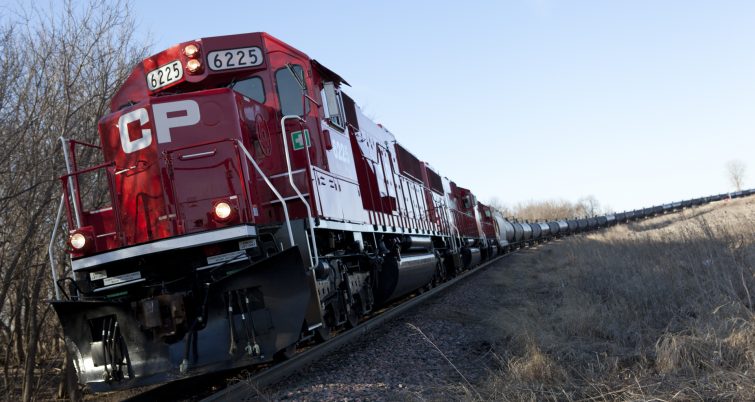
CALGARY, Alberta — Canadian Pacific is bracing for the possibility that crude by rail volumes could drop to zero amid a crash in global oil prices.
CP hauled a record 36,000-plus carloads of crude in the first quarter, Chief Marketing Officer John Brooks said on the railway’s earnings call on Tuesday afternoon.
But the economic slowdown related to the COVID-19 pandemic and the oil production dispute between Saudi Arabia and Russia have caused oil prices to plunge. Oil futures dropped below an unprecedented $0 a barrel on Monday and production has not fallen as quickly as demand, creating a lack of available storage space.
As a result, CP projects a steep decline in crude oil carloads. “It’s not inconceivable, given the volatility we’re seeing, that could move to zero,” Brooks says.
“It’s hard to tell what that goes to,” Brooks says, noting that volumes have been falling rapidly in recent weeks and the railway is projecting at least a double-digit decline in crude loads in the second quarter.
|
|
Article 6 -
SUPPLY CHAIN NEWS
Workers' Just-in-Time Moment
From the Black Plague of the Middle Ages to the flu pandemic of 1918 to COVID-19, disease and pestilence have always followed two of humanity’s most well-trod paths: those of war and trade.
When the plague ravaged Europe in the 14th century it took years to cross the Silk Road from Asia to Europe and then to cover that continent through the footsteps of traders and the mobile armies of the Hundred Years War. The influenza of 1918 followed the trenches and troop movements of World War I in months.
When the coronavirus hit Wuhan, it took just days to spread across China and only a couple of weeks to follow the supply chains and trade routes of today’s just-in-time capitalism—the warehouses, rail depots, intermodal yards, airports, sea ports, and all the interpersonal contact at the connecting points—to the Middle East, then Europe, then North America. By the beginning of March it had reached 72 countries.
Three decades of streamlining and refining the movement of goods along tech-enhanced but labor-intensive supply chains have accelerated the speed of disease transmission as well as of commodities and money. But the very speed of these taut arteries of commerce has also increased their vulnerability to disruption.
|
|
Article 7 -
AMTRAK RAIL NEWS
Amtrak to Require Masks for Employees
—
Effective today, Amtrak will require all customer-facing employees wear a facial covering of some kind — a mask if available— and strongly encourages all other employees and passengers to wear coverings. At Friday’s employee town hall, the first hosted by new CEO William Flynn, CEO asked employees to start each day with a new disposable mask or a freshly-washed cloth mask. He said the company now has disposable masks available at all staffed stations and crew bases. “We are not providing customers with facial coverings at this time; they are responsible for bringing their own,” said Flynn, adding, “If a customer refuses to wear a mask after an employee graciously asks, let it go. It’s not a requirement, just a recommendation.” In the question and answer session, obtained by Trains News Wire, Amtrak Executive Vice President and Chief Administrative Officer D. J. Stadtler, said that Amtrak is not requiring patrons to wear masks, “because we travel through so many states and localities where rules are different. We’re strongly encouraging; If they refuse, make sure the passengers are practicing social distancing away from employees and other passengers,” said Stadtler. While masks are not mandatory at shops, he noted that Amtrak “began distributing 415,000 disposable masks in the past few days and expects to receive over a half a million more in the coming week.”
— Canada’s Minister of Transport is also
asking passenger rail operators to require masks
or face covering for passengers. As part of measures announced Friday, which require masks or face covering for air passengers, Transport Canada is recommending that passengers are informed when buying a ticket that they should travel with a mask, and verify that passengers have such face coverings before boarding. Rail companies can set and implement their own policies, and are authorized to deny boarding to ensure the safety of their operations. VIA Rail Canada has subsequently said passenger are “invited” to wear masks, but they are
not required
except for international travelers using the train to reach their place of quarantine.
|
|
Article 8 -
INTERNATIONAL RAIL NEWS
Could sleeper trains replace international air travel?
Dutch airline KLM recently launched a new advertising campaign called “
Fly Responsibly
”. Remarkably, it seems to encourage viewers to fly less. “Do you always have to meet face-to-face?”, the advert asks. “Could you take the train instead?”.
European high-speed rail networks already offer an alternative to air traffic between European countries for distances shorter than 1,000 kilometres. For longer journeys, sleeper trains are becoming increasingly popular. These services run through the night and offer passengers a berth to sleep in. As more and more consumers question the ethics of their next flight, rail companies see an opportunity – and competition with airlines is heating up.
But can night trains help offset the international journeys that most people currently make by aeroplane?
The renaissance of European night trains
From 2009 until 2018, the European night train network shrank steadily. The same is true for conventional intercity train networks, especially in southern and western Europe. This made air travel the only alternative on many routes. But that
appears to be changing
.
|
|
|
|
|
|
|