Your Monthly News & Updates | |
|
The 16-Year Clark Tavern Saga Draws to a Close! | |
|
Lorraine Laverty, the last owner and resident of the 1740 Clark Tavern at 353 Main Street, died in 2007. Its history was rich, but its condition was poor. Because of its location close to the center of town, the acre of land was attractive to developers, who viewed the old tavern simply as a tear-down.
Sixteen years later, Open Space Builders is about to complete a satisfying long-term solution, although the historic building has not been preserved in the usual sense.
There was a glimmer of hope for preservation in 2012 when Fidelity executives John and Michele Linnert bought the old tavern with the intention of restoring and turning it into a restaurant and bed and breakfast. Over 1,000 Medfield residents signed an online petition of support, and the Linnerts drew up ambitious plans.
But three neighbors (all of whom I believe have since moved out of town) scuttled the idea. They filed objections in court, and each time the Linnerts accommodated them, the neighbors kept going out and finding new objections to file. Ultimately the Linnerts gave up and sold the property in 2018 to LCB, and Michele told me it was the worst experience of her life.
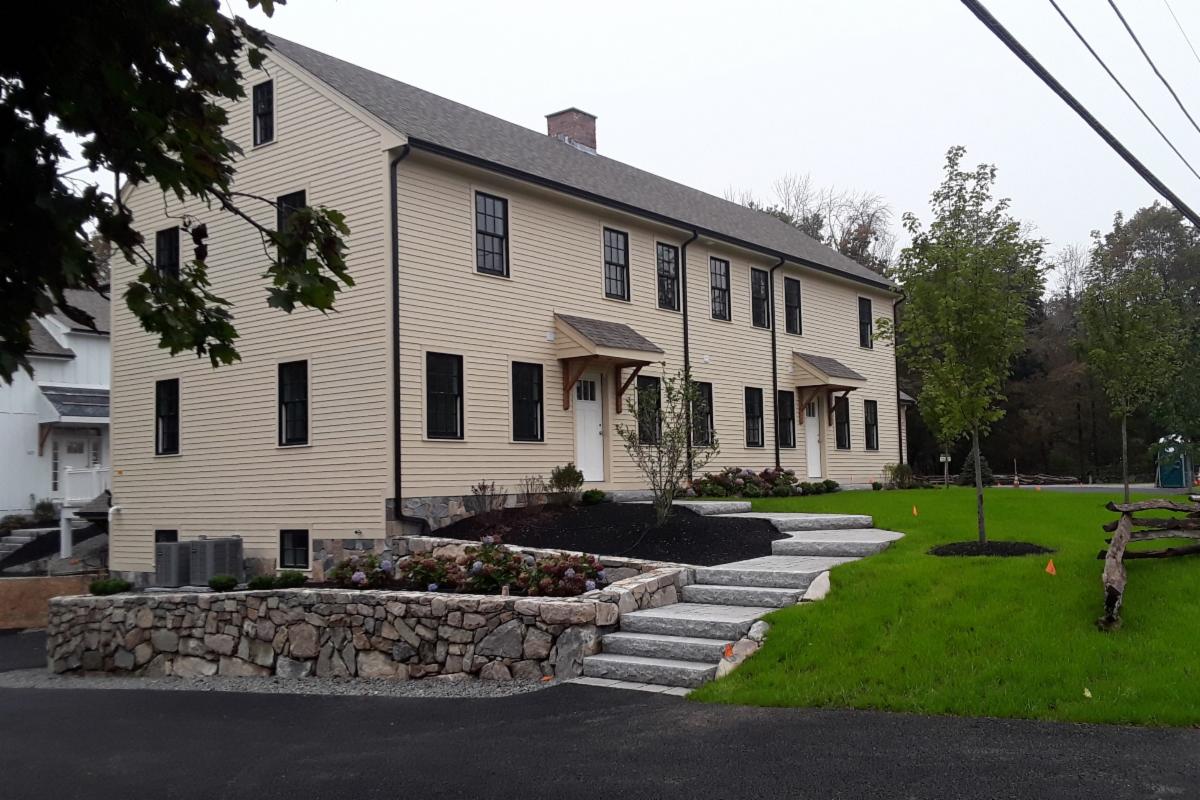
| 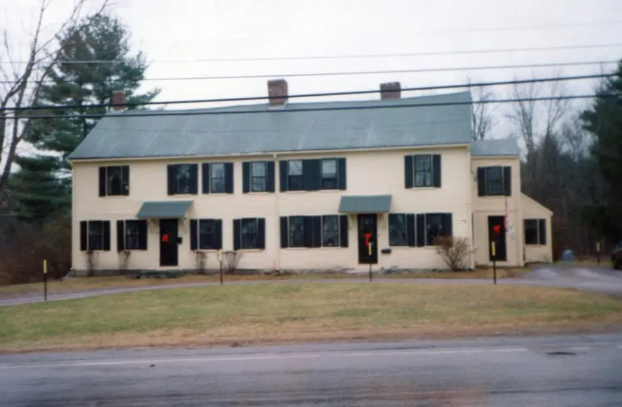 | The nearly completed replica of the Clark Tavern. Note the snake fence that runs from the driveway all the way up past the Peak House, part of which is visible in the back. It was Dave MacCready's idea to do this type of fence. Snake fences, aka worm fences, were widely used in the colonial era. The weight of the timbers kept everything in place, and the fences could be relatively easily moved when the need arose. This fence is made with 188 black locust rails, which will resist rot almost forever. | |
LCB hoped to build a 24,000-square-foot, three-story treatment and residential facility for people with Alzheimer’s. The proposal met with stiff opposition from Medfield residents. LCB ultimately abandoned the project and sold the property at a loss in 2021 to Dave and Rob MacCready’s Open Space Builders of Medfield.
The MacCreadys planned to restore the tavern building as two condo units and put up two other complementary-styled buildings with three more units. When the MacCreadys discovered the tavern building was in even worse shape than they expected, they took it down but used many of the nearly 300-year-old timbers in the replica building.
The buildings are nearly complete now. Two units have already been sold and will soon be occupied. Altogether they are much larger than the original, and people have lamented how they seem to dwarf the adjacent Peak House.
Though I would have preferred the Linnert’s B&B restoration plan, I feel the MacCreadys have come up with a very good solution, given the additional decade of decay in the original tavern. The MacCreadys have earned their money. We have a modern replica that is respectful of the original and is appropriate to the site. Worth noting: the little canopies that extend over the front doors are supported by brackets made from original timbers that have been remilled to fit.
| |
Return to Norumbega with Joe Hunter | |
|
Monday, Oct 2
7:30 pm
First Parish Unitarian Universalist Church
26 North Street, Medfield
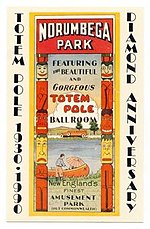
If you grew up in or near Medfield in the 1940s, 50s, or 60s, you’ll probably remember fun times at end-of-school-year outings to Norumbega Park with its tilt-a-whirl and other rides, penny arcade, and other attractions. Or maybe you even remember dancing at the Totem Pole ballroom. Here’s a chance, on October 2, for you to relive those happy days, even though the park itself was demolished and replaced in the 1960s by the Newton Marriott at the intersection of the Mass. Pike and Route 128.
The Medfield Historical Society will sponsor a showing of Return to Norumbega, a nostalgic and affectionate look at Newton’s Norumbega Park in its heyday. This documentary by Joe Hunter, a Newton resident and filmmaker who has created a number of award-winning films on local history, will be shown at the First Parish Unitarian Universalist Church on North Street in Medfield on Monday, October 2 at 7:30 p.m. Hunter will introduce his fifty-minute film and conduct a Q & A afterward.
Norumbega Park was an amusement park that drew hundreds of thousands from all over New England from 1897 until it closed in 1963. Located in the Auburndale section of Newton along the Charles River, the park featured canoeing, picnic areas, a penny arcade, a restaurant, a zoo, a carousel, and an electric fountain. Its Totem Pole Ballroom provided topnotch vaudeville entertainment, musical plays, comedies, and melodramas. It featured performances by Benny Goodman, Artie Shaw, Lawrence Welk, Ozzie Nelson, Frank Sinatra, Dinah Shore, and the Von Trapp Family, among others. Thousands fondly recall dancing at what was widely considered one of America’s most exciting ballrooms.
| |
John Thompson to Speak on Indigenous People in Medfield | |
|
Monday, Nov 13
7:30 pm
First Parish Unitarian Universalist Church
26 North Street, Medfield
In honor of National Indigenous Peoples month, John Thompson will be speaking on the topic of indigenous people's past in Medfield. Stay tuned for more information on what promises to be a fascinating program.
| |
New Bi-Annual Medfield Magazine on Tap | |
|
The Medfield Historical Society is in the process of producing a new bi-annual Medfield Magazine. This magazine will serve as a permanent record of town clubs, local businesses, historical sites, and annual events. In addition, each edition will include feature articles that dive into the rich history of Medfield – past and present.
Members can share a photo and a short memory which will be included in this publication and preserved at the society for generations to come. Current members should simply email a photo, a short title, and up to 50 words to PeggySue Werthessen.
Not sure your membership is up to date? Feel free to pay your dues now and it will be extended through 2024.
| |
Our dream is to expand distribution beyond members and to deliver a physical copy to every home in town. But, in order to make this dream a reality, we must raise enough funds to cover the cost of printing and distribution. If you are interested in purchasing an ad to support this effort, please email Yumi Jones.
For a sneak peek at the magazine, click here.
| |
Eleven Thousand Seven Hundred and Four! | |
|
by PeggySue Werthessen
Several months ago, I was talking to Selectman Pete Peterson about our dream of increasing public access by digitizing the collections at the museum. Although excited, I was overwhelmed by the task ahead of us – starting with the massive collection of index cards that had been lovingly typed and organized by the late Toni Hurd who served as Archivist at the society from 1972 to 1992.
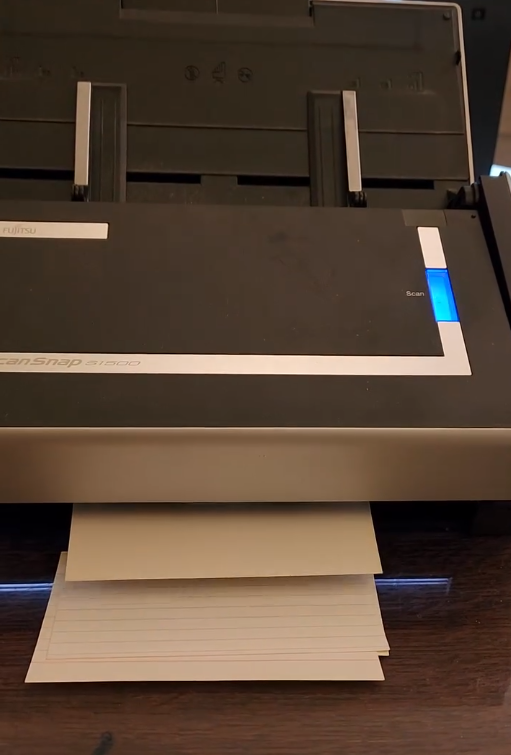
By my estimates, there were about 13,000 catalog cards - each reflecting an item added to the collection during the first 100 years of the society's existence. Scanning each card - front and back - using a traditional scanner was going to take almost as long as typing them in the first place. But, it turned out that Pete Peterson had the perfect solution – a high end document scanner with a hopper and which he was willing to let us borrow for the summer.
| |
The last card – number 11,704 – being scanned. | |
|
I am happy to report that it worked perfectly! If you were to visit the museum in the last few months, you might have seen us feeding batches of index cards into a scanner. Each scanned card – both front and back – is now stored into an individual PDF file. And, for the 90% of the cards which were typed (vs hand written) they are now searchable. For example, a search of the text "Lowell Mason" results in a list of 63 index cards while a search of the word "Indian" results in 23 results.
In the end, we didn't have 13,000 cards... only 11,704.
We have much more work to do and still need to raise additional funds so that we can invest in the technology needed to make these resources available online but it is a great step forward. Looking forward to sharing it with you!
| |
Your copy should address 3 key questions: Who am I writing for? (Audience) Why should they care? (Benefit) What do I want them to do here? (Call-to-Action)
Create a great offer by adding words like "free" "personalized" "complimentary" or "customized." A sense of urgency often helps readers take an action, so think about inserting phrases like "for a limited time only" or "only 7 remaining"!
| |
The Medfield Inventor of the Roller Skate | |
October is National Roller Skating Month, according to the Roller Skating Association International of Indianapolis, Indiana. – news item | |
Roller blades, skateboards and roller skates are popular forms of entertainment that are seen on the streets, sidewalks, skate parks, and rinks all over the world. All trace their roots to Medfield and to the invention of the first successful modern roller skate by James Plimpton.
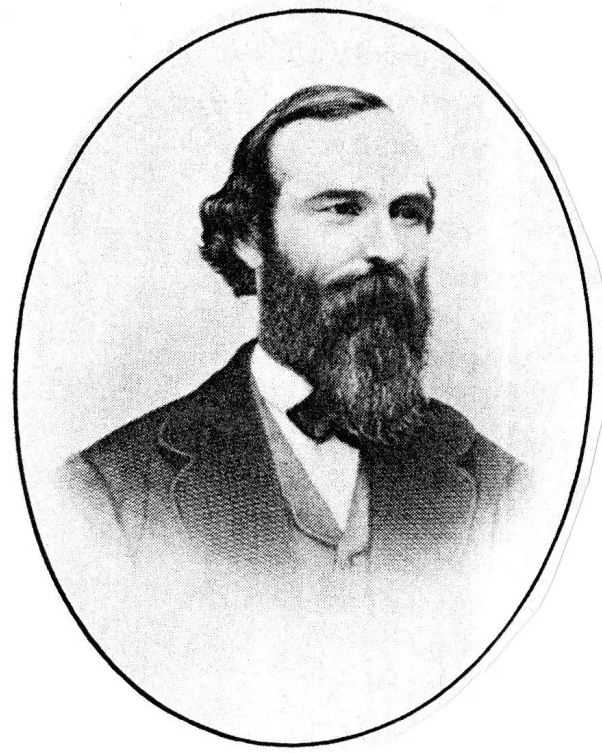
James Leonard Plimpton, the fifth of nine children born to Leonard and Sarah (Lane), was born on April 14, 1828. The Plimptons lived at 230 North Street, Medfield, next to what is now the hunt club land. As a boy in rural Medfield, James was brought up helping his father with the small family farm and with his father’s business of manufacturing cloth, which was run out of a small shop by their house.
James attended the nearby North School at the corner of North and Harding Streets. As a boy, James was a tinkerer who was fascinated with machinery. In that time of the Industrial Revolution, James was a natural mechanical genius. At age 16 he was apprenticed to a nearby machine shop, and before his 18th birthday he was foreman in a large machine shop in Claremont, New Hampshire. When James turned 21, he joined his brother and opened a business in Westfield, Massachusetts building machinery. Later, James opened a furniture business on his own in New York City. The young New England entrepreneur was making money and developing life-long business skills.
| |
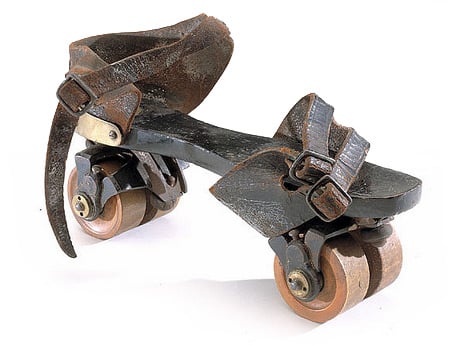
Early roller skate by James L. Plimpton. | |
|
At age 32, during the winter of 1860–1861, James’ health began to deteriorate. On advice from his doctor, James took up ice skating, getting out in the fresh air of the ponds in Central Park. Plimpton noted an immediate improvement in his health.
Once spring set in and ice skating was no longer possible on the ponds, James wanted to find a way to continue his healthy exercise. In New York City, Plimpton invented the modern roller skate. His invention copied the ice skate, making it possible to duplicate the graceful type of skating he was able to do on the pond’s ice.
Plimpton’s “land” skates used two rollers under the ball of the foot and two under the heel. They were so arranged that both sets of wheels would rock in the direction in which the skater leaned, making possible the graceful curves of ice skating. His skate could be controlled by foot pressure. The wheels were made of boxwood. He called his invention “parlor skates.”
Click here to read more >>
| |
Medfield Murders, Body Snatchers, and Halloween | |
|
Editor's Note: This story was originally run in the October 2020 issue of the Portal, but it's always a good one to revisit at Halloween.
It is perhaps the strangest and most horrifying story in all of Medfield history. The fact that events unfolded on Halloween just adds to the intrigue.
This very spooky tale takes place here in Medfield back in the year 1802 and involves both the Mason and Allen families. Asa Mason, at the time, lived on the Mason farm in the very northeastern part of Pine Street, at the Dover line. Today this would be the property at the very end of Overfield Drive.
|  | |
At age 75 Asa was not in good health, and his mind was showing memory loss and fatigue. Normally the oldest son would be called upon to take control of the family farm, but Asa’s oldest son, Ebenezer, had a history of being mentally unstable. Therefore, Asa bypassed his oldest son and turned over the care and control of the family farm to his son-in-law William Pitt Allen, who had married Asa’s daughter, Kezia.
This decision enraged Ebenezer, who felt that control of the farm should have been his.
On May 18, 1802, the two men were fertilizing the fields, which extended down along Pine Street, when Ebenezer came up behind William Pitt Allen and viciously bludgeoned Allen at least six times, slamming the shovel into his head. Ebenezer then fled. Horrified family members came across Allen’s dead body several hours later.
Click here to read more >>
| |
People and Places of the Past | |
Hitchhiking to Medfield and Beyond | |
|
While most Americans today can’t fathom the thought of hitchhiking, many people at an earlier time would routinely stick out their thumbs on the side of the road. There were many different reasons that led people to hitchhike and why hitchhiking became acceptable.
Hitchhiking was once a common form of getting around for students and travelers of all ages. But it had an overtone of being something reserved for desperate or unsavory individuals. Billy Cook’s 1950 murder spree was the basis for The Hitch-Hiker, a 1953 American film noir co-written and directed by Ida Lupino, starring Edmond O’Brien, William Talman, and Frank Lovejoy, taken hostage by a hitchhiker during an automobile trip to Mexico.
When cars were less plentiful and gas was rationed, hitchhiking was common in the Depression in the 1930s and the World War II years and its aftermath in the 40s.
Hitchhiking was a bit less common the 50s, but a big resurgence took place in the 60s and 70s. Hitchhiking, aka “thumbing,” was common and socially acceptable, and drivers seemed more sympathetic and inclined to pick someone up and enjoy the company.
By the 80s, people seemed to change. People were less inclined toward the hippie ethos of cooperation and more inclined to the yuppie ethos of looking out for themselves. Hitchhiking may never recover.
At one time in Medfield, many young people used to hitchhike to different parts of the state and beyond. I remember back in the summer of the early sixties, when Ronnie Kerr and I took the Trailways bus from Medfield to Park Square in Boston. We grabbed a couple of slices at the King of Pizza on Washington Street and took the subway over to Kenmore Square to catch the Red Sox.
Click here to read more >>
| | | | |