Civil Jury Project

Volume: 10| Issue 1

Winter: 2025

 
Opening Statement


North Brooklin, Maine,

30 March 1973


Dear Mr. Nadeau:


As long as there is one upright man, as long as there is one compassionate woman, the contagion may spread and the scene is not desolate. Hope is the thing that is left to us, in a bad time. I shall get up Sunday morning and wind the clock, as a contribution to order and steadfastness.


Sailors have an expression about the weather: they say, the weather is a great bluffer. I guess the same is true of our human society — things can look dark, then a break shows in the clouds, and all is changed, sometimes rather suddenly.


It is quite obvious that the human race has made a queer mess of life on this planet. But as a people we probably harbor seeds of goodness that have lain for a long time waiting to sprout when the conditions are right. Man’s curiosity, his relentlessness, his inventiveness, his ingenuity have led him into deep trouble. We can only hope that these same traits will enable him to claw his way out.


Hang on to your hat. Hang on to your hope. And wind the clock, for tomorrow is another day.


Sincerely,

E. B. White


Given the recent news I thought E.B. White's beautiful letter responding to a man despairing of the future was a good place to start this winter edition.


Less than two weeks ago news outlets reported on the recent Gallup poll that showed public opinion of the U.S. court system was at an all-time low. According to the poll, Americans' confidence in their courts plunged from 59% to 35% over a four-year period. This is a record low.


Pundits attributed this to a variety of causes including recent decisions by the Supreme Court, Supreme Court justices receiving gifts, the influence of politics on judicial appointments and certain high profile jury verdicts that were either applauded or booed depending on political affiliation.


The poll was a general one that dealt with the entire judicial system. What the poll did not address was the attitude of jurors towards our system of justice after completing jury service.


From academic research, informal polls by judges and just talking to jurors after a case we know that jurors generally have a more favorable opinion of our jury trial system after jury service.


Accordingly, we will continue to "Wind the Clock" here at the Project. We will continue our mission to be a resource for judges and attorneys who try jury cases. We hope this effort ultimately aids the jurors who decide our cases and results in them having a more favorable view of our system of justice.


We begin with a contribution by one of our Judicial Advisors, Judge Jack Zouhary. Judge Zouhary took up our invitation to write for the newsletter and we truly appreciate him reaching out to us.


Reading Judge Zouhary's bio brought me back to a time when times were not so politically polarized. He was unanimously confirmed by the Senate on a vote of 96 to 0.


We then turn to our "Winding the Clock" column featuring some work we did in the last quarter and a look forward to 2025. We finish with a piece on the power of silence. A topic perhaps welcomed after all the shouting from this last political season.


As always, if your court or bar association is interested in a presentation on jury trials, the Civil Jury Project or jury improvement tools please call me at (217) 430-7459 or contact me at markd56.md@gmail.com.


If you have a jury trial topic that you would like to write about, please reach out to me at markd56.md@gmail.com.


Sincerely,

Hon. Mark A. Drummond (ret.),
Executive/Judicial Director

 
Upcoming Events

January 17, 2025

Trials in a Post-Pandemic World South Carolina Bar Convention

Trial & Appellate Advocacy Section

8:30 - 11:45 a.m.

Columbia Metropolitan Convention Center

Click for information

View All Events


On Your Mark, Get Set . . .

By Hon. Jack Zouhary


Voir dire is often discussed but not well understood. Movies which depict jury selection simply do not reflect reality. Further, procedure varies from court to court, even judge to judge in the same courthouse.


Some judges are totally hands off --letting the trial lawyers do all the questioning. Sometimes the lawyers and the judge battle over who should lead the discussion; sometimes a panel can be seated in just a couple hours. (A court reporter tells me that a recent voir dire took one and a half hours -- the shortest in her 20-year career.) Sometimes it takes all day or longer.


Of course, “one size does not fit all.” And the needs of each case may differ. Likewise, the questioning may differ too. The length of time will depend on the number of lawyers, the number of parties as well as the complexity of the case.


To get ready for a jury trial, a Trial Order should set out dates for pretrial filings, including a date for counsel to suggest voir dire questions. A questionnaire is sent out to a random pool to complete before jurors arrive at the Courthouse.


The name of the case is not yet mentioned to avoid a clever search of the public docket. But some questions mention the general nature of the case (e.g. civil or criminal, guns and drugs, breach of contract, personal injury, etc.).


Follow up questions in court allow counsel to gage potential conflicts for that particular kind of case. The pool then returns completed questionnaires by mail or email. Some members, after review by the Clerk, are excused or deferred if they have a legitimate excuse (work demands, medical condition, prepaid vacation, etc.).


The juror is asked to provide more information or documentation as needed to verify the excuse. When enough “good” questionnaires are received -- usually 25 for civil or 35 for criminal single party cases -- we share those completed questionnaires with trial counsel a day or two before trial.


This allows counsel to do whatever background or social media research they may wish to conduct before they actually meet the jurors in the courtroom. When this information is released to counsel, we caution counsel they can make no contact with the prospective jurors.


We gather on the first day of trial and start with any agreements or stipulations with respect to cause based solely on the questionnaire responses. I display a PowerPoint which emphasizes the importance of jury duty, the history of jury trial, and the civic responsibility for all American citizens.


The PowerPoint continues with a number of general topics, such as potential witness

names, and other questions to discern if the juror can be “fair and impartial.” At the end of that presentation, we have a conversation with individual jurors if there is something in their questionnaire which needs to be explored or explained.


I close the PowerPoint with individual conversations allowing the jurors to talk a little about themselves: “Describe your job / Spouse / Children -- what do they do; Hobbies / Interests / Sports; Books / TV Shows / Movies; You may be surprised to know. . . .”


These individual conversations allow counsel and me to get a feel for

each juror. Some are quite talkative; some more shy. Each juror is given an opportunity to become comfortable in what is usually a once-in-a-lifetime courthouse experience.


For a straightforward four-day trial, we can select a jury in the morning and in the afternoon proceed with opening jury instructions and openings arguments of counsel -- sometimes the first witness too.


And how does it all end? When it is time to deliberate, the jury is sent back with the

appropriate instructions and verdict forms along with a home-made “Deliberation Cake!” After they reach a verdict and it is announced in open court, they complete another questionnaire -- this one an evaluation of me and my staff and suggestions for improvement.


Jurors are then welcomed into Chambers to ask questions of me. They are advised they can choose to visit with counsel in the Courtroom for further conversation.


The most often asked question of me by jurors is: “Did we do the right thing?”

Usually the jurors are appreciative of our efforts to accommodate them and make their experience a positive one. And usually they report the experience was much better than they expected.


We all agree jury service is an important civic function. We should also agree to do all we can to make that service a positive experience.


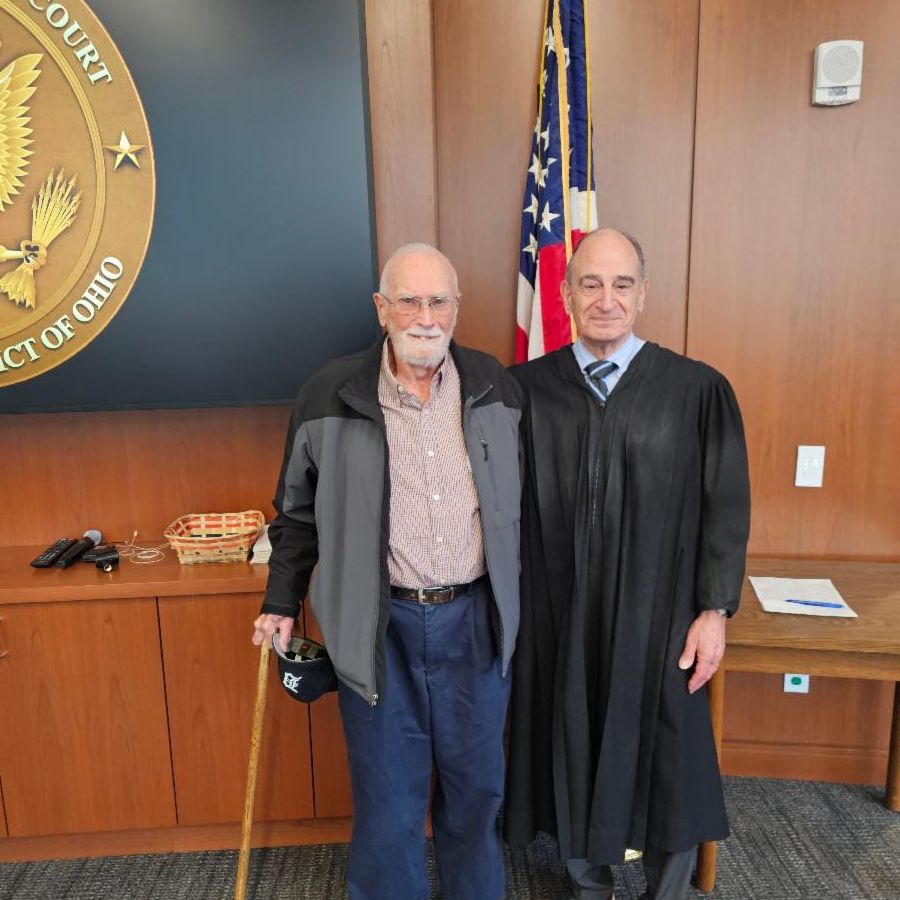
I close with a picture of me and Richard, who recently reported for jury service. He could have been excused due to his age of 90. Although he did not make the final cut, he received a round of applause for his appearance, driving an hour and a half away from our Courthouse.


Here is our brief colloquy:


The Court: Number 17 Richard, how shall I call you?

Juror: Dick. I am retired.

The Court: Dick gets an award. He is the oldest juror, I hope I won’t embarrass you, that I’ve had since I have been on the bench.

Juror: Judge, you don’t have to bring my age up.

The Court: I’m not going to tell them your age. I am going to say he could have opted out, but he chose to do his civic duty and be here today. Thank you for that.

Juror: My wife passed away in July. I have four children. They’re all retired. Thank God. And I used to play golf and softball, but I don’t do any of that anymore. And I watch a little TV now. And I, in 2020, retired after 60 years on the volunteer fire department.

The Court: Thank you for that service as well. You’ve been granted a good long life.


A real-life scene you will not find in the movie “Jury Duty” or “Juror #2.”


Judge Jack Zouhary with Richard

Hon. Jack Zouhary graduated cum laude from Dartmouth College (’73) and received his

law degree from the University of Toledo (’76). He practiced law from 1976 to 2005. He was appointed by the Ohio Governor to the State Court of Common Pleas in March 2005, and then nominated by the President to the federal District Court in December 2005, with unanimous Senate confirmation in March 2006. He has served as a visiting District Court judge in ten states and has sat by designation on the Sixth and Ninth Circuit Courts of Appeals. Judge Zouhary was inducted as a Fellow of the American College of Trial Lawyers (ACTL) in 1995 and remains active in several committees. He served on the Advisory Board of the Institute for the Advancement of the American Legal System (IAALS), and on the Standing Committee on Rules of Practice and Procedure of the Judicial Conference of the United States. He is a Master and past President of the Morrison Waite Chapter of the Inns of Court.


His unanimous confirmation by the Senate was on a vote of 96 to 0.


Winding the Clock


By Hon. Mark A. Drummond (ret.)

Executive/Judicial Director of the Civil Jury Project


Here are some of our efforts to "Wind the Clock" from this past quarter and upcoming in 2025.


Advocacy Training for Legal Services Lawyers-December 2024


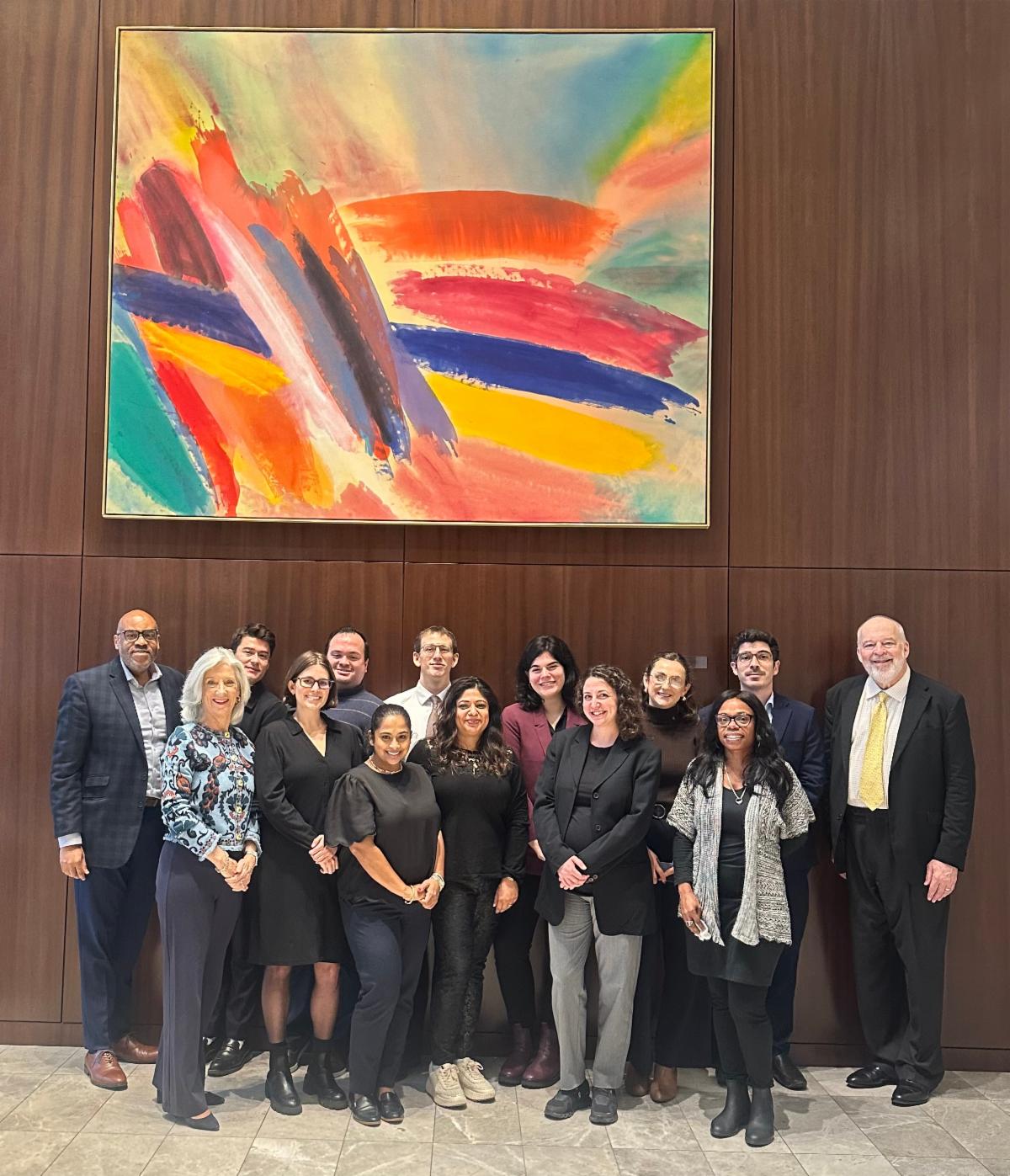
 Above is our class picture with attorneys from Access Justice Brooklyn, New York Legal Assistance Group (NYLAG) and the New York County Lawyers Association (NYCLA) We thank the firm of Gibson Dunn for donating space in their New York office for this training. NITA (National Institute for Trial Advocacy) trainers Mark Drummond and Mariana Hogan led the program. Below are some of the comments received.


“Thank you Mark and Mariana for a wonderful three days. Your knowledge and expertise have been invaluable. I know that we will take all the skills into our everyday work.”


“Mark and Mariana, thank you for imparting your years of knowledge and expertise with us. I had an outstanding learning experience and wonderful time during the last three days. Something that I was anxious about [yet] you both made me feel at ease. I only wish this was longer.”


“I thought the program was great - I appreciated the balance between lectures and skill workshops. During lectures, I found it very informative to hear about real life examples.”


A2C Skills Training-December 2024


“Wonderful program! Fantastic instructors!”


“This was an excellent training - thank you so much!”


“Wonderful program, distinguished faculty, thank you so much.”


“I had an excellent experience! So appreciative of all the faculty.”

-sample comments from participants


We participated in the Access to Counsel (A2C) training sponsored by the Federal Bar Council and the American College of Trial Lawyers (N.Y. Downstate Chapter). The program is offered in partnership with the American College of Trial Lawyers and the National Institute for Trial Advocacy (NITA).


This advocacy training was for attorneys who volunteer to be appointed by the court to assist civil pro se litigants. The attorneys had the benefit of some of the top trial attorneys from the area with three faculty members per courtroom. All of the skills sessions were recorded so the attorneys could receive additional feedback immediately after the skills session.


The training was held in courtrooms at the Daniel P. Moynihan US Courthouse.

Thanks to the judges and the staff at the courthouse for adding realism to the training.


South Carolina Bar-January 2025


As featured in our Events section at the beginning of this newsletter, I will be speaking at the South Carolina Bar Convention to the Trial & Appellate Advocacy Section on the topic of Trials in a Post-Pandemic World.


The topics to be covered are:

Trial in a Post-Pandemic World

Addressing the Backlog of Civil Cases

Packing the Most Persuasion into the Shortest Period of Time

Navigating the Remote World for the Trial Lawyer & Trial Judge


January 17, 2025, 8:30 - 11:45 a.m.

Columbia Metropolitan Convention Center

Click for information

Trial Tactics Article:

Silence is Your Friend


By Hon. Mark A. Drummond (ret.)

Executive/Judicial Director of the Civil Jury Project


Given the recent deluge of information from a variety of sources; some valid, some biased and some seemingly divorced from reality, I chose the topic of silence for this edition of Trial Tactics.


Moreover, given the above, I am adding a quote, versions of which have been attributed to both Abraham Lincoln and Mark Twain.


"Better to remain silent and be thought a fool than to speak and to remove all doubt."

“Silence is Golden” – Proverb: Ancient Egypt


“No word was ever as effective as a rightly timed pause.”

– Mark Twain's Speeches (1923 ed.)


As trial lawyers, words are our stock in trade. We have many tools at our disposal for

persuasion. In addition to our words, we have exhibits, demonstratives, and the emotion we put into our words. However, this article is about a little talked about tool in our arsenal. The tool of silence. I believe silence aids us in three distinct areas.


Depositions


Many times, just being silent gets you more information. It is the old reporter’s trick. You just throw a good short, open-ended question out there and then shut up. You just sit there…maintaining eye contact…and just nod…and nod…and nod. Most people hate silence, especially while under pressure.


Law enforcement agents know that silence is an effective tool for investigations. Silence is uncomfortable for many people. They will want to “break” the silence and many times useful information will come out.


However, it takes discipline to remain silent. The inexperienced advocate will ask a question, break eye contact, perhaps write a lengthy note and be thinking of, or looking at, their next question. All this activity takes their focus off the deponent. When the inexperienced advocate is doing this, that or the other thing the pressure lessens on the deponent.


The experienced advocate during the fact- gathering phase of the deposition will ask a broad, open-ended question to get the most information, such as, “List for me everything you did after getting this text.” They will maintain eye contact and just nod as the deponent starts listing each item.


There is no need to break eye contact since, if the deponent gives a long answer, the

attorney can ask the reporter to read back the answer. To make sure it is “everything”

experienced counsel will then ask, “Anything else?” followed by silence until the deponent finally says, “No, that is everything.”


Then after gathering all the facts the experienced advocate may choose to theory test with questions such as, “In hindsight, what could you have done to avoid this situation?” Most times the deponent will blurt out, “Absolutely nothing!” But if the attorney immediately moves on and doesn’t ask, “Really, nothing you can think of?” followed by absolute silence, they will never get the occasional, “Well, this is really all your client’s fault, but maybe I could have called earlier.”


I am not saying that silence will work each and every time with each and every witness. But, if you ignore the power of silence, you have one less tool to use in questioning.


Finally, silence can be one of your most effective tools to deal with opposing counsel

who might be less than professional. Not rising to the bait is professional, perhaps tactically the best option and, in many cases, has the added benefit of really getting under their thin skin. Regardless of what they are doing, you are professional. However, you treat them as if they are not even in the room.


Cross-Examination


You’ve asked a simple, one-fact question to which everyone in the courtroom knows can be answered “yes” or “no”. You don’t get the simple answer. Instead, the witness serves up a long-winded explanation.


Now, some advocates attempt to interrupt to the dismay of both the judge and court

reporter. Others, jump in right at the very end of the answer with a frantic, “That’s not what I asked you” and then repeat the question quickly.


However, an effective option is silence. You’ve asked the plaintiff’s chiropractor,

“Doctor, Ms. Smith came to you three weeks after the accident, true?” He then serves up a 125-word, minute and a half, discourse beginning with, “Well, counsel that’s not atypical in these severe injury cases since…blah, blah, blah, etc.”


Many attorneys will attempt to interrupt. This usually draws an objection, resulting in three people talking over each other. In turn, this draws the ire of the judge and the court reporter. Consider silence instead.


You simply pause, totally silent for a few seconds, perhaps you look towards the jury and in a low, measured tone, parse out, “Now Doctor…Ms. Smith…came to see you…three weeks…after the accident, correct?”


Everyone in the courtroom knows you’re entitled to a “yes”, and nothing more. Silence can be devastating on cross.


Openings and Arguments


Listen to Gregory Peck’s closing argument as Atticus Finch in To Kill a Mockingbird. It is a master class in the power of the pause.


Finch’s main argument is that the victim was beaten by a person who was left-handed. He then delivers this line, “…and Tom Robinson now sits

before you…having taken the oath…with the only good hand he possesses…his right.”

The silence after the delivery of that line is over 12 seconds. You can even hear a car honk outside.


“Comedic timing” is a well-known phrase. The classic example is from the comedian,

Jack Benny. It was first done on radio. This is even more impressive since it relies on silence as opposed to any visual for comedic effect.


Benny created a character who was notoriously cheap. A robber surprises Benny and says twice, “Your money or your life.” Benny pauses, silent, for over 12 seconds and the audience immediately starts laughing until he delivers the punch line, “I’m thinking it over!”


Perhaps one of the greatest real-life examples is Rev. Dr. Martin Luther King Jr.’s I Have a Dream speech. Dr. King not only pauses at the end of a sentence, but pauses between important phrases within each sentence.


So, why does silence work? It works because the listener needs time to think about what you just said. The pause helps your great points sink in better. Silence also helps you. Pauses give you time to think.


The inexperienced advocate feels they must constantly be filling the void

of silence with sound. Sometimes the sounds coming out are not even words. They are the “and’s” and “uhm’s” of the nervous speaker. Give your audience … and yourself … the gift of silence with a well-timed pause.


This article began with a quote from a humorist, but I shall end with a quote from a

pianist. The great Artur Schnabel said, “The notes I handle no better than many pianists. But the pauses between the notes - ah, that is where the art resides.”


Resources:


Colin Schmidt, Interrogation - The Lever of Silence, LinkedIn, (July 20, 2022).


Hon. Mark A. Drummond (ret.), Long Answers to Short Questions: Crossing the Expert Who Can’t Say “Yes” , Litigation News, Volume Vol. 49, No. 1, (Fall 2023).


Hon. Mark A. Drummond (ret.), Dealing with Jerks, Litigation News, Volume Vol. 37, No. 1, (Fall 2011).


To Kill a Mockingbird, Robert Mulligan: Director, Harper Lee: Story, Universal Pictures, (1963).


Jack Benny, Your Money or Your Life, YouTube, VistaRecordsBoard.


Rev. Dr. Martin Luther King, Jr., I Have a Dream, August 28, 1963, YouTube, Rare


This article was first published on December 25, 2024 in Litigation News, a publication of the Litigation Section of the American Bar Association.


The Hon. Mark A. Drummond (ret.) is the Executive / Judicial Director of the Civil Jury Project. He was a trial lawyer for 20 years before serving on the bench as a trial court judge in Illinois for 20 years. He is a program director and co-director for Teacher Training for The National Institute for Trial Advocacy. For over 25 years he has written the Practice Points column for Litigation News, a publication of the Litigation Section of the American Bar Association. He is licensed to practice in Illinois and has applied to practice in New York.


Look out for the Spring 2025 Newsletter!


Contact Information
Civil Jury Project, NYU School of Law
Wilf Hall, 139 MacDougal Street, Room 407, New York, NY 10012
markd56.md@gmail.com
Follow Us
 
Facebook  Twitter  Instagram  Youtube  
Donate to the Civil Jury Project
 
Stephen Susman
Founder
1943 - 2020
Samuel Issacharoff
Faculty Director

Mark Drummond

Executive/

Judicial Director

Michael Shammas
Research Fellow
Kaitlin Villanueva
Admin. Assistant