Advent at FPC Boise


Friends, welcome to the third week of our Advent Devotion:

“The Faith We Await: the Word Made Flesh.” 


This season we are imaging how to bring fuzzy and amorphous ideas into a focus. Advent is about BIG ideas. It is about the incarnation of aspirational naivete—we actually hold have faith that impossible ideas can come true—can be made flesh and live among us. And so each week we will bring one such idea into focus through scripture, anthem, written reflections, artwork, poetry, and prayer. We begin this week with the prophetic imagination around messianic hope—HOPE made flesh, we will continue with JOYous witness, embracing LOVE, and PEACEful presence. Through this booklet or email we hope you will journey with us, write down your responses, re-visit them through the week and move from remote and conceptual to an articulated and concrete reality of the Word made flesh.

December 22nd

Peace in Song


Sunday’s anthem focused on the nature of Christ as one who set aside power (or as Philippians puts it, “what it means to be God”) to be in full solidarity with the powerless. We drew upon this to help us think about a peace that is not built through power, domination, or intimidation—but a peace that is built through vulnerability and inter-dependance.


In the first verse of the anthem, we hear:


Thou who wast rich beyond all splendour, All for love's sake becamest poor.

Thrones for a manger didst surrender, Sapphire-paved courts for stable floor.


I think it is easy for us to forget how bold this claim is… Jesus chose to forgo the advantages of wealth, power, and, well, being God. And that had a cost—his very life. Do people actually willingly give up power? Who are people you have seen model this kind of purposeful power-less-ness?


Can you think of a time when you had an advantage or extra power and resisted using it because it felt unjust or unfair?  Can you think of a time you didn’t resist?


Can you think of ways today that you might have power that is preventing true peace? What is the cost of giving that up? Are you willing to pay that cost?


In the second verse we hear:


Thou who art God beyond all praising, All for love's sake becamest man

Stooping so low, but sinners raising, Heavenward by Thine eternal plan


Solidarity is the word we use for standing alongside a group to share their predicament and the responsibility for overcoming it. The “word made flesh” is an ultimate act of solidarity—choosing to BE human, and from within the experience of humanity to shape our lives to reflect God’s Kingdom. This make God’s kingdom something that is not imposed from outside of us… but grows peace from within—ground up! We hear this kind of solidarity because Jesus doesn’t just descend into humanity (become man)—he also lifts up what it means to be human (sinners raising)!

Who in our community are we called to stand with in solidarity?


What ways could we do expand that work deeper and wider?


Jesus removed barriers to create unity and tear down walls—even the wall created by good things… like being our Creator!  How do we make sure when we do solidarity and mission that it isn’t like a “white knight” saving people, but more like seeing, hearing, embracing, and empowering our neighbors in a Jesus way? 

Thou who art love beyond all telling

Saviour and King, we worship Thee

Emmanuel, within us dwelling

Make us what Thou wouldst have us be

Thou who art love beyond all telling


A significant motivator to greed (and war!) is the idea that there is not enough to go around—so if someone else gets something, you must be losing it. The hymn repeats “love beyond all telling.” I think it is important that remember God has more than enough love to go around, because this means we don’t need to compete for it. It is in infinite

resource—and there is more than enough for all!


Have you ever found yourself accidentally treating love like a scarce commodity to

compete for?


Competition for resources, righteousness, and respect fuels the divisions that rob our world of peace… Jesus gave all that away when he set aside divine power, hung out with sinners, and confronted those in power and prestige. This—Jesus says—is the way that makes for peace. 


What are three ideas that come to mind about how you can follow Jesus' example to be this kind of peacemaker?


December 23rd

Reflecting on Peace Made Flesh

by Christine Caven


One of my most treasured values is Peace. I don’t just mean peace on earth—although of course I mean peace on earth (we miss you, Skip Dautel!). I'm talking about maintaining a place of peace in my mind, knowing how to bring peace to my body, and understanding how to construct peace in the physical spaces I inhabit. I'm learning! But I fail often, and so I often call myself a chaos monster, because while peace is one of my core values, I really do love a mess, too.


When people shake their heads in confusion at how much I love teaching middle schoolers, or hear me being disruptive in the back row with the high schoolers, or witness me galloping around with elementary school students, they say, "Isn't it just like herding cats?" I usually just shrug and smile. I've always hated that metaphor. It's not like herding cats; it’s like being fully human with other humans.


As I sit down, out of breath and reticent to return to my "adult" duties, I sometimes wonder if my core value of Peace is working against my chaos-loving nature. But I don't think so.


I think that Peace is meant to make its home in chaos.


Honestly, that's the only place that it can be born. As I work to nurture peace in my mind, my body, and my spaces, I learn what it means to exist in chaos without being swept away by chaos. Peace itself does not require silence, orderliness, or "good" behavior in order to grow. Peace-made-flesh is within the noise, the questions, the laughter, the chaos, and the mess. Peace-made-flesh is the ability to exist - and to stay relevant and ALIVE - while the rest is still unfolding. Peace is knowing that I am "at home" with a rowdy 7-year-old and "at home" with a book and tea.


It's Advent. And Hope, Joy, Love, and Peace are arriving... and HAVE arrived. The arrival of the Prince of Peace did not signal the end of chaos. Rather, it showed us that Peace is always in generative tension with chaos. Jesus' incarnational presence did not erase disorder... it entered it. It sat down crisscross-applesauce with it, it told the truth inside of it, and it loved people right where they were. Like a human, being a human.


Living the mission of Jesus is an energetic dance between the chaotic beauty of God's beloved... us... and the Peaceable Kin-dom of God, of which we are citizens. Amen?!


December 24th

Peace Made Flesh Imagined

by Cora Holliday


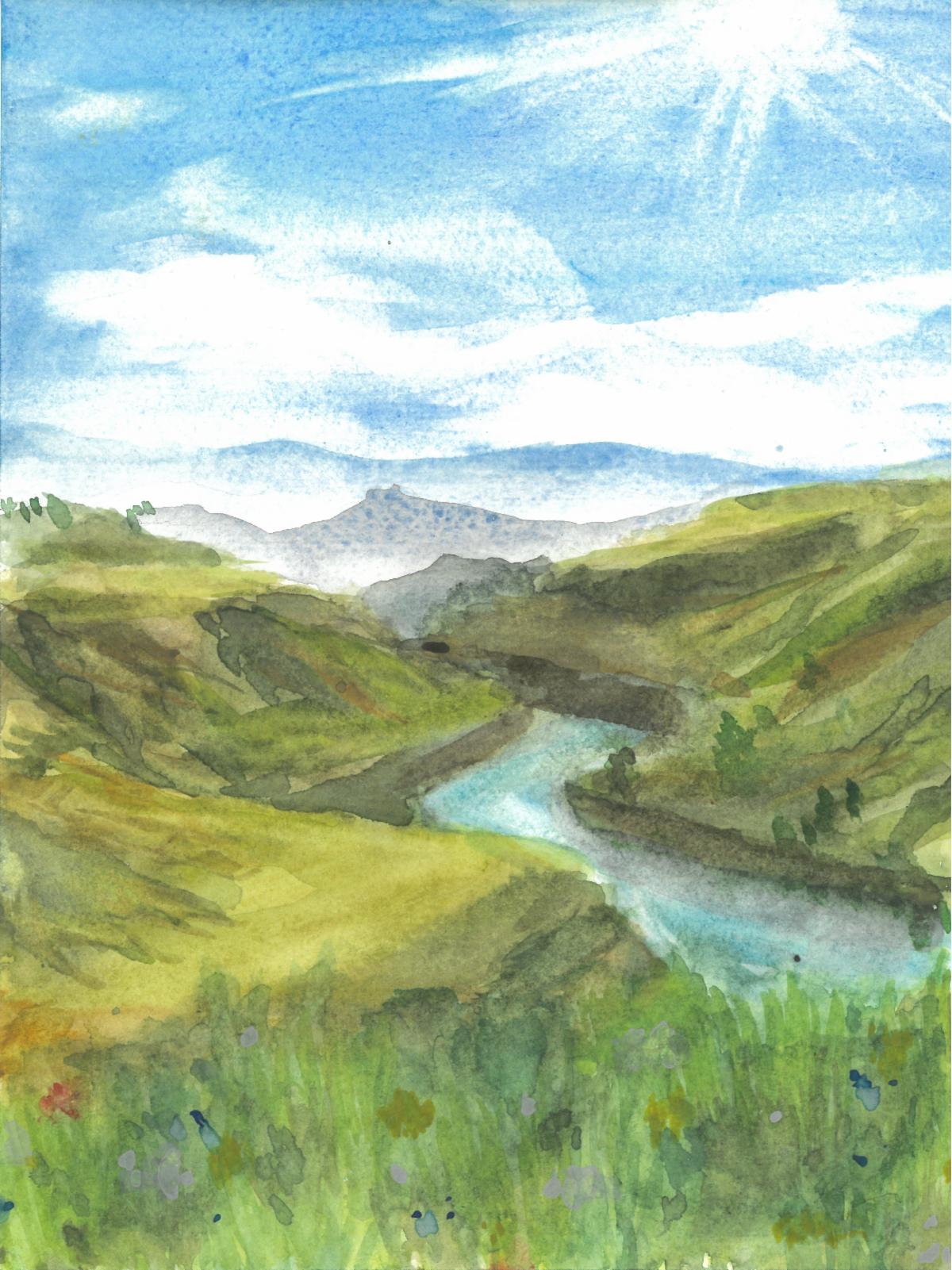
Celtic Christianity captures the history of "thin places" where the veil between earth and heaven feels permeable. The Incarnation - the Word Made Flesh - is the ultimate thin place. This artwork, by Boise High (and Immanuel Lutheran) neighbor and friend, Cora Holliday, captures the peace she felt last year on a hike... a peace which she can still feel through this remembered thin place. Do you have a place, a memory, an experience that cultivates such peace-made-flesh for you? 


December 25th

Peace Made Flesh in Poetry

"Poem", by Muriel Rukeyser


I lived in the first century of world wars.

Most mornings I would be more or less insane.

The newspapers would arrive with their careless stories,

The news would pour out of various devices

Interrupted by attempts to sell products to the unseen.

I would call my friends on other devices;

They would be more or less mad for similar reasons.

Slowly I would get to pen and paper,

Make my poems for others unseen and unborn.

In the day I would be reminded of those men and women,

Brave, setting up signals across vast distances,

Considering a nameless way of living, of almost unimagined values.

As the lights darkened, as the lights of night brightened,

We would try to imagine them, try to find each other,

To construct peace, to make love, to reconcile

Waking with sleeping, ourselves with each other,

Ourselves with ourselves. We would try by any means

To reach the limits of ourselves, to reach beyond ourselves,

To let go the means, to wake.


I lived in the first century of these wars.


December 26th

Peace Made Flesh in Prayer

We turn from reflection to articulation. Fridays we will provide “prayer prompts” for you to write, or speak, a prayer that is emerging from a week of bringing Advent into focus. Look back through the week’s reflections as inspiration for your prayer for Hope, Joy, Love, and Peace made flesh.


Where do you most long for peace right now? Name your answers without judging them.

Pray: Prince of Peace, you know where my unrest is living in me. I offer You the unfinished-ness of it all. Teach me what peace actually is... not the kind I can manufacture, but the kind You give. Amen.


What chaos is currently part of your daily life? Instead of hoping for it to go away, ask: what if peace can exist here, too?

Pray: God-with-us, I know you don't erase the chaos... instead, you are within it, and you say, "Let there be light." Please meet me here. Let peace grow in places I thought were unworthy. Amen.


Who are the people that stretch you, exhaust you, delight you, or confuse you? Say their names and see them in your mind's eye.

Pray: Incarnate Christ, you choose people over perfection. Help me to love the reality of real humans, including myself. Amen.


What false requirements have you placed on peace? Think about releasing one of these requirements. What will it cost you? What will it bring you?

Pray: Spirit, I know I don't need to earn what you freely give.


When/where has peace felt most tangible to you? Maybe it's a trail in the wilderness, a conversation, a person, or a season. Remember that peace has already been with you before.

Pray: Emmanuel, thank you for the places that remind me you are closer than I think. Amen.


December 27th

Creating Peace

We hope we have helped bring peace into focus for you this week. As we close, we invite you to write your own poem, draw your own art, or imagine in an artistic space:


What does PEACE made flesh look like for you?


© 2025, First Presbyterian Church, Boise