Rail Workers Weekly News Digest
Number 18 - May 5th, 2020
|
|
Below is a series of articles compiled over the previous week.
They are of interest to railroad workers.
|
|
Article 1 -
CREW CONSIST NEWS
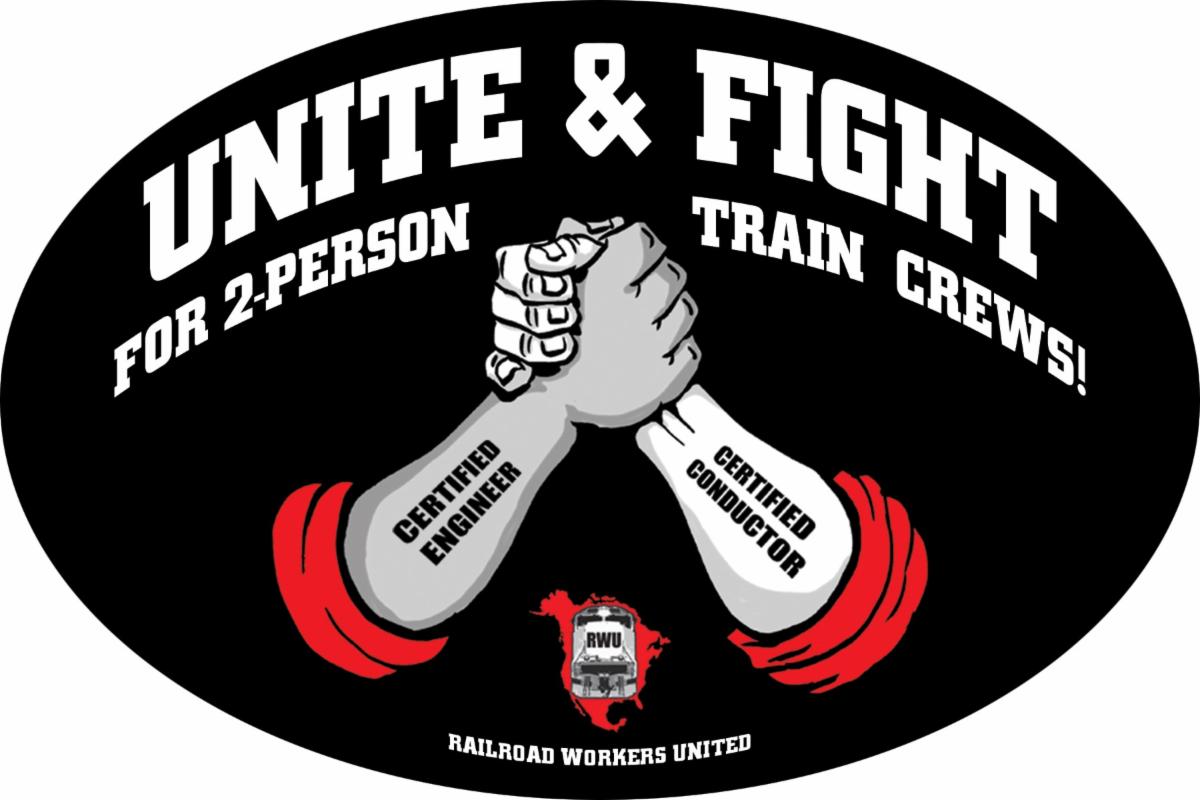
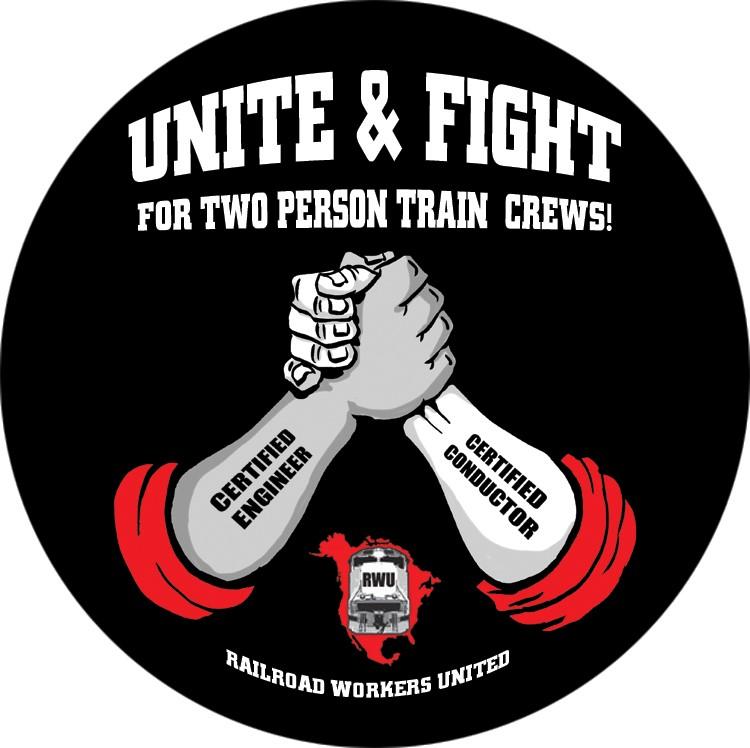
RWU Bolsters Efforts in the Fight to Save the Two-Person Train Crew
The Covid-19 pandemic has distracted rail workers' attention for the moment. But RWU continues to follow the developments in the ongoing dispute between the rail carriers and rail labor on the question of train crew size. The battle lines are drawn, and the issue is expected to come to a head in the months ahead. All railroad workers - especially those in train and engine service - must be united, ready to act in solidarity, and be firm in our convictions. We can - and we will - win this fight!
|
|
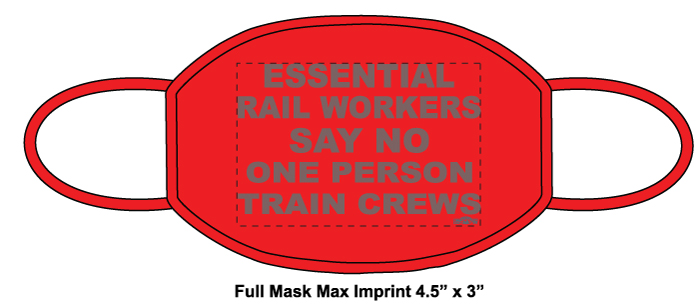
RWU Stocks a Full Line of Items
to Support 2-Person Crews
|
|
RWU has produced a whole line of products to assist in spreading the word, building strength, and uniting rail workers to win this fight. All items are union-made-in-the-USA and are made available to you AT COST.
RWU makes no money on these sales
. Check them out below at our online Store. Click on each item individually for more details, or visit the Store
HERE
.
|
|
Article 2 -
CORONAVIRUS NEWS
MTA Expands Employee Temperature Testing Initiative
(Editor's Note: Had the MTA along with other railroads and employers around the country undertaken this simple and cost effective measure at the onset, we would have had far less pain and suffering, death and service disruption. Let's hope this testing continues and expands. RWU has advocated this in our
Resolution on Coronavirus
adopted
March 19, 2020)
More than 3,500 employee temperatures are being checked each day as part of efforts to reduce the spread of the coronavirus.
The MTA’s Temperature Brigade Program instructs a team of medically trained contract workers and MTA safety and security personnel, fire marshals and fire brigade staff to check the temperature of all employees entering a work location. The employees are tested using contactless thermal scan thermometers on foreheads.
Anyone with a temperature of 100.4 degrees or higher is sent home and instructed to seek medical guidance and report back to the MTA.
Temperatures are now checked at 40 New York City Transit subway, four MTA Long Island Rail Road, three MTA Metro-North Railroad and 24 other bus, bridge and police department locations.
These locations include train service delivery crew reporting facilities, stations, rail-car and right-of-way maintenance facilities, subway control centers and a central operations training location
|
|
Article 3 -
LEGISLATIVE NEWS
DeFazio: Use Infrastructure Investment to Jumpstart Economy
House Transportation and Infrastructure Committee Chair Peter DeFazio (D-Ore.) today expressed concern about a report that Senate Majority Leader Mitch McConnell (R-Ky.) is opposed to the idea of infrastructure investment as part of a future economic rescue package.
News outlet Axios yesterday
reported
that McConnell, in a conference call with Republican senators, panned the idea of using a coronavirus stimulus bill to fund major infrastructure projects. The idea has been floated by President Donald Trump.
DeFazio responded to the report by saying a massive infrastructure spending plan would help fire up a U.S. economy that's on the precipice of the worst downturn since the Great Depression of the 1930s.
"Just like the New Deal of the 1930s, the best way to restart our economy and put workers first is with a massive investment in the kind of infrastructure that will help future generations succeed — from better bridges and roads,
to robust transit and passenger-rail service,
to fully functioning ports and harbors, to modernized waste and drinking water systems and widely available broadband internet," DeFazio said
in a prepared statement.
|
|
Article 4 -
RAIL SAFETY NEWS
Union and SEPTA Agree on New Coronavirus Protocols
(Editor's Note: A number of demands from the
RWU Resolution
have been implemented now at SEPTA. Rail Workers on other properties are encouraged to follow the lead of these heroic workers and use the threat of strike action over unsafe working conditions to win safety improvements if/when the carrier is not adequately addressing the Covid-19 pandemic)
Last week, SEPTA and the Transport Workers United union almost came to blows over the union’s position that SEPTA was not providing adequate safety protections from coronavirus for its workers.
After a series of negotiations, SEPTA and the union have reached an agreement around a new set of protocols that the union called “enhanced safety measures” for the workers, according to
WHYY
, Philadelphia’s public broadcasting station.
In order to push the agreement forward, Philadelphia Mayor Jim Kenney got involved in the discussions, and requested that Willie Brown, the SEPTA union president, to delay a strike that was scheduled for Thursday of last week. Philadelphia city spokesperson Kelly Cofrancisco added that a shut down of the SEPTA system “would jeopardize many lives.”
Kenny praised both the union and the agency for reaching an agreement without a strike, which was done sometime around this past weekend.
According to SEPTA spokesperson Andrew Busch, the agency’s workforce has been reduced by 20%, as coronavirus cases among SEPTA employees have exceeded 220. Sadly, the agency suffered its fifth loss of an employee to coronavirus this week when Yolanda Woodberry, a bus operator out of Frankford depot, died. Woodberry was employed by SEPTA for 17 years.
SEPTA has eased up on some rules for workers, including those dealing with sick leave and benefits. For example, there are certain situations where workers can stay home if the need to, without violations of rules. Workers who have COVID-19 along other workers they’ve been in contact with, will receive their full paycheck. In addition, those employees who are in the “high risk” category for contracting COVID-19 are able to use sick leave even if they don’t show any symptoms.
The new safety protocols include regular temperature checks and COVID-19 testing for all employees, a more robust cleaning schedule which calls for wiping down equipment facilities and surfaces, along with vehicles, every two hours. And, SEPTA will now sterilize work areas where several employees have positive COVID-19 test results.
The union is also negotiating with SEPTA on providing a $500,000 death benefit for any worker who dies from coronavirus. Workers at New York transit negotiated a benefit like this earlier in April.
All Rail Workers Encouraged to Report Safety Issues at Work!
|
|
Article 5 -
FREIGHT NEWS
FTR: Rail Freight Volumes Have Likely Bottomed Out
(Editor's Note: In the face of Coronavirus and the dramatic loss of freight traffic, perhaps in retrospect, the carriers may wish that they never heard of PSR. The rail system could have been gaining traffic in the months prior to Covid-19 rather than losing it).
“While a recovery is expected following economic restart, the length of the recovery is largely unknown,” FTR says. “The firm will be updating this index weekly “with the expectation that it will be a valuable tool for freight professionals to better understand where we are at within the recovery.”
The COVID-19 Rail Freight Recovery Index measures rail and intermodal’s response and recovery based on pre-pandemic levels, while accounting for historical patterns and seasonal fluctuations. Indexes are now available for North American carload and intermodal, economically sensitive freight, automotive and energy sectors.
“The FTR Rail Freight Recovery Index provides necessary context to shippers and carriers on how sharp the volume declines have been in response to COVID-19, and how far away from ‘normal’ the current situation places particular commodity groups,” notes Vice President of Rail and Intermodal Todd Tranausky. “As the recovery continues and states slowly reopen their economies, the index will provide a valuable tool to the rail supply chain to understand where the recovery is related to pre-pandemic levels.”
|
|
Article 6 -
RAIL EMPLOYMENT NEWS
Class I Employment Level Remained Flat in March
(Editor's Note: When the Coronavirus pandemic began, the rail industry had already furloughed over 20,000 workers due to PSR. The industry and its workforce could have fared far better had PSR not decimated freight movements and employment levels in the 18 months priort to the pandemic)
C
lass Is employed 127,867 workers as of mid-March, up 0.18 percent since mid-February, but down 11.78 percent compared with March 2019's employment level,
Surface Transportation Board
data shows.
Four of six employment categories logged month-to-month decreases. They were: professional and administrative, down 0.66 percent to 10,746 employees; transportation maintenance of equipment and stores, down 0.49 percent to 22,062; transportation (other than train and engine), down 0.19 percent to 5,306; and executives, officials and staff assistants, down 0.11 percent to 7,568.
The two categories that posted month-to-month increases were transportation (train and engine), up 0.68 percent to 51,801 employees; and maintenance of way and structures, up 0.26 percent to 30,384.
|
|
Article 7 -
PTC NEWS
GAO: Railroads Report PTC Progress, but Some Face 'Compressed' Schedules to Meet Deadline
Forty-two railroads — including
Amtrak
, 30 commuter and several freight railroads — were required to implement PTC by Dec. 31, 2018. Almost all received two-year extensions. By the end of 2019, more than three-quarters of the railroads were conducting advanced testing or had implemented PTC on their own tracks, but had work left to reach full implementation, GAO officials said in the report.
Full implementation means a railroad has implemented a PTC system certified by the
Federal Railroad Administration
(FRA) on all its own required territories and achieved interoperability with any railroads that operate on its tracks.
By Dec. 31, 2019, 17 of the 31 railroads that must achieve interoperability had done so.
Several face tight schedules for the rest of the work, making problems with software and vendors more acute, GAO officials said.
|
|
Article 8 -
BENEFITS FOR RAILS
Flexibilities Under the Railroad Unemployment Insurance Act (RUIA) During the COVID-19 Virus Outbreak
The RUIA provides for payment of unemployment insurance (UI) benefits to eligible employees for days of unemployment and for the payment of sickness insurance (SI) benefits for days of sickness. Provided below are some frequently asked questions regarding those situations in which benefits are payable during the COVID-19 outbreak and based on the recent legislation passed by Congress. Please note that the answers to these questions are based on the assumption that the employee meets all necessary eligibility requirements. Instructions on filing for benefits are provided following the questions and answers.
|
|
|
|
|
|
|