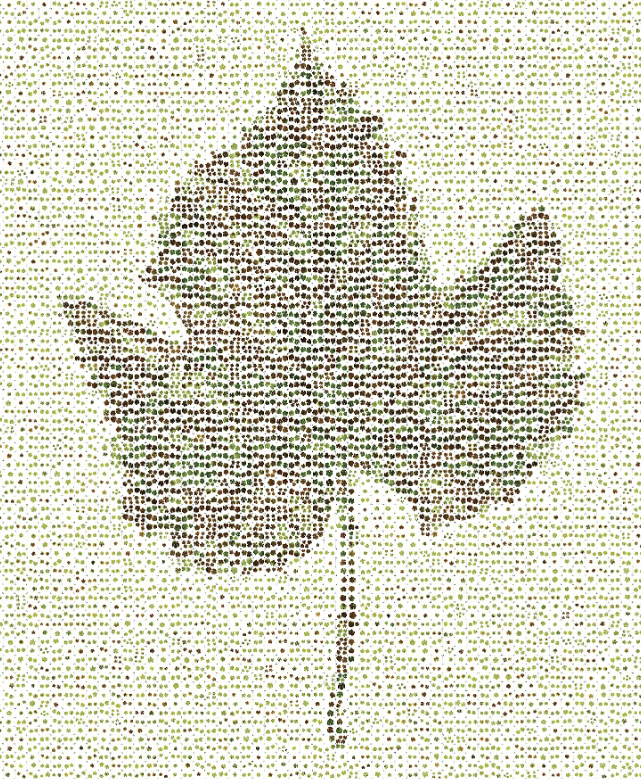
A mosaic of a grape leaf, composed of grape leaves* |
|
The conference sessions included everything from scientific breakthroughs (see Research Focus below) to potentially controversial (but gently presented) findings, and from what I call “failed experiments” (the brave and important exposition of hypotheses that proved untrue) to the beautiful basic research into what makes things tick. Legendary now-retired grape scientists (Pat Bowen, Agriculture & Agri-Food Canada, and Wayne Wilcox, Cornell) gave keynotes alongside legends in the making (Chris Gerling, Cornell, and Simone Castellarin, University of British Columbia). We learned about unique nematodes in Washington, table grapes in New Hampshire, new ways of solving old problems…and old ways getting a fresh look. We heard from grad students and postdocs, extension agents and professors, early career scientists and their experienced mentors.
Throughout the three days, there also was a kind of interplay between talks that forms a dialog of its own. For example, in one of my favorite symposium presentations, UC Davis’ Megan Bartlett talked about adapting stomatal traits to premium regions. Her work, done in collaboration with a computer scientist/modeler from INRAE, explores the genetic mechanisms that control grapevines’ most basic response to hotter, drier conditions, offering one unique and fundamental approach to grape breeding for climate change. Yet in an earlier talk, Elizabeth Wolkovich (University of British Columbia) suggested that, perhaps it isn’t new varieties we need at all—that there is much unexplored diversity and untapped potential in the thousands of grape varieties we already have. Days later, one audience questioner went so far as to suggest that, in a warming world, maybe we don’t need wine at all. To this, Chris Gerling rightly replied that wine (and grapes, I might add) are important to the foundations of our culture, traditions—our very humanity.
It was a wonderful, vibrant dialogue among the members of an academic community that values and respects different perspectives…and whose work ethic is undeterred by a sunny seaside setting. Kudos to ASEV Board member and Technical Program Director Jim Harbertson (Washington State University) and ASEV Executive Director Dan Howard and their respective teams for knocking it out of the park with this year’s events.
|
|
|
|
|
*ABOUT THE PHOTO:
Look closely! Dan Chitwood, Assistant Professor in the Department of Horticulture at Michigan State University, composed this stunning mosaic using thousands of scans of leaves from Vitis vinifera. View and download the complete image. He's also made posters of wine and table grape leaves, all free to download. Check out this one of 60 wine and table grape varieties from the USDA Wolfskill Repository in Winters, CA, originally measured by the famous ampelographer Pierre Galet.
|
|
Only Five Seats Left at NVEELC 2022 |
|
The next National Viticulture and Enology Extension Leadership Conference (NVEELC) is scheduled for August 14-17, 2022, in California's San Joaquin Valley—the largest, most diverse viticulture production area in the U.S. Organized and hosted by UC Cooperative Extension with support from NGRA and sponsored by the California Table Grape Commission, E. & J. Gallo Winery and Sun-Maid Growers of California, NVEELC 2022 offers an extraordinary opportunity to tour raisin, table grape and wine vineyards, and postharvest and production facilities—including Gallo’s Livingston Winery, the largest wine production facility on Earth—at the start of harvest. Join with other extension and outreach specialists for professional development, best-practice sharing, research and regional reports, collaboration and dialogue on the unique challenges in V&E extension in America. See the complete three-day agenda and snag one of the last remaining tickets now!
Plus: Congrats to the 2022 NVEELC travel scholarship winners: Michael Cook (Texas AgriLife Extension), Cody Copp (Oregan State University Extension Service), Charlotte Oliver (Colorado State University Extension), Fran Pontasch (Texas AgriLife Extension) and Maria Smith (The Ohio State University). Travel scholarships were generously funded by E. & J. Gallo Winery and J. Lohr Vineyards and Wines.
|
|
Chavonda Jacobs-Young Confirmed as USDA Chief Scientist |
|
Chavonda Jacobs-Young was this month confirmed as the USDA’s Undersecretary of Agriculture for Research, Education and Economics (REE) and Chief Scientist. She was sworn in on June 13, 2022. Most recently, Chavonda served as Acting Deputy Undersecretary for REE, Acting USDA Chief Scientist and Administrator for the Agricultural Research Service (ARS). She also is former Acting Director for USDA’s National Institute of Food and Agriculture (NIFA) and was instrumental in establishing the USDA Office of the Chief Scientist, serving as its first director. She is the first woman and first person of color to lead REE, whose annual budget is $1.82 billion. |
|
FY 2023 Ag Approps Include Smoke Taint, Pest Mitigation |
|
This month, the U.S. House Appropriations Committee passed the fiscal year (FY) 2023 appropriations bill for the Department of Agriculture. In it, the Committee appropriated $5 million for wildfire smoke taint research on winegrapes, which is an additional $500,000 above FY 2022, the California Association of Winegrape Growers reports. This funding supports research to identify the compounds responsible for smoke taint, establish a reliable database of background levels of smoke taint compounds occurring naturally in wine grapes, develop mitigation methods to reduce or eliminate smoke taint, and study compounds that can act as a barrier between the grapes and smoke compounds. In addition, the Committee supports research to establish standard methodologies for sampling and testing of smoke-exposed grapes and smoke-affected wines.
In addition, the FY 2023 bill sets forth $219,698,000 for USDA-APHIS Specialty Crop Pests, an increase of $10 million over FY 2022. These appropriations include:
- $22,266,000 for the glassy-winged sharpshooter (additional $1 million from FY 2022)
- $5,043,000 for the European grapevine moth
- $18,319,000 for spotted lanternfly (additional $1 million from FY 2022)
|
|
New FPS Greenhouse Will Protect U.S. Grapevine Collection |
|
A new, $5.25 million, 14,400-square-foot greenhouse is being built on campus at UC Davis to safeguard the important grapevine collection at Foundation Plant Services (FPS) from red blotch disease and other pathogens. FPS serves as the primary source for grapevine plant material distributed to nurseries under the California Department of Agriculture’s Grapevine Registration and Certification Program, which provides the majority of grapevines planted in the U.S. For the grape industry, it is essential to protect this material from disease-carrying insects and guarantee fast access to clean plant material. The greenhouse is expected to be finished by the end of 2023, and a second one is planned in the next two to three years. “This is kind of a game changer for us,” says FPS Director Maher Al Rwahnih. |
|
Research Shines in New York Annual Report |
|
The New York Wine & Grape Foundation's 2021-2022 annual report cites the state's unique model by which, Executive Director Sam Filler writes, "the availability of state funds creates an important inducement to encourage private sector industry contributions that support a robust applied research program with annual investment valued at $570,000," which generated contributions of $185,000 from private donors to match New York's $350,000 investment. "Funding wine-related research improves the productivity and competitiveness of the New York wine industry and creates additional jobs for New Yorkers," Sam adds. This research funding makes possible the Foundation's sustainability program, including the release of the VineBalance 2022 (2.0) workbook, and supported 19 funded projects, listed on page 21 of the report.
|
|
Andy Waterhouse Retires from UC Davis |
|
UC Davis’ Andrew (Andy) Waterhouse retires today after 31 years with the Department of Viticulture & Enology. He has served as Chair of the department, Associate Dean of Graduate Studies, and most recently Director of the Robert Mondavi Institute for Wine and Food Science. A retirement seminar honoring his career at the university is planned for May 2023. In the meantime, he will continue as the Director of the Robert Mondavi Institute.
|
|
Summaira Riaz Joins USDA-ARS |
|
Summaira Riaz is the new Grape Breeder/Research Geneticist in the Crop Diseases, Pests and Genetics Research Unit at the USDA-ARS San Joaquin Valley Agricultural Sciences Center in Parlier, CA. Summaira has worked with both cultivated and wild grapes. She led the research to identify resistant loci for Pierce’s disease (PD) and grape powdery mildew in native American and Chinese grapevine species. These resistant loci are the backbone of the winegrape breeding program at UC Davis that released five PD resistant varieties in 2020. In the new role, her responsibility is to develop and introduce new cultivars of table grapes and raisins with high fruit quality, disease resistance to powdery mildew and PD, consumer appeal, and economic production to sustain American agriculture. |
|
USDA-ARS Seeks a Precision Viticulturist |
|
USDA-ARS is hiring a Research Horticulturist (Computational)/Agricultural Engineer/Computer Scientist to be located in Prosser, WA, a worksite of the Horticultural Crops Production and Genetic Improvement Research Unit in Corvallis, OR. In this new position, you’ll design and implement sensor technology that leads to or enhances automation of vineyard tasks. You’ll also develop predictive models and actionable information to improve automation and precision vineyard management. And you’ll develop or modify cyber-physical systems to improve automation and precision management and create workflows to organize and analyze data from sensors, cameras and other equipment. Learn more and apply.
|
|
BREAKTHROUGH! SULFUR-CONTAINING COMPOUNDS ARE MARKERS FOR SMOKE TAINT |
|
For years, a class of compounds known as volatile phenols have been used as the sole markers for smoke taint in wine and grapes. But their efficacy wasn’t consistent. Often, wines with high levels of volatile phenols didn’t taste ashy or smoky, while wines with low levels did. With West Coast winemakers in urgent need of more reliable markers for predicting smoke taint in wines made with grapes exposed to wildfire smoke, Oregon State University enology professor Elizabeth Tomasino and her lab set out to search for other compounds that could be causing the issue.
Last fall, Elizabeth and doctoral student Jenna Fryer devised a new standard for isolating and training the palate on the smoky/ashy component of smoke taint, made of charred leek. In a tasting of the new standard with Washington State University’s Tom Collins in November, the group decided to analyze the standard for sulfur-containing compounds, known to be present in leek. In Tom’s subsequent analysis, it was confirmed: a class of sulfur-containing compounds called thiophenols was found not only in the standard but also in smoke-affected wines. These compounds were not found in wines that had not been exposed to smoke. Further sensory evaluation proved that very low concentrations of thiophenols result in smoky and ashy aromas when combined with volatile phenols.
“This is a critically important for winemakers who are increasingly dealing with the impact of wildfire smoke on their grapes,” Elizabeth said. “It provides them markers that are much more predictive of smoke taint in wine than we previously had.” The findings are not yet published, but she and Tom Collins presented them at the ASEV National Conference this month and in a webinar organized by the West Coast Smoke Exposure Task Force.
Cole Cerrato, a postdoc in Elizabeth’s lab, confirmed the structure of the compounds using Nuclear Magnetic Resonance, an instrument that allows the molecular structure of a material to be analyzed by observing and measuring the interaction of nuclear spins when placed in a powerful magnetic field. Ongoing sensory analysis in the lab continues to validate the finding that wines are described as smoke-tainted only when these sulfur compounds are present with volatile phenols.
“This discovery changes the game, as these new compounds are a completely different class of compounds than we were previously studying,” Elizabeth said. “Much of the smoke taint mitigation work to date has not been overly successful and now we know it’s because we have been looking at the wrong thing. We should be much more successful over the next year or two in providing the industry with mitigation strategies that are actually effective.”
A $7.65 million Specialty Crop Research Initiative (SCRI) grant from the USDA’s National Institute of Food and Agriculture ensures that the work will continue. Elizabeth co-leads the project focused on the impact of smoke exposure on grapes with Tom Collins and UC Davis enologist Anita Oberholster. Its broad goal is to provide tools for the grape and wine industry to quickly make decisions about whether to harvest grapes or make wine following a smoke event. This new discovery is a big step in the right direction!
|
|
Funding Opportunities
Sharpen your pencils! These research funding programs have upcoming deadlines.
|
|
The Open Data Framework (ODF) program will build a framework needed to create a neutral and secure data repository and cooperative where producers, universities and nonprofit entities can store and share data in ways that will foster agricultural innovation and support technological progress, production efficiencies, and environmental stewardship. ODF projects must include details of the existing data storage and sharing landscape, communication plans for sharing knowledge of the existing landscape, and details of how the project will leverage existing infrastructure and knowledge. Deadline is July 14, 2022.
The National Science Foundation's Faculty Early Career Development (CAREER) program offers the most prestigious awards in support of early-career faculty who have the potential to serve as academic role models in research and education and to lead advances in the mission of their department or organization. Activities pursued by early-career faculty should build a firm foundation for a lifetime of leadership in integrating education and research. NSF encourages submission of CAREER proposals from early-career faculty at all CAREER-eligible organizations and especially encourages women, members of underrepresented minority groups, and persons with disabilities to apply. Note that each year NSF selects nominees for the Presidential Early Career Awards for Scientists and Engineers (PECASE) from among the most meritorious recent CAREER awardees. The White House Office of Science and Technology Policy makes the final selection and announcement of these awardees. Deadline is July 27, 2022.
The USDA Animal and Plant Health Inspection Service (APHIS) invites stakeholders to submit project suggestions for fiscal year (FY) 2023 Plant Protection Act Section 7721 (PPA 7721) funding. APHIS will provide $75 million in plant protection funding for these projects, including at least $7.5 million for projects under the National Clean Plant Network (NCPN). There are six strategic goal areas for PPA 7721 funding and three priorities for NCPN—get details at the link above. Deadline is August 1, 2022.
The Foundational and Applied Science Program of USDA-NIFA's Agriculture and Food Research Initiative supports fundamental and applied research in six priority areas: plant health and production, and plant products; animal health and production, and animal products; food safety, nutrition and health; bioenergy, natural resources and environment; agriculture systems and technology; and agriculture economics and rural communities. Deadlines run through November 17, 2022, depending on the program area.
|
|
June 23, 2022 │ WineTitles
Scientists in Australia are releasing a new computer vision system called VitiVisor to help grape growers gather and analyze field data, like plant area index, pruning weight, inflorescence and shoot number, bud count, and plant leaf temperature. The system is powered by machine learning, trained on a library of more than 175,000 images of grapevines at different stages of development, called VitiData. Both VitiVisor and the open-source VitiData will be available to Australian growers soon.
In just-published research by Larry Williams (UC Davis, retired), Alec Levin (Oregon State University) and Matt Fidelibus (UC Davis), new crop coefficients were developed by measuring the shade beneath the canopy across a range of trellis systems. These values should help grape growers estimate evapotranspiration and improve irrigation—especially deficit irrigation—management.
June 22, 2022 │ Knowable Magazine
Warming, wildfires and unpredictable weather are threatening traditional winemaking. This article is a who’s who of researchers and producers exploring ways to adapt, such as alternative rootstock selections, shade netting, novel cover crops and altered management practices like harvest timing, canopy management and more.
June 17, 2022 │ The New York Times
A worldwide fertilizer shortage is making farmers desperate for an alternative. It just so happens that human urine is full of the nitrogen, phosphorus and potassium plants need—a lot more than Number Two, with almost none of the pathogens. Organizations like the Rich Earth Institute and concerned citizens have decided to #peethechange by collecting and donating urine.
June 15, 2022 │ National Science Foundation
Using Napa Valley vineyards as a model system, scientists at the University of Colorado Boulder have found that agricultural sulfur has a unique isotype fingerprint that can be traced from application to endpoint, helping to understand its downstream impacts. “We found that you could see the effect of viticulture in the Napa River when vineyards are only 11% of the land cover in the watershed,” said PI Eve-Lyn Hinckley. “It's a very stable fingerprint for us to trace and understand what ultimately happens.”
June 9, 2022 │ Western Farm Press
The five-acre soil health vineyard in Washington is a project of Washington State University’s Soil Health Initiative and now part of the USDA-ARS Long-Term Agroecosystem Research Network. “Our goal here is to find ways to protect the soil and keep the vineyard alive as long as possible while monitoring how various management practices influence the soil,” says USDA-ARS Research Soil Scientist Devin Rippner, who oversees the vineyard. Washington Wine Commission’s Melissa Hansen adds, “This new research vineyard will use soil metrics and measurements relevant to wine grape production which will quantify the effects of cover crops, mowing, composting, using biochar and alternative irrigation strategies to improve soil health, vine health, and grape quality.”
June 9, 2022 │ San Francisco Chronicle
While grape-growing requires a lot of water, a lot more is used making wine and cleaning winemaking facilities. Citing a study in the journal Water Science & Technology, Esther Mobley writes, “Compared with other forms of beverage production, winemaking does not look very water-efficient: Coca-Cola used 1.84 liters of water for every liter of Coke produced in 2020, while wineries use about 7 to 16 liters of water per liter of wine.” The options for dealing with a hotter, drier future are mitigation, adaptation and...suffering.
June 8, 2022 │ Good Fruit Grower
After a long history of crossing native V. riparia with other grapes, the University of Minnesota’s cold-hardy wine grape varieties are the basis of a growing wine industry across the Upper Midwest, Northeast and into Canada. The vines must be able to survive temperatures of minus 35 degrees Fahrenheit. Itasca, the UMN breeding program’s most recent release, has proven to be its hardiest. Another white wine variety called Clarion will be available in limited volumes next year, says grape breeder Matt Clark. He’s also working on cold-hardy, seedless table grapes.
June 8, 2022 │ NC State University News
A new analysis from North Carolina State University indicates that the spotted lanternfly is likely to spread to North Carolina and California by 2027. They forecast that, without treatments to control populations, the dreaded pest will be established throughout much of the U.S. by 2037.
June 6, 2022 │ Wine Business Monthly
After the extreme high and low temperatures (and related vine damage) of 2019, Texas grape growers are poised for a full recovery. But the 2022 growing season has so far offered new challenges: drought, hail and wind.
June 6, 2022 │ Lodi Winegrape Commission
Soil mapping and variable rate (VR) fertilizer application technology can ensure growers apply the right amount of nutrient in the right place (two of “the 4 Rs of Nutrient Stewardship) by breaking a field or block into smaller management zones so different areas of the field can be treated most effectively.
June 2, 2022 │ UC Davis
Students studying atmospheric science at UC Davis use a mix of modern and historic instruments and data to make near-term and long-range weather predictions. Uniquely, the UC Davis weather station has been in operation since 1871! Davis weather station records dating back to March 1906 are accessible via a National Oceanic and Atmospheric Administration website.
May 29, 2022 │ Modern Farmer
A new study led by researchers from Sweden and Switzerland has found that the weight of farming machinery today is approaching that of dinosaurs (sauropods, to be precise). And that's not good news for soil, which can only withstand so much pressure before becoming chronically compacted.
May 26, 2022 │ Western Farm Press
Washington State University’s Markus Keller explains some of the research questions around drought. When irrigation water gets shut off during the growing season, what’s a grapegrower to do? Irrigate more quickly? Irrigate less? Quickly pick fruit to ensure vines will survive to the next season? “Problem is, we don’t know whether that’s even necessary,” he says. “There’s just not enough information to deal with these kinds of situations.”
May 25, 2022 │ USDA National Institute of Food and Agriculture
In a massive, multi-institutional effort called NE1720: Multi-state Coordinated Evaluation of Winegrape Cultivars and Clones, funded by USDA-NIFA, researchers are testing the performance and resulting wine quality of different grape varieties at more than 20 test sites across the country. Establishing vines at a broad scale helps to distinguish how genetic factors, environmental conditions and management practices influence grape yield and quality, and advise growers accordingly.
May 23, 2022 │ The New York Times
Customs officials intercepted a grave threat to U.S. agriculture when it found a nonnative moth known to defoliate forests and feast on or contaminate crops. Next time your bag is searched at the airport, say thank you!
May 23, 2022 │ University of Maryland AGNR News
Scientists from the University of Maryland College of Agriculture and Natural Resources have developed CRISPR-Combo, a method to edit multiple genes in plants while simultaneously changing the expression of other genes. This new tool will enable GE combinations that work together to boost plant functions (like growth and productivity) and improve breeding, rather than just one or the other. The team also devised a way to promote regeneration in tissue culture without the addition of growth hormones—a non-transgenic shortcut to a longstanding bottleneck. They will now test CRISPR-Combo in citrus, carrots and potatoes.
May 19, 2022 │ Cornell CALS
A Ph.D. student at Cornell named Fernando Romero Galvan is the first at the university’s School of Integrative Plant Science to receive NASA’s FINESST (Future Investigators in NASA Earth and Space Science and Technology) award. He’s working to develop scalable grapevine disease detection with imaging spectroscopy, using leafroll virus and vinifera as a model system.
May 4, 2022 │ YourCentralValley.com
Did you know that the Fresno State Winery is the largest commercial winery on a university campus in the U.S.? With the guidance of viticulture faculty member Luca Brillante, students there also are learning that winemaking starts in the vineyard—and can be greatly aided by technology. “We need to improve efficiency of production and digital precision agriculture is a tool for that, and we train our students in that direction,” Luca says.
|
|
Find these stories and more, published every weekday, on our Facebook and Twitter feeds.
|
|
July 3-8, 2022
Bordeaux, France
July 10-17, 2022
Landau/Pfalz, Germany
July 11-12, 2022
NGRA Mid-Year Board Meeting and Strategic Planning Meeting
Bloomington, MN
July 13-15, 2022
Bloomington, MN
July 17-21, 2022
Ontario, Canada
July 20-22, 2022
Cremona, Italy
July 30-August 3, 2022
Chicago, IL
August 1-26, 2022
New Brunswick, NJ
August 14-17, 2022
San Joaquin Valley, CA
October 18-20, 2022
Fresno, CA
|
|
The monthly NGRA Update is provided as a service to the U.S. grape and wine industry.
|
|
|
|
|
|
|