Cedric MacLeod
From the executive director's desk
|
We wrapped up 2021 with our second virtual annual conference, Forage Landscape Synergies. Over 200 participated in the fully bilingual event that provided the CFGA with an exciting opportunity to showcase the forage sector in Quebec. The conference also explored ecological services and grassland ecosystems, export market opportunities and forage and landscape management innovations.
Our collaboration with the Conseil québécois des plantes fourragères (CQPF) to organize and host this event helped make it the success it was. I thank CQPF’s Annie Claessens, Serge Pageau and the rest of the CQPF team for all of their help. We have now begun planning for the 2022 conference with a national focus that will allow us to collaborate with our provincial members to showcase the forage sector across the country. We will share more information about the 2022 conference in future newsletters.
As with the annual conference, the CFGA is focussing on collaborations with provincial and national organizations on a number of projects. One example of this is the ECCC Nature Fund-funded project working towards the development of province-specific Habitat and Biodiversity Assessment Tools. We are on track to launch tools in Manitoba, Saskatchewan and Nova Scotia this year and are now working with organizations in Ontario, British Columbia and New Brunswick to develop tools for those provinces. Phase-3 of this project, set to launch in 13 months, will focus on tool development in the remaining Canadian provinces.
The CFGA’s national Grazing Mentorship Program is now in full development mode and implementation is slated to start soon. We’re pleased to have Alberta rancher and custom grazier, Steve Kenyon, developing the curriculum and training materials, including a grazing manual and key topic presentations. We are working with delivery partners in each province to complete the provincial planning and deployment tasks and plan to pilot the program in Atlantic Canada later this month.
The CFGA also continues to be busy with our export portfolio. We are in the planning stages of an inbound trade mission with representatives from the United Arab Emirates wishing to explore what the Canadian export forage sector has to offer the world. We are planning to attend the 2022 edition of the World Dairy Expo in Madison, Wisconsin this fall, and our export members continue to receive quarterly updates from the Hoyt Report on Canadian and world forage markets, including number and value reports of Canadian forage exports, analysis on trends and export totals from the other main exporting countries.
Watch future issues of this newsletter for updates on these, and other exciting projects in the pipeline. In the meantime, don't hesitate to contact me if you have any questions or concerns. As always, be well, stay safe.
- Cedric MacLeod
|
|
CFGA News
CFGA celebrates successful 12th annual conference
|
|
The Canadian Forage and Grassland Association (CFGA), in partnership with the Conseil québécois des plantes fourragères (CQPF), held a successful conference in December. During the three-day virtual event, more than 200 attendees focused on sustainability and ways to enrich the contribution of Canadian grasslands in the reduction of greenhouse gas emissions.
The theme of the conference was Forage Landscape Synergies. Topics included ecological services and grassland ecosystems, building a resilient agrisystem, export market opportunities and exciting and cutting-edge forage happenings in Quebec.
Those who attended the conference via standard registration have one more week to access the recordings, while VIP registrants have access for the remainder of the year. Emails with access links have gone out several times via email since the conference so check your inboxes (and your junk folders) for details. Contact info@canadianfga.ca if you need assistance.
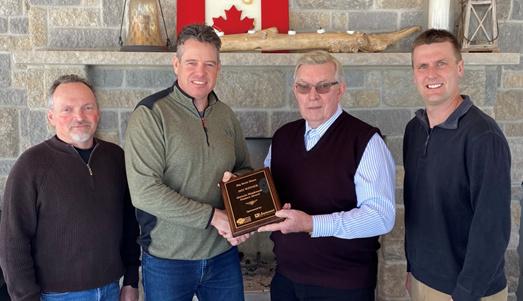
A highlight of the conference was the presentation of the 2021 CFGA Leadership Award to Germain Lefebvre. Marking his 50th year as an agronomist, Germain is also a producer of field crops and commercial hay, the author of several reports on forages and a public speaker on the topic. He began work in the forage sector in 1985, participating in the first meeting organized to launch a Quebec forage council in the fall of 1987. He was also one of the CQPF members to attend the inaugural meeting of the CFGA’s founding organizations in 2010. Congratulations Germain!
The 2021 CFGA Conference was funded through the Program Innov'Action agroalimentaire, under the Canadian Partnership for Agriculture, an agreement between the governments of Canada and Quebec, and the generous support of CFGA’s conference sponsors and annual partners.
|
|
nouvelles provinciales : Conseil Québécois des plantes fourragères
Événements québécois
Les 14-15-16 décembre derniers, le Conseil québécois des plantes fourragères (CQPF) était fièrement l’hôte virtuel du 12e Congrès annuel de l’Association canadienne pour les plantes fourragères (ACPF), un événement annuel présentant des conférenciers du Québec, du Canada et des États-Unis. Pas moins de 230 personnes étaient inscrites; quel succès rassembleur! Une superbe occasion de travailler en équipe avec l’association canadienne et les différents partenaires. L'événement était pour la deuxième fois en mode virtuel. Germain Lefebvre a été la vedette le temps de la remise du prix du leadership remis tous les ans par l’ACPF. Tout un honneur pour la contribution de Germain au secteur des plantes fourragères qui, dans la même année, fête ses 50 ans de carrière en agronomie. Bravo!
Le CQPF tiendra son assemblée générale annuelle le 16 mars prochain, tout de suite après la deuxième journée du Colloque pour les plantes fourragères organisé par le CRAAQ en mode virtuel. Suivez notre site web pour connaitre les moyens de s’inscrire.
Le Centre de Référence en Agriculture et Agroalimentaire du Québec (CRAAQ) présente cette année, Colloque sur les plantes fourragères. En webdiffusion, le Colloque sur les plantes fourragères vous propose deux avant-midis dédiées aux dernières avancées du secteur, du semis à l’étable, ainsi qu'à plusieurs façons d’optimiser l’utilisation des plantes fourragères.
Les impacts du Plan d'agriculture durable du Québec et les opportunités pour les producteurs de plantes fourragères; Le choix des espèces pour les cultures d’urgence; Les plantes fourragères pérennes dans les systèmes d’agriculture régénératrice. Programme.
Le retour du congé des fêtes 2021 fut annonciateur de bonnes nouvelles, puisque deux demandes de financement déposées au MAPAQ ont été acceptées. Le CQPF reçoit une aide financière pour permettre de défrayer le salaire d’un agent de développement jusqu’au 31 décembre 2022, un soutien précieux pour notre organisation. Guy Allard, directeur du Pôle-PFQ, prend en charge un projet fort important pour le secteur fourrager, grâce à un comité d’experts. Ce projet permettra d’agréger des besoins de recherche, développement et transfert en plantes fourragères et de déterminer les opérations d’un continuum de la recherche à l’adoption de pratiques agricoles - un projet porteur et rassembleur.
|
Provincial News: Ontario Forage Council
Bison producers receive Ontario Pasture Award
The 2021 Ontario Pasture Award, sponsored by MAPLESEED and the Ontario Forage Council, goes to Mark and Heather Shouldice of Big Rock Bison near Shallow Lake in Grey County, Ontario. The couple received the award on Feb. 24 for their environmental and pasture improvements and management, receiving $250 and a bag of forage seed.
The Big Rock Bison operation includes140 bison and are on pasture 12 months of the year. The 150 acres of pastureland is set up with nine paddocks to practice rotational grazing, allowing sufficient time for pasture to rest, re-grow and recover before the bison go back on that paddock.
“The bison stay out 12 months of the year in a low-stress environment, with room to roam and be social,” says Mark. “They are built for and thrive in the winter, but we do have sacrifice pasture for wet/mud season, so typically the bison move out on fresh pasture May 7 and this is when we stop feeding hay for the season.”
Mark says they are committed to sustainable and regenerative farming practices that have a positive impact on the land and the bison, while producing both a nutritious and delicious red meat protein.
For pasture health and vitality, they try to prevent the pasture from getting grazed below four inches in forage height in order to maintain maximum growth and health and prevent erosion due to rain and/or wind.
(continued at right)
|
|
Provincial news: Quebec Forage Council
Quebec News
On Dec. 14 to 16, the Conseil québécois des plantes fourragères (CQPF) proudly hosted the 12th Annual Canadian Forage and Grassland Association (CFGA) Conference, an annual event featuring speakers from Quebec, Canada and the United States. No less than 230 people were registered; what a unifying success! Held for the second time as a virtual event, it was a great opportunity to work as a team with the Canadian association and the various partners. Germain Lefebvre was the recipient of the CFGA Leadership Award given every year by the CFGA. This is a great honour for Germain's contribution to the forage sector who, in the same year, celebrates his 50th anniversary in agronomy. Congratulations!
The CQPF will hold its annual general meeting on March 16, immediately following the second day of the Centre de Référence en Agriculture et Agroalimentaire du Québec (CRAAQ)'s virtual Forage Plant Symposium. Visit the CQPF website to find out how to register.
Forage Plant Symposium
The Centre de Référence en Agriculture et Agroalimentaire du Québec (CRAAQ) is presenting a symposium on forage plants. In webcast, the Forage Plant Symposium offers two pre-morning sessions dedicated to the latest advances in the sector, from seeding to the barn, as well as several ways to optimize the use of forage plants.
Impacts of Quebec's Sustainable Agriculture Plan and opportunities for forage producers; The choice of species for emergency crops; Perennial forages in regenerative agriculture systems. Program.
The return of the 2021 vacation season brought good news as two funding applications submitted to MAPAQ were accepted.
The CQPF is receiving financial assistance to cover the salary of a development officer until Dec. 31, 2022, a valuable support for our organization. Guy Allard, Director of the Pôle-PFQ, is taking charge of a very important project for the forage sector, thanks to a committee of experts.
This project will make it possible to aggregate research, development and transfer needs in forage plants and to determine the operations of a continuum from research to the adoption of agricultural practices – a promising and unifying project.
|
(continued)
Bison producers receive Ontario Pasture Award
The Shouldices believe that healthy pastures and soil creates a diverse and strong ecosystem, which has a positive impact on climate change. As Mark says, “Healthy pastures equal healthy bison equal healthy meat equal maximum profit.”
In reviewing this nomination, Scott Fisher, sales manager (Western Ontario) with Mapleseed says he finds it exciting and encouraging that land stewardship is front and centre across all portfolios of meat production.
Ray Robertson, manager of the Ontario Forage Council, commented that even though this applicant is truly unique in the area, it demonstrates the economic and environmental benefits of a well-managed pasture operation.
The deadline for applications for the 2023 MAPLESEED Beef Pasture Award is Nov. 30, 2022. For details, call the Ontario Forage Council at 1-877-892-8663 or visit either the Ontario Forage Council website at www.ontarioforagecouncil.com or Beef Farmers of Ontario at www.ontariobeef.com. |
|
CFGA Gold Sponsor
News from Dairy Farmers of Canada
DFC targets net-zero greenhouse gas emissions by 2050
|
|
On Feb. 2, 2022, Pierre Lampron, president of Dairy Farmers of Canada (DFC), announced that DFC will be committing to a goal of net-zero greenhouse gas (GHG) emissions from farm-level dairy production by the year 2050.
As Lampron explained, we are bearing witness to the impacts of climate change first-hand on our farms and at our doorsteps. It is no longer a question of how our livelihoods will be affected by climate change, but rather a question of how we will be affected if we don’t act now.
Fortunately, our sector has a long history of environmental stewardship, and our net-zero goal is sending a clear message to Canadians, consumers, stakeholders and governments: Dairy farmers are leaders and we are part of the solution!
How will we reach this objective?
Reaching net-zero will be done through emissions reduction and GHG removal offsets. Best management practices on farms related to soil health, water, biodiversity, waste and energy will contribute to improve our sector’s environmental stewardship.
There will also be new opportunities to explore
To get us there, DFC is working with experts to lay out different pathways to net-zero – because each farm is unique and what works for one may not work for another. Farms will be able to identify their best path forward and Lampron stressed that farmers will not be alone in this effort. DFC will leverage partnerships and government programs, as well as provide tools and support.
DFC will be consulting dairy farmers to streamline and reduce the administrative burden, as well as to make sure that farms can benefit from the funding and programming needed to achieve our net-zero objective. Working with environmental organizations and government initiatives is foundational to our plans, as pursuing this goal cannot be a financial burden to dairy farmers.
Lampron stressed that net-zero does not need to come at the expense of our competitiveness, either. We can be both profitable and sustainable. In fact, more and more dairy farmers are adopting green strategies that contribute to environmental sustainability, while generating revenues through a circular economy.
Because of these efforts, it now takes six per cent less water and 11 per cent less land to produce a litre of milk than it did just a decade ago. We also lowered our GHG emissions by seven per cent in that same timeframe. Few industries can report that kind of progress and we should be incredibly proud of what we have accomplished together.
That’s why part of DFC’s outreach activities includes giving deeper meaning to what the Blue Cow logo represents, by telling the story of dairy farmers as stewards of the land. We’re ensuring that political and consumer support for our sector remains strong.
Where do we go from here?
Over the coming months, DFC will engage with members to develop a DFC Net-Zero Roadmap with specific initiatives that can be deployed to reach our goal. This engagement will be important as it will feed into the central theme of sustainability for our annual general meeting in July 2022.
|
|
Forage News
Alfalfa: Queen of forages, and perhaps sustainability
by Emily Meccage, senior technical support specialist with Forage Genetics International
Anyone involved in agriculture today has heard the discussion around sustainability, carbon credits and how we can use agricultural methods to help mitigate the effects of climate change. After all, agriculture is one of the main areas where we can improve in areas, like carbon sequestration, to help offset other areas, like energy generation, where improvement is limited.
Two of the main focuses in the conversation of sustainability has been utilizing cover crops and converting from conventional tillage to no-till or min-till. Numerous research projects around the world have shown improvements can be made by implementing these practice changes, including decreasing erosion, improving carbon sequestration and improving soil structure. What has been largely overlooked is the impact inclusion of alfalfa can have in these same areas, and more.
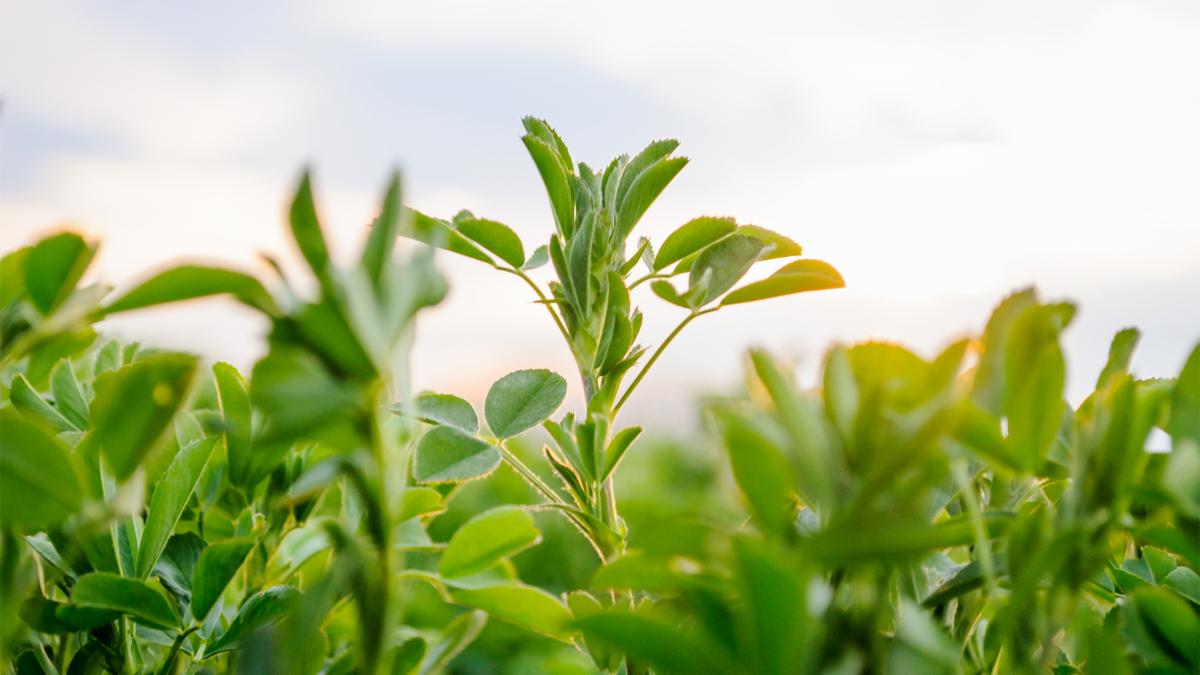
Anyone familiar with alfalfa knows its multitude of benefits – as a perennial, it does not require annual tillage like many row crops; as a legume, it has the ability to fix nitrogen which can then be utilized by the following crop; its deep taproot system can help to improve soil structure, while accessing deep soil water that would otherwise be inaccessible; and its almost year-round cover (depending on management) helps to significantly decrease erosion and improve soil aggregation.
These are just some of the benefits that we see by incorporating alfalfa into a typical cropping rotation. Research is finding, in many areas, that the use of alfalfa over a several-year period in between crops like corn or wheat can improve soil carbon stores as well as decrease overall nitrogen fertilizer needs. This can have major impacts as fertilizer production produces large amounts of carbon emissions, so decreasing our reliance on nitrogen fertilizer through alfalfa production can also indirectly decrease carbon emissions. Especially when no-till establishment of alfalfa can be utilized, we decrease the carbon losses from the soil that can happen during conventional establishment of alfalfa, and research in this area is ongoing.
Many carbon programs have emerged in recent years to try to link growers employing these sustainability methods with companies that are looking to improve their carbon footprint. One of the largest ones is Truterra, the sustainability division of Land O’ Lakes. Truterra has three focus areas: soil health, livestock and sustainable technology programs. The benefit of a program such as Truterra is that it is farmer-driven and that it works directly with farmers, ag retailers and participating companies.
Truterra has recognized alfalfa’s importance and included it in its current program offering as a practice change that qualifies for carbon payments. In 2022, Truterra has two available programs. The first program is the Truterra Carbon Program which pays $20/ton for additional carbon removed on eligible ground from practice changes up to three years prior. The second program is the Truterra Carbon Market Access Program which pays a per-acre fee for a qualifying practice change in 2022 without requiring a long-term commitment. This is meant to be a first step for those who are interested in getting started in the carbon market and does not limit those acres from being eligible for participating in future carbon programs.
Carbon programs are still in their infancy and there is a lot left to figure out. However, making important practice changes, such as incorporating alfalfa into your rotation, can help set growers up for success, not only with their cropping systems, but by improving their on-farm sustainability as well.
|
Forage News
StatsCan: Complete your Farm Management Survey
Statistics Canada is now actively contacting farm operators to complete the Farm Management Survey. The survey gathers key information about livestock and crop operations, specifically the production of dairy, beef, poultry, pig, field crops, forage crops and vegetable, fruit, berry and nut crops.
The Farm Management Survey captures current farming practices and the environmental impact of agriculture, and informs programs that directly benefit farmers. In support of farmers impacted by severe weather across the country, survey collection will be adjusted as necessary as to not burden farm operations.
Every survey counts. All farms selected are specifically chosen to achieve a complete understanding of farm management in Canada.
If you have been selected for the survey, please complete it today.
|
Calendar of Events
At the time this newsletter was distributed, all event times and locations were accurate, but please check event websites for the most current information. Some events may have been postponed or cancelled.
March 7-11: Prairies Got the Goods Week. More info.
March 8: Ontario Forage Council Profitable Pastures, webinar: Making the cows work for you with Pam Iwanchysko. 7:30 p.m. EST. Register and more information.
March 9: Ontario Forage Council Profitable Pastures webinar: 2022 Mapleseed Pasture Award Recipient. 7:30 p.m. EST. More information.
March 10: Ontario Forage Council Profitable Pastures webinar: Grazing ruminants: The original soil builders. Lessons learned from my Nuffield Scholarship with Ryan Boyd. 7:30 p.m. EST. More information.
March 16-18: 2022 Sustainability of Canadian Agriculture Conference: Farming for sustainable food systems. Virtual. More information.
More event listings:
|
|
|
|
|
|
|
|