Shining a spotlight on the state's ethics rules. | | |
Sanford N. Berland
Executive Director
| | | |
Seymour W. James, Jr.
Chair
| | |
The New York State Commission on Ethics and Lobbying in Government (COELIG or the Commission) held its fourth annual public hearing on Wednesday, September 30, 2026, providing members of the public the opportunity to comment in person, by videoconference, or in writing.
The purpose of the public hearing was to receive comments concerning the Commission’s current operations and its governing laws, regulations, and advisory opinions; what it is doing well, and how the Commission can more effectively perform its many tasks and carry out its mandate to restore public confidence that state government is working in the public interest.
Comments and tangible recommendations received will be taken into consideration for operational process improvements and expansions. The Commission will use feedback from commenters to better gauge its strengths, weaknesses, and how it can continue to better serve the public. Public comments are posted on the Comission's website.
Thank you to all of those who attended, watched, spoke, or provided written testimony this year!
| | 'Fall' into ethics training with COELIG! Remember, EVERY state employee must complete ethics training every year. | | |
Live Training Requirement
The live ethics training requirement can be satisfied by taking the Commission's Comprehensive Ethics Training Course (CETC) or, if offered, comprehensive live training provided by your agency.
State employees who completed no live training or no training at all in 2025 must complete live training in 2026.
All employees can easily enroll in one of our live comprehensive training classes utilizing our Class Registration Self-Enrollment Portal. If the portal requests your employee ID number, please check your paystub or your LATS timesheet to confirm you are entering your correct Employee 'N' ID number. Note: Employees, faculty, and staff of SUNY and CUNY campuses should review the SUNY CUNY Employee ID fact sheet prior to enrolling.
Keep in mind - new state employees must attend live ethics training within 90 days of starting their job!
Get ahead of the December 31 deadline - enroll in training today!
| | |
On-Demand Ethics Training Course
COELIG offers an online, on-demand ethics training course (OERC) for state employees.
Who should take On-Demand Ethics Training?
The on-demand ethics training video should be completed by employees who completed live comprehensive ethics training in 2025.
Ensure your training completion counts!
If you received an email from the COELIG team, follow the directions provided for enrolling in ethics training. If you haven’t received an email, please check with your agency's Ethics Officer or training coordinator before enrolling in the on-demand ethics training course. Some agencies require that employees complete live training every year. If self-enrolling in the COELIG on-demand ethics training and you select an agency that requires an employee ID number, please check your paystub or LATS to confirm you are entering your correct Employee 'N' ID number. Note: Employees, faculty and staff of SUNY and CUNY campuses should review the SUNY CUNY Employee ID fact sheet prior to enrolling.
| | |
PLEASE NOTE:
All MTA employees (headquarters and subsidiaries) receive ethics training directly from MTA.
| | |
ETHICS LATEST
Your 'need to know' ethics updates!
| |
| |
The NYS Commission on Ethics and Lobbying in Government (COELIG) and NYS Inspector General Lucy Lang (IG) announced a settlement in the matter of former NYS Acting State Budget Director Sandra Beattie related to alleged violations of the Public Officers Law (POL). The settlement followed an investigation conducted by the IG’s office and further proceedings by COELIG’s Investigation and Enforcement Division.
The investigation found that Ms. Beattie brought on her friend, who was a registered lobbyist, to serve as a voluntary consultant on a COVID-related project. The lobbyist then went on to become a paid subcontractor for a company that had been involved in that same project. The state paid the Company and the registered lobbyist for this work. Ms. Beattie approved the invoice while the lobbyist was actively lobbying the DOB. In addition, Ms. Beattie stayed at the Florida residence of the registered lobbyist while he was engaged in lobbying the DOB. Ms. Beattie also was feted and appeared as a featured speaker at events held by the registered lobbyist for his clients and prospective clients.
As part of the settlement agreement, Ms. Beattie admitted that her conduct violated POL § 74(3) and will pay a fine of $5,000.
COELIG also settled three additional ethics cases. The four settlements resulted in penalties totaling $10,900.
| |
| | |
2025 Academic FDS Due:
November 17, 2026
| | |
PLEASE NOTE
The non-academic FDS filing deadline was May 15, 2026.
If you receive, or have received, a Failure to File notice, you must file within 15 days, or you will be deemed delinquent, your agency will be notified, your name will be published on the Commission’s website, and you will be subject to a penalty of up to $40,000. File immediately.
| | |
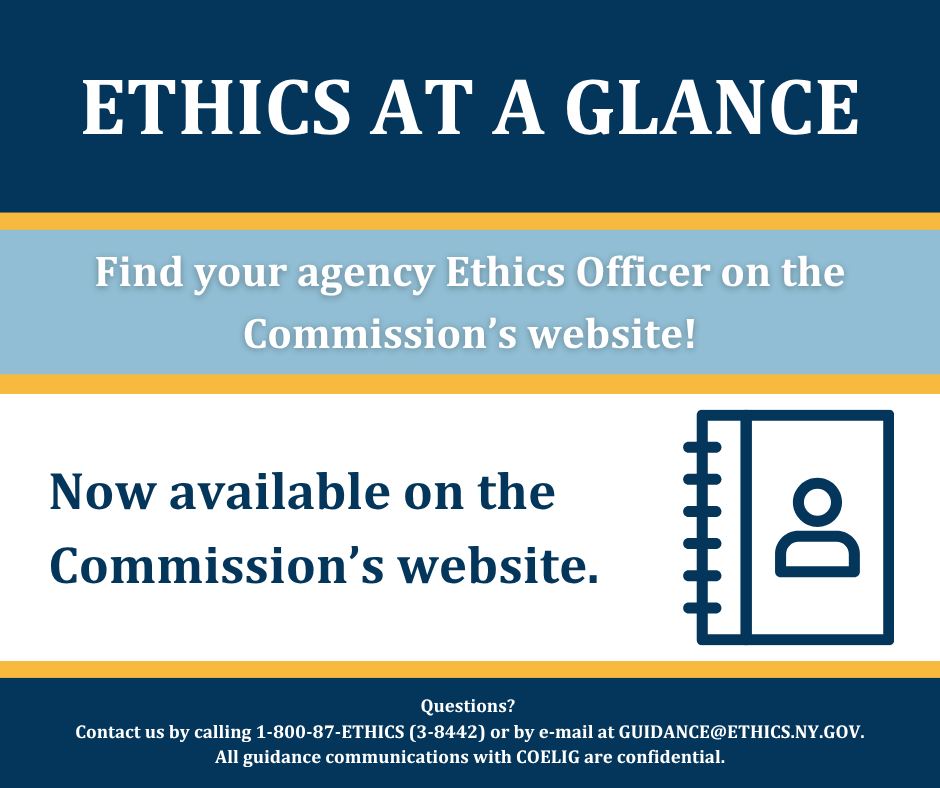
Find your agency Ethics Officer on the Commission’s website!
Check out our Ethics at a Glance document to learn more about what an Ethics Officer does, why you might need assistance, and how to contact one at your agency.
| |
DEAR COELIG
Commonly asked questions and relevant answers.
| |
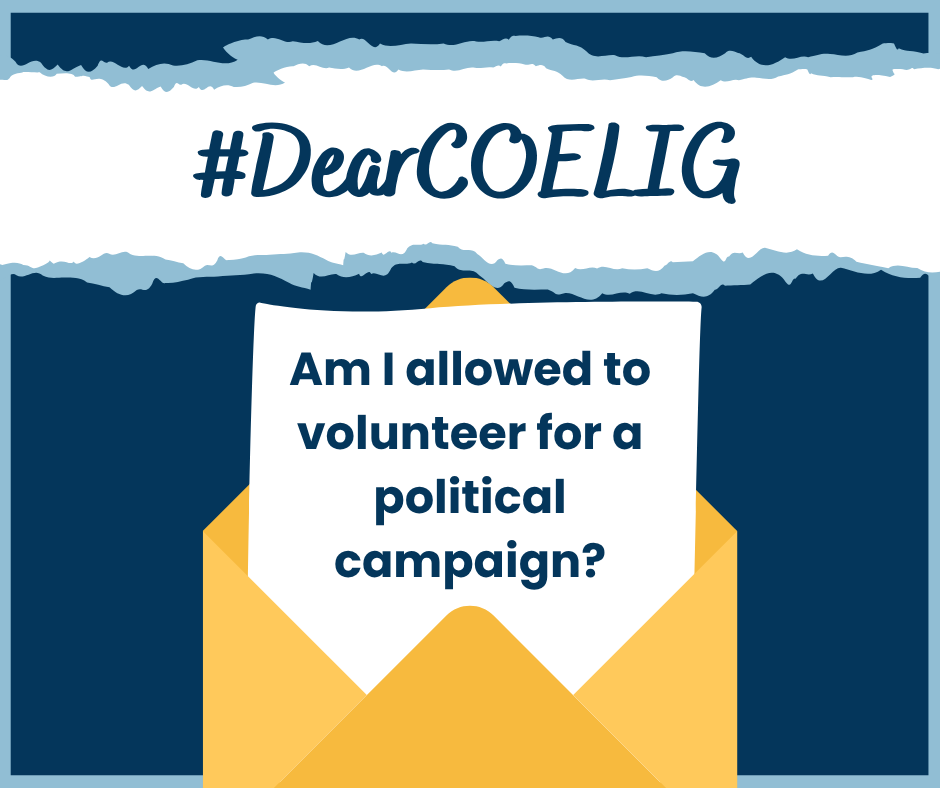
| Am I allowed to volunteer for a political campaign? | |
State employees may volunteer for political campaigns as long as they follow the state ethics laws. Under Civil Service Law § 107, state offices may not be used for soliciting or collecting any political contributions. State officers and employees, and prospective employees, may not be questioned or asked about their political affiliation, whether they made any political contributions, or how they voted. No person may use their official state position to coerce, intimidate, or influence other state officers or employees for any political purpose, action, or contribution, or to interfere with any election. A state officer or employee cannot solicit political support from anyone they deal with in the performance of their official state duties.
The following political activities violate the Code of Ethics in POL § 74:
- Circulating a candidate’s nominating or designating petition within your office;
- Printing or copying campaign materials using a work printer or copier;
- Using your work computer (laptop or office) to produce campaign literature of any kind, including in support of or in opposition to a candidate or a ballot question; or
- Using state internet connections or accounts to forward e-mail messages received from an electoral campaign, or those supporting or opposing a candidate or ballot initiative, or any campaign emails.
| | | |
KNOWLEDGE CHECK
Test your knowledge of the state ethics laws and regulations!
| |
| Policymakers, including those in an unpaid or per diem position, are prohibited from holding any office in any political party or political organization. (A political organization does not include campaign or fundraising committees.) | |
| Is this statement true or false? | | | | Scroll down to see if you answered correctly! | | | October 21, 2026 | | November 18, 2026 | | December 16, 2026 | | | KNOWLEDGE CHECK - DID YOU ANSWER CORRECTLY? | |
| |
The answer was TRUE!
Policymakers, including those in an unpaid or per diem position, are prohibited from serving:
- as an officer of any political party or political organization. (A political organization does not include campaign or fundraising committees.)
- as a member of any political party committee. This prohibition covers, for example, serving as a political party district leader or a member of the national committee of a political party.
Learn more about outside activities on our website.
| |
FOLLOW THE COMMISSION ON SOCIAL MEDIA | | You received this email because you are a state employee. | | | | |