Weekly Digest Number 27 - July 13, 2021 |
|
SMART-TD LOCAL 807 MEMBER KILLED IN TRANSPORT ACCIDENT |
|
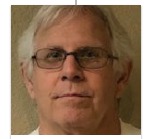
Brother Karl Middlemas, 62, of Local 807 (Tucson, Ariz.) – a member of our union for more than 13 years – died when the crew van he was being transported in collided with a tractor-trailer late on July 6.
Brother Middlemas hired on in 2007 and most recently served as a conductor for Union Pacific. He had completed his shift July 6 and was en route back to Tucson from Nogales when the van was struck at 11:24 p.m. local time on Interstate 19 south of Tucson. He was killed instantly in the crash.
He enjoyed working on and restoring cars, especially classic Mopars.
|
|
SMART-TD ARBITRATES CREW-CONSIST DISPUTE |
|
On June 15 and 16, 2021, the simmering dispute between the SMART Transportation Division and carriers over crew consist finally reached arbitration before neutral party John LaRocca in Sacramento, Calif.
Class I railroads BNSF, UP, NS and KCS initiated a claim in October 2019, just prior to the opening of the current round of national contract handling, that asserted the moratorium provisions of various local agreements no longer barred the service of a Section 6 notice regarding the topic of crew consist.
At the arbitration, 13 SMART-TD General Committees presented their arguments against the National Railroad Labor Conference (NRLC), which represented the railroads involved.
A ruling by LaRocca in favor of SMART-TD would leave current crew-consist agreements closed from negotiations until the expiration of the moratoriums. A ruling by LaRocca in favor of the carriers would open these agreements up for negotiation on the respective properties as the current round of national contract discussions continues.
|
|
OPINION: Bootstraps and boardrooms |
|
How capitalism is supposed to work By JOHN MOYLE |
|
One of the basic rules of economics that we all learn in school is the “Law of Supply and Demand.” When the supply is lower than the demand for something, the price for it goes up. Every business applies this concept to its products and services all the time.
For example, look at the current cost of building materials like lumber and wire. Unexpected high demand has seriously exceeded the available supply and driven the price for these materials through the roof over the last year or so. However, the effect of this law is not limited to products and services. It applies to everything, including wages as well.
Across the country today many would-be champions of capitalism in business, media and government are screaming about people “not wanting to work anymore.” They are actively blaming workers instead of recognizing the basic fact that, if you can’t get people to accept a job at your current wage and benefit offer, the Law of Supply and Demand dictates you need to improve that offer.
|
|
NTSB issues reports on deaths of two workers in railyard accidents |
|
One victim was found to be intoxicated while moving outside of a yard walkway was a factor in the death of another, and according to National Transportation Safety Board reports on fatal accidents on CSX Transportation in 2019 and the Port Authority Transit Corp. in 2020.
In the first incident, on April 13, 2019, a CSX Transportation carman was struck and killed by a remote control locomotive in the Wauhatchie Rail Yard in Chattanooga, Tenn.
According to the NTSB report, forensic toxicology tests determined the carman’s blood alcohol level was such that he would have been considered legally intoxicated, “too impaired to operate a motor vehicle and would experience prolonged reaction times, altered perception of the environment, slowed thinking, and worsening motor coordination.” While the carman performed several of his duties, “he appeared to have ignored safe operations in rail yards and did not maintain general situational awareness.” This failure to maintain situational awareness because of alcohol was determined to be the probable cause of the accident.
The July 26, 2020, incident at PATCO’s Lindenwold, N.J., yard saw a maintenance worker struck and killed between two railcars. The NTSB report indicates the worker was walking outside of a designated walkway, which was blocked by a stored train. This placed him in an area with insufficient clearance, where he was struck during an uncoupling maneuver.
While his movement outside of the walkway was determined to be the probable cause of the NTSB, PATCO’s storage of cars in a location that blocked the walkway, and the fact it did not require employees to use those walkways, were considered contributing factors. PATCO — which operates a line between Philadelphia and Lindenwold — subsequently changed its rules to require use of the walkways, establish storage limits on equipment to create greater spacing between stored sets of cars, and emphasize the use of personal protective equipment. The victim was not wearing a reflective vest and did not have a portable radio.
|
|
Norfolk Southern lays off 86 employees at Altoona locomotive shop |
|
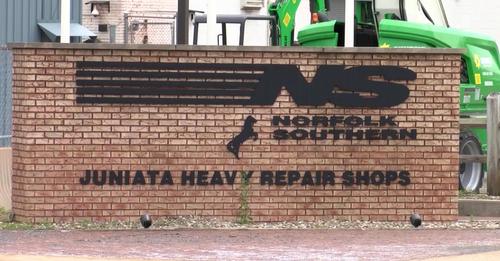
Approximately 86 employees working for Norfolk Southern at the locomotive shop in Juniata were laid off on Friday morning.
According to Norfolk Southern Spokesperson Jeff DeGraff, employees working in their mechanical department were furloughed as part of a long-term business plan by the company that he says will best serve the needs of their customers.
In addition, 16 positions that were vacant will no longer be filled.
“We appreciate the hard work and commitment of all the men and women on the Thoroughbred Team and will work with furloughed employees on opportunities to apply for open positions, elsewhere in our system,” DeGraff said.
|
|
GAO agrees to investigate PSR's effect on reliability, fees for shippers |
|
UPDATE: July 6, 2021:
The GAO accepted Congress' request to conduct a study on the effects of PSR. "Work will likely begin in September," Charles Young, managing director of public affairs at the GAO, said in an email. "We won't have an estimated timeline for completion until after the work begins."
Dive Brief:
- A committee of the U.S. House of Representatives on Wednesday sent a letter asking the Government Accountability Office to conduct a study into the impact precision scheduled railroading has had on shippers and "other affected parties."
- The letter from the House Transportation and Infrastructure Committee asked the GAO to investigate whether there is a direct link between the PSR model and 10 practices or metrics tracked by railroads, such as changes in demurrage fees and reliability of service to freight shippers.
|
|
NOTE: This article (from Railway Age) includes a response to the Executive Order from AMTRAK, the AAR, the STB and the CP. |
|
President’s Executive Order: For Rail, Much Ado About Not Very Much? |
|
"On July 9, as expected, President Joe Biden signed his latest Executive Order, “Promoting Competition in the American Economy.” The 6,861-word document contains very little language directly pertaining to the USDOT, STB and the railroad industry, with the possible exception of how a merger could affect Amtrak. Railway Age has extracted what we consider relevant."
READ THE ARTICLE HERE...
|
|
Amtrak signs deal for 83 multi-powered trains. Some will replace rail cars that are 50 years old |
|
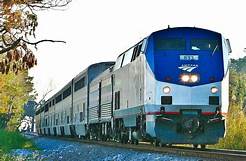
Amtrak has awarded Siemens Mobility $3.4 billion in contracts to design, manufacture and provide technical support services and maintenance for 83 trainsets of two power configurations, with options for up to 130 additional trainsets. For Siemens, it is the company’s largest North American contract in history. For Amtrak, its total investment, with a long-term parts supply and service agreement, facility modifications and upgrades, and contingencies, is $7.3 billion. Deliveries are slated to commence in 2024.
The new equipment, which includes dual-power (AC catenary/diesel) locomotives and first-of-their-type Venture Hybrid battery trainsets,will operate on the Northeast Corridor, long distance Palmetto and various state-supported routes. It will replace Amtrak-owned Amfleet, Metroliner, and state-owned equipment on certain routes throughout the country. In addition to the Northeast Regional, other routes will include the Adirondack, Carolinian, Cascades, Downeaster, Empire Service, Ethan Allen Express, Keystone Service, Maple Leaf, New Haven/Springfield Service (Amtrak Hartford Line and Valley Flyer), Pennsylvanian, Vermonter and Virginia Services.
|
|
The Baltimore maglev: another too good to be true promise in city transportation |
|
City representatives have officially recommended against building a proposed high-speed SCMaglev train between Baltimore and Washington, with eventual plans to stretch to New York City. This recommendation might surprise some Baltimore residents. After all, how could an innovative technological project that promotes sustainability, provides jobs and creates faster connections to surrounding cities not be good for a struggling city like ours?
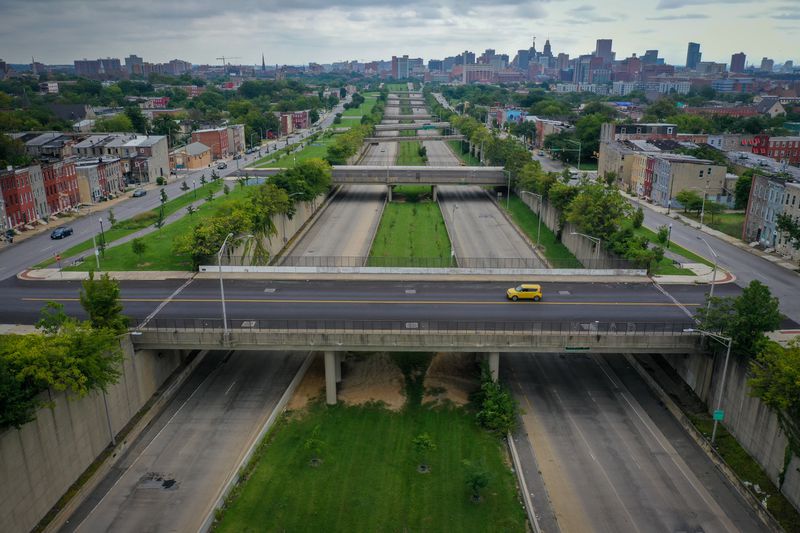
The city’s reasoning, however, becomes more understandable when we consider the maglev project as part of a longer history of transportation planning in the Baltimore region. For over half a century, Baltimore has grappled with the traumatic consequences of past large-scale transportation infrastructure projects, most notably the elaborate plans for urban interstate highways of the 1950s and 1960s. Arguments made back then in favor of these highways are eerily similar to the current utopian claims from the Northeast Maglev company.
|
|
KCS sets stockholder meeting date for CN merger vote |
|
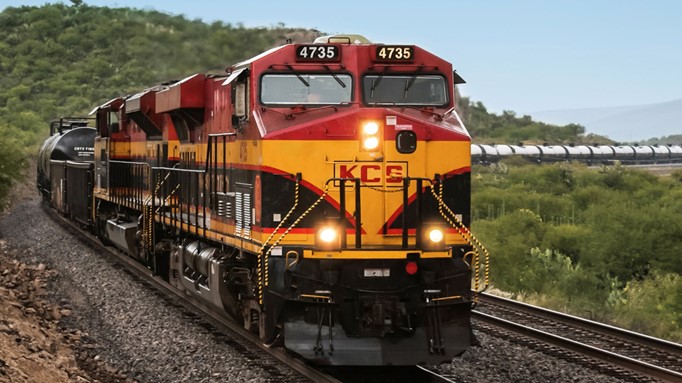
Kansas City Southern has scheduled for Aug. 19 a virtual special meeting of stockholders to vote on the proposed merger with CN.
All stockholders of record of KCS common stock and 4% non-cumulative preferred stock as of the close of business on July 1, 2021, will be entitled to vote their shares at the special meeting, KCS and CN officials said in a press release.
As previously announced on May 21, under the terms of the agreement KCS stockholders will receive $200 in cash and 1.129 shares of CN common stock for each KCS common share, with KCS stockholders expected to own approximately 12.65% of the combined company.
KCS' preferred stockholders will receive $37.50 in cash for each preferred share. Additional information regarding the combination can be found in the definitive proxy statement that has been filed with the U.S. Securities and Exchange Commission.
|
|
EDITOR'S NOTE; While all these "acts of nature" have retarded UP's ability to move freight, the effects have been greatly exacerbated by PSR and the "lean and mean" approach to railroading that keeps resources - including locomotives and crews - trimmed to the bone. Acts of nature - including blizzards, tornadoes, floods, fires, temperature extremes, bumper crops, and more - are all part of life on a regular basis, and growing ever more common with climate change. The railroad needs to operate according to a business model that takes these factors into account, not one that is in denial, one that looks only at the operating ratio and next quarters' profits. |
|
Union Pacific taking it on the chin from Mother Nature |
|
The railroad recently released the following statement on the battering, and its impact to customer service:
“We are currently experiencing the following interruptions throughout our rail network.
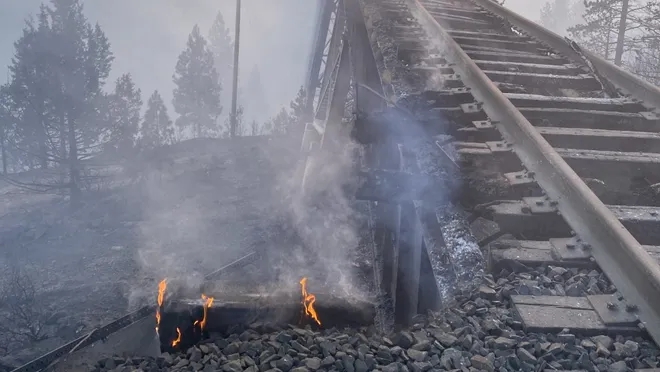
- The fire burning in the Shasta-Trinity National Forest near Weed, California, is impacting rail operations between Redding, California and Eugene, Oregon. Our Engineering team is currently assessing the extent of the damage to our rail infrastructure including the Dry Canyon bridge near Hotlum, California. A reroute plan is in place to move traffic around the impacted area. As a result of the alternate routing, customers may experience delays in excess of 72 hours.
- Engineering forces are currently working to restore the railroad as a result of the recent washouts east of Kansas City, Missouri. Estimated time of opening is now expected to be end of the week. For traffic moving between Kansas City and St. Louis, we have increased crew boards, repositioned crews and added transportation resources. Customers should continue to anticipate delays between 24-48 hours through opening and until backlog of traffic is worked off.
- The Pacific Northwest is currently experiencing extreme heat. As a result, we are performing additional track inspections, keeping a watchful eye on the safety of our crews and monitoring the area for any potential wildfire risks.
- In Iowa, our network continues to recover from the service interruption late last week. Additional crew transportation was injected to work off the backlog of rail traffic.
|
|
CSX has no plans for precision scheduled railroading in joint venture bought from Pan Am |
|
CSX Corp. plans to improve portions of the 1,200-mile network of rail that it will buy as part of its acquisition of Pan Am Railways, it told regulators in its most recent filing — but on at least a portion of the network, it doesn't plan to implement the efficiency-focused Precision Scheduled Railroading model that has lowered its operating ratio but sometimes angered customers.
In its most recent — and most voluminous — application to the Surface Transportation Board, CSX indicated it will improve the Pan Am Southern track from a Class 1 designation, where its top freight traffic can be hauled at 10 mph, to a Class 2 designation, which would allow freight to be moved at 25 mph.
A 7.6-mile stretch between Worcester and Ayer would be improved to Class 3 standards, which would allow freight to move at 40 mph, the railroad said in the July 1 filing.
|
|
Chinese rail inventions have overtaken European ones |
|
In total numbers, China produces the most innovations in the railway sector, finds a new report by the European Union Agency for Railway (ERA). Interestingly, most of these patents are filed only domestically, and when looking at innovations brought to multiple countries, the EU takes the lead. Part of the ERA analysis are the European Union, the United States, China, Japan, and South Korea.
When it comes to railway innovations, how does the European rail sector perform versus other regions? That is one of the questions the report aims to answer. ERA observes that the number of Chinese inventions have grown substantially over the last decade, and in terms of absolute numbers have overtaken those by European railway innovators. Within Europe, the vast share of patents is filed by German applicants, accounting for more than half.
|
|
Are Electric Trains the Future for the American Railroad? |
|
Colossal freight locomotives are a fixture of the American landscape, but their 4,400-horsepower engines collectively burn 3.5 billion gallons of diesel annually, at a time when railroads and other fossil fuel users face pressure to reduce pollution and greenhouse gas emissions.
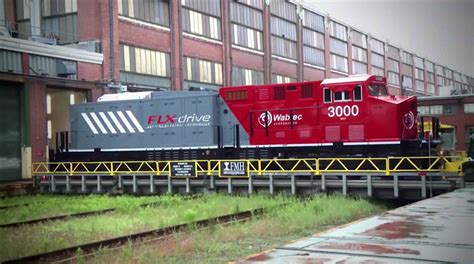
With little fanfare, however, the industry has begun operating locomotives that run on stored electrical power, moving toward a future in which toy shops are not the only source of battery trains. American passenger lines could also be transformed by the technology, though California rail officials say it will not work for the state’s bullet train.
|
|
Editor's Note: We continue to see outside "experts" regurgitating carrier PR regarding two person train crews. When will the BLET and SMART-TD mount a PR campaign of their own? |
|
Towhey: Union Push for Increased Staffing At Odds With Green Goals of Expanded Rail |
|
It sounds like the setup to a bad joke: How many people does it take to crew a freight train?
But with the federal government wading into the debate, no one thinks it’s funny.
In 2019, the Federal Railroad Administration under former President Donald Trump issued a rule revoking a 2016 proposed regulation and enabling railroads and labor unions to determine staffing through collective bargaining. California, Nevada, and Washington states sued, claiming the rule would undermine rail safety. The Ninth Circuit Court of Appeals in February upheld a lower court’s order requiring two people in the cab, opining that the Trump rule was arbitrary.
At the end of the month, the U.S. House Subcommittee on Railroads, Pipelines, and Hazardous Materials is scheduled to look at this issue. But rail observers say the focus is misplaced.
“A law or regulation that permanently requires a minimum crew size of two — especially where there is no evidence that one-person crews are less safe — can only stand in the way of further reductions in accidents caused by human error,” said Patrick McLaughlin, senior research fellow at the Mercatus Center at George Mason University.
|
|
Joe Biden Says He Stands With Unions. This Is His Moment to Prove It. |
|
Speaking on the recent National Solidarity Call in support of striking nurses at St. Vincent’s Hospital in Worcester, Massachusetts, Our Revolution leader Joseph Geevarghese characterized the situation as “Biden’s PATCO Moment.” The call was convened by the Labor Campaign for Single Payer to help mobilize national support for the 800 nurses at the Tenet Healthcare-owned hospital who are now engaged in the longest nurses strike nationally in over a decade.
Tenet has spent more than $75 million to date to prolong the strike. A fraction of those funds could have easily met the nurses demands for the staffing improvements that are the sole issue driving the strike.
Now Tenet is threatening to permanently replace the striking nurses who are represented by the Massachusetts Nurses Association (MNA). This action, by a notorious healthcare profiteer (Tenet leveraged federal bailout funds intended to provide urgent relief to employees and patients to triple its profits at the height of the pandemic last summer), has transformed a hard fought strike battle into a red line issue for the entire labor movement.
|
|
Transit workers risk 'great ambush' without federal investment in training, labor leaders say |
|
Advancing legislation in Congress gives transportation labor leaders hope for creating a national training center for transit workers that could help them prepare for using new technologies and bringing future generations into the sector.
The Investing in a New Vision for the Environment and Surface Transportation in America (INVEST in America) Act includes provisions for a national public transportation workforce training center, a long-held priority for organized labor. The U.S. House of Representatives passed the bill Thursday morning and sent it to the U.S. Senate for consideration.
The bill, which reauthorizes the nation's surface transportation legislation, comes as labor leaders warn that developments like automation and electrification risk leaving workers behind if leadership does not prepare them for the future.
|
|
|
|
|
|
|