Quarterly Newsletter

July 2025

CA Quits Webinar


Emerging Tobacco/Nicotine Products:

Opportunities for Intervention and Treatment Among Youth and Young Adults


Speakers: Kim Homer-Vagadori (California Youth Advocacy Network) and Dr. Rina Edi (Kick It California)


Date: Tuesday, July 22, 2025

Time: 10:00 – 11:00 AM PST


Join us to learn about:

  • New and emerging tobacco/nicotine products
  • Current use trends among youth and young adults
  • Effective intervention and treatment strategies


This session is ideal for health systems, public health departments, and Medi-Cal managed care plans. Don’t miss this opportunity to stay informed and engaged!

Health Systems

California Department of Health Care Services (DHCS) released its 2023 evaluation report on the value-based care program for public hospital clinics known as the Quality Incentive Pool program (QIP). The evaluation report for 2022 and 2023 showed public hospital clinics reporting high rates of tobacco assessment, but much lower rates on tobacco assistance. It’s great to see that a large public hospital clinic selected the tobacco measure as their Health Equity focus for their Black/African American patients. Based on the report, continued focus is needed to close gaps in cessation support, particularly for priority populations.

TABLE: Tobacco Assistance Rates by Public Hospital Clinics


2022

2023

Large Public

Hospitals Clinics

65% (n=13)

73% (n=13)

Small Public

Hospitals Clinics

13% (n=5)

36% (n=6)

CA Quits continues to partner with public hospital clinics to improve both tobacco screening and assistance rates. This includes increasing screening rates for all tobacco products (smoking, smokeless, and e-cigarettes/vapes) as well as the new 2025 QIP requirement to screen all patients aged 12 and older.


For more information, please contact CA Quits Quality Improvement Specialist, Moreen Sharma, mmsharma@ucdavis.edu.


Medi-Cal Managed Care Plans


At the June 18 CA Quits Medi-Cal Managed Care Plan (MCP) tobacco cessation workgroup meeting, we invited local health department tobacco prevention programs to attend and learn about collaborative opportunities.


  • Kern Family Health Care co-presented with the Kern County Tobacco Prevention Program and shared their partnership in providing cessation services to the Medi-Cal members and the community.


  • Inland Empire Health Plan provided an update on their pilot cessation interventions, including training internal staff and community health workers (CHWs) and partnering with a local hospital cancer center for comprehensive lung cancer screening services.


  • There were 25 attendees, with 13 MCPs and 6 local health department tobacco prevention programs represented. 


For more information about the MCP workgroup or if you are with an MCP and would like to participate, contact Shannon Haggitt, Plan & Partner Manager, srhaggitt@ucdavis.edu.

UPDATE: New Tobacco Quality Measures for

Health Plans for 2026


The National Committee for Quality Assurance (NCQA) has approved the new Tobacco Use Screening and Cessation Intervention (TSC-E) measure for measurement year (MY) 2026.


The measure includes:

  • Screening 12 and older for commercial tobacco products, including e-cigarettes, vapes, and smokeless products
  • Providing cessation intervention to individuals identified as tobacco users.


In 2024, UC Davis Health and Inland Empire Health Plan conducted beta testing for the tobacco quality measure. This new tobacco quality measure for health plans aligns with the DHCS public hospital clinic tobacco measure.


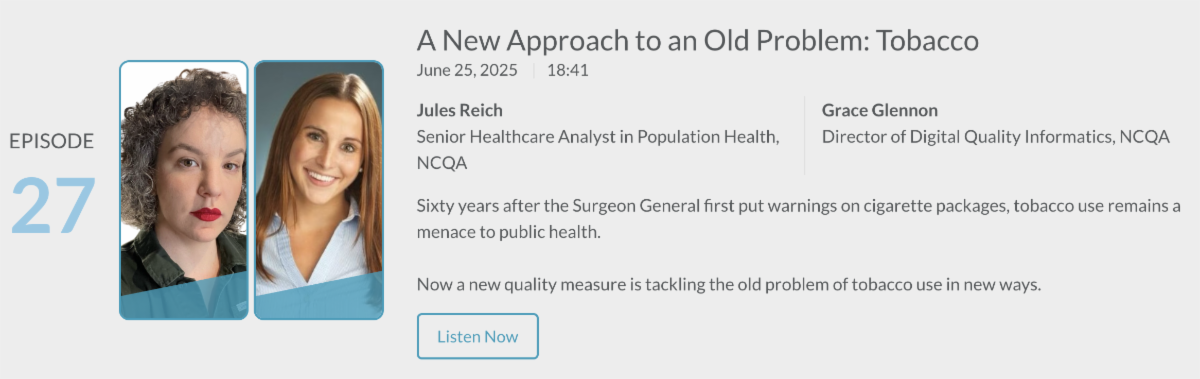
For more information, listen to Quality Matters: A Podcast by NCQA

EDUCATION


Estimating the prevalence of disability among adults in the USA who smoke cigarettes, 2019–2023


A May 2025 analysis of US data (2019–2023) shows that adults who smoke are roughly twice as likely to experience disability as those who have never smoked, with about 40% of the 25 million current US smokers reporting at least some functional difficulty. Impacts span vision, hearing, mobility, cognition, and self-care, underscoring how smoking exacerbates daily challenges. The authors call for inclusive smoking cessation strategies that consider accessibility and universal design to better support people with disabilities.


Varenicline for youth nicotine vaping cessation - A randomized clinical trial


A recent JAMA study found that combining varenicline with behavioral counseling significantly increased nicotine vaping cessation among youth who vape but do not smoke cigarettes. The results underscore varenicline’s potential as part of effective, youth-focused vaping cessation programs.

Nicotine replacement therapy as a smoking cessation tool for adolescents: an update


A February 2025 systematic review examined nicotine replacement therapy (NRT) in adolescents. While NRT helped reduce smoking frequency and managed withdrawal symptoms, long-term quit rates remained low. Overall, NRT was safe (with only mild side effects like skin irritation and headaches), but the findings highlight a need for stronger program adherence, behavioral support, and tailored treatment strategies for youth.

Vaping cessation interventions improve quit rates


A February 2025 meta-analysis found that vaping cessation interventions significantly improved quit rates across multiple time points. The results support the effectiveness of tailored tools like digital programs and medications in helping adults quit vaping.


RESOURCES


CA Quits | www.caquits.com.