Jackie Augustine, Executive Director, has made a concerted effort to document the birds, wildflowers, and insects on all of AOK’s properties this year. Of the 188 species identified at Mount Mitchell, a 45-acre AOK Sanctuary south of Wamego, 53% are plants and 37% are insects. Of the insects, butterflies or moths were the most common (27%), followed by grasshoppers and katydids (19%) and beetles (17%). The grasshopper diversity on this site was remarkable given that grasshoppers, katydids, and crickets only make up 2.4% of the worldwide insect diversity (according to Wikipedia). To learn more about grasshoppers, Jackie turned to a grasshopper expert with ties to Manhattan, Dr. Ellen Welti. She stated that grasshoppers are a dominant herbivore in grasslands. In the west, grasshoppers are often considered pests which eat crops and compete with cattle. Drought, a common phenomenon in the west in recent years, can increase grasshopper densities. This has led to large-scale aerial spraying efforts which have intensified in recent years, both by local land owners, and by government agencies. Large-scale aerial spraying may control grasshoppers in the short-term but it has many negative long-term effects. First, grasshopper species can compete with each other, which can keep individual species in check. Large-scale spraying selects the few most robust species, which may cause larger outbreaks in later years. Spraying is indiscriminate and also can kill important invertebrates such as those that are predators and parasitoids of grasshoppers, as well as pollinators and seed dispersers. The loss of grasshoppers, an integral member of grassland ecosystems, will have strong repercussions up and down the food chain. Find out more about grasshoppers in our upcoming issue of Prairie Wings, our printed magazine.
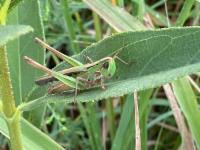
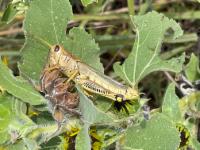
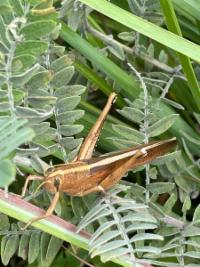
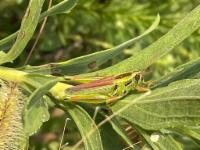
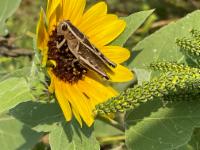
Grasshoppers pictured are:
Upper left: Admirable Grasshopper Syrbula admirabilis
Upper right: Differential Grasshopper Melanoplus differentialis
Second down on Right: Spotted Bird Grasshopper Schistocerca lineata
Third down on right: Snakeweed Grasshopper Hesperotettix viridis
Lower right: Two Striped Grasshopper Melanoplus bivittatus