|
Banging, Hopping,
Jumping & Throwing
into New Year!
Why meet the New Year with charm and grace when we can act like a festive lunatic for a few acceptable minutes?! As the clocks tick toward midnight, the world over friends and family are found performing a remarkable array of bizarre rituals as they greet the New Year not with quiet reflection, but with symbolic stunts that suggest luck is a stubborn beast best coaxed with food, noise, and the occasional airborne chair.
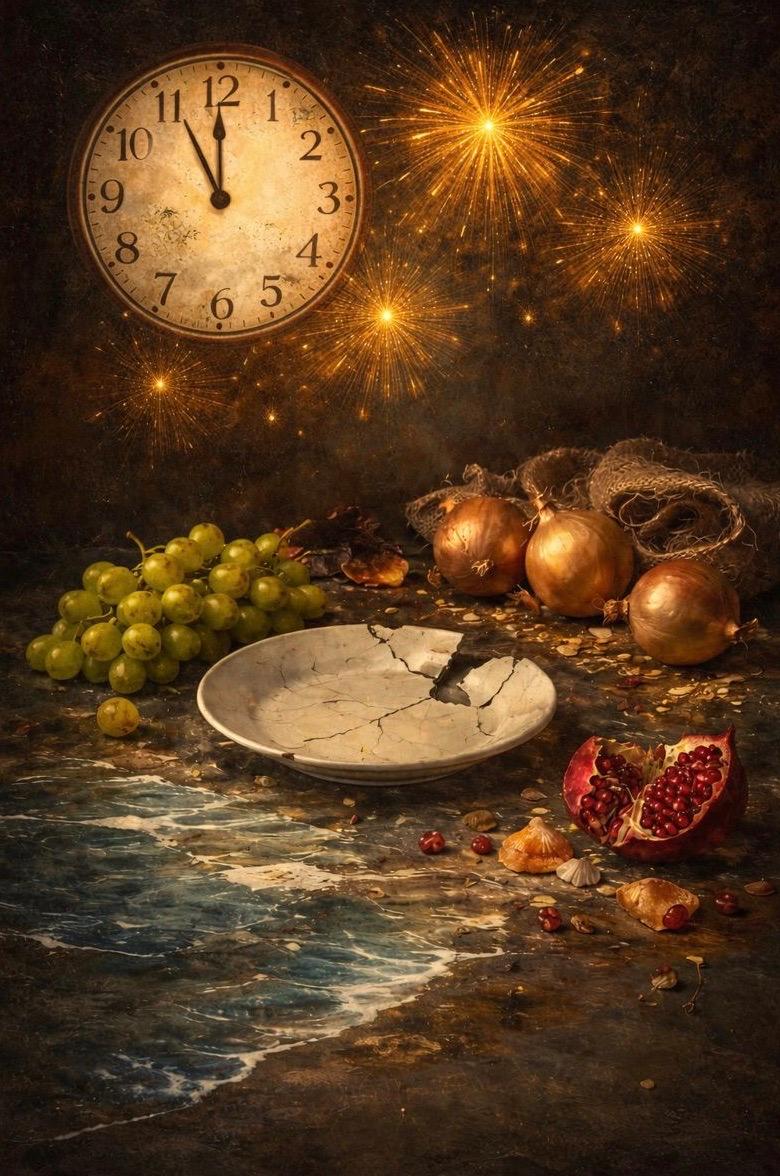
In Spain, for example, next year’s luck seems to hinge on eating fruit fast and rhythmically. On each of the twelve chimes of midnight, you must eat a grape. Success guarantees a lucky year, but failure invites misfortune.
For those brave enough, in Brazil, you head into the ocean to jump seven waves. Each one honors a divine spirit and earns a wish. It’s a spirituality cardio workout. In Greece, water gives way to tears as onions take center stage. Because they grow even when neglected, a massive bunch of onions hung over the door becomes a botanical metaphor for resilience and abundance.
Many believe prosperity can be delivered by swallowing circular food. Italians eat lentils shaped like coins. Filipinos serve twelve round fruits for twelve months of abundance. Roundness equals wealth, and geometry has never been so aspirational.
In Ireland, it's all about the bread, whatever its shape. Bad spirits are sent packing by banging a loaf against walls and doors. It’s a baker’s exorcism meant to bring good luck. Not to be outdone, Turkey finds its luck in pomegranates smashed on doorsteps. The messier the explosion, the richer the year will be.
Puerto Rico aims to flush out the bad luck, too, but saves its food by throwing water from windows instead. It’s a cleansing ritual that doubles as a public hazard, and pedestrians are advised to carry an umbrella.
In Colombia, three potatoes are hidden under a bed: one peeled, one not, one half-peeled. Grab one to discover whether your year will be rich or poor, and perhaps who is cooking.
As the clocks chime in Portugal, people jump into the New Year with their right foot first. Meanwhile, the Danes seem to thrive on weaponizing crockery – hurling it at friends’ doors on the stroke of midnight.
Not to be outdone, in parts of Italy, New Year’s Eve once meant throwing old furniture off balconies to symbolize renewal. Today, softer objects are used, though vigilance is still advised.
Across continents and centuries, these rituals share a single belief: luck must be actively generated. It must be startled, fed, smashed, jumped over, or knocked politely off course. Whether through grapes, waves, or flying crockery, the message is clear. If the future won’t listen, make enough noise, and it just might flinch.
|