|
“There never was a time when, in my opinion, some way could not be found to prevent the drawing of the sword.”
-Ulysses S. Grant
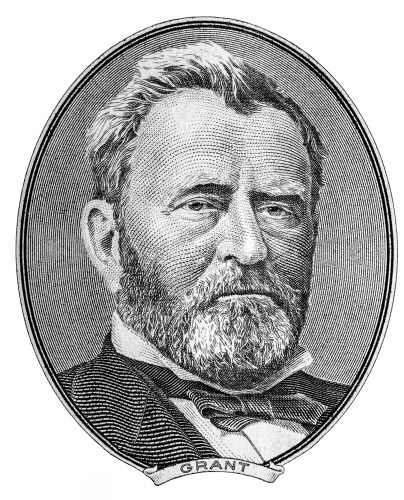
There’s a story in the autobiography of Ulysses S. Grant that goes like this: He was a young lieutenant, about 24, in the early days of the War with Mexico. He and another young lieutenant were traveling between forts across the vast Texas Prairie, riding through the night to make it to their new post. Grant heard a pack of wolves in the distance making a horrible racket. It was just him, his compatriot, their mounts and a pack horse and he was certain this pack of wolves was large enough to take them all down. The other officer who grew up on the plains, whereas Grant grew up in the comparatively large town of Galena, Illinois, seemed less nervous. Grant’s companion asked him, “how many wolves to you think are making all that noise?” And Grant, believing it had to be at least 50 didn’t want to seem overly nervous so he confidently told the other man; “Probably about 20.” A mile or so up the trail they came upon the wolves, just two wolves who’d killed a small deer were making all that noise. Grant notes in his memoirs that this lesson stuck with him throughout the Mexican American War, the Civil War and his Presidency. As Grant puts it; “There’s always more before the counting.”
Grant goes on to explain how this experience taught him two things. The first was not to panic and assume the worst, a lesson that served him well in the Civil War. The second was that the loudest voices are not always an actual majority, a lesson that applied more to his Presidency. I want to talk about both those lessons as we try to process the very stressful last couple of weeks.
I’m a financial advisor, but I understand that there are many facets to this war with Iran beyond the market and economy. There are political fallouts in the United States, International relations issues galore with our opponents and allies and of course the actual loss of life. While I have plenty of opinions on all those things, I’m not an expert on any of them and that’s not what this newsletter is about, so I’m going to stick mostly to the short-term market reactions and if things go on longer in future editions I may delve into the long-term ramifications of higher oil prices and the impact higher fertilizer prices and depleted helium supplies have on agriculture and semiconductor manufacturing respectively. I also have to write this newsletter about a week before it’s published and with the frantic and chaotic nature of the news cycle, especially with respect to how this military action has been conducted and explained, I may touch on things that only a few days after writing them seem woefully out of date.
But let’s return to Grant and his wolves. The initial market reaction to the bombing of Iran was pretty negative in all aspects – unless you were holding oil futures contracts. U.S. Treasury yields went up, which means the market price for any bonds you hold would have dropped slightly. The stock market dropped, although nothing approaching a full-blown correction as of this writing, it did go down 5-7% pretty quickly. And even the alternative holdings that have done so well the last few years, like gold and other metals, had major drops with gold down more than 10% (but still up more than 50% year-over-year.) Just like Grant didn’t know how many wolves were around the corner, we never know how long a slide like this is going to go on. We see our accounts down maybe 5% in two weeks and project out that pattern and imagine we’ll be down 50% by July, but that’s not how it works. Just because you hear a lot of noise doesn’t mean there have to be a deadly number of wolves up ahead. Maybe the recent lows are the lows – of course they may not be – but as always if your investments are for the future then what you get paid for in the traditionally higher rates of return the markets provide is not panicking and sticking with your investments. The trail up ahead seems scary because we don’t know what’s up there, if we knew it was just two wolves, we wouldn’t be nervous in the first place. As somebody who has been in this business through 9/11, the “Great Recession” and Covid, let me assure you things can turn up just as quickly as they turned down and the biggest mistake is to take your money out of the markets and miss that turn around – of course if we could time it perfectly we’d all be Warren Buffett level wealthy, but since we’re not, we obviously can’t.
Then there is the second lesson Grant learned that the loudest voices are not necessarily the majority. Most people out there don’t pay close attention to what’s going on in the world and pay even less attention to the markets. The majority of market participants are just throwing whatever percentage of their salary they defer into their 401(k) plans each month and maybe once a year they look at their balance. I know that may seem hard to believe, but studies show that it’s true. Meaning, the people screaming on the internet about wars, the economy and the stock markets are by definition a very, very small minority of people. Couple that with the fact that these voices have become more and more partisan, so they’re not only being loud, but they’re also spinning whatever they’re saying to totally support or totally defame. The majority of people, once again, are somewhere in the vast middle of these voices in their opinions and actions so the predicted extremes on both sides are unlikely to come true. Certainly, higher oil prices are the one thing that everyone pays attention to and a prolonged period of $4.00 plus gas prices will have serious impacts on our economy. But as of now it’s been a couple of weeks and we have no idea what the price of gas is going to be in May, much less next year. We’ll worry about that when it happens.
Even before this military action against Iran, there were signs the economy was slowing down. Fourth quarter GDP growth came in at only 0.7% (the government shut-down had some impact on that but it was lower than estimated even with the shut-down) and for the year it was only 2.1%. The February unemployment report showed a loss of almost 100,000 jobs and revised down the growth for the previous two months to the point where the unemployment rate ticked up slightly to 4.4%. Inflation meanwhile (the recent gas shock notwithstanding) is still running a lot closer to 3% than the Fed’s target of 2%. There is fear of us running into a mild recession over the next few quarters if we’re not in one already. At the same time there’s a lot of optimism that aspects of the One Big Beautiful Bill Act that are only kicking in this year, will juice the economy in the second half of 2026 – but the military action against Iran throws all of that analysis into question. But that’s all fodder for a future edition of this newsletter.
For now, the snow is gone and I’m back from Puerto Rico. Please keep us in mind if you run across anyone in need of some financial advice. As always, our lines and doors are open if you want to get together and talk about any of this stuff. Until next time…
|