|
Dear Presidents’ Alliance Member,
In this week’s Member Update:
- DOL Publishes Proposed H-1B Rule, Seeking to Increase Prevailing Wages
- ICYMI! Webinar on Navigating H-1B Visa Changes: Policy Updates and Resources for Higher Education
- Federal Court Rejects DOJ Challenge to Minnesota Tuition Equity Law
- Supreme Court Hears Arguments on Birthright Citizenship
- Register for Our Policy and Legal Strategy Session in Washington, D.C.
- Join Our Biweekly Policy Update Meetings
- We’ve Moved to a New Home in D.C.!
- Immigration in Brief
- Calendar of Events
- Top Reads
| | |
DOL Publishes Proposed H-1B Rule, Seeking to Increase Prevailing Wages
On March 27, the Trump administration published a proposed H-1B prevailing wage rule in the Federal Register that would significantly increase the minimum wages required to hire H-1B visa holders and certain other employment-based nonimmigrants. The changes are expected to raise costs for employers, including colleges and universities across the United States, and disproportionately affect recent international graduates and early-career professionals, who are typically classified at lower wage levels.
The rule would raise required salaries by approximately 21 to 33 percent, depending on experience level. Notably, Wage Level I — which covers most entry-level workers — would increase from the 17th percentile to the 34th percentile, representing the largest jump among the four wage tiers. The proposal closely mirrors the 2021 rule published during the first Trump administration, which ultimately did not go into effect after it was challenged in court and was withdrawn by the Biden administration. The Presidents’ Alliance was one of the named plaintiffs in the lawsuit challenging the 2021 rule.
The rule is open for a 60-day public comment period (deadline: May 26), allowing stakeholders to assess its impact and submit feedback. The Presidents’ Alliance, in collaboration with partners, plans to submit comments on its implications for higher education, workforce development, and the broader talent pipeline.
| | |
ICYMI! Webinar on Navigating H-1B Visa Changes: Policy Updates and Resources for Higher Education
On Tuesday, March 31, the Presidents’ Alliance and the International Student Resource Center hosted a webinar on Navigating H-1B Visa Changes: Policy Updates and Resources for Higher Education. During the session, our expert speakers discussed recent and anticipated changes to the H-1B program, including the proposed DOL prevailing wage rule, $100K visa fee, OPT, and D/S, and their implications for campuses, international students, faculty, and staff, as well as key legal developments, key arguments, and messaging. The webinar provided tools and resources for institutions and impacted students and scholars.
| | |
Federal Court Rejects DOJ Challenge to Minnesota Tuition Equity Law
A federal court in Minnesota dismissed the DOJ’s challenge to the state’s tuition equity law, marking the first of these cases to reach a decision on the merits. Among its holdings, the court found that federal law does not preempt policies based on criteria like high school attendance and graduation, and that Minnesota’s laws are compliant with federal law. This case is part of a broader DOJ effort challenging tuition equity laws in multiple states. To view the latest updates on other tuition equity challenges, visit the in-state tuition litigation tracker.
| | |
Supreme Court Hears Arguments on Birthright Citizenship
Today, the Supreme Court hears arguments in Trump v. Barbara, a case challenging the January 2025 Executive Order restricting birthright citizenship. Many legal analysts, including Steve Yale-Loehr, argue that if the Court upholds the order, it could harm millions of people.
The Presidents’ Alliance joined an amicus brief in support of the legal challenge. The brief argues that the Executive Order would improperly deny citizenship to U.S.-born children whose mothers were deemed either “unlawfully present” or present on a “lawful but temporary” basis, and whose fathers were neither U.S. citizens nor lawful permanent residents. It explains how the Order would affect individuals with long-standing ties to the United States, including DACA recipients, TPS holders, F-1 international students, H-1B professionals, and others with federal authorization to live, study, and work in the country, and includes real-world examples of students and DACA recipients who have pursued higher education, built careers, and started families in the U.S., underscoring the far-reaching consequences of the policy.
| |
Register for Our Policy and Legal Strategy Session in Washington, D.C. | |
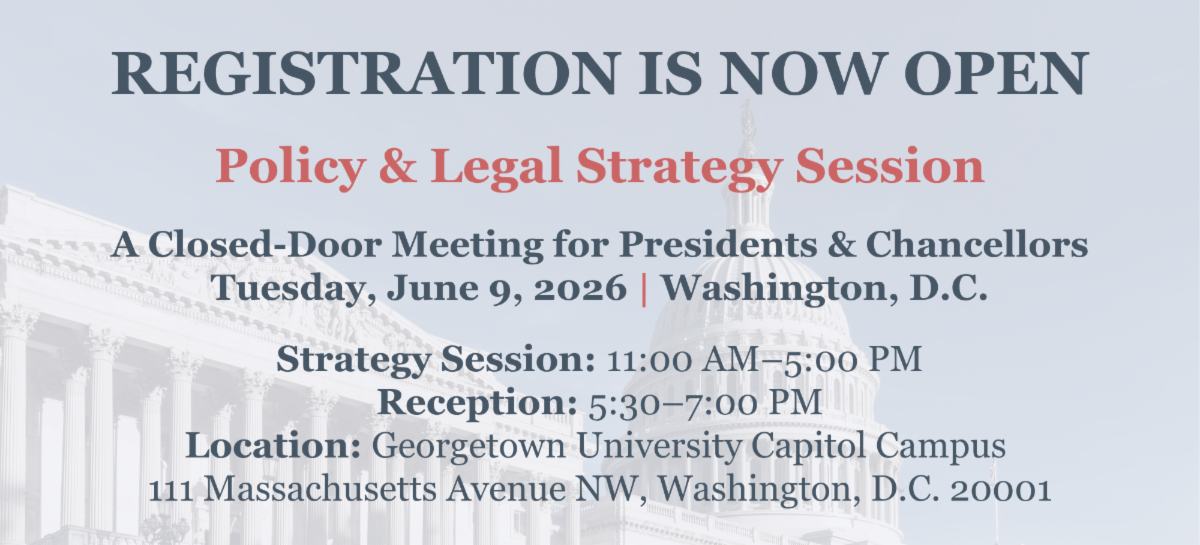
For Presidents and Chancellors: We invite you to register for the Presidents’ Alliance in-person Policy and Legal Strategy Session on June 9 at Georgetown University’s Capitol Campus. The session will take place from 11:00 AM–5:00 PM, followed by a DACA Anniversary Reception from 5:30–7:00 PM honoring bipartisan immigration reform champions.
The session will focus on timely policy and legal strategy for undocumented, immigrant, refugee, and international students and scholars, including federal and state developments, litigation, and regulatory changes.
If you have any questions, please contact Diego Sánchez at federalpolicyteam@presidentsalliance.org.
| | |
Join Our Biweekly Policy Update Meetings
Current Presidents’ Alliance members are invited to join our biweekly policy update meetings for timely policy updates, practical takeaways, and discussion with peers. Our next meeting will take place on April 10 at 12:00 p.m ET. If you or a member of your senior leadership team would like to receive the invitations, please contact Corinne Kentor at federalpolicyteam@presidentsalliance.org.
| |
|
We’ve Moved to a New Home in D.C.!
We’re excited to share that the Presidents’ Alliance has moved to a new physical location in Washington, D.C.: 1776 I St NW, Suite 750, Washington, DC 20006. Our new space is located at the Arizona State University D.C. campus, co-located with the McCain Institute. We extend our tremendous thanks to ASU for their generous partnership and for welcoming us into this collaborative space. We are also deeply grateful to New America, which provided us with a supportive home since our start in January 2018.
| | |
Immigration in Brief
- The Senate passed a bill to fund most of DHS, but it excluded ICE and some CBP operations and omitted enforcement guardrails, such as protections for sensitive locations and judicial warrants for entry into nonpublic spaces. The House, meanwhile, passed its own 60-day continuing resolution, which has no viable path in the Senate. Congress is now out for a two-week recess, prolonging the shutdown stalemate.
- The discharge petition on Haiti TPS reached enough signatories to compel a vote on the House floor. The resolution would direct the Department of Homeland Security (DHS) to designate Haiti for temporary protected status (TPS) until January 20, 2029. At the same time, the termination of Haiti TPS currently sits before the Supreme Court, with oral arguments scheduled for late April and a decision expected in late June or early July.
-
Reports indicate that the pause on processing asylum claims will come to an end, except for the “travel ban” countries. See the USCIS update here.
-
A new analysis of the OPT Observatory data by Chris Glass suggests several ways of reforming the program “for the future” to reflect the ongoing labor market, technology, and geopolitical changes.
-
A provision of Indiana’s Senate Enrolled Act 256 requires the state’s public colleges and universities to conduct a “foreign influence and research security review” before enrolling students from countries such as China, Russia, North Korea, and Iran into certain programs. Under the law, starting Aug. 15, 2026, institutions may not admit new students from these designated “adversarial” countries into some STEM fields without first assessing potential security risks or foreign influence.
-
TheDream.US CEO Gaby Pacheco wrote a compelling letter to Congressional leaders calling for action and oversight to address DACA processing delays, detentions, and deportations.
| | |
Calendar of Events
-
April 21, 2026 | Campus Compact & ECAR Webinar – Meeting the Moment: How Campuses Are Continuing to Support Refugees | Register Here
-
June 9, 2026 | In-Person Policy and Legal Strategy Session + DACA Anniversary Reception | Register Here
| | |
Thank you for your support and engagement.
The Presidents’ Alliance Team
| | | | |