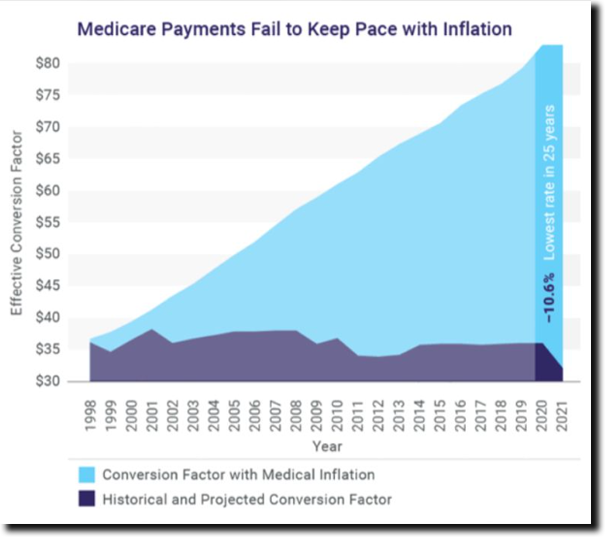
Compounded by an escalating 9% inflation, this equals a 20% cut!
This is worse than we expected. Your survival is at stake - respond now!
Join ASIPP's effort to reverse these alarming trends by clicking here.
|
|
|
To see sample rates compared to 2022, click here. In addition to the 4.4% cuts, some codes have faced higher reductions with very few codes facing increases. The same applies to 10.4% cuts.
In reference to ASCs, as of now, they are not proposing any cuts; however, a 6% cut will remain in effect unless the 2% sequester cut from ACA and 4% statutory PAYGO from the American Rescue Plan Act are eliminated.
The fee schedule remains stable except for a few small increases. Some of the procedures that received major increases include sacroiliac joint arthrodesis and moderate increases for peripheral nerve stimulators.
|
|
Dr. Anthony Fauci’s Golden Parachute Will Exceed $350,000 Per Year – The Largest In U.S. Federal Government History
On Christmas Eve, Dr. Anthony Fauci turned 81. However, he is not retiring just yet. If he did, Fauci would reap the largest federal retirement package in U.S. history.
Our auditors at OpenTheBooks.com estimate Dr. Fauci’s annual retirement would exceed $350,000. Thereafter, his pension and benefits would continue to increase through annual cost-of-living adjustments. Fauci has 55 years of service as a federal employee.
For the second year in a row, Fauci was the most highly compensated federal employee and out earned the president, four star generals, and roughly 4.3 million of his colleagues. As director of the National Institute of Allergy and Infectious Diseases (NIAID), Fauci earned $434,312 in 2020, the latest year available, up from $417,608 in 2019.
|
|
Register today for the CALSIPP Annual Meeting and join us for an Evening Cruise on the Bay!
Saturday, October 15 | 7:30 pm
|
|
Enjoy an entertaining three-hour yacht cruise around Newport Bay on a two-level contemporary yacht. Take in the beautiful sights from the outdoor viewing areas on the large bow, aft deck, or by strolling the walk-around decks.
Limited tickets are available, so do not wait! Tickets are $100 per registered meeting attendee or guest and must be selected on the registration form.
Register for the meeting and select the Cruise Add On.
|
|
Study yields critical clues for successful inflammatory recovery
Recommends wearing a mask for 10 days and testing on or after day 5 instead
Inflammation is the body's first line of defense, occurring as droves of immune cells rush to the site of injury or acute illness to make repairs and stem further damage.
When successful, inflammation helps the body survive and heal after trauma. However, when the recovery following an inflammatory response goes awry, it signals that damage is still occurring -; and the inflammation itself can cause further injury, leading to more-severe illness or even death.
But what differentiates a good inflammatory recovery from a bad one?
A new study, led by researchers at Harvard Medical School and Massachusetts General Hospital, published August 22 in Nature Communications, yields critical clues.
The scientists identified universal features of the inflammatory responses of patients who successfully recovered after surgery or acute illnesses such as COVID-19, heart attack, and sepsis. These features, they discovered, include precise paths that white blood cell and platelet counts follow as they return to normal.
|
|
Surprise Billing Regulations Finalize Insurer-Doctor Dispute Process
— Final rule is "a little more provider friendly," doesn't default to median in-network rates
HHS issued its final rule Friday for part of the No Surprises Act, smoothing over some language that physician groups had argued would give insurers an unfair advantage in pricing disputes, although the rule itself is largely unchanged.
Numerous legal disputes over the final rule's interim predecessor hinged on the role of the QPA (qualifying payment amount) in the independent dispute resolution (IDR), the process by which healthcare providers and insurers settle payment for medical services with the help of an arbitrator if they can't agree on a number themselves.
|
|
NEXT EXAM DATES:
Part I
August 27, September 17,
October 22, November 19 & December 17
Part II
September 23
|
|
The worst behavior physicians have seen in the workplace
In Medscape's 2022 "Physicians Behaving Badly" report, released Aug. 19, physicians laid out the worst behavior they have witnessed from colleagues.
Medscape surveyed more than 1,500 physicians about physician misbehavior and what they have experienced in recent years.
|
|
News addiction linked to not only poor mental wellbeing but physical health too, new study shows
People with an obsessive urge to constantly check the news are more likely to suffer from stress, anxiety, as well as ill health, finds a new study.
People with an obsessive urge to constantly check the news are more likely to suffer from stress, anxiety, as well as physical ill health, finds a new study published in the peer-reviewed journal Health Communication.
During the last two years we have lived through a series of worrying global events, from the COVID pandemic to Russia invading Ukraine,large-scale protests, mass shootings and devastating wildfires. For many people, reading bad news can make us feel temporarily powerless and distressed.
For others, being exposed to a 24-hour news cycle of continually evolving events can have serious impacts on mental and physical wellbeing -- as these new findings, out today, show, with those who have a high-levels of news addiction reporting "significantly greater physical ill-being."
|
|
Despite Its Fan Base, Newly Authorized “Traditional” Novavax COVID-19 Vaccine Is Having Trouble Gaining a Foothold in the US
To say that Krystal Lashley went to great lengths to get the Novavax COVID-19 vaccine (NVX-CoV2373) would be a gross understatement.
In April, Lashley traveled roughly 3700 miles from her home in Metuchen, New Jersey, to a pharmacy in Paris, France, for her first dose. She then flew to the UK, where she stayed with relatives before returning to Paris a month later for her second dose of NVX-CoV2373.
After writing about her journey on social media, Lashley said, she received numerous requests for help from other people in the US who wanted or were required by their employer to get vaccinated against COVID-19 but, for various reasons, chose not to get either of the messenger RNA (mRNA) shots available to them. Lashley had done her homework and knew which countries that had already authorized NVX-CoV2373 would provide it to nonresidents.
She shut down her ad hoc vaccine travel agency after the US Food and Drug Administration (FDA) on July 13 authorized NVX-CoV2373 for emergency use as a 2-dose primary COVID-19 vaccine in adults 18 years or older. Six days after the FDA acted, the US Centers for Disease Control and Prevention (CDC) Advisory Committee on Immunization Practices (ACIP) issued an interim recommendation about the use of NVX-CoV2373.
“For those waiting for a COVID-19 vaccine built on a different technology, now is the time to get vaccinated,” CDC Director Rochelle Walensky, MD, PhD, tweeted after endorsing the ACIP recommendation.
|
|
|
|
Please plan to join us at the
2023 ASIPP Annual Meeting
March 16-18 National Harbor, Maryland
Register Early
More details will be posted on our website at asipp.org.
Registration begins November 2022.
|
|
For meeting or exhibitor/sponsor information:
|
|
- ASIPP Members Only Site Information - |
|
-
To log in for the first time you will need to click “forgot password” at the bottom of the login window.
- Check your email and then log in as directed.
-
If you have problems logging into your account, click here.
|
|
Pain Medicine Case Reports (PMCR) and Editor-in-Chief Alaa Abd-Elsayed, MD, PhD would like to invite you to submit case reports and case series to the PMCR journal. Your article will be published free of charge.
Open access journals are freely available online for immediate worldwide open access to the full text of published articles. There is no subscription fee for open access journals. Open access journals are no different from traditional subscription-based journals: they undergo the same peer-review and quality control as any other scholarly journal.
Interested in becoming a member of the PMCR Editorial Board?
Editorial board members are asked to review 2-6 manuscripts per year. Please submit your most up-to-date CV to sgold@asipp.org for consideration.
For more information or to submit your articles, click here.
|
|
| CASE REPORT |
Jyotsna Punj, MD, Longjam Darendrajit Singh, MD, Heena Garg, MD, Dhruv Jain, MD, Jay Prakash Thakur, MD, and Gaurav Gomez, MD
Abstract
BACKGROUND: We describe a new method of ultrasound-guided lumbar transforaminal injection with an electrical stimulation needle (NsUTFI) in 2 patients with disc herniation at the L5-S1 and L4-L5 levels, respectively. The patient provided HIPAA compliant consent for the inclusion of their clinical information in this report.
CASE REPORT: NsUTFI was performed by eliciting sensory and/or motor stimulation of nerve roots by an electrical stimulation needle, which was inserted in an out-of-plane (OOP) trajectory just beyond the intertransverse ligament between the appropriate 2 transverse processes via a paramedian sagittal oblique (PSO) approach with a curved probe. Fluoroscopic confirmation was not done. Both patients reported 50% pain reduction at 2 weeks’ follow-up.
CONCLUSION: We conclude that a new technique for lumbar radicular pain with NsUTFI with a PSO OOP needle trajectory at the intertransverse ligament may be safe and effective and should be further explored.
KEY WORDS: Electrical stimulation, paramedian sagittal oblique, transforaminal injection, ultrasound
|
|
| RANDOMIZED TRIAL |
Matthias Hubert Morgalla, MD, PhD, and Lydia Domay, MD
Abstract
BACKGROUND: In the presence of neuropathic pain, other sensory qualities, such as touch or pressure, which are a sign of nerve damage, are almost always affected. However, it is unclear to which extent spinal cord stimulation (SCS) influences these simultaneously damaged sensory pathways or possibly contributes to their regeneration.
OBJECTIVES: The aim of this study was to investigate the effects and possible differences of tonic and BurstDR (Abbott, Austin, TX) SCS on somatosensory profiles of patients with chronic neuropathic pain, using quantitative sensory testing (QST).
STUDY DESIGN: A randomized, single-blinded, single-center study.
SETTING: University medical center.
METHODS: After a washout phase of 4 hours and having done the basic QST measurement, either tonic or BurstDR stimulation was performed for 30 minutes in a randomized fashion. Then, the second measurement was taken. The third measurement followed after using the remaining stimulation mode for 30 minutes. Mean values of all QST parameters were calculated and compared. We also computed Z-values using standard data.
RESULTS: We examined 14 patients (9 women, 5 men, mean age 58.4 years) with previously implanted SCS systems for chronic neuropathic pain, using QST (7 tests, 13 parameters).
The QST raw data showed a statistically significant improved vibration sensation (A-Beta) (P = 0.019) and lower mechanical pain threshold (A-Delta) (P = 0,031) when testing BurstDR in comparison to tonic SCS. We found a significant improvement in the vibration sensation and also A-Beta fiber function during BurstDR when we used the Z-value analysis (P = 0.023). With regard to Z-values, BurstDR seemed to be superior regarding the normalization tendency of the A-Delta fiber function in the mechanical pain threshold (P = 0.082), and tonic SCS seemed superior regarding heat detection threshold (C) and cold pain threshold (C and A-Delta) (P = 0.093).
LIMITATIONS: The study is limited by its small number of cases.
CONCLUSIONS: In this study, it could be shown that, in some QST parameters and tested fiber functions, normalization tendencies were recognizable by using BurstDR or tonic SCS. However, BurstDR SCS seemed to be superior to tonic stimulation in this regard.
KEY WORDS: Quantitative sensory testing, spinal cord stimulation, neuropathic pain, BurstDR stimulation, tonic stimulation, Z-transformation
|
|
| PROSPECTIVE STUDY |
Amol Soin, MD, David Barrall, MD, Joe Chen, MD, Anu Patel, MHCDS, Ann Pollack, MHCDS, and Amos Wangombe, MHCDS.
Abstract
BACKGROUND: In the United States, the prevalence of opioid use disorders has increased in recent years along with an attendant rise in the incidence of chronic pain disorders and prescription opioid use. Patient navigation services have been used to improve health outcomes in cancer and other chronic disease states, but it is unclear whether the implementation of patient navigation services can facilitate improved outcomes among patients receiving chronic opioid therapy.
OBJECTIVES: The objective of this study was to compare the outcomes of patients receiving chronic opioid therapy plus patient navigation services and those receiving chronic opioid therapy as a part of usual care.
STUDY DESIGN: This was a prospective, observational study. Consecutive patients receiving chronic opioid therapy were enrolled, with alternating assignments to patient navigation (n = 30) or usual care (n = 30). Participants in the patient navigation group received support from a non-physician, non-advanced practice provider staff member who initiated frequent contact via telephone, telemedicine, or in-clinic visits to discuss the patient’s health goals. The minimum follow-up period was 90 days. Outcomes qualitatively compared across groups included final pain score, final morphine milligram equivalent (MME) per day, and discharge rates. Risk factors for discharge within the navigation group were assessed. Patient feedback was also solicited.
SETTING: This study was conducted at a single independent pain clinic in the United States.
RESULTS: Demographic features were similar between the navigator group and the control group. The control group had a higher average initial pain score (7.0/10) than the intervention group (5.9/10) and were receiving a higher initial dose of opioids (23.1 vs 19.0 MME/d). After an average follow-up of 108.7 days, patients in the navigator group had a 16% decrease in final opioid dose compared with a 23% increase in the control group. Furthermore, patients in the control group were discharged from the practice at a higher rate (23.3% vs 6.6%), suggesting increased opioid misuse in the control group compared with the navigator group. In the navigator group, higher levels of anxiety and depression were the primary predictors of discharge.
LIMITATIONS: This was a single-center study with a small sample size. The generalizability of these results to other clinic settings is unknown.
CONCLUSIONS: Patient navigation decreased opioid use and practice discharge compared with usual care in an independent pain clinic, suggesting a role for patient navigation in reducing opioid misuse and potentially reducing adverse events.
KEY WORDS: Opioid prescribing, patient navigation, Opioid Risk Tool, opioid nonadherence, anxiety, depression
|
|
Since this malpractice insurance program officially launched in November 2018, ASIPP has signed up hundreds of providers with an average savings of 30%. This is professional liability insurance tailored to our specialty and will stand up for us and defend our practices.
Norcal Mutual is A-Rated by AM best and is licensed in all 50 states. To read a few important points to keep in mind about the program, including discounts, administrative defense, cyber coverage, aggressive claims handling, and complimentary award-winning risk management CME activities, click here.
|
|
ASIPP® has formed a partnership with Henry Schein and PedsPal, a national GPO that has a successful history of negotiating better prices on medical supplies and creating value-added services for independent physicians. Working with MedAssets, PedsPal provides excellent pricing on products like contrast media that alleviate some of the financial pressures you experience today.
|
|
ASIPP® is now offering our members the benefit of a unique revenue cycle management/ billing service.
We have received a tremendous amount of interest in the ASIPP® billing and coding program.
Click here to learn more about the negotiated rate for practices and more!
|
|
|
up-to-date news related to you, your practice, and your patients!
|
|
|
|
|
|
|