e-Newsletter | April 12, 2024 | |
The Last Wreck of the Gertrude L. Thebaud | |
|
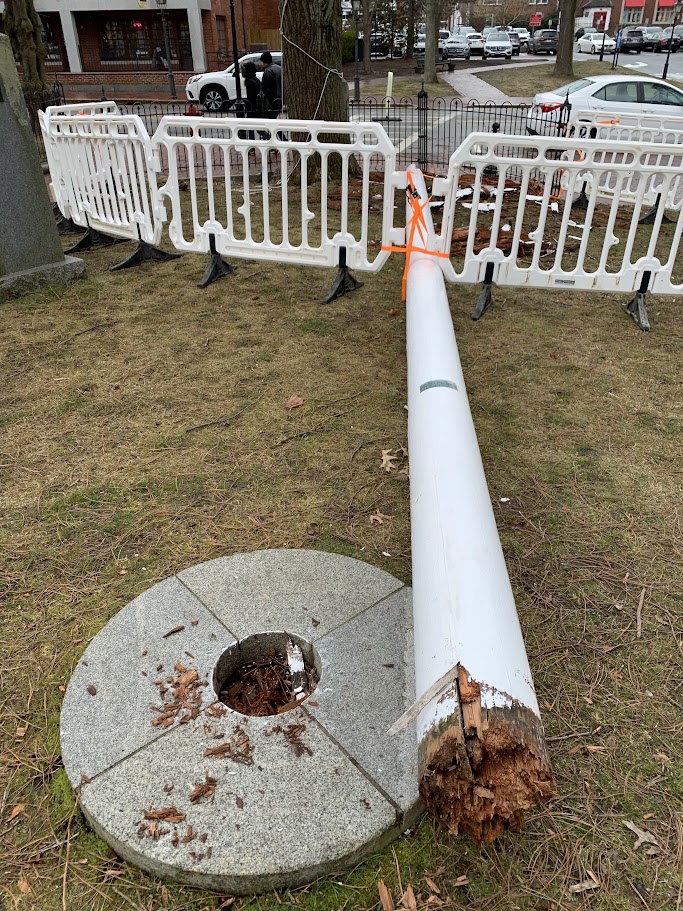
Last Thursday, April 4, 2024, a howling nor’easter took down the flagpole in Waterfront Park near the Firehouse Center for the Arts. As it lay smashed on the ground, passersby may have noticed a small plaque along its white painted midsection and realized that this flagpole was, well, not a flagpole at all, at least not in its earlier life.
Read the title story following event announcements!
Credit: Peary-MacMillan Arctic Museum, Bowdoin College
| |
|
Splendor in the Grass: Art Inspired by the Great Marsh
Thursday, April 18, 2024, 7:00 PM
| |
|
Thursday, May 16, 2024, 6:30 PM
| |
|
Sunday, June 2, 2024, 10:30 AM
| |
|
Saturday, June 8 and Sunday June 9, 2024 10:00 AM - 4:00 PM
| |
Upcoming Community Events | |
|
22nd Annual Newburyport PTO Kitchen Tour & Tasting
Saturday May 11, 2024 10:00 AM - 3:00 PM
| |
The Last Wreck of the Gertrude L. Thebaud
...by Bethany Groff Dorau
| |
|
This flagpole, made from the boom of the Gertrude L. Thebaud, was felled by a storm on April 4, 2024.
Credit: Graham McKay
| |
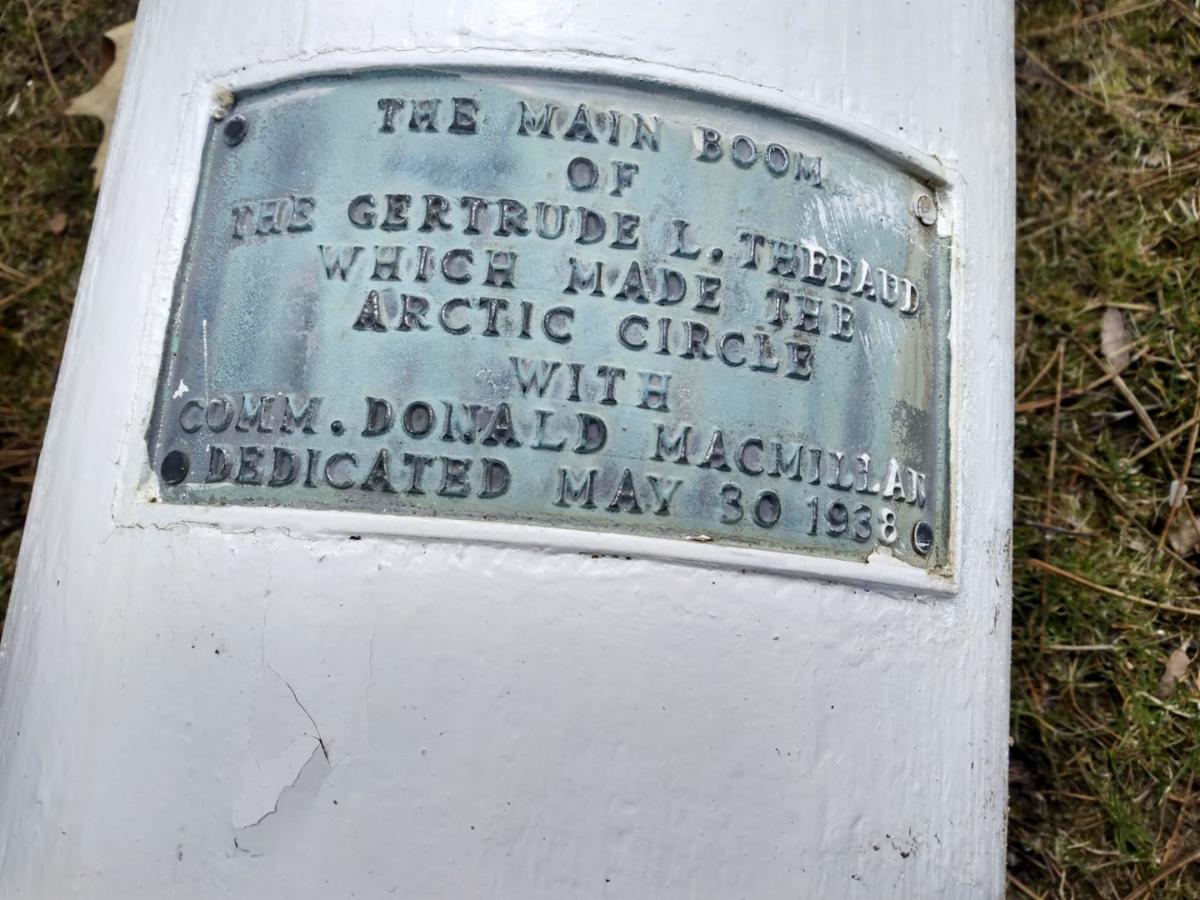
Last Thursday, a howling nor’easter took down the flagpole in Waterfront Park near the Firehouse Center for the Arts. As it lay smashed on the ground, passersby may have noticed a small plaque along its white painted midsection and realized that this flagpole was, well, not a flagpole at all, at least not in its earlier life. The plaque reads, “The main boom of the Gertrude L. Thebaud which made the Arctic Circle with commander Donald MacMillan, dedicated May 30th, 1938”. | The plaque on the flagpole reads, "The main boom of the Gertrude L. Thebaud which made the Arctic Circle with commander Donald MacMillan, dedicated May 30th, 1938." | |
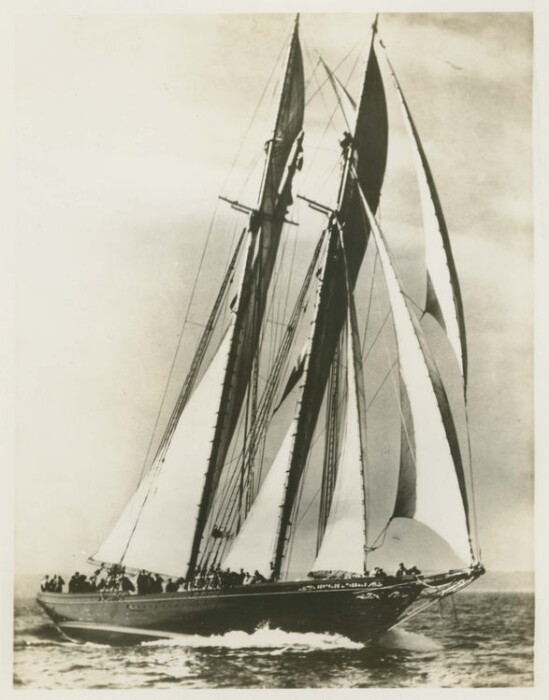
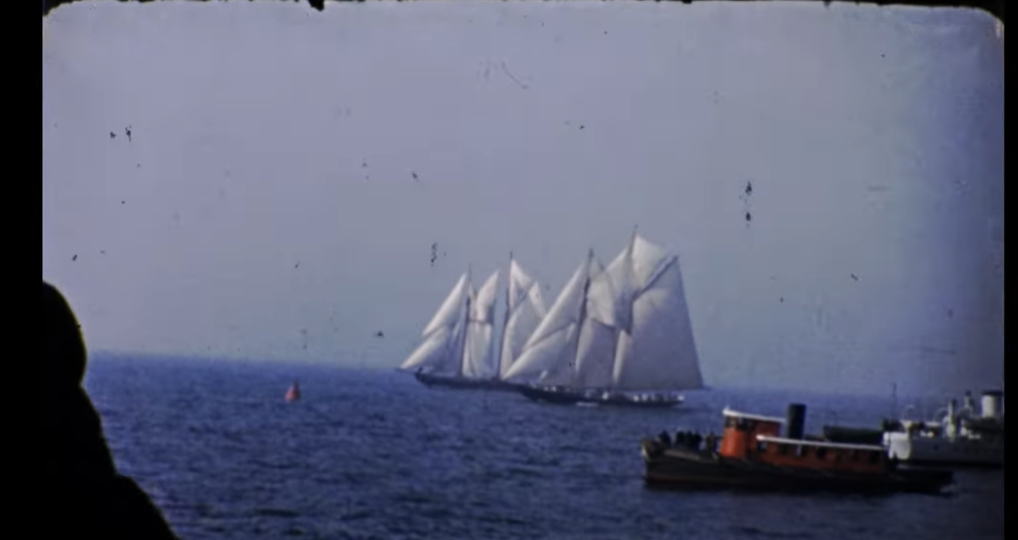
The Gertrude L. Thebaud began her life as a design by marine architect Frank C. Paine, executed in the Arthur D. Story Shipyard in Essex. She was commissioned by Gloucester summer resident Louis A. Thebaud, and named after his wife. She was already an old-fashioned vessel when she was built, an effort to recapture the days when fishing schooners would race each other for sport. She was not only built to race, however. To compete, she had to also be a fully functioning vessel that was actually engaged in fishing. By the time of her launch in 1930, diesel engines were standard for newly built fishing vessels, but the pride of Gloucester depended on the wind. | |
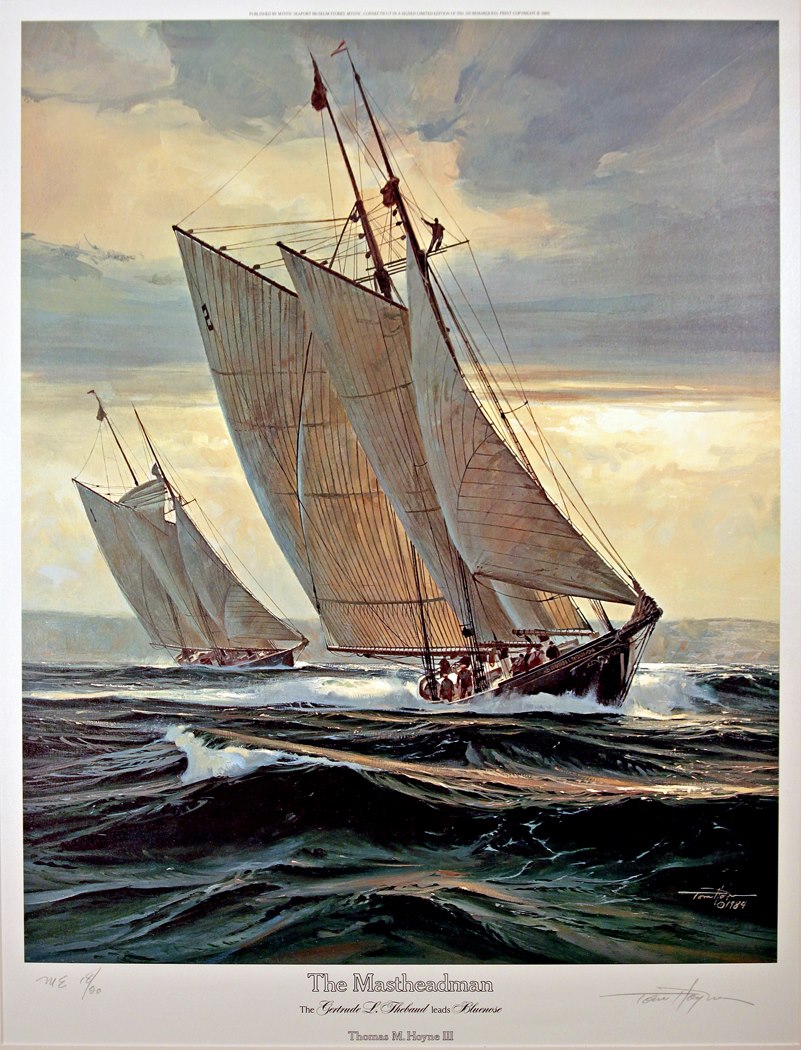
The Mastheadman: The Gerturude L. Thebaud leads Bluenose, a print by Thomas M. Hoyne. | |
|
A long, sometimes acrimonious rivalry had developed between Gloucester and Nova Scotia, with both sides claiming superiority in their fishing fleet. The last challenge between them, the International Fishermen’s Race in 1923, ended with accusations of cheating on both sides and no clear winner, though the Canadian schooner Bluenose was first across the finish line by, well, a nose.
The Gertrude L. Thebaud was commissioned to reinvigorate this ancient rivalry and challenge the Bluenose. The Thebaud was victorious in 1930, lost in 1931, appeared at the 1933 World’s Fair in Chicago in 1933, and then returned to Gloucester to await a rematch with the Bluenose. It was the Depression. Fishing vessels had to earn their keep, and the Bluenose added a diesel engine in 1936, effectively eliminating it from competition. The owners of the Thebaud made a financial compromise of another kind – in the spring of 1937, they leased her to Admiral Donald MacMillan, for his sixteenth expedition to the Arctic.
| 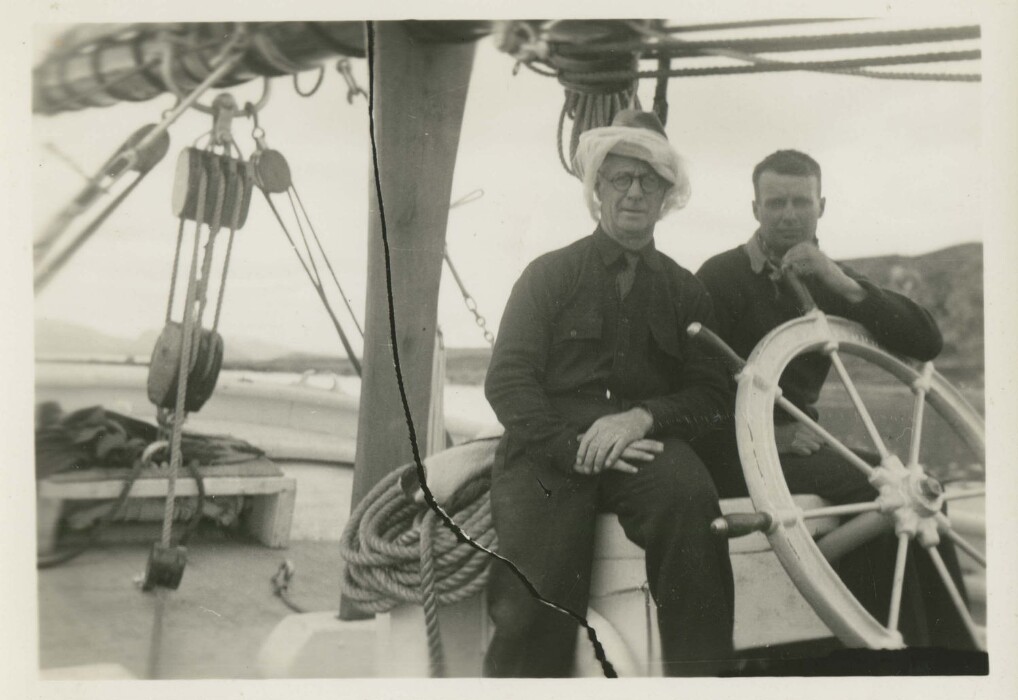 | |
Donald MacMillan and Captain Jack Crowell at wheel of the Thebaud.
Credit: Peary-MacMillan Arctic Museum, Bowdoin College
| Donald B. MacMillan, born in 1874 in Provincetown, first went to the Arctic in 1908, and would go on to make over 30 expeditions, studying Indigenous languages and experimenting with electricity, aircraft, and radio communications in the polar regions. On June 24, 1937, MacMillan and a crew of thirty-five sailed out of Gloucester and up the Maine coast. Like the Bluenose, the Thebaud was now sporting a diesel engine to cut down on travel time, in part because several members of her crew were college students who had to be back in school in the fall. | |
|
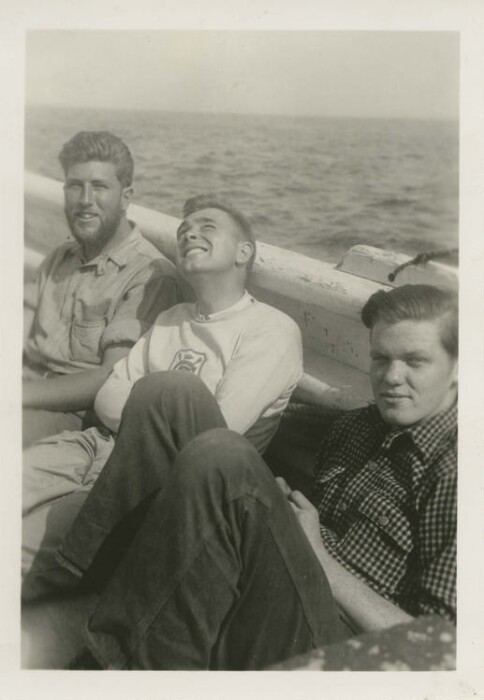
Many of the crew members aboard the Thebaud were college students having the adventure of a lifetime!
Credit: Peary-MacMillan Arctic Museum, Bowdoin College
| |
|
By July 4, the Thebaud was sailing past Newfoundland, making frequent shore excursions in Labrador and further north onto Resolution Island, areas known for their many hazards, from impenetrable fog to reefs and pack ice. By the end of July, the expedition was exploring Frobisher Bay, an inlet into Baffin Island across Baffin Bay from Greenland. Despite the difficulties of securing the Gertrude L. Thebaud in the deep water of Frobisher Bay, MacMillan dropped anchor frequently so that the expedition could row ashore and study the glaciers and cliffs that ringed the bay.
By the evening of July 29, the crew of the Thebaud was exhausted, having spent days in the wake of the indefatigable MacMillan, clambering over glaciers and scaling cliffs. The schooner was tenuously moored at the base of a cliff using anchor and shorelines. The captain, John “Jack” Crowell, sent all but one member of the crew to bed.
The wind picked up and the tide rose as they slept, and the Gertrude L. Thebaud turned and ran aground. Crowell was awakened and knew instantly that the schooner was in serious peril. She would fall as the tide went out, swamping herself at best, capsizing at worst. The Gertrude L. Thebaud was resting on rock and her planking was beginning to separate.
| 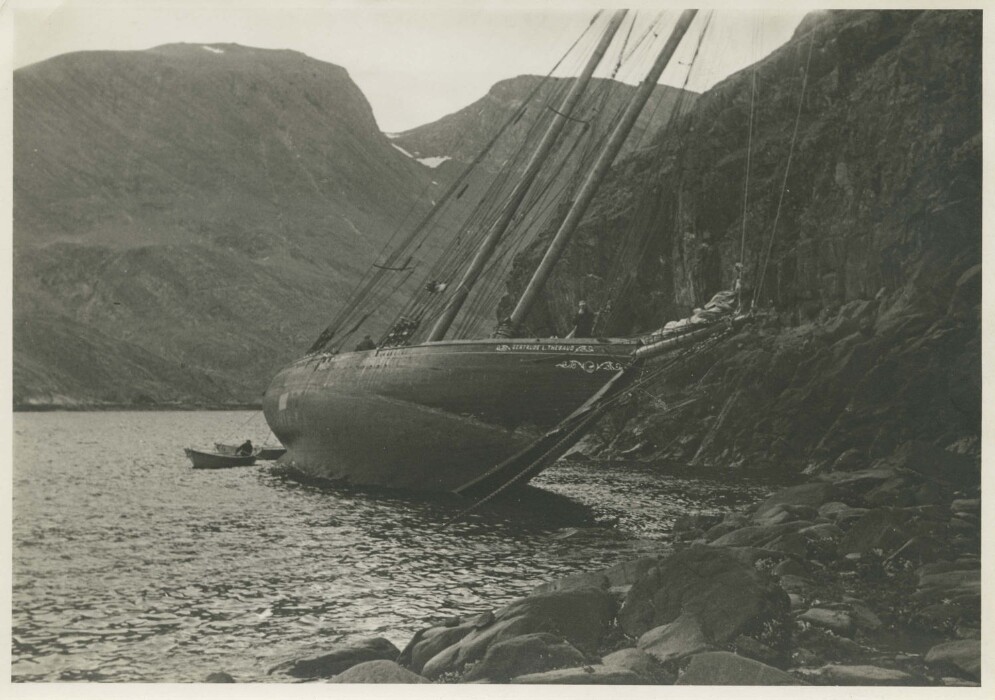 | |
The Gertrude L. Thebaud in peril in Frobisher Bay.
Credit: Peary-MacMillan Arctic Museum, Bowdoin College
| |
Water came in with the rising tide until the schooner was nearly filled. Her engine, most of her supplies, her cookstove, and the crew’s bedding and gear were underwater. And then, miraculously, the tide began to drop, and the Gertrude L. Thebaud began to right herself. She was moved off the beach with great difficulty, and every person aboard began to pump and bail. Crowell later credited the strength and fear of the college students for the speed at which she was cleared of water, and, also miraculously, the schooner eventually stopped leaking and they even managed to restart the engine.
Having come so close to catastrophe, MacMillan tempted fate one more time, convincing Captain Crowell to sail to the Artic Circle, since he had promised the members of the expedition that they would reach it. The Gertrude L. Thebaud and her intrepid crew sailed north until pack ice forced their retreat.
| |
|
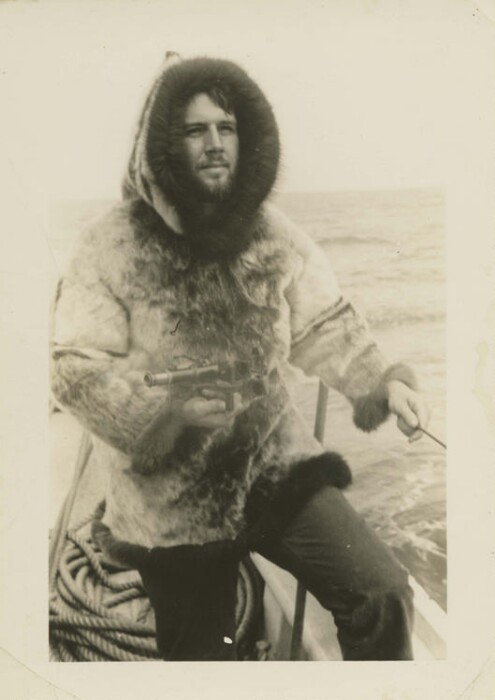
Crewmember John Halford aboard the Thebaud wearing a sealskin jacket.
Credit: Peary-MacMillan Arctic Museum, Bowdoin College
The Gertrude L. Thebaud headed for home, putting in at Bar Harbor before returning to Gloucester. The college students headed back to school with a memorable tale of adventure and peril at the top of the world. The schooner, which had been severely damaged, despite its lucky voyage home, was overhauled completely, her damaged boom removed, and in the spring of 1938, she challenged the Bluenose to one more competition. After the Bluenose shed her mechanized additions, she took on the Gertrude L. Thebaud, beating her on October 1938. It would be the last contest of two North Atlantic wind-driven fishing schooners.
| |
|
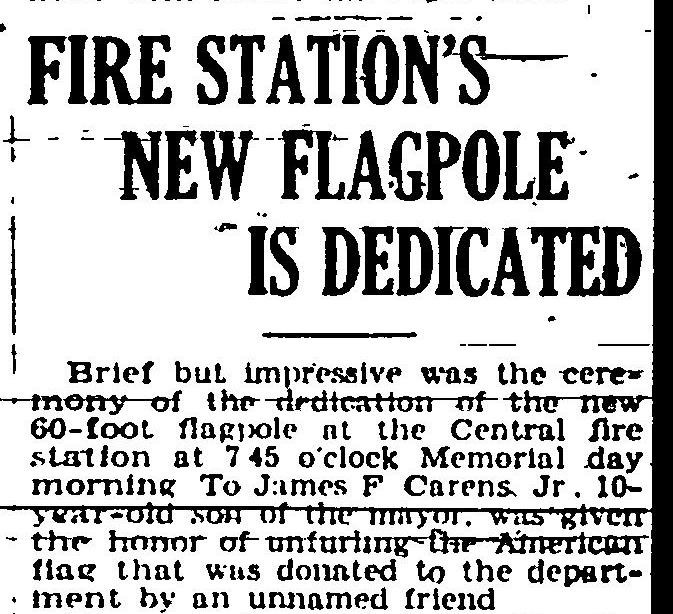
The announcement of the dedication of the flagpole at the Central fire station on May 30, 1938 made no mention of the Thebaud or its boom, saying only that arrangements were made by Chief Creedon.
As the Thebaud was preparing for her final race, Newburyport Fire Chief C. Frank Creeden, who had been following her adventures, bought her boom from a salvage yard and put it into service as the new flagpole outside the Central Fire Station, now the Firehouse Center for the Arts. It was dedicated in May 1938, and there it stood, moved only once, until last Thursday
The Gertrude L. Thebaud, minus her boom, sank off the coast of Venezuela in 1948 after a period of service in the United States Coast Guard. The only piece of her above the water was standing tall, right here in Newburyport, reminding those who paused to read the signs, that we are surrounded, on all sides, by history, in this wonderful place. The shattered boom of the Gertrude L. Thebaud has been returned to Essex, her future uncertain. Whether we see her again or not, the story of the life and death of this flagpole is a compelling reminder to look around, read the signs, and prepare to be amazed.
Note: the author is indebted to the Peary-MacMillan Arctic Museum at Bowdoin College for the use of images and articles for this piece and to Graham McKay from Lowell's Boat Shop for inspiring the recipe below and for images and resources.
| |
Something Is Always Cooking... | |
|
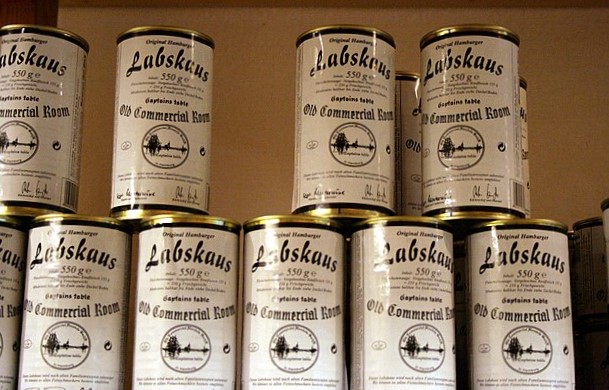
Lobscouse/Labskaus
We have no proof of age for the dish, beyond the fact that the earliest known English reference to it dates from 1706; clearly, though, it is an old and well-established nautical tradition in several countries.
As of 197o, labskaus was on the official menu for the seamen's mess of the Norwegian-American Line and to this day labskaus is so popular in the German port of Hamburg that some restaurants there serve nothing else. (Many of them garnish it with a fried egg, which in our minds only serves to underscore the resemblance between Lobscouse and modern corned beef hash.)
-From Lobscouse and Spotted Dog by Anne Grossman and Lisa Grossman Thomas
INGREDIENTS:
2 pounds corned beef
2 pounds corned pork or smoked ham
1 bay leaf
4 large onions
6 large potatoes
4 large leeks
8 ounces Ship's Biscuit (you can substitute oyster crackers) or enough to produce 3 ½ cups crumbs
6 juniper berries, crushed
1 teaspoon ground allspice
1 teaspoon ground nutmeg
1 teaspoon mace
½ teaspoon ground cloves
½ teaspoon ground cardamom
Dash cayenne
Salt
Fresh-ground pepper
-
Place the corned meat in a pot with bay leaf and cold water to cover.
-
Bring to a boil and cook, covered, over medium-low heat until tender (2½-3 hours. Remove the meat from the pot and discard the bay leaf. Skim and reserve the slush (fat). Reserve 3 cups of the cooking liquid.
- (If you are using smoked ham instead of corned pork, you may want to pre-cook it as well, though this is not strictly necessary. We feel it improves the texture, so we usually cook it with the beef for about an hour.)
-
Trim the meat and cut it into ¼-inch dice. Peel the onions and potatoes and cut them into ¼-inch dice. Put the potatoes in cold water to cover.
-
Remove the root tips and the tough green ends of the leeks.
- Cut the remaining portion in quarters, lengthwise, and wash thoroughly under running water, separating the layers to remove any grit. Cut into 1/4 inch slices.
-
Place the Ship's Biscuit (or oyster crackers) in a plastic bag and pound it into coarse crumbs with a marlinspike or a belaying pin, a mallet, or any other large blunt instrument.
-
Heat 6 tablespoons of slush in a large frying pan over high heat. Add the meat and cook, stirring occasionally, until it begins to brown (10-15 minutes). Remove the meat from the pan and set aside, draining as much fat as possible back into the pan.
-
Sauté the onions over medium heat in the same pan (adding a little more slush if needed) until they start to soften. Add the leeks and cook until the onions start to brown. Drain the potatoes, add to the onion mixture, and cook, stirring often, about 5 minutes. Add the browned meat. Cover and cook over medium-low heat until the potatoes are almost tender (5-10 minutes).
-
Stir in the pounded biscuit and 11 cups of the reserved cooking liquid (less if you like your Lobscouse very dry, more if you prefer it soupier). Add the spices and salt and pepper to taste (be very generous with the pepper).
- Mix well. Cover and cook another 5 minutes.
Serves 8
| |
|
Click the image to do the puzzle
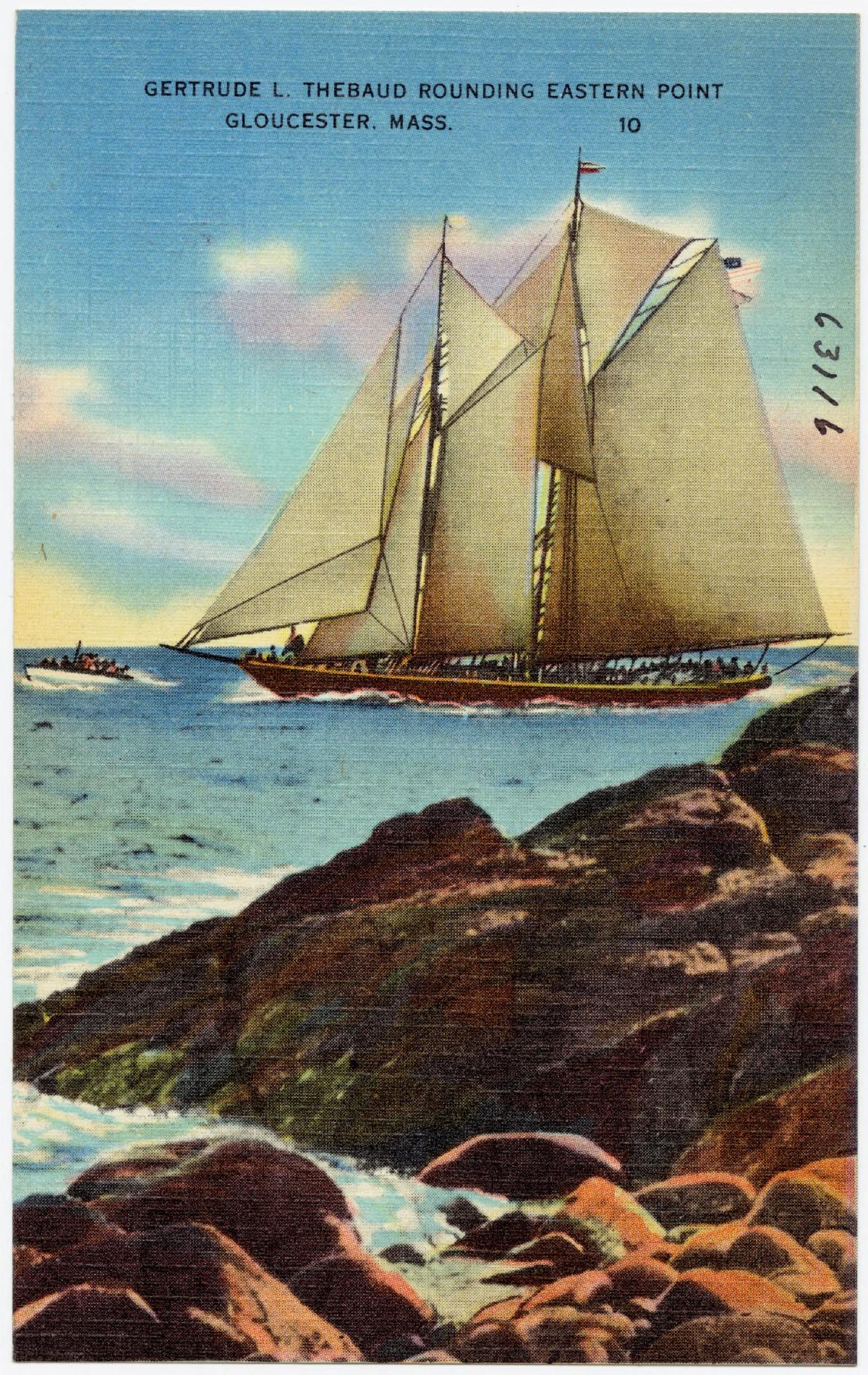
This postcard shows the Gertrude L. Thebaud rounding Eastern Point in Gloucester.
| | |
Museum e-Newsletter made possible through the
generosity of our sponsors:
| |
| | | |