The RNA Transcript, November 15, 2021 |
|
The CRISPR Cas Casting
In the bacterial world, CRISPR complexes come in many shapes and forms, and scientists have only explored the capabilities of a few of these proteins in a limited number of microorganisms. To date, there are two classes of CRISPR, Class I and Class II. CRISPR Cas9, the basis for the 2020 Nobel Prize in Chemistry, belongs to Class II which constitutes only about 10% of all the CRISPR systems.
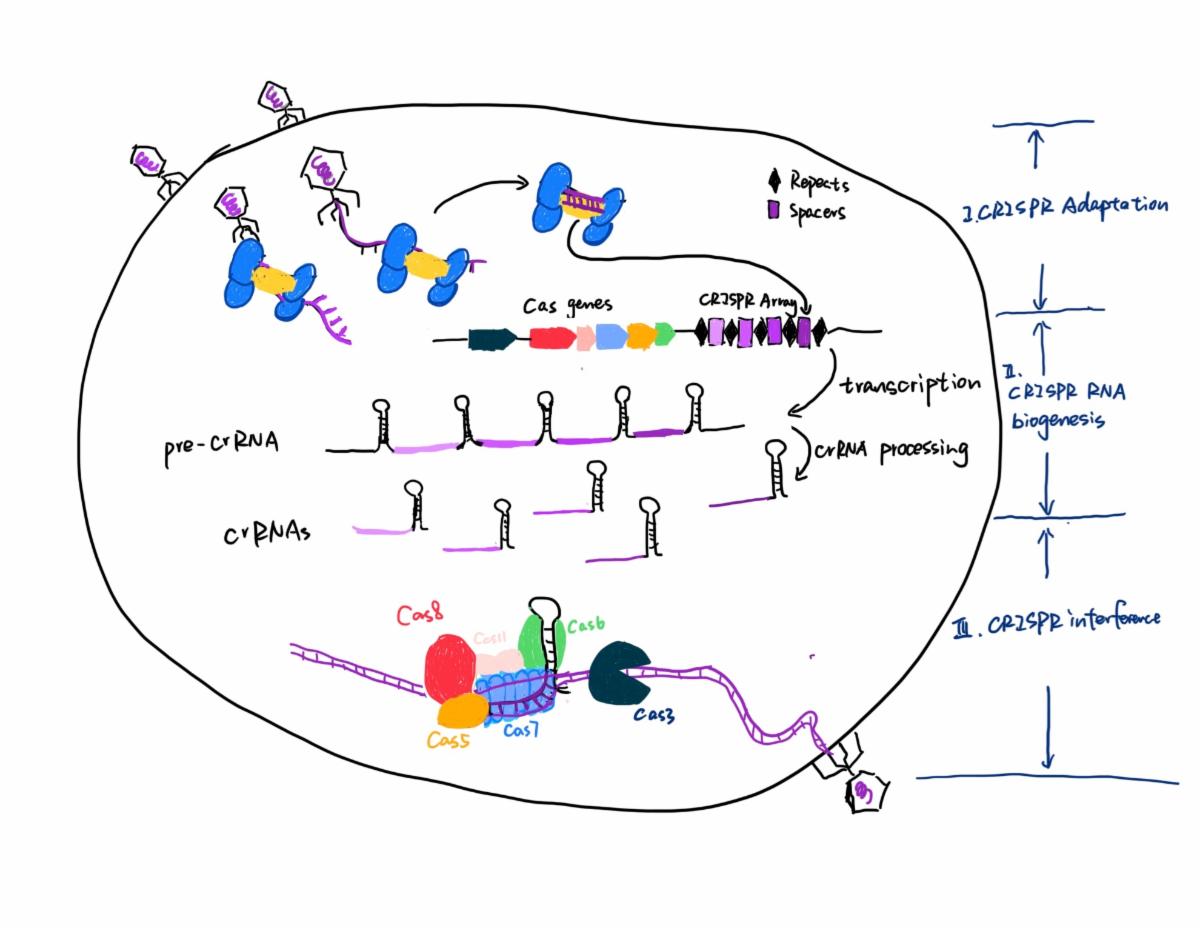
Yan Zhang, Ph.D., Biological Chemistry, Medical School, is particularly interested in the CRISPR-Cas3 systems that represent more than half of all the bacterial CRISPR-Cas systems. Cas3 is a nuclease and helicase fusion enzyme that can break up longer sections of the genetic material as it goes along the DNA. It is comparable to a “DNA shredder with a motor.”
READ MORE about CRISPR in RNA Translated 2021, pp. 22–44
“Harnessing diverse compact CRISPR-Cas3 for long-range genome engineering”
|
|
A sketch of CRISPR-Cas3 at work as an adaptive immune system in bacteria. The Zhang lab studies CRISPR-Cas biology, mechanism and application, and recently developed CRISPR-Cas3 into a “DNA shredder” technology for creating large genomic deletions in human cells. Artwork by Renke Tan, a graduate student in Dr. Yan’s lab. (Reprinted from RNA Translated 2021)
|
|
18 U-M scientists and scholars present their research on three RNA therapeutics areas: mRNA vaccines, ASOs, and CRISPR. The second half of the magazine highlights the main activities of the Center for the July 2020–June 2021 period.
Special thanks to all our contributors!
|
|
Monday, November 15, 1:00–2:00 pm ET, Zoom | University of Michigan Single Cell Spatial Analysis Program
“Integrative Visualization of Multi-Modal and Spatially-Resolved Single-Cell Data”
Nils Gehlenborg, Ph.D., Associate Professor of Biomedical Informatics, Harvard Medical School, Director, Master of Biomedical Informatics (MBI) Program
|
|
Monday–Wednesday, November 15–17, 2021, 9:00 am–1:00 pm (must attend all sessions) | BRCF Bioinformatics Core Virtual 3-Day Workshop: RNA-Seq Demystified
Cost: $250
This three-half-day, virtual, hands-on workshop is targeted toward researchers who would like to be able to understand the analysis of differential gene expression in bulk RNA-Seq data.
Please note that this workshop assumes a basic familiarity with genetics as well as familiarity with the basics of using Bash and R. If you don't have background in Bash/R, we hope to offer a complete workshop series that covers both Bash/R and RNA-Seq early in 2022.
|
|
Tuesday, November 16, 12:00–4:00 pm ET | TriLink BioTechnologies. Free event
"mRNA Day"
This year will be a global, virtual event in partnership with Genetic Engineering & Biotechnology News (GEN) and The CRISPR Journal to discuss mRNA vaccines, applications in gene and cell therapy, and mRNA manufacturing and biology.
|
|
Tuesday, November 16, 3:00 pm ET, Zoom | Harvard Medical School Initiative for RNA Medicine Seminar
“Machine Learning Enabled Delivery of Antisense Oligonucleotides”
|
|
"Targeting Critical Factors that Promote Liniage Plasticity in Lethal Prostate Cancer"
Joshi Alumkal, M.D., Professor, Genitourinary Medical Oncology Section, Internal Medicine, Medical School
|
|
“RACK1 as a regulator of Protein biosynthesis”
"RNA Shapes Zika virus gene expression"
|
|
"Multiome Webinar Series"
Explore 10x Genomics' Loupe Browser software and how it can be used to quickly and easily visualize and analyze 10x Chromium™ Single Cell Multiome ATAC + GEX data. It combines the tools previously developed for looking at Single Cell Gene Expression and Single Cell ATAC data, and adds functionality to allow users to easily connect and relate gene expression and ATAC data generated for the same cells.
|
|
January 3–6, 2022, St. Petersburg, Florida | The RNA Society
Sixth Conference on Regulating with RNA in Bacteria & Archaea — CRISPR systems, small noncoding RNAs, riboswitches, transcriptomics, host-pathogen interactions, and more.
The deadline for poster abstracts is TODAY, November 15, 2021.
|
|
For press releases and blog articles about your upcoming top journal publications, please
|
|
Our members' publications are available through Altmetric. Five queries are currently available: "RNA," "microRNA," "Transcriptome," "Translation," and "Molecule." Please make sure to have at least one of these key words in your title or abstract. Below is a recent highlight.
|
|
Single cell transcriptomics reveals distinct effector profiles of infiltrating T cells in lupus skin and kidney, Garrett S. Dunlap, Allison C. Billi, Feiyang Ma, Mitra P. Maz, Lam C. Tsoi, Rachael Wasikowski, Johann E. Gudjonsson, J. Michelle Kahlenberg, Deepak A. Rao, bioRxiv preprint, doi: https://doi.org/10.1101/2021.10.19.464575
Abstract: Overall, these data represent the first detailed transcriptomic analysis of the of T and NK cells in cutaneous lupus at the single cell level and have enabled a cross-tissue comparison that highlighted the stark differences in composition and activation of T/NK cells in distinct tissues in lupus.
|
|
The International Society of RNA Nanotechnology and Nanomedicine (ISRNN): The Present and Future of the Burgeoning Field, Morgan Chandler, Brittany Johnson, Emil Khisamutdinov, Marina A. Dobrovolskaia, Joanna Sztuba-Solinska, Aliasger K. Salem, Koen Breyne, Roger Chammas, Nils G. Walter, Lydia M. Contreras, Peixuan Guo, and Kirill A. Afonin, ACS Nano 2021, Publication Date: October 22, 2021 https://doi.org/10.1021/acsnano.0c10240
Abstract: The International Society of RNA Nanotechnology and Nanomedicine (ISRNN) hosts an annual meeting series focused on presenting the latest research achievements involving RNA-based therapeutics and strategies, aiming to expand their current biomedical applications while overcoming the remaining challenges of the burgeoning field of RNA nanotechnology. In this Nano Focus, we summarize the main discussion points, conclusions, and future directions identified during this two-day webinar as well as more recent advances to highlight and to accelerate this exciting field.
|
|
Rapid kinetic fingerprinting of single nucleic acid molecules by a FRET-based dynamic nanosensor, Kunal Khanna, Shankar Mandal, Aaron T.Blanchard, MuneeshTewari, AlexanderJohnson-Buck, Nils G.Walter, Biosensors and Bioelectronics, Volume 190, 15 October 2021, 113433, https://doi.org/10.1016/j.bios.2021.113433
Highlights:
• Amplification-free single-molecule kinetic fingerprinting identifies diverse disease biomarkers.
• A dynamic DNA nanosensor generates kinetic fingerprints via intramolecular single-molecule FRET.
• iSiMREPS in 10 s detects biomarkers with a limit of detection of ~3 fM in 1,000,000-fold WT excess.
|
|
Share your news
and comments,
|
|
|
|
|
|
|
|