
Fed Rate Decision, Updated Forecasts and Powell Presser on Wednesday
Trump threatens 100% tariffs on Mexican-made cars by China Firms | Lighthizer on tariffs
Washington Focus
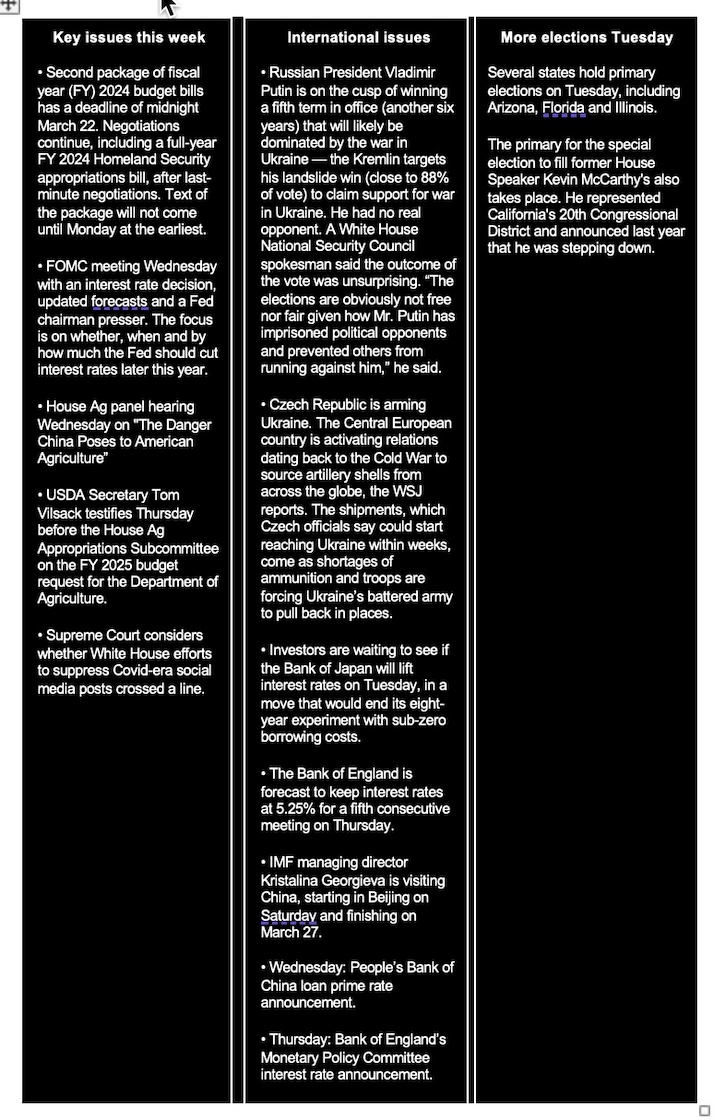
Focus this week: (1) A second package of fiscal year (FY) 2024 budget bills with a deadline of midnight March 22; (2) FOMC meeting Wednesday with an interest rate decision, updated forecasts and a Fed chairman presser; (3) a House Ag panel hearing Wednesday on "The Danger China Poses to American Agriculture”; and (4) USDA Secretary Tom Vilsack testifies Thursday before the House Ag Appropriations Subcommittee on the FY 2025 budget request for the Department of Agriculture.
The Senate is scheduled for a two-week recess starting after close of business March 22 and slated to return to the Capitol April 8. The House leaves for Easter recess after close of business March 22 and will return April 9.
— Lawmakers drafted a full-year FY 2024 Homeland Security appropriations bill after last-minute negotiations, prompted by White House intervention. Initially, a yearlong stopgap measure was being pursued, with negotiations on necessary changes as "anomalies" to the FY 2023 status quo. However, the White House's late request for $1.56 billion in border-related funding led to Republican rejection, citing insufficient ties to border protection and immigration enforcement. Despite initial resistance, ongoing discussions between the two sides led to a return to the fully fleshed out Homeland bill, indicating progress.
The release of the complete six-bill package, including Defense, Labor-HHS-Education, Financial Services, Legislative Branch, and State-Foreign Operations measures, is expected on Monday at the earliest.
Appropriators grappled with issues such as funding for Immigration and Customs Enforcement detention bed capacity and Transportation Security Administration pay raises.
House rules allot members 72 hours to read legislation before voting on it, and it usually takes the Senate a couple days to process any legislation. The package will also include the Defense, Labor-HHS-Education, Financial Services, Legislative Branch and State-Foreign Operations measures.
Bottom line: A full-year FY 2024 Homeland Bill, expected to exceed the current year's funding level, provides a platform for bipartisan negotiations, potentially incorporating additional funding for border and immigration-related accounts within nondefense limits through measures like rescissions and emergency spending designations.
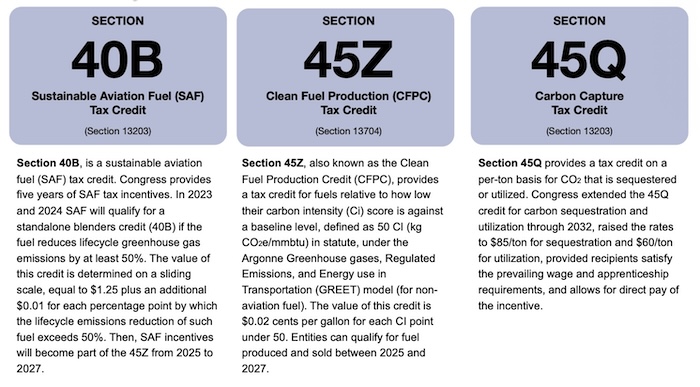
— Waiting on SAF details: Week 2. USDA Secretary Tom Vilsack at the Commodity Classic in Houston said it would be “weeks, not months” when detailed information comes out regarding the Sustainable Aviation Fuel (SAF) program after the initial by March 1 date was not met. The Treasury Department will release tax credit details for SAF. An updated Greenhouse Gases, Regulated Emissions and Energy Use in Technologies (GREET) model will come from USDA, EPA and the departments of Transportation and Energy.
Feedstock Carbon Intensity Calculator (FDCIC) is what a farmer gets at the field level in GREET. It encompasses factors such as crop inputs, grain yield, energy usage, fertilizer usage, location, farm practices and land practices, including indirect land use. Spreadsheets and other helpful tools will be available to determine how or if a farm operation qualifies, and to what degree. Start here.
The Inflation Reduction Act (IRA) enacted some new energy credits. Congress provides five years of SAF tax incentives. In 2023 and 2024 SAF will qualify for a standalone blenders credit (40B). Then tax incentives fall under Section 45z — Clean Fuel Production Credit. This credit is slated to start in 2025 and run through 2027 based on the current law.
Farmers who can prove their Carbon Intensity (CI) is lower than the standard for corn or soybeans may qualify for a premium from their ethanol/biofuels plant. But GREET alone won’t secure corn ethanol’s future in SAF. Ethanol producers need to shave off more CI points, says Lauren Lurkins, a strategist from Bloomington, Illinois. Today, GREET says corn ethanol has 43% less emissions of GHG than petroleum-based jet fuel. That must increase to 50% to unlock SAF tax credits. How? Land use change… environmental impacts when moving to corn production. What about corn produced with climate-smart practices? Also: Refining processes, carbon capture and sequestration (CCS), and/or some combination.
— GOP Whip Emmer calls for rethink on State of the Union invitations. House Majority Whip Tom Emmer (R-Minn.) suggested that GOP leadership should reconsider how presidents are invited to give the State of the Union address following President Biden's recent speech, which he deemed as "divisive." Emmer criticized Biden's remarks, describing them as a "hyper-partisan" campaign speech and expressing disappointment that the address lacked a more unifying tone.
Emmer emphasized that if Biden is re-elected and delivers a similar speech next year, he should not be invited to address Congress. While Emmer remains optimistic about former President Trump's chances of defeating Biden in the upcoming election, he stressed the importance of a more inclusive and unifying State of the Union address.
— Mexico rejects USDA’s new ‘Product of USA’ labeling rule, warning of potential challenges under the USMCA or WTO. The rule (link) requires meat, poultry, and egg products labeled "Product of USA" to be entirely sourced and processed in the United States. Mexico and Canada criticize the rule, fearing negative impacts on their exports. Mexico, a supplier of beef to the U.S., argues that the rule undermines regional trade integration and may lead to disruptions in supply chains. The Mexican government is urging the U.S. to reconsider the rule and emphasizes its commitment to resolving differences through dialogue but hints at potential legal action if necessary.
Of note: The Ministry of Agriculture and Rural Development (SADER) highlighted that Mexican cattle and beef exports to the U.S. were worth almost $3 billion last year, and noted that “Mexico continues to be one of the [United States’] main suppliers of beef and beef products.”
— Former President Donald Trump threatened to impose a 100% tariff on cars manufactured in Mexico by Chinese companies, doubling the previous proposed levy on automobiles made in Mexico. He directed this threat at Chinese President Xi Jinping during a rally in Ohio, stating that every car crossing the border would face the tariff. Trump emphasized the potential consequences if he were not to win the upcoming U.S. presidential election, describing it as a "bloodbath."
Earlier, Trump had suggested a 50% tariff on Chinese cars and proposed tariffs of up to 60% on all Chinese goods and 10% on goods produced globally. He expressed indifference to potential retaliatory actions from China or other nations, asserting a stance of reciprocal treatment: "You screw us, and we’ll screw you."
— Former USTR Lighthizer advocates tariffs for economic growth and security. Robert Lighthizer, former U.S. Trade Representative (USTR) under the Trump administration, argues for the implementation of tariffs, citing economic, geopolitical, and moral justifications. In a recent Economist commentary article (link), he contends that while tariffs have been historically vital for America's economic growth, they have been unfairly demonized in recent times by free-trade advocates. Lighthizer emphasizes the need for a nuanced discussion regarding tariffs, especially concerning Donald Trump's proposed tariffs on Chinese goods and those manufactured in Mexico by Chinese companies (see previous item).
Lighthizer points out that America's experiment with nearly eliminating tariffs since the Cold War has failed, resulting in significant trade deficits and foreign ownership of American assets. Lighthizer argues that tariffs can protect domestic industries and national security interests, citing examples of other countries' successful industrial policies.
Lighthizer criticizes the belief in the "comparative advantage" theory, arguing that other nations' industrial policies, particularly China's, have distorted global trade. He highlights the importance of a vibrant manufacturing sector for national security and economic prosperity, challenging the assumption that tariffs always lead to inflation or negative economic outcomes.
Drawing on data from the Trump administration, Lighthizer demonstrates that tariffs can stimulate domestic production and employment without significantly impacting consumer prices. He supports Trump's proposed tariffs to offset foreign trade distortions and boost American manufacturing, predicting potential increases in household income and job creation.
Lighthizer, appearing on a recent Larry Kudlow show on Fox Business, said that regarding potential inflation concerns from tariffs, argues that countries with significant economic intervention, like China, have not experienced inflation but in fact deflation. He dismisses the notion that tariffs would be inflationary, emphasizing the importance of revitalizing manufacturing to create high-paying jobs and restore American greatness.
Kudlow suggests offsetting tariff impacts domestically with measures like tax cuts, which Lighthizer agrees with, emphasizing the need to generate industries that create millions of high-paying jobs. Lighthizer also underscores the geopolitical threat posed by China, advocating for higher tariffs on Chinese goods for both moral and economic reasons.
Bottom line: Lighthizer asserts that tariffs, when strategically implemented, can address economic imbalances, protect domestic industries, and promote the well-being of American workers and communities.
Economic Reports and Events for the Week
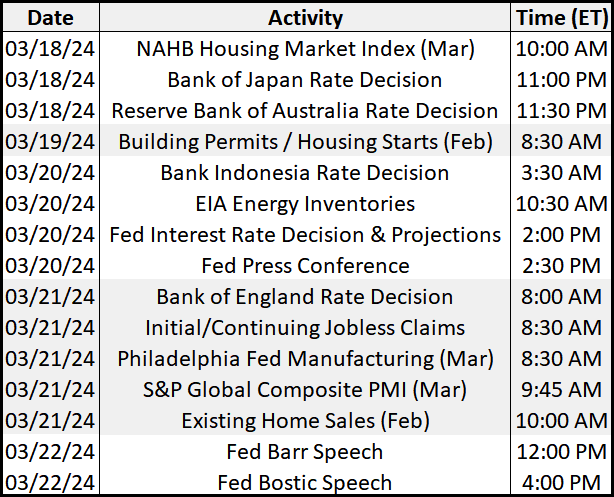
The Federal Open Market Committee (FOMC) will release its statement and summary of economic projections (SEP) on Wednesday, with Chair Jerome Powell's press briefing to follow. Given the absence of significant data changes before or after the FOMC meeting, the focus is on potential shifts in monetary policy.
Of note: Due to the blackout period, there was no fed commentary on the two inflation reports last week so the reaction from Powell will be important.
During his recent testimony, Powell hinted that the current fed funds rate may be at the peak of the tightening cycle. With little expectation for another rate hike, attention turns to the possibility of easing measures.
The SEP update is expected to update FOMC forecasts, with Powell suggesting potential rate cuts later in the year if economic data support them. However, recent data indicate a tight labor market and persistent inflation, particularly in shelter costs and non-housing services, which may alter previous rate cut projections.
Changes in the SEP are likely to dominate questions for Powell during the press briefing. Additionally, there may be discussions on quantitative tightening (QT), as policymakers plan to assess progress in reducing the Fed's reserve holdings. Powell has emphasized the need to reduce the Fed's balance sheet stimulus to return to relying on interest rate policy.
As of Friday, traders in the futures market were pricing in just three quarter-point cuts this year, in line with the Fed’s forecasts from its December dot plot.
Bottom line: Higher-for-longer when it comes to interest rates.
Monday, March 18
Tuesday, March 19
Wednesday, March 20
Thursday, March 21
Friday, March 22
Hearings & Other Events of Note
Monday, March 18
Tuesday, March 19
Wednesday, March 20
Thursday, March 21
Friday, March 22
Key USDA & international Ag & Energy Reports and Events
On the ag front, China’s second batch of trade data, including agricultural imports, will be published Monday, while a grain conference in Paris occurs Wednesday. London hosts a cargo insurance event on Thursday.
The energy sector this week will focus on officials from major energy companies and gov’t ministers for the industry’s CERAWeek conference in Houston, which starts on Monday.
Monday, March 18
Ag reports and events:
Energy reports and events:
Tuesday, March 19
Ag reports and events:
Energy reports and events:
Wednesday, March 20
Ag reports and events:
Energy reports and events:
Thursday, March 21
Ag reports and events:
Energy reports and events:
Friday, March 22
Ag reports and events:
Energy reports and events:
|
KEY LINKS |
WASDE | Crop Production | USDA weekly reports | Crop Progress | Food prices | Farm income | Export Sales weekly | ERP dashboard | California phase-out of gas-powered vehicles | RFS | IRA: Biofuels | IRA: Ag | | Russia/Ukraine war, lessons learned | | SCOTUS on WOTUS | SCOTUS on Prop 12 pork | New farm bill primer | | Gov’t payments to farmers by program | Farmer working capital | USDA Ag Outlook Forum |