| | |
Connecting
Sept. 17, 2026
Click here for the sound of the Teletype
| | |
Colleagues,
Good Thursday morning on this Sept. 17, 2026,
Few people knew AP’s legendary Rome bureau chief Victor Simpson better than our colleague Frances D’Emilio.
They first met 41 years ago and worked together in the AP’s Rome bureau for 28 years. The two were to meet up Wednesday in Rome after she and her daughter arrived from the United States…but he died four days earlier.
She shares a remarkable remembrance of Victor as our lead article in today’s issue. And contributing equally heartfelt memories of Victor are Richard Boudreaux who worked in Rome as the Los Angeles Times’ Southern Europe correspondent and his wife Candice Hughes, who worked as a reporter in the AP Rome bureau.
Our colleague Jon Gambrell, AP’s Gulf and Iran news director, has joined The Wall Street Journal as its deputy Middle East bureau chief, working out of Dubai, United Arab Emirates, and shares his thoughts on what AP meant to him in his 20-year career. A remarkable story.
And, we bring you the AP announcement of the recent opening of its new global production hub in Noida, India, where by the end of 2026, nearly 100 AP staffers will work on video and photo editing.
And, we bring you an MS NOW profile of John Solomon, a former AP journalist who announced in June that he had joined the Trump administration as a special government employee, leading a task force that would “help the government identify some documents, some secrets, some things you should know about when it comes to weaponization, election integrity, and other things.”
Here’s to a great day – be safe, stay healthy, live it to your fullest.
Paul
Remembrance of Victor Simpson across the decades in Rome
| |
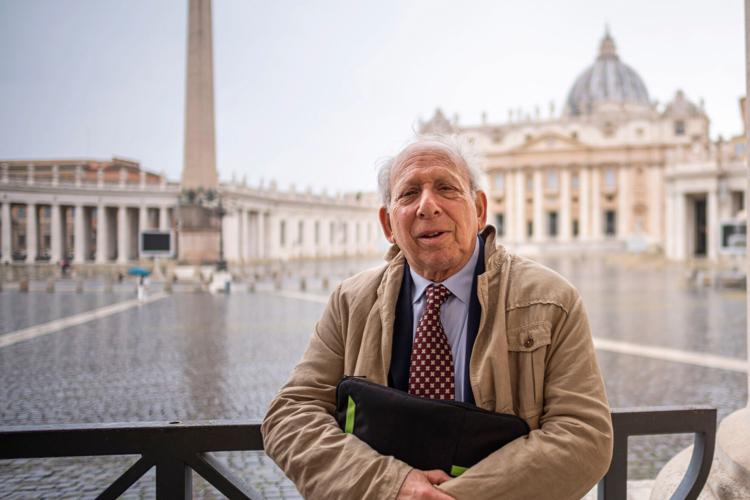
(AP Photo/Domenico Stinellis, File)
Frances D’Emilio - About 10 days ago, when I called Victor at his home after discharge from his latest hospitalization, I told him that I’d see him soon. I was flying back to Rome, from New York, this time accompanied by my daughter on vacation, and on our first full day in the city, we’d pay him a call, I said.
Victor was delighted.
That visit was supposed to be Wednesday, Sept. 16. Instead, I am writing this recollection of a friend and colleague so ever-present in my life in Rome that his name for me is synonymous with the city.
I once joked to Victor Simpson’s wife, Daniela Petroff, that after her I probably spent the most hours of the week with her husband. I trust she took the quip in the right spirit, because, indeed, spending three, four, or five days a week, many hours per working day in the newsroom added up over the nearly 28 years that Victor and I found ourselves together in the Rome newsroom.
My first encounter with Victor came two years before I was assigned in May 1985 to the Rome bureau. (As it was for Victor, Rome was the only overseas AP posting for me.) Soon after my arrival in 1983 in New York at what was then called the Foreign Desk, Victor passed through on home leave. While I was pushing to go to Warsaw and was being tutored in Polish, the then foreign editor, Nate Polowetzky, was determined to send me to Rome.
Finally, Nate said, we’ll send someone there who already knows Italian. (I had majored in Italian studies as an undergraduate.) He took Victor’s arm and brought him to my desk. “Go see how her Italian is,’’ ordered Nate, in his raspy, rough voice. Victor and I awkwardly made our way to the cafeteria on the fourth floor of 50 Rock. I don’t remember how the “interview” went. Whether it was the lousy coffee they served there or my flawed Italian, I never knew. Our chat lasted maybe five minutes, but our friendship would span decades.
Victor’s brilliance in crafting memorable ledes in the briefest of time, often dictating them in those pay-phone days, is rightly legend. As was his honed talent in wading through Vatican encyclicals and slogging through ministers’ droning-on news conferences and zeroing in, seemingly effortlessly, on the first graf.
I recall him on the stingy side with praise because we were all expected to deliver fast, accurate and readable news if we made into AP’s foreign correspondent ranks. So, whenever he did tell me, “You nailed it,’’ I was particularly proud. As a fellow New Yorker, brusqueness didn’t faze me.
Victor was generous with friendship. Together with Daniela, he made new arrivals in Rome feel they had a second family outside the newsroom.
Daniela’s parents had a summer house in Fregene, an elegant seaside town studded with pine trees in the Rome suburbs. The Simpsons would invite staffers, and their spouses and children, to the Fregene beach club during the summer. On my first visit there, in summer 1985, Victor and Danny’s daughter, Natasha, a gifted athlete, began teaching me how to swim in the club pool.
Natasha’s grace and naturalness were striking. At 11, she was still pure girl, with no trace of the awkwardness that often comes with pre-adolescence.
In early October, my Polish-American mother came from New York to Rome, ahead of our trip together to Krakow, Poland, to visit with her relatives. The evening before our departure, Victor took us both out to dinner. When I turned on the radio at home – later that night or early the next morning, I don’t remember – I was shocked by the news of the Achille Lauro cruise ship hijacking in the Mediterranean. I called Victor to offer to come in and help. Knowing my mom was so keen about her Polish trip, he thanked me but told me to go ahead with my weeklong vacation.
Before heading to the airport, and with the ever more dramatic developments in hijacking that would include the killing of an elderly U.S. passenger who used a wheelchair, and trigger confrontation between the U.S. and Italian governments, I telephoned Victor again. “Fran, if you call one more time, I will make you come in! Get on that plane!”
Christmas 1985 would mark the first of dozens of Christmases and Easter that I would cover the Vatican festivities, including the pope’s Urbi et Orbi speech, during my tenure in Rome. Victor and Danny invited me to join them, and their children Natasha and Michael, for Christmas Eve dinner so I could be with a family on that day, when Romans would all be dining at home or in restaurants, and feel less alone as a newcomer to the city.
We dined at Sabatini, a historic restaurant opposite an ancient basilica, and the Simpsons, generous as always, treated me. Afterwards we all went to their home at the time, near Piazza Venezia, to open gifts at midnight. I brought presents for the children. Knowing the family would depart three mornings later for New York on Victor’s home leave, I gave Natasha a cosmetic travel case. She was thrilled to receive an accessory that ladies would use.
Dec. 27, 1985, brought a blur of frantic phone calls with ever grimmer news. Somehow the Rome newsroom managed to report and transmit the news of the terror attack on Rome’s Leonardo da Vinci airport, a massacre that would claim among the victims, Natasha, and seriously wound Michael and cost Victor the loss of a finger. Tears fell on keyboards, and at least one senior staffer left the newsroom briefly to pound on the wall in the corridor in anger when confirmation came about Natasha’s death.
On New Year’s Eve, Michael was still recovering in a Rome hospital from a serious abdominal wound. I had a party invitation, but who could be festive? I kept Victor and Danny company as they sat at Michael’s bedside. Their deep devotion and solid love for each other as husband and wife were remarkable – two strong personalities and yet one reality.
I as so many others would wonder how Victor would cope with Danny’s loss when she died in February this year.
Like all of us, Victor had his newsroom rituals.
In our Renaissance-era palazzo, he was fond of holing up down the hall with a pack of cigarettes. With smoke building up in a small archives room that held books filled with copies of every story the bureau had produced for decades, Victor would put his feet on a desk, puff away and regale newsroom staffers, especially the latest arrivals, with tales of his reporting. Or maybe he’d just shoot the breeze about the latest Italian government crisis or his beloved Roma soccer club’s performance.
All told, his recollections made for a collection of journalistic experiences that in today’s news world would sound incredible. With the shutters blocking out the afternoon sun from the unofficial smoking room one day, Victor recounted, how, on an August Sunday in 1978, while he was working solo, Pope Paul VI died at the papal summer palace in Castel Gandolfo. Victor filed the story, with multiple updates, and went home. Went home! The desk in New York transmitted it, and no one called frantically from headquarters to request various versions and other treatments of the news.
I had worked in Rome with Victor so long that I heard many of his stories twice or three times over. When the book he wrote in his retirement, “The Life of a Reporter” was presented at the Foreign Press Association in Rome, I smiled when I perused the pages and saw many familiar stories. But there were some I had never heard before. Such was the wealth of Victor’s professional accomplishments.
In another Simpson ritual, Victor would make a sort of dramatic entrance into the newsroom, multiple times daily, especially after his smoke breaks down the hall. He’d snap the wooden door open, with a sharp clank of the brass handle. We didn’t have to look up. We knew Victor had arrived.
When Canadian sprinter Ben Johnson was pickpocketed as he strolled along Rome’s Via Veneto in 2000, he was outrun by a group of child thieves who made off with his wallet containing nearly $5,000. When the former world record holder didn’t answer our phone calls at his hotel, Victor and I decided to dispatch one of the bureau’s interns.
I explained to the young lady that we wanted to hear his reaction. “Go get Ben Johnson,” I said.
Maybe an hour later, the intern returned, with Johnson in tow. I was asking him some questions when I heard that signature door handle snap.
In walked Victor. He took exactly two strides, turned his head, spotted Johnson, and, as if in a reverse action video, took two steps backwards and out the door.
That anecdote didn’t make the cut of his book, but over the years, Victor and I would laugh many times over how the intern reacted surprised to our surprise. “You told me to get Ben Johnson, so I got Ben Johnson.”
It was part of the craziness of the news business that Victor relished, as he never took himself too seriously even while taking his work so seriously.
I missed not hearing that door snap over after Victor retired in 2013. I will now miss those retirement phone calls, lunches and coffees, where he would both serve up seemingly endless stories from his long journalist run as well as hash out the foibles and feats of journalists today.
Remembering ‘mensch-in-chief’ of Vatican press corps
Richard Boudreaux - Victor was a godsend. He was a generous colleague and became a dear friend during my five years in Rome as the Los Angeles Times’ Southern Europe correspondent. My wife, Candice Hughes, had some of the finest years of her AP career as a reporter in Victor’s bureau.
Candice and I had come to Rome from Moscow, where we thought the Kremlin was a tough place to cover. Then we encountered the Vatican, seemingly a far more impenetrable bureaucracy. Victor’s wisdom and insight, shared on dozens of flights on John Paul II’s papal plane, helped me demystify and understand the place. He helped other newcomers to the beat in this way, as mensch-in-chief of the Vatican press corps.
Victor’s devotion to Dani and their family was palpable. As was the weight he carried over the tragic loss of their daughter Natasha. And yet his big-hearted kindness extended outward to the many who worked with him and learned so much.
And…
Candice Hughes - I spent five years in the Rome bureau when Victor Simpson was news editor. He was the best boss I ever had.
Victor was a true mensch; you could always count on him.
He was completely at ease in Italy but so very much himself that even in his fluent Italian, he sounded like that guy in front of you in line at Zabar’s.
He bore his immense loss quietly, but the pain never left. He and Dani loaned us their little place in the Dolomites one summer. There, on the bedside table, was a photo of Natasha, their lost daughter - the last thing they saw before turning out the lights.
AP opens doors to new global production hub in Noida
| |
AP Corporate Communications
AP’s new global production hub in Noida, India, recently opened its doors and welcomed over two dozen new video colleagues who came together for induction meetings, training sessions and team-building activities. By the end of 2026, nearly 100 AP staffers will work from the Noida production hub on video and photo editing.
Over the course of two weeks, the group took part in production training, met with AP leaders and colleagues across the organization, reviewed AP’s editorial standards and production processes, and began hands-on work tied to the hub’s central role in supporting AP’s visual report.
The production hub, which officially opened Aug. 31, will allow AP to increase its production capacity and capabilities as visual content becomes increasingly essential to customers and audiences.
“AP’s visual journalism is already second to none and of paramount importance to our future,” said @Derl McCrudden, vice president and head of global news production.
“Over 80% of our content today is visual. Customers are asking for more and they want it faster and in many different formats across both breaking news and planned events. We’re pleased to welcome our new colleagues in Noida and look forward to how their contributions will help expand and strengthen an already robust visual report for customers.”
Noida sits just outside of New Delhi and is a major center for media, film and entertainment companies. The location gives AP access to a deep pool of digital-first journalism talent.
“As someone who has only ever wanted to be a journalist, there’s a handful of newsrooms that truly allow you to be a global, nonpartisan one. For me, the AP tops that list,” said Noida-based producer @Paridhi Bhanot.
“It was a longstanding career goal to work with a global news agency and seeing that the AP is moving towards a visual-first approach, the incentive was even more.”
“I have always wanted to be part of a global platform, and what better place than AP, where there is so much to learn and so much scope for professional growth,” added Noida-based producer @Sushmita Gogoi. “The opportunity to work with an organization with such a strong global reputation was a major factor in my decision to join. I also felt that this role would allow me to broaden my skills, gain exposure to international news workflows and challenge myself in a new environment.”
The Noida team will contribute to AP’s broader visual journalism efforts in several key areas. By the end of the year AP will have nearly 100 people based there, a significant increase to both AP's video and photo editing teams.
“Our new Noida colleagues will play a key role in how AP meets the growing demand for video across formats and platforms,” said @Sara Gillesby, director of global video.
“Our focus is on continuing to move fast on breaking news, expanding our digital and vertical video capabilities, and delivering even more of the distinctive visual storytelling our customers and audiences expect from AP.”
Global Director of Photography @Lucy Nicholson added: “AP has a world-leading team of photojournalists. Expanding our team in Noida will strengthen that network, adding fast editing support around the clock for the world’s biggest breaking news and sporting events and helping keep AP’s photo report as competitive as possible.”
The News Media Guild said the AP will lay off 20 video production staff in the U.S. today and move those jobs to a new hub in India, and that an additional 10 photo editors in the U.S. and 10 video production staff in London are being targeted for layoffs, though it is unclear when their jobs would be terminated. News Guild
CONNECTING EDITOR’S NOTE – On Aug. 18, AP News Media Guild members across the U.S. were sending emails to Executive Editor Julie Pace and CEO Daisy Veerasingham opposing the offshoring of 40 U.S. and U.K. jobs to India, contending it is a violation of the Guild-AP contract and demanding this effort be stopped.
AP’s Jon Gambrell joins Wall Street Journal
| |
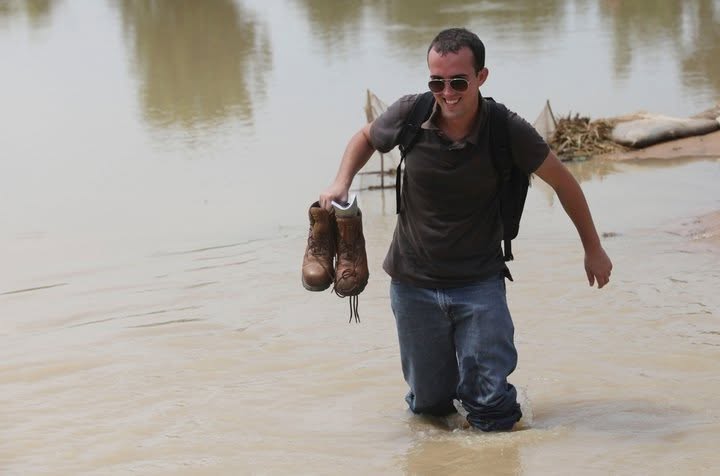
Jon Gambrell wading through floodwater in Jigawa, Nigeria, in 2010, in photo shot by AP's Sunday Alamba.
EDITOR’S NOTE: Jon Gambrell, who had been serving as The Associated Press' Gulf and Iran news director, now is working at The Wall Street Journal as its deputy Middle East bureau chief, working out of Dubai, United Arab Emirates. He provided this story for Connecting in what is a tribute to the AP and his AP colleagues of two decades.
Jon Gambrell – I've been lucky enough to have spent 20 years at The Associated Press, a job that I wanted since I was a student at Miami University in Oxford, Ohio. One of my first-ever journalism classes took place on Sept. 11, 2001. As the class stared at the burning Twin Towers on a boxy television, I got onto the internet and The Washington Post's website. I found myself transfixed by the AP's mainbar story, a term I would only learn years later. Each time I refreshed, paragraphs danced and new details cut into the copy. I couldn't believe that an organization could make sense, moment to moment, of the incomprehensible. My professors at Miami helped me get into professional newsrooms right away and I had the incredible luck of interning at The Cincinnati Enquirer under Dan Sewell, a longtime AP journalist who later would return to be the Cincinnati supervisory correspondent. Dan taught me how to write tightly and focus, as well as how to deal with the many personalities you meet in a career of words.
I didn't immediately go to the AP but got my start at the Little Rock, Ark., bureau in 2006. The late Robert Shaw hired me out of The Bellingham Herald newspaper in Washington state. There, I worked with Kelly P. Kissel, Andrew DeMillo, Noah Trister and Jill Zeman Bleed, who is still with the AP as a top supervisor stateside. Working at Little Rock meant having to do everything, whether filing the broadcast wire, writing high school football stories or helping cover the Legislature. The great culling of the U.S. media had yet to start, meaning when the phone rang, it could be anything from an afternoon newspaper, a low-power AM radio station in the Mississippi Delta or New York wanting something to go to the AAA wire. I was lucky to have good managers in Kelly and Robert who let me roam and write, filing on everything from baby bears in the Ozarks to the sex abuse trial of evangelist Tony Alamo.
But I had wanted to be a foreign correspondent, so I always had my antenna up, looking for an opportunity. Patrick Quinn, now in Bangkok for the AP, had interviewed me for a role in Baghdad and suggested there was another trouble spot in the world that might be a good fit for me. So in December 2009, with the blessing of international editor John Daniszewski, I found myself landing in Lagos, Nigeria, where I'd spend the next four years. The AP had begun really focusing on ensuring cross-format coverage on major stories, so I learned video production from Lekan Oyekanmi, who now works in Texas for the cooperative. Nigeria was intense, with a lot of communal violence, militant attacks in the oil-rich Niger Delta, the rise of Boko Haram and other stories. Andrew Selsky led the Africa Desk and again, gave me a lot of freedom to write other stories like on the legacy of Fela Kuti and Nigeria restarting train service. I did rotations in South Africa, covering the Oscar Pistorius trial and the Marikana mine shooting, as well as one relief tour in Afghanistan. I also picked up a love of photography while there, with Sunday Alamba coaching me on how to take an image. I still shoot today because of his guidance.
I transferred to be an editor on the Middle East Desk in Cairo in 2013. I arrived as Egyptian Gen. Abdel-Fattah el-Sissi took power following the Arab Spring. Shooting regularly took place around Cairo in those first days, including a gun battle just outside the AP's offices on Abu El Feda Street in Zamalek. It wasn't a great time to be a foreigner even after things somewhat calmed, particularly as each time I got into a taxi cab, the driver would go the opposite way to show me a billboard criticizing then-President Barack Obama. Working on the desk under then-Middle East news director Ian Phillips, even with his comforting presence, was intense. A lot of people in the operation had done multiple tours in Baghdad and Kabul at that point and you could feel the strains in how they interacted with each other. The Islamic State group's sudden takeover of territory in Iraq and Syria further stressed us, particularly having to watch and verify their filmed killings of captives. But there were lovely, kind people as well, like longtime AP Mideast editors Katarina "Katya" Kratovac and Lee Keath, who knew and cared about the region. If ever there is a wire-service graduate program, it would be juggling a Libyan violence story, something blowing up in Beirut and a feed from Afghanistan all at the same time, typically just before closing time at midnight.
I ended up transferring to Dubai in the United Arab Emirates in late 2015, eager to start writing again. The news quickly found me. A stampede struck the hajj in Saudi Arabia. Then there was a New Year's Eve blaze. The AP's push into live video had me holding my mobile phone up, transmitting to London as the crowd pushed around me. It was great working under Adam Schreck, who now oversees Asia for the AP, whose calm demeanor in chaos I still try to emulate. After he left, I took over as news director, which by that point fully had replaced 'bureau chief' in the cooperative's nomenclature. While live video and edits remained a major focus, the words we filed still underpinned everything. The coronavirus pandemic saw us all working from home, though Dubai reopened far faster than the rest of the world, as the great Isabel DeBre, now in Buenos Aires, Argentina, found.
| |
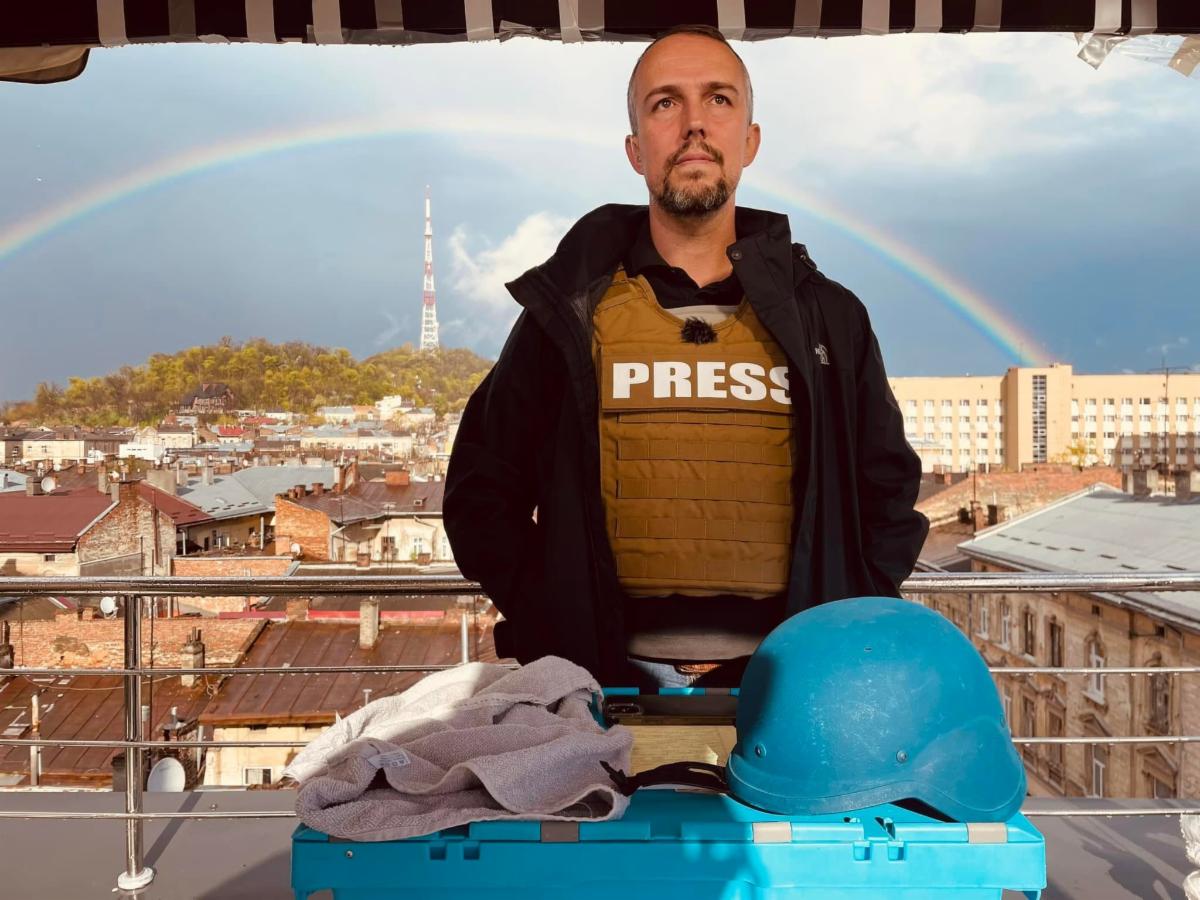
Jon Gambrell in Lviv, Ukraine, in April 2022 doing a standup for AP GMS.
Soon, I found myself doing something I never would have believed years earlier -- appearing regularly on television. Russia's full-scale invasion of Ukraine in 2022 opened an opportunity for AP's GMS arm -- now known as AP360 -- to provide correspondents on scene for clients. I rotated in and out of Ukraine repeatedly, appearing on stations across the world. Nico Maounis, Julian Jones, Philip Crowther and former cameraman Luke Mailander taught me how to handle live shot after live shot with missile sirens wailing. The effort won a Gramling Award in 2022. I'd end up traveling into Jerusalem repeatedly after the Oct. 7, 2023, Hamas attack and subsequent war in the Gaza Strip on the same mission, working closely with Josef Federman and others there.
But Iran would be a major focus over my last decade with the AP. I worked closely with our incredible team in Tehran and traveled in and out when able, the last time in November. We also gamed out and prepped what open warfare could be like between Iran and the U.S. But nothing could have prepared me for receiving a call from AP's longtime correspondent Nasser Karimi on Saturday, Feb. 28, that there had been an explosion at Supreme Leader Ayatollah Ali Khamenei's compound at the start of the working day. That set in motion literally every worst-case scenario we ever envisioned. With threats everywhere, including one Iranian drone strike near the Dubai bureau, everyone across the region worked flat out for months.
By the time a friend told me The Wall Street Journal was looking for a new deputy Middle East bureau chief, I felt like I had accomplished everything I had set out to do in the AP. It was time for a new challenge elsewhere. It wasn't an easy decision. Despite the long days and nights, the constant pressure and nearly insatiable client demands, the AP has been an important part of my life and granted me opportunities to do things I could have never imagined. I've learned much and hopefully helped those who continue the cooperative's good works even into an uncertain future.
I'm reachable at jgambrell@gmail.com if ever needed.
How a White House reporter became Trump’s election fraud spinmeister
| |
By Tom LoBianco
MS NOW
The byline read John Solomon, the same name printed atop four decades of journalistic work.
But now Solomon’s byline led an August White House press release, alleging a broad conspiracy by Democrats and American spies to falsely accuse President Donald Trump of colluding with Russia to hijack the presidency.
In it, Solomon reported some news: that federal investigators in 2017 opened a short-lived intelligence probe into the sitting president over concerns that he may have been co-opted by a foreign enemy. But Solomon flipped the news on its head, spinning the probe as evidence of a wider “deep state” conspiracy against Trump and his allies.
An editor’s note at the bottom of the release revealed that Solomon had taken a leave of absence from his editor-in-chief role at his news outlet, Just the News, “while working as the chairman of the White House Government Transparency Task Force.”
A year ago, Solomon would have been better known for his role in shaping the conservative media landscape over decades of journalistic work in Washington. But this midterm season, his name has been popping up on government websites and news articles not written by John Solomon, describing him as a presidential “insider,” a White House “adviser” and even “Trump’s own election fraud guy.”
Over a few short years, Solomon transitioned from a scoop-hungry Washington editorial director giving favorable coverage to Trump’s election integrity narratives to a government operative, hand-picked by the president to write the narratives himself. He announced in June that he had joined the Trump administration as a special government employee, leading a task force that would “help the government identify some documents, some secrets, some things you should know about when it comes to weaponization, election integrity, and other things.”
Read more here.
A Book, a Ceiling Plug, a Raccoon
Bill Kaczor - What do a book, a ceiling plug and a racoon have in common? Me, apparently. As noted in a couple recent Connecting posts, I have written a book titled "In the Land of the He-Coon, Blue Angels and Saint Bobby: Reporting from the Florida Panhandle." He-Coon was the nickname of the late U.S. Rep. Bob Sikes. Just as an alpha male racoon provides for and protects his brood, Sikes took care of his constituents by filling his district with economy-boosting, job-creating military bases during 38 years in Congress. Voters were so happy with Sikes that they returned him to office even after the House reprimanded him for also taking care of himself through some questionable business practices. He finally retired after the Democratic Caucus stripped him of his lucrative chairmanship of the Appropriations Subcommittee on Military Construction.
The book title comports with some raccoon-ish events that happened to me last week. First, I stepped into my bathroom one morning to find a plug covering a hole in the ceiling had come crashing down to the floor. The hole was for a light fixture that had been removed during remodeling about 10 years ago. A plastic part that held the plug in place had broken and I thought it must have just worn out. I discovered that was not the case at about 5:30 a.m. the next morning when my sleep was interrupted by noises coming from the bathroom ceiling. I shined a flashlight into the hole left by the fallen plug. In less than a minute, I had my answer. A furry and bewhiskered black-masked face appeared and peered down at me for a few seconds before scurrying off into the darkness of the attic above. I had come face-to-face -- about three feet away -- with a real-life namesake of my book's first title character. I wasn't sure if it was a he-coon, a she-coon or some other kind of coon, but it quickly dawned on me that whatever it was had been responsible for dislodging the ceiling plug.
I contacted a critter guy, who inspected my attic (actually more of a crawl space) and informed me that the situation was even worse than I had imagined. I not only had a racoon, I had rats! The masked invader apparently had self-deported by this time. It probably had been attracted by the rodents, he said, because raccoons consider such vermin to be a tasty treat. We then inspected the exterior of the house and discovered that the raccoon had gained entry by climbing up a gutter drainpipe and then ripping off a soffit cover. The critter guy also pointed out that I had smaller openings at the bottom of my siding and along the roofline that were open doors for rats. Both species also left behind feces and urine and tore up my ceiling insulation. The bottom line is that patching up everything, cleaning out the poop and pee and replacing the damaged and contaminated insulation is going to be rather costly. I am now thinking about reissuing my book under a pen name after this series of unfortunate events. How does "Lemony Snicket" sound?
AP Sighting
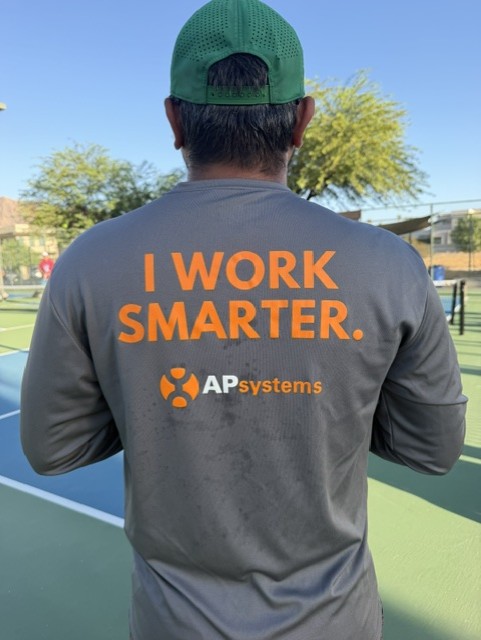
| | Cliff Schiappa - My pickleball bud Rishat came to the court recently wearing this shirt. APsystems provides technology that “puts more power and efficiency into your solar array.” They have another system called “APsmart” which is a cool name as well. | | Connecting wishes Happy Birthday | | |
Stories of interest
‘Our hearts are broken’: L.A. news stations mourn journalist, pilot killed in helicopter crash
| |
A memorial for Eliana Moreno and George Marciniw, who died in a helicopter crash, is seen at the site where their helicopter used to park at Whiteman Airport in Los Angeles. (AP Photo/Ethan Swope)
By: Tom Jones
Poynter
The scene in Chatsworth, a suburban neighborhood of Los Angeles, on Tuesday was already tragic. An SUV had crashed into a Metro bus, killing two people.
But then it got worse. A news helicopter covering the accident plummeted to the ground, killing NBC4 aerial photojournalist Eliana Moreno, pilot George Marciniw and 29-year-old Edy Gutierrez Mejia, who was on the ground.
The helicopter, operated by Angel City Air and providing news coverage for NBC4 and Telemundo 52, crashed and burst into flames around 7 p.m. Pacific time. Investigators are still trying to figure out the cause.
The Los Angeles Times’ Iris Kwok, Terry Castleman, Karen Garcia and Richard Winton reported, “Moreno and Marciniw’s last moments tragically were captured on a live broadcast. Video from their helicopter shows an aerial view of the bus crash, with the sound of the helicopter in the background. Then, the sound of the engine’s motor winds down, the angle of the camera begins to descend, and Moreno is heard saying ‘You can’t pull up?’ before the image cuts out.”
Zoey Tur, a veteran news helicopter pilot who operated the type of helicopter the NBC4 crew was flying, told the Times that the craft is equipped with “an emergency horn that sounds when either there’s a low RPM issue or the helicopter loses hydraulics.”
Tur told the Times, “If you listen carefully to the on board transmission, the microphone picks up the engine shutting down. First, the engine starts winding down, which in turn reduces power to the rotor blades. Then you hear the horn warning of low rotor RPM. You can even hear the blade slap slow down.”
Tur said that the aircraft likely didn’t run out of fuel because it caught on fire after hitting the ground.
Read more here.
-0-
EU chief proposes bloc-wide social media ban for kids under 13
By Sam McNeil and Kelvin Chan
The Associated Press
BRUSSELS (AP) — The European Union’s top official proposed on Wednesday banning children under 13 across the 27-nation bloc from using social media sites and imposing limits for older teens on accessing the platforms.
The plan outlined by European Commission President Ursula von der Leyen adds to global efforts to protect young people using platforms such as Instagram and TikTok from online harm.
“I am aware that many perceive the power of Big Tech as overwhelming and impossible to roll back. I disagree,” von der Leyen said in her annual State of the European Union speech in Strasbourg.
“We do not have to accept addictive features. We do not have to accept children being drawn into ever more extreme content. We do not have to accept that girls have their photos used for AI-generated sexualized images,” she said.
Von der Leyen said that under her proposal “mini accounts” chaperoned by guardians would be granted to kids aged 13-15, with limits on features and the amount of time they can be accessed.
For 15-to-18-year-olds, platforms will need to provide a “safe design,” she said. Further details of the plan are expected Thursday.
Read more here. Shared by Doug Pizac.
-0-
Democrats accuse FBI director of intimidating journalists
By AFP
Senate Democrats accused FBI Director Kash Patel at a fiery congressional hearing on Tuesday of abusing his position as head of the law enforcement agency to intimidate journalists.
"Like a thug, you're using your agency to go after reporters," said Senator Cory Booker, a Democrat from New Jersey. "Reporters wrote about the president and your bureau went to their homes and subpoenaed their mothers.
"A reporter wrote about you and your bureau ran her name through records and began an investigation," Booker added.
The FBI director said it was a "total lie" that he had used FBI resources to target reporters.
Patel filed a $250 million suit in April against The Atlantic magazine and the author of an article he called a "defamatory hit piece."
Read more here. Shared by Doug Pizac.
-0-
How the Times Lost a Defamation Trial
By Beill Grueskin
Columbia Journalism Review
It is rarely a good sign when the New York Times standards editor fires off an email to you at the end of the day. That’s especially true when that email arrives after your reporter published a “scoop” that was based on a shaky anonymous source and that was rapidly denied by key figures in your story.
But such was the scenario on the evening of March 16, 2023, when Phil Corbett, who was then the associate managing editor, wrote this to the leaders of the Times’ Sports section: “To state the painfully obvious, I hope we’re right on this. Also, I hope we did our usual level of due diligence in handling this anonymous sourcing.”
Corbett’s instincts were justified. The Times’ story was a bad misfire—one that resulted in the paper’s first defamation trial loss in a United States court in more than fifty years. When the trial ended last month, in the United States District Court for the Northern District of Alabama, a jury awarded 9.25 million dollars to a former University of Alabama basketball player named Kai Spears, because the Times had mistakenly placed him as a passenger in a car that was at the scene of a tragic shooting death.
The Times calls the erroneous story “an honest mistake,” says it is reviewing its legal options, and has already won one concession: on August 31, Annemarie Carney Axon, the US district court judge, trimmed the award almost in half, to 4.75 million dollars, upon determining that the jury’s punitive-damage figure was too high.
Read more here. Shared by Doug Pizac.
-0-
The Newsground blends engaging investigative journalism with coffee and tea
By Alyssa Choiniere
Editor and Publisher
In an age of disinformation, doomscrolling and distrust in journalism, one investigative reporter aims to renew the tradition he witnessed as a child: reading the newspaper with a cup of coffee.
Scott Stedman launched The Newsground in March, an online publication with a simple mission: “investigative journalism fueled by coffee and tea.” His subscribers receive regular shipments of their beverage of choice, along with ad-free reading online and in a newsletter.
For about one year prior to his launch, Stedman conducted research for his concept, attempting to find the root causes for the declining trust in journalism and a model for what the industry was like at a time when people still trusted the news.
Read more here. Shared by Doug Pizac.
-0-
DOJ seeking reporter’s LinkedIn records in secretive First Amendment court fight
By Kyle Cheney and Josh Gerstein
Politico
A secret, months-long battle between tech titans and the Justice Department — over prosecutors’ effort to obtain details on a journalist’s LinkedIn interactions for use in a national security leak probe — spilled into view Tuesday during a federal court argument in Virginia.
Though the details of the case remain sealed, a panel of the Richmond-based 4th Circuit Court of Appeals described the stakes in stark terms: a fight to find balance between the government’s life-and-death national security interests and the First Amendment protections for reporters to maintain the secrecy of their sources, particularly when investigators seek to obtain them from third-party companies.
Joshua Ferrentino, a Justice Department national security attorney, told the court that prosecutors are demanding details of about 1,900 LinkedIn interactions from six users as part of the unspecified probe.
A judge in the Eastern District of Virginia granted that request in June and appended a “non-disclosure order” prohibiting LinkedIn from alerting its users to the subpoena.
That order required LinkedIn to turn over information about specific people’s use of the service, which can reveal connections between users. But a search warrant would typically be required before law enforcement could see the content of their communications.It’s unclear whether such warrants have been sought or obtained in this investigation.
Read more here. Shared by Doug Pizac.
-0-
How the Chicago Area Gets its News
By Stephoanie Edgerly and Tim Franklin
Northwestern / Medill
In 2024, the Medill Local News Initiative at Northwestern University conducted its first in-depth survey of Chicago-area news consumers to understand how smartphones and social media were remaking the relationship between audiences and local news. Medill did a second survey in 2025. It now has completed a third annual study to capture not just a 2026 snapshot but a three-year timeline of the digital revolution’s impact on local news.
The survey results lay bare the severe pressure faced by legacy media to retain and grow audiences. Print has become a niche product, while linear broadcast TV and radio are losing their audiences at an alarming rate. One encouraging sign is that survey respondents say they maintain a strong interest in consuming local news. However, if news organizations believe that incorporating artificial intelligence is an easy fix for streamlining newsgathering at lower cost, they will need to think hard about their approaches. This year’s study looked closely at the relationship between consumers and AI. It found respondents are deeply skeptical of AI in news for anything more than helping to check spelling or grammar.
With three years of survey data, it’s clear news consumers have established new habits and tastes in the way they access information. Their device of choice is the smartphone, and they are much more likely to search for news or turn to social media than pay for subscriptions. Young people in particular are reliant on content creators for local news, one of many major changes underway in the way people search out and absorb news and information.
Read more here. Shared by Doug Pizac.
-0-
Justice Department Sides With Paramount on Demand That States Post $1.88 Billion Bond
By Winston Cho
The Hollywood Reporter
The government is urging a federal judge to force a dozen states led by California to bear the costs of the holdup caused by their lawsuits challenging the $111 billion megamerger of Paramount and Warner Bros. Discovery.
In a statement of interest filed on Tuesday, the Justice Department argues that the states must post a “proper bond” taking into consideration potential damages.
“The bond requirement forces parties to have skin in the game,” the motion states.
The move follows Paramount last week continuing to press California Attorney General Rob Bonta for a $1.88 billion bond to cover losses if it wins the cases over the deal, which has been temporarily halted. A trial has been scheduled for March, months past CEO David Ellison’s target closing date of late September.
Read more here. Shared by Doug Pizac.
-0-
Reach to cut editorial team by further 160 jobs as key metric becomes ‘active engaged time’
By Charlotte Tobitt
Press Gazette
Reach is planning to cut about 220 editorial jobs and create 60 new roles as it shifts focus away from page views and volume.
This will result in a net loss of around 160 editorial jobs.
Reach owns national and regional titles including the Mirror, Express, Daily Star, Manchester Evening News, Liverpool Echo and dozens of smaller local newsbrands.
Chief content officer David Higgerson told staff in a memo: “The roles being created are ones which are needed to drive digital revenue growth, particularly in subscriptions and in longer-form video, and enhance brand reputation through well-read journalism which creates loyalty.”
Read more here. Shared by Doug Pizac.
-0-
OpenAI strikes first news deal in Canada
By Sara Fischer
Axios
Village Media, one of Canada's largest digital-only local news networks, is launching an AI-powered community services tool via a partnership with OpenAI.
It marks OpenAI's first news deal in Canada. The partnership will see Village Media and OpenAI teaming up to launch Open Door, an AI-powered community health and care navigation platform.
Read more here. Shared by Doug Pizac.
-0-
The Library Newsroom Project could be coming to a library near you
By Sophie Culpepper
Nieman Lab
As journalism reached breakneck speed to produce mountains of content for insatiable digital platforms, it “drifted away from where people actually live their lives,” Parris Jr. wrote last year. He predicted 2026 would “push us back toward the physical and tangible in the spaces we work, the ways we engage, and the products we create.” And he pointed to one civic space well positioned to serve as a starting point for that work: libraries.
After several years leading engagement journalism initiatives at ProPublica, The New York Times, and The City (now The City Reporter), and securing an MLIS from library school along the way, Parris Jr. has spent the past year as a John S. Knight fellow at Stanford refining his vision for the Library Newsroom Project. Through the project’s first pilot, a partnership with the Brooklyn Public Library’s Sunset Park branch, a group of community members has published more than a dozen editions of a free, print monthly bulletin called the Sunset Park Sun.
Read more here. Shared by Doug Pizac.
-0-
The Atlantic is getting more subscribers from Google traffic, even as referrals fall
By Sarah Scire
Nieman Lab
Like many in the news industry, The Atlantic is seeing its referrals from Google drop. At the same time, CEO Nicholas Thompson said, the number of subscribers The Atlantic gets from Google traffic has gone up.
“Google is sending us fewer people who aren’t going to subscribe,” Thompson said in an interview with longtime media journalist Peter Kafka. On the Friday episode of Channels, Thompson answered questions as the CEO of a profitable media company — and as a news creator himself.
Thompson has 1.6 million followers on LinkedIn and about 6,500 on YouTube. His videos and podcasts are produced independently of The Atlantic’s editorial team but provide revenue that gets reinvested into the newsroom. (The latest episode of The Most Interesting Thing in AI is sponsored by PwC.)
The Atlantic currently has 1.6 million paid subscribers, Thompson said. The magazine reported a profit in 2024 and has been in the black since.
Read more here. Shared by Doug Pizac.
| Today in History - Sept. 17, 2026 | | |
Today is Thursday, Sept. 17, the 260th day of 2026. There are 105 days left in the year.
Today in history:
On Sept. 17, 1787, the Constitution of the United States was completed and signed by a majority of delegates attending the Constitutional Convention in Philadelphia.
Also on this date:
In 1862, more than 3,600 men were killed in the Civil War Battle of Antietam (an-TEE’-tum) in Maryland.
In 1908, Lt. Thomas E. Selfridge of the U.S. Army Signal Corps became the first person to die in the crash of a powered aircraft, the Wright Flyer, at Fort Myer, Virginia, just outside Washington, D.C. The pilot, Orville Wright, was seriously injured but survived.
In 1944, during World War II, Allied paratroopers launched Operation Market Garden, landing behind German lines in the Netherlands.
In 1978, after 12 days of meetings at the U.S. presidential retreat of Camp David, Egyptian President Anwar Sadat and Israeli Prime Minister Menachem Begin (men-AH’-kem BAY’-gihn) signed the Camp David Accords, a framework for a peace treaty.
In 1980, former Nicaraguan President Anastasio Somoza was assassinated in Paraguay.
In 2001, six days after 9/11, stock prices nosedived but stopped short of collapse in an emotional, flag-waving reopening of Wall Street.
In 2011, a demonstration calling itself Occupy Wall Street began in New York, prompting similar protests around the U.S. and the world.
In 2021, a Los Angeles jury convicted New York real estate heir Robert Durst of killing his best friend 20 years earlier. (Durst, who was sentenced to life in prison, died in 2022.)
In 2024, thousands of pagers distributed to the Shiite Muslim political party and the militant group Hezbollah blew up in homes, offices and front lines across Lebanon, remotely detonated by Israel. The pager attack killed 12 people and wounded more than 3,000 others.
Today’s Birthdays: Sen. Chuck Grassley, R-Iowa, is 93. Mountaineer-explorer Reinhold Messner is 82. Basketball Hall of Fame coach Phil Jackson is 81. Indian Prime Minister Narendra Modi is 76. Actor Cassandra Peterson (“Elvira, Mistress of the Dark”) is 75. Director-actor Paul Feig is 64. Film director Baz Luhrmann is 64. Singer BeBe Winans is 64. Actor Kyle Chandler is 61. Rapper Doug E. Fresh is 60. Author Cheryl Strayed is 58. Actor Matthew Settle is 57. Designer-TV personality Nate Berkus is 55. NASCAR driver Jimmie Johnson is 51. NHL forward Alexander Ovechkin (oh-VECH’-kin) is 41. Actor Danielle Brooks is 37. NFL quarterback Patrick Mahomes is 31. Actor Mia Talerico is 18.
| | Got a photo or story to share? | | |
Connecting is a daily newsletter published Monday through Friday that reaches more than 2,000 retired and former Associated Press employees, present-day employees, and news industry and journalism school colleagues. It began in 2013. Its author, Paul Stevens, retired from the AP in 2009 after a 36-year career as a newsman in Albany and St. Louis, correspondent in Wichita, chief of bureau in Albuquerque, Indianapolis and Kansas City, and Central Region vice president based in Kansas City.
Got a story to share? A favorite memory of your AP days? Don't keep them to yourself. Share with your colleagues by sending to Ye Olde Connecting Editor. And don't forget to include photos!
Here are some suggestions:
- Connecting "selfies" - a word and photo self-profile of you and your career, and what you are doing today. Both for new members and those who have been with us a while.
- Second chapters - You finished a great career. Now tell us about your second (and third and fourth?) chapters of life.
- Spousal support - How your spouse helped in supporting your work during your AP career.
- My most unusual story - tell us about an unusual, off the wall story that you covered.
- "A silly mistake that you make"- a chance to 'fess up with a memorable mistake in your journalistic career.
- Multigenerational AP families - profiles of families whose service spanned two or more generations.
- Volunteering - benefit your colleagues by sharing volunteer stories - with ideas on such work they can do themselves.
- First job - How did you get your first job in journalism?
- Most unusual place a story assignment took you.
Paul Stevens
Editor, Connecting newsletter
paulstevens46@gmail.com
| | | | |