In This Issue
Research Spotlight: CPCE Takes Part in 11th Annual Global Health Conference
Deadline Extended: CPCE is Accepting Applications for T32-Funded Postdoctoral Training Program
CPCE In the News:
Vaping and Teens
CPCE In the News: City Council passes bills outlawing discrimination against gender non-conforming youth
CPCE In the News: Accuracy of Autism Screening
Upcoming Events
Recent Publications
|
|
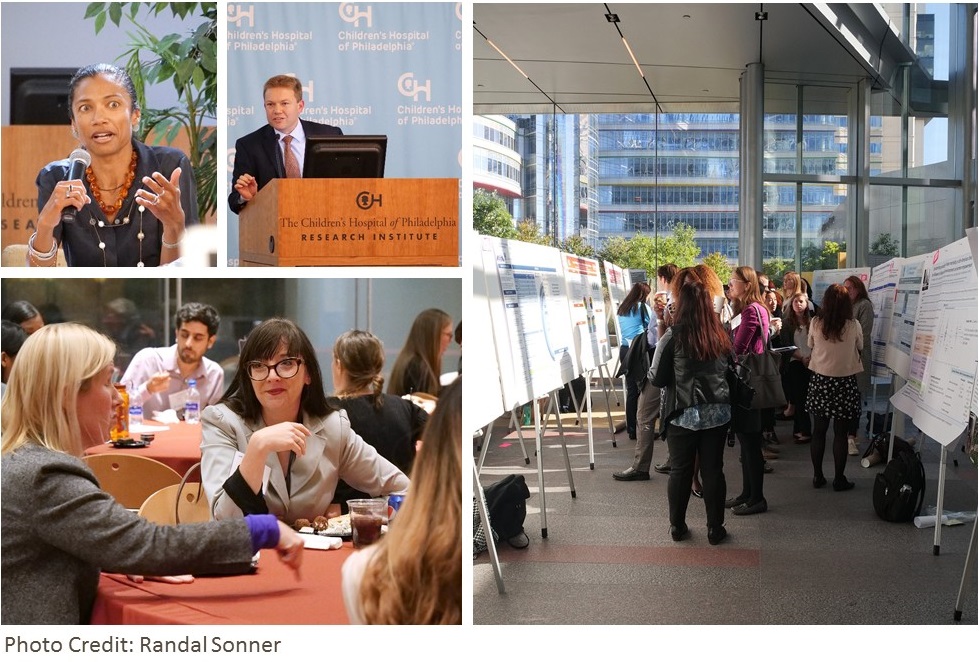
CPCE Takes Part in 11th Annual Global Health Conference
|
The 11th Annual CHOP Global Health Conference took place last week, with more than 200 global health professionals and trainees in attendance. This year’s theme,
Global Health in Our Own Backyard: Controversies, Initiatives, and Innovations for our Local Underserved Populations, explored the intersections between domestic, local, and international global pediatric health to better reach the underserved here at home in the United States.
|
Recognizing that in order to improve child health we must provide equitable quality care to all, including historically underserved populations and geographic areas, attendees had the opportunity to increase their awareness of existing disparities and sharpen their skills to both advocate and care for underrepresented patients. The two-day conference provided attendees with knowledge and tools to be more effective providers for all patients, especially those who struggle most to access care.
CPCE faculty and staff participated in a variety of ways.
- Andrew Steenhoff, MBBCh, DCH moderated the Friday evening keynote by David Nichols, MD, MBA titled “A Report Card on the U.S. Health System, with an Emphasis on Children” highlighting areas of strength and weakness within our system and potential solutions.
- Katherine Yun, MD, MHS gave the Saturday morning welcome, and moderated a session titled “Local Global Health Stories.” These stories included presentations about CHOP’s Homeless Health Initiative and a Community Health Worker model to optimize diabetes care for children and youth in Philadelphia.
- Kristen Feemster, MD, MPH, MSHP lead a breakout panel entitled “Career Opportunities: Serving the Underserved in the United States.”
- Sixty five posters were presented at ePoster sessions, one of which was moderated by Elizabeth Lowenthal, MD, MSCE, and poster walks organized around different themes. Jennifer Chapman, MPH moderated the “Not Invisible: The Socio-Behavioral Health of Adolescents” poster walk.
- Hansel Otero, MD presented posters on teleradiology and teaching radiology quality improvement methods in the Caribbean.
- Anna Hoplamazian presented a poster on The Opening Doors to Early Intervention Study.
Common themes of a move toward trauma-informed care and developing an understanding of the interaction between lived experience and health outcomes permeated the conference.
|
|
Deadline Extended: CPCE is Accepting Applications for T32-Funded Postdoctoral Training Program
CPCE has extended the deadline to
November 1st for applications to the Pediatric Hospital Epidemiology and Outcomes Research Training (PHEOT) program. PHEOT is a T32-funded postdoctoral training program recruiting for the academic year beginning July 1, 2020. Our training program values inclusion and diversity, and we encourage applications from pediatricians whose insight and experiences will broaden and hence strengthen the scope and impact of child health research. We believe that pediatric researchers should reflect the diversity of the children in our communities.
The PHEOT program trains the next generation of clinical scientists who will understand how to best measure and improve outcomes, assure patient safety, and manage costs for hospitalized children. PHEOT is open to fellows in all clinical specialties, as long as their primary research is in hospital epidemiology and outcomes.
The fellowship typically fund trainees for two years, and include a stipend, tuition support, health insurance benefits, and some support for training related expenses such as books, software, or conference travel. Physicians who are United States citizens or permanent residents and have at least two years of postgraduate training are eligible to apply.
More information about the program, including how to apply, is available
here.
|
|
Vaping and Teens
With cases of vaping-related illness on the rise, CPCE and PolicyLab Core Faculty member
Brian Jenssen, MD, MSHP has discussed the many issues associated with e-cigarettes, particularly among teens and young adults. The Philadelphia Inquirer interviewed more than a dozen teens about the impact of vaping on their personal and social lives. While they expressed concern over its effect on their health, some of them are already addicted. “Nicotine is one of the most addictive drugs,” Dr. Jenssen told the Inquirer. “And nicotine on the developing brain is really harmful. It leads to addiction [and] increased impulsivity.”
In another story, Central Pennsylvania-based The Patriot-News interviewed a teen who had been treated for vaping-related illness. Here, Dr. Jenssen commented on the lack of knowledge about exact cause or long-term effects of the illness. "We don't know everything, but what's already there is really concerning," he said. He further explained that illness severity varies from one patient to another, and that the number of cases may be underreported.
Some doctors, according to Quartz, have started prescribing off-label nicotine replacement therapies (NRTs) to patients who are addicted to vaping. The challenge is a lack of research on NRTs in pediatric patients.
Another apparent concern is that of very young children accidentally ingesting e-cigarette cartridges or liquid nicotine bottles, attributable at least in part to imitation. “If you see an older sibling or parent putting this in their mouth, you may see kids try to emulate them by vaping,” Dr. Jenssen told Rolling Stone.
The Penn Public Health Seminar Series will host a panel discussion on the current state of data on vaping on October 30th. See more detail below under
Upcoming Events.
|
|
City Council passes bill outlawing discrimination against gender non-conforming youth
Philadelphia City Council passed a package of bills that will strengthen non-discrimination policies in schools and other public places. Linda A. Hawkins, PhD, MSEd, LPC and
Nadia Dowshen, MD, MSHP co-direct the
Gender and Sexuality Development Clinic at CHOP. “Many of the more than 1,300 transgender and gender-diverse children and adolescents for whom we provide care have experienced bullying at school or in social settings,” they said in a City Council statement. “When we work with patients, families, and school staff to ensure a better environment for transgender youth in our clinic, and youth can then go to school and learn rather than feeling excluded or discriminated against, we see positive impacts on their health and well-being.”
|
|
Accuracy of Autism Screening
Early detection of autism spectrum disorder (ASD) and referral to supportive therapies has been shown to improve long-term outcomes for patients with ASD. Accordingly, the American Academy of Pediatrics recommends universal screening for ASD at 18 and 24 months. Until recently, however, there was little data on the accuracy of universal screening for ASD in a clinical setting. CPCE Core Faculty member
Whitney Guthrie, PhD, along with colleagues from
PolicyLab and the
Center for Autism Research, analyzed results from 26,000 CHOP Primary Care patients who were screened for ASD using the Modified Checklist for Autism in Toddlers with Follow-Up (M-CHAT/F). Enabled by CHOP's Electronic Health Record, Dr. Guthrie and colleagues found that M-CHAT/F detected only about 40% of children who went on to be diagnosed with ASD. The study also revealed disparities in the ability of M-CHAT/F to detect ASD in girls, children of color, and those of lower socioeconomic status. "While these findings are indeed sobering and may be interpreted by some as evidence against universal screening, we caution against this interpretation, given that screening still led to earlier age of diagnosis for children who were accurately identified by the M-CHAT/F," wrote Dr. Guthrie and co-author
Kate Wallis, MD, MPH for MedPage Today. Instead, they encouraged continued use of the M-CHAT/F and future research to improve the screening process and reduce disparities. This work was covered widely in science and health news sources.
|
|
Upcoming Events
Child Trafficking: A Global and Local Crisis, and What We Can Do
Date: October 14, 2019
Time: 9:00 - 10:30 AM
Location: Roberts Center for Pediatric Research, 1st floor, 1-120A
Sponsored by the CHOP Global Health Research Affinity Group, and presented by Carmelle Tsai, MD, DTMH, senior Pediatric Emergency Medicine and Global Health Fellow at CHOP. View the event
flyer.
Fighting Asthma Disparities Summit
Date: October 18, 2019
Time: 8:00 AM - 4:30 PM
Location: Roberts Center for Pediatric Research
The 11th Annual Asthma Disparities Summit will explore the benefits and logistics of engaging community-based resources to support families in managing their child’s asthma. Please register by October 10. Learn more
here.
Challenging Dogma - Mechanisms and Implications of Nondifferential but Dependent Misclassification
Date: October 25, 2019
Time: 12:00 - 1:00 PM
Location: Roberts Center for Pediatric Research, 2nd Floor, 2-160
The CPCE and PolicyLab Speaker Series welcomes Kelly D. Getz, PhD, Assistant Professor of Epidemiology, Department of Biostatistics, Epidemiology & Informatics, University of Pennsylvania Perelman School of Medicine. RSVP to
CPCE@email.chop.edu.
Novel methods from behavioral economics and their application to the Habit Formation Trial
Date: October 29, 2019
Time: 12:00 - 1:00 pm
Location: Roberts Center for Pediatric Research, 2nd floor, 2-180
Sponsored by the CHOP Clinical Trials Research Affinity Group (RAG) and presented by Iwan Barankay, PhD, Associate Professor of Management, Wharton School, and Mary Putt, PhD, ScD, Professor of Biostatistics, Hospital of the University of Pennsylvania. Learn more
here.
Piecing Together the Data on Vaping: What is the Current State?
Date: October 30, 2019
Time: 12:00 - 1:30 PM
Location: Biomedical Research Building, Gaulton Auditorium, 421 Curie Blvd.
The Penn Public Health Seminar Series will host Frank Leone, MD, MS, from Penn Medicine, Catherine Maclean, PhD, from Temple University, and Cheryl Bettigole, MD, from the Philadelphia Department of Public Health. Learn more and register
here.
American Public Health Association Annual Meeting & Expo
Dates: November 2-6, 2019
Location: Pennsylvania Convention Center, 1101 Arch St. Philadelphia
APHA's Annual Meeting and Expo is the largest and most influential annual gathering of public health professionals. Learn more
here.
|
Recent Publications
Language barriers constitute some of the pediatric health care disparities in the United States, as access to language services influences quality of care and readmission rates. There are increasing numbers of US children with a parent or caregiver with limited English proficiency (LEP); that figure is currently around 15%. Despite a robust body of literature about spoken language services, little is known about the provision of written language services for patients with LEP, such as translation of discharge instructions. Nearly half of hospitals do not translate discharge instructions.
Katherine Yun, MD, MHS and colleagues studied barriers and potential strategies for translating children’s discharge instructions. They found that current strategies focus on translating standardized documents, but innovation and collaboration may help encourage provision of personalized documents.
Most cardiopulmonary resuscitation (CPR) events in children’s hospitals occur in PICUs; many children who require CPR die during or shortly after the event, and those who survive are often left with new disabilities. One way of identifying patients who may require CPR is a paper checklist. However, the time needed to manually screen the criteria for each patient has proven to be a barrier to implementation. Therefore,
Christopher Bonafide, MD, MSCE and a team of researchers sought to automate the clinical decision support tool. They found that the automated version demonstrated reduced accuracy in prediction.
Microbiological testing helps clinicians identify pathogens and optimize treatment. However, infection may be misdiagnosed when a “positive” culture represents colonization or contamination. Misdiagnosis of infection may delay correct diagnosis, prompt inappropriate antibiotic use, and result in patient harm. The proliferation of diagnostic tests has increased our reliance on tests for diagnosis.
Julia Szymczak, PhD and colleagues look at the mental models and social contexts that drive overuse of microbiological testing, which is key to reducing overdiagnosis and overtreatment of infection.
There are scarce data about the prevalence and mortality of necrotizing enterocolitis in neonates with congenital heart disease. This study, with contributions from
Joe Rossano, MD, MS
, sought to address this lack of data. They found that the prevalence of necrotizing enterocolitis among this group of neonates is 3.7%, and varies among different heart defects.
Unintended pregnancy is a major public health problem in the USA, particularly among adolescent and young adult (AYA) women. Long-acting reversible contraceptive (LARC) devices are the most effective methods for preventing pregnancy, but they are underutilized by young women.
Aletha Akers, MD, MPH, and
Danielle Weldon, MPH, contributed to a study that looked at follow-up care patterns and continuation rates during the first 6-months after initiating a LARC device among AYA women. They found that clinical practices should be prepared to address issues that arise during follow-up encounters, whether in-person or by phone.
|
|
About CPCE
We are a pediatric research center dedicated to discovering and sharing knowledge about best practices in pediatric care by facilitating, organizing and centralizing the performance of clinical effectiveness research -- research aimed at understanding the best ways to prevent, diagnose and treat diseases in children. CPCE’s multidisciplinary team conducts research on a diverse range of clinical effectiveness topics.
CPCE E-News is edited by
Holly Burnside. Please feel free to contact us with questions or feedback.
|
|
|
|
|
|
|