|
The ordinance uses language equating people who are unhoused with a public safety threat, despite data showing people who are unhoused are more likely to be victims of crime than perpetrators. It encourages local governments to forcefully remove people and their belongings, regardless of whether those individuals and families are living in encampments. As written, the order would give local communities the illusion their governments are taking responsible action, while making it harder for state and local agencies to implement effective solutions.
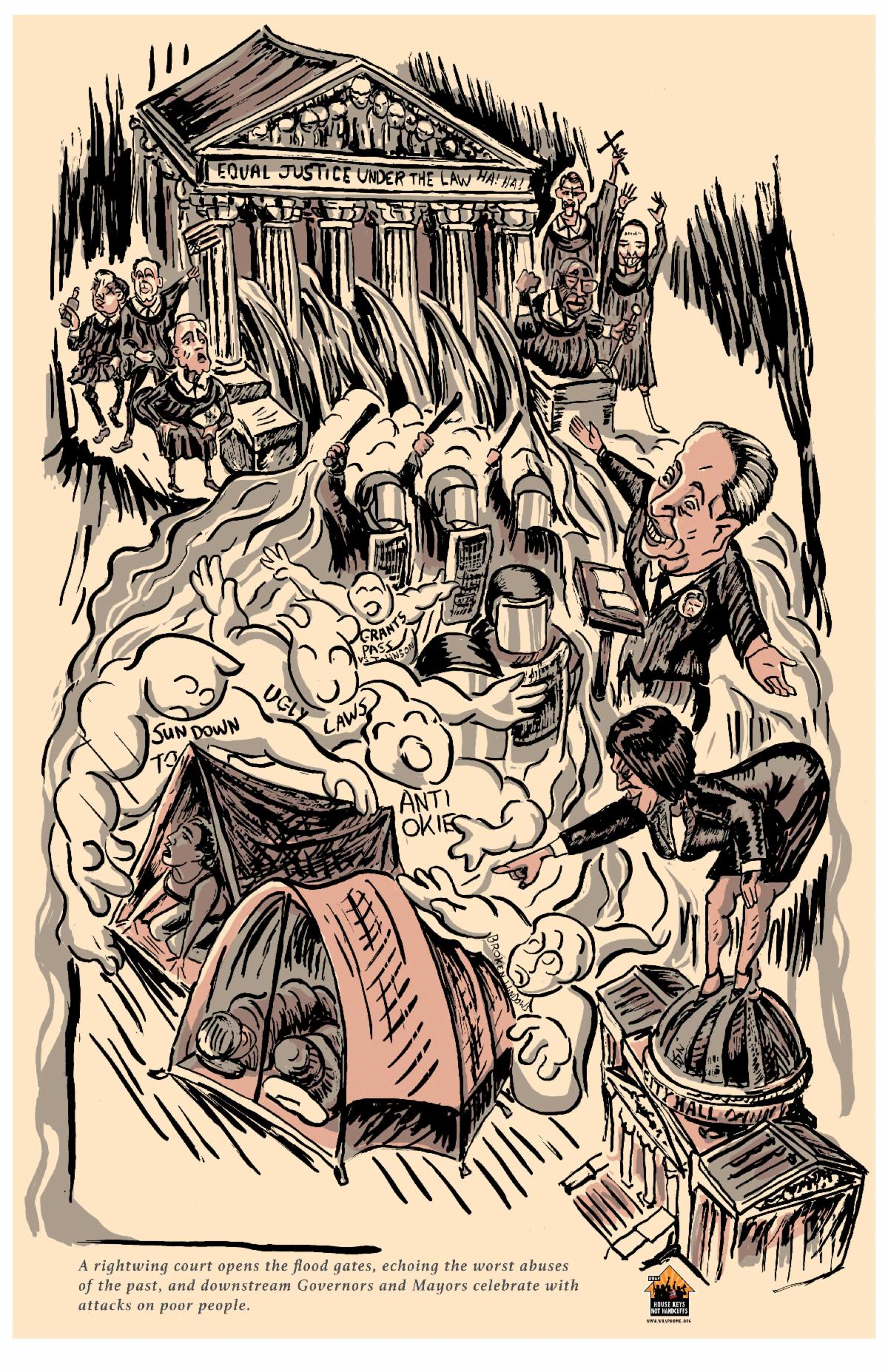
The Governor’s model ordinance follows his Executive Order N-1-24, banning encampments on state-owned land, and the U.S. Supreme Court’s 2024 ruling on City of Grants Pass v. Johnson, et al. that reversed constitutional protections for people living outside, and has since emboldened jurisdictions seeking to treat people who are unhoused as criminals. The model ordinance comes at a time when federal leaders are proposing massive cuts to funding for housing vouchers, sure to lead tens of thousands of Californians to lose their homes (decades of federal disinvestment, in fact, has contributed significantly to mass homelessness). Further, it represents a dangerous and rapid shift away from proven housing and supportive services solutions and back to regressive, punitive, costly, and discriminatory approaches that local governments have long tried and that have long failed.
It also comes at a time when homelessness levels in California remained relatively flat, despite significant increases in homelessness nationally, thanks to state investment in housing and local communities housing more people than ever before. Tossing aside that success, the Governor is calling on local governments to turn back the clock.
The Governor’s model ordinance purports to offer dignity and respect to people who are unhoused and reportedly discourages local communities from punishing people. Yet, forcing people to move 200 feet every three days is traumatizing, stigmatizing, arbitrary, and cruel. It creates more barriers for outreach workers, family members, and case managers to help people exit homelessness. In fact, these ordinances lead outreach workers to lose contact with their clients and people to lose their identification and other documentation needed to move into housing. People with lived experience of houselessness report that forcing people who are unhoused to move frequently is disorienting and painful, particularly for seniors, people with disabilities, and people with children. They also report that forced moves interfere with health care they need. Likewise, 48-hour notices are never sufficient notice for outreach workers to connect to people living in encampments to understand their needs and to align the resources necessary to respond adequately to those needs, all of which are proven practices that help people move out of encampments. Enforcement of similar ordinances is deeply dehumanizing. When asked about the hardest part of being cited or arrested for being unhoused, one California resident told us, “Feeling like a criminal. And having to go to court for just living is just degrading. I can’t even get a good night’s sleep.”
The model also fails to clarify what “offer of shelter” means, or whether and how local jurisdictions will assist people to exit homelessness through an “offer of shelter” or track and verify shelter beds, especially given data showing most people who are unhoused want shelter and cannot access a bed. Moving someone forcefully from an encampment does nothing to resolve their unhoused or even unsheltered status or give them any place to go. Moreover, shelters do not solve houselessness and people typically must return to the streets eventually, creating a revolving door of forced moves, occasional shelter stays, and returns to the streets.
The model ordinance classifies an experience of homelessness, such sleeping in a sleeping bag or using a cardboard box as protection from the elements, or any other measures to survive as “unlawful.” The ordinance language does not clarify the difference between “unlawful” and “criminal.” On the contrary, the model ordinance ignores compelling, independent research, including a recent analysis of Los Angeles practices and a RAND report, proving that clearing encampments is ineffective and disproportionally harms people of color, people with disabilities, older adults, and people who identify as gay, lesbian, bisexual, or transgender, all of whom are overrepresented among unhoused communities due to discrimination in all areas of life.
Local assessments of similar ordinances find 81% of people are not offered any services and, when they are offered any referrals to shelter beds, most beds are full. One city linked only 6% of people impacted to shelter beds. Similarly, for 82% of people forcefully moved or punished for failing to move off the streets, enforcement officers offered no storage of people’s belongings. Sixty-two percent of people reported their belongings were thrown into trash trucks. Review after review of enforcement of ordinances show that, despite intentions, a law enforcement response to homelessness is a highly costly, highly ineffective, and harmful response.
Rather than repeating what does not work again and again, expecting different results, California can instead choose to invest in effective solutions that create sustainable, healthy and safe communities and ensure dignity through ongoing, scalable investments in housing for all, based on data-driven and fiscally responsible solutions, including the following:
• Leveraging insights from those with lived experiences of houselessness,
• Working in coordination with local governments to assist people in encampments to move into permanent housing,
• Accelerating new affordable and accessible housing development, investing in rental assistance, improving subsidized housing voucher utilization rates, and repairing and preserving existing supportive and public housing,
• Mobilizing public health teams, and
• Engaging people living in encampments and connecting individuals to housing and supportive services through one-on-one connections led by services staff.
The Equal Rights for Every Neighbor Coalition fights for a world in which all neighbors have equal rights and the opportunity to participate fully and equally in their communities. We oppose discrimination based on housing status, and work to abolish criminalization of unhoused Californians.
|