Despite estimates for early 2026 that showed sluggish momentum with roughly 50,000 jobs added in December, a Gallup poll released Monday and conducted in early January showed nearly half (49 percent) of adult Americans expect the economy to grow over the next six months. | | |
Survey data collected Jan. 2-17, 2026
Notably, a majority (62 percent) said they anticipate even higher inflation, and half (50 percent) also think unemployment will go up in the next 6 months:
| | |
Survey data collected Jan. 2-17, 2026
Vegas Room Rate Dropped for Superbowl LX
Many Las Vegas Strip rooms were going for less than $100 a night leading into last weekend, and even luxury resorts dropped their room rates compared to prior Super Bowl weekends, according to a Review-Journal story published a few days before the big game.
The R-J story cited its Wednesday survey that found the average cost of a valley hotel room for Saturday and Sunday night was $138.88 — 25.4 percent less than the average daily room rate ($186.16) for February 2025, per the Las Vegas Convention and Visitors Authority.
Some rooms at Palazzo and The Venetian were going for $206 a night, and Caesars Palace was offering rooms for $359 a night.
Explanations for the decrease vary with the source but whatever the case, it aligns with a general softening of room rates compared to previous years, with some data indicating a 12 percent decline in Q4 2025 and a 5 percent drop in average daily rates reported in the first part of 2026.
One caveat: Downtown Fremont’s Super Bowl room rates (for 18 hotels) averaged $119, up from $96 on February 2025.
Regional Economics
For a high-level assessment of key Washoe vs. Clark County economic indicators, look no further than Fact Pack co-publisher and economist John Restrepo, who was overheard succinctly stating the case at a recent business-centric event:
In the last part of 2025, Washoe County outperformed Clark County in several key indicators. Washoe’s taxable sales surged 31.9 percent year-over-year as of September — largely because of activity at the Tahoe-Reno Industrial Center —while Clark County saw a more modest increase of 8.1 percent.
The following month, in October, Clark County saw a 4.6 percent decline in visitor volume and 7.6 decrease in airport passengers, whereas Washoe County saw a 1.9 percent and 0.5 percent increase, respectively.
Table:
| |
Related: Nevada Tax Deadline Change
Starting this month, the Nevada Department of Taxation has moved the sales and use tax filing deadline up to the 20th of the month (previously the end of the month). The first return under this new rule is due February 20, 2026.
Nevada Solar News
The Nevada Governor’s Office of Economic Development (GOED) has awarded $900,000 in tax abatements to Comstock Metals for a first-of-its-kind solar panel recycling facility in Silver Springs. The project involves a $12 million capital investment and is expected to create at least 43 high-paying jobs.
Small Business “Structural Shift”
A new report from UNLV’s Center for Business and Economic Research (CBER) reveals that 40 percent of all businesses currently operating in Nevada were created after the pandemic. Nevada now ranks 3rd in the nation for growth in employer businesses per 1,000 residents.
| | Source: CEBR As of 2022 data | | |
Source: CEBR As of 2024 data
New Olympic Medal High: 116 Events
The Winter Olympics have come a long way since the original 16 events in Chamonix, France in 1924: just two each in only eight sports: bobsleigh, curling, cross-country skiing, figure skating, ice hockey, Nordic combined (speed skiing + cross country), ski jumping, and speed skating.
| | |
As of 2025
In Milan and Cortina d’Ampezzo, this year’s venues, one new sport will be added with three medal events: ski mountaineering.
Medal Counts
Athletes with the all-time most medals, as of the end of the 2024 Summer Olympics (note that Michael Phelps’ gold medal tally is more than twice as nice):
| | |
As of August 5, 2024
Construction Jobs
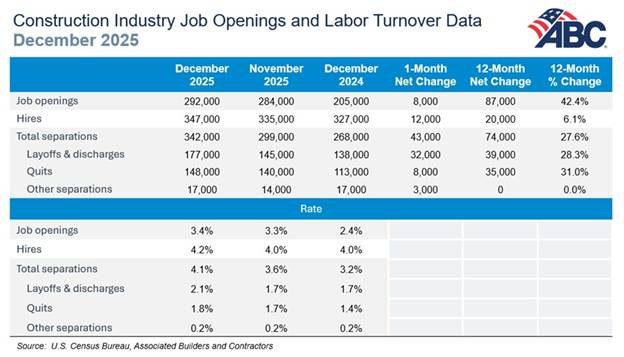
The construction industry had 292,000 job openings on the last day of December 2025, according to an Associated Builders and Contractors (ABC) analysis of data from the U.S. Bureau of Labor Statistics’ Job Openings and Labor Turnover Survey.
Industry job openings increased by 8,000 in December over November and were up by 87,000 from the same time last year.
| | Trend lines for openings and quits since 2012: | | |
Fact Pack co-publisher and economist John Restrepo
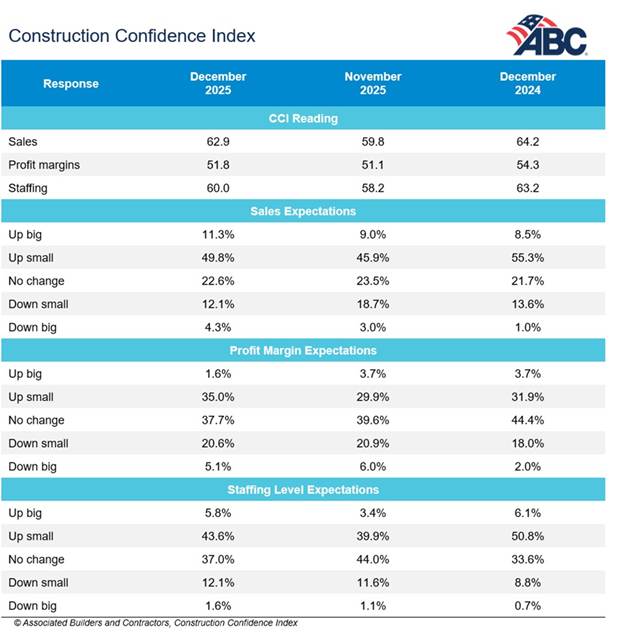
“Demand for construction workers has been generally subdued for the last eight quarters. Fewer construction workers were hired in 2024 and 2025 than in any two-year period since 2015-2016. Notably, neither fact has cut into contractor confidence. Surveyed ABC members said in late December they planned to increase their staffing levels over the next six months.”
| | |
Source: ABC
Nevada’s Immigrant Economy
Immigrants are crucial to Nevada’s economy. That’s the upshot of a FWD.us analysis of the state’s workforce showing immigrants contribute an estimated $20.2 billion to the economy annually in personal income — making up nearly 20 percent of all spending-power dollars in the state.
| | |
Source: FWD.us analysis of 2023 American Community Survey data,
with projections through 2024
The analysis reveals that immigrants in Nevada make up significant shares of workers in its top industries and service sectors:
| | |
Source: FWD.us analysis of 2023 American Community Survey data, with projections through 2024
Also substantially supported by immigrant labor:
- Leisure and hospitality (31 percent)
- Transportation and utilities (25 percent)
- Manufacturing (23 percent)
The analysis noted that 87 percent of immigrants in Nevada speak English, 80 percent have lived in the U.S. since 2015 or earlier, and about 58 percent are homeowners.
Read the rest of the report here.
Effect of Immigrants on Federal Government Budget
For those who haven’t yet seen it, a Cato analysis titled “Immigrants’ Recent Effects on Government Budgets: 1994–2023” concluded that the presence of immigrants in the U.S. has been a net fiscal benefit over the last three decades.
| | |
Source: Cato Institute As of 2023 Census Bureau data
Fiscal Highlights
- $14.5 Trillion Surplus: From 1994 to 2023, immigrants created a cumulative fiscal surplus of $14.5 trillion (in real 2024 dollars).
- Annual Contribution: In 2023, immigrants generated $878 billion in fiscal savings for the government.
- Deficit Reduction: Immigrants reduced the total U.S. budget deficit by about one-third over the three-decade period.
- Preventing Debt Crisis: Without immigrants, U.S. public debt would have reached 205 percent of GDP by 2023—nearly double the actual level.
Tax Contributions vs. Benefit Use
- Higher Tax Revenue: Immigrants generate higher-than-average tax revenue because they are 12 percentage points more likely to be employed than the U.S.-born population.
- Lower Expenditures: Immigrants consume significantly fewer benefits than their share of the population would suggest. In 2023, their share of government expenditures was 25 precent less than their share of the population; immigrants paid $1.3 trillion in taxes and received $761 billion in benefits.
Demographic Data
- Noncitizens: Even noncitizens (including undocumented immigrants) were fiscally positive, accounting for $6.3 trillion of the total $14.5 trillion in debt savings.
- Non-College Graduates: Accounted for $2.8 trillion in savings. Even immigrants with the lowest educational attainment were found to have a net positive impact on the deficit-to-GDP ratio.
The Cato report noted that one of the reasons for the net benefit is that most immigrants receive their education in their home country and arrive “ready to work” so the U.S. does not have to pay for their childhood education. Immigrants also use fewer senior and old-age benefits either because they are ineligible for programs or leave the U.S. before or when they retire.
Note: The Cato Institute described its findings as a conservative “lower bound” estimate because it counted only direct tax payments and benefit outlays and did not include indirect economic benefits such as consumer spending.
Benefit Stealing & Welfare Fraud
In another recent CATO analysis based on data from the U.S. Sentencing Commission, noncitizens were shown to be 8 percent less likely to be convicted of welfare fraud than citizens. In inflation-adjusted 2024 dollars, the average U.S. citizen was convicted of stealing $1.68 per year from government benefits programs from 2013 to 2024, while the average noncitizen was convicted of defrauding $1.16 per year — amounting to 31 percent less.
The commission identified $5.5 billion in benefits fraud losses during the one-year period ($6.5 billion in inflation-adjusted 2024 dollars). Citizens accounted for 95 percent of the losses in real money terms.
Price of Admission
From 2000 to 2025, prices for admission to sporting events more than doubled, increasing by 123 percent, according to the Bureau of Labor Statistics. Prices consumers paid to see movies, theatrical performances, and concerts also went up over this 25-year period, increasing by 105 percent.
| |
As of 2025
Prices for recreation, a larger category that includes televisions, pets, sporting goods, toys, games and hobbies, and recreational reading materials, as well as admissions, increased only 37 percent.
In comparison, the all items index of consumer prices, which includes housing, transportation, food, apparel and more, increased 87 percent from 2000.
R&D Wars
For decades, the U.S. was the global leader in research and development (R&D) spending; however, China is increasingly challenging the scientific balance of power.
- China spent $785.9 billion in research and development (R&D) in 2024, surpassing the U.S. for the first time.
- Global R&D spending reached $2.9 trillion that year, with 45 percent driven from countries in Asia. Following China in the region were:
- South Korea ($126.4 billion)
| | |
Source: Visual Capitalist As of 2024
Sovereign Wealth
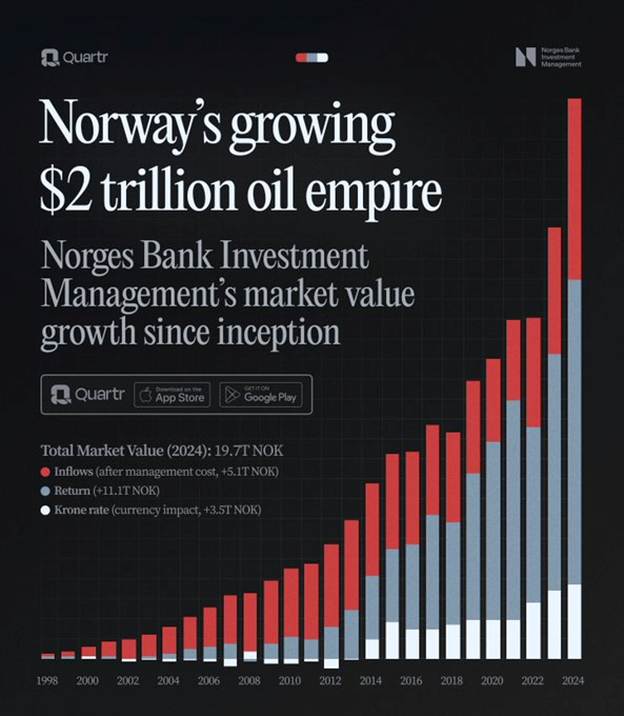
Norway, a country with a population of just over 5 million people, manages the world’s largest sovereign wealth fund — worth nearly $2 trillion. That translates to around $340,000 for every citizen.
How can this be so, you ask…? In a word: oil.
| | |
Source: @Rainmaker1973 on Twitter (X) As of 2024
Norway’s immense fund is rooted in oil revenues, but it’s more a story of its long-term strategy of investing globally in stocks, bonds, and green energy projects.
Not Your Grandfather’s Ferrari
Five years and a lot of money in the making, and the planet’s tech wonders will soon include Ferrari’s first EV — the “Luce” (meaning “light” or “illumination”). The car will be revealed later this year before shipping in October, and its product-less rollout prompted this article lead-off by journalist Mark Wilson:
I hold the key to the Ferrari in my hand. I press it, like a puzzle piece, into a notch by my right hip. Yellow fades from the key as the hue enters the shifter and the dashboard comes to life with a wave of yellow.
I’m enchanted. My foot can’t wait to slam down on the pedal. The only thing I’m missing is . . . the entire rest of the car.
Even for a legendary automaker launching its first EV, it was a preposterous pitch: Ferrari’s big car reveal would not show the car. And it wouldn’t show the car’s interior, either. Instead, journalists were asked to fly—some of them halfway across the world—to scope out a steering wheel, a few chunks of dashboard, a center console, and a seat.
I can count the designers I’d do that for, not on one hand, but on one finger. As it happens, that was the designer pointing the way.
The design history provided in the rest of the article is fascinating if you’re into that kind of thing. Teaser:
| | The Ferrari Luce seat with steering wheel console in the background Photo: Ferrari | |
|
On the Horizon
MarketWatch calendar:
| |
Data & Dialogue About the Economy
The Fact Pack is a monthly business e-report co-authored by Mike PeQueen of Hightower Las Vegas and John Restrepo of RCG Economics, which combines important metrics relevant to business decision makers and financial commentary on the current issues facing the economy.
See what's happening on our social media sites!
| |
Mike PeQueen
Hightower Las Vegas
| |  |
John Restrepo
RCG Economics
| | | | | |