e-Newsletter | March 4, 2022
|
|
Edward Hale Perry and the Battlefield Banknote
by Jim Downey with Introduction by Bethany Groff Dorau
|
|
While researching the life of Eben Bradbury, a young marine killed in World War I, I came across a portrait of Edward Hale Perry on the Gold Star wall in Newburyport City Hall. Perry predeceased Eben by several months, and I was surprised to find that he was not listed as the first Newburyporter killed on the battlefields of France. Perry was apparently not considered enough of a local to make the list, as he was only a summer resident, but his service was honored in both Newburyport and Boston. See more on this topic here: https://bethanygroffdorau.com/the-first-newburyport-boy-to-be-killed-in-france/
As I considered his service and his tragic death, I found an article published by the Numismatic Notebook website, dealing with coins and paper money. The author, Jim Downey, was kind enough to allow us to share this article. It is a fascinating reminder of how many ways there are to “meet” people from the past, whether in a hallway in City Hall, or through a letter of credit found in a soldier’s pocket.
|
|
Edward Hale Perry, the younger brother of Colonial Williamsburg architect William Graves Perry, was born in Boston on January 23, 1887, and his family purchased the grand house at 47 High Street in 1898. Perry lived in Newburyport when not at school. He was graduated from Harvard with a degree in mining engineering in 1913. He was attracted to the geological aspects of mining and spent most of his time in the western part of the country. He was working in Arizona in 1917 when the United States entered WWI. He completed the job he was on and went back east to enlist in the Army. |
|
He applied to the officer’s training school in Plattsburg, NY. He transferred to the Corps of Engineers and was made a First Lieutenant. He was posted to the 6th Engineer Regiment and was in charge of a mining, sapper and demolition platoon within Company D. He was offered the opportunity to remain stateside as an instructor but he declined and set sail for Europe on December 5, 1917 from Hoboken on the SS Huron with the rest of Company D.
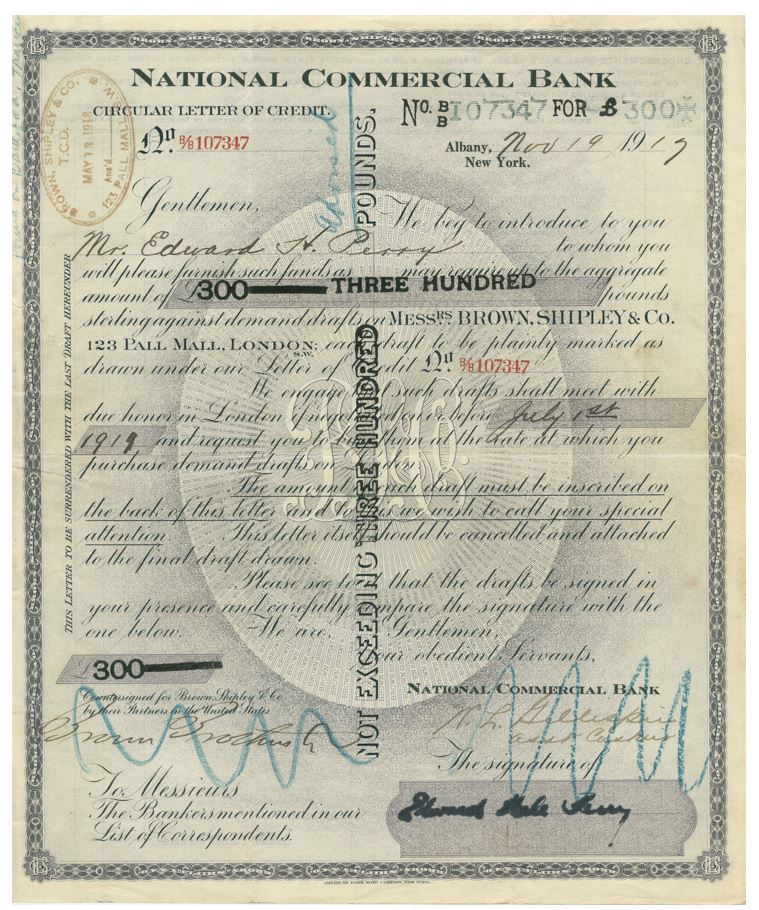
Prior to departing the United States, Lieut. Perry got his financial affairs in order and took out a letter of credit for £300. This amount was the equivalent of $1,500.00 in 1917. Letters of credit were a precursor to travelers’ cheques that allowed the holder to draw funds from an in-country financial institution which was reimbursed by the issuing bank. Amounts paid out are entered on the back.
|
|
Letter of credit belonging to Lieut. Edward Perry. |
|
In January 1918, Company B and Company D of the 6th Engineers were detached for service with the British 5th Army. The American Engineer Companies were assigned to construct steel bridges over the Somme. On March 21, 1918 the German Army launched their Spring Offensive, Operation Michael, against the British and French positions.
As the Germans advanced and the British 3rd and 5th Armies retreated, the American Engineer Companies remained at the Somme bridges to destroy them after the Allied withdrawal was complete. Having done their duty on the bridges, the American Engineers were thrown into a gap that had developed in the British lines between Hamel and Villers-Bretonneux as part of Carey’s Force, a hastily composed task force made up of whatever units could be found nearby.
The German Offensive eventually petered out but not before Lieut. Perry would perish. His last actions are described by Captain Harris Jones, his Company Commander:
It was Saturday, March 30. We underwent a good preliminary bombardment followed by the infantry attacks supported by heavy barrages. Our trenches were pretty poor, as we had to get underground at the same time that we were keeping the Fritz out of the way, and the artillery smashed a good deal of our defenses. A shell had demolished a traverse in Perry’s section of trench, killing four men. He was working in the gap repairing the damage with his own hands, when a bullet, probably from a machine gun in an enemy aeroplane which was raking the trenches, penetrated his skull. (Transactions of the American Institute of Mining and Metallurgical Engineers, Volume LXI (1920)
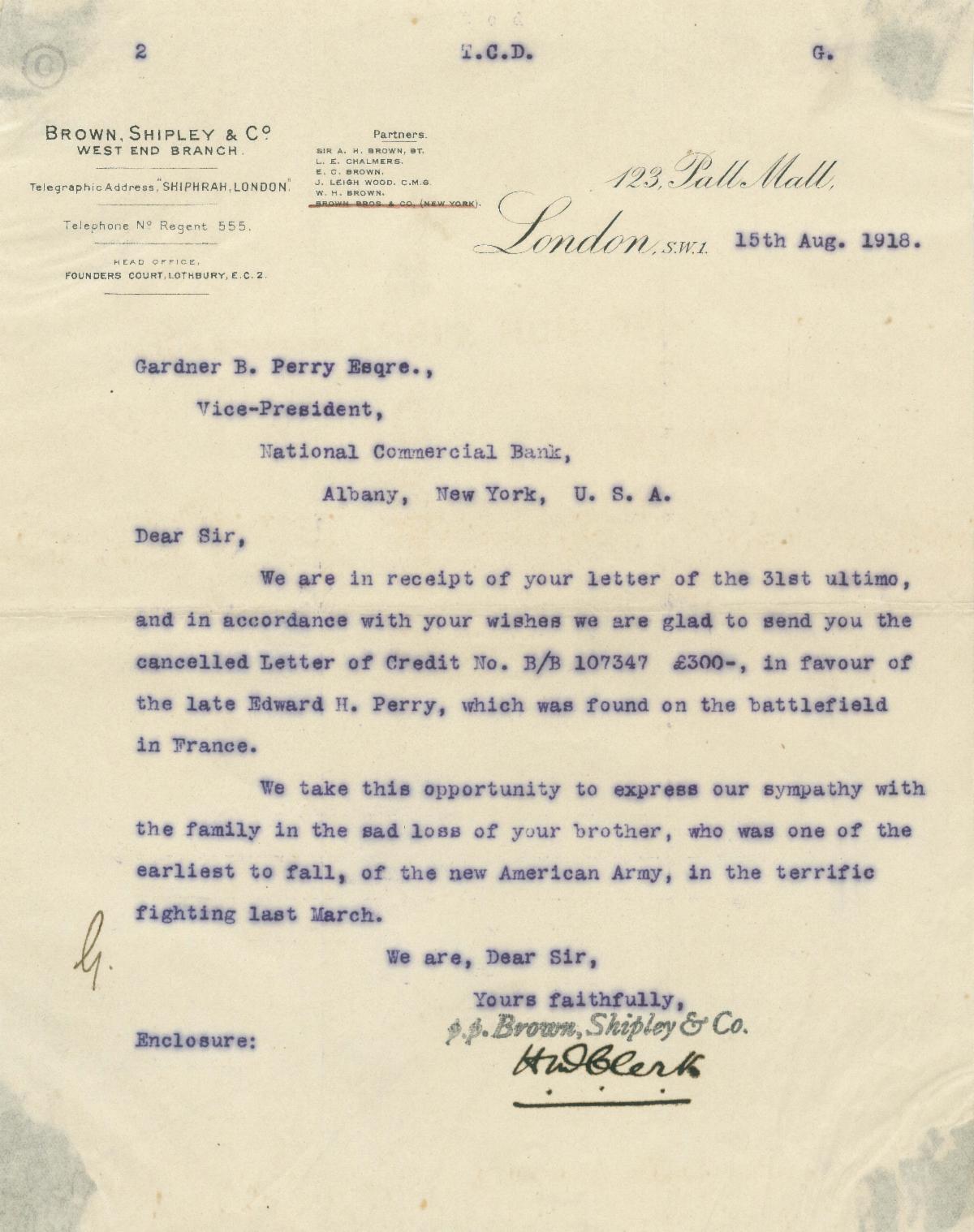
Despite the eyewitness account of Lieut. Perry’s death, his remains were never identified and the American Battlefield Monuments Commission lists him as missing in action. Curiously, the letter of credit was found somewhere in the French countryside and returned first to Brown, Shipley & Co. and then to his family.
|
|
Perry’s captain said of him, “No officer in the regiment was so trusted and looked up to by the men; they gave him their money to keep for them, asked his advice on all sorts of affairs, and besieged me with requests to transfer to his platoon.”
104 years later, we remember him.
|
|
Woman on the MOON...a blog by Bethany Groff Dorau
|
|
In Praise of Aunts (and Uncles) |
|
For me, history means context. Context is comforting. It means that whatever ridiculous thing is happening to me, chances are it has happened to many other people before me, and most of them seem to have survived, so maybe it won’t be so bad, right?
This did not work so well as I faced down the gauntlet of childbirth – twice. I knew too much. Rather than sailing into the joyous occasion with optimism, I spent too much time remembering what a frightening affair impending birth was to most women throughout history. Until quite recently, Newbury’s glowing mothers-to-be spent a good deal of time in prayer, getting their affairs in order, as the happy day approached (some still do). And it wasn’t just the labor, which is enough cause for prayer. It was the very real possibility that you, and the child you were carrying, would die in the process. Maternal death, pre-antibiotics, hovered around 2.9%. Not a huge percentage, you may say. Not so fast, sporty. Remember, you can expect to be expecting 10-12 times. Now your risk of dying is up to more than 30%. In the case of a maternal death, with eight or ten children (including, perhaps, a newborn), the most common path forward was a speedy remarriage to a woman who would then take over the rearing of the children. Families were formed and re-formed with astonishing frequency. But what if such a match could not be easily made?
Enter the aunts, and in many cases, the uncles.
In an earlier newsletter, I told you the story of my great-great-great uncle George Washington Noyes, whose kindness to Dick Johnson reverberated through our relationship. And, of course, my great-aunt Emily Noyes Poore was a pivotal person in my life. They are both part of a long chain of caregivers in my family, and so many others, who loved and care for young ones in addition to, or in the absence of parents. And of course, this was a critically important safety net in the centuries when mothers (and fathers) were much more likely to be gone.
|
|
There is a long history in my Newbury family, and many others, of one of its members, often the youngest daughter, eschewing marriage and children to act as the safety net for the rest of the family. At the Spencer-Peirce-Little Farm, it was Aunt Eliza. Eliza Adams Little was born in 1861 at the farm, the youngest of four. Her siblings were all boys, and the oldest, Henry Bailey, left home early for a successful career as a banker. Her other brothers, Daniel and Ed Francis and their wives, Amelia and Sarah, lived at the farm with Eliza, who helped to raise their children. Tragedy struck the family repeatedly. First Amelia died after a long battle with tuberculosis in 1903, leaving behind five children. Then Daniel slipped under a train in 1912 and was killed instantly. Two of their children died of tuberculosis, and their only son left home. Eliza’s sister-in-law, Sarah, was bedridden for many years. Aunt Eliza shepherded the last generation of her family, her nieces Agnes, Margaret, and Amelia, into adulthood, and the four of them lived together until the end of their lives, a tight-knit community of single women devoted to each other and to the preservation of their family farm. |
|
Eliza Adams Little, who raised her nieces and had a key role in the preservation of the Spencer-Peirce-Little Farm in Newbury. |
|
My family continues to reverberate from the death in 1892 of my great-great grandmother Charlotte Dyer Noyes. She was 28 years old, and left her husband, Joshua Dummer Noyes, and five children (they also had a son who died in infancy). Dummer, as he was known, was not able to either remarry quickly or care for all the children himself, so he kept the oldest two, Georgianna and Robert, ages 8 and 10, and sent one daughter to live with another family in Georgetown. My great-grandmother, Mary, and her younger sister Charlotte, ages 6 and 3, were passed around various family members for a few months, and then my great-grandmother was given to a family on holiday as a companion for their daughter. The family lived in Washington D.C., and according to family lore, Mary cried every day for a full year until the family sent her back. George Washington Noyes, her 20-year-old bachelor uncle, the youngest of his siblings and the least likely candidate to raise two young girls, stepped in and assumed the care of Mary and Charlotte, an act of extraordinary selflessness and kindness. |
|
George Washington Noyes, who played a key role in preserving the Noyes family after the death of his sister-in-law |
|
In a box upstairs in the Poore House there are hundreds of postcards, the text messages of their day, that flew back and forth between Uncle George and his dear Mary. When Mary, herself the mother of six children, died in 1934, Uncle George assumed a greater role in the lives of her children, taking her two youngest daughters, my great-aunts Louise and Emily, to New York City to distract them all from this terrible loss. Uncle George continued to send postcards almost daily to his great-nieces and nephews until his death in 1956. Many are from Byfield, just a thought or a joke sent to a beloved child. One can never know the alchemy that forms family systems, but Aunt Emily, born in 1919, was certainly given a powerful example of kindness and care by Uncle George. |
|
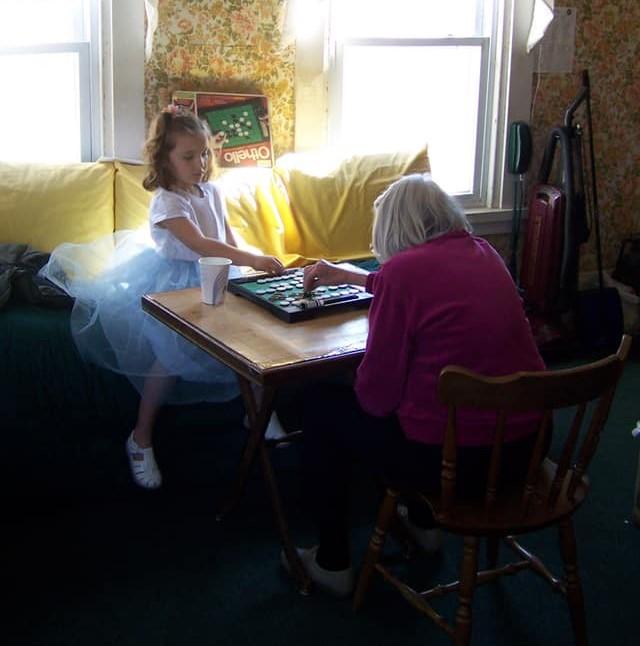
Aunt Emily, like Aunt Eliza Little, was the youngest daughter. She also never married but remained in the house where she was born, working as a bookkeeper to make repairs and pay the taxes, while caring for a long list of children who lived with her. She cared first for her nieces – my mother and her sister, and then my generation, as well as a gang of neighborhood children who dropped in for cookies and Hawaiian punch. In the last decade of her life, she cared for my children – playing endless games of Connect Four with my son and Othello with my daughter. |
|
Emily Noyes Poore plays Othello with her great-great-niece, Margaret Emily Groff, 2008 |
|
At a time when many of us are increasingly led through history by genealogy, it seems an important reminder that families and love are not always a straight line. So, here’s to the uncles and aunts, the steps and fosters, the safety-net and favorite playmate for countless children the world over. Thank you. As I write this, I am reminded that I owe my own nephews, who live far away, a bit more of my attention. Coop and Ben, you’re about to get a whole bunch of postcards. |
|
An Evening with Mary Lyon (1797-1849)
Thursday, March 10, 2022, 7:00 PM - in person at the museum. Register below.
|
|
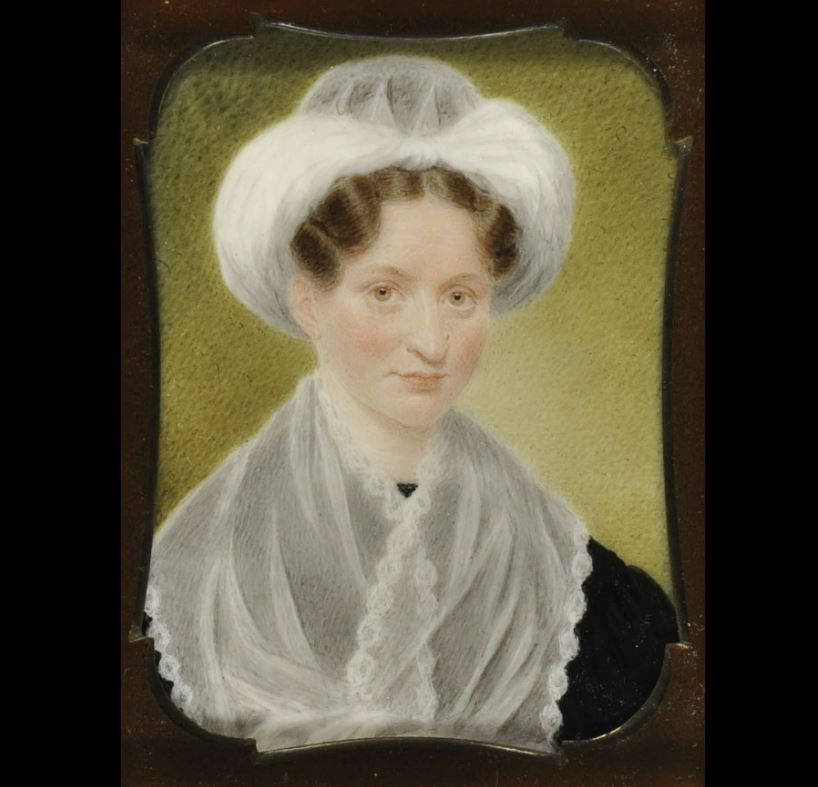
Mary Lyon, miniature painting. Courtesy image. |
|
Join us for a fun evening where Miriam Boylan will present and dramatize the life and philosophy of Mary Lyon (1797-1849), a pioneer in women's education with local ties.
Born in Buckland, Massachusetts, Lyon came to the Byfield Female Seminary in her early 20s. Here, she fell under the tutelage of Rev. Joseph Emerson and Zilpah Polly Grant whose training emphasized rigorous learning for women with a Christian commitment as Emerson advocated in his Discourse on Female Education (1822). Thereafter, carrying these ideas forward, Lyon taught variously at female academies in Buckland, Adams, and Ipswich.
In 1834 Laban Wheaton sought Lyon's help to establish Wheaton Female Seminary in Norton, Massachusetts, where she labored for three years. Lyon created the first curriculum with the goal that it be equal in quality to those of men's colleges. This would later become Wheaton College.
Then, in November,1837 Lyon opened Mount Holyoke Female Seminary with hopes to attract to its curriculum and values women of diverse backgrounds.
Our presenter, Miriam Boylan, attended Gordon College and taught for seven years at local elementary schools. She remains an active teacher at the Sunday school of the Byfield Parish Church.
This is an in-person event. Free for museum members (join here), $10 for non-members.
|
|
Women, Wenches and Witches in the 17th Century Newbury
|
|
Women were well represented as defendants, witnesses, and accusers in 17th century court cases. Settle in for a fun evening of actual women's voices from the sizzling pages of the Essex County Quarterly Court. Cursing, fornication, slander, witchcraft, even murder besmirched the reputations of Newbury's Puritan goodwives, and their experience is louder, bawdier, and livelier than most of us were taught in school.
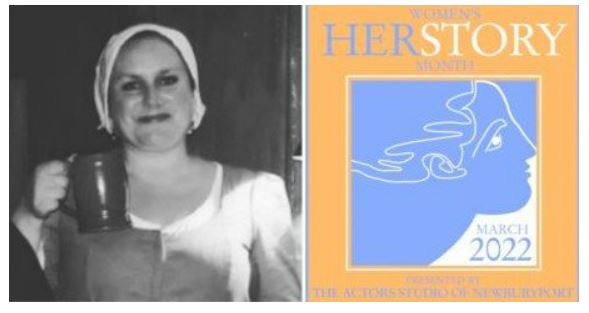
Join historian and author Bethany Groff Dorau for a theatrical rendition of a 17th century ZOOM court session. Each ticket comes with two beers courtesy of Ipswich Ale Brewery. Pick-up details to follow with Zoom link. Part of The Actors Studio of Newburyport's Womens HERstory Month. $10 for museum members, $15 for non-members.
|
|
Recipes Sought for Newbury Cookbook
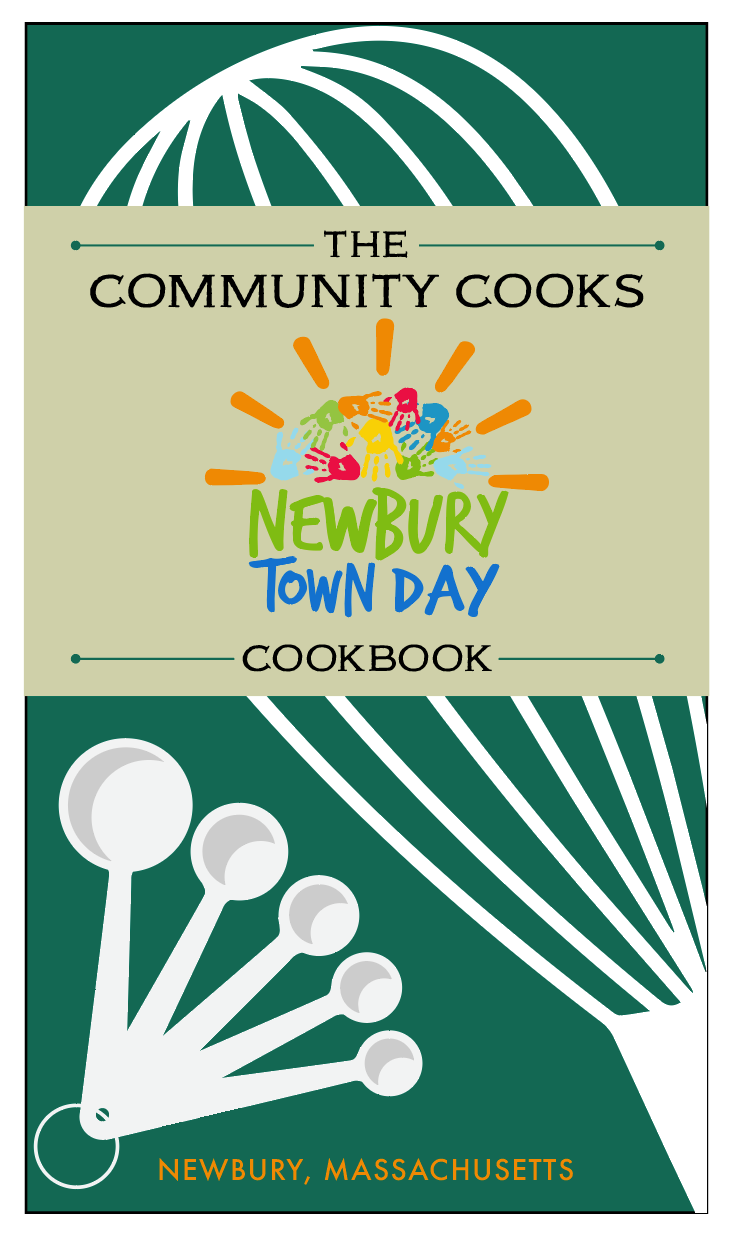
If you have a recipe with a connection to "Old Newbury" (Newbury, West Newbury, and Newburyport), please consider sharing it in the upcoming Newbury Town Day cookbook. This can be something handed down, or something new that you enjoy today. Or both! Information on how to contribute can be found here.
Seeking New Museum Docents
Are you passionate about local history? And comfortable speaking to small groups? We are looking for additional docents to give tours at the museum once the doors open in May. We'll be meeting in March and in the coming months. Please contact the office to find out more - call Kristen at 978-462-2681 or email kristen@newburyhistory.org. |
|
Something is Always Cooking at the Museum |
|
Irish Brown Bread
Completely different than the raisin studded Irish soda bread found in the U.S., this wholemeal bread is still served all over Ireland today. Specialty millers make a coarse whole wheat flour especially for this bread. In the U.S., the following recipe works with easily available ingredients. This recipe comes from Mary Murphy of Schull, West Cork.
1 3/4 c. whole wheat flour
1 c. white flour
3/4 c. oats
1/2 c. wheat germ
1/4 c. dark brown sugar
1 t. salt
2 t. baking soda
1/4 t. baking powder
1 T. olive oil
1 egg
1/4 c. yogurt
approx. 1 1/2c. milk
Mix dry ingredients. Add oil, egg, yogurt and enough milk to wet all ingredients. Scoop into a parchment lined bread pan for 60-70 minutes at 350 degrees F.
|
|
Click on image above to play the puzzle |
|
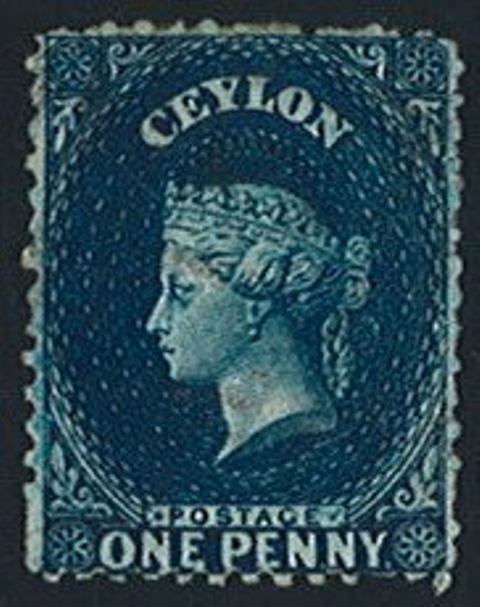
"Penny Blue" Ceylon Postage Stamp
Perkins Bacon & Co., England
1860-1869
Gift of Rick Bagg, Museum of Old Newbury collections
Jacob Perkins arrived in England in 1819 with the hope of winning the contract for issuing British currency. He was not successful. However, he and his partner Gideon Fairman did print books, bank notes, and postage stamps. Their first stamp was the Penny Black in 1840. Over two and a half decades, Perkins had several business partners. Perkins Bacon & Co. was established with his son-in-law, Joshua Butters Bacon, in 1829.
|
|
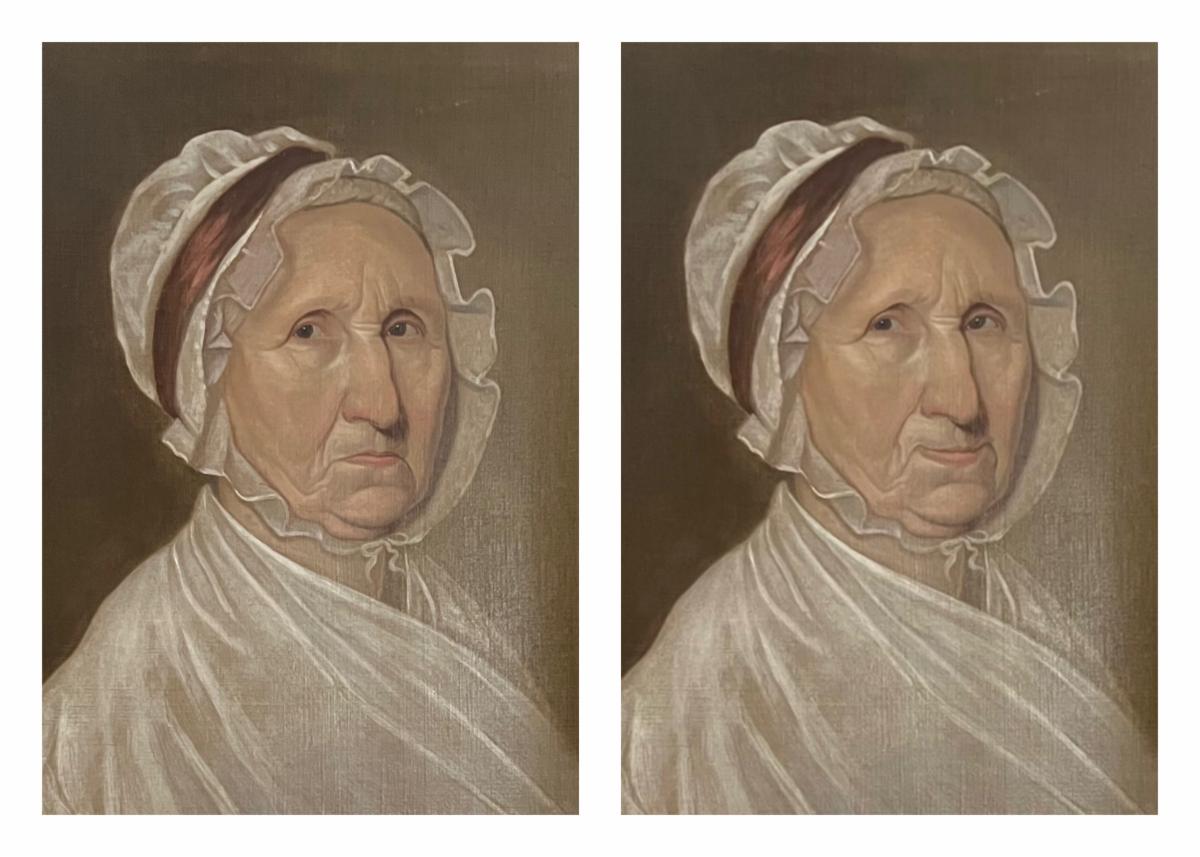
Let's give Mrs. Somerby a reason to smile! Be on the lookout for our Annual Fund reminder postcard. We have until March 31 to raise $50,000. We hope you will consider a donation to the museum.
Thank you for your continued support.
|
|
Museum e-Newsletter made possible through the
generosity of our sponsors:
|
|
|
Museum of Old Newbury
98 High Street
Newburyport, MA 01950
978-462-2681
|
|
|
|
|
|
|
|