Weekly update from the National Housing Conference | | News from Washington | By Brittany Webb | | |
NHC, housing groups express serious concerns with HUD’s Disparate Impact Rule
The U.S. Department of Housing and Urban Development (HUD) issued a proposed rule that would completely eliminate HUD’s disparate impact rules under the Fair Housing Act. First established in 2013, the existing interpretation of disparate impact acknowledges that programs or policies with disparate outcomes for protected classes may be considered discriminatory, even if those policies do not explicitly seek to exclude a protected group. In its 2015 decision in Texas Department of Housing and Community Affairs v. Inclusive Communities Project, the Supreme Court found that disparate impact claims were cognizable under the Fair Housing Act.
NHC and several other organizations submitted a letter opposing HUD’s proposed rule ahead of the comment period ending on Friday, February 13. In the letter, the organizations argue that HUD’s disparate impact regulations not only provide important fair housing protections for individuals but create a clear, uniform framework for industry and other organizations. “Through its definition of discriminatory effects, legal justifications, burden-shifting framework, and disparate impact claims filing process, the rule also provides uniform, clear regulatory guidance that helps mitigate litigation risks and the potential for conflicting court cases,” the letter argued. “This is especially true for entities that operate across multiple jurisdictions.”
| | | |
Don't miss THE housing communications event of the year
On April 8, 2026, the National Housing Conference will convene housing communications leaders from across the country for Solutions for Housing Communications at the National Press Club in Washington, D.C.
Technology—and increasingly artificial intelligence—is playing a powerful role in shaping how housing stories are told and understood. During the panel “Technology and the Future of Housing Narratives,” experts examine how algorithms, generative AI tools, and social platforms can amplify, distort, or sideline narratives about housing affordability and policy. Panelists will discuss how communicators can:
- Adapt their messaging for AI-influenced media environments.
- Anticipate emerging narrative risks.
- Use AI strategically while maintaining authenticity and public trust.
Additional panels will spotlight strategies for clearly communicating complex and technical housing issues and building strong, effective relationships with housing reporters. Sessions will also explore the power of intergenerational storytelling, best practices for communicating before, during, and after natural disasters, and practical tools to help participants engage confidently across today’s evolving media landscape.
Whether you’re shaping narratives, influencing policy, or engaging the media, this convening offers practical insights and valuable connections to strengthen housing advocacy through effective communications.
Members of the media receive complimentary registration.
Please contact kbeigay@nhc.org for more information.
| | |
Congressional hearings spotlight housing affordability, secondary mortgage market
The Housing Financial Services Committee (HFSC) held two hearings last week examining the nation’s deepening housing crisis. At a full Committee hearing, “Priced Out of the American Dream: Understanding the Policies Behind Rising Costs of Housing and Borrowing,” lawmakers examined the barriers to affordable homeownership. The witnesses included Brian Brooks, Chairman and Chief Executive Officer, Meridian Capital Group; Kevin O'Leary, Chairman, O'Leary Ventures; Stephen Moore, Co-Founder, Unleash Prosperity; and Dr. Darrick Hamilton, University Professor, the New School, and Chief Economist, AFL-CIO.
Chairman French Hill (R-Ark.) and Ranking Member Maxine Waters (D-Calif.) celebrated the overwhelming House passage of the Housing for the 21st Century Act, signaling bipartisan momentum on housing supply-focused reforms. Witnesses emphasized that regulatory compliance and permitting processes can account for 30-45% of construction costs in some high-cost markets. Members also debated the impact of institutional investors purchasing single-family homes, with some expressing concern about reduced homeownership opportunities and others defending build-to-rent models as expanding rental options.
The hearing surfaced tensions over federal housing programs, as Ranking Member Waters and Representative Joyce Beatty (D-Ohio) challenged delays in CDFI Fund distributions and warned against proposals to dismantle programs supporting small business lending and community development. Meanwhile, Republican members advocated for policies to promote capital formation, strengthen capital markets, and revitalize local banking.
The Housing and Insurance Subcommittee also held a hearing titled “Homeownership and the Role of the Secondary Mortgage Market,” examining the path forward for Fannie Mae and Freddie Mac (the Enterprises), and touching on the roles of Ginnie Mae and the private sector. The witnesses included Michael Bright, Chief Executive Officer, Structured Finance Association; Robert D. Broeksmit, President and Chief Executive Officer, Mortgage Bankers Association; Dr. Norbert J. Michel, Vice President and Director, Center for Monetary and Financial Alternatives, Cato Institute; and Dr. Sharon Cornelissen, Director of Housing, Consumer Federation of America.
HFSC Chairman Hill challenged assumptions about a near-term public share offering, noting that Fannie Mae and Freddie Mac face a capital shortfall approaching $190 billion. Chairman Hill noted this gap dwarfs even the largest initial public offerings in history and insisted that Congressional action must precede any fundamental restructuring. Witnesses underscored the importance and complexity of the secondary mortgage market. Dr. Cornelissen testified that the Federal Housing Finance Agency’s (FHFA) recent policy reversals, including the termination of equitable housing finance plans and the weakening of affordable housing goals, will harm approximately 177,000 working families while abandoning the Enterprises’ Congressional mandate to serve underserved markets.
When members pressed witnesses on affordability solutions, responses centered on product innovation including expanding access to small-dollar mortgages, reforming manufactured housing financing, and allowing prospective rental income from accessory dwelling units to qualify borrowers. Representative Scott Fitzgerald (R-Wis.) previewed forthcoming legislation that would formalize the end of conservatorship of Fannie and Freddie while imposing a utility-style regulatory model intended to prevent the Enterprises from straying beyond their core mission. The hearing underscored the stakes of preserving stability in the housing finance system and the importance of any reform effort ensuring continued availability and affordability.
| | | |
Housing for the 21st Century Act passes House
The House of Representatives passed the Housing for the 21st Century Act by a significant bipartisan majority, with a vote of 390-9. The bill includes a range of provisions that seek to address the housing supply and affordability crisis.
NHC endorsed the bill and applauded its passage: “By modernizing outdated housing programs, reducing unnecessary barriers to development, and increasing flexibility for local communities, the Housing for the 21st Century Act helps create the conditions needed to build and preserve more affordable homes across America. The bill also appropriately emphasizes transparency, consumer protections, and accountability.”
Over 70 other organizations also endorsed the bill and issued statements of support. Habitat for Humanity International said, "This is the most meaningful housing package that has come out of the House in more than a decade, and we are encouraged by this step as well as the ongoing efforts in the Senate to prioritize housing. At its core, the housing crisis is a supply problem, and this legislation will make it easier to build more, including starter homes, which are critically needed in the market."
In a Statement of Administration Policy, the White House expressed qualified support for the Housing for the 21st Century Act ahead of its floor vote: “Though the Administration is pleased that several of the President’s reforms are included in this package, H.R. 6644 still lacks other presidential priorities, particularly a ban on the purchase of single-family homes by large institutional investors. This is a key priority that will do much to drive down the cost of single-family homes. The Administration seeks to continue working with Congress on a final bill and looks forward to future discussions regarding the President’s priorities on housing affordability.” The proposed institutional investor ban has not yet been fully developed, and is controversial in Congress, though there is some bipartisan support for the concept, including from Senate Banking Committee Ranking Member Elizabeth Warren (D-Mass.).
The House, Senate, and White House have all signaled interest in reaching an agreement on a final package. The Senate is expected to take up its own housing package, the ROAD to Housing Act, as a standalone bill in the coming weeks. The bill previously passed the Senate as an amendment to its version of the National Defense Authorization Act in October, with the Administration’s support at that time. House Financial Services Committee Chairman French Hill (R-Ark.) has said he would like to reach an agreement with the Senate this spring and see a final bill signed into law before the summer. NHC will continue to monitor developments as negotiations move forward.
| | | |
New episode released
On December 3, the National Housing Conference hosted its Solutions for Affordable Housing convening at the National Press Club. The event brought together policymakers and affordable housing stakeholders to discuss tangible, impactful, and achievable actions to address the nation’s most critical housing policy challenges.
In this week's episode, we revisit the panel, “Ending Homelessness: Successful Strategies for Sustainable Results,” featuring a discussion on the evolving dialogue on homelessness. Panelists shared insights on what’s working, where gaps remain, and how stronger alignment across systems can lead to more effective, sustainable support for individuals and families facing homelessness. Listen here.
| | |
FHFA finalizes repeal of equity plans
The Federal Housing Finance Agency (FHFA) issued its final rule repealing its previous Fair Lending, Fair Housing, and Equitable Housing Finance Plans regulation, which required Fannie Mae and Freddie Mac (the Enterprises) to maintain and implement Equitable Housing Finance Plans (EHFP). The rule is effective March 9. FHFA first directed the Enterprises to submit three-year EHFPs in September 2021, and the first plans were published in June 2022. Organizations and experts, including the Urban Institute, advocated for EHFPs and additional improvements as impactful tools for promoting accessible, affordable, and sustainable housing opportunities in an equitable way.
The final rule notes that the repeal does not change the statutory requirements of the Enterprises to comply with “applicable fair lending and fair housing laws, such as the Fair Housing Act, Equal Credit Opportunity Act (“ECOA”), the fair housing provisions of the Federal Housing Enterprises Financial Safety and Soundness Act of 1992, as amended (Safety and Soundness Act), and the prohibitions on Unfair or Deceptive Acts or Practices (“UDAP”) under the Federal Trade Commission (“FTC”) Act.”
The language of the final rule emphasizes and centers arguments around the fact that part 1293, which established the EHFPs, is inconsistent with the current Administration’s priorities.
“Almost all comments that were opposed to repeal addressed the desirability of part 1293, but did not address the FHFA’s reasons for repeal, including that part 1293 is not necessary and that it is inconsistent with the Administration’s priorities,” it reads. “FHFA appreciates the thoughtful input provided by commenters who opposed the proposed repeal of part 1293, particularly those who emphasized the societal benefits attributed to the EHFPs. The Agency remains committed to promoting fair access to credit and the housing finance system but maintains that repeal of part 1293 aligns with Administration policies to restore regulatory clarity, reinforce statutory alignment, and strengthen the effectiveness of its supervisory framework.”
| | | |
Democrats file brief to defend CFPB
Nearly 200 Members of Congress filed an amicus brief challenging the Trump Administration’s ongoing efforts to shutter the Consumer Financial Protection Bureau (CFPB). Led by Senate Democratic Leader Chuck Schumer (D-N.Y.), Senate Banking Committee Ranking Member Elizabeth Warren (D-Mass.), and House Financial Services Committee Ranking Member Congresswoman Maxine Waters (D-Calif.), the brief was filed ahead of a hearing before the full U.S. Court of Appeals for the D.C. Circuit scheduled later this month. Democratic staff on the Senate Banking Committee also published a report that found the total cost of dismantling the CFPB to be $19 billion over the past year. This number does not include the savings that the CFPB could have secured for Americans were it operational. Earlier this month, a report tracking the actions and status of the CFPB from the Government Accountability Office (GAO) was also made public, illustrating the timelines of CFPB changes.
“Wherever the line may be between the sorts of routine changes in policies and priorities that occur from one administration to another and the evisceration of an agency’s ability to fulfill its statutory mandates, Appellants have crossed it: “firing all probationary and term limited employees without cause, cutting off funding, terminating contracts, closing all of the offices, and implementing a reduction in force . . . that would cover everyone else,” the brief states.
| | | |
NHC seeks strategic leader for Membership Director role
As the affordable housing landscape continues to shift, the power of strong networks and strategic collaboration has never been clearer. NHC is pleased to announce an opening for a Membership Director, a senior leadership role dedicated to expanding and strengthening our dynamic community of more than 300 corporations, organizations, and individuals across the affordable housing sector.
This position goes beyond traditional membership management. It offers the opportunity to shape how a national organization engages, convenes, and supports leaders working to advance affordable housing nationwide. The Membership Director will balance strategic growth with relationship-building—ensuring members are engaged, valued, and deeply connected to NHC’s mission and impact.
Reporting to the Chief Operating Officer and serving on the senior management team, the Membership Director will spearhead member recruitment, drive retention efforts, and continually refine and elevate NHC’s membership value proposition. We’re seeking a strategic, collaborative leader with at least five years of relevant experience in membership organizations, strong customer service, communication and marketing skills, and a solid understanding of affordable housing policy and finance—someone ready to expand our network, cultivate meaningful partnerships, and help lead in a rapidly evolving environment. To apply for this position, please submit a cover letter and salary requirements, writing sample, and resume to info@nhc.org.
| | |
Equity extraction in AANHPI groups more likely over two decades
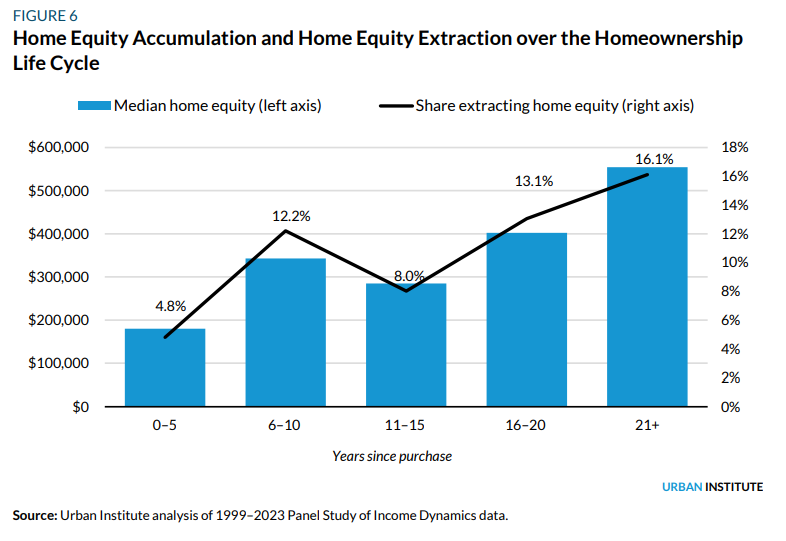
Homeownership strongly shapes the wealth paths of Asian American, Native Hawaiian, and Pacific Islander (AANHPI) households according to a new partnered report from the Asian Real Estate Association of America and Urban Institute. The report, entitled AANHPI Homeownership and Wealth Building Trajectories, highlights how long-term, stable homeownership allows AANHPI households to build substantial equity and then draw on that equity later in the homeownership life cycle, supporting education, small business formation, retirement security, and intergenerational wealth—while also underscoring the importance of policies that help households both get into homeownership and remain securely housed over the long term. The data shows the median home equity rising from roughly $180,000 in the first 0-5 years of ownership to about $350,000 after 6-10 years, dipping slightly to around $270,000 in years 11-15, and then climbing to about $400,000 in years 16-20 and nearly $550,000 after 21 or more years. Over the same period, the share of AANHPI owners extracting home equity grows from 4.8% in the first five years to 12.2% in years 6-10, eases to 8% for those who have owned their homes for 11-15 years, then rises to over 16% at 21 or more years, indicating that tapping equity becomes more common as owners age and equity levels increase.
| | |
A blog post from the Urban Institute examines whether regulating large single-family institutional investors would meaningfully improve affordability, noting that these firms own a very small share of the national housing stock but can exert outsized influence in select markets. The piece emphasizes that structural drivers of high housing costs, including constrained supply, zoning barriers, and inadequate production of lower-cost homes, are far more consequential than institutional investor activity alone. It highlights policy options that prioritize expanding supply, supporting first-time homebuyers, and tailoring interventions to local market dynamics rather than relying on blunt restrictions on investor participation.
At a press conference with members of the Congressional Black Caucus and civil rights leaders, House Democratic Leader Hakeem Jeffries (D-N.Y.) highlighted how Trump-era policies have worsened economic conditions for Black Americans, pointing in particular to higher Black unemployment and declining Black homeownership. Jeffries framed President Trump’s housing record as part of a broader affordability and opportunity crisis, arguing that Black families face greater barriers to stable housing, wealth-building, and community investment under the Administration's agenda. He linked these housing impacts to a wider rollback of civil rights, voting rights, and health care protections, warning that Black communities are at risk of losing hard-won gains across multiple fronts.
Bloomberg reports that Trump administration officials are weighing an antitrust investigation into major U.S. homebuilders as part of a broader focus on the nation’s housing affordability crisis. According to the reporting, the Department of Justice is considering whether information-sharing among members of the Leading Builders of America could be facilitating restricted supply or coordinated pricing, though no final decision to proceed has been made. The potential probe underscores growing federal scrutiny of market concentration and pricing power in the homebuilding sector amid persistently high housing costs for consumers.
| | The National Housing Conference is a diverse continuum of affordable housing stakeholders that convene and collaborate through dialogue, advocacy, research, and education, to develop equitable solutions that serve our common interest. | | Defending Our American Home since 1931 | | Copyright © 2024. All Rights Reserved. | | | | |