|
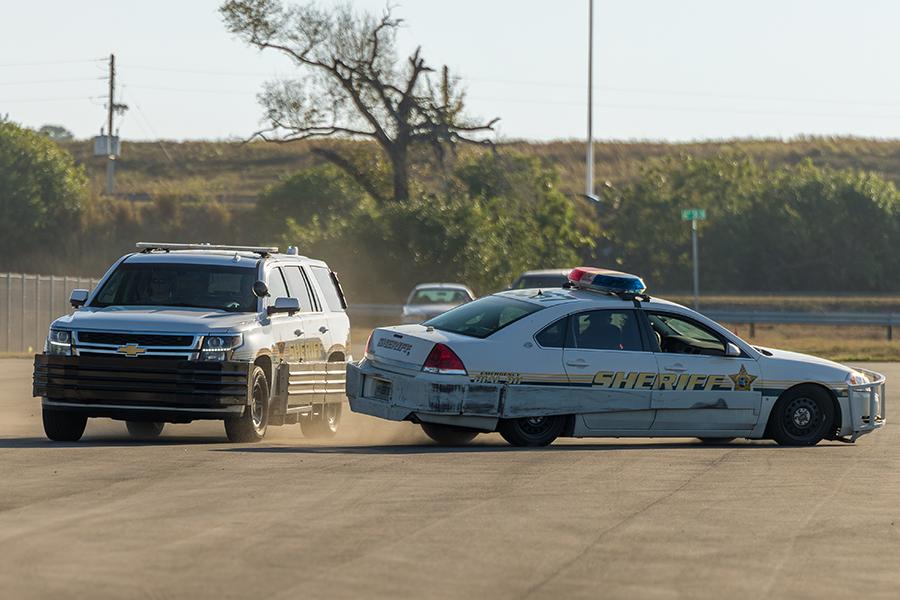
Imagine that we’re in an Impala, fleeing after committing a forcible felony with a firearm. The public is in danger from our reckless crime spree and our dangerous driving. Suddenly there’s a Pinellas County Sheriff’s Office (PCSO) Tahoe behind us. We see that star, and we know we’re in trouble! It catches up quickly, then moves up alongside our rear quarter panel, perfectly matching our speed. We brace ourselves, expecting to be rammed, but no – when it makes contact the push is almost gentle. Suddenly, with a squeal of tires, we’re spinning out of control. Dizzy and disoriented, we skid to a stop, stalled, and know that our life of crime is over.
We’re in the rabbit car, driven by the Training Division’s Corporal Casey Hunter as deputies practice their moves at PCSO’s brand-new FDLE-certified driving facility that helps them learn the enhanced skills they need to stay safe on the road. It is a countywide resource that will be used by the Allstate Center’s law enforcement academy as well as other local law enforcement agencies. As he simulates a fleeing bad guy, Corporal Hunter (and his Public Relations sidekick for the day) get spun around dozens of times to make sure the deputies get enough practice with these technical maneuvers.
Deputies spend most of their 12-hour shift in their vehicle, and driving is one of the most dangerous things they can do. Driving related incidents – including crashes, being accidentally struck while outside the vehicle, or being deliberately hit by a criminal – account for a large percentage of law enforcement officer deaths. While most citizens can (or should) focus on driving and only driving whenever they’re behind the wheel, deputies don’t have that luxury. When they’re driving to a domestic battery or vehicle burglary call they have to listen to the dispatcher, talk on the radio, read call notes on their in-car laptop, and navigate, all while balancing speed with safety.
And that’s just for regular driving. When the situation gets more critical, such as when someone has just robbed a bank at gunpoint, or they’re high and driving so dangerously that they must be stopped immediately, deputies have to use more advanced techniques to stop them. On one recent training day at the new driving facility, deputies practiced two such techniques: boxing in, and the Precision Immobilization Technique, or PIT.
In a PIT, the deputy matches the speed of the suspect vehicle and smoothly puts the side of their bumper against the rear quarter panel, behind the back tire. They then turn into the suspect vehicle, driving on as the target spins. “It should be a nice, smooth transfer of energy,” Corporal Hunter said. “See how he’s coming up on my side?” he pointed out during a practice attempt. “He’s too high up. If he goes too high and tries to PIT us he’s going to T-bone us.” That attempt was aborted, and on the next pass the deputy did it perfectly. Done right, the target car arcs smoothly in front of the deputy’s Tahoe, spinning 180 degrees or more, and the deputy’s vehicle will continue on forward without getting hit. Not all vehicles will stall, but for a time the driver is stopped and disoriented, giving deputies time to make their next move.
Experienced deputies use the new driving facility to keep their skills sharp, and new recruits get to try serious driving for the first time. “The most challenging thing for deputies learning to PIT is that it’s not natural – we’ve been taught our whole lives to not hit things,” Corporal Hunter said. “Now we’re telling them it’s okay to smash this car.” The Training Division has a small fleet of semi-retired cruisers outfitted with protective plating.
PCSO has a lot of regulations governing when a deputy can PIT. They can only PIT at certain speeds, and some high profile vehicles are off limits. Another option is to do a preemptive PIT. “We do more preemptive pits, rather than a pursuit leading into a PIT,” Corporal Jim Lancia said. “Our goal is to end it sooner to avoid a pursuit and reduce the risk to the public.” A preemptive PIT can only be done for certain crimes. Sometimes the driver must be positively identified first, but not if the vehicle is being driven in an extremely dangerous way and needs to be stopped immediately because of the risk to the public. The deputy must determine if the technique may be safely used and does not pose a reasonably foreseeable risk of harm to other motorists, pedestrians, the deputy, or the vehicle’s occupants.
A controlled PIT in the setting of the deputy’s choosing is safer to the public than a pursuit. Before they can PIT, the deputy has to account for a lot of variables, including the presence of other vehicles, people, buildings, and hazards like barricades or water. “The big thing is taking in all the information at once,” Corporal Hunter said. Once he called out on the radio that he had found a stolen vehicle, and his supervisor authorized a PIT. But the supervisor couldn’t see the traffic conditions – rush hour on a busy road. Corporal Hunter had to make the decision himself whether it was safe to PIT, and he ultimately decided the risk wasn’t worth the reward. “That’s something we have to convey to the newer generation,” he said. “Just because a supervisor says they can PIT, that’s not carte blanche to do it.” Deputies need to use all their training, experience, and common sense to evaluate each situation and make the best decisions. The more they practice at the new driving facility, the better their decisions will be.
Before the construction of the new driving facility, deputies trained at empty county lots, the Allstate Center, Showtime Speedway, and even in the space behind Derby Lane. They made it work, but it wasn’t ideal. Now, with this 14-acre state-of-the-art facility they can make sure each deputy gets the best driving training possible, with a classroom, ample storage and parking for the training vehicles, plenty of room to maneuver and a realistic design that mimics the roads and highways deputies will navigate in real life.
“It’s really nice,” Corporal Hunter said. “We have street signs so the recruits can call out the location of actual streets. And we have stop signs and a traffic light. The violator can blow the red light, but as the deputy, you have to clear the intersection, then get back up on it to catch the suspect.”
The facility’s design is a constant reinforcement that their top priority is public safety, and the realistic roads remind them that they’re driving around someone’s neighborhood, near cars with people’s families in them. Every decision they make on the road has to be not just with the thought of catching the bad guy, but keeping everyone else safe. That might mean calling off a pursuit, but with the technology, investigative techniques, and air support at PCSO’s disposal, the suspect might drive away that day, but will be captured tomorrow.
|