|
Welcome
The JITI Journal is a bimonthly publication of the Japan International Transport Institute, USA (JITI), in which JITI shares information on transportation developments in Japan and elsewhere, as well as recent JITI programs. As a supplement to our regular events, we hope that the Journal likewise serves as a resource for the transportation community.
We hope this issue finds you well.
In this issue we introduce JITI's new president, Mr. Tomomi Tsuchiya. In addition, JITI staff member Sarah Fraser expands on our 2018 Airport Workshop by writing a feature on a
irport concession policy in Japan and its implementation. Finally, staff member Daisuke Miyamoto writes an article introducing AWAODORI, a summer dance festival that entices all to join in.
|
|
Introducing JITI's New President
|
 Tomomi Tsuchiya
President of JITI USA
We have the pleasure to introduce JITI's new president, Mr. Tomomi Tsuchiya.
Prior to the assumption of his current position, Mr. Tsuchiya has held many important positions with the Government of Japan since entering the Ministry of Land, Infrastructure, Transport and Tourism (MLIT) in 1982. He has also held important roles with public bodies in the field of transportation.
As Deputy President of the Japan Railway Construction, Transport and Technology Agency, he led many transportation projects ranging from arranging a 30 billion dollar loan for the Maglev Project, leading the effort in the IPO of Kyushu Railways, and developing state-of-the-art coastal vessels.
As the Director-General of the Kansai Regional Transport Bureau of MLIT, he devoted himself to securing public transportation for the disadvantaged and promoting tourism in the Kansai region.
He also served as Deputy Director- General of the Traffic Safety Bureau of the National Police
Agency and as General Manager/ Strategic Planning Director of the Central Japan International Airport.
This is the second time Mr. Tsuchiya is holding a position in Washington D.C., as he previously held a position as Counselor at the Embassy of Japan from 1998 to 2001. He earned his bachelor's degree from the University of Tokyo in 1982 and his master's degree in Public Policy from the Kennedy School of Government at Harvard University in 1989.
Mr. Tsuchiya is looking forward to meeting you all at JITI USA's future seminars and workshops.
|
|
JITI Events
UPCOMING:
We currently have no upcoming events planned. To stay informed of upcoming events, please check our website.
PAST:
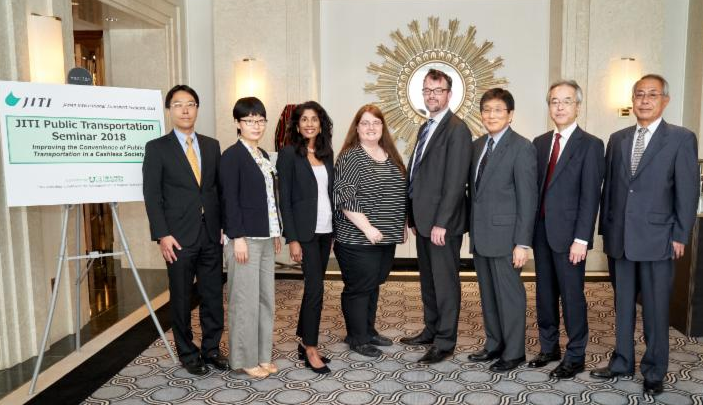
JITI Public Transportation Seminar 2018:Improving the Convenience of Public Transportation in a Cashless Society
With recent advancements in ICT technology we have seen a rapid spread of cashless payments, in which our day-to-day transactions are accomplished through the use of credit cards, smartphones, and contactless payment cards called 'transportation IC cards'.
The growth of cashless societies has been rapid, especially in China. With the popularity of third-party smartphone payment applications operated by internet giants, mobile payment systems have spread widely in the day-to-day transactions of consumers. Based on the system's dominating presence in consumer markets, they are expanding their use to include public transportation, which is regarded as a key sector in enhancing user convenience.
In Japan, the first transportation IC card was introduced in 2001 and, since then, over 130 million contactless payment cards have been issued. The popularity of these transportation IC cards may be attributed to their multi-purpose use. They can be used not only for transit payments, such as railroad and bus travel, but also as electronic payments for shopping at many stores. In addition, these cards can be mutually utilized with multiple Japanese transit companies. Therefore, the use of transportation IC cards is expanding in many parts of Japan.
The United States has also been active in introducing contactless payment systems. The Chicago Transit Authority (CTA) introduced a contactless payment card called 'Ventra Card' in 2013, which promotes mobile payments on subways and buses. Also, the American Public Transportation Association (APTA) signed a collaboration agreement with the NFC Forum to jointly educate the industry on NFC (Near Field Communication) technologies, supporting the needs of public transportation operators. These are just two examples of the many uses of contactless payment cards in the transit industry in the States.
In this rapidly advancing cashless society, JITI USA invited experts on the subject from Japan, the U.S., and China, to discuss the progress so far, especially milestones accomplished, as well as the future path for improving the convenience of public transportation in a cashless society.
|
|
Airport Concession Policy in Japan
|
|
b
y Sarah Fraser
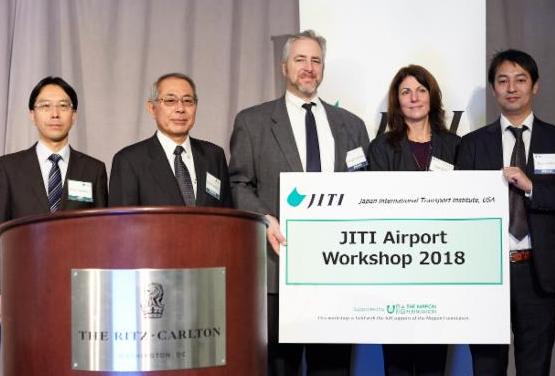
Earlier this year, in February, JITI USA held a workshop regarding airport redevelopment using public-private partnerships or P3s. I would like to take a moment to check in with this issue and see what developments or changes have been happening since this time. As you may remember from our workshop, we had speakers from a variety of organizations such as the Eno Center for Transportation, as well as a speaker from the LaGuardia Airport and MLIT Japan. In the seminar we discussed recent cases of airport redevelopment using P3 in the United States, such as the LaGuardia Airport Terminal B project, as well as the efforts in Japan, such as the Sendai Airport and the Fukuoka Airport. In addition, we discussed many of the challenges and benefits there are in utilizing P3s in airport redevelopments.
JITI staff, former president, and the speakers of our 2018 Airport Workshop
From left: Hiroki Sakamoto (JITI), Makoto Washizu (JITI), Robert Puentes (ENO), Lysa Scully (LaGuardia), Azuma Kato (MLIT)
I would like to take a moment to review the Japanese approach to airport concession, as explained by Mr. Kato during our seminar. Regional economies and airports in Japan are and were facing a tough time which created the idea to call for airports to serve as points of regional revitalization. In this way, areas could attract tourists and there would be more flexibility to fly in and out of Japan's regional airports as opposed to hub airports. Concessions would also give the addition benefit of improve efficiency for airport governance. When the airports were governed by MLIT for aeronautical activities and private companies were in charge of non-aeronautical activities there was a disconnect between the management strategies. The idea behind using a concession system was the ability to unify this strategy and attract airlines to various airports. In addition, by using a concession strategy, there would more incentive for efficient airport management and operations across the board, as well as more incentive to promote individual airports for tourism or in connection with local business and other entities. With concessions in place, there are a variety of important benefits, such as improved accessibility to destinations, a stimulus for Japan's overall airline industry, and local revitalization, one of the main focal points. For more information, you can find Mr. Kato's presentation here (link to presentation
) via the JITI website.

Attracting airlines is one benefit of implementing concessions systems.
Recently, MLIT has announced that starting in 2020 they will outsource the operation of four national airports, as well as two specific municipal airports and one municipal airport, to the private sector. In accordance with this, MLIT has developed an application guidelines document, which contains conditions and procedures, the selection methods for P3s, and schedules/deadlines for applications and selections. According to the schedule, the terminal building operations will begin in January of 2020 with runway operations continuing at later dates from June of the same year to March of 2021. Using the private-sector know-how and P3s, MLIT hopes to promote tourism and improve the regional activation of the seven airports in Hokkaido. It will be interesting to see the process and the fruits of this extensive P3 project in Hokkaido.
|
|
AWAODORI: A Japanese Traditional Dance Festival Held in Tokushima
|
|
by Daisuke Miyamoto
There are many different kinds of festivals in the world, and we can learn the unique characteristics of each country from their festivals. Japan has many kinds of festivals in every region. GION-festival, TENJIN-festival and KANDA-festival are the most famous in Japan, and these three are recognized as Japan's major ones. Many tourists from foreign countries visit so that they may enjoy seeing the festival. In this article I would like to introduce a unique, Japanese traditional dance festival called AWAODORI, which has been performed in Tokushima for about 400 years. Why? Because not only can you observe the festival, but you can also easily join in.
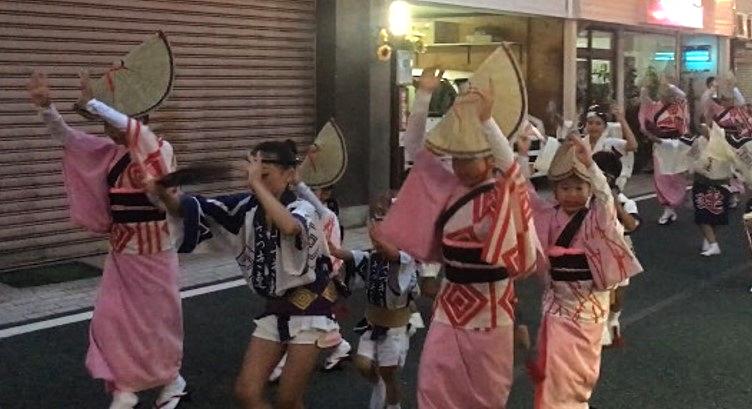
AWAODORI is one of Japan's three major BON ODORI-festivals, which is a type of Japanese traditional dance festival held in the summer. It is held all over Tokushima prefecture and has recently been held in other locations as well, but Tokushima City's festival is the biggest with over one million people attending last summer's festivities. AWA was once the name of Tokushima, and ODORI means dance. There are two types of dance forms. One is called Man-dance which expresses briskness, and the other is called Woman-dance which expresses glamour. Men cannot dance Woman-dance but women can dance both. This is the rule, but the dance forms are similar. The biggest difference between the two are the costumes.
Those wearing white costumes are dancing Man-dance. Those wearing pink costumes are dancing Woman-dance. (Daisuke Miyamoto)
How do you dance AWAODORI? Don't worry. It's very simple. Just wave your hands over your head and step to the traditional music which is played by Japanese
flutes, drums, bamboo, and chimes.
How do you join in? Don't be afraid. Many groups called "REN", consisting of dancers and music players, parade the street. The REN is formed by region, business company, or some other distinction. When you find the municipal office a REN group, you can join it if you want.
Finally, I would like to leave you with a famous proverb about AWAODORI. It goes, "there are silly watching people and silly dancing people. You might as well dance if you're going to be silly anyway." The most important thing is to be silly and enjoy the dance!!
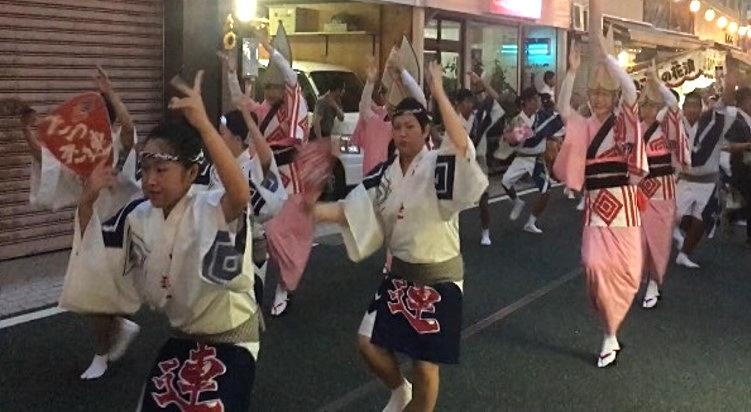
It is very popular with children as well. (Daisuke Miyamoto)
The finale of the dance -they're so excited!!
|
|
Stay in Touch with JITI
|
Please follow the Japan International Transport Institute Twitter feed at @JITIUSA or check back with our website to get the latest information on workshops and seminars.
|
| Thank you for reading the JITI Journal. Until the next issue, whatever your mode, travel safely! The JITI Team |
|
|
|