|
The American Society of
Le Souvenir Français Inc.
Monthly Bulletin - Vol. VI, No. 10
October 2026
| | |
America250
Part of a series
Le Souvenir Français at Yorktown
A Tour of the Yorktown Battlefield
(from a French Perspective)
September 28 - October 19, 1781
| |
| |
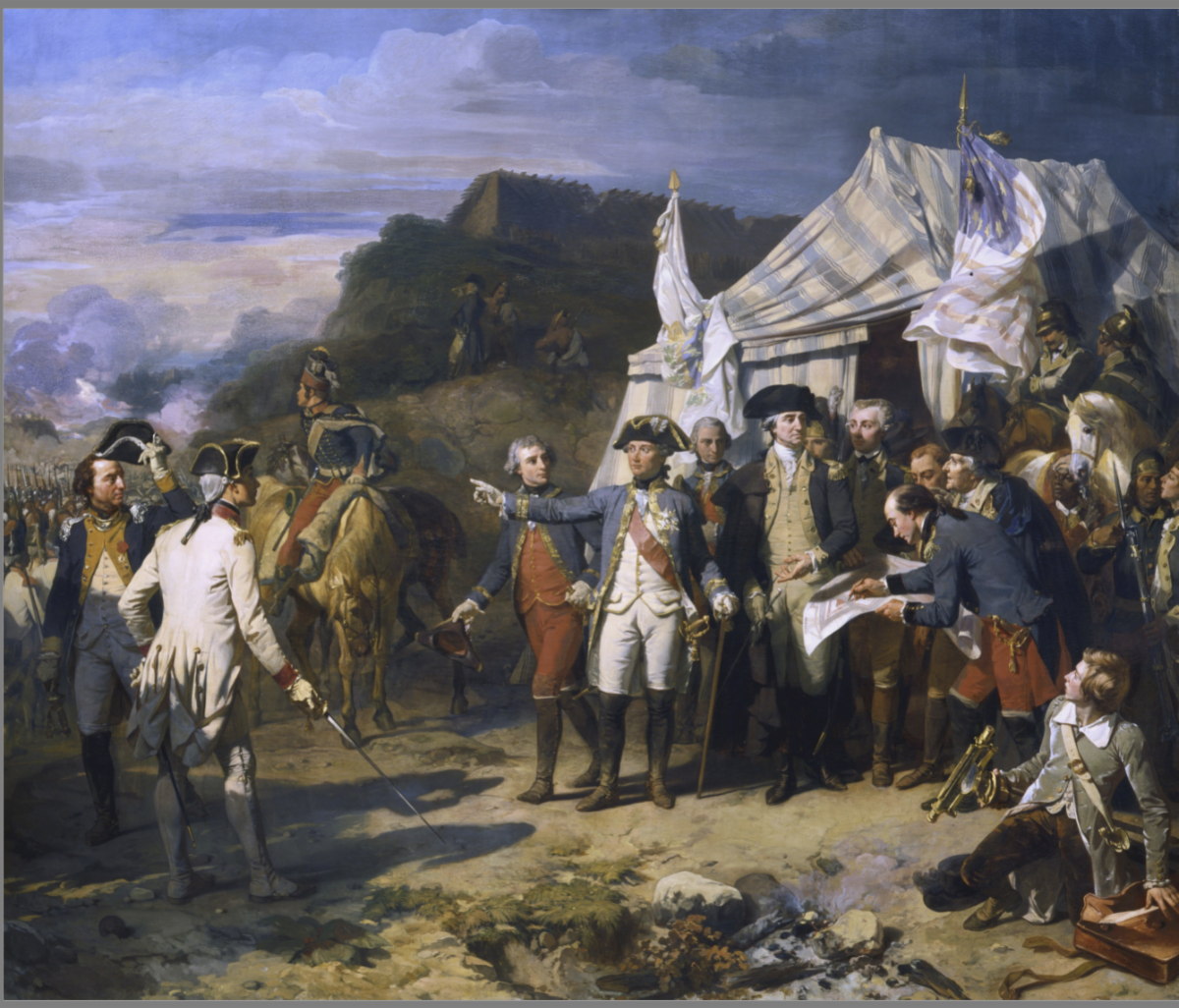
Cover illustration:
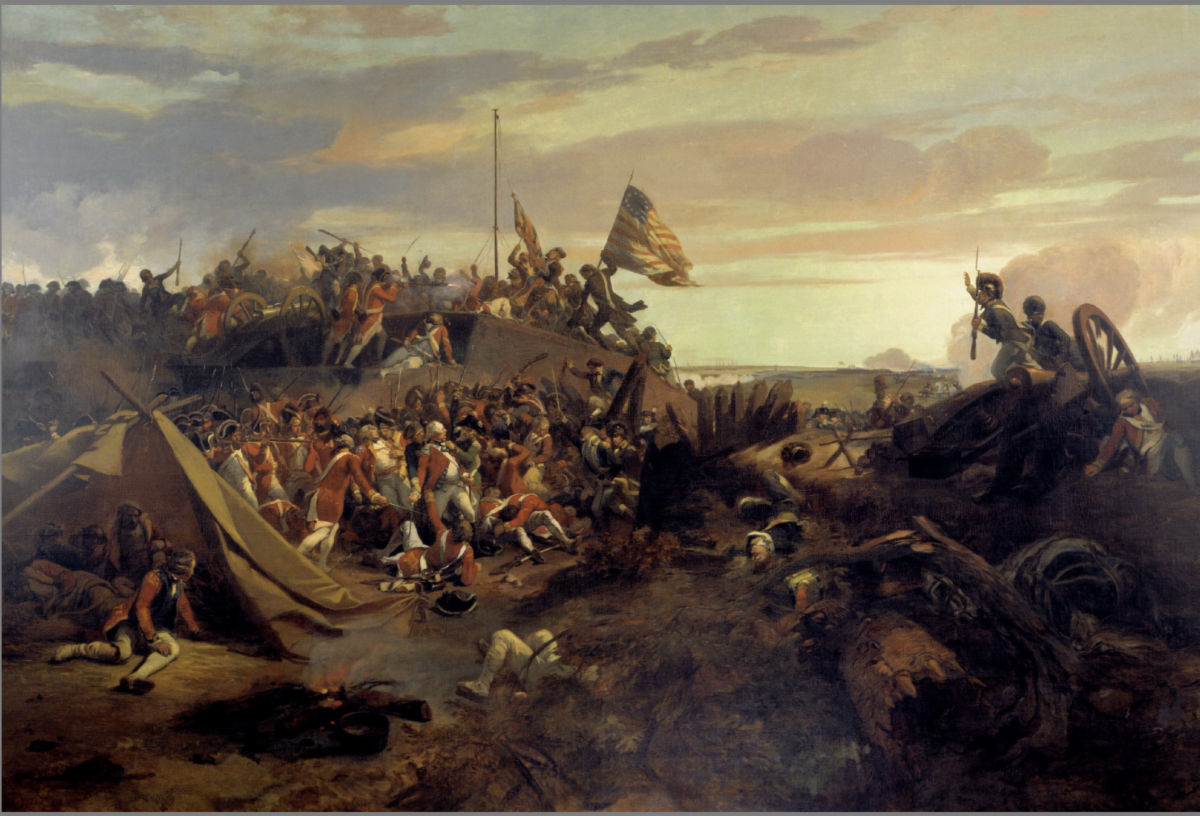
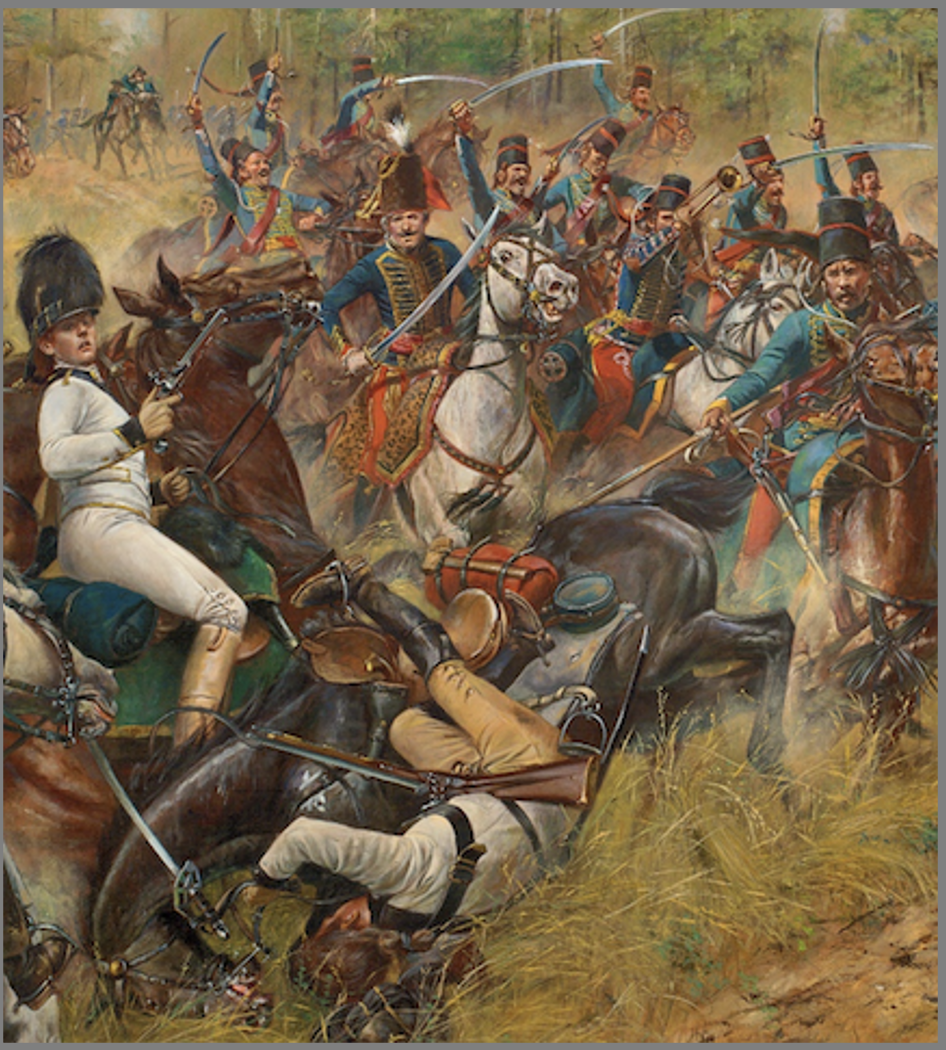
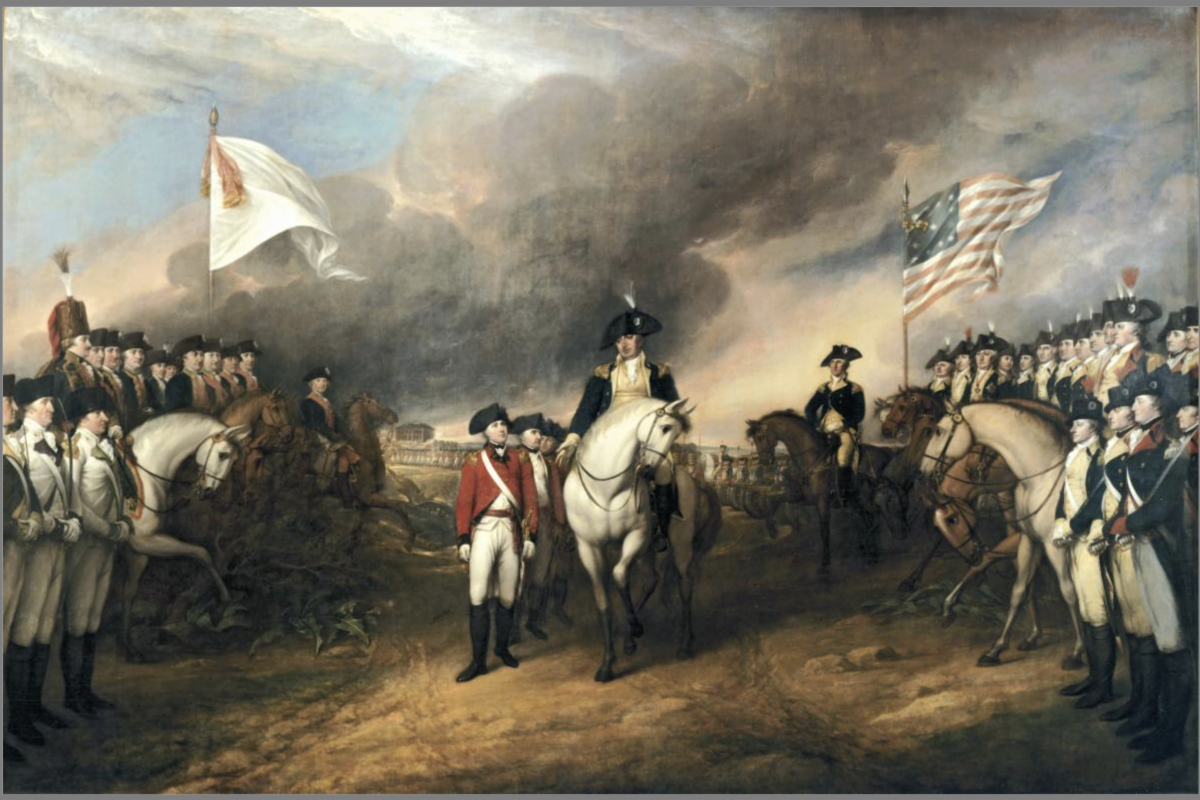
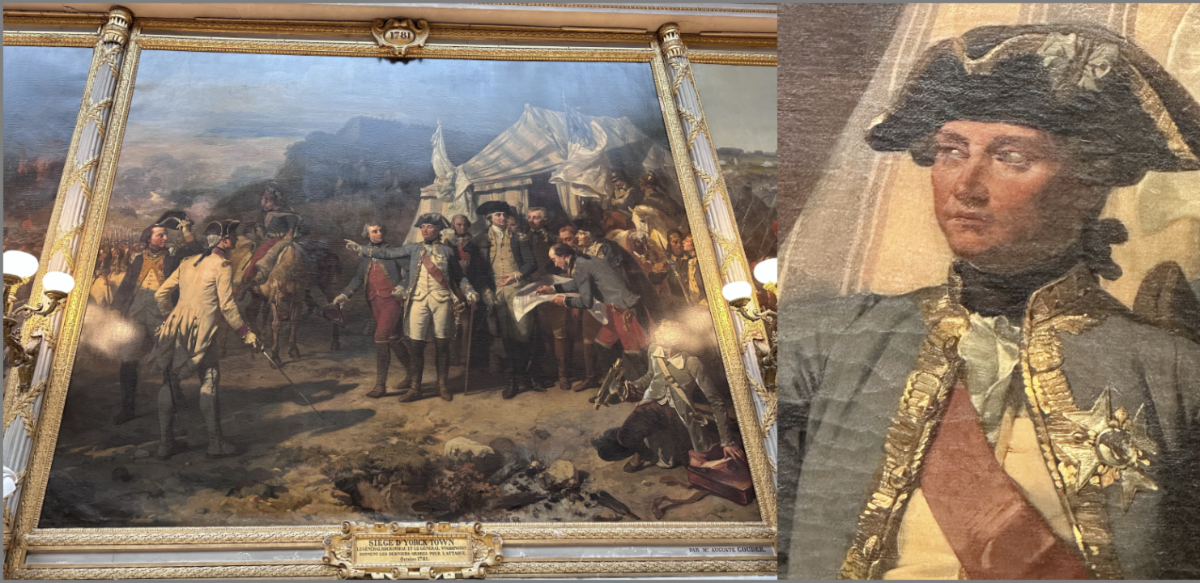
"Siège d'Yorck-town" by Auguste Couder (1789-1873), oil on canvas painted c. 1836, most likely influenced by the 1784 Blarenberghe initial version for King Louis XVI. Rochambeau is seen giving orders, flanked by general Washington to his left. Behind the two men, we recognize the Marquis de La Fayette, and to Washington's right is the Marquis de Saint Simon and the Comte de Ménonville. On the left, on horseback and with his back turned, is the Duke of Lauzun. Rochambeau wears the 'field dress': lighter blue coat and off white waistcoat and breeches. Galerie des Batailles, Palais de Versailles, (a copy exists at the French Embassy in Washington DC). Public Domain,
https://commons.wikimedia.org/w/index.php?curid=7029460
| | |
Editorial
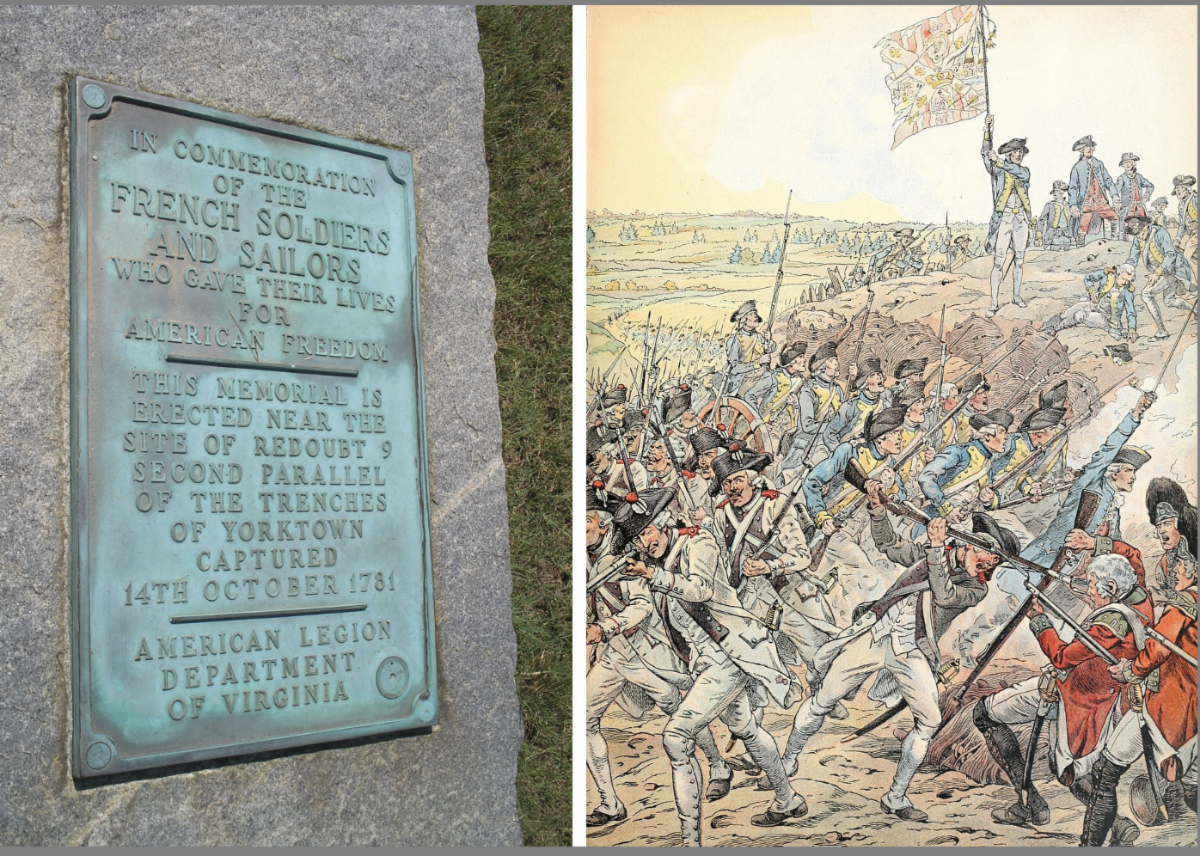
There are many accounts written about the siege of Yorktown, the crucial Franco-American victory that paved the way for American independence. The siege lasted from September 28 to the British surrender on October 19, 1781.
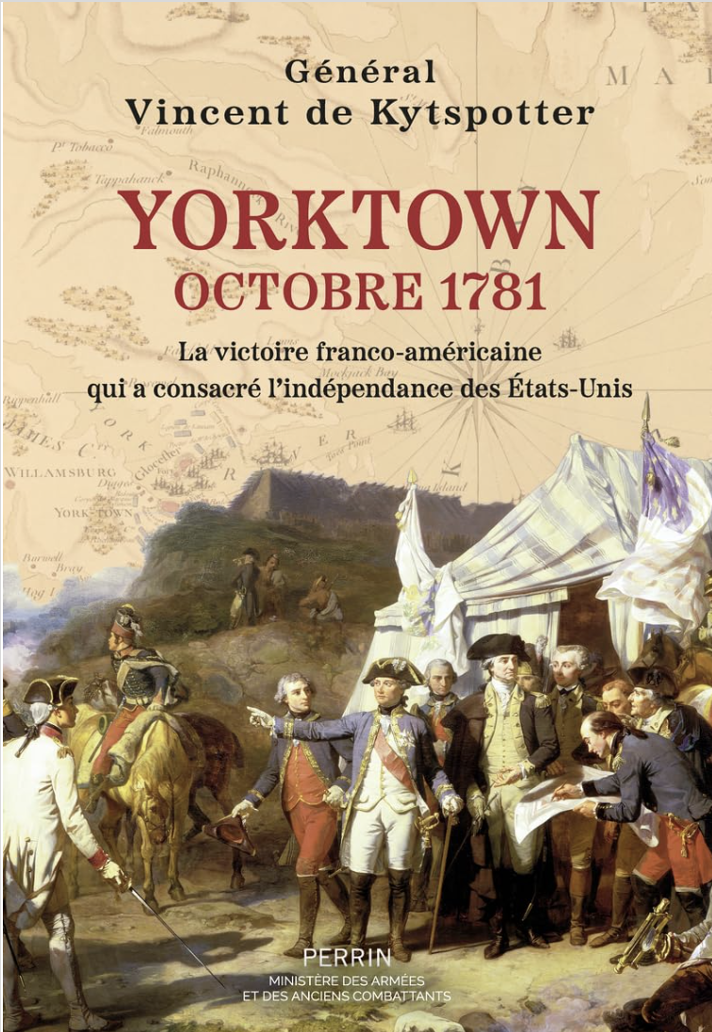
The latest book, by French Army Major General (2S) Vincent de Kytspotter, Ph.D., offers a comprehensive account of the siege, and we refer our readers to it at the end of this Bulletin. As we are about to celebrate the 245th anniversary, we thought it useful to propose a tour of the battlefield, as if you were a visitor. We will highlight the memorials and markers dedicated to the French Army and Navy that dot the 4,000 acres of the Yorktown battlefield, which make up about half of the Colonial National Historical Park.
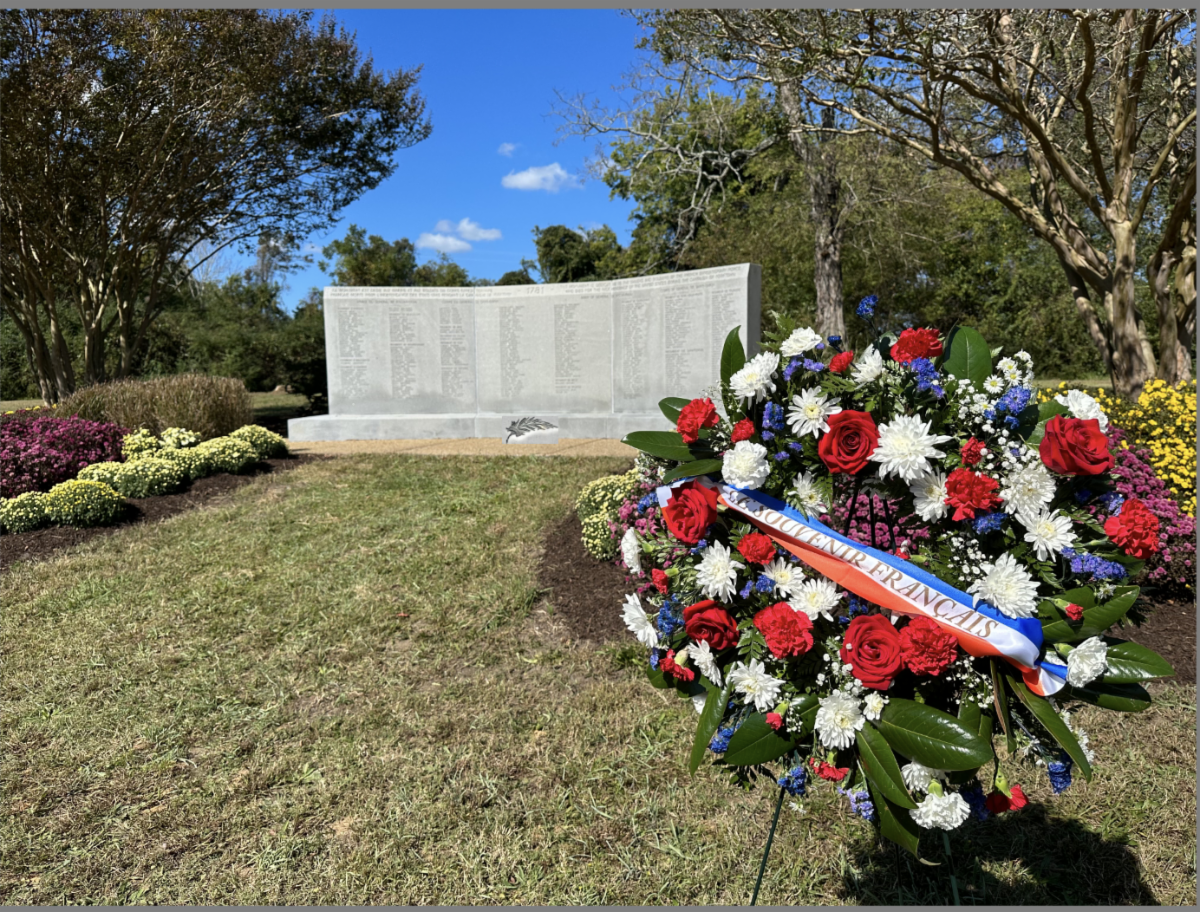
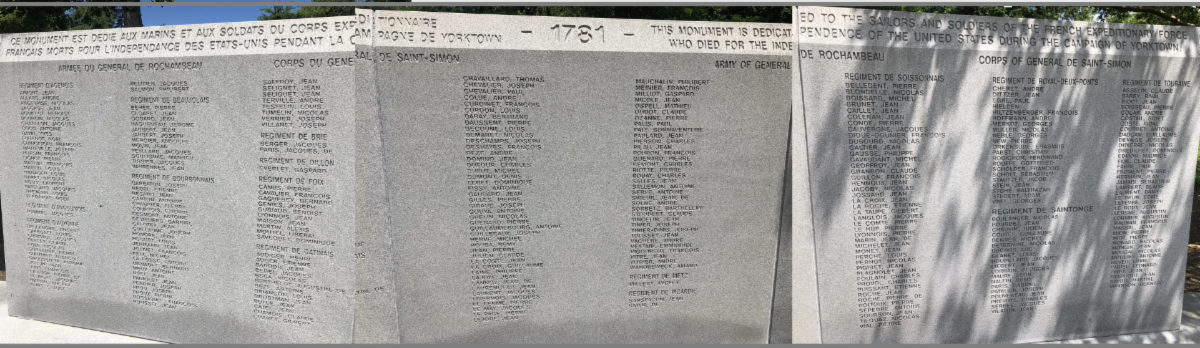
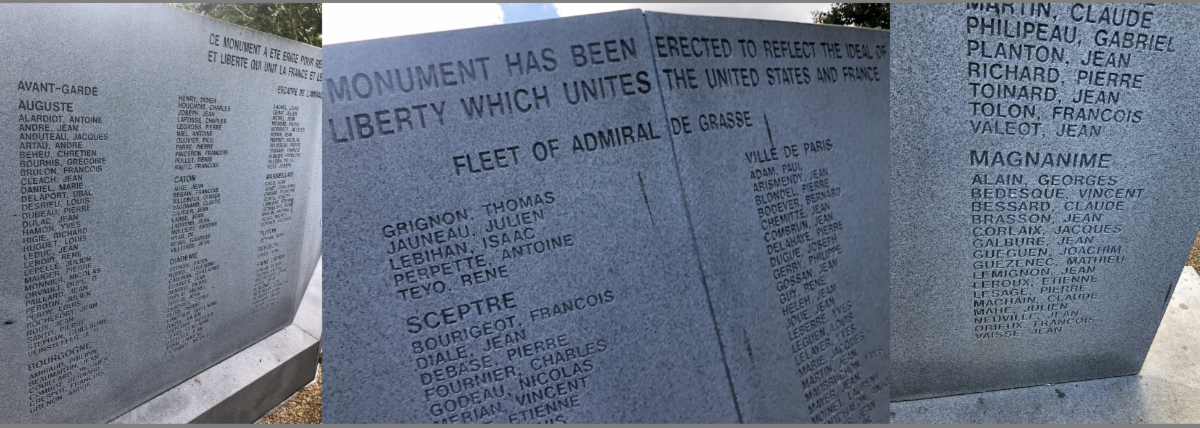
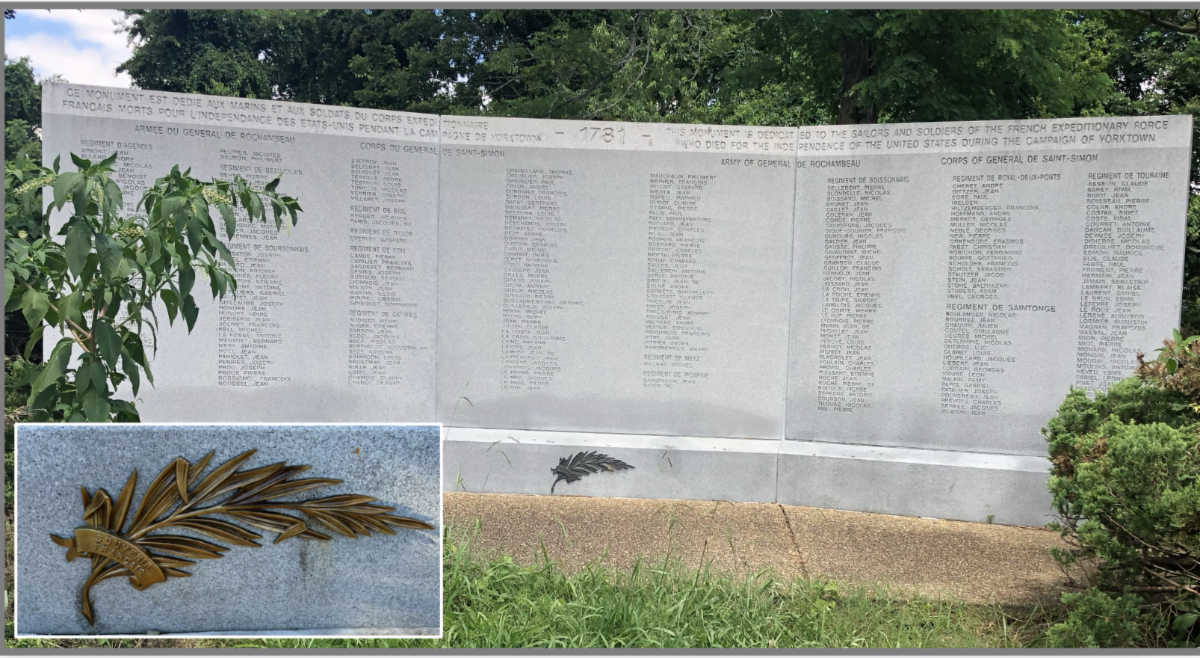
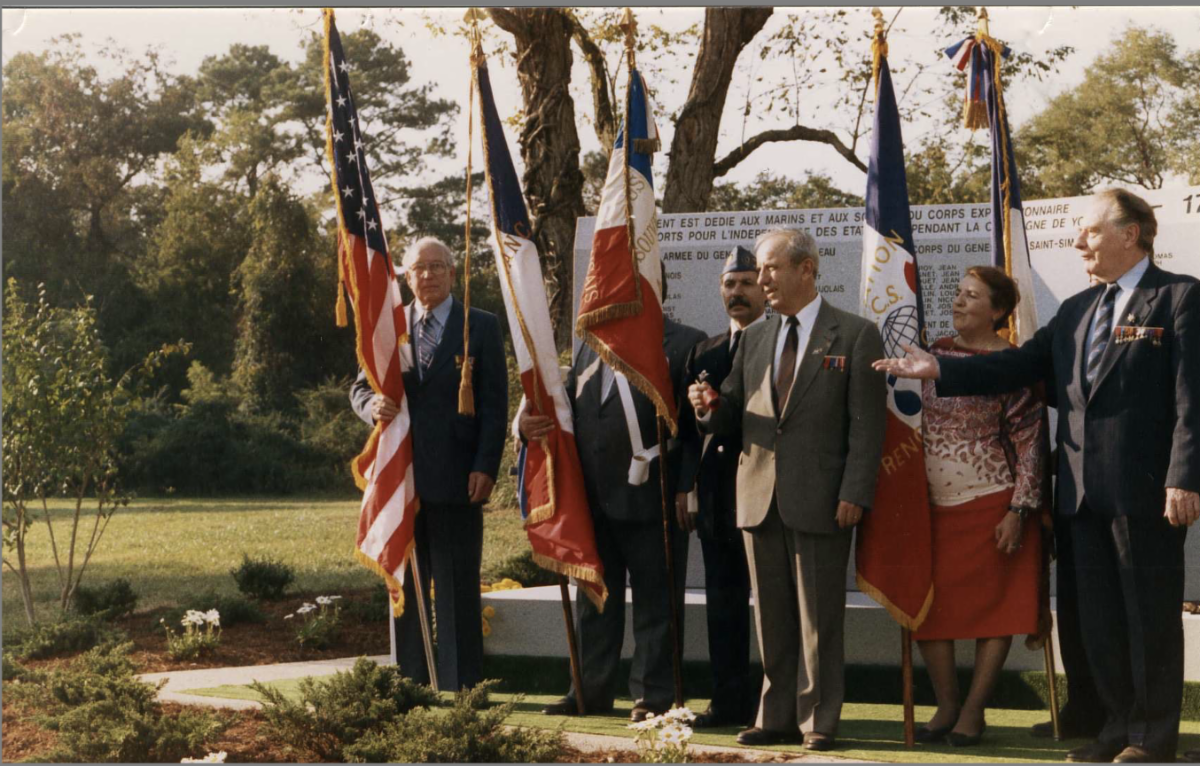
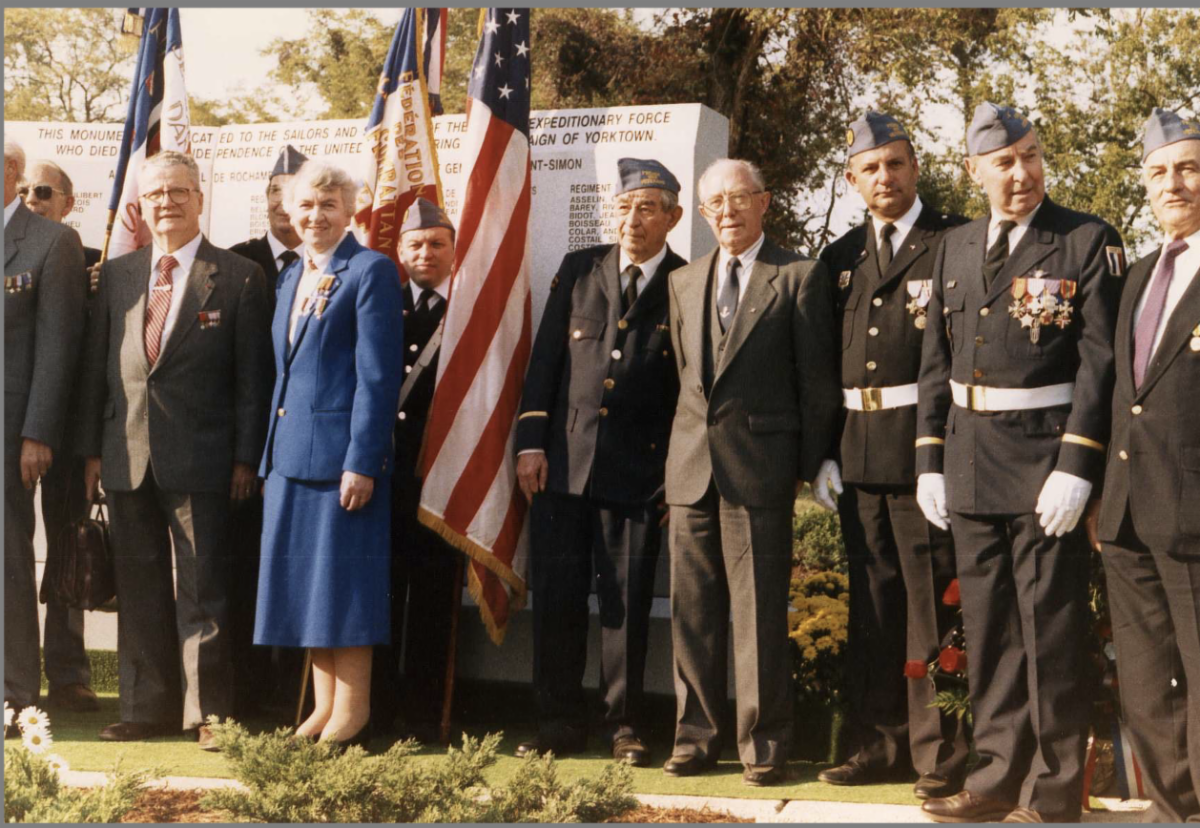
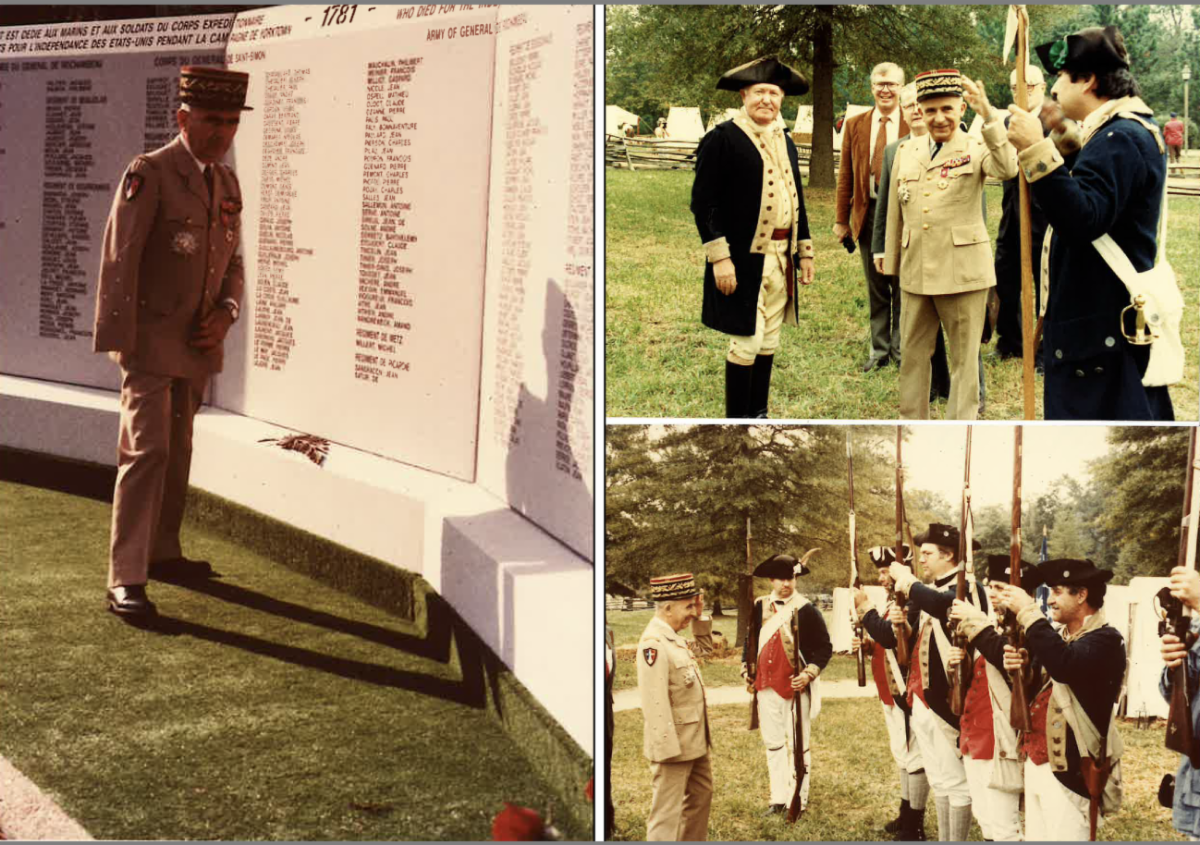
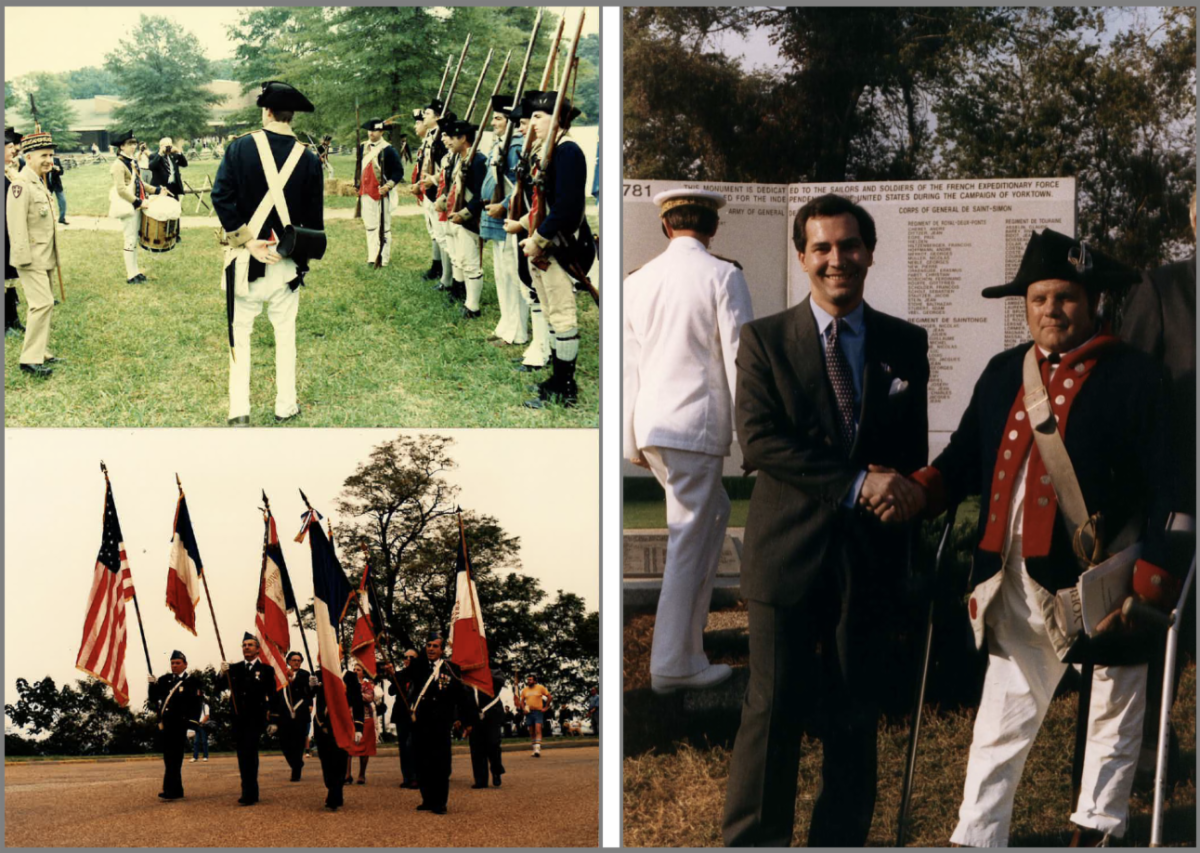
Le Souvenir Français has been intimately involved in these celebrations for decades. After all, the white marble cross in the French Cemetery was installed by our Society in 1971, and the French Memorial listing the names of casualties of the Yorktown Campaign was erected in great part by our Society in 1989.
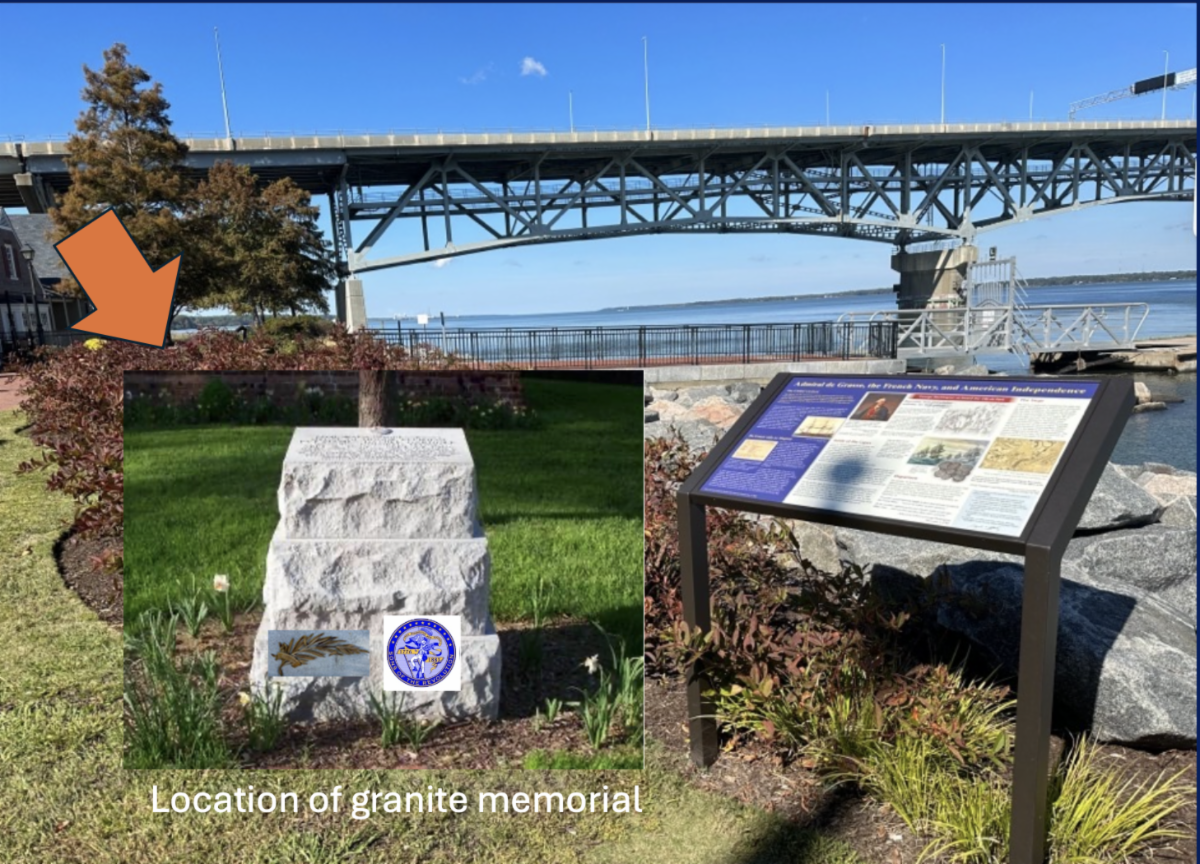
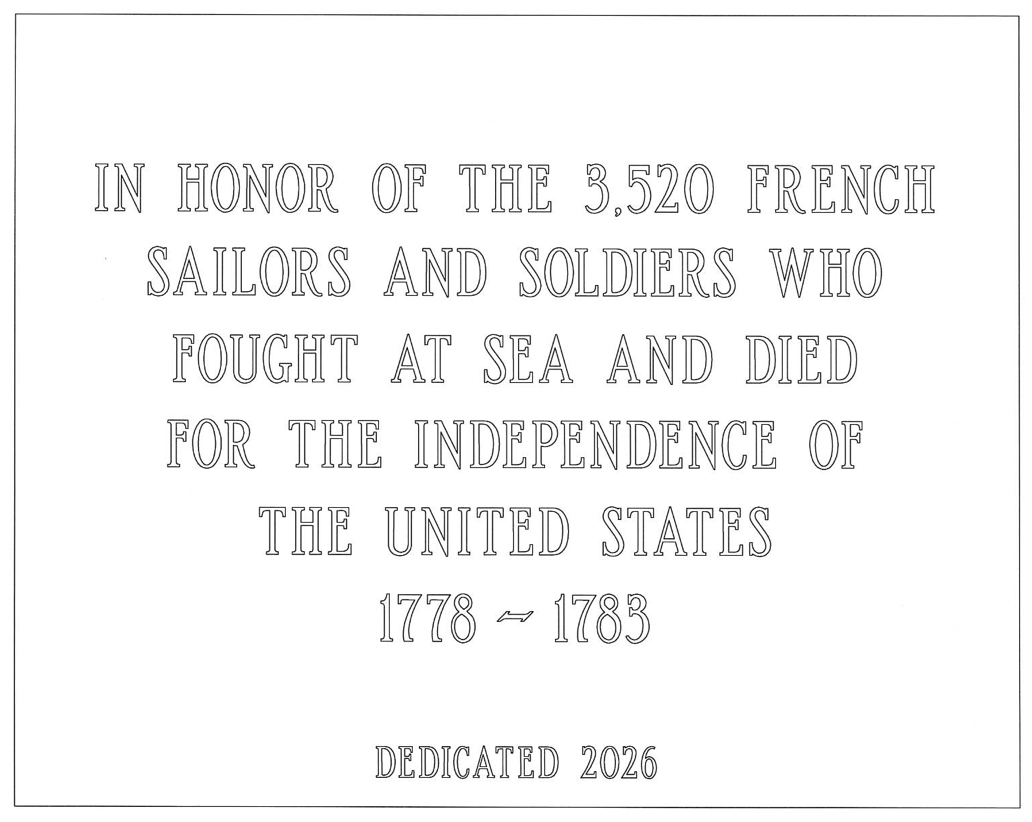
Of course, you are cordially invited to join us, along with the many American patriotic and civic associations that gather every year in October to celebrate this important moment in American (and French) history, especially this year, which marks the 250th anniversary of the independence of the United States. On October 18, we will inaugurate a granite memorial on Riverwalk honoring the 3,520 French sailors and soldiers who have no grave. We hope you will attend.
Follow the guide! Suivez le guide!
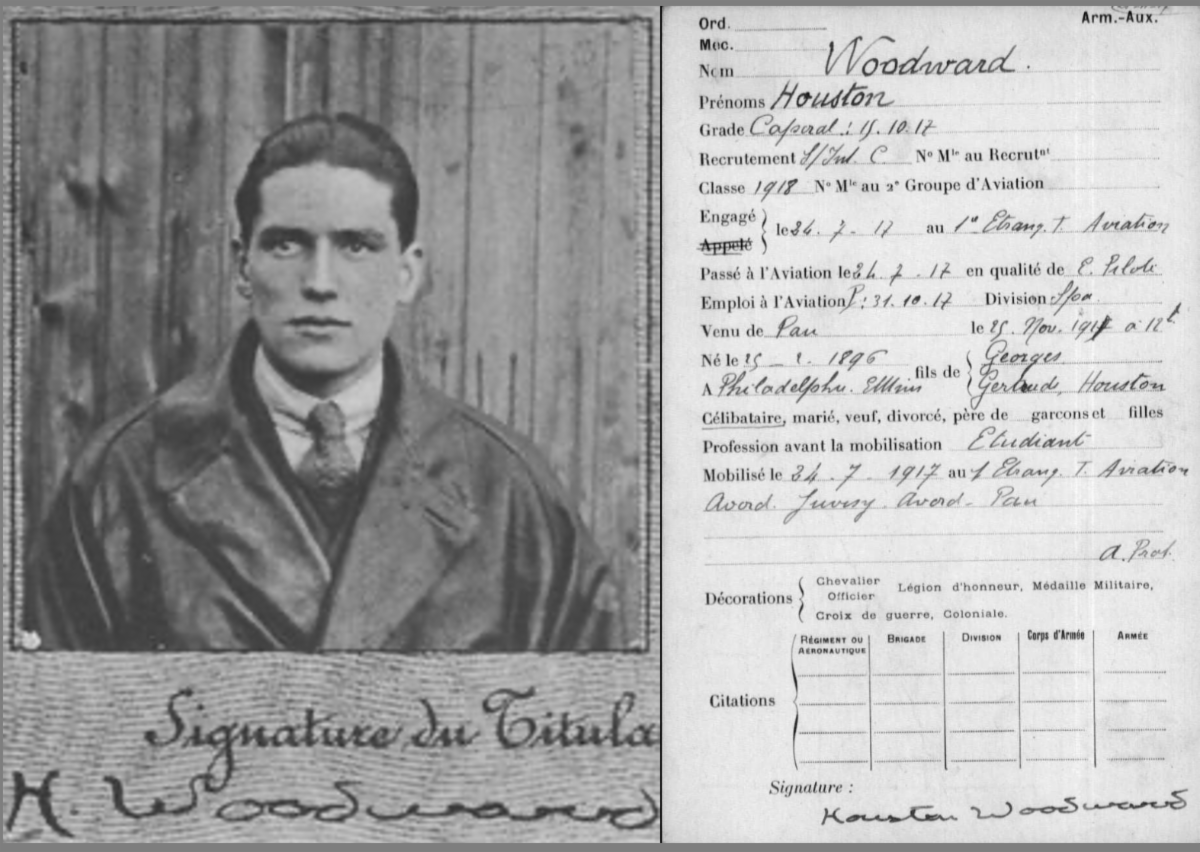
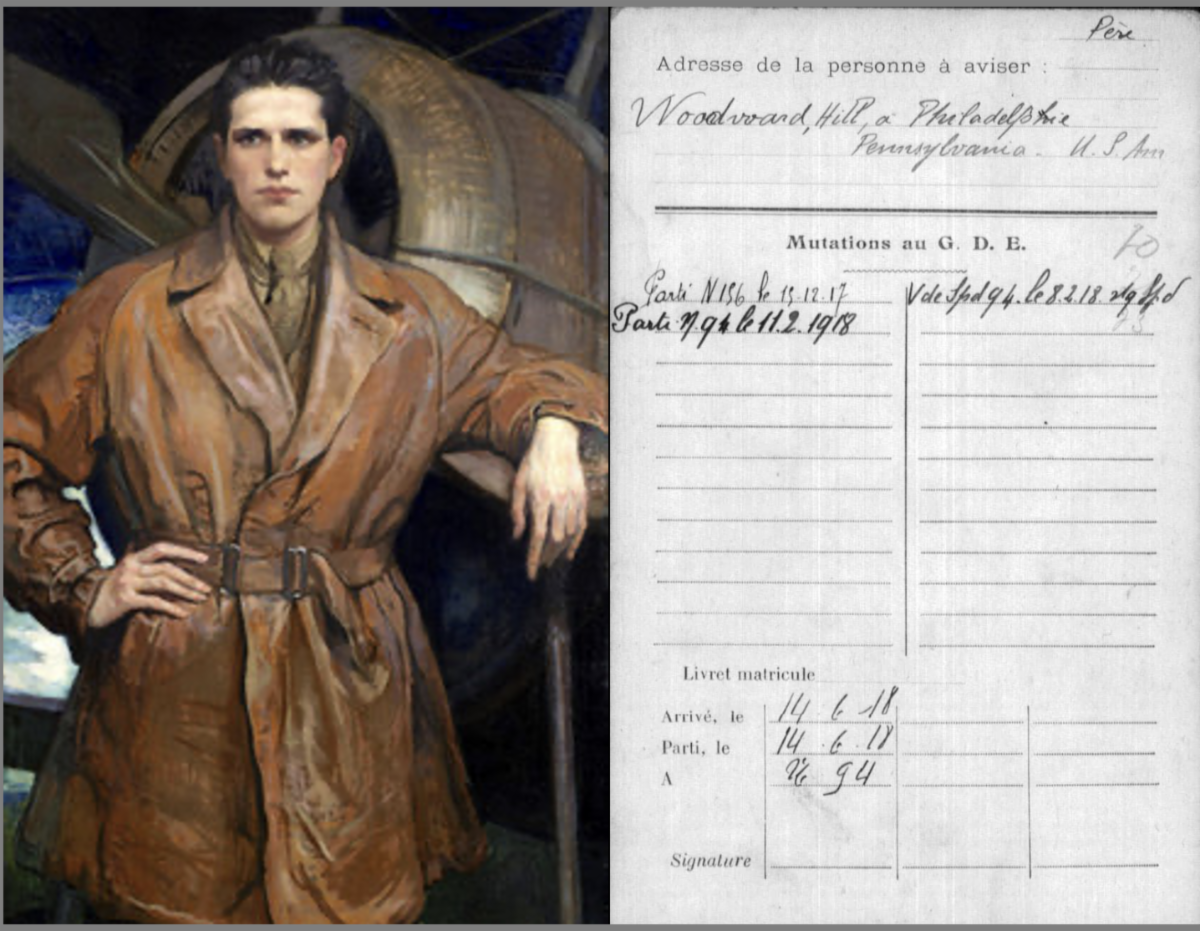
Part Two of this Bulletin continues our tradition of honoring a particular American volunteer who fought and died for France: Corporal Henry Houston Woodward, of Philadelphia, PA, who was shot down and declared "Mort pour la France" near Montdidier (80-Somme, historically Picardy).
Scroll down a little further to find Part Three, which lists several news items and save-the-dates for this fall.
This Bulletin is dedicated to the memory of Nicole Yancey, former Honorary Consul of France in Virginia, chevalier de la Légion d'honneur, who, as Regional Delegate of Le Souvenir Français in Virginia, labored tirelessly over the past 50 years to celebrate the bonds of alliance and friendship between France and the United States in Yorktown. The upcoming ceremonies of October 18 and 19, 2026, will be held without her for the first time, and we will sorely miss her presence among us.
Dear readers, thank you always for your expressions of support! Remember, we rely solely on your dues and donations to fulfill our missions. If you can, please consider making a tax-deductible donation before the end of the year. Any amount is greatly appreciated!
Merci infiniment.
On behalf of the Board of Directors,
Thierry Chaunu
President, The American Society of Le Souvenir Français, Inc.
Délégué Général du Souvenir Français pour les Etats-Unis.
| |
|
The Siege of Yorktown,
September 28 - October 19, 1781
Context
| | |
Above:
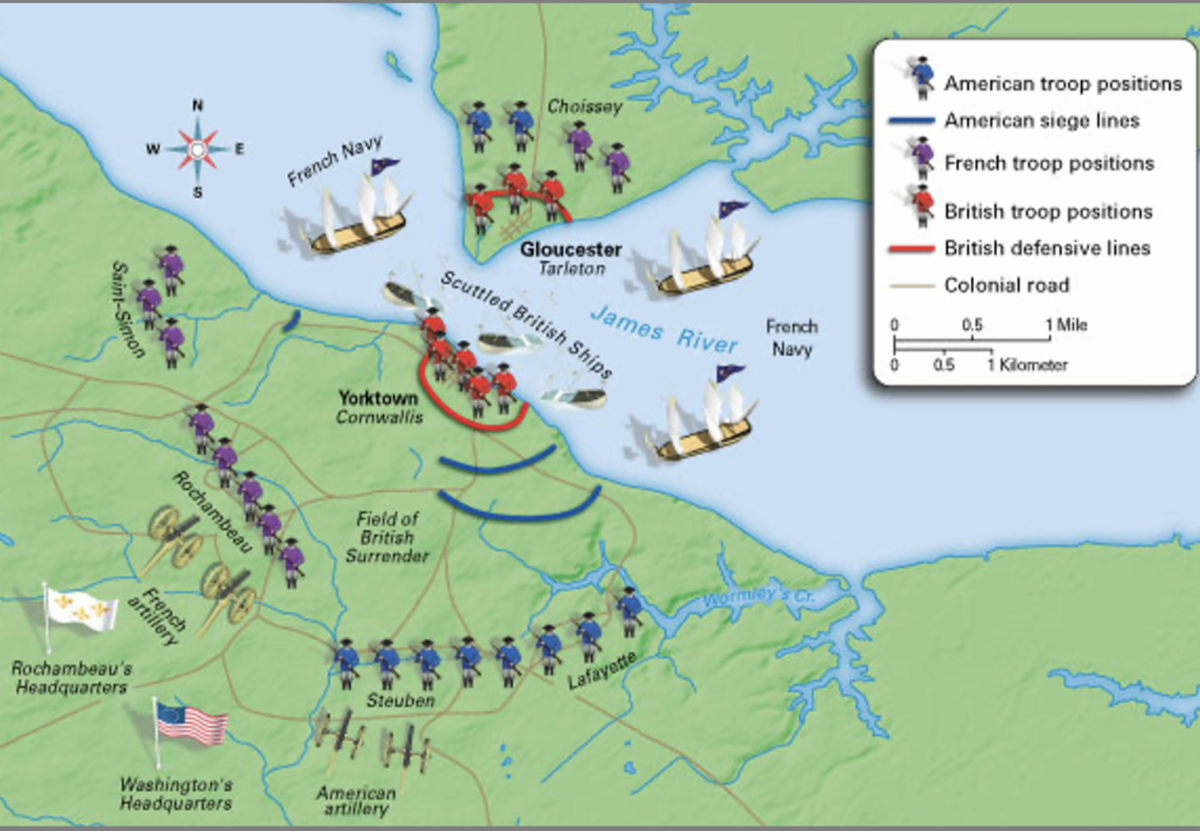
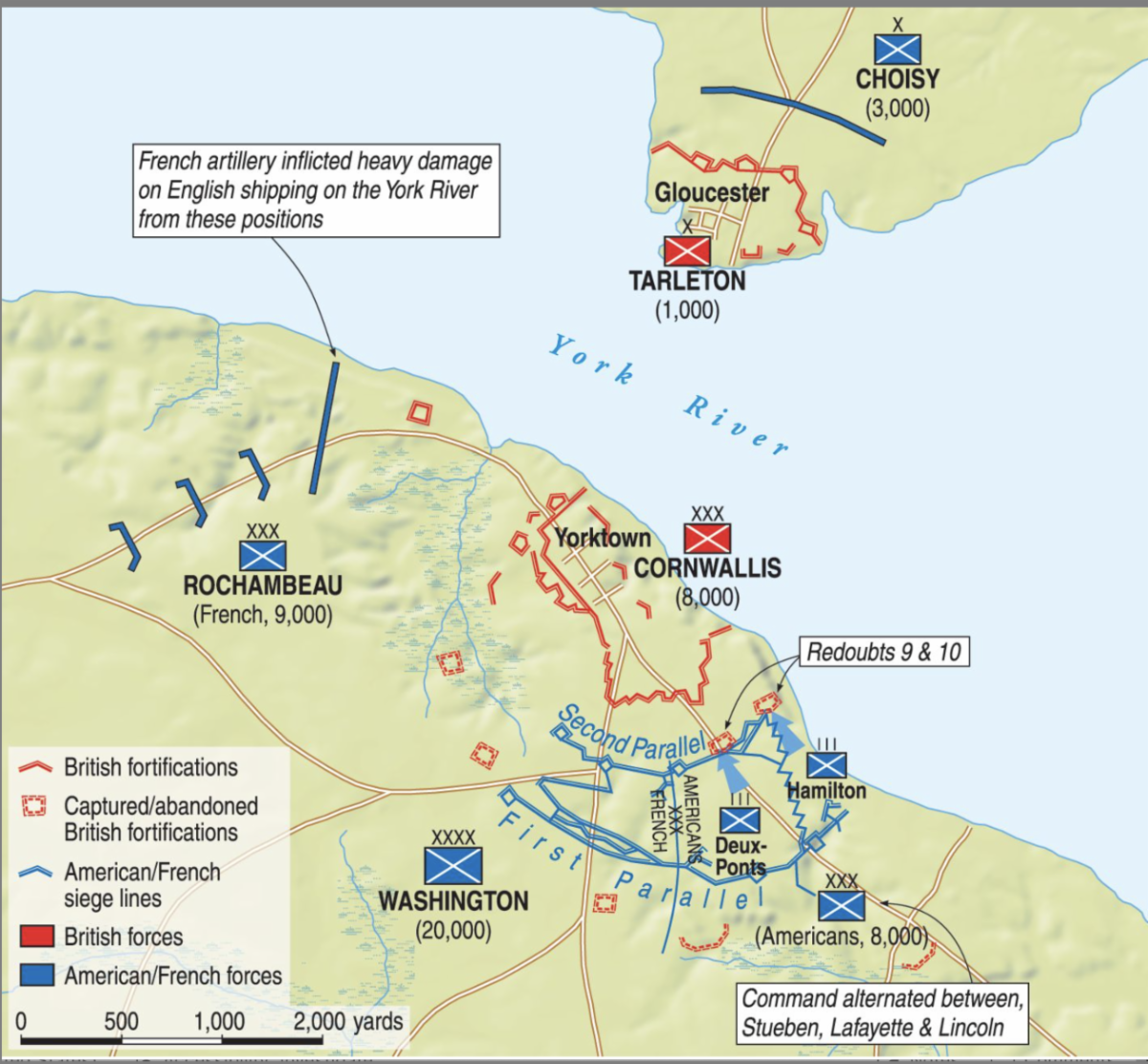
Simplified map of the siege of Yorktown (The figures cited are approximate and do not strictly adhere to historical accuracy) https://www.facebook.com/groups/119086105282320/posts/228709334319996/
Bottom: Another map, also with approximate numbers https://warfarehistorynetwork.com/article/the-redoubts-at-yorktown/
|
A short overview
By 1781, the American Revolutionary War had ground into its sixth year. After early British successes in the northern colonies stalled, London shifted strategy toward the South, hoping to rally Loyalist support and use naval superiority to control the coast. British General Lord Cornwallis campaigned through the Carolinas and into Virginia, but after a costly string of engagements he moved his army to the tobacco port of Yorktown, on Virginia's Chesapeake coast, in the summer of 1781 where he was pinned down by the American troops led by Gen. Lafayette. There he began fortifying a defensive position, expecting resupply and possible evacuation by the Royal Navy.
That expectation proved fatal. General George Washington, commanding the Continental Army alongside French forces under the Comte de Rochambeau, was persuaded by Rochambeau's strong preference to move south. Rather than continuing to threaten British-held New York, the two commanders executed a bold pivot, marching their combined armies roughly 450 miles south to Virginia in a swift campaign designed to trap Cornwallis before he could escape by sea."
The Naval Key
The siege's outcome was decided as much at sea as on land. In early September 1781, as we narrated in our Bulletin last month, a French fleet under Admiral François de Grasse engaged and repelled the British Royal Navy at the Battle of the Chesapeake (also called the Battle of the Virginia Capes). This victory sealed off the Chesapeake Bay, cutting Cornwallis off from reinforcement or retreat by water. Without naval support, his army at Yorktown was effectively trapped.
The Siege
By September 28, some 8,000 American and 10,800 French troops surrounded roughly 9,000 British and German soldiers entrenched at Yorktown. The Allied forces began classic siege warfare — devised by expert siege warfare Gen. Rochambeau, and a team of French engineers operating within both armies, : digging parallel trenches ever closer to the British lines while artillery pounded the defenses.
On October 14, 1781, American and French light infantry, in a coordinated night assault, stormed and captured two key British redoubts (the French at Redoubt No. 9 and the Americans at Redoubt No. 10), critically weakening Cornwallis's perimeter.
With his defenses collapsing, ammunition dwindling, and no hope of relief, Cornwallis attempted a last-ditch escape across the York River on the night of October 16, but a storm scattered his boats. Recognizing his position was hopeless, he requested terms the next day.
Surrender
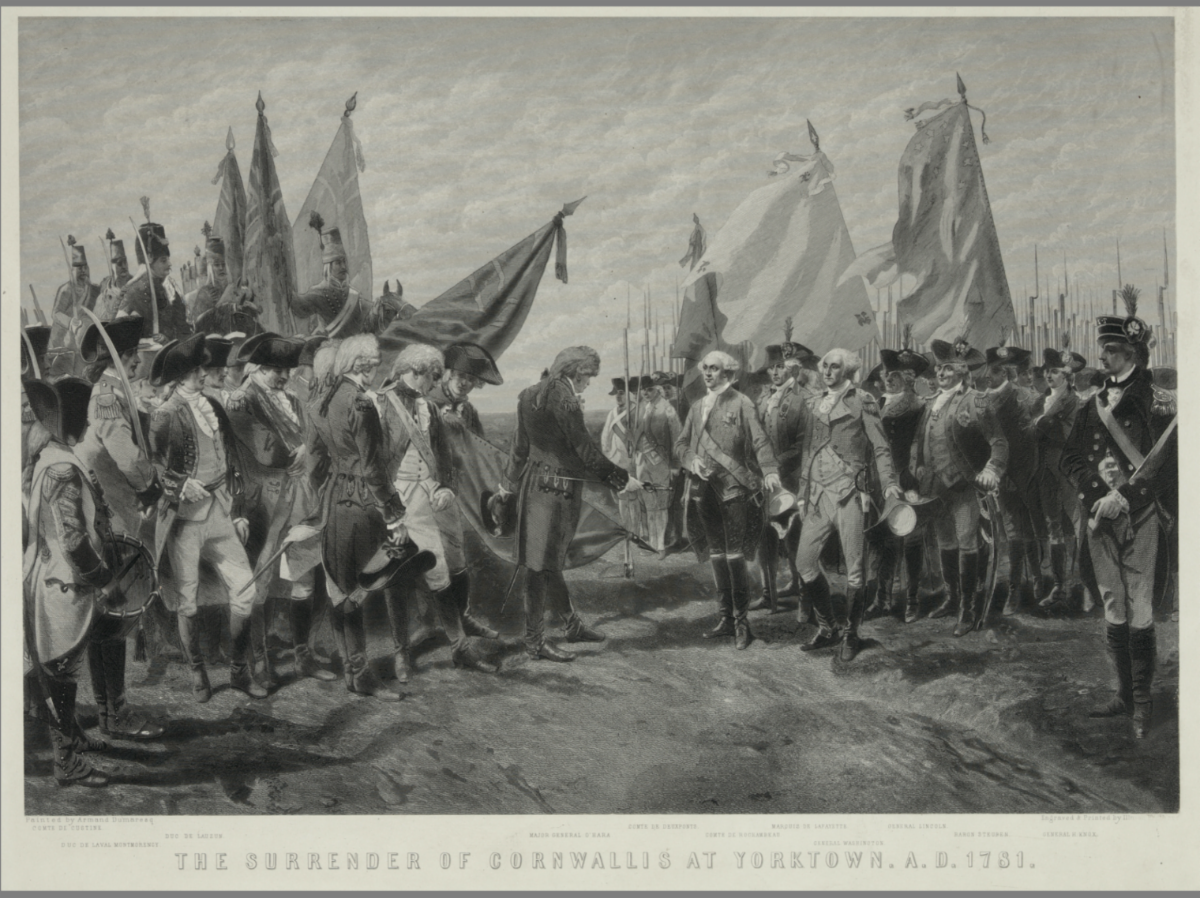
On October 19, 1781 at 2:00PM, Cornwallis surrendered his army of roughly 8,000 men. Tradition holds that British bands played "The World Turned Upside Down" as troops laid down their arms. While the war would not formally end until the Treaty of Paris in 1783, the defeat at Yorktown broke British political will to continue fighting, leading Parliament to seek peace negotiations.
Yorktown stands as the last major land battle of the Revolutionary War and the decisive stroke that secured American independence — as well as the perfect example of a successfully coordinated French-American Allied victory.
There are many books detailing the siege of Yorktown hour by hour, including the most recent one "Yorktown" written by French Major General Vincent de Kytspotter (see the announcement at the end of this Bulletin) and we refer our readers to them, as well as our October 2021 Bulletin: "On the footsteps of Rochambeau (Part 5 – Final episode: Victory in Yorktown!)"
https://conta.cc/3BOnY8l (original version in English)
https://conta.cc/3AzLSCW (version en français)
Instead, we will tour the battlefield and highlight the monuments and markers dedicated to the role of the French Army, which in and by themselves narrate many episodes and present several key commanders to the tourists. Follow the guide!
| | An Overview of the Battlefield | | |
Above:
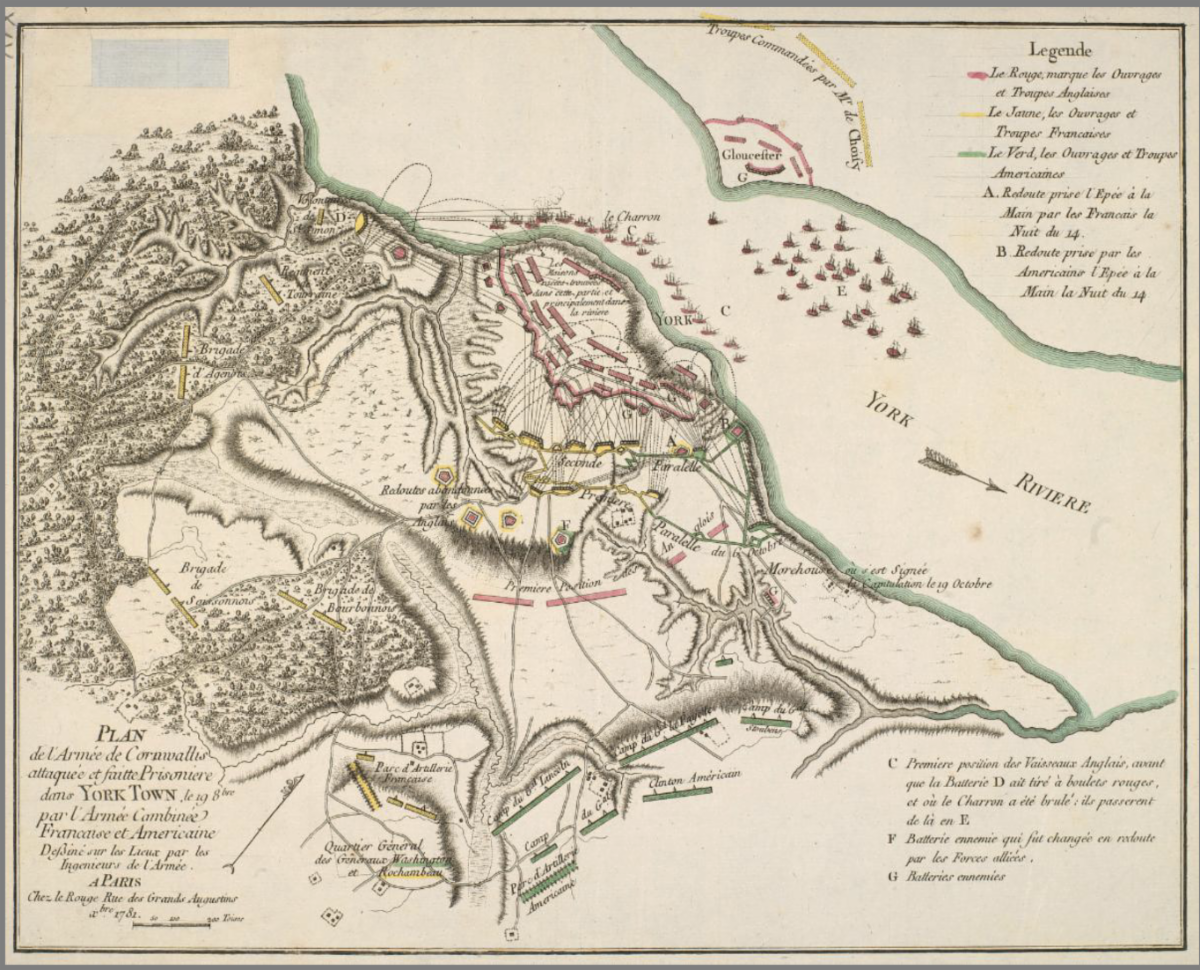
Top: A map of Yorktown, Oriented with north-west to top. Royal Collection Trust, George III maps, by Georges Louis Le Rouge (1707-93/4) - Royal Collection Trust / © Her Majesty Queen Elizabeth II 2021
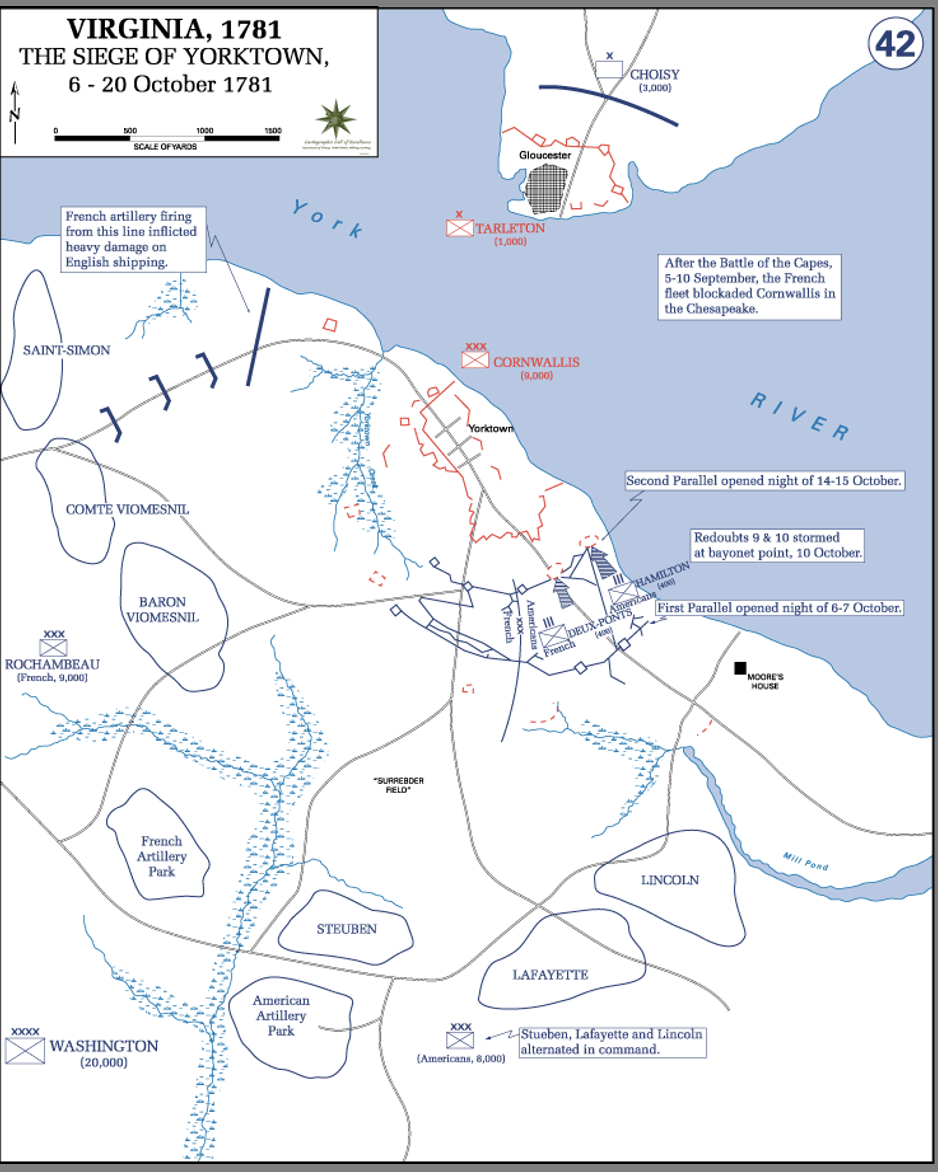
Bottom: another map, with a few mistakes in the dates (the siege started in earnest on September 28, not October 6, and the storming of the 2 redoubts happened on October 14, not October 10). Yorktown Map October 6-20, 1781: This map shows the disposition of the allied American and French forces surrounding the British army trapped at Yorktown, VA. Click on the map once to obtain a larger image. (Online Atlas Collection, History Department, U.S. Military Academy at West Point). By U. S. Military Academy - United States Army, Public Domain,
https://commons.wikimedia.org/w/index.php?curid=8259519
| | |
A few facts about the number of forces in presence:
• Most professional historians and sources offer a presentation that concentrates on the land forces. Numbers vary according to sources, but generally hover around:
Americans:
5,900 regular troops and 3,100 militia = total 9,000
French:
10,800 men on land and 36 warships
Total Allied: 19,800
British: 9,000 (including 3,000 Hessian mercenaries)
• Sadly, a website, American Battlefield Trust does not acknowledge the French forces:
"Battle Facts, Yorktown, Virginia, September 28, 1781: Result: American Victory. Forces engaged: 28,900 - American: 19,900 - British: 9,000".
This past January, at our request, Rochambeau's nationality was corrected from "American" to "French" on the website.
• Be that as it may, French sailors on board the 36 French Navy ships were not spectators, but actively engaged in sealing off the British from escape by sea.
Therefore, our count differs from the presentations and maps shown above:
American Continental Army & militia: ~8,000–9,000
French forces:
- Rochambeau's corps (who arrived from Newport, RI on September 16) ~6,000
- Saint-Simon's corps (embarked from the West Indies on De Grasse's fleet, and landed on September 5):~3,000–3,300
- French Navy sailors (29 de Grasse + 7 de Barras: ~36 ships): ~19,000
Total French forces: ~28,000
Supplemental Note:
What is established is that the French military contribution was preponderant. Also, contrary to what was witnessed at the 2022 commemoration, there were no Spanish soldiers on the battlefield. The strategic decision to fight at Yorktown was made exclusively by Washington and Rochambeau, While a financial bailout was secured via an emergency loan from Spanish Havana to keep the campaign afloat, Spain itself was never officially allied with the United States.
| |
|
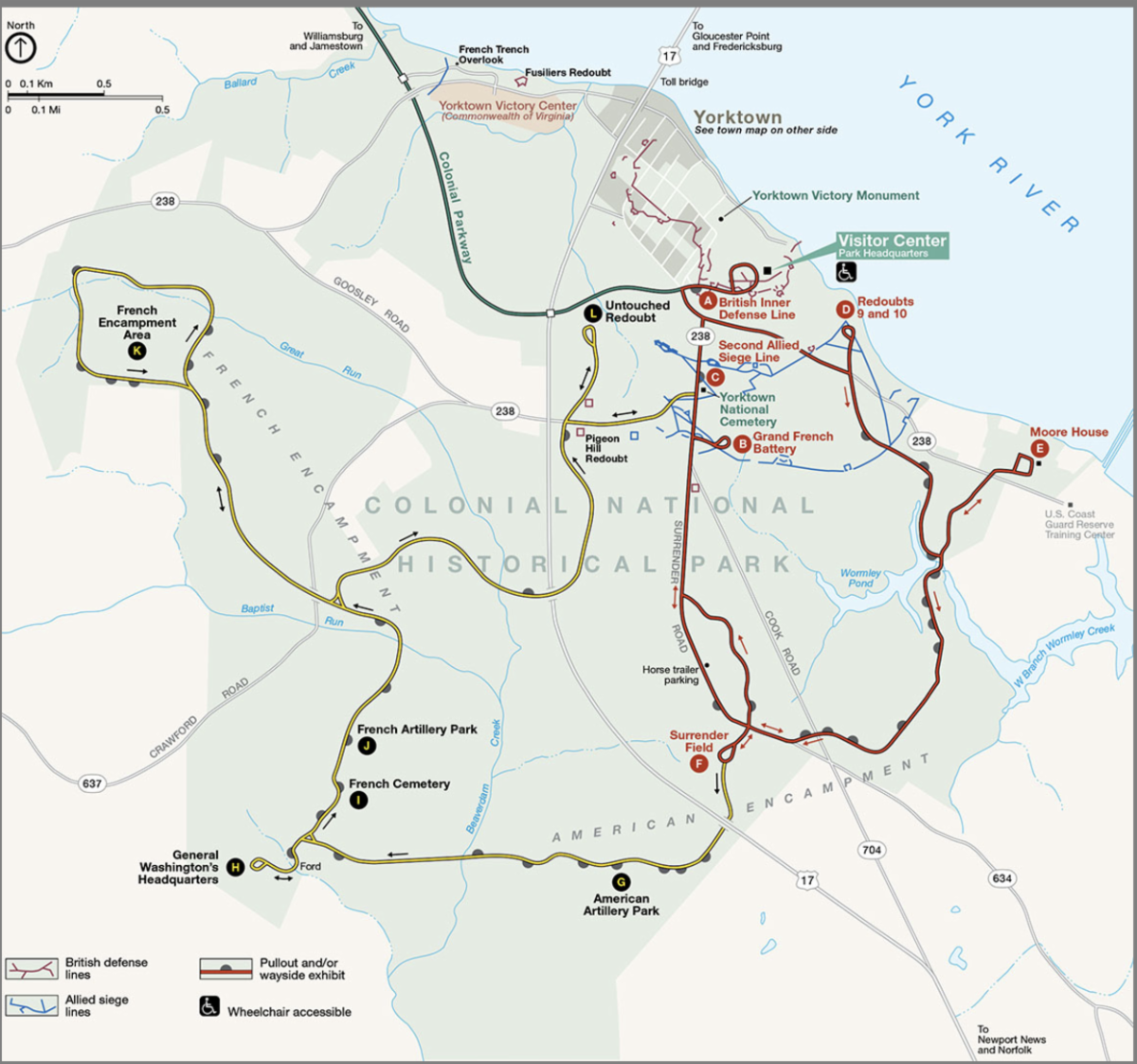
Above:
This very detailed (although it does not mention the location of Rochambeau's headquarters) and accurate map of the National Park Service limits itself to the Colonial National Historical Park, and does not show Gloucester across the river. https://npplan.com/parks-by-state/virginia-national-parks/colonial-national-historical-park-park-at-a-glance/colonial-national-historical-park-yorktown-battlefield-at-a-glance/colonial-national-historical-park-yorktown-park-map/
| |
A succinct timeline:
September 5: as we saw in our Bulletin last month, the Battle of the Cheasapeake allows the French fleet to establish local naval supremacy and to prevent any rescue of the British forces by sea.
September 14: General George Washington and Comte de Rochambeau arrived ahead of the main army in Williamsburg
September 18: Gen. Washington meets with admiral de Grasse on board the Ville-de-Paris, and de Grasse accepts to postpone his departure from October 15 until the end of the month.
September 20, 1781: Allied troops began their arrival in Williamsburg after marching from the north.
September 28: American and French forces immediately lay siege to Cornwallis and his men who had built a series of redoubts on the outskirts of Yorktown.
American and French troops begin to feverishly dig, night and day, often in total silence, a series of parallel trenches, in order to bring troops and artillery close enough. All the while, the British attempted to disrupt Allied operations, keeping the Allies under continuous fire, killing many men, however their attempts were futile.
October 3-4: In Gloucester, across the river, infamous British Lieutenant Colonel Banastre Tarleton, who committed war atrocities in South Carolina, engaged in a battle with the Duke of Lauzun (the Battle of the Hook")
October 9: In the afternoon, at 3:00PM the Allied barrage begins, with the French opening the salvo, with the French troops accompanying it with a general shout of "Huzza for the Americans!"
From then on, the artillery pounded the British with no respite for several days: 36 siege guns, and 54 cannons.
October 11: Allied troops start digging a second parallel 400 yards closer to the British lines. The new line is in place by the morning of October 12. The artillery barrage continues.
October 14: Finally, American and French forces prepare a surprise assault on redoubts #9 and #10.
Lt. Col. Alexander Hamilton’s force, consisting of a detachment of 400 of his light infantry, assaults redoubt #10 with bayonets fixed and muskets unloaded.
Units of French regiments of Gâtinais followed by units of the Royal-Deux-Ponts simultaneously assault redoubt #9 and, after an equally fierce firefight, wrest control from the British.
Cornwallis’s position is untenable as the Franco-American alliance has artillery on three of his sides, with additional new pieces positioned in redoubts #9 and #10 after their fall.
October 15: In a last-ditch effort, Cornwallis orders a futile counterattack, which fails miserably.
October 17: That morning, a small British drummer boy, beating “parley” appeared, followed by British officer waving a white handkerchief tied to the end of a sword. Blindfolded and brought inside American lines, the British officer secures terms of surrender for the British Army.
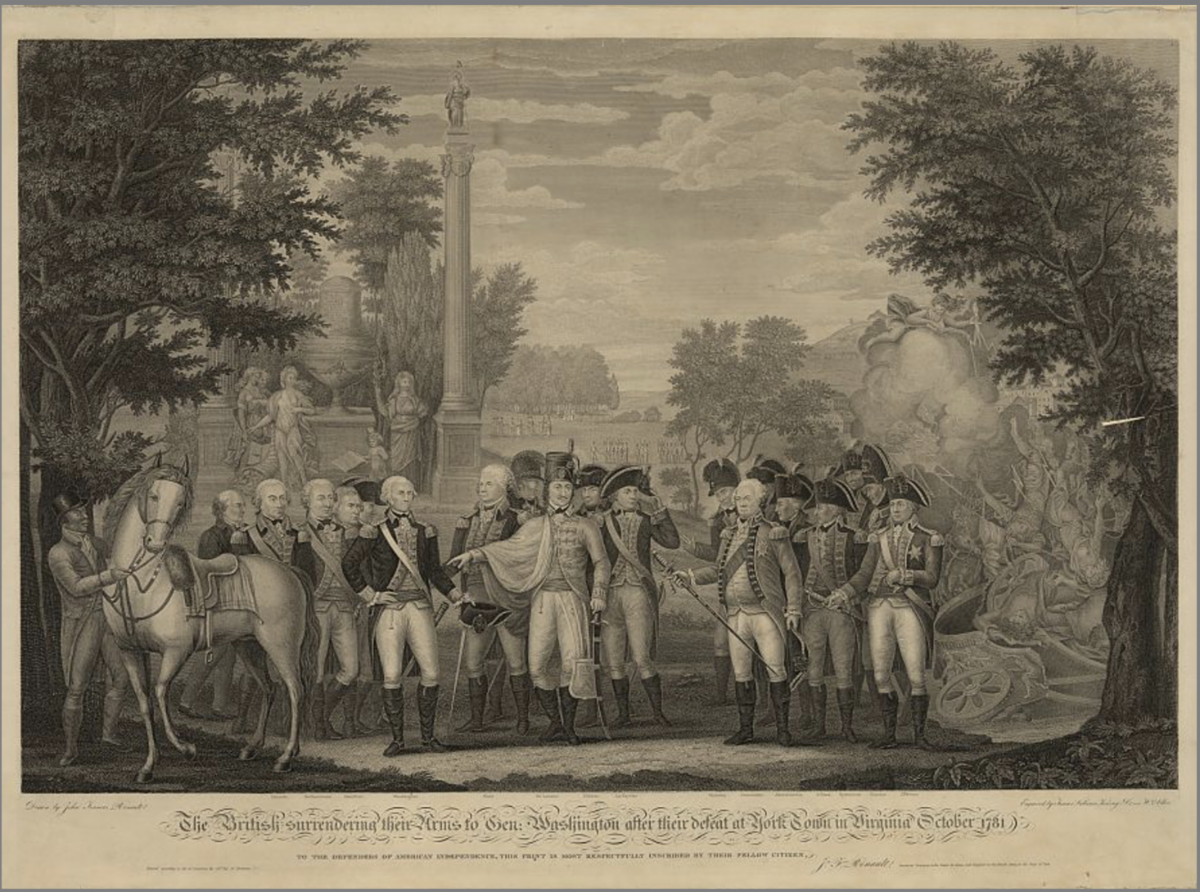
October 19: In a field outside of Yorktown, at 2:00PM, the capitulation takes place as British troops and their Hessian allies, with flags furled and cased, late for the ceremony, marched somberly between long lines of American and French forces. A second surrender, often ignored in narrations of the battle of Yorktown, occurred an hour later at 3:00PM across the river in Gloucester, as the British forces there surrendered to the Marquis de Choisy.
| |
Le Souvenir Français Interactive Map
French markers at the Yorktown Battlefield
| |
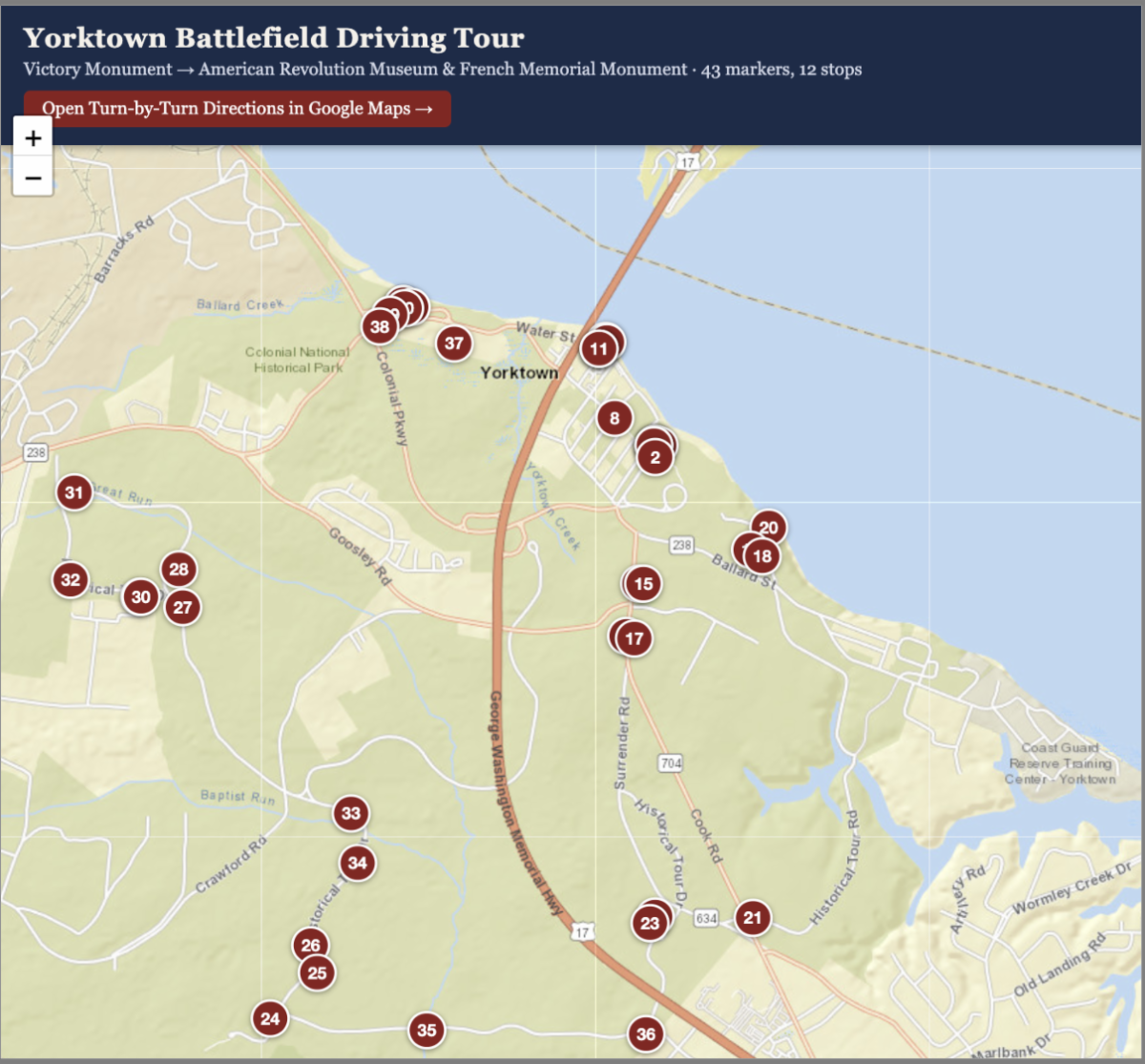
Above:
You can access online this map on our website and zoom in on any cluster of markers numbered 1 to 43. Simply click on the map above or visit:
https://souvenirfrancaisusa.org/wp-content/uploads/2026/09/Yorktown_Battlefield_Map.html
| |
Above:
You can access online this map on our website and zoom in on any cluster of markers numbered 1 to 9. Simply click on the map above or visit:
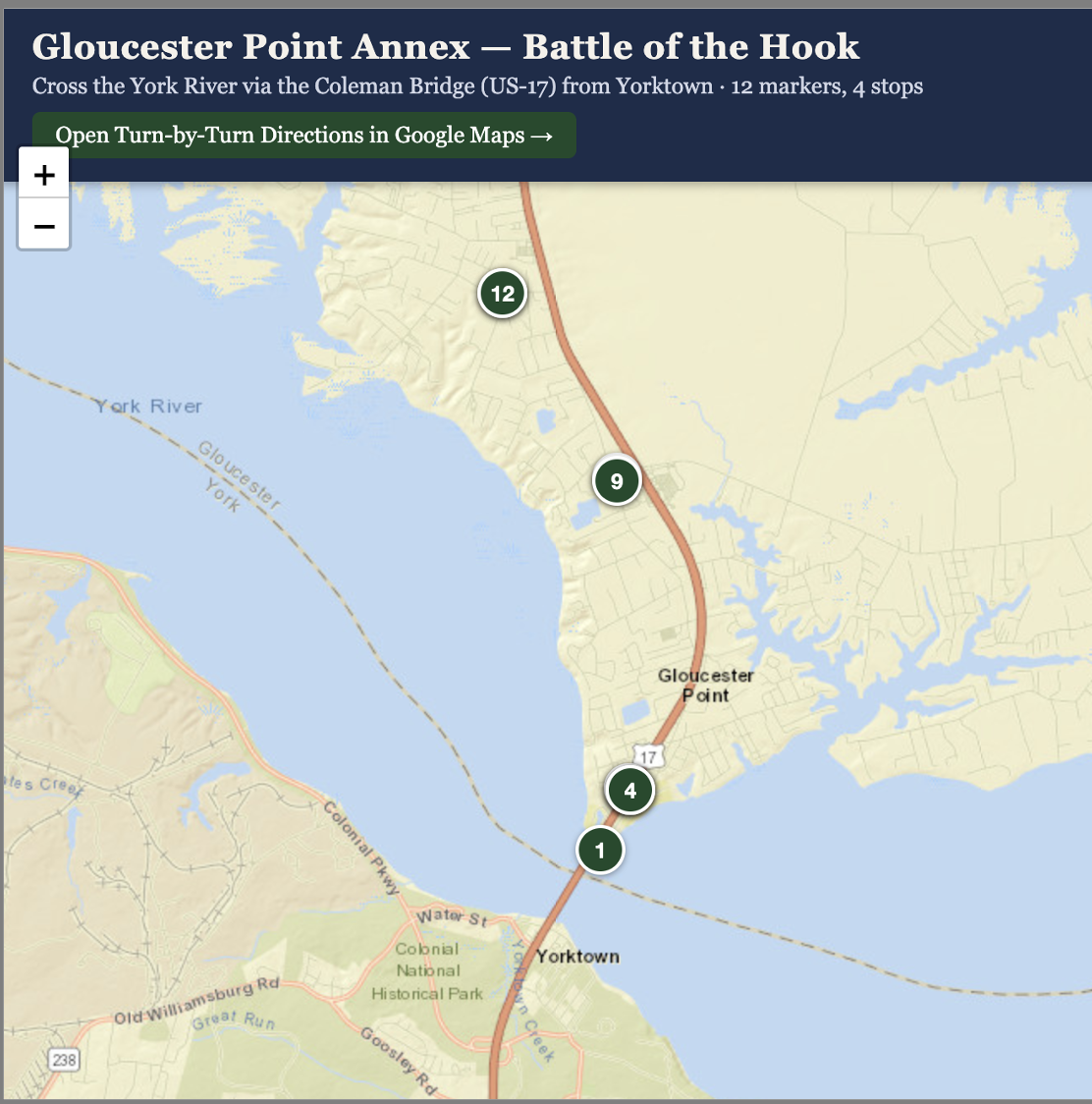
https://souvenirfrancaisusa.org/wp-content/uploads/2026/09/Gloucester_Annex_Map.html
| |
Our tour differs slightly from the two tours proposed at the Visitor Center. Signs with red arrows are for the Yorktown Battlefield Tour. Signs with yellow arrows are for the Allied Encampment Tour. The tour we propose in this Bulletin only selects the markers and monuments dedicated to the French forces.
A complete tour can take more than 2 1/2 hours by car, if you are interested in stopping near the markers, walking around, and meditating a bit instead of just sitting in the car!
We grouped them by clusters of markers and plaques along the way, rather than in chronological order. We start at the Monument to Alliance and Victory column, and end at the French Memorial.
The second part, which we also recommend, is across the York River in Gloucester, and takes about an hour to complete by car (stops not included). You may choose to do everything in one day, but it may be an overdose of history. Or, simply read this Bulletin piecemeal, at your leisure.
En route!
| |
Stop #1
Monument to Alliance and Victory
| | |
Above :
Monument to Alliance & Victory, and nearby bronze plaques embedded in concrete above the lawn.
Photos: TC © ASSFI 2020 & 2021
| | |
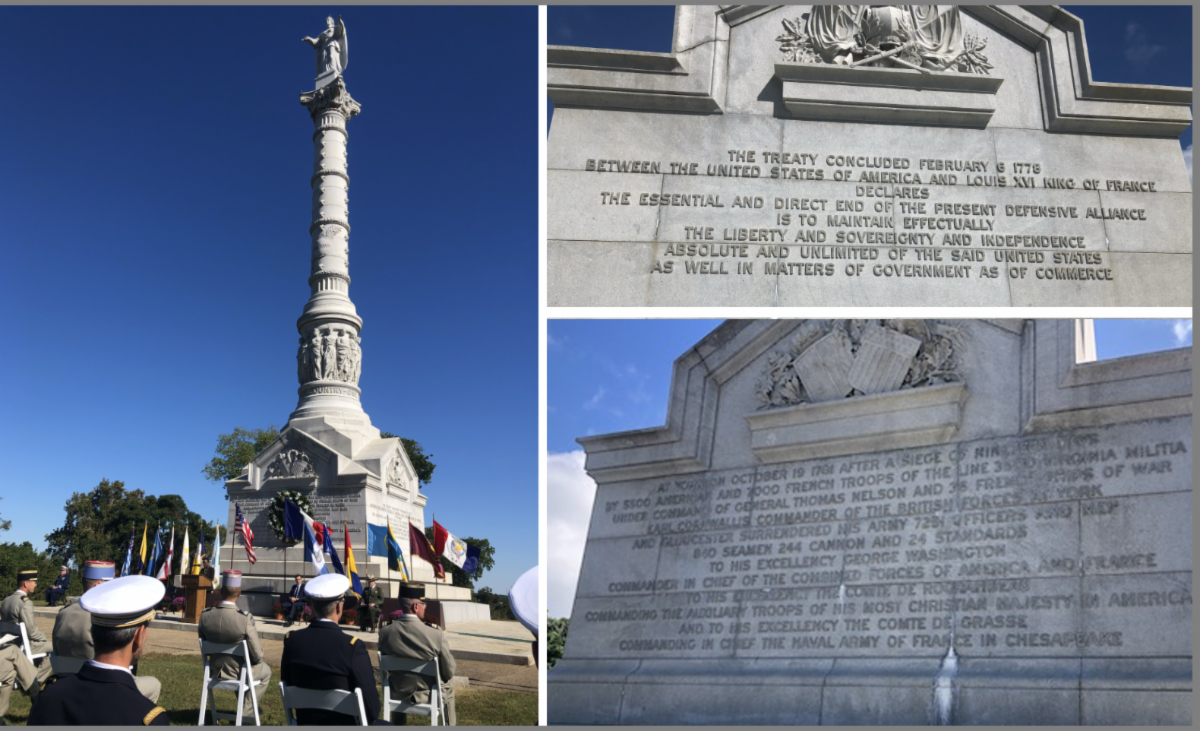
A short walk from the Visitors Center, stands a tall Maine granit column, 84' high (98' with the figure of Liberty on top). A marker recalls that this column was decided by Congress in 1781, however it was erected in 1881 and completed in 1884. The “Monument to the Alliance and Victory" is the official name and was the first monument ever authorized by the Federal Government.
“Resolved, That … Congress … will cause to be erected at York, in Virginia, a marble column, adorned with emblems of the alliance between the United States and his Most Christian Majesty; and inscribed with a succinct narrative of the surrender of Earl Cornwallis to his excellency General George Washington … to his excellency the Count de Rochambeau … and his excellency the Count de Grasse ….” Journals of Congress, October 29, 1781
"Just 10 days after the victory at Yorktown, the Continental Congress directed a monument be built to commemorate the siege and the American-French alliance. However, funds were not legislated for its construction until 1880, as the continental anniversary of the battle approached.
A congressional committee of legislators from the original 13 colonies delegated oversight of the project to the Secretary of War, who in turn, chose architects, Richard M. Hunt and Henry Van Brunt, and sculptor John Quincy Adams Ward to design the new monument. The country’s spirit of reconciliation in the aftermath of the Civil War affected the design, as evidenced by the inscription, “One Country, One Constitution, One Destiny” on the monument’s shaft.
On October 18, 1881, the cornerstone for the monument was dedicated during events commemorating the 100th anniversary of the siege. "
#1 to #4: Monument to the Alliance & Victory
GPS: 37.233510, -76.505041
• Inscription front (South) side:
“At York on October 19 1781, after a siege of nineteen days by 5500 American and 7000 French troops of the line, 3500 Virginia Militia under command of General Thomas Nelson and 36 French ships of war, Earl Cornwallis, commander of the British forces at York and Gloucester, surrendered his army, 7251 officers and men, 840 seamen, 244 cannon and 24 standards, to his Excellency George Washington, Commander in Chief of the combined forces of America and France, to his Excellency the Comte de Rochambeau commanding the auxiliary troops of his most Christian Majesty in America and to his Excellency the Comte de Grasse Commanding in Chief the naval army of France in Chesapeake” Erected 1881 by United States of America
• Inscription right (East) side:
“The treaty concluded Feb 6 1778 between the U.S.A. and Louis XVI King of France declares the essential & direct end of the present defensive alliance is to maintain effectually the liberty & sovereignty & independence absolute & unlimited of the said U.S. as well in matters of government as of commerce” Erected 1881 by United States of America
• Inscription back (North) side:
« Erected in pursuance of a resolution of Congress adopted Oct 29 1781 & an act of congress approved June 7 1880 to commemorate the victory by which the independence of the U.S.A. was achieved” Erected 1881 by United States of America
• Inscription left (West) side:
“The provisional Articles of Peace concluded Nov 30, 1782 & the definitive treaty of peace concluded Sept 3 1783 between the U.S.A. and George III King of Great Britain & Ireland declare His Britannic Majesty acknowledges the said U.S. viz New Hampshire Massachusetts Bay Rhode Island and Providence Plantations Connecticut New York new Jersey Pennsylvania Delaware Maryland Virginia North Carolina South Carolina and Georgia to be free sovereign and independent states” Erected 1881 by United States of America
| | |
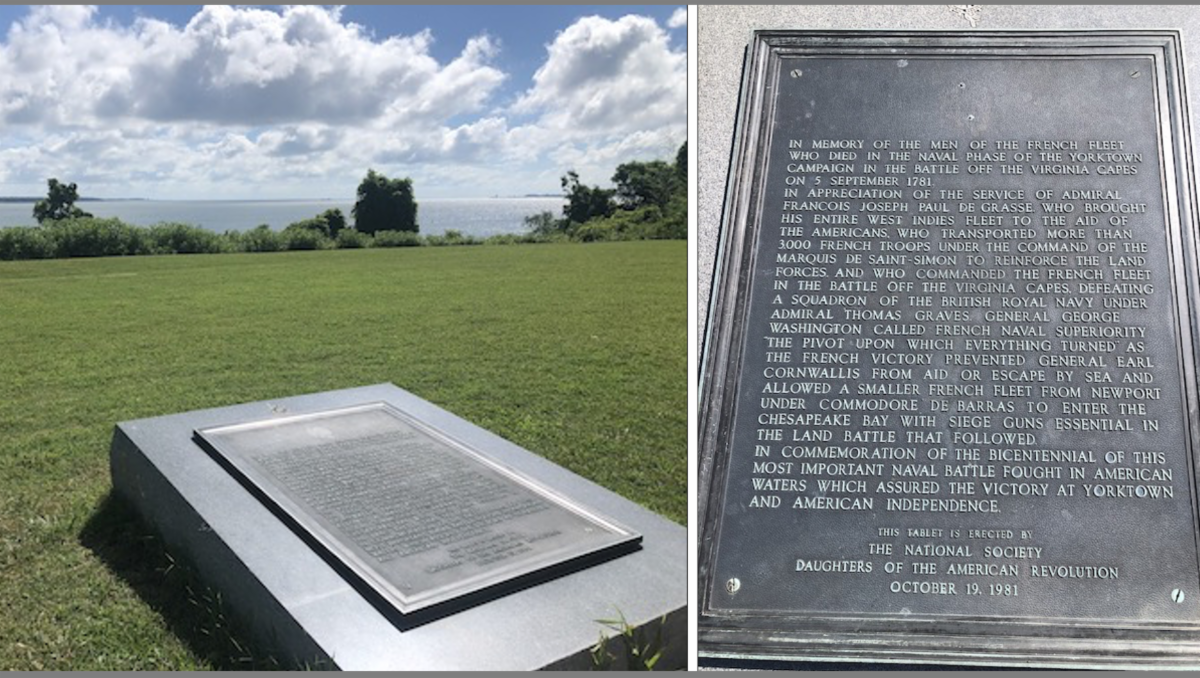
#5 Plaque, « In memory of the men of the French Fleet »
A few feet near the Monument to the Alliance & Victory
GPS: 37.233462, -76.504745
• Inscription:
“In memory of the men of the French Fleet who died in the naval phase of the Yorktown campaign in the Battle off the Virginia Capes on 5 September 1781.
In appreciation of the service of Admiral François Joseph Paul de Grasse who brought his entire West Indies Fleet to the aid of the Americans, who transported more than 3000 French troops under the command of the Marquis de Saint-Simon to reinforce the land Forces, and who commanded the French Fleet in the battle off the Virginia Capes, defeating a squadron of the British Royal Navy under Admiral Thomas Graves. General George Washington called French naval superiority “the pivot upon which everything turned” as the French victory prevented General Earl Cornwallis from aid or escape by sea and allowed a smaller French Fleet from Newport under Commodore de Barras to enter the Cheasapeake Bay with siege guns essential in the land battle that followed. In commemoration of the bicentennial of this most important naval battle fought in American waters which assured the victory at Yorktown and American Independence.
This tablet is erected by The National Society Daughters of the American Revolution October 19, 1981”
| | |
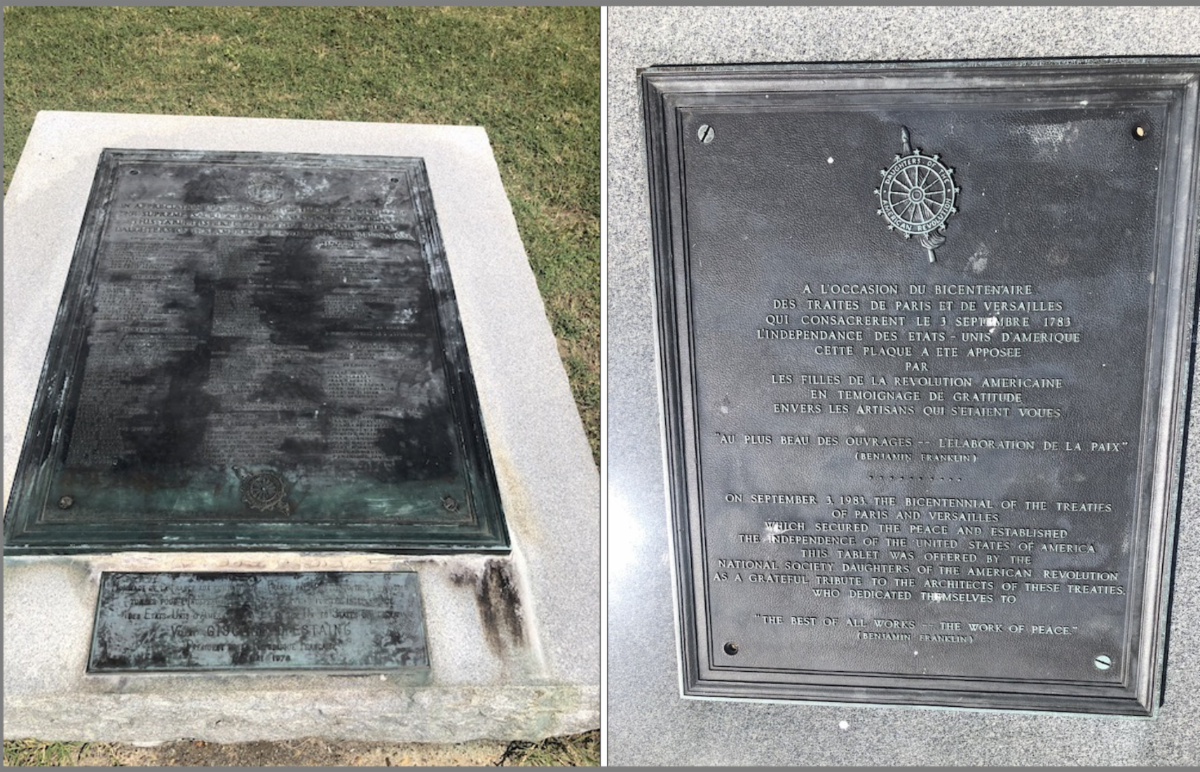
#6 Plaque, « In memory of ...»
A few feet near the Monument to the Alliance & Victory
GPS: 37.233494, -76.505094
• Inscription:
In appreciation of the service of these men who made
The supreme sacrifice in the Yorktown campaign 1781
This tablet is erected by the National Society
Daughters of the American Revolution October 19, 1931
[Names of the Fallen and their regiments]
• Inscription additional tablet :
"Hommage de la France aux Combattants France pays tribute to those who died
Tombés pour l’Indépendance Fighting for the independence
Des Etats-Unis d’Amérique Of the United States of America
Valéry Giscard d’Estaing
President de la République Française
19 mai 1976"
#7 Marker, « Bicentennial of the Treaties of Paris and Versailles”
A few feet near the Monument to the Alliance & Victory
GPS: 37.233494, -76.505094
• Inscription:
“A l'occasion du bicentenaire des traites de Paris et de Versailles qui consacrerent le 3 septembre 1783 l'Independance des Estats-Unis d'Amerique cette plaque a ete apposee par les Filles de la Revolution Americaine en temoignage de gratitude envers les artisans qui s'etaient voues
"Au plus beau des ouvrages -- l'elaboration de la paix"
(Benjamin Franklin)
On September 3, 1983, the bicentennial of the Treaties of Paris and Versailles which secured the peace and established the Independence of the United States of America. This tablet was offered by the National Society, Daughters of the American Revolution as a grateful tribute to the architects of these treaties, who dedicated themselves to
"The best of all works -- the work of peace."
(Benjamin Franklin)
Erigé par le National Society, Daughters of the American Revolution.
| | |
Stop #2:
Historic quarter, Yorktown
| | |
Above:
Old Custom House with tablet above the entrance door. Photos: TC © ASSFI 2020
| | |
A few steps from the Victory monument, you should stroll throught the historic area of Yorktown, along many charming houses that were built or rebuilt after the war.
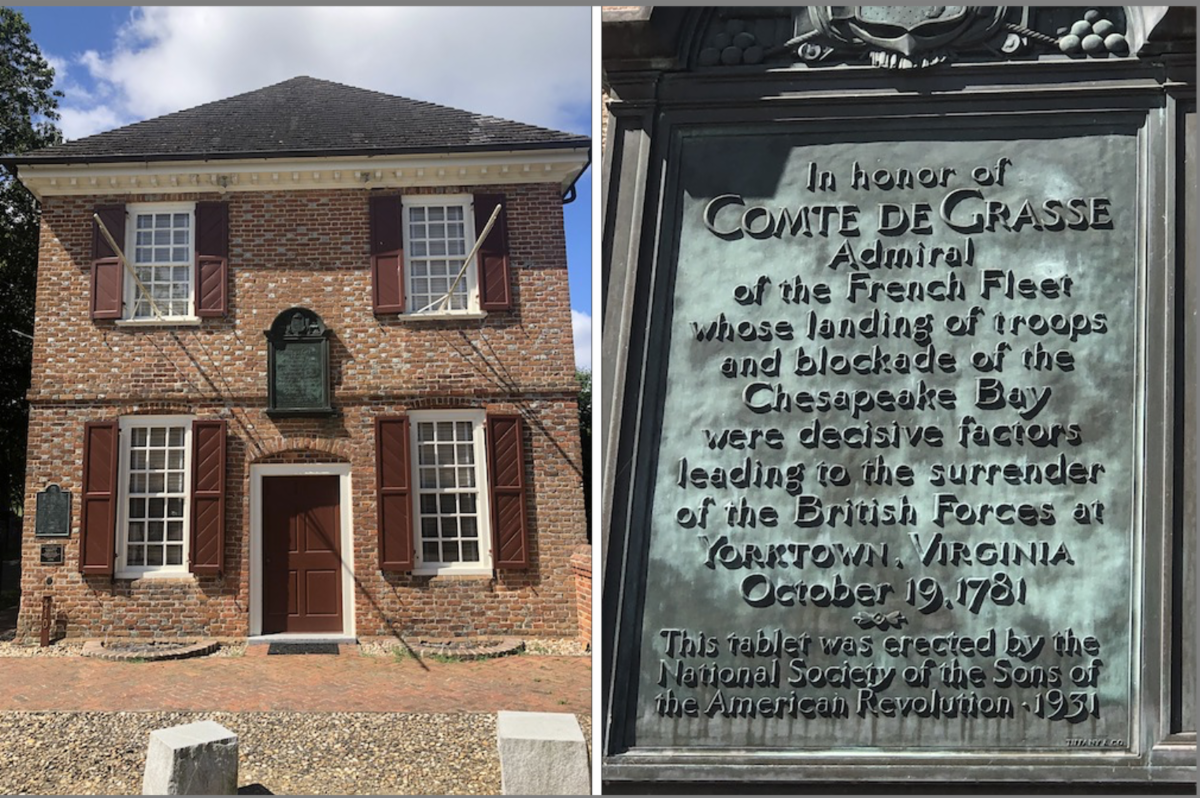
#8 Tablet, Comte de Grasse, at Old Custom House
410 Main Street, Yorktown, VA 23690
In the heart of historic Newport
GPS: 37.234885, -76.507711
• Inscription:
“In honor of
COMTE DE GRASSE
Admiral
of the French Fleet
whose landing of troops
and blockade of the
Chesapeake Bay
were decisive factors
leading to the surrender
if the British Forces at
YORKTOWN, VIRGINIA
October 19, 1781
This tablet was erected by the
National Society of the Sons of
the American Revolution 1931”
Although not related to the events in Yorktown in 1781, we point out this bronze plaque reminding tourists that Gen. George Washington's ancestor was French:
Plaque, “Site of the Home of Nicolas Martiau”
114 Ballard St, Yorktown, VA 23690
GPS: 37.236750, -76.508517
• Inscription:
“The adventurous Huguenot
who was born in France 1591
Came to Virginia 1620
and died at Yorktown 1657
He was a captain in the Indian uprising
A member of the House of Burgesses
Justice of the County of York
In 1635 a leader
in the thrusting out of Governor Harvey
which was the first opposition
to the British colonial policy
The patentee for Yorktown
and through the marriage
of his daughter Elizabeth
to Col. George Reade he became
the earliest American ancestor of both
General George Washington
and Governor Thomas Nelson”
Erected 1931, Huguenot Society of Pennsylvania"
Take one of the streets that lead steeply downhill toward downtown to reach the Riverwalk promenade.
| | |
Stop #3
Riverwalk Landing
| | |
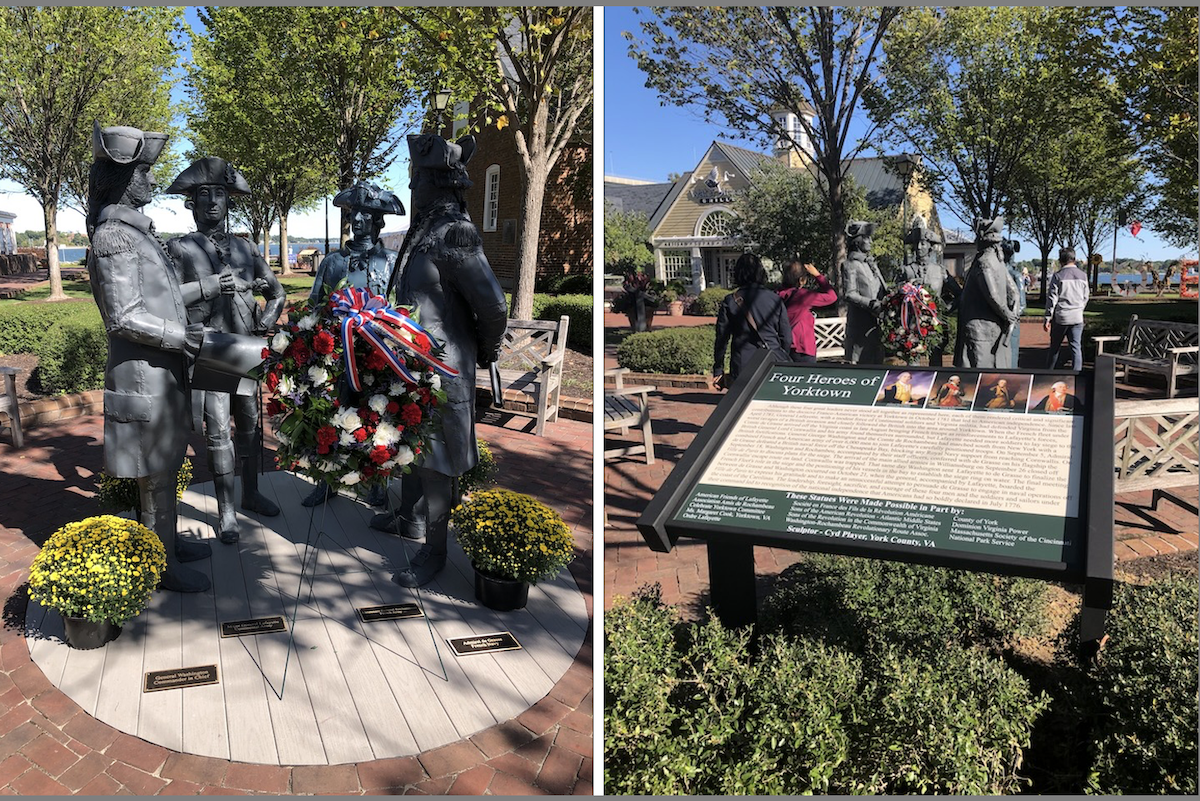
#9 Washington, Lafayette, de Grasse & Rochambeau statues
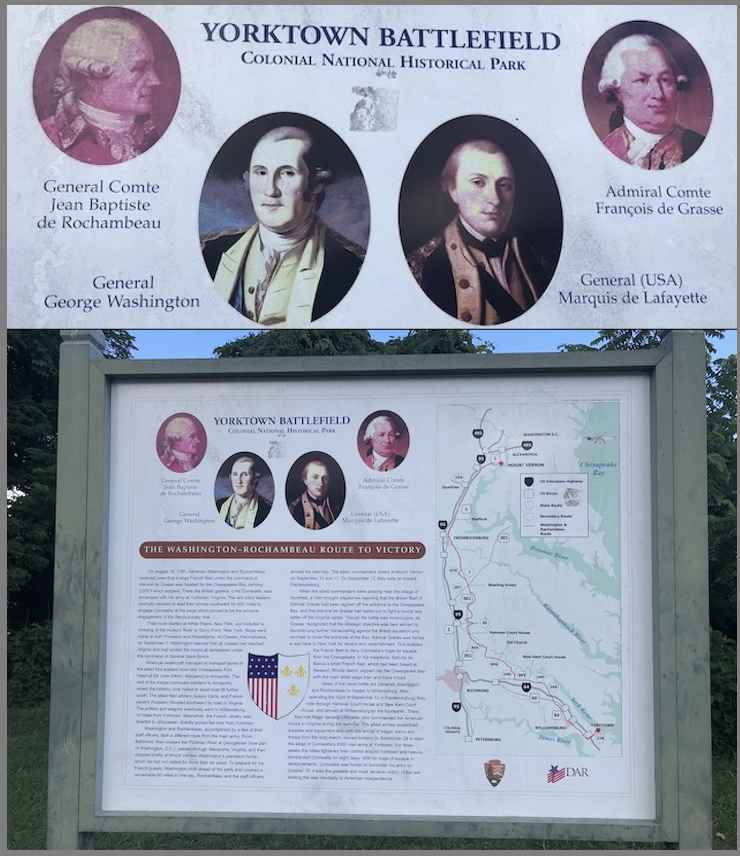
• The statues standing at Riverwalk Landing were only two when inaugurated in 2005: General George Washington, Commander of the American forces and Admiral Francois DeGrasse, Commander of the French Fleet. On October 18, 2017, General Lafayette joined them, and on October 18, 2021, Comte de Rochambeau joined his comrades-in-arms and the conversation for eternity.
• The display was celebrated as a symbol of French and American friendship that several people at the ceremony said started with the popularity of Lafayette and his love for the United States.
• Cyd Player, is a Williamsburg-based artist who sculpted the four statues. She spent about 10 months on Lafayette alone.
• The American Friends of Lafayette led the fundraising for the statue and credited the Celebrate Yorktown Committee for being the top donor. The Massachusetts Society of the Cincinnati and members of the Ordre Lafayette contributed as well.
#10 Marker "Four Heroes of Yorktown"
Riverwalk Landing, Sidewalk along Water Street, Yorktown, VA
GPS: 37.238536, -76.508676
• Inscription:
“Although these four great leaders never stood altogether as represented here, each of them rendered critical and significant contributions ot the decisive Franco-American victory at Yorktown in October 1781 that led to American independence. Since late April 1781, General Lafayette, with a modest force of Continental soldiers and Virginia militia, had defended Virginia from the worst ravages of a British invasion and closely followed the British into the area around Yorktown. When the French fleet under Comte de Grasse arrived of the Virginia coast in late August bringing French troops as reinforcements to Lafayette's forces, British General Lord Cornwallis and his army found themselves surrounded, but Lafayette needed more soldiers to lay siege to the British fortifications. General George Washington and the Comte de Rochambeau had marched south from New York with a combined French and American army of over 6,000 men* to join Lafayette's carefully positioned troops. On September 5, Admiral de Grasse defeated a British naval force off the Chesapeake Bay, blocking any Royal Navy support from reaching Cornwallis. On September 18, Washington and Rochambeau, accompanied by their staff officers, conferred with de Grasse on his flagship the Ville de Paris to discuss plans for the siege. The arrival of the main allied armies in Williamsburg on September 26 closed of Cornwallis' escape route on land. Cornwallis was trapped. That same day Washington sent Lafayette to de Grasse to finalize the French Fleet's role in the siege and the positioning of his vessels in the bay to establish the siege ring on water. The final meeting between de Grasse and Washington occurred on October 21, when the general, accompanied by Lafayette, boarded the Ville de Paris to express his gratitude and to make an unsuccessful attempt to persuade de Grasse to engage in naval operations off the coast of the Carolinas. The leadership, foresight, sacrifice, and courage of these four men and the soldiers and sailors under their command led to recognition of the national independence that Americans had so boldly declared in July 1776.”
Erected 2021 by York County."
Note: * the number 6,000 men is erroneous. The combined French & American forces marching to Yorktown were approximately 12,000.
#11 Markers, George Washington and Francois De Grasse
On Water Street west of Buckner Street, Yorktown, VA 23690
GPS: 37.238536, -76.508676
• Inscription :
“Two of the most significant Revolutionary War
leaders at Yorktown were
General George Washington
in command of the Allied ground forces, and
Admiral Francois de Grasse
in command of the French fleet controlling the
nearby waters. Their roles were closely linked but
they only met twice. Both meetings were held on De
Grasse’s flagship, Ville de Paris.
The first was on September 20, 1781
to complete planning for the attack onYorktown
and the other was on October 21
to explore future operations in the south.
This tribute has been made possible by the Yorktown Foundation with special thanks to:
The Celebrate Yorktown Committee, The County of York, Va, Ms. Margaret Cook, Yorktown, Va, Dominion Virginia Power, Sculptor – Cyd Player, York County, Va”
Our marker is next to another marker, commemorating Lafayette's visit in 1824 and erected by our friends at the Lafayette Trail, Inc. (more about its significance at the Epilogue section further down), and another interpretive marker, erected by the County of York. Note that the numbers of Allied forces align with our own.
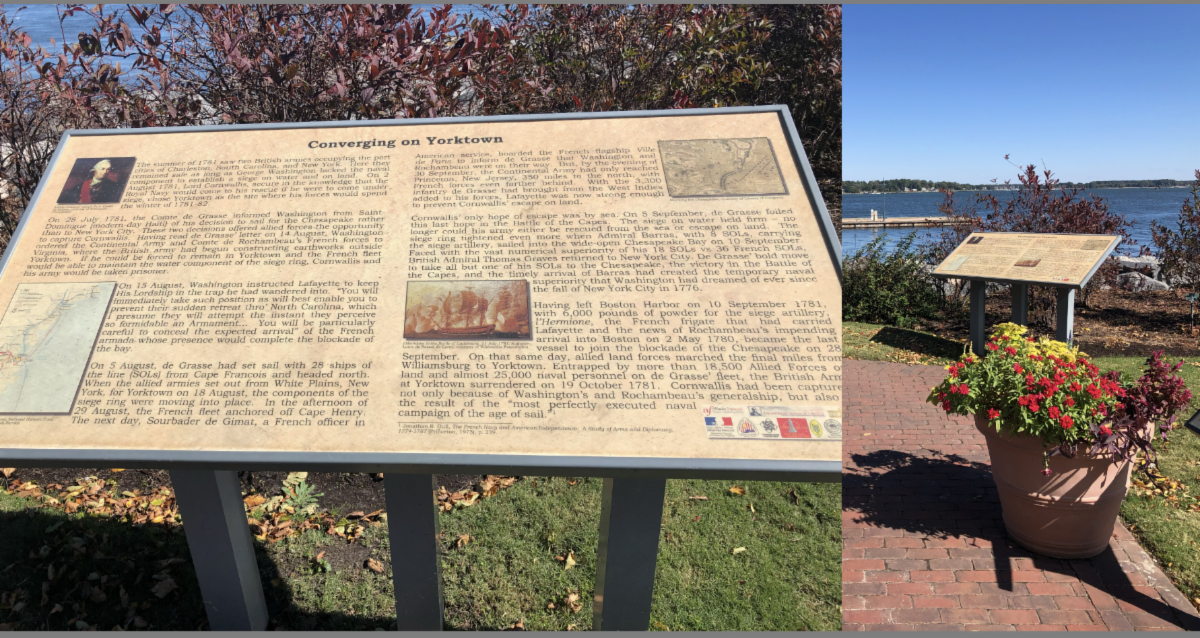
#12 Marker, « Converging on Yorktown“
Riverwalk, 323 Water Street, Yorktown VA 23690
GPS: 37.238883, -76.508167
• Inscription (excerpts):
“On 5 August, de Grasse had set sail with 28 ships of the line (SOLs) from Cape Francois and headed north. When the allied armies set out from White Plains, New York, for Yorktown on 18 August, the components of the siege ring were moving into place. In the afternoon of 29 August, the French fleet anchored off Cape Henry. The next day, Sourbader de Gimat, a French officer in American service, boarded the French flagship Ville de Paris to inform de Grasse that Washington and Rochambeau were on their way. But, by the evening of 30 September, the Continental Army had only reached Princeton, New Jersey, 350 miles to the north, with French forces even farther behind. With the 3,300 infantry de Grasse had brought from the West Indies added to his forces, Lafayette was now strong enough to prevent Cornwallis' escape on land.
Cornwallis' only hope of escape was by sea. On 5 September, de Grasse foiled this last hope in the Battle of the Capes. The siege on water held firm - no longer could his army either be rescued from the sea or escape on land. The siege ring tightened even more when Admiral Barras, with 8 SOLs, carrying the siege artillery, sailed into the wide-open Chesapeake Bay on 10 September. Faced with the vast numerical superiority of his 18 SOLs vs 36 French SOLs, British Admiral Thomas Graves returned to New York City. De Grasse' bold move to take all but one of his SOLs to the Chesapeake, the victory in the Battle of the Capes, and the timely arrival of Barras had created the temporary naval superiority that Washington had dreamed of ever since the fall of New York City in 1776”.
[...] Having left Boston Harbor on 10 September 1781, with 6,000 pounds of powder for the siege artillery, L'Hermione, the French frigate that had carried Lafayette and the news of Rochambeau's impending arrival into Boston on 2 May 1780, became the last vessel to join the blockade of the Chesapeake on 28 September. On that same day, allied land forces marched the final miles from Williamsburg to Yorktown. Entrapped by more than 18,500 Allied Forces on land and almost 25,000 naval personnel on de Grasse’s fleet, the British Army at Yorktown surrendered on October 19, 1781. Cornwallis had been captured not only because of Washington's and Rochambeau's generalship, but also as the result of the "most perfectly executed naval campaign of the age of sail.”
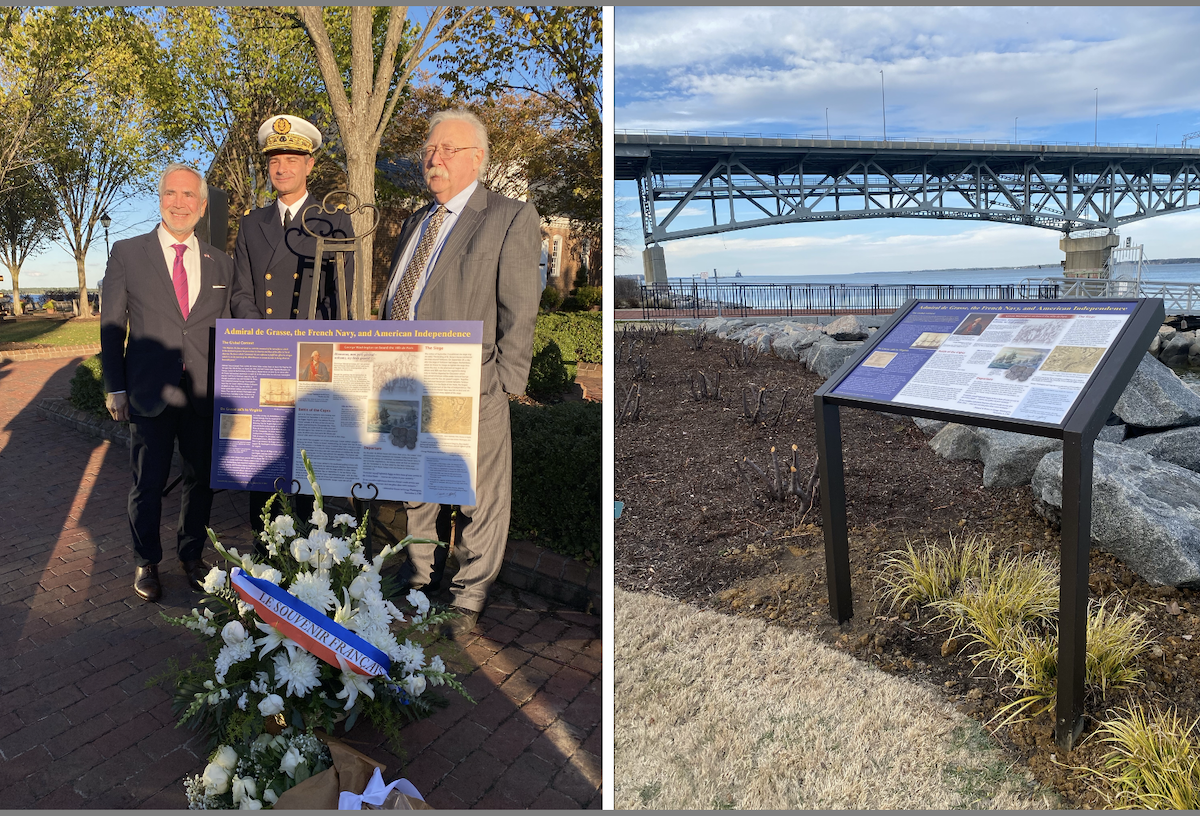
A few steps behind this sculptural grouping, and near the marker above by the river, stands a marker erected by our Society in 2022:
| | |
Above:
Top Left: Thierry Chaunu, Rear Admiral Frédéric de Rupilly, French Navy, and Dr. Robert A. Selig, Ph.D. (writer of the text of the marker) at the dedication ceremony, October 18, 2022. Photo: courtesy of York County
Top Right: interpretive marker in situ, Riverwalk.
Below: Markers Lafayette Tour and "Converging in Yorktown", All photos: TC © ASSFI 2022
| |
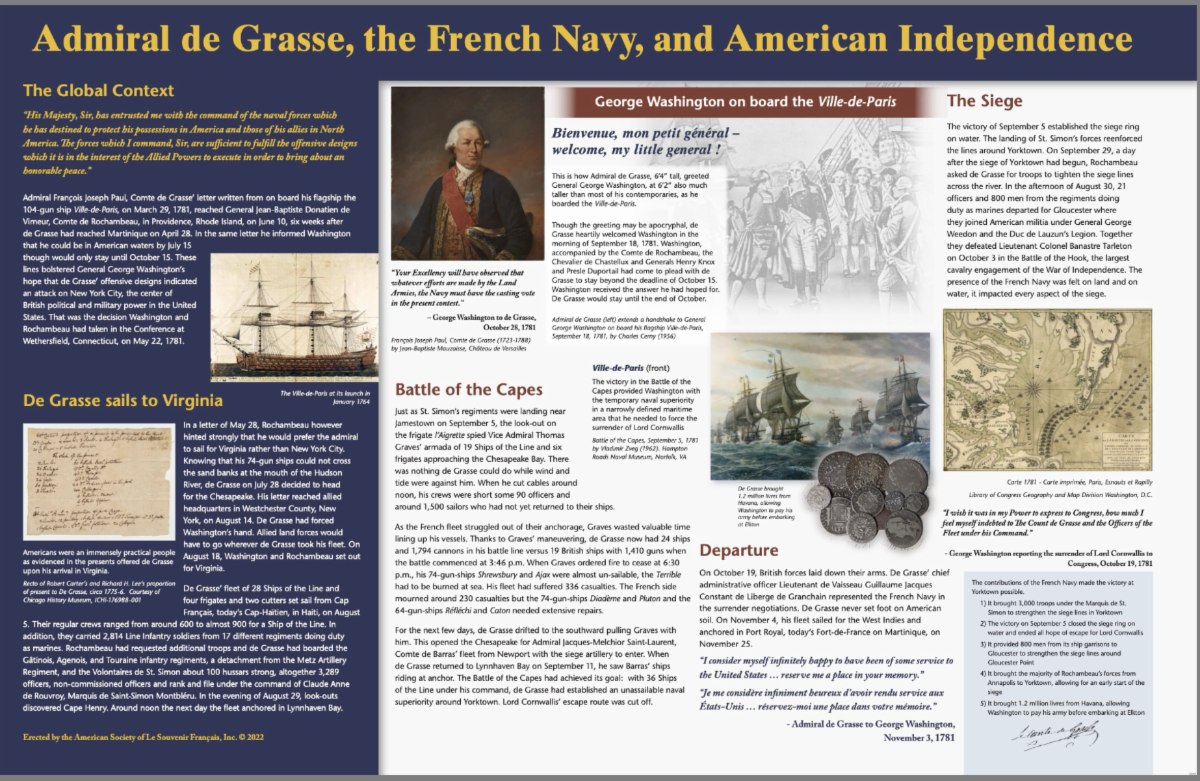
#13 Marker, « Amiral de Grasse, the French Navy and American Independence“
Riverwalk, 323 Water Street, Yorktown VA 23690
GPS: 37.238921, -76.508253
• Inscription (excerpts):
“His Majesty, Sir, has entrusted me with the command of the naval forces which he has destined to protect his possessions in America and those of his allies in North America. The forces which I command, Sir, are sufficient to fulfill the offensive designs which it is in the interest of the Allied Powers to execute in order to bring about an honorable peace.” —– Admiral François Joseph Paul, comte de Grasse’ letter written from on board his flagship the 104-gun ship Ville-de-Paris, on March 29, 1781.
“Admiral François Joseph Paul, Comte de Grasse' letter written from on board his flagship the 104-gun ship Ville-de-Paris, on March 29, 1781, reached General Jean-Baptiste Donatien de Vimeur, Comte de Rochambeau, in Providence, Rhode Island, on June 10, six weeks after de Grasse had reached Martinique on April 28. In the same letter he informed Washington that he could be in American waters by July 15 though would only stay until October 15. These lines bolstered General George Washington's hope that de Grasse offensive designs indicated an attack on New York City, the center of British political and military power in the United States. That was the decision Washington and Rochambeau had taken in the Conference at Wethersfield, Connecticut, on May 22, 1781.”
De Grasse sails to Virginia
In a letter of May 28, Rochambeau however hinted strongly that he would prefer the admiral to sail for Virginia rather than New York City. Knowing that his 74-gun ships could not cross the sand banks at the mouth of the Hudson River, de Grasse on July 28 decided to head for the Chesapeake. His letter reached allied headquarters in Westchester County, New York, on August 14. De Grasse had forced Washington's hand. Allied land forces would have to go wherever de Grasse took his fleet. On August 18, Washington and Rochambeau set out for Virginia
De Grasse' fleet of 28 Ships of the Line and four frigates and two cutters set sail from Cap Français, today's Cap-Haïtien, in Haiti, on August 5. Their regular crews ranged from around 600 to almost 900 for a Ship of the Line. In addition, they carried 2,814 Line Infantry soldiers from 17 different regiments doing duty as marines. Rochambeau had requested additional troops and de Grasse had boarded the Gâtinois, Agenois, and Touraine infantry regiments, a detachment from the Metz Artillery Regiment, and the Volontaires de St. Simon about 100 hussars strong, altogether 3,289 officers, non-commissioned officers and rank and file under the command of Claude Anne de Rouvroy, Marquis de Saint-Simon Montbléru. In the evening of August 29, look-outs discovered Cape Henry. Around noon the next day the fleet anchored in Lynnhaven Bay.”
Battle of the Capes
Just as St. Simon's regiments were landing near Jamestown on September 5, the look-out on the frigate l'Aigrette spied Vice Admiral Thomas Graves' armada of 19 Ships of the Line and six frigates approaching the Chesapeake Bay. There was nothing de Grasse could do while wind and tide were against him. When he cut cables around noon, his crews were short some 90 officers and around 1,500 sailors who had not yet returned to their ships.”
“As the French fleet struggled out of their anchorage, Graves wasted valuable time lining up his vessels. Thanks to Graves' maneuvering, de Grasse now had 24 ships and 1,794 cannons in his battle line versus 19 British ships with 1,410 guns when the battle commenced at 3:46 p.m. When Graves ordered fire to cease at 6:30 p.m., his 74-gun-ships Shrewsbury and Ajax were almost un-sailable, the Terrible had to be burned at sea. His fleet had suffered 336 casualties. The French side mourned around 230 casualties but the 74-gun-ships Diadème and Pluton and the 64-gun-ships Réfléchi and Caton needed extensive repairs.
For the next few days, de Grasse drifted to the southward pulling Graves with him. This opened the Chesapeake for Admiral Jacques-Melchior Saint-Laurent, Comte de Barras' fleet from Newport with the siege artillery to enter. When de Grasse returned to Lynnhaven Bay on September 11, he saw Barras ships riding at anchor. The Battle of the Capes had achieved its goal; with 36 Ships of the Line under his command, de Grasse had established an unassailable naval superiority around Yorktown. Lord Cornwallis escape route was cut off.”
George Washington on board the Ville-de-Paris
“Bienvenue, mon petit général - welcome, my little general!”
“This is how Admiral de Grasse, 6'4" tall, greeted General George Washington, at 6'2" also much taller than most of his contemporaries, as he boarded the Ville-de-Paris.
Though the greeting may be apocryphal, de Grasse heartily welcomed Washington in the morning of September 18, 1781. Washington, accompanied by the Comte de Rochambeau, the Chevalier de Chastellux and Generals Henry Knox and Presle Duportail had come to plead with de Grasse to stay beyond the deadline of October 15. Washington received the answer he had hoped for. De Grasse would stay until the end of October.”
The Siege
“The victory of September 5 established the siege ring on water. The landing of St. Simon's forces reenforced the lines around Yorktown. On September 29, a day after the siege of Yorktown had begun, Rochambeau asked de Grasse for troops to tighten the siege lines across the river. In the afternoon of August 30, 21 officers and 800 men from the regiments doing duty as marines departed for Gloucester where they joined American militia under General George Weedon and the Duc de Lauzun's Legion. Together they defeated Lieutenant Colonel Banastre Tarleton on October 3 in the Battle of the Hook, the largest cavalry engagement of the War of Independence. The presence of the French Navy was felt on land and on water, it impacted every aspect of the siege.”
The contributions of the French Navy made the victory at Yorktown possible.
1) It brought 3,000 troops under the Marquis de St. Simen to strengthen the siege lines in Yorktown
2) The victory on September 5 closed the siege ring on water and ended all hope of escape for Lord Cornwallis
3) It provided 800 men from its ship garrisons to Gloucester to strengthen the siege lines around Gloucester Point
4) It brought the majority of Rochambeau’s forces from Annapolis to Yorktown, allowing for an early start of the siege
5) It brought 1.2 million livres from Havana, allowing Washington to pay his Army before embarking at Elkton”
Departure
“On October 19, British forces laid down their arms. De Grasse' chief administrative officer Lieutenant de Vaisseau Guillaume Jacques Constant de Liberge de Granchain represented the French Navy in the surrender negotiations. De Grasse never set foot on American soil. On November 4, his fleet sailed for the West Indies and anchored in Port Royal, today's Fort-de-France on Martinique, on November 25.”
“I consider myself infinitely happy to have been of some service to the United States... reserve me a place in your memory."
-Admiral de Grasse to George Washington, November 3, 1781
After all this reading, you might want to grab some excellent food and refreshments from the restaurants nearby! You will need to climb up the street to retrieve your car at the visitor parking lot and start the driving tour on the Yorktown Battlefield Auto Tour.
| | |
Stop #4
Siege Lines
Grand French Battery
| | |
Above:
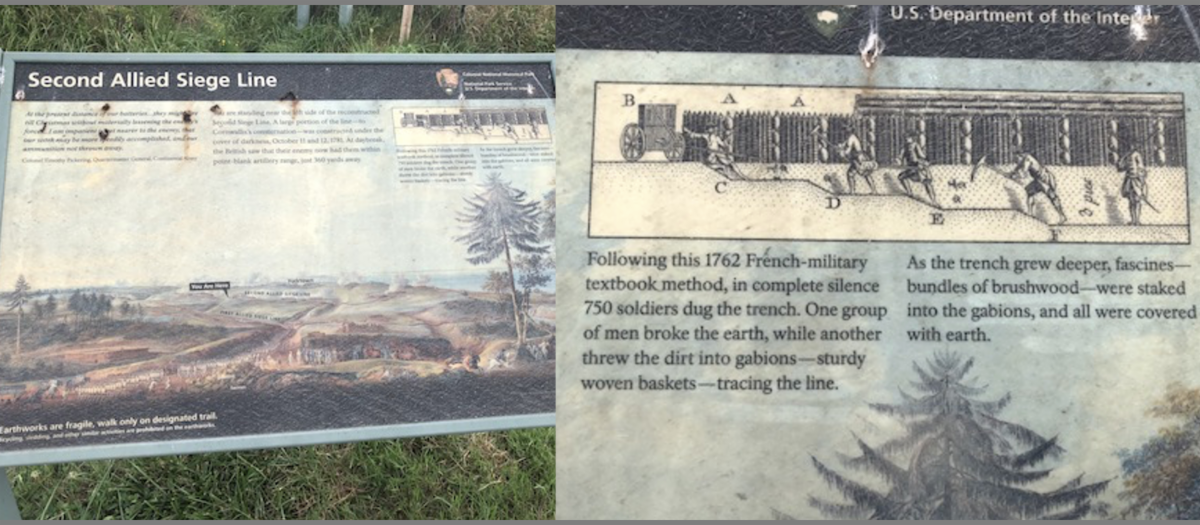
Detail of marker, "Second Allied Siege Line", describing the siege technique. French engineers served both within the French Army and the Continental Army. Photos: TC © ASSFI 2020
| | |
#14 Marker, “Surrender at Yorktown Colonial National Historical Park”
Colonial National Historical Park, Yorktown, VA 23690
Marker is on Cook Road, on the right when traveling north. Marker is located on the Yorktown Battlefield in Colonial National Historical Park, at stop “C” on the Battlefield Tour
GPS: 37.226224, -76.506039
• Excerpts from Marker:
“Near this spot on the afternoon of October 19, 1781 – as silence prevailed among the Allied soldiers and onlookers – all eyes were trained on the approaching British troops. Cornwallis, sending word that he was ill, appointed his second in command, Brigadier General Charles O’Hara, to surrender his sword. O’Hara mistakenly approached French General Rochambeau to present the sword. He was quickly corrected and led to Washington, the supreme commander of the Allied forces. Washington refused to take the blade from O’Hara’s “good hand,” and referred him to Major General Benjamin Lincoln, his second in command. Lincoln, accepting it, escorted O’Hara to an open field about one and a half miles from here, where British and German soldiers, regiment after regiment, grounded their arms.”
Erected by Colonial National Historical Park, National Park Service.
#15 Marker, Second Allied Siege Line
Colonial National Historical Park, Yorktown, VA 23690
On the Yorktown Battlefield in Colonial National Historical Park, at stop C on the Battlefield Tour
GPS: 37.226207, -76.505799
• Inscription:
“At the present distance of our batteries … they might fire till Christmas without materially lessening the enemy’s force …. I am impatient to get nearer to the enemy, that our work may be more speedily accomplished, and our ammunition not thrown away.
— Colonel Timothy Pickering, Quartermaster General, Continental Army
You are standing near the left side of the reconstructed Second Siege Line. A large portion of the line – to Cornwallis’s consternation – was constructed under the cover of darkness, October 11 and 12, 1781. At daybreak, the British saw that their enemy now had them within point-blank artillery range, just 360 yards away.
Erected by Colonial National Historical Park, National Park Service”.
The upper right of the marker contains an illustration of the siege fortifications with the caption “Following this 1762 French-military textbook method, in complete silence 750 soldiers dug the trench. One group of men broke the earth, while another threw the dirt into gabions – sturdy woven baskets – tracing the line. As the trench grew deeper, fascines – bundles of brushwood – were staked into the gabions, and all were covered with earth.”
| | Above: Photos: TC © ASSFI 2020 | | |
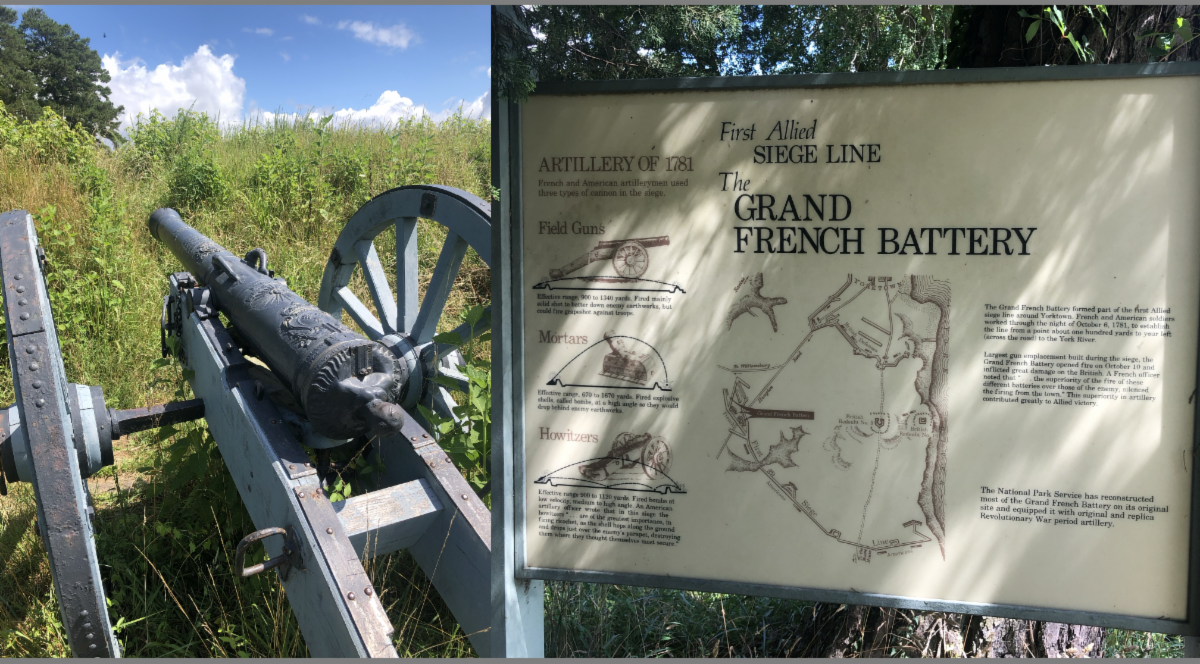
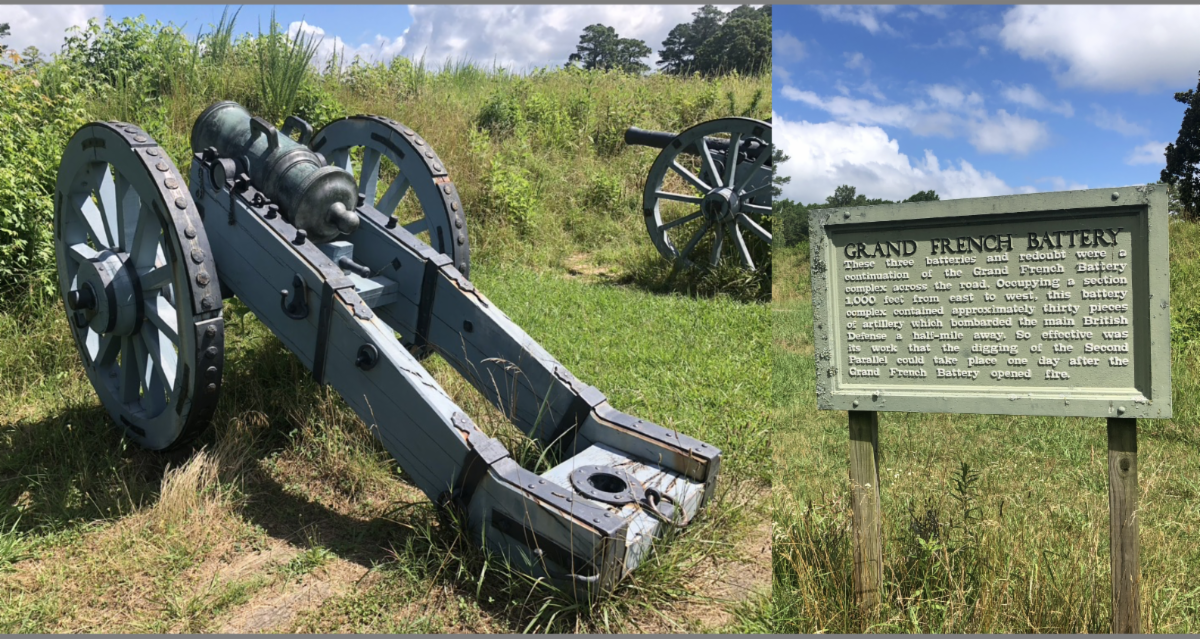
#16 Marker, Grand French Battery
Colonial National Historical Park, Yorktown, VA 23690
Marker is on on Cook Road (Virginia Route 704) Battlefield in Colonial National Historical Park, near stop “B” on the Battlefield Tour
GPS: 37.223524, -76.506894
• Inscription:
“These three batteries and redoubt were a continuation of the Grand French Battery complex across the road. Occupying a section 1,000 feet from east to west, this battery complex contained approximately thirty pieces of artillery which bombarded the main British Defense a half-mile away. So effective was its work that the digging of the Second Parallel could take place one day after the Grand French Battery opened fire.”
Erected by National Park Service”.
#17 Marker, The Grand French Battery
First Allied Siege Line
Yorktown, VA 23690
Marker is on on Cook Road (Virginia Route 704) Battlefield in Colonial National Historical Park, near stop “B” on the Battlefield Tour
GPS: 37.223374, -76.506417
• Inscription:
“The Grand French Battery formed part of the first Allied siege line around Yorktown. French and American soldiers worked through the night of October 6, 1781, to establish the line from a point about one hundred yards to your left (across the road) to the York River.
Largest gun emplacement built during the siege, the Grand French Battery opened fire on October 10 and inflicted great damage on the British. A French officer noted that “ … the superiority of the fire of these different batteries over those of the enemy, silenced the firing from the town.” This superiority in artillery contributed greatly to Allied victory.
The National Park Service has reconstructed most of the Grand French Battery on its original site and equipped it with original and replica Revolutionary War period artillery."
Erected by Colonial National Historical Park, National Park Service.”
| | |
Stop #4b
Redoubts No. 9 & No. 10
| | |
#18 Marker, “Redoubt #9”
Yorktown Battlefield in Colonial National Historical Park, on the Battlefield Tour, Yorktown VA 23690
GPS: 37.227683, -76.497967
• Inscription:
“ … once we were inside the redoubt. People of four nations were thrown together: Frenchmen, English, Scots, and Germans ….” Private Georg Flohr, Royal Deux-Ponts Regiment
“ … a trait which characterized the French grenadiers …. They … charged like lions and lost one-third of their men.” Comte de Rochambeau
On October 14, 1781, Baron Antoine de Vioménil had overall command of the French attack on Redoubt 9, which was defended by approximately 120 British and German forces. Vioménil selected Colonel en Second Guillaume de Forbach des Deux-Ponts (also known as Wilhelm von Forbach) to lead the 400 man assault that was comprised of troops from the Gâtinais and Royal Deux-Ponts Regiments. The later regiment was also known as “Das Deutsche Königlich Französische Infantrie Regiment von Zweibrücken” (The German Royal French Infantry Regiment from Zweibrücken). The French approach was delayed as engineering troops took heavy casualties while clearing obstructions protecting the British perimeter. The difficulties of the assault were compounded by darkness, close quarters combat, German forces on both sides wearing similar uniforms, and the confusion of German commanders coming from both attackers and defenders. Within 30 minutes, however, Vioménil congratulated Deux-Ponts on capturing the redoubt. The last obstruction to the Allies completing their Second Siege Line had fallen."
Erected by Colonial National Historical Park, National Park Service."
#19 Plaque, “Redoubt #9, American Legion"
Yorktown Battlefield in Colonial National Historical Park, on the Battlefield Tour, Yorktown VA 23690
GPS: 37.228000, -76.498783
• Inscription:
“In commemoration
of the
French Soldiers
and Sailors
who gave their lives
for
American freedom
--------------------
This memorial is
erected near the
site of Redoubt 9
second parallel
of the trenches
of Yorktown
captured
14th October 1781
--------------------
American Legion
Department of Virginia”
Capture of Redoubt #10
| | |
• Jean-Joseph Gimat de Soubadère, Chevalier de Gimat, (1747–1794) was born in Vic-Fezensac in Gascony as the son of a military officer, Gimat began his career as an ensign in the Guyenne Regiment in 1761, though promotion came slowly — he did not reach first lieutenant until 1776. His fortunes changed when his hierarchy authorized him to accept a commission from American envoy Silas Deane as Major in the Continental Army on December 1st, 1776. He
embarked on the Victoire as a volunteer with Lafayette. whom he served as an aide-de-camp. Along with Louis Saint Ange Morel, chevalier de la Colombe, he met George Washington at his headquarters in August 1777.
• He was present at the Battle of Brandywine that September, helping Lafayette after he was wounded, and soon after was folded into Lafayette's expanded staff of twenty French officers before being promoted to lieutenant colonel on February 2nd, 1778.
• Gimat's American service deepened in 1781 when Washington ordered Lafayette to Virginia to try to capture Benedict Arnold; Gimat took command of a battalion in that campaign and was promoted to major in the American army by Silas Deane. At Yorktown, he was originally slated to lead the assault on Redoubt 10 but was replaced by Alexander Hamilton, and was instead wounded in the foot during the siege. He returned to France in 1782, was formally discharged from American service in November 1783, and was rewarded for his American record with a colonel's commission in the French army, taking command of a regiment in Martinique before later serving as governor of Saint Lucia. He was killed in Martinique on June 19, 1793, while trying to reclaim the island for the Royalists.
• He was a member of the French branch of the Society of the Cincinnati.
#20 Plaque, “Capture of Redoubt No. 10”
Yorktown Battlefield in Colonial National Historical Park, on the Battlefield Tour, Yorktown VA 23690
GPS: 37.229167, -76.497550
• Inscription:
“On this line at the
Siege of Yorktown
on October 14, 1781, at night
the Battalions of
Gimat, Hamilton and Laurens
of the Light Infantry Division of
Major-General Marquis de Lafayette
under the command of
Lieutenant-Colonel Alexander Hamilton
with unloaded muskets and fixed bayonets, scaled the parapets and gallantly captured Redoubt No 10 which formed the extreme left outlying defense of the British and so hastened the surrender of Yorktown in the last fighting of the troops of
Gen. George Washington.
----------
Erected 1925 by Sons of the Revolution in the State of New York."
#21 Marker, « Marquis de Lafayette and His Division - 1781 Siege of Yorktown”
Yorktown Battlefield in Colonial National Historical Park, on the Battlefield Tour, Yorktown VA 23690
GPS: 37.208733, -76.498567
• Inscription:
“Here we are at last … before Yorktown, and our operations will soon be noisy.”
Marquis de Lafayette, Camp before Yorktown, September 30, 1781
In April 1781, with a developing British military campaign in Virginia, Washington sent the Marquis de Lafayette, with a detachment of troops, to protect the state. At age 23, Lafayette was the youngest of the major generals in the Continental Army.
Always outnumbered by the British, Lafayette occasionally sparred with the enemy, while keeping Washington, who was in New York, informed of the war in Virginia. When Cornwallis moved his army to Yorktown, Lafayette provided Washington with accurate military intelligence that helped Washington plan for the siege as he moved his forces southward to join Lafayette. On September 14, 1781, Washington reached Williamsburg, where Lafayette and his small army waited. With the arrival of the rest of the American and French forces, Washington consolidated Lafayette’s regiments into his army and placed Lafayette in command of a division of the Continental Army. During the siege, Lafayette’s soldiers spent most of their time assisting with earthwork construction and manning the trenches. He was particularly proud of his light infantry troops, when on the night of October 14, they successfully stormed British Redoubt 10. Lafayette described to a friend that during the assault: “ … my heart was beating for the reputation of my light infantry.” With the British surrender, Lafayette wrote his wife, “I would be finicky indeed if I were not pleased with the end of my campaign in Virginia.”
Erected by Colonial National Historical Park, National Park Service.”
Go back to the car and drive a few minutes to the vast Surrender Field at the heart of the battlefield, preserved much as it was in 1781.
| |
Above:
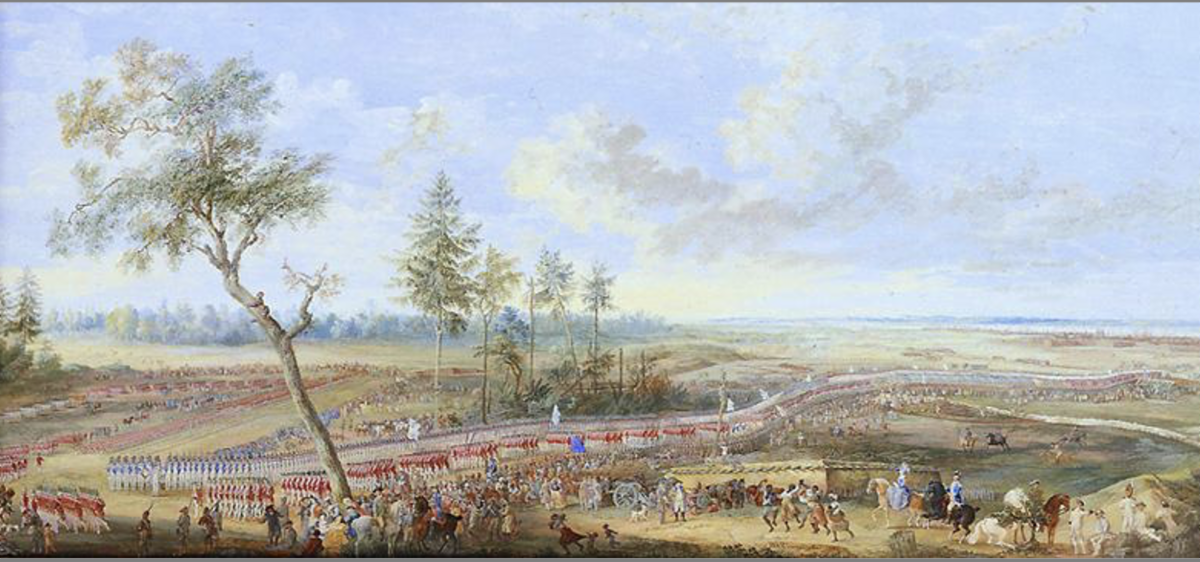
Top: The Surrender of Yorktown by Louis-Nicolas Van Blarenberghe (1716-1794), 1786, gouache on panel, 23.5 in x 37 in., private collection, a gift of King Louis XVI to Rochambeau, by Louis-Nicolas Van Blarenberghe, Public domain.
https://commons.wikimedia.org/w/index.php?curid=62059687
This painting was directed by Alexandre Berthier, who instructed the painter to paint each one of the hundred of faces with individual countenance: French and American pleased and proud, the British weeping and angry.
Middle & Bottom: Markers NPS. The Surrender Field has been left intact since 1781. Photos: TC © ASSFI 2021
| | |
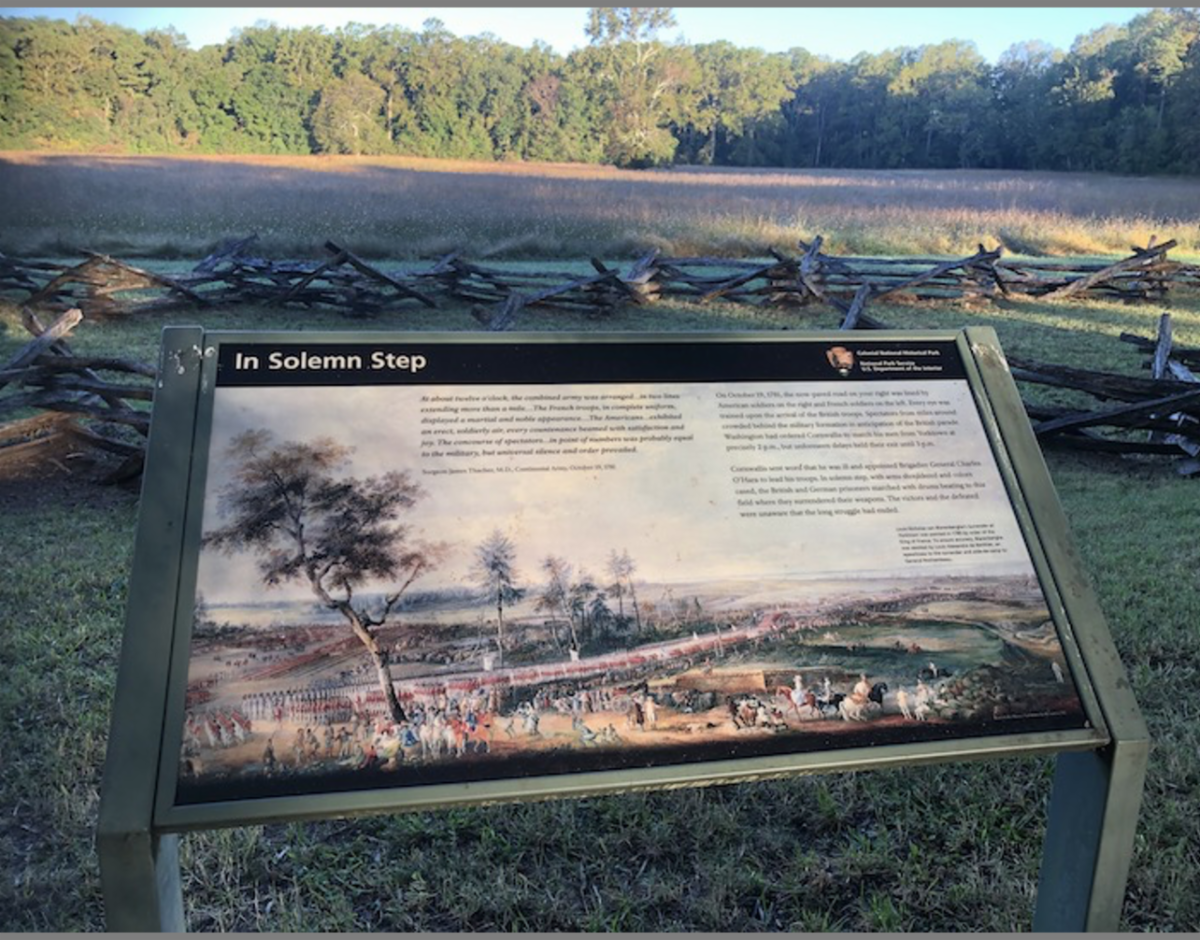
#22 Marker, « In solemn Step “
Yorktown Battlefield in Colonial National Historical Park, at stop F on the Battlefield Tour, Yorktown, VA 23690
GPS: 37.208817, -76.504983
• Inscription:
“At about twelve o’clock, the combined army was arranged … in two lines extending more than a mile …. The French troops, in complete uniform, displayed a martial and noble appearance …. The Americans … exhibited an erect, soldierly air, every countenance beamed with satisfaction and joy. The concourse of spectators … in point of numbers was probably equal to the military, but universal silence and order prevailed."
— Surgeon James Thacher, M.D., Continental Army, October 19, 1781
"On October 19, 1781, the now-paved road to your right was lined by American soldiers on the right and French soldiers on the left. Every eye was trained upon the arrival of the British troops. Spectators from miles around crowded behind the military formation in anticipation of the British parade. Washington had ordered Cornwallis to march his men from Yorktown at precisely 2 p.m., but unforeseen delays held their exit until 3 p.m.
Cornwallis sent word that he was ill and appointed Brigadier General Charles O’Hara to lead his troops. In solemn step, with arms shouldered and colors cased, the British and German prisoners marched with drums beating to this field where they surrendered their weapons. The victors and the defeated were unaware that the long struggle had ended.”
Erected by Colonial National Historical Park, National Park Service."
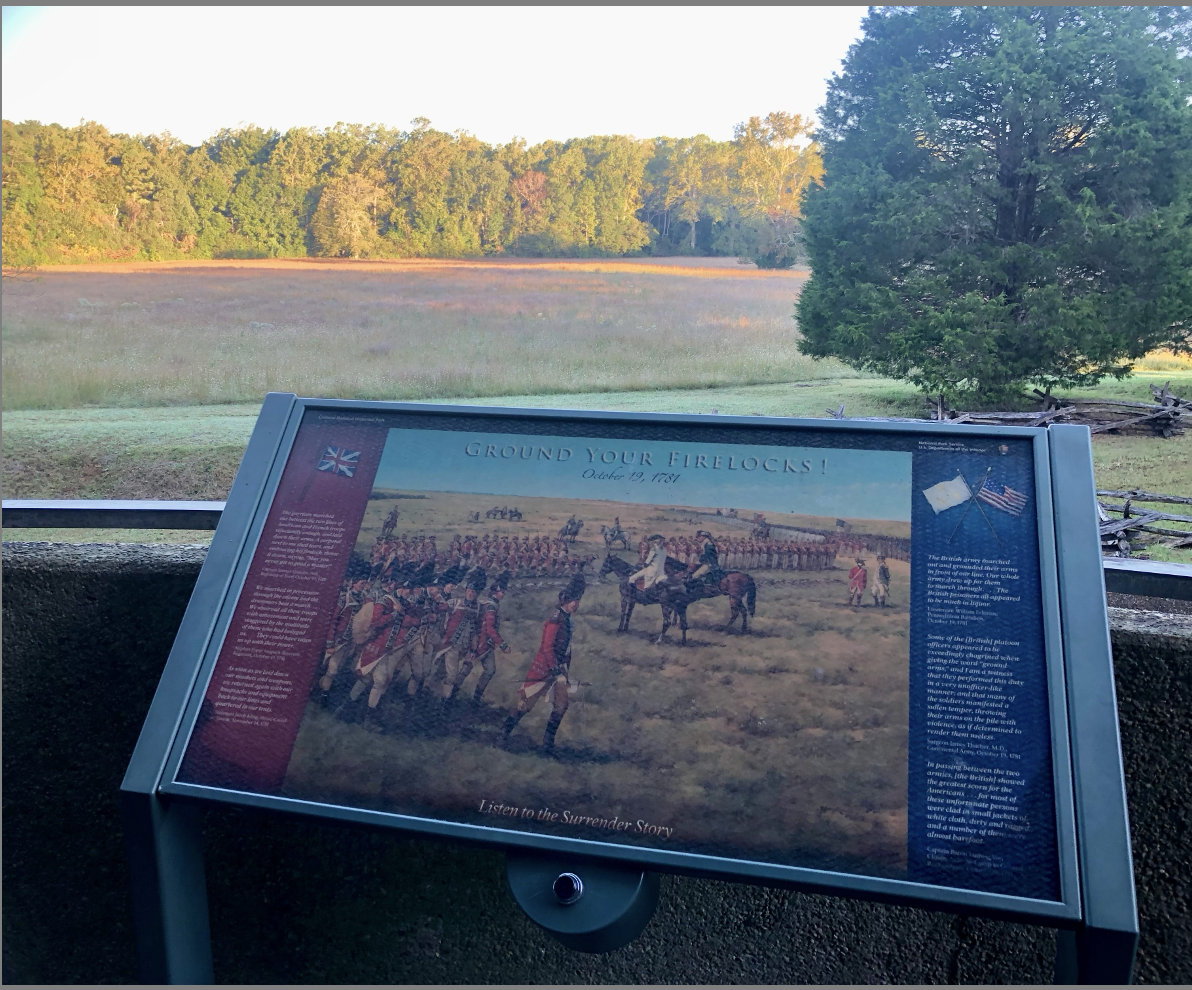
#23 Marker, « Ground your firelocks, October 19, 1781 “
Yorktown Battlefield in Colonial National Historical Park, at stop F on the Battlefield Tour, Yorktown, VA 23690
GPS: 37.208450, -76.505367
• Inscription (excerpts):
Beneath the intertwined American and French Flags (To the right of the sign):
[...] "The British army marched out and grounded their arms in front of our line. Our whole army drew up for them to march through …. The British prisoners all appeared to be much in liquor."
— Lieutenant William Feltman, Pennsylvania Battalion, October 19, 1781
"Some of the British platoon officers appeared to be exceedingly chagrined with giving the word “ground arms,” and I am a witness that they performed this duty in a very unofficer-like manner; and that many of the soldiers manifested a sullen temper, throwing their arms on the pile with violence, as if determined to render them useless."
— Surgeon James Thacher, M.D., Continental Army, October 19, 1781
"In passing between the two armies, [the British] showed the greatest scorn for the Americans … for many of these unfortunate persons were clad in small jackets of white cloth, dirty and ragged, and a number of them were almost barefoot."
— Captain Baron Ludwig von Closen, Aide-de-Camp to General Rochambeau, October 19, 1781
Erected by Colonial National Historical Park, National Park Service."
Supplemental note: O'Hara first offered his sword to Rochambeau, who directed him to Gen. Washington; Washington, in turn, had O'Hara surrender to Gen. Benjamin Lincoln.
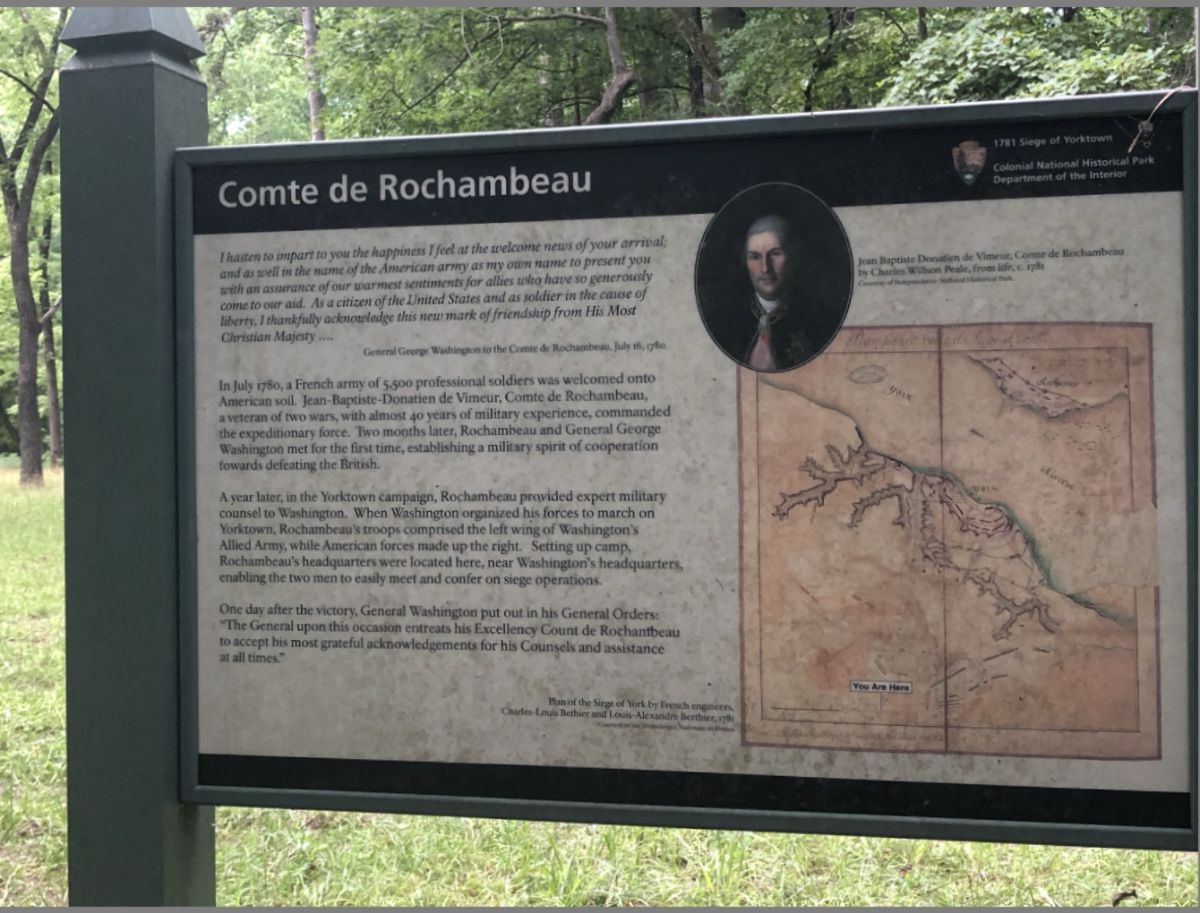
Continue driving on the narrow, one-way road towards the French Cemetery and a series of French encampments markers. On the way there, stop at a marker dedicated to Rochambeau at the emplacement of his headquarters :
| | |
Stop #5
Rochambeau Headquarters
| | |
Above:
Sign explaining (very succintly) Rochambeau's role, located near the site of his headquarters.
Photo: TC © ASSFI 2020
| | |
#24 Marker, “Comte de Rochambeau 1781 Siege of Yorktown”
Colonial National Historical Park, Yorktown, VA 23690
Marker is on Historical Tour Drive, Yorktown VA 23690
GPS: 37.203500, -76.530317
• Inscription:
“I hasten to impart to you the happiness I feel at the welcome news of your arrival; and as well in the name of the American army as my own name to present you with an assurance of our warmest sentiments for allies who have so generously come to our aid. As a citizen of the United States and as soldier in the cause of liberty, I thankfully acknowledge this new mark of friendship from His Most Christian Majesty …
— General George Washington to the Comte de Rochambeau, July 16, 1780
"In July 1780, a French army of 5,500 professional soldiers was welcomed onto American soil. Jean-Baptiste-Donatien de Vimeur, Comte de Rochambeau, a veteran of two wars, with almost 40 years of military experience, commanded the expeditionary force. Two months later, Rochambeau and General George Washington met for the first time, establishing a military spirit of cooperation towards defeating the British.
A year later, in the Yorktown campaign, Rochambeau provided expert military counsel to Washington, Rochambeau’s troops comprised the left wing of Washington’s Allied Army, while American forces made up the right. Setting up camp, Rochambeau’s headquarters were located here, near Washington’s headquarters, enabling the two men to easily meet and confer on siege operations.
One day after the victory, General Washington put out in his General Orders: “The General upon this occasion entreats his Excellency Count de Rochambeau to accept his most grateful acknowledgements for his Counsels and assistance at all times.”
Erected by Colonial National Historical Park, National Park Service.”
| | |
Above:
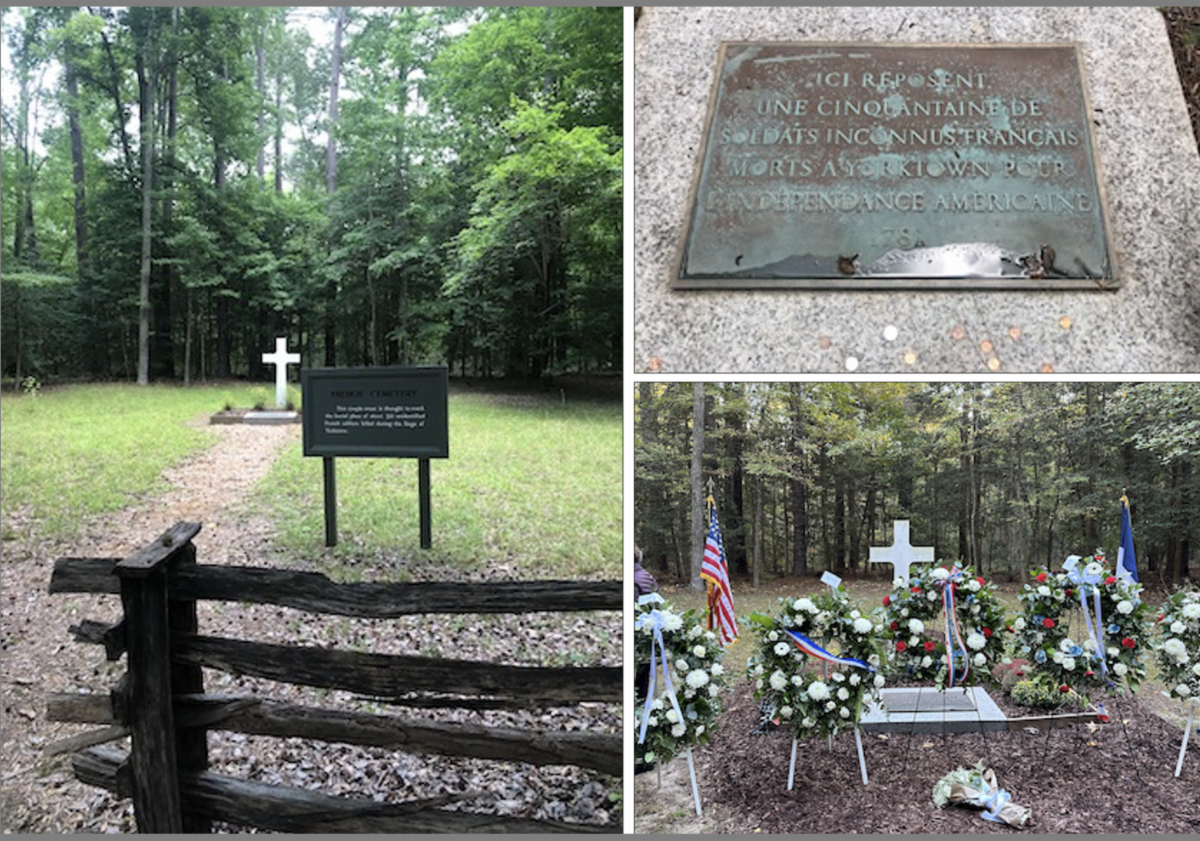
Top: French Cemetery (mass grave) at Yorktown. Photos: TC © ASSFI 2020, 2021, 2024
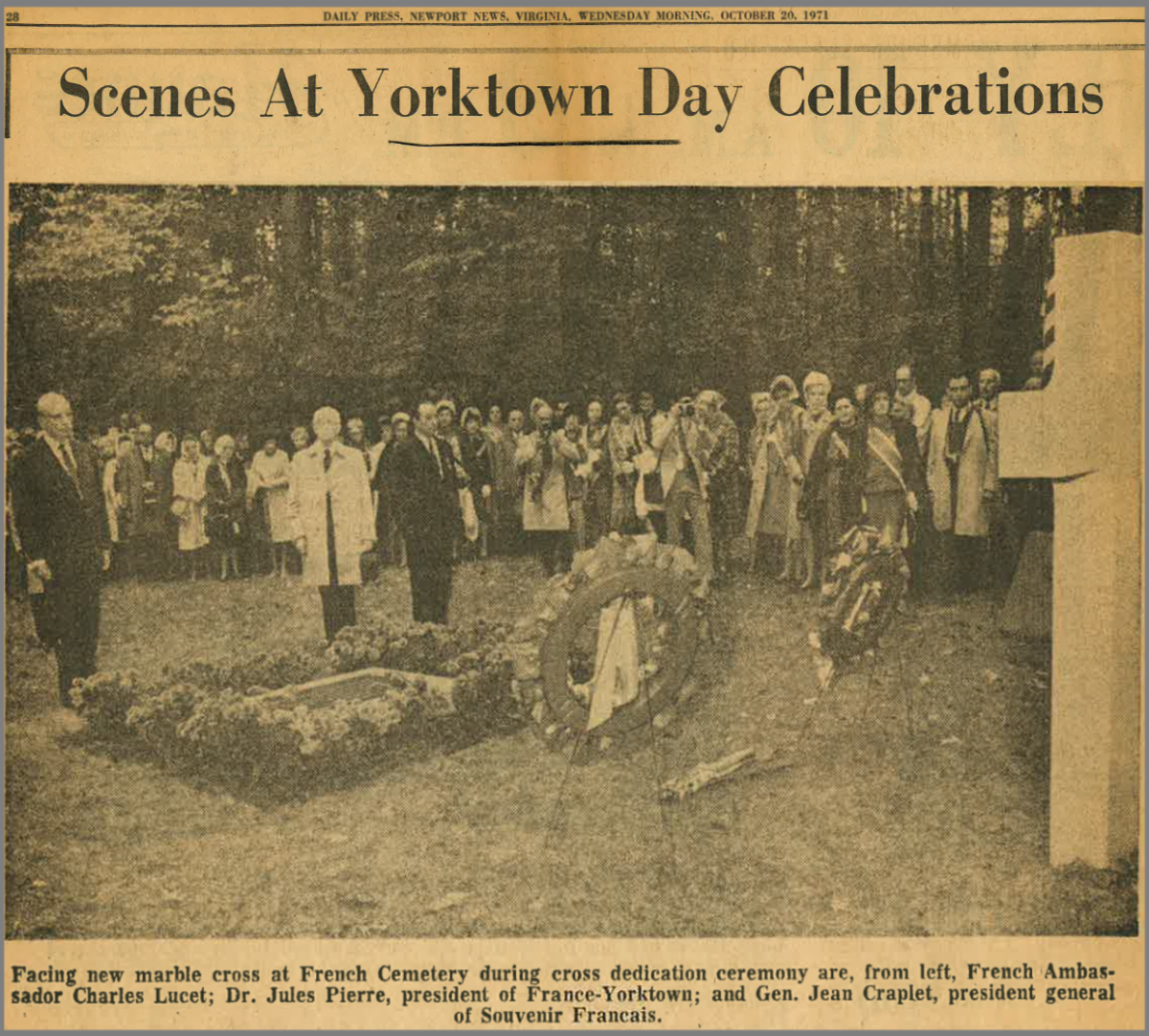
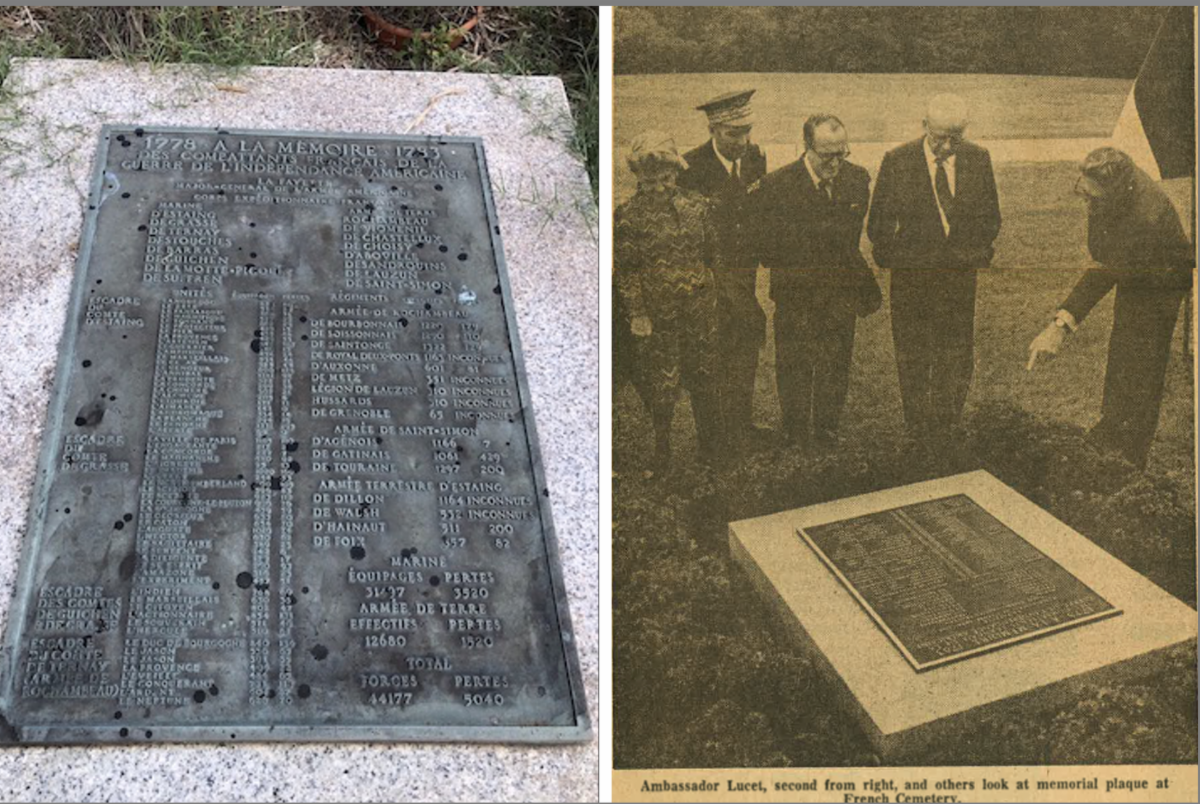
Bottom: page from the Daily News, Newport News, Virginia, Wednesday October 20, 1971 at the dedication ceremony of the White Cross and plaque with French General of Army Corps Jean Craplet, President general of Le Souvenir Français in France, and Dr. Jules Pierre, General Delegate of Le Souvenir Français in the United States and President of France-Yorktown association.
| | |
Le Souvenir Français and the French Cemetery
• The French cemetery is located in a clearing along the (narrow) historical tour road, about two miles from Surrender Field. It consists of a simple white marble cross, and a bronze plaque.
• Both the white marble cross and the bronze plaque were installed by Le Souvenir Français in 1971, under the leadership of Dr. Jules Pierre, General Delegate for the United States. Prior to this, there was only a wooden cross.
• A marker erected by the National Park Service is placed at the entrance.
• Note: About 226 French soldiers died during the siege of Yorktown; their names and regiments are known. Another 132 died from wounds and illnesses at the Williamsburg hospital and are buried there (see pages below). However, we cannot identify which soldiers are among the 50 traditionally believed to be buried at this site, nor do we know the precise location, as battlefield dead were typically buried in mass graves.
• Members of the American Friends of Lafayette graciously clear the area of fallen leaves a week prior to the annual ceremony on October 19.
• A wreath-laying ceremony is held every year in the early morning of October 19, attended by the Souvenir Français and several patriotic associations, before moving on to the French Memorial (see pages further below) which lists 638 names of French casualties during the 1781 campaign for another wreath-laying ceremony.
• Representatives of the Society of Honor Guard/Tomb of the Unknown Soldiers from Arlington National Cemetery, who "adopted" these French Unknowns, lay a white rose “Never Forget” bouquet at the foot of the cross.
#25 French Cemetery, Yorktown
Yorktown Battlefield in Colonial National Historical Park, at stop “I” on the Allied Encampment Tour
GPS: 37.205865, -76.527233
• Inscription (in French) of bronze plaque:
“Ici reposent
Une cinquantaine de
Soldats Inconnus Français
Morts à Yorktown pour
l’Indépendance Américaine
1781”
Translation:
“Here lie
About Fifty
Unknown French Soldiers
Who died at Yorktown for
American Independence
1781”
The white marble cross has been covered by graffiti over the years. Our Society is determined to restore both the cross and the bronze plaque to their original, pristine condition, in order to respect the dignity of these hallowed grounds. This will be done next year, and again if necessary in time for the 250th anniversary of the battle in 2031.
| | |
Stop #7
French Artillery Park
Emplacements of French Regiments
| | |
Above:
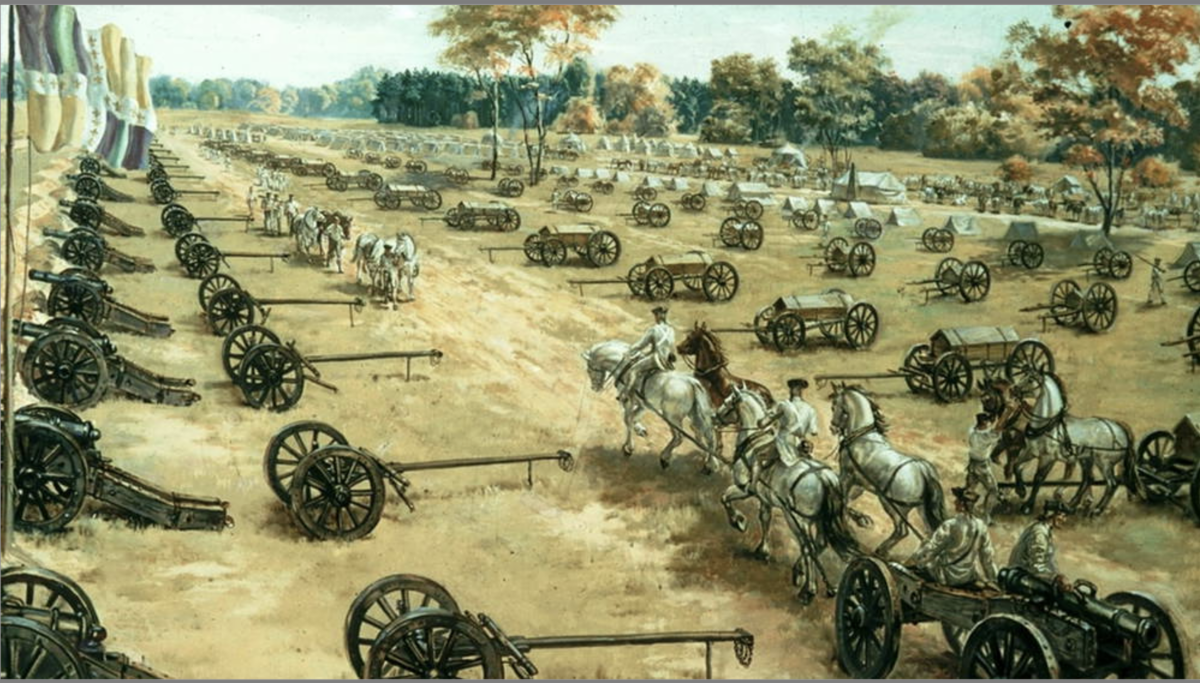
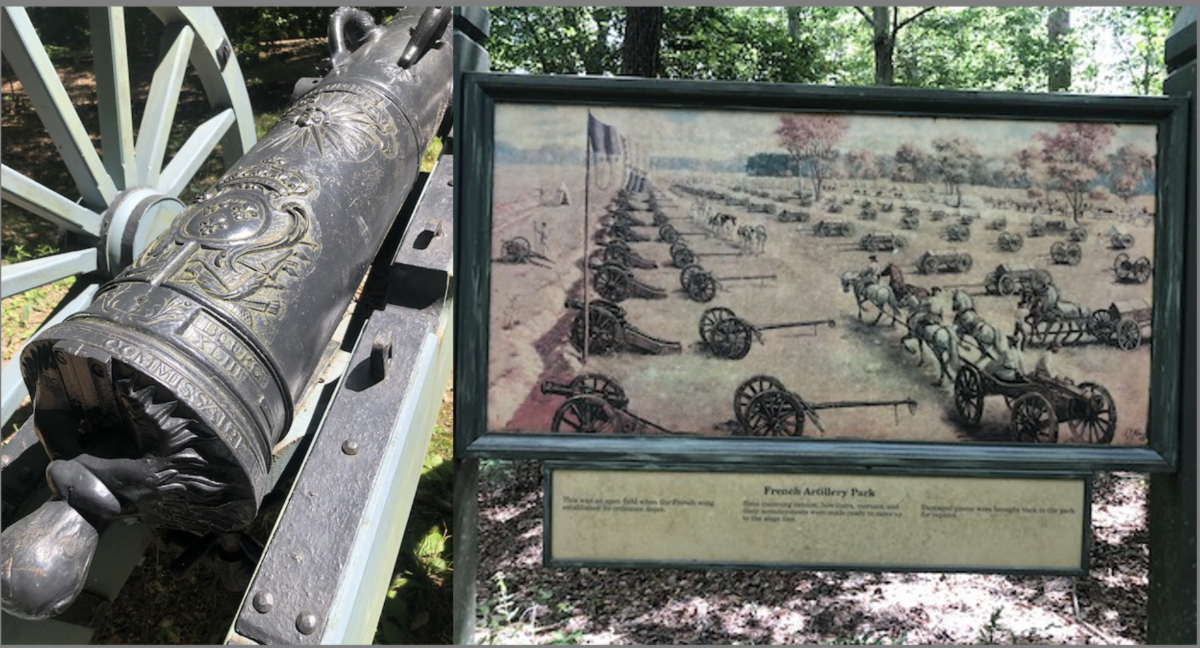
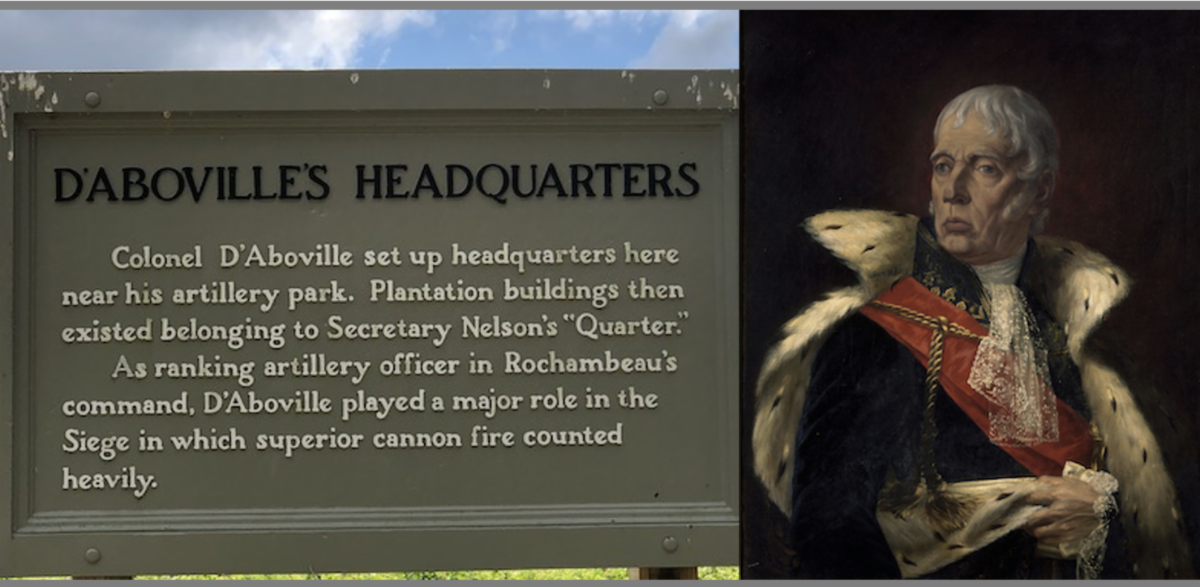
The painting "French Artillery Park at Yorktown" (above) is by artist Sidney E. King (1906–2002) who painted this work around 1955 for the U.S. National Park Service.
Photo of markers: TC © ASSFI 2020
| | |
#26 Two Markers, French Artillery Park
Colonial National Historical Park, Yorktown, VA 23690
Marker is on Historical Tour Drive, located on the Yorktown Battlefield in Colonial National Historical Park, at stop “J” on the Allied Encampment Tour
GPS: 37.207274, -76.527700
• Inscription Marker #1:
“This was an open field when the French wing established its ordnance depot. Here incoming cannon, howitzers, mortars, and their accouterments were made ready to move up to their siege line. Damaged pieces were brought back to the park for repairs.”
• Inscription Marker #2:
“Cannon were repaired and stored here. The time-worn earthworks visible on each side of the road were for protection, probably built by the French soldiers who operated the “Park.”
| | |
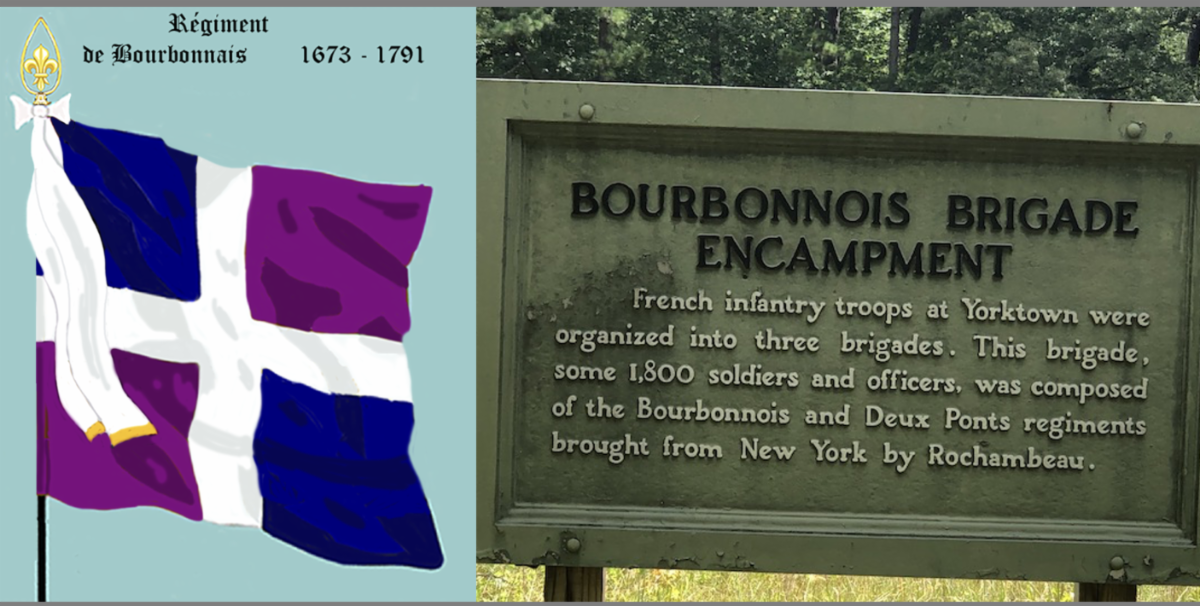
The Bourbonnais Regiment was commanded by Colonel Marquis de Montmorency-Laval, duc de Laval, with Viscount de Rochambeau, son of Count de Rochambeau, as Colonel en second.
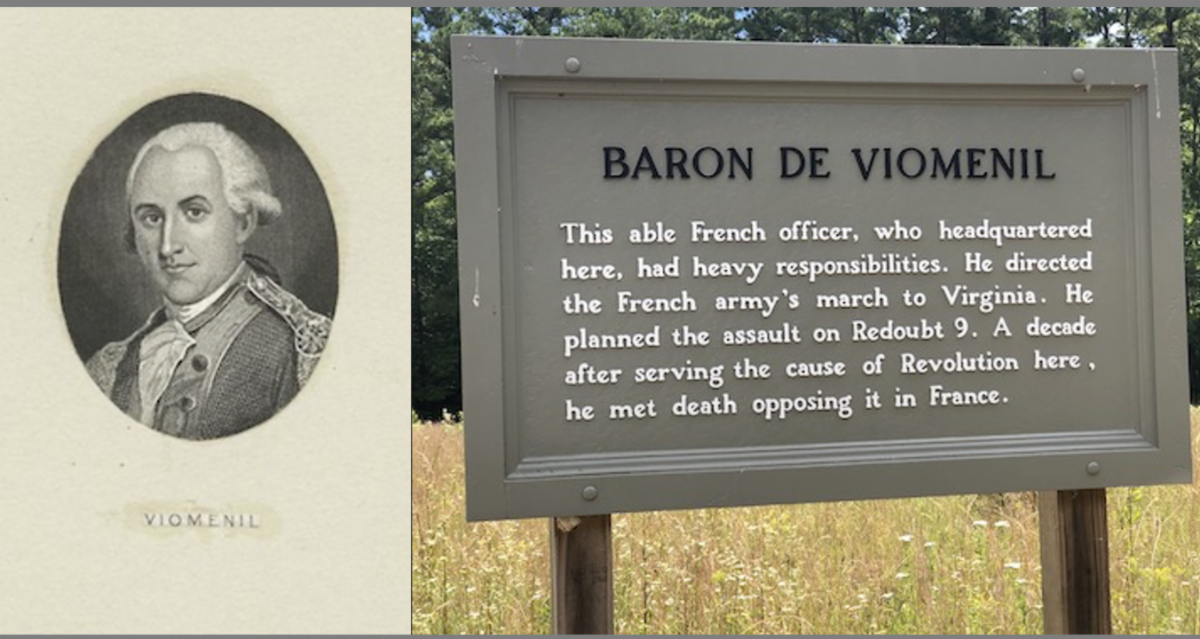
Together with the Regiment Royal-Deux-Ponts, they formed the Bourbonnais Brigade, under the overall command of Major General Antoine-Charles de Houx, Baron de Viomenil (see dedicated marker further below).
• Born in Paris in 1747 to one of France's oldest noble houses, Anne-Alexandre-Marie de Montmorency-Laval joined Freemasonry in 1773 and went on to serve in the American Revolutionary War as part of Rochambeau's expeditionary force. He held the rank of colonel of the Régiment de Bourbonnais. For his American service he was later inducted as an original member of the Society of the Cincinnati, the exclusive fraternal order founded by officers who had served in the war.
Following his return to France, he was promoted to maréchal de camp in 1789, but with the outbreak of the French Revolution he chose to emigrate rather than remain in the country. He did not resurface in French public life until the Bourbon Restoration, when Louis XVIII made him a life peer in June 1814 and promoted him to lieutenant general the same month; he also cast a vote for the death penalty at the trial of Marshal Michel Ney. A Commander of the Order of Saint-Louis, he died in Paris in 1817 and was buried at Père Lachaise Cemetery, with the peerage of Duke of Laval made hereditary upon his death.
#27 Marker, Bourbonnois Regiment Encampment
Colonial National Historical Park, Yorktown, VA 23690
Marker is on Historical Tour Road 0.8 miles west of Crawford Road (County Route 637). Located in the French Encampment Area of the Yorktown Battlefield
GPS: 37.224982, -76.536116
• Inscription:
“French infantry troops at Yorktown were organized into three brigades. This brigade, some 1,800 soldiers and officers, was composed of the Bourbonnois and Deux Ponts regiments brought from New York by Rochambeau.”
| | |
• Christian, Comte (later Marquis) de Deux-Ponts, Freiherr von Zweibrücken (1752–1817) was the elder of the two brothers and held senior command of the Infantry Regiment "Royal Deux-Ponts," a unit raised under an 1751 agreement between his father and Louis XV to supply France with a German infantry battalion. He rose through the regiment's ranks over nearly two decades, from sous-lieutenant in 1768 to colonel-titulaire — the officer commanding in the field — by 1776. In this senior capacity, he led the regiment during the Seven Years' War and, later, as part of Rochambeau's expeditionary force in the American Revolution.
At Yorktown in 1781, Christian commanded the regiment overall during the decisive assault of October 4 while his younger brother Philippe Guillaume served under him as second-in-command.
After the French Revolution forced him to leave French service as a maréchal de camp (major general), he continued his military career abroad, rising to general-major in the Prussian army and eventually General der Infanterie in Bavaria. He died in Munich and was buried alongside his brother in the Old Southern Cemetery.
• Philippe Guillaume (Wilhelm), Vicomte de Deux-Ponts, Freiherr von Zweibrücken (1754–1807) was Christian's younger brother and served as his deputy within the same regiment, the Royal Deux-Ponts. From 1777 to 1782 he held the post of colonel-lieutenant-en-second — effectively the regiment's second-in-command — while Christian held senior command as colonel-titulaire. The two brothers thus led the regiment together, with Philippe Guillaume supporting Christian's overall command rather than commanding independently.
Their partnership was most consequential during the Yorktown campaign in 1781, when Philippe Guillaume personally led some 400 French regulars in the assault on Redoubt 9, a key action that helped break open the British defenses during the "German Battle."
Like his brother, he later transitioned to service in the Bavarian army following the French Revolution, eventually becoming a general. He died in Munich in 1807 and was buried beside Christian in the Old Southern Cemetery.
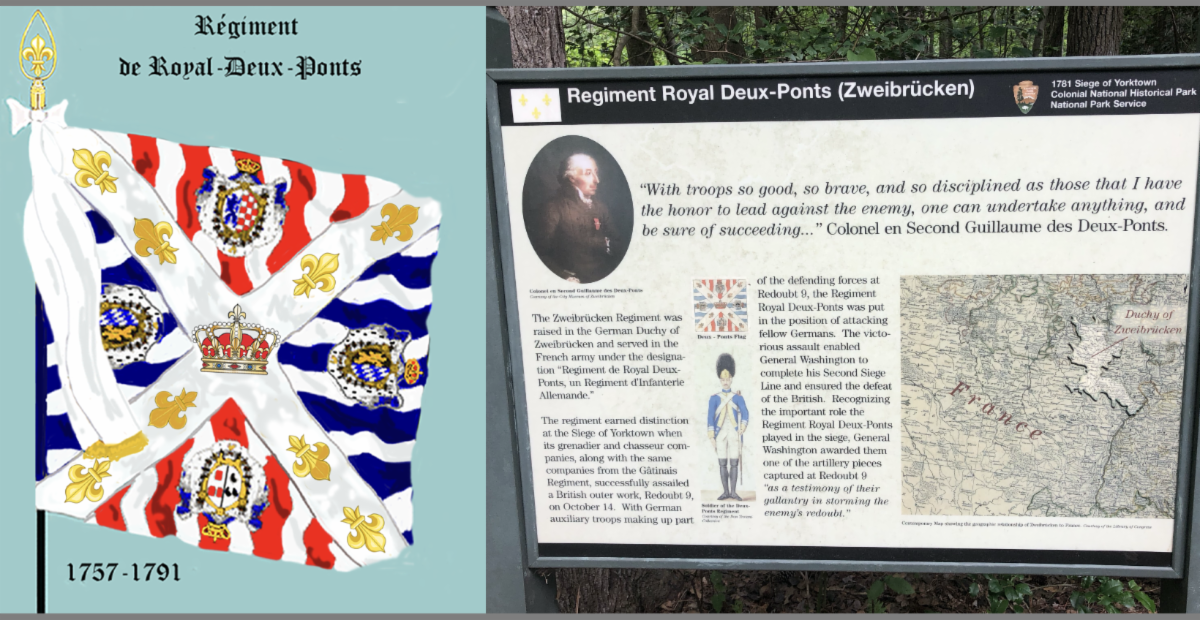
#28 Marker, Royal Deux-Ponts
Colonial National Historical Park, Yorktown, VA 23690
Marker is located on the Yorktown Battlefield in Colonial National Historical Park, at stop “K” on the Allied Encampment Tour
GPS: 37.226999, -76.536383
• Inscription (excerpts):
“With troops so good, so brave, and so disciplined as those that I have the honor to lead against the enemy, one can undertake anything, and be sure of succeeding … ”
Colonel en Second Guillaume des Deux-Ponts.
'The Zweibrücken Regiment was raised in the German Duchy of Zweibrücken and served in the French army under the designation “Regiment de Royal Deux-Ponts, un Régiment d’Infanterie Allemande.”
The regiment earned distinction at the Siege of Yorktown when its grenadier and chasseur companies from the Gâtinais Regiment, successfully assailed a British outer work, Redoubt 9, on October 14. With German auxiliary troops making up part of the defending forces at Redoubt 9, the Regiment Royal Deux-Ponts was put in the position of attacking fellow Germans. The victorious assaults enabled General Washington to complete his Second Siege Line end ensured the defeat of the British. Recognizing the important role the Regiment Royal Deux-Ponts played in the siege, General Washington awarded them one of the artillery pieces captured at Redoubt 9 “as a testimony of their gallantry in storming the enemy’s redoubt.”
| | |
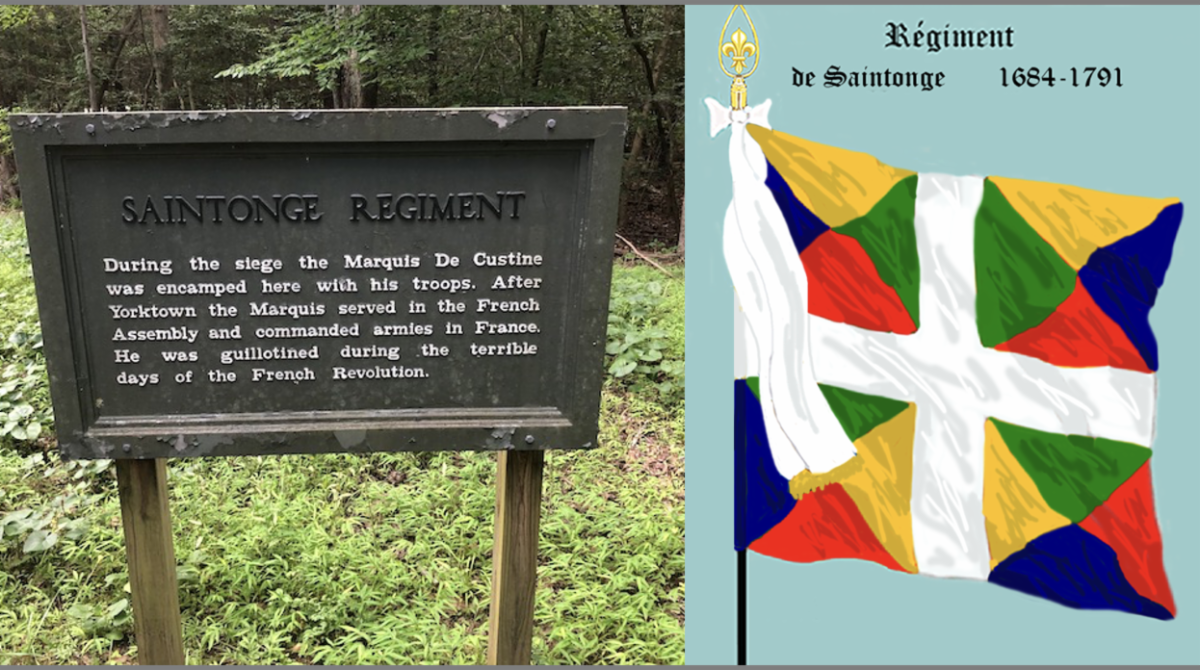
The Saintonge Regiment was commanded by Adam Philippe, Comte de Custine.
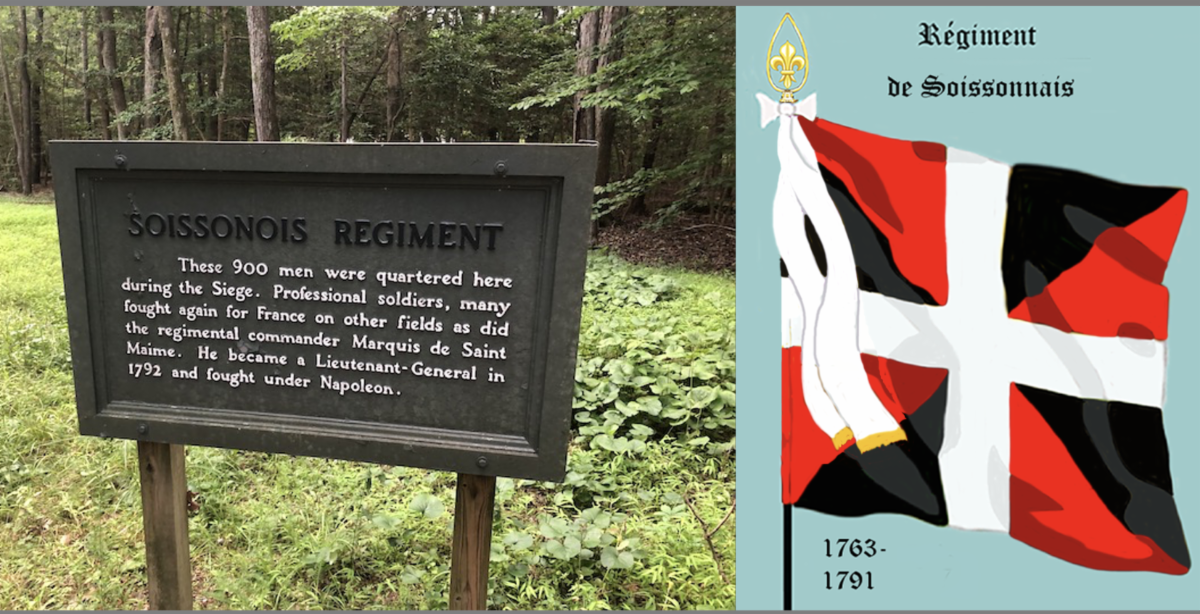
Together with the Regiment Soissonnais, commanded by Colonel Jean-Baptiste-Louis-Philippe de Felix d'Olieres, Count de Saint-Maisme, (see next marker) they formed the Soissonais Brigade, under the overall command of General Joseph-Hyacinthe Comte de Viomenil (brother of Antoine-Charles du Houx, Baron de Vioménil).
• Adam Philippe, Comte de Custine de Sarreck (4 February 1740 – 28 August 1793). As a young officer in the French army, he served in the Seven Years’ War, then served under Rochambeau. During the French Revolution he was elected to the Assemblée Constituante as a representative from the eastern city of Metz, trying ot protect the king’s prerogatives. He was eventually named general in charge of the Army of the Rhine, but the emigration of the royalist officers depleting the French army led to the loss of all the conquests of 1792. Accused of treason, he was declared guilty by the dreadful prosecutor Fouquier Tinville on August 27, 1793 and sent to the guillotine the next day.
• He was a member of the French branch of the Society of Cincinnati.
#29 Marker, Saintonge Encampment
Colonial National Historical Park, Yorktown, VA 23690
Marker is on Historical Tour Road one mile west of Crawford Road (County Route 637). Located in the French Encampment Area of the Yorktown Battlefield
GPS: 37.225524, -76.538883
• Inscription:
“During the siege the Marquis de Custine was encamped here with his troops. After Yorktown the Marquis served in the French Assembly and commanded armies in France. He was guillotined during the terrible days of the French revolution.”
| | |
Above:
Left: marker, Photo: TC © ASSFI 2020
Right: Flag of the Soissonois Regiment, By User:Centenier - Own work, Public Domain, https://commons.wikimedia.org/w/index.php?curid=31587318
| |
• Jean Baptiste Louis Philippe de Félix d'Ollières, comte de Saint-Maime et du Muy (1751-1820) was first known as the Comte de Saint Maime, joined the Army in 1766 as 1st lieutenant at the age of 15, then was promoted to captain in 1772, and became Colonel of the Soissonais regiment at the age of 19 in 1775. After Yorktown he received a very generous pension from the King. He is promoted brigadier general in 1792 during the French Revolution. In 1798 he is part of Napoleon’s expedition in Egypt, and is esteemed by Berthier and Napoleon, who names him Governor of the province of Silesia (today a part of Poland, the Czech Republic and Germany). He was equally liked liked by Louis XVIII who named him Peer of France in 1816.
#30 Marker, Soissonois Regiment Encampment
Colonial National Historical Park, Yorktown, VA 23690
Marker is on Historical Tour Road one mile west of Crawford Road (County Route 637. Located in the French Encampment Area of the Yorktown Battlefield.
GPS: 37.225541, -76.538872
• Inscription:
“These 900 men were quartered here during the Siege. Professional soldiers, many fought again for France on other fields as did the regimental commander Marquis de Saint Maime. He became a Lieutenant-General in 1792 and fought under Napoleon.”
| | |
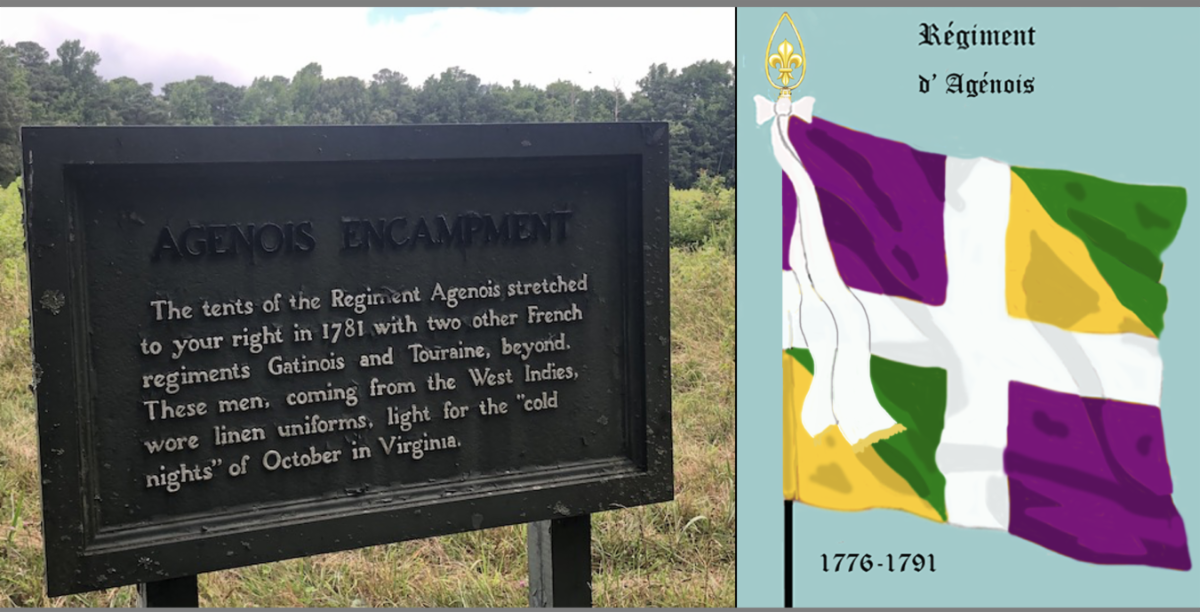
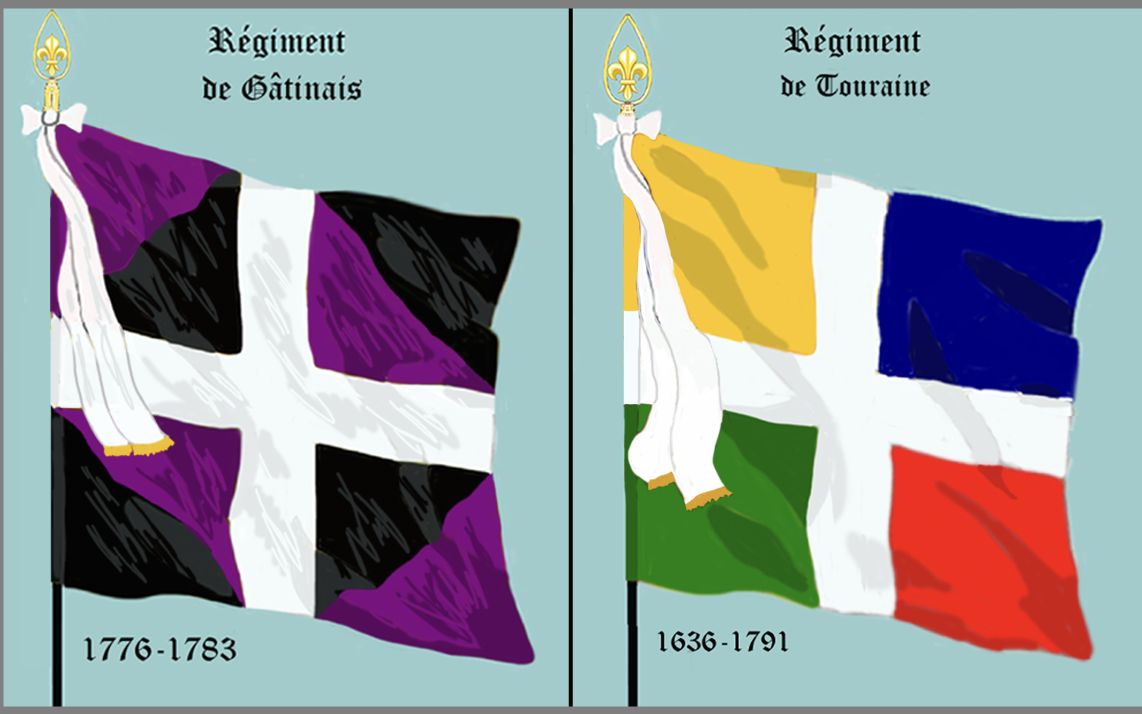
Above:
Top Left: NPS marker, Photo: TC © ASSFI 2020
Top Right: Flag of the Agenois Regiment, By User:Centenier - Own work, Public Domain, https://commons.wikimedia.org/w/index.php?curid=31552329
Bottom Left: Flag of the Gâtinais regiment, which took back its name of Royal-Auvergne following its conduct at the capture of Redoubt No. 9, by User:Centenier — Own work, Public Domain, https://commons.wikimedia.org/w/index.php?curid=31613460
Bottom Right: Flag of Regiment de Touraine, by User:Centenier — By User:Centenier - Own work, Public Domain, https://commons.wikimedia.org/w/index.php?curid=31955330
| | |
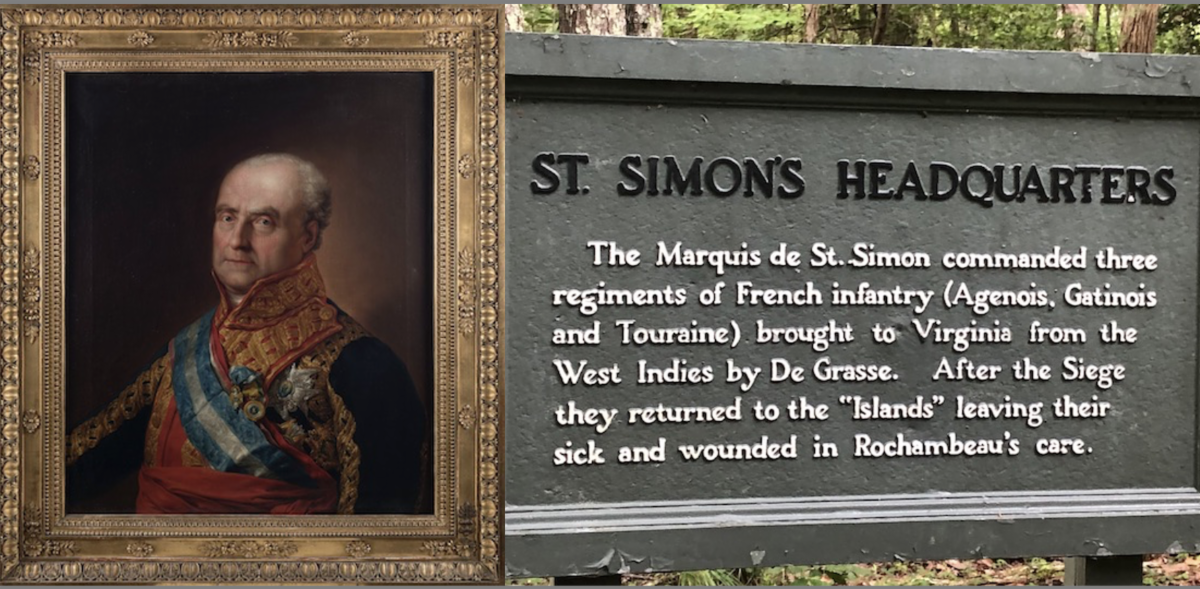
• The Agénois Regiment was commanded by Colonel Antoine-Joseph-Eulalie, Count de Beaumont d'Autichamp (often referred to as the Comte d'Autichamp).
Together with the Regiment Gâtinais, commanded by Colonel Juste-Antoine-Henry-Marie-Germaine, Marquis de Rostaing, they formed the Agenois Brigade, under the overall command of Major General Claude-Ann, Marquis de Saint-Simon Montbleru, Maréchal de Camp (see dedicated marker next).
• Born in Angers (province of Anjou) in 1744, Colonel d'Autichamp began his career as aide-de-camp to Maréchal de Broglie in 1759 (the same de Broglie who hosted the famous diner of Metz in 1775, during which Lafayette decided to fight for the Insurgents), then served as major in his brother's dragoon regiment, overseeing its administration.
He gained recognition for his conduct in Corsica in 1769 under Marshal de Vaux, and later commanded as a colonel of the Agenois infantry regiment seeing action at both Yorktown and the Battle of St. Christopher in the Caribbean.
After his promotion to maréchal de camp, he was appointed governor of the southern part of Saint Domingue (today's Haiti) in 1782, a post he held until returning to France in 1788. He emigrated in 1792 following the Revolution and took part in the Champagne campaign against the revolutionary government, before being struck from the émigré list in 1799 and living privately in France. His public career resumed in 1815, when Louis XVIII named him governor of Saint-Germain, a position he held until his death in 1822.
He was a member of the French branch of the Society of Cincinnati.
• Henri-François-Liamart, Vicomte de Poudenx began his command career as colonel of the Provincial Artillery Regiment of Toul starting in March 1774. In April 1780, he was promoted to mestre de camp commandant of the Touraine Infantry Regiment, and it was in this capacity that he sailed to America the following year, joining the Marquis de Saint-Simon's contingent from Saint-Domingue as part of the auxiliary force sent against Lord Cornwallis at Yorktown.
His regiment embarked from Martinique on August 5, 1781, reaching Chesapeake Bay just ten days later, before returning to the West Indies that November once the campaign concluded. In recognition of his service during the Yorktown campaign, Poudenx was promoted to brigadier general of infantry on January 1, 1784, and rose further to maréchal de camp in March 1788. He emigrated from France in 1792 following the Revolution.
He was a member of the French branch of the Society of Cincinnati.
• Just-Antoine-Henry-Marie-Germain, Marquis de Rostaing (1740–1826)
was born at the Château de Veauchette in Auvergne and began his career attached to the household of the Dauphin and served as a page to Louis XV before receiving a cavalry lieutenant's commission. After campaigning in Germany from 1760 to 1762 and a stint with the King's Musketeers, he became colonel of the Auxerrois Regiment and, in 1778, of the Gâtinais Regiment (later Royal-Auvergne). In this capacity he served under Rochambeau during the American Revolutionary War, where his courage at Yorktown earned him promotion to maréchal de camp and the Cross of Saint-Louis in 1783; he was also an original member of the French Society of the Cincinnati.
As grand bailiff and sword seneschal of the Forez region, Rostaing was elected in March 1789 as a nobility deputy to the Estates-General, where he took a moderate stance in favor of reform. He served as secretary of the National Assembly and vice-president of its military committee, helped push through a 1790 decree standardizing military pay across all branches, and delivered several reports on army organization and uniforms. Promoted to lieutenant general in February 1792, he withdrew from public life shortly afterward and spent his remaining years away from politics, at his estates.
He was a member of the French branch of the Society of Cincinnati.
#31 Marker, Agenois Regiment Encampment
Colonial National Historical Park, Yorktown, VA 23690
Marker is on Historical Tour Drive. Located on the Yorktown Battlefield in Colonial National Historical Park, on the Allied Encampment Tour
GPS: 37.231032, -76.543216
• Inscription:
“The tents of the Regiment Agenois stretched to your right in 1781 with two other French regiments Gatinois and Touraine, beyond. These men, coming from the West Indies, wore linen uniforms, light for the “cold nights” of October in Virginia.”
| |
Above:
Left: Portrait of Marquis de Saint Simon, by Vicente López y Portaña c.1818 Hidden away during the Spanish Civil War and subsequently forgotten, The American Revolution Institute acquired the piece and brought it to the United States in 2018, restoring it to public eye.
Right: NPS marker, TC © ASSFI 2020
| | |
• Claude-Anne de Rouvroy, marquis de Saint-Simon-Montbléru (1740-1819) was a commander who sailed with de Grasse from the West Indies. Saint-Simon commanded an outstanding corps of 3,300 additional French troops: “...you have not seen troops as universally well-made, so robust, or of such appearance as those General Saint-Simon has brought to our assistance” (Pennsylvania Packet, Sept 18, 1781)
He was a member of the French branch of the Society of Cincinnati.
• George Washington, wrote to the marquis on October 24, 1781, shortly before he departed the United States: “I cannot suffer you to leave this Country, without testifying my sense of the distinguished services which you have rendered the Allies during your stay (...) The military ardour and perfect discipline for which they have been conspicuous in the seperate Attack and during the other operations of the Siege, and your measures, as judicious and vigorous on all occasions, have secured you the esteem of this country; they will at all times claim my particular applause, and I entreat you to accept my warmest acknowledgements.”
#32 Marker, St Simon’s Headquarters
Colonial National Historical Park, Yorktown, VA 23690
Marker is on Historical Tour Drive, located on the Yorktown Battlefield in Colonial National Historical Park, on the Allied Encampment Tour.
GPS: 37.226425, -76.543444
• Inscription:
“The Marquis de St. Simon commanded three regiments of French infantry (Agenois, Gatinois and Touraine) brought to Virginia from the West Indies by De Grasse. After the Siege they returned to the “Islands” leaving their sick and wounded in Rochambeau’s care.”
| | |
Stop #9
Vioménil & d'Aboville
| | |
Above:
Left: Portrait of Vioménil, The Miriam and Ira D. Wallach Division of Art, Prints and Photographs: Picture Collection, The New York Public Library. (1870). Retrieved from https://digitalcollections.nypl.org/items/cae4d460-c530-012f-0307-58d385a7bc34
Right: NPS marker, by TC (2020) © ASSFI
| |
• Antoine Charles du Houx, Baron de Viomenil, (1728-1792) entered the military as a lieutenant in the Limousin Regiment in 1740. He served with distinction in many campaigns. He came to America with General Rochambeau in 1780, and attained the rank of major general in 1781. Viomenil was second in command to General Rochambeau during the Yorktown campaign and commanded the French assault on Redoubt 9. Viomenil was a Royalist and supported the king during the French Revolution. On October 10, 1792, he was shot in the knee while defending the king against an assault of a Parisian mob. He was hidden and his wound tended, but the old veteran died of complications in February 1793.
He is not to be confused with his brother the Marquis Charles-Joseph (1734-1827) also with Rochambeau, who was commanding the French artillery and eventually became Marshall and Peer of France, and also not to be confused with their cousin Antoine Louis, who was severely wounded at Yorktown.
They were both members of the French branch of the Society of Cincinnati.
#33 Marker, Baron de Vioménil
Colonial National Historical Park, Yorktown, VA 23690
Marker is on Historical Tour Drive. Located on the Yorktown Battlefield in Colonial National Historical Park, on the Allied Encampment Tour.
GPS: 37.214216, -76.525000
• Inscription:
“This able French officer, who headquartered here, had heavy responsibilities. He directed the French army’s march to Virginia. He planned the assault on Redoubt 9. A decade after serving the cause of Revolution here, he met his death opposing it in France.”
| | |
• François Marie d'Aboville (January 23, 1730 – November 1, 1817) commanded the artillery. He was born in Brest in Brittany. He fought in the Seven Years' War and was a Colonel at the time of the battle of Yorktown). During the French Revolution he fought at the Battle of Valmy in the War of the First Coalition and became a général de division (major general). He retired from the Army in 1802 and became Vice President of the Senate and Count of the Empire. During the Hundred Days of 1815 and after the Bourbon Restoration, he served in the Chamber of Peers. He was a grand officer of the Legion of Honour and a recipient of the Grand Cross of the Order of Saint Louis. He is the father of two generals, both also serving in Artillery, Baron Augustin-Marie d'Aboville (1776–1843) and Augustin Gabriel d'Aboville (1773– 1820) was a general de brigade and who was made a baron by Napoléon.
He was a member of the French branch of the Society of Cincinnati.
#34 Marker, d’Aboville Headquarters
Colonial National Historical Park, Yorktown, VA 23690
Marker is located on the Yorktown Battlefield in Colonial National Historical Park, on the Allied Encampment Tour
GPS: 37.21157, -76.524555
• Inscription:
“Colonel D’Aboville set up headquarters here near his artillery park. Plantation buildings then existed belonging to Secretary Nelson’s “Quarter. As ranking artillery officer in Rochambeau’s command, D’Aboville played a major role in the Siege in which superior cannon fire counted heavily.”
| | |
Stop #10
Beaver Dam Creek & French Hospital
| | Above, clockwise: marker French hospital, a vire of the field, by TC © ASSFI 2020, nearby marshland and marker Beaver Dam Creek, photos by Don Morfe, of Baltimore, MD, Dec. 5, 2012, https://www.hmdb.org/m.asp?m=61591 | | |
#35 Marker, Beever Dam Creek
Colonial National Historical Park, Yorktown, VA 23690
Marker is on Battlefield Tour Road 1.3 miles west of Surrender Road (Virginia Route 634), located in the American Encampment Area of the Yorktown Battlefield
GPS: 37.202849, -76.52003
• Inscription:
“This sluggish and marshy headwater of the Warwick River generally divided the French and American encampments. Although both forces were under Washington, separate unit organization was respected and preserved through the siege.”
#36 Marker, French Hospital
Colonial National Historical Park, Yorktown, VA 23690
On Historical Tour Road, a few yards before crossing route 17 George Washington Memorial Parkway
GPS: 37.202679, -76.505594
• Inscription:
“Across the field to your right, Hudson Allan’s plantation building dominated the 1781 scene. Barns and sheds as well as mansions were useful to the French for field hospital purposes.”
We can now turn back and drive back towards Yorktown, to end our tour at the beautiful American Revolution Museum, and the French Memorial as a grand finale of the Yorktown tour.
| | |
Stop #11
(Finale)
American Revolution Museum
The French Trench
&
The French Memorial
| | |
#37 Lafayette’s 12 Pounder English Gun
The American Revolution Museum, 200 Water St, Yorktown, VA 23690
GPS: 37.238822, -76.518202
• Inscription:
“The Lafayette Gun”
“The 12 Pounder English gun facing this tablet was taken by General Lafayette in person at the storming of a redoubt at Yorktown in 1781. General Lafayette personally identified this gun by the conspicuous indentation made by a shot on its side when he visited the arsenal in 1825. At the General’s death in 1834 this gun was used to fire the half hour salute in his honor.”
• Alternative display sign (2020)
“The Lafayette Cannon”
“According to tradition, General Lafayette identified this dented cannon while visiting the United States in 1824. The distinctive dent on the British tube was inflicted by an allied cannon ball during the siege. When the general saw this piece again, it is said that he became sentimental and embraced the barrel.”
Leave the car parked and walk across the parkway towards the river and the French Memorial, located where a French battery once stood.
The French Trench
| | |
Above:
Top & Middle: The bottom of the marker "The French Trench" features a map of the French batteries in relation to the vessels that they set afire. The location of the marker is also indicated. The upper right of the marker contains a reproduction of a “1781 French map illustration depicting the destruction of the HMS Charon. Lithograph courtesy of the Edward E. Ayer collection, the Newberry Library, Chicago".
Bottom: Marker "Yorktown Battlefield" featuring the 4 Allied Commanders, Photos: TC © ASSFI 2020
| | |
The French Trench
• Located at the extreme left of the American and French lines, this French artillery battery was commanded by the Marquis de Saint-Simon.
• Artillery at this battery harassed British ships anchored between Yorktown and Gloucester Point on the far side of the bridge. On October 10, this battery set fire to three British ships using superheated cannon balls.
• This was the first battery of siege guns to fire on the British, aiming at the nearby Royal Welch Fusiliers Redoubt on October 9. These cannon are located in front on the marker.
#38 (optional) Marker, “Washington Rochambeau Route”
Colonial National Historical Park, Yorktown, VA 23690
Marker is on Old Williamsburg Road (Virginia Route 1020) 0.3 miles south of Fusiliers Redoubt Ramp, on the right when traveling south. You may want to stop by once you retrieve your car at the Museum parking lot.
GPS: 37.239682, -76.523150
• Inscription:
“General Washington and the French troops under General Rochambeau began the siege of Great Britain's General Cornwallis at Yorktown on September 28, 1781. Cornwallis surrendered his army on October 19 after a siege of 21 days.”
Erected 1976 by French Government, Committee of the Bicentennial.”
#39 Marker, “French Trench”
Colonial National Historical Park, Yorktown, VA 23690
Marker is on Old Williamsburg Road (Virginia Route 1020) 0.3 miles south of Fusiliers Redoubt Ramp, on the right when traveling south
GPS: 37.240299, -76.522477
• Inscription:
“This earthwork was manned by the “Regiment Touraine” and formed the western portion of the French and American siege line surrounding Yorktown. From this line the French fired upon ships in the York River and the British fort behind you.”
#40 Marker, “French Trench, The 1781 Siege of Yorktown”
Colonial National Historical Park, Yorktown, VA 23690
Marker is on Fusiliers Redoubt ramp, on the left when traveling east. Marker is located across the road from the Yorktown Victory Center
GPS: 37.240624, -76.521466
• Inscription (excerpts):
“The extreme left of the American and French lines, commanded by the Marquis de Saint-Simon, was held by a French artillery battery. On October 9, it became the first battery of siege guns to fire on the British, aiming at the nearby Royal Welch Fusiliers Redoubt. The French also effectively used this position to help contain the British within their defensive lines and to harass British ships anchored between Yorktown and Gloucester Point. On October 10, using superheated cannon balls, called hot shot, the French battery set fire to three British ships. Following the British surrender, General Washington extended commendations to the Marquis de Saint-Simon and his troops: “The military ardour and perfect discipline for which they [Saint-Simon’s troops] have been conspicuous … Have secured you the esteem of the country …”
“The ships were enwrapped in a torrent of fire, which spreading with vivid brightness among the combustible rigging, and running with amazing rapidity to the tops of the several masts, while all around was thunder and lightning for our numerous cannon and mortars, and in the darkness of night, presented one of the most sublime and magnificent spectacles which can be imagined.”
Dr. James Thacher, Surgeon, Continental Army
#41 Marker, “The Washington – Rochambeau Route to Victory - Yorktown Battlefield”
Colonial National Historical Park, Yorktown, VA 23690
Marker is on Fusiliers Redoubt ramp, on the left when traveling east
GPS: 37.240682, -76.52105
• Inscription (excerpts):
“News of the naval battle [of the Capes] led Generals Washington and Rochambeau to hasten to Williamsburg. After spending the night of September 12 in Fredericksburg, they rode through Hanover Court House and New Kent Court House, and arrived at Williamsburg on the fourteenth. There they met General Lafayette, who commanded the American forces in Virginia during the summer. The allied armies assembled supplies and equipment and, with the arrival of wagon trains and troops from the long march, moved forward on September 28 to start the siege of Cornwallis’s 8,300 man army at Yorktown. For three weeks the Allies tightened their control around Yorktown and heavily bombarded Cornwallis for eight days. With no hope of escape or reinforcements, Cornwallis was forced to surrender his army on October 19. It was the greatest and most decisive victory of the war, leading the way inevitably to American Independence.”
Erected by Colonial National Historical Park, National Park Service and The Virginia Daughters of the American Revolution."
The French Memorial Monument
| | |
Above:
The French Memorial, featuring the Souvenir Français Bronze Palm. Photos: TC © ASSFI 2020-2024
Photos from the dedication ceremony on October 14, 1989, featuring Col. Roger Cestac, then President of our Society and Delegate General of Le Souvenir Français in the United States, with Senator Jacques Habert. Pictured are André Ferrara, Alain Dupuis, and Bruce Boeglin of the Federation of French War Veterans, Inc. (complete list will be provided next month) Photos: TC 1989
Photos from the dedication ceremony on October 14, 1989, attended by Army General (Ret.) Jean Richard, President General of Souvenir Français; archives © Le Souvenir Français
Bottom right: Thierry Chaunu shaking hands with an American reenactor during the monument’s dedication on October 14, 1989; Photo © Federation of French War Veterans, Inc.
| | |
#42 French Memorial Monument
Fusiliers Redoubt
By the river, across the American Revolution Museum, Yorktown, VA
GPS: 37.240875, -76.521614
• During the 1981 Bicentennial of the Battle of Yorktown, French veterans came to the realization that approximately 50 French soldiers buried in a common grave on the battlefield were commemorated only by a cross and plaque—with no names inscribed. This contradicted French tradition of honoring fallen soldiers by name. At the urging of veterans' groups, French Ambassador Emmanuel de Margerie appointed the ‘Committee for the Yorktown French Memorial’, chaired by Professor André Maman of Princeton University, to create a proper memorial.
• The committee's mission was to honor all French soldiers and sailors who died in the 1781 Yorktown campaign, including those lost during the siege and the naval Battle of the Capes. French and American hereditary societies—including the Sons and Daughters of the American Revolution, the Order of the Cincinnati, and French veteran organizations—raised $60,000 through private donations to fund the project.
• On October 14, 1989, U.S. and French dignitaries led by Ambassador de Margerie unveiled a 6-foot-tall, 17-foot-wide granite monument overlooking the York River, where a French artillery battery had defended Yorktown's western edge in 1781.
• The memorial bears the names of 638 French soldiers and sailors: more than half died either during the siege ending in British surrender on October 19, 1781 or in the following weeks from their wounds or illness at the Williamsburg hospital (132 are buried in mass graves there, which will be the subject of a future Bulletin). The others were sailors killed when the French fleet defeated the British off Cape Henry, on September 5, 1781.
• Though located just outside the battlefield's official perimeter, the monument remains under National Park Service protection.
• Inscription:
"CE MONUMENT EST DEDIE AUX MARINS ET AUX SOLDATS DU CORPS EXPEDITIONNAIRE FRANCAIS MORTS POUR L'INDEPENDANCE DES ETATS-UNIS PENDANT LA CAMPAGNE DE YORKTOWN
- 1781 -
THIS MONUMENT IS DEDICATED TO THE SAILORS AND SOLDIERS OF THE FRENCH EXPEDITIONARY FORCE WHO DIED FOR THE INDEPENDENCE OF THE UNITED STATES DURING THE CAMPAIGN OF VORKTOWN"
(Regiments and names of the soldiers killed in front)
(French Navy ships and names of sailors in the back)
French Memorial Plaque
| | |
Above:
Left: The French Memorial Plaque was installed by Le Souvenir Français and dedicated in 1971, 18 years before the French Memorial was erected in 1989. Photo: TC © ASSFI 2020
Right: page from the Daily News, Newport News, Virginia, Wednesday October 20, 1971 with French Ambassador Charles Lucet (in Washington D.C. from 1965 until 1972.
| | |
• A few feet from the French Memorial monument is a bronze plaque that provide some significant statistics on the sacrifice of French soldiers and sailors who gave their life so that the United States could become an independent nation during the Revolutionary War between 1778-1783.
• This bronze plaque was installed by the Souvenir Français in October 1971 (before the French Memorial was erected in 1989), under the leadership of Dr. Jules Pierre, General Delegate of Le Souvenir Français in the United States. An exact replica is affixed at the Memorial to the French Fleet in Newport, R.I.
#43 French Memorial Plaque, Yorktown
Fusiliers Redoubt Ram, across the American Revolution Museum
GPS: 37.240875, -76.521614
• Inscription:
(List of regiments and ships with losses)
French Navy: Total: 31,497 sailors Dead: 3,520
French Army: Total: 12,680 soldiers Dead: 1,520
Total: 44,177 Dead: 5,040
• These numbers have increased since 1971, as more archives are digitized, and a more precise tally in 2026 is: 7,071 dead. Also, most historians agree that the theater of operations in the Caribbean was directly linked to the war in the Continent and thus casualties there should be counted.
• Since the French population at the time (1780) was estimated at 27,600,000, if we compare this with the American population of 200,461,000 in 1968, we arrive at a number roughly equivalent in proportion to the number of American soldiers killed in Vietnam (41,000).. And 13 billion (in today's US dollars) spent at the time by the French state, which subsequently went bankrupt, as well as countless other donations or private contributions from numerous French volunteers who often paid for all their war expenses out of their own pockets.
Congratulations!
You have just completed the (French) portion of the Yorktown Battlefield!
However, the siege also took place across the York river, in Gloucester, and is often bypassed by tourists (and historians...)
Below are the stops in this additional tour:
| | |
Gloucester
2nd part of the tour
Annex Stop #1
| | |
Above:
Top Left: Armand Louis de Gontaut, duc de Lauzun, and duc de Biron, By Joseph-Désiré Court (painting 1834-35) Château de Versailles, Public Domain, https://commons.wikimedia.org/w/index.php?curid=654933
Top Right: Marker "Freedom is Won", located by the river, under the bridge, with Yorktown at a distance. Photographed by Bernard Fisher, April 25, 2010, https://www.hmdb.org/m.asp?m=30142
Bottom: "To the defenders of American independence, this print is most respectfully inscribed by their fellow citizen, Jn. Fcis. Renault, assistant secretary to the Count de Grasse, and engineer to the French Army, at the siege of York." The Duc de Lauzun is seen at the center of the scene.
"The British surrendering their arms to Gen. Washington after their defeat at YorkTown in Virginia October 1781" / drawn by John Francis Renault ; engraved by Tanner, Vallance, Kearny & Co. and Wm. Allen. Library Of Congress Prints And Photographs Division Washington, D.C. 20540 https://www.loc.gov/resource/pga.02820/
| | |
• This marker doesn’t mention the crucial role of the Duc de Lauzun (not pictured) and his Legion of hussars in the battle of Hook of October 3, 1781 and the ensuing encirclement of the British during the siege of Yorktown.
• Born into the guards in 1761, Armand Louis de Gontaut, duc de Lauzun, later duc de Biron, took part in the Corsica expedition as aide-de-camp to de Chanvelin in 1767 and was made a Chevalier of the Order of Saint Louis in 1769. After years of extravagant living across Europe left him deeply in debt, he redirected his energies toward military affairs, publishing a well-received essay on the defenses of Britain and its colonies that led to a field command in 1779; that year he captured Fort St. Louis in Senegal from the British. He then raised a volunteer force of hussars and infantry known as Lauzun's Legion for service in America, arriving in Rhode Island with 600 men while the rest remained stuck in France.
During the Yorktown campaign, Lauzun's Legion served as the advance guard for Rochambeau's main army, screening its flank as it marched south along the Washington-Rochambeau route, and Lauzun himself skirmished with British forces near Gloucester, Virginia, in October 1781. He was chosen to carry news of the Yorktown victory back to France, arriving to a hero's welcome and promotion to maréchal de camp. Elected deputy to the Estates-General in 1789, he embraced the Revolutionary cause and rose to command the Army of the Rhine and later the Army of the Coasts of La Rochelle against the Vendéan uprising, winning notable successes at Saumur and Parthenay — but mounting political suspicion and troop insubordination forced his resignation in 1793, and he was subsequently accused of disloyalty to the Republic, tried, and guillotined that December. He was a member of the French branch of the Society of Cincinnati
#1-44 Marker, « Freedom is Won“
Parking area under the Coleman Bridge, Gloucester Point, VA 23062
GPS: 37.245450, -76.504567
• Inscription:
“I have the mortification to inform your Excellency that I have been forced to give up the posts of York and Gloucester, and to surrender the troops under my command, by capitulation on the 19th instant, as prisoners of war to the combined forces of America and France."
— Lt. General Charles Marquis Cornwallis
During the siege of Yorktown, a French force supported by 3,000 colonial militia encircled the British forces of Colonel Tarleton at Gloucester Point. One significant engagement took place on October 3, 1781, when the British forces conducting a food gathering mission into Gloucester County were overtaken by an Allied force and the 'Battle of the Hook' followed. During the battle, Colonel Tarleton was nearly captured when his horse was killed. The bottling up of British forces at the Point and siege in Yorktown cut off Cornwallis's supplies of food for men and horses.
General Cornwallis had hoped to evacuate his troops through the Point during the night of October 17th, but a strong storm forced him to cancel the plan. Two days later, he was forced to surrender his forces and inform General Clinton of his actions.”
Erected by Chesapeake Bay Gateways Network.”
| | |
Gloucester
Annex Stop #2
Tyndall's Point Park
| | |
Above:
Views of markers and park entrance, Photos: Image Capture May 2019, © Google 2021
| | |
• Claude Gabriel, Marquis de Choisy, born on January 27, 1723, in Moulins (Province of Bourbonnais) and died on July 3, 1797, in Vitry-le-François (Province of Champagne) received the 2nd British reddition, a fact often overlooked in history textbooks.
Choisy's military career began well before the American Revolution: fighting alongside Poland's Bar Confederation against Russia, he led just 270 men to capture Kraków from a Russian force of 1,500 on February 2, 1772, earning promotion to brigadier general of infantry that same year. After being turned away from the first wave of officers bound for America, he sailed anyway, reaching Newport in September 1780 to join Rochambeau's expeditionary force, and in 1779 had already been named mestre de camp of the 4th Chasseurs à Cheval.
At Yorktown, Rochambeau entrusted Choisy with a mixed force of Lauzun's Legion, George Weedon's Virginia militia, and 800 French marines, tasking him with blocking the British escape route at Gloucester Point, where he faced off against Banastre Tarleton. For this service he was awarded the Libertas Americana medal by Benjamin Franklin and promoted to maréchal de camp in December 1781.
He continued his military career into the Revolutionary period, commanding the Army of the North in 1791 and rising to lieutenant general before retiring in 1793; earlier, in 1791, he had also led troops enforcing France's annexation of Avignon and the Comtat Venaissin, arriving in the aftermath of the Massacres of La Glacière before a general amnesty closed the matter.
He was a member of the French branch of the Society of Cincinnati
#2-45 Marker, « Attacking with “Decisive Vigor” - “The Battle of the Hook“
7418 Battery Dr, Gloucester Point, VA 23062
The marker is located at the entrance to Tyndall's Point Park
GPS: 37.250450, -76.501400
• Inscription:
“…the Cavalry…has attaqued them, pierced through and…have had a great advantage of them.” Duc de Choisy to George Washington, October 3, 1781
“One of the largest cavalry battles of the Revolution was fought a few miles north of Gloucester Point. The Battle of the Hook set the stage for the American victory at Yorktown.”
“The bottled-up British needed food. General Cornwallis instructed Lieutenant Colonel Thomas Dundas to lead a foraging party out of the Gloucester defenses. Returning with sheep, cattle, and corn in their wagons, the party was jumped near Seawell’s Ordinary by a large American-French force. The Virginia militia had been joined by veteran French cavalry and marines led by two officers, the Duc de Choisy and the Duc de Lauzun. In the ensuing struggle, Colonel Banastre Tarleton, leading his legion of troops, was unhorsed but was saved by his men as the heavily laden wagons ducked into the British lines. Casualties on both sides were few but the results of the October 3, 1781, battle were critical. General George Washington was thrilled. He congratulated the French officers or their “Judicious disposition and decisive Vigour.” The British forces were trapped at Gloucester Point and could no longer forage or escape north without a fight.” Erected by National Park Service, Chesapeake Bay Gateways Network.”
#3-46 Plaque, « After the Surrender at Yorktown“
Tyndall’s Point, 7418 Battery Dr, Gloucester Point, VA 23062
The marker is located at the entrance to Tyndall's Point Park
GPS: 37.250450, -76.501400
• Inscription:
“Near this place on October 19, 1781, a surrender occurred one hour after the Surrender at Yorktown. The British troops under Lieutenant Colonel Banastre Tarleton surrendered to the French Brigadier General M. de Choisy, Commander of the French and American forces, thus ending British rule in America.” Erected 1981 by Gloucester County Board of Supervisors.”
#4-47 Marker, « Gloucester Point The 1781 Siege of Yorktown”
7418 Battery Dr, Gloucester Point, VA 23062
GPS: 37.250367, -76.501417
• Inscription:
“The works on the Gloucester side are in some forwardness, and I hope a situation to resist a sudden attack.” General Charles Lord Cornwallis to General Sir Henry Clinton, August 12, 1781.
While the earthworks in front of you date to the Civil War, during the 1781 Siege of Yorktown, the British also constructed extensive fortifications in this area. The narrow gap in the York River between Yorktown and Gloucester Point necessitated fortifications and artillery batteries at both places so the British under Cornwallis could protect ships anchored in the gap.
In Yorktown, as Cornwallis’ predicament worsened, he decided to escape from the grip General George Washington had on his troops by escaping across the York River. The attempt to join his troops at Gloucester Point on the night of October 16-17 was thwarted by bad weather. Lieutenant Colonel Tarleton noted that with the failed escape attempt: “Thus expired the last hope of the British army.” Two days later Cornwallis surrendered.”
Gloucester Point Forces – 1781 Siege of Yorktown
British Garrison: 1,000 British Commander: Lieutenant Colonel Thomas Dundas (until Oct. 12, 1781) - Lieutenant Colonel Banastre Tarleton
American and French Forces: 2,900 Overall Commander: Brigadier General Claude Gabriel de Choisy (French)”
#5-48 -Marker, « A Vital British Outpost at Gloucester Point“
7418 Battery Dr, Gloucester Point, VA 23062
GPS: 37.250567, -76.501567
• Inscription:
“They have one or two little works to preserve a communication with the Country.” American General Anthony Wayne describes the British defenses at Gloucester Point, 1781
In 1781, large armies and important events came to Gloucester Point and to Yorktown across the river. An 8,300-man British army, commanded by General Charles Lord Cornwallis, marched to the Virginia coast to establish a naval base. A French battle fleet, allies of the Americans, beat British ships sailing to ensure British control of the Chesapeake Bay. After the September 5th “Battle of the Capes,” in which the French navy inflicted heavy damage on the British fleet, Cornwallis’s army was all but trapped at Yorktown.
In late September, General George Washington, commanding a 17,600 man American and French army, arrived at Yorktown. Gloucester Point became the only “communication with the country” for the besieged British. They needed the Point as a base to forage for local supplies and as an escape route from Yorktown.
British forces built a strong defensive line across the Point nearby to your right. Four redoubts, earthen forts reinforced with artillery, were joined by a stockade that stretched from shore to shore. About 900 soldiers guarded these isolated defenses.” Erected by National Park Service, Chesapeake Bay Gateways Network.”
#6-49 Marker, “The British Safety Valve”
7418 Battery Dr, Gloucester Point, VA 23062
GPS: 37.250567, -76.501583
• Inscription:
“Thus expired the last hope of the British army.” Colonel Banastre Tarleton
On the night of October 16, 1781, after almost three weeks of the American-French siege, the British defenses at Yorktown were crumbling. In a last ditch effort to save his army, General Cornwallis decided on a desperate plan. He would have most of his army row across the river and escape northward through the 2,900 American and French soldiers besieging the Point. After midnight, the British started ferrying troops in sixteen boats across the York River. Using the cover of darkness, they rowed the first 1,000 soldiers safely over to Gloucester Point. Then a sudden storm, with high winds and violent squalls, scattered the boats. Cornwallis called off his risky escape. The next morning, October 17, his men rowed back in full view of Washington’s forces.
With the hope of escape gone, Cornwallis requested a cease fire to discuss surrender terms. Two days later, on October 19, his troops formally surrendered. The victory at Yorktown secured independence for the United States of America.
Most of the British troops laid down their weapons in a field south of Yorktown. At Gloucester Point, the British forces commanded by Colonel Banastre Tarleton had their own ceremony, surrendering to the Americans and French led by the Duc de Choisy.” Erected by Chesapeake Bay Gateways Network.”
| |
Gloucester
Stop #3
Battle of the Hook site
October 3, 1781
| |
Above:
Markers at Hayes Road, Gloucester. Photos: Photographed by Devry Becker Jones (CC0), February 26, 2021, https://www.hmdb.org/m.asp?m=167803 and https://www.hmdb.org/m.asp?m=167804
| |
#7-50 Marker, « Battle of the Hook »
2408 Hayes Rd, Hayes, VA 23072
GPS: 37.276117, -76.502817
• Inscription:
“Here at the Hook on October 3rd, 1781, in the largest cavalry action of the American War of Independence, the Duc du Lauzun's Legion and Lieutenant Colonel John Mercer's Select Battalion of Militia defeated Lieutenant Colonel Banastre Tarleton's British Legion and a detachment of the Royal Welch Fusiliers. This action, involving as many as 1,300 troops, half of them mounted, ended foraging operations Crown forces had been conducting around Gloucester since early August and destroyed Lord Cornwallis' hopes of escaping through Gloucester. British forces retreated inside their works at Gloucester Town, today's Gloucester Point. Their surrender on October 19th, the last surrender of Crown forces in North America, took place one hour after Cornwallis' forces had laid down their arms across the river in Yorktown. Erected by Gloucester County Historical Society and Parks, Recreation & Tourism 2016.”
#8-51 Marker, « The Hook “
2408 Hayes Rd, Hayes VA 23072
GPS: 37.276000, -76.502800
• Inscription:
“At this point, known formally known as "The Hook", on the 3rd October 1781 a fierce engagement took place between the British Forces under the command of Tarleton, and the Continentals under command of Lauzun. This was the last engagement of the opposing forces before the surrender of General Cornwallis at Yorktown, on the 19th October 1781.”
#9-52 Marker, « Tarleton's Last Fight“
2377-2399 Hayes Rd, Hayes, VA 23072
GPS: 37.275850, -76.502850
• Inscription:
“Here, at the Hook, Tarleton, commanding the cavalry of Cornwallis's army, fought an action with Choisy's French force and Virginia militia, October 3, 1781. The Duke de Lauzun's cavalry charged Tarleton, who retired to Gloucester Point. There he was blockaded by the French and by Virginia militia." Erected 1928 by Conservation Development Commission. (Marker Number 7-NA.)”
| |
Gloucester
Stop #4, Grand Finale
Abingdon Elementary School
Le Souvenir Français memorial
& markers
| |
Above:
Top Left: This marker dedicated Oct. 18, 2023, is co-signed by the American Society of Le Souvenir Français. and Gloucester County The texts are written by Dr. Robert A. Selig, Ph.D. recognized as one of the foremost historians of the French campaigns in the Revolutionary War.
Top Right: Reenactor and Actor Mark Schneider impersonating the Duc de Lauzun in perfectly acccurate period uniform, with French Army Major General Vincent de Kytspotter, Ph.D. (then Brig. Gen., Head of Military & Defense Mission of the French Permanent Mission at the United Nations)
Bottom: text and illustrations of the marker Photo: TC © ASSFI 2023
| |
#10-53 Marker, « The Duc de Lauzun and the Battle of the Hook“
Abingdon Elementary School Park, 7087 Powhatan Dr, Hayes, VA 23072
GPS: 37.291278, -76.514633
• Inscription:
The Volontaires-étrangers de Lauzun
“Lauzun's Legion was created on March 5, 1780, expressly for him, and numbered around 600 men during the American Campaign. It was considered part of the French Navy, consisting of light infantry, fusiliers, grenadiers, artillery, and two squadrons of 150 hussars each (light cavalry with roots in south-eastern Europe). They used German as their language of command and included a bodyguard for Lauzun "armed with Lances" and wearing, "fur Caps.”
Anxious for combat, Lauzun wrote to American Brigadier General George Weedon on September 30, 1781, stating, "I will be happy if we would have some things to do with Tarleton and Simco. I wish very much to make farther acquaintance with those Gentlemens. I intend to command myself mi legion." Lauzun's wish came true three days later when he led his hussars against Lieutenant Colonel Banastre Tarleton in the Battle of the Hook. Research published in 2021 confirmed that this battle, the largest cavalry conflict of the American Revolution, took place near where you are standing.”
Lauzun Comes to Virginia
“In late-September of 1781, the allied armies of Americans and French joined with Brigadier General George Weedon's militia near Gloucester Courthouse. Lauzun was to assist Weedon in his efforts to reduce British foraging. In a letter to Weedon, General George Washington instructed allied troops in Gloucester to "endeavor to perform, with all your Diligence, without precipitating your Troops into too great Danger." Combat and danger, however, was just what Lauzun was looking for.”
Lauzun Meets Mrs. Whiting
“I perceived a very pretty woman at the door of a small house, on the main road, I questioned her, she told me that at the very moment, Colonel Tarleton had left her house [and] was very anxious to shake hands with the French Duke. I assured her that I came expressly to him that pleasure. - Louis Armand de Gontaut, Duc de Lauzun, October 3, 1781.”
The Battle of the Hook - October 3, 1781
“Around 10:00 a.m., Tarleton engaged his force of 325 cavalrymen. Lauzun heard gunfire and advanced with about 50 hussars. Lauzun recalled, "I perceived the English cavalry three times more numerous than mine; I charged it without stopping, and we came together."
A duel was about to take place:
"Tarleton picked me out," wrote Lauzun, and "came to me with his pistol raised." But the hussars had followed the duc in his headlong gallop and the dragoons quickly rushed the field in support of Tarleton. "We came together” and Tarleton’s horse was thrown down by the of his dragoons who was being pursued by one of my lancers." Tarleton's cavalry galloped across the field to rescue their unhorsed commander, and Lauzun retreated" into the shelter of his hussars. Tarleton's men pulled back and the hussars pursued, but when they came under fire from Tarleton's infantry, the hussars retreated as well.”
Reinforcements Turn the Tide
By midday, an additional 150 hussars commanded by Lieutenant Colonel Robert Dillon approached the battlefield. Now 330 riders strong, the allied cavalry advanced and initially pushed Tarleton back. When Tarleton deployed dismounted reinforcements, the allies retreated. At this critical moment, the 160-men strong Select Battalion of Grenadiers under Lieutenant Colonel John Mercer reached the battlefield. Their well-aimed volleys forced Tarleton to retreat. At around 2:00 p.m. the battle was over. Lauzun's wish had been fulfilled and his allied forces were victorious. As a result, British troops at Gloucester Point were surrounded. The following day, General Washington congratulated “the Army upon the brilliant success of the Allied Troops near Gloucester."
The Cost of Victory
“The Battle of the Hook ended British forays into Gloucester County, but it carried a price in human lives. The losses of Mercer's Grenadiers are unknown, but two hussars of Lauzon’s Legion, 21-year-old Jacob Colin and 27-year-old Pierre Dietienne were killed and buried where they had fallen. Eleven hussars were wounded and likely taken to the hospital in Abingdon Church where a third hussar, 24-year-old Jean Scherrer, died on October 22, 1781. His final resting place is unknown.”
“The End of the Duc de Lauzun and his Legion:
On October 19, 1781, immediately following the surrender of Cornwallis at Yorktown, Tarleton's men marched out of their earthworks "with shouldered Arms." Lauzun's Legion remained in the United States until May of 1783, among other reasons, to help protect the young Republic while peace negotiations were underway. A casualty of the French Revolution, Lauzun was guillotined on December 31, 1793.
(captions)
• The Seawell Incident, October 3, 1781. Acrylic on canvas by David Wagner (b. 1940). Courtesy of the Gloucester Museum of History
• Lauzun depicted in a general's uniform of the French Revolutionary armies. Portrait by Georges Rouget (1783-1869). Collection of the Palace of Versailles.
•This is the only known image from the American Revolution that shows a Lauzun hussar. Uniformes militaires des troupes françaises et étrangères, 1779
• Lieutenant Colonel John Mercer's reinforcements were key to the allied victory at the Battle of the Hook. Portrait by Robert Field (1769-1819). Emmet Collection of Manuscripts, New York Public Library, New York
• Lapel pin of the 5th Hussars and its successor units with Lauzun's cypher and coat of arms. The 13 stars pay homage to the 13 original United States.
• The enlistment record of Jacob Colin of the First Escadron of Hussars. It records Jacob as "Tué à l'affaire du 3. 8bre 1781." Translated as "Killed in the action of October 3, 1781." Archives Nationales de France." Erected 2023 by Gloucester County and The American Society of Le Souvenir Francais, Inc.
Illustration below:
Battle of the Hook by John Trumbull, Gloucester County, Virginia
https://www.frauncestavernmuseum.org/gloucester-point-and-lauzuns-legion
| | |
#11-54 Adjacent marker, « The Siege of Gloucester Point, 1781“
Abingdon Elementary School Park, 7087 Powhatan Dr, Hayes, VA 23072
GPS: 37.291278, -76.514633
• Inscription (excerpts):
The War of Independence comes to Gloucester County
“A large British force commanded by Lord Cornwallis marched from North Carolina and reached Virginia in May of 1781. After a summer of skirmishes with American forces under the Marquis de Lafayette, Cornwallis took up positions near Yorktown. British forces also constructed fortifications across the York River at Gloucester Point. Cornwallis was not entirely pleased with the location, but he felt secure knowing that the Royal Navy would evacuate his troops in an emergency.”
Blocking in Lord Cornwallis
By mid-September Cornwallis realized that the allied siege would consist of three components a French fleet in the Chesapeake Bay to prevent his evacuation by the Royal Navy, a Franco-American army near Yorktown, and Virginia militia potentially reinforced by regular infantry: Yet Cornwallis knew that he had to control Gloucester; it provided food for his troops and was the only escape route on land he had left if he could not hold Yorktown.”
General Weedon sets up the Siege
[...] "Since Weedon also needed a reserve force, he ordered Lieutenant Colonel John Francis Mercer, a veteran of the 3rd Virginia Regiment, to select "from the militia such old soldiers as I cou'd find, who having retir'd from the army after the expiration of their term of service, were now performing their tours of duty with the militia as other citizens..." Mercer assembled a force of 200 men, including a proportionate number of officers to lead them. After arming and disciplining them, this new reserve force was attached to Lauzun's Legion.”
Brigadier General George Weeden takes Command
[...] "Weedon's forces lacked resources and numbered only around 1,200 militiamen; however, he wrote exuberantly to his friend General Nathanael Greene on September 5: "I am all on fire — by the Great God of War. I think we may all hang up our Swords by the last of the year in perfect peace and Security." Nothing could dampen his hopes that the arrival of the Franco-American armies would result in the capture of Cornwallis in Yorktown. Good news arrived on September 18, when he learned that Lauzun's Legion would soon join him with 300 hussars, 300 infantry, and artillery. Just as Weedon was complaining about his lack of resources, General Washington and the Comte de Rochambeau were meeting with Admiral de Grasse on his flagship the Ville de Paris, finalizing the role of the French Navy in the siege of Yorktown. Fortune was shining on the cause of American Independence.”
“The forces of Mercer and Weedon were not strong enough to stop British foraging. With no Continental Army units available, General Washington asked Rochambeau to send Lauzun's Legion to Gloucester. The arrival of 300 hussars on September 24 and 300 infantrymen on September 27 greatly improved Weedon's strength.
An additional 80 French troops under General Gabriel de Choisy arrived on October 1. These reinforcements tipped the scales in favor of the Franco-American allies. During the Battle of the Hook on October 3, they pushed Lieutenant Colonel Danastro Tarleton's forces back to Gloucester Point, where they stayed for the remainder of the siege.
At 3:00 p.m. on October 19, 1781, one hour after the British surrender at Yorktown, the British troops at Gloucester Point laid down their weapons. The Prisoners of War marched to Pennsylvania and Maryland, their wounded remaining behind in a makeshift hospital in Abington Church.”[...]
French memorial to the Hussars killed
| | |
Above:
Granite memorial honoring the names of the 5 Lauzun Legion hussars killed at the battle of the Hook, Abington Elementary School, Gloucester, VA, dedicated in 2024, a year after the dedication of the 2 markers. Photos: TC © ASSFI 2024
| | |
#12-55 Memorial, « In honor of French Soldiers“
Abingdon Elementary School Park, 7087 Powhatan Dr, Hayes, VA 23072
GPS: 37.291278, -76.514633
• Inscription:
“In honor of French Soldiers
Who fought on this ground and
Died for the Independence of
The United States”
Jacob Colin, hussar killed in battle Oct. 3, 1781
Pierre Didier, hussar, killed in battle Oct. 3, 1781
Denis Jacob, corporal, died of his wounds Oct. 10, 1781
Jean Dossin, grenadier, died of his wounds Oct. 19, 1781
Jean Scherrer, hussar, died of his wounds Oct. 22, 1781
Erected 2024”
| | |
Above:
"Surrender of Lord Cornwallis" by John Trumbull (1756-1843) painted 1820, placed 1826 in the Rotunda of the US Capitol, depicts the forces of British Major General Charles Cornwallis (who was not himself present at the surrender), surrendering to French (White Royal Flag of France) and American forces after the Siege of Yorktown. Public Domain, https://commons.wikimedia.org/w/index.php?curid=1379717
| | |
Yorktown ranks as one of the most important battles in world history, not by its size, but by its consequences.
In France, the momentous events of the French Revolution somehow erased from public memory this remarkable achievement of the French Army and the French Navy, a textbook example of what an Allied military operation should be.
In the United States too, this foundational event, which paved the way for the independence of the nation, seems to slowly fade with each generation. Looking at archival photos from some fifty years ago, one can objectively say that the number of civilians and military personnel attending the celebrations has declined.
Yet the sacrifices of valiant American and French soldiers and sailors enabled the freedoms we enjoy — some would say, take for granted — to flourish. It is our duty to remember and honor them.
From the perspective of our Society, we are humbled by the memorial work done by several civic and patriotic associations organizing and participating in the annual celebrations.
We would like to give a shout-out to all of them, and their volunteers, who keep the flame of remembrance alive. We are proud to work alongside the American Friends of Lafayette, the Virginia chapters of the Sons of the American Revolution, the Sons of the Revolution, the Society of the Cincinnati, the Friends of Rochambeau, the Washington-Rochambeau Revolutionary Route Association (W3R), the Daughters of the American Revolution, the Society of Honor Guard / Tomb of the Unknown Soldier, and, last but not least, the National Park Service and its Washington-Rochambeau Revolutionary Route administrators, as well as the local authorities of York County and Gloucester County.
We look forward to continuing to work with them (and other member associations of the Yorktown Day Association) to enhance future annual celebrations, culminating in a resoundingly successful 250th anniversary in 2031!
| | |
Remarks about the French Commanders
&
Remarks about French casualties
| | |
Above:
The surrender of Cornwallis at Yorktown A.D. 1781, by Armand Dumaresque (French, 1826-1895), engraved by Illman Brothers, [ca. 1870], Library Of Congress Prints And Photographs Division Washington, D.C. 20540
"Print depicts the surrender of the British forces after the Battle of Yorktown. Major General O'Hara, substituting for General Cornwallis, is shown handing his sword to the Comte de Rochambeau, who is standing next to General Washington." The names of the principal characters are (in this order, from left to right): "Comte de Custine - Duc de Laval Montmorency - Duc de Lauzun (on horse) - Major General O’Hara - Comte de Deuxponts - Comte de Rochambeau - Marquis de Lafayette - General Washington - General Lincoln - Baron Steuben - General H. Knox”
https://www.loc.gov/item/2004670530/
Below: Detail of the "Siège d'Yorck-town" (sic) with a close-up of Rochambeau, Galerie des Batailles, Château de Versailles. Photo: TC © ASSFI 2026
| | |
Much work remains to be done to properly honor the French Army at this seminal battlefield.
While many markers dot the landscape, many commanders are not mentioned in any of them, nor is there, to our knowledge, a plaque listing all of them. Hopefully we will be allowed to install such a plaque in the coming years, before the 250th anniversary of the siege in 2031.
In the meantime, here they are:
List of French Battlefield Commanders
In italics: not mentioned in any marker (to our knowledge)
Commander of the King's Forces in America:
Lieutenant General Jean-Baptiste-Donatien de Vimeur, Count de Rochambeau
Marechal de Camp: Major General Francois-Jean. Chevalier de Chastellux
Marechal de Camp: Brigadier General Claude-Gabriel, Duc de Choisy
Quartermaster General: Brigadier General de Beville
Chief of Artillery: Colonel Commandant d'Aboville
Chief Engineer: Colonel Commandant Desandrouins
Adjutant General: Colonel-en-Second Donatien-Joseph de Vimeur, Viscount de Rochambeau (Rochambeau’s son)
First Deputy Adjutant General: Lieutenant Colonel Francois-Louis-Arthur-Thibaut,
Count de Menonville
Intendant: Lieutenant Colonel de Tarle
Commissary General: M. Claude Blanchard
Finance Officer: M. de Baulny
Provost Marshal: M. de Ronchamp
Superintendent of Hospitals: M. de Mars
Chief Physician: M. de Coste
Chief Surgeon: M. Robillard
Chaplain: L'Abbe de Glesnon
Aide-de-camp: Hans Axel, Count von Ferson
Aide-de-camp: Marquis de Vaubon
Aide-de-camp: Chevalier de Lameth
Aide-de-camp: Marquis de Damas
Aide-de-camp: Guillaume-Mathieu, Count Dumas
Aide-de-camp: M. de Lauberdiere
Aide-de-camp: Baron de Closen
Left Wing: Count de Rochambeau
Brigade Bourbonnois: Major General Antoine-Charles de Houx, Baron de Viomenil, Marechal de Camp
Regiment Bourbonnois: Col.Anne-Alexander-Marie-Sulpice-Joseph de Montmorency, Marquis de Laval
Regiment Royal Deux-ponts: Colonel Count Christian des Deux-Ponts (but his Deputy and younger brother, Guillaume, is quoted)
Brigade Soissonois: Major General le Count de Viomenil, Marechal de Camp
Regiment Soissonois: Colonel Jean-Baptiste-Louis-Philippe de Felix d'Olieres, Count de Saint-Maisme
Regiment Saintonge: Colonel Adam-Philippe, Count de Custine de Sarreck
Brigade D'Agenois: Major General Claude-Ann, Marquis de Saint-Simon Montbleru, Marechel de Camp
Regiment d'Agenois: Colonel Antoine-Joseph-Eulalie, Count de Beaumont d'Autichamp
Regiment Gatenois: Colonel Juste-Antoine-Henry-Marie-Germaine, Marquis de Rostaing
Cavalry
Lauzun's Legion: Brigadier General Armand-Louis de Goutant Biron, Duc de Lauzun
Attached Units
Regiment Touraine: Colonel Mestre-de-Camp Henry-Francois Liamart, Viscount de Poudenx
Engineer Detachments: Colonel Commandant Desandrouins
Artillery: Colonel Commandant d'Aboville (although he has a sign dedicated to him, the Regiment he commanded, the Auxonne Regiment, is not mentioned in any marker, again, to the best of our knowledge)
| | |
Remarks about French Casualties
and Commemorations
We know, with 99% certainty and from the French muster rolls, the names of all the French soldiers and sailors who served, as well as all those who died during the Revolutionary War. However, we do not know the identity of those who rest in the mass grave at the French Cemetery, nor do we know precisely where the other mass graves are located near the Williamsburg and Hampton hospitals.
The names of 638 soldiers and sailors who died during the "Yorktown Campaign" are engraved on the French Monument. Still, we now know from newly found records that some names are missing. We will find a way to properly recognize them in the coming months, and certainly before the 250th anniversary.
We are in the process of finalizing all these lists to be published on our Society's website. We will announce each new addition in future Bulletins.
As noted above, we are very grateful to other civic and patriotic associations for including us in the celebrations they organize. In particular, with respect to the French Cemetery at Yorktown, we are indebted to the volunteers of the American Friends of Lafayette, who regularly beautify the site in advance of the annual October 19 commemoration, and to their leaders Chuck Schwam and Robert Kelly, Jr. (who is also our new Regional Delegate following the passing of Nicole Yancey).
We are also deeply grateful to Richard Azzaro, Co-founder and President of the Tomb of the Unknown Soldier Foundation, and Co-founder and Past President of the Society of the Honor Guard / Tomb of the Unknown Soldier. The Tomb Guards at Arlington—who keep watch over the Tomb of the Unknown Soldier, the most sacred place in America—have symbolically 'adopted' the French Unknowns buried at the French Cemetery in Yorktown by placing a 'Never Forget' bouquet of white roses.
We therefore conclude this Bulletin in memory of all those brave soldiers and sailors who fought for France and for the independence of the United States, with the motto of Le Souvenir Français:
"À nous le Souvenir, à eux l'Immortalité!"
(“To us, remembrance; to them, immortality”)
| |
| |
PART TWO
Tribute to the American Volunteers
who joined the Lafayette Flying Corps:
Every month, we are paying tribute to an American volunteer who fought for France, freedom and democracy. This month, we honor:
Corporal Howard Woodward
Declared "Mort Pour la France"
April 1st, 1918
at Montdidier (80 - Somme, France)
Note*: "Mort pour la France" meaning "Died for France," is a legal term in France. It is an honor given to men or wome who lost their lives in conflicts while serving the country. This phrase appears on their death certificates. Both French citizens and foreign volunteers can receive this recognition.
| | |
Henry Howard Houston Woodward V
Rank: Corporal
Serial Number: 12347
Unit: 1er régiment étranger (1er RE), then Lafayette Escadrille
Date of Death: 1918-04-01
State: Pennsylvania
Decoration: French Médaille Militaire and French Croix de Guerre
Mention Mort pour la France
Cemetery: Suresnes American Cemetery, Suresnes, France
Plot: B, Row: 16 Grave:27
Inscription on grave:
CORPL. PILOT ESC. 94 LAFAYETTE F.C.
Fr. C. de G.
Fr. MED. MIL.
Henry Houston Woodward was born on February 27, 1896, in Pennsylvania, the son of George Stanley Woodward and Gertrude Houston Woodward. His military involvement began early, through his membership in the Yale Battery and time at Tobyhanna Camp in 1916. During his sophomore year at Yale, he left school to join the American Field Service, departing for France on February 19, 1917. By March 31st, he was serving at the front with Ambulance Section Thirteen, which was quickly attached to a French division entering the major Champagne offensive.
On July 24, 1917, he transferred into the Aviation Service of the French Army, continuing his service with French forces. He trained at the French flying school in Avord, Cher, then at Juvisy, advancing quickly and earning his pilot's brevet on October 1, 1917. Additional training at Avord and Pau refined his flying skills, and by December he had joined Spad Escadrille 94 at the front.
Corporal Houston was killed in action on April 1, 1918. While flying a patrol over enemy lines that afternoon, he was spotted repeatedly by fellow patrol members during an engagement with German aircraft before vanishing from sight. Nearly a year later, searchers found the burned wreckage of his Spad roughly three kilometers south of Montdidier, alongside a solitary grave marked with fragments of the plane. He now rests in the Suresnes American Cemetery in Suresnes, France, and is also memorialized with a cenotaph at Saint Thomas Episcopal Church Cemetery in Whitemarsh, Montgomery County, Pennsylvania. His burial site lies beside that of his first cousin, Lieutenant Henry Howard Houston II, in the Suresnes American Cemetery (Plot B, Row 16, Grave 28).
From the American Field Service website:
"Born February 27, 1896, in Philadelphia, Pennsylvania. Son of Dr. George and Gertrude H. Woodward. Educated Taft School, Connecticut, and Sheffield Scientific School, Yale University, Class of 1920. Yale Battery, Tobyhanna, 1916. Joined American Field Service, February 19, 1917; attached Section Thirteen until July 23, 1917. Enlisted French Aviation, July 24th. Trained Avord, Juvisy, and Pau. Breveted October 1, 1917. Caporal Pilote, Spad Escadrille 94, December. Killed in action, April 1, 1918, near Montdidier. Croix de Guerre. Buried south of Montdidier, Somme.
HENRY H. HOUSTON WOODWARD, Caporal Pilote, Escadrille Spad 94, of the French Army was killed in combat, April 1, 1918. Having been sent out to patrol the enemy's lines on the afternoon of that day, he was seen several times by other members of the patrol during an attack made on some German planes, then disappeared. It was almost a year later that the remains of his charred Spad were located about three kilometers south of Montdidier, with a lone grave close by, marked with broken pieces of the plane. His brilliant sacrifice was the climax of a year's devotion to France and to the cause for which she fought.
Houston's military career began in his association with the Yale Battery of which he was an active member, and at Tobyhanna Camp, in 1916. In his sophomore year he resigned from Yale to enlist in the American Field Service, and sailed for France on February 19, 1917. He was sent to the front on March 31st, with Ambulance Section Thirteen, which was immediately attached to a French Division just going into line in the great Champagne offensive. Thus he served his novitiate in France in one of the most terrible battles of the war.
Tall, handsome, and of a remarkably winning personality, he made friends quickly in the Section. And as one of his fellow drivers writes: "When the section ran into very hard work during the offensive of Mont Cornillet, his friendships were cemented by a very great admiration for the tremendous and untiring energy and zeal which he devoted with all his soul to the performance of his duty as an ambulance driver and which enabled him to accomplish so much more than the rest of us. His courage, which appeared at times to amount to rashness, was in reality prompted by a desire to throw everything he had into his work without thought of reserving himself."
It was this same desire which urged him as the summer wore on to turn his thoughts toward aviation. Here he felt would be an opportunity to give his all unstintingly, and on July 24, 1917, he enlisted in the Aviation Service of the French Army, with which he had thus far served. He was assigned to the French Training School at Avord, Cher, France, and later to Juvisy, made rapid progress as a flyer, and was breveted on October 1, 1917. Then followed a period of further training at Avord and Pau, to perfect himself in the art of flying, and in December he was sent to the front with Spad Escadrille 94
His life, from then until his death, was full to the brim of the things which counted most for him. Good companionship and friends, the joy of combat, and most important of all, a work for which he felt himself admirably suited in a cause which he knew was just. As to the quality of the work he did, one of his comrades in the Escadrille states he was a most daring aviator, thoroughly skillful in the mastery of his plane and courageous almost to the point of recklessness. He was given official recognition for the descent of one German plane in a posthumous citation for the Croix de Guerre with palm.
One need not touch here on the heartbreaking suspense which his family and friends were forced to undergo after the news of his disappearance, and before it could be definitely established whether he had been killed in battle or was perhaps lying, badly wounded, in some German prison camp. What we do know is this,---Houston Woodward died, as he had lived and fought, a gentleman in word and deed, and a hero in the annals of his country."
Tribute from Memorial Volume of the American Field Service, 1921
| | |
PART THREE
NEWS & ANNOUNCEMENTS
| | |
Visit of a Delegation
of Young French Volunteer Firefighters
September 11 Ceremonies, NYC
| | |
We were proud to welcome to NYC a group of young French volunteer firefighters from Sénas, near Marseille, and their instructors, led by Adjudant-Chef Jérôme Brard.
They wanted to express their solidarity and admiration for the FDNY at the commemoration of the tragic terrorist attack of 9/11. They offered one of their own helmets to the FDNY as a gesture of friendship.
Our Society joined TheFrenchWillNeverForget, the Federation of French War Veterans, and the Association of French Reserve Officers in the United States (ACREFEU) to lay a wreath at FDNY Engine Company 10 and Ladder Company 10, known as the Ten House, right next to the WTC. Firefighters from the FDNY were touched by this gesture.
Most firefighters in France are volunteers. These young women and men (average age 18) spent every Saturday for the last four years at their local engine company in their hometown of Sénas, training under their seniors.
It was a moving testimony of civic dedication to protect fellow citizens, one that impressed all those who spent time with them.
| | |
Ceremony of the Wheat
Sacred Soil Marker
Arlington National Cemetery
September 27, 2026
| | |
On Sunday, September 27th, we were honored to participate in the “Ceremony of the wheat” at the Sacred Soil Marker in Arlington National Cemetery. We joined the Blue Star Mothers of America, Inc., a national nonprofit organization dedicated to supporting military service members, veterans, military families, and the families of America’s Fallen Heroes.
Founded in 1942, Blue Star Mothers brings together mothers, stepmothers, grandmothers, foster mothers, and female legal guardians who have children serving in the military, National Guard, or Reserves, as well as those whose children are veterans.
Mr. Alain Leca, our Society Regional Delegate for Washington, D.C. (and President of the French War Veterans in Washington DC), offered these moving remarks:
”
On behalf of the American Society of le Souvenir Français, it is my honor to welcome you to the Borne de Terre Sacree Memorial.
Our mission is to preserve the memory of the French soldiers, sailors and airmen who gave their lives for treedom.
In addition, we aim to strengthen the traditional friendship and benevolence between the American and French peoples.
One of the ways we do this is by erecting and maintaining memorials and monuments that tell this story.
This memorial was originally presented by French war veterans to the American people, after the first World War.
This year, Le Souvenir Francais helped lead the effort to restore this memorial which had collapsed and been removed.
We were proud to work with a French and American coalition to return this marker to its rightful place.
Today, as stewards of the memorial, we are honored to welcome you all to the revival of the ceremony of the wheat.
We thank you for joining us today, as we honor the memory of the Americans who fought and died for France's freedom, and for the ideals that are so sacred to both of our nations.
And to the mothers of those who gave their lives for these ideals, I say to you that your children carry on the legacy of the heroes of World War One and World War Two.
France will never forget this legacy. We stand with you in remembrance of your sons and daughters, and the sons and daughters of generations past.
Thank you.
“
Among the dignitaries present were Ryan Hegg, Master of Ceremony, Director of United War Veterans Council (and our Society’s ambassador to Veterans organizations), Karen Stillwell, National President, Blue Star Mothers Inc., COL Noê-Noël Ushida, Military Attaché at the French Embassy, and our Society Member COL USAF (ret) Pierre Oury, who was instrumental in having United Airlines fly the Sacred Soil Marker from France (see our July 2026 Bulletin. See also further below the announcement of Pierre Oury's lecture on the Escadrille Lafayette on October 13).
| | |
"1778: Battle of Rhode Island"
a film presented by
the Battle of Rhode Island Association
| | |
The film traces Rhode Island’s path from a colony anchored by the bustling seaport of Newport and the communities around Narragansett Bay to a society transformed by the American Revolution. Beginning before the British occupation, it highlights a thriving Newport and Narragansett Bay, where intense Atlantic trade collides with rising tensions with the Crown.
As British troops seize Newport and Aquidneck Island, the story moves into years of occupation and upheaval—fortified streets, divided neighbors, and the 1778 Battle of Rhode Island that brings the war directly to Aquidneck Island. Featured are the contributions of the First Rhode Island (Black) Regiment, a unique Continental regiment of formerly enslaved men who gained their freedom by enlisting, and bravely fighting, for the duration of the war. This battle marked the first engagement of the American and French alliance, which was key to the Revolution's victory.
The film relies heavily on McBurney’s book, "The Rhode Island Campaign: The First French and American Operation in the Revolutionary War". Narration is by Michelle Girasole, Christian McBurney, Rebecca Sattel, and Jim Stearns. The film was funded by the BoRIA, RI250 Commission, and the Pappito Opportunity Fund. It was produced by Fresh LLC and ParMedia.
Click on the image above or HERE to view the film!
We are proud to announce our collaboration with the Battle of Rhode Island Association to erect an interpretive marker — part of a series — that will be installed at Butts Hill Fort, Rhode Island, honoring the role of French military engineers in 1780. Stay tuned for further details in our next bulletin!
| | |
Lecture
Ahead of the Installation in Miami
of Our Sculpture
"Saint-Exupéry & Le Petit Prince"
October 7, 2026
| | |
"Saint Exupéry and the Americas"
Author of "Le Petit Prince"," The Little Prince", " El Principito"
Wednesday, October 7, 2026 at 6:30 PM
Coral Gables Museum
285 Aragon Ave | Coral Gables, FL 33134
Lecturer/ Guest Speaker: Thierry Chaunu, President of The American Society of The Souvenir Français (Lecture in English) - The book "The Little Prince" will be available for purchase on site in English, French, and Spanish.
Click HERE for RSVP and tickets
Our sculpture about to go to the Foundry!
| | |
If our Petit Prince sculpture in New York is any indication, this life-size sculpture in front of Miami's Frost Museum of Science is sure to become a big hit with locals and tourists alike — and one of the most 'Instagrammable' sites in Miami.
Thanks to the generosity of small and large donors, the sculture is about to be cast in bronze! It will take about 3 months to complete and ship it across the Atlantic.
The inauguration is now tentatively set for end of January - end of February as the Frost Museum celebrates "Children Day", in the presence of American and French dignitaries. We will keep you posted with more details in upcoming bulletins.
We are still in need of funding. Please contribute any amount you can—and let us know if you're aware of any organizations or individuals who might be able to make significant donations. Donors of $1,000 or more will have their names on the Donors Plaque at the Frost Museum. Thank you!
Please send your donation (specify: Petit Prince)
by ACH wire to:
The American Society of Le Souvenir Français Inc.
TD BANK - 1031 1st Avenue, New York, NY 10022
Routing # 026013673 - New Account# 4457717820
Or by check, made payable to:
The American Society of Le Souvenir Français Inc.
500 East 77th Street #2017, New York, NY 10162
or via PayPal:
https://www.paypal.com/donate/?hosted_button_id=WP5E5SCTBTFMN
| | |
Announcement from
The American Friends of Lafayette
Free Zoom Presentation
The Lafayette Escadrille
By Pierre Oury
Tuesday, October 13th, 2026
7:30PM EDT
| | |
"Pierre Oury is a retired U.S. Air Force Colonel and a Captain for United Airlines, based in Washington DC. He spent over three decades in military and civilian aviation, flying fighter jets for the Air Force before becoming an airline pilot, and along the way held senior posts at the Pentagon and at U.S. Air Force headquarters in Europe, working on partnerships between the American military and allied air forces abroad.
As a first generation American, Pierre has deep, personal ties to France — he's fluent in French, splits time between the U.S. and France, and today runs his own consulting firm advising on international aviation and defense partnerships. He's long been active in preserving the shared history between France and the United States, including supporting many commemorations and veteran travel to Normandy, and he's a proud member of the American Friends of Lafayette. As a lifelong aviator himself, he brings a pilot's-eye perspective to the story of the Lafayette Escadrille — the young American volunteers who flew for France before the U.S. even entered the First World War.
Here is the Zoom link: https://us06web.zoom.us/j/89433697207
We look forward to seeing you on Tuesday, October 13th at 7:30PM EDT!"
(Text and illustration: American Friends of Lafayette)
Supplemental Note: Every month our Society pays tribute to a volunteer of the Escadrille Lafayette or the Lafayette Flying Corps who "Died for France". Readers can also access our October 2023 Bulletin: "Tribute to the Lafayette Escadrille"
https://conta.cc/3Qz0Xjl (original version in English)
https://conta.cc/3QCRqYM (version en français)
| | |
Yorktown celebrations
October 18-19, 2026
Dedication
of our Memorial to French Sailors
Riverwalk, Yorktown, VA
October 18, 2026 at 5:00PM
| |
In 2022, we installed an interpretive marker dedicated to Admiral de Grasse, explaining the crucial role of the French Navy from 1778 to 1783. It has been seen by thousands of tourists on Riverwalk, a few steps from the 4 sculptures of Washington, Rochambeau, Lafayette and de Grasse.
On Sunday October 18, 2026, at 5:00 PM, we will dedicate a granite memorial next to our marker on Riverwalk:
"In honor of 3,520 French
Sailors and soldiers who
Fought at sea and died
For the independence of
The United States
1778 – 1783"
The overwhelming majority of them do not have tombs, as they are resting at the bottom of the ocean.
We are deeply grateful for the support of the Virginia Society, Sons of the Revolution. This memorial will thus be co-signed with our respective bronze insignia.
This dedication ceremony is open to all; there is no need to RSVP. It will end by 5:40 PM, to allow time for those attending the Yorktown Day Association dinner at 6:00 PM to proceed to the Museum of the American Revolution.
On Monday, October 19, 2026, we will be meeting at the Surrender Field Parking Circle at 7:45am, caravaning to the cemetery by 8:00am EDT. After the Cemetery Ceremony, we will then caravan together to the French Memorial Ceremony.
| | |
Announcement
The W3R Association
Meet Rochambeau
October 17th, 2026
| |
Announcement
The American Friends of Lafayette
Free Events on October 18th, 2026
Williamsburg, Gloucester and Yorktown
| | |
"Hello Friend of Lafayette...
This upcoming October 18th is a BIG DAY for the American Friends of Lafayette. We have THREE, FREE and exciting events happening that day.
Please read carefully below and register.
~~~~~~~~~~~~~~~~~~~~~~~~~~~~~~~~~~~~~~~~~~~~~~~~~~~~~~~~~~~
At 1:00pm ET, Mark Schneider will be performing as Lafayette at the Kimball Theater in Colonial Williamsburg. Titled: Lafayette: The Campaign That Won Independence, this performance explores Lafayette's role in 1781, when he was dispatched to Virginia to play a cat and mouse campaign against British General Lord Cornwallis, that would end with the allied victory at Yorktown in October 1781. Come learn about the important events that lead to this monumental victory. If you have not seen Mark Schneider perform in a theater setting, this is an event that is not to be missed. He's amazing.
The Kimball Theater is located at 428 W Duke of Gloucester Street, Williamsburg, VA. Parking is available in public lots throughout Colonial Williamsbuirg.
GREAT NEWS: Colonial Williamsburg is waiving the admission fee for this performance as "an appreciation of our partnership" !!! Consequently, you can attend for FREE !!! However, I must produce a guest list, so registration is required. You can register for this free event by clicking: HERE
~~~~~~~~~~~~~~~~~~~~~~~~~~~~~~~~~~~~~~~~~~~~~~~~~~~~~~~~~~~
At 3:00pm ET the AFL will be holding an event at the Gloucester Museum of History (6539 Main St, Gloucester, VA 23061). There is plenty of street parking available.
Here we will be displaying many of the items gathered from our Lafayette Bicentennial including: proclamations, programs, souvenirs, and all kinds of fun stuff that we acquired during our 13-months of commemorations.
Most importantly we will be displaying the costumes that Michael Halbert wore during his incredible portrayal of Lafayette in 2024 and 2025.
~~~~~~~~~~~~~~~~~~~~~~~~~~~~~~~~~~~~~~~~~~~~~~~~~~~~~~~~~~~
At 5:00pm ET, the American Society of Le Souvenir Français will be unveiling a granite memorial in honor of 3,520 French sailors and soldiers who died at sea 1778 - 1783 for the independence of the United States.
This unveiling will take place behind the Historic Freight Shed (331 Water St, Yorktown, VA 23690). Free parking is available art the parking deck across the street (330 Water Street). This is a free and meaningful event.
For those of you attending the 6:00pm dinner at the American Revolution Museum, it is just up the street.
(Text & Illustration: The American Friends of Lafayette)
| | |
Save-The-Date!
Sons of the American Revolution
Prison Ship Martyrs Memorial
Wreath-laying ceremony
October 20, 2026
Brooklyn, NY
| | |
Prison Ship Martyrs Memorial 2026
Date: Saturday, October 10, 2026
Time: 12:00 Noon to 2:00PM
Place: Monument Plaza, Fort Greene Park, Brooklyn
"This SAR ceremony honors the thousands who perished aboard British prison ships during the American Revolution, including Americans and citizens of the Netherlands, France, and Spain. Wreaths will be laid in remembrance, with remarks from leaders of national lineage organizations and representatives of allied nations.
The men and women held aboard British prison ships during the Revolutionary War were among America’s first prisoners of war. Thousands perished from disease, starvation, and brutal conditions. They came from diverse backgrounds, including French, Spanish, Irish, and Dutch communities, as well as free and enslaved Black Americans; a testament to the many people whose lives and sacrifices were part of the struggle for American independence.
As we remember these patriots and all who suffered as prisoners of war, we would be honored to have you join us again this year.
Please save the date. Additional details and a formal invitation will follow.
The event is open to the public."
(Text and illustration : Sons of the American Revolution)
We thank Gary T. Lane, Vice President, Battle of Brooklyn Chapter Sons of the American Revolution for the invitation to join and participate in this important event.
Lt. Pierre Gervois, French Air Force (reserve) will represent the Association of French Reservce Officers in the United States and our Society and will lay a wreath.
| | |
Major General Vincent de Kytspotter, Ph.D.
Yorktown, October 1781
The Franco-American victory
that secured the independence
of the United States
| |
The forgotten victory that brought independence to the United States.
Yorktown, on October 19, 1781, was the last major battle of the American Revolutionary War, which, in the end, led the British Crown to relinquish its thirteen American colonies.
It was the culmination of France’s tremendous political and military drive to avenge the humiliation of its defeat in the Seven Years’ War (1756–1763) and to reclaim its central place among the great European powers. This iconic and historic victory over the world’s finest army was achieved thanks to the resolute and decisive commitment of the French expeditionary force under the command of exceptional and visionary general officers: General Count de Rochambeau for the land forces, and Admiral Count de Grasse for the Royal Navy.
The Siege of Yorktown also stands as a prime example of the seamless interoperability and coordination between the Continental Army of the United States and the French auxiliary force, both under the unified command of General Washington. This unprecedented military campaign, conducted between 1780 and 1782 in North America, served as a formidable testing ground for new French weapon systems—which would later bring glory to the Napoleonic armies—such as the Gribeauval artillery system and the Charleville musket. The corps of general staff officers of the Kingdom, the Republic, and later the Empire had its origins on the American battlefields. Rochambeau’s captains would go on to become Napoleon’s generals and marshals! It was also the last victorious military campaign of the Ancien Régime—one that the French Revolution, the wars of the Republic, and later the military exploits of the Empire would help to consign to oblivion.
Finally, the victory at Yorktown not only led to the independence of the United States—the 250th anniversary of which we are celebrating—but it also profoundly altered the balance of power for centuries to come, thereby contributing to the emergence of a new world.
Paperback, in French, $39.60, available on Amazon
| | |
Join Us!
If you have not done so already....
Please renew now your Membership!
Whether you are renewing, joining us for the first time, or after an absence, we send you our warm greetings of welcome.
Your contribution is essential to our activities!
- $ 25 for Veterans and Students
- $ 50 for a membership ($80 for a couple)
- $100 for a Supporting Level membership
- $150 for a Benefactor Level membership
- $250 donation for the 'America250 special fund' (installation of a bronze plaque at Gwynn Island, VA)
- $500 donation for our granite memorial at Riverwalk, Yorktown, VA to honor the 3,250 French sailors who died at sea for the independence of the United States (1778-1783)
-
Any amount for the sculpture of Le Petit Prince and Antoine de Saint Exupéry in Miami (with $1,000, your name will be on the Donors plaque inside the Museum)
- We are an IRS-qualified 501(c)3 non-profit organization. Dues and/or donations are tax deductible. Donations of $250 or more automatically include membership for 2026
Note: If you joined in the final quarter of 2025, your membership is automatically extended through the entirety of the calendar year 2026.
The list of our activities, achievements, projects, is extensive and can be discovered on our site: www.SouvenirFrancaisUSA.org as well as our monthly Bulletins.
Please help us promote the historical ties between France and the United States. We thank you for your membership and any donations you may make to help us promote our missions and values!
| | |
You can send your Membership or donation
via PayPal:
https://souvenirfrancaisusa.org/donate/
(100% secure - no need to have an account with PayPal - major credit cards accepted)
or
By check, payable to "American Society of Le Souvenir Français, Inc"
Mailing address:
Yves de Ternay, General Secretary
5650 Netherland Avenue #4G Bronx NY 10471
You will receive a Membership e-card, a donation receipt,
and
a unique link to access our compilation of French sites in the U.S.A.
(a $19.5 value)
| | |
The 3rd edition of Memories of France (Revised & Augmented) is now available on Amazon documents 3,000 sites of French presence across all 50 states and five centuries of American history, up from 2,000 from the previous edition.
Join us and receive a special link to access a free PDF special version !
| |
OUR MISSIONS:
• To preserve the memory of the French soldiers, sailors and airmen who gave their lives for freedom, and who are buried in the United States.
• To honor French Citizens who did great deeds in the United States, or with a strong connection with the United States,
• To promote the appreciation for French culture and heritage in the United States, and the ideals that unite our two nations, in order to pass the torch of memory to younger generations.
• To strengthen the long-standing traditional bonds of friendship between the American and French peoples, and to this end: erect or maintain memorials and monuments and encourage historical research, public presentations and publications in the media.
The American Society of Le Souvenir Français, Inc. is an independent American corporation, apolitical, established in 1993 in NY, with 501 (c) 3 non-profit status.
| | |
Board of Directors
2025 - 2028
Directors:
Françoise Cestac, Honorary President • Gabriel Chalom • Thierry Chaunu, President • Yves de Ternay, General Secretary • Patrick du Tertre, 1st Vice President • Francis Dubois • Alain Dupuis, 2nd Vice President •
Daniel Falgerho • Dr. Patti Maclay, M.D. • Domitille Marchal-Lemoine •
Mathias Maisonnier, Treasurer • Prof. Clément Mbom, 3rd Vice President •
Jean-Hugues Monier, Auditor • Patrick Pagni • Harriet Saxon
We are pleased to announce that W. Robert Kelly, Jr. is our new Regional Delegate for Virginia as of June 1st, 2026.
Regional Delegates:
Jacques Besnainou, Great Lakes and Midwest • Bruno Cateni, South •
Prof. Norman Desmarais, New England • W. Robert Kelly, Jr., Virginia •
Alain Leca, Washington D.C. • Marc Onetto, West Coast •
Brigitte Van den Hove – Smith, Southeast
| | |
MONTHLY BULLETINS
OUR AIM: To turn the spotlight on a famous, or less famous, episode or historical figure during the long shared history between France and the United States, with illustrations and anecdotes.
You can have access to our past monthly Bulletins
(in English and French) at: www.SouvenirFrancaisUSA.org
Click on the illustrations on each page for further access to sources and references
| | |
The American Society of Le Souvenir Français, Inc. is a registered NY State non-profit corporation and has full IRS tax exempt 501(c)3 status. All donations are tax deductible.
Copyright © 2026 The American Society of Le Souvenir Français, Inc.
All Rights Reserved
Merci de nous contacter si vous souhaitez recevoir ce bulletin dans sa version traduite en français.
Contact: Thierry Chaunu, President
Email: tchaunu@SouvenirFrancaisUSA.org
| | | | |