Sunday News

April 14, 2024

CEO: Gayle Nash, RN, MPH

COO/CFO: Sam Sheth, PharmD, MBA

Technical Manager: Kristin Miller, JD

CEO Corner


Hi all and hope you have had a good week.

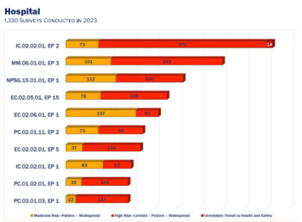
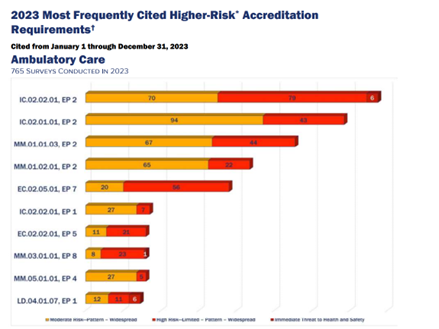
This week I have an overview of the frequently cited standards for 2023. I sent this out a few weeks ago but since it was released in the April Perspectives, I wanted to do a re-review just as a reminder for you.


In the interest of space on this blog, we will discuss the trends for hospital and ambulatory but for those of you with behavioral health programs in the BH manual and other programs such as Office Based Surgery, please review the April Perspectives for more information. 


The hospital frequently cited, no surprises: IC.02.02.01 EP 2: The hospital reduces the risk of infections associated with medical equipment, devices and supplies. This one also involves the Immediate Threat to Health and Safety category (the 14 cited for 2023). The National Patient Safety Goal 15.01.01 EP 1 still ranks high on the list. Problematic areas include lack of ligature resistance in dedicated behavioral health settings, or in non-dedicated spaces such as the Emergency Department (ED), staff members are unable to discuss or provide evidence of a process to remove objects that pose a risk for self-harm that could be easily removed without adversely affecting patient care. This finding will be scored in the high-risk category if a process has not been defined to address bathrooms and access to bathrooms by suicidal patients in the ED.


Lets take a look at that last one: PC.03.01.03 EP 1: Before operative or other high-risk procedures are initiated, or before moderate or deep sedation or anesthesia is administered: The hospital conducts a presedation or preanesthesia assessment.  

I am often surprised that this one keeps resurfacing. It’s like the history and physical. We know its required, its been a requirement for decades but it keeps finding its way to the top 10 for example: In the Emergency Department, the record of a patient who had undergone a procedure under moderate sedation was reviewed and the hospital could not demonstrate that a pre-anesthesia (pre-sedation) evaluation had been completed. A pre-anesthesia evaluation is required in the medical staff rules and regulations.


If you do not already audit records in areas such as the ED, I would highly recommend you do so just to get a baseline and a better understanding of where you are with presedation assessments.   

In the Ambulatory manual you will see the same standard at the top of the chart. For ambulatory centers with dental clinics that have a sterile processing department or staff in the clinic perform ultrasound procedures requiring the use of high-level disinfection and perform point of use instrument processing. If you do have a sterile processing department, be sure you are disposing of single use items. Also, as described in this finding, ensure that all staff members are performing point of use processing as defined in the policy and the manufacturer’s instruction for use. For example: “It was observed in the dental clinic that staff did not follow the organization’s infection control policy IC.4.4.2 INFECTION PREVENTION AND CONTROL and the PrepZyme manufacturer’s instructions for use when instruments were removed from the procedure room without prior spraying of the instruments with an enzymatic spray.” We do find issues with point of use instrument processing, particularly in the ambulatory programs.  


In the second most frequently cited standard, once again, in the infection control chapter, this finding is a good representation of what this element of performance represents: During tracer activity, in the outpatient infusion center, for a patient receiving IV medications, the medical assistant preparing the infusion for the RN did not clean the septum of three newly opened medication vials prior to puncture. 

When we observe this habit, staff members will often tell us that they thought, since the vial had not been opened, it should be sterile and would not require cleaning the septum. Medication Preparation Questions | Injection Safety | CDC


Lets look at one more at MM.03.01.01 EP 8. Compliance with this element of performance is simply having a process to remove expired medications. For example: “An anesthesia and malignant hyperthermia cart each containing medications that had expired the month prior to the inspection date on the cart was reviewed. Medications in the carts are typically checked by the pharmacy. The Director of the Pharmacy reviewed the cart and concurred with the observation and also agreed, their inspection process must be evaluated.”  

If you are preparing for survey or are in a constant state of preparedness, develop a checklist for the top ten. Compliance with these standards will help to eliminate risk of high risk, widespread findings or higher. 


Have a good week and let us know if we can assist with your preparation.

Information for You

  1. AWOHNN: Quantification of Blood Loss Learn More
  2. AWHONN: Role of TXA in PPH Learn More
  3. CDC: Tap Water Quality and Infrastructure Discussion Guide for Investigation of Potential Water-Associated Infections in Healthcare Facilities Learn More
  4. The Joint Commission Journal on Quality and Patient Safety: Nurses’ Perceived Causes of Medication Administration Errors: A Qualitative Systematic Review Learn More
  5. TJC: Perspectives Part 1 Learn More
  6. TJC: Perspectives Part 2 Learn More
  7. TJC: Perspectives Part 3 Learn More
  8. TJC: Perspectives Part 4 Learn More
  9. TJC: Perspectives Part 5 Learn More
  10. Suicide and Life Threatening Behavior: A longitudinal study examining the associations of bullying victimization and suicidal ideation among sexual minority adolescents Learn More

We would love to hear from you!


We can help support your organization.

For consultations, education, and training, please contact us.

See our Website
Contact Us
Join Our Email List