e-Newsletter | January 21, 2022
|
|
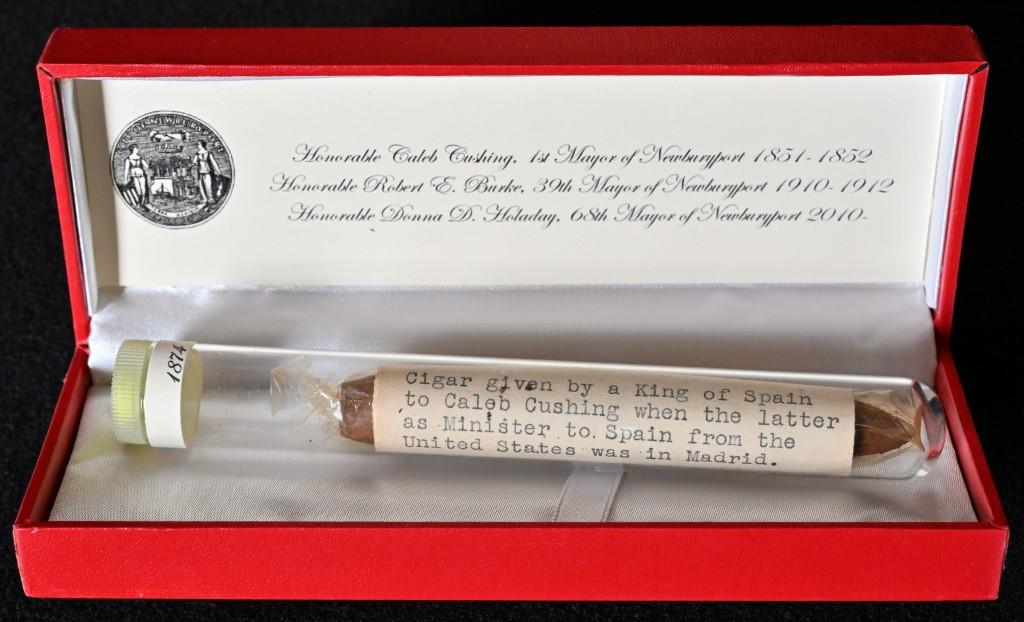
Presentation Cigar to Caleb Cushing from King Alfonse XII of Spain. The cigar was acquired by Robert E. Burke, 39th Mayor of Newburyport. John Crawshaw, nephew of Robert Burke presented the cigar to Donna Holaday, 68th Mayor of Newburyport in 2012. Gift of Mayor Donna Holaday to the Museum of Old Newbury. Photo credit Bob Watts. |
|
"A Good Panatela and Excellent Bordeaux"
Caleb Cushing (1800-1879), Newburyport's first mayor, had a distinguished political and diplomatic career stretching across the globe as far as China. Much has been documented about his national and international roles in 19th century America.
Cushing's last diplomatic post was as Envoy Extraordinary and Minister Plenipotentiary to Spain where he served from January 1874 until April 1877. He had been sent to Madrid due to the Virginius Affair in which 53 American and British mariners were executed for trying to land men and munitions in Cuba to attack the Spanish regime there. Cushing negotiated $80,000 in reparations to the American families of the men who were executed and avoided what might certainly have been a costly war between the United Sates and Spain.
|
|
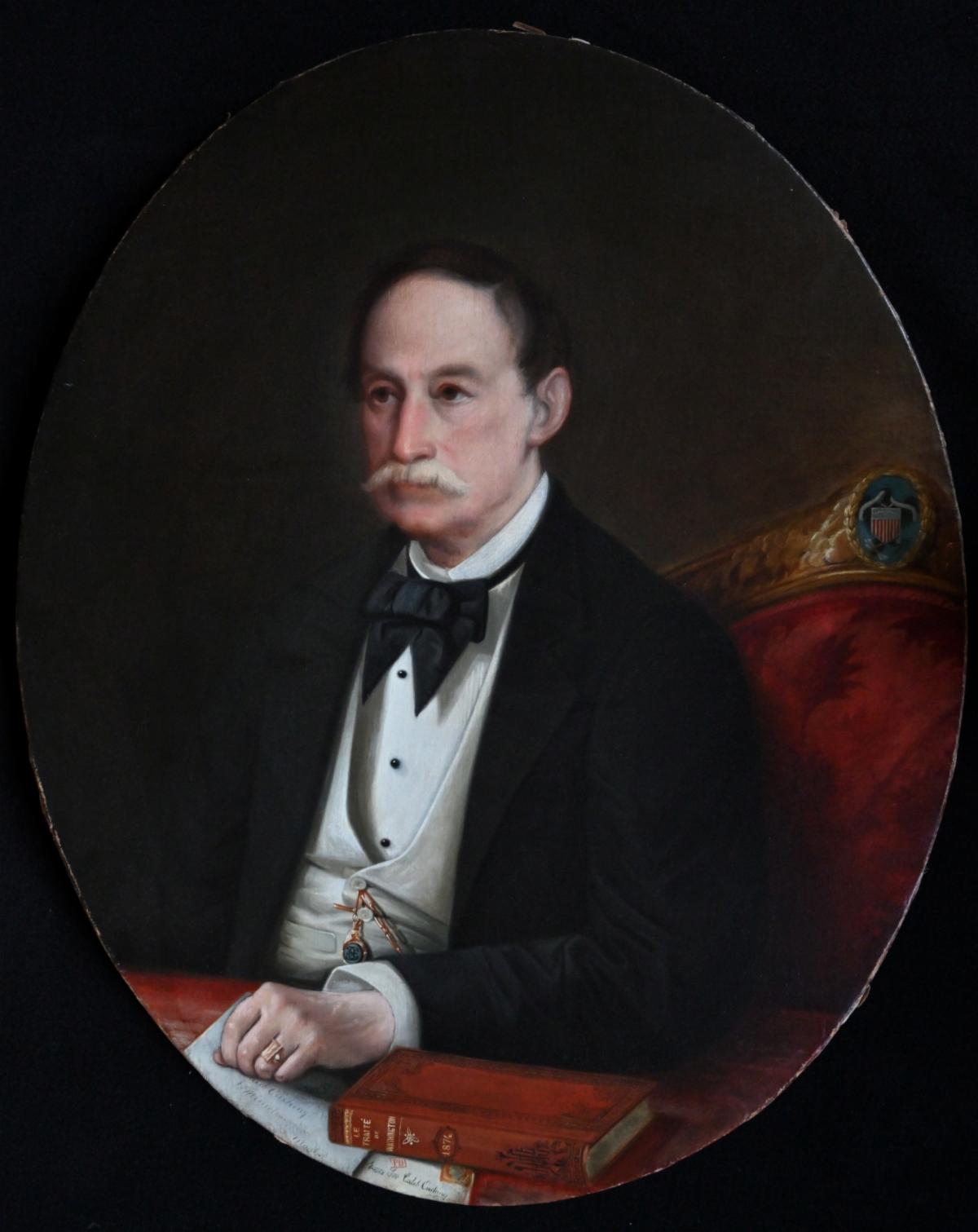
Portrait of the Honorable Caleb Cushing during his tenure in Madrid. From the collections of the Museum of Old Newbury. Gift of Francis Abbott Goodhue III, a descendant of Caleb Cushing. Photo credit Bob Watts. |
|
The majority of Cushing's tenure in Madrid has been described as being "leisurely and rational" and he seized the opportunity to enjoy the social affairs that the city offered. On his first trip to Europe with his wife Caroline in 1828, he was enthusiastic about the people and, in particular, Spanish women whom he said "reflected moral purity, delicacy and 'in the best interpretation of the word feminine' all that he held dear."
According to one of his biographers, John Belohlavek, Caleb Cushing was a lifelong lover of literature, and he composed poetry, as well as enjoyed reading Spanish poetry. He had a circle of associates in the diplomatic corps, and he attended soirees and hosted elaborate dinner parties. When he left Madrid in 1877 to retire and return to the United States, he shipped home 15 boxes of fine wine.
Another lifelong passion was cigars. An 1827 inventory of his belongings included a cigar box -- an object that he would never relinquish, although throughout his life many of his women friends and acquaintances tried to curb his indulgence for smoking, they would never succeed. It is documented that in 1849 Cushing spent almost as much on tobacco as on his wardrobe.
|
|
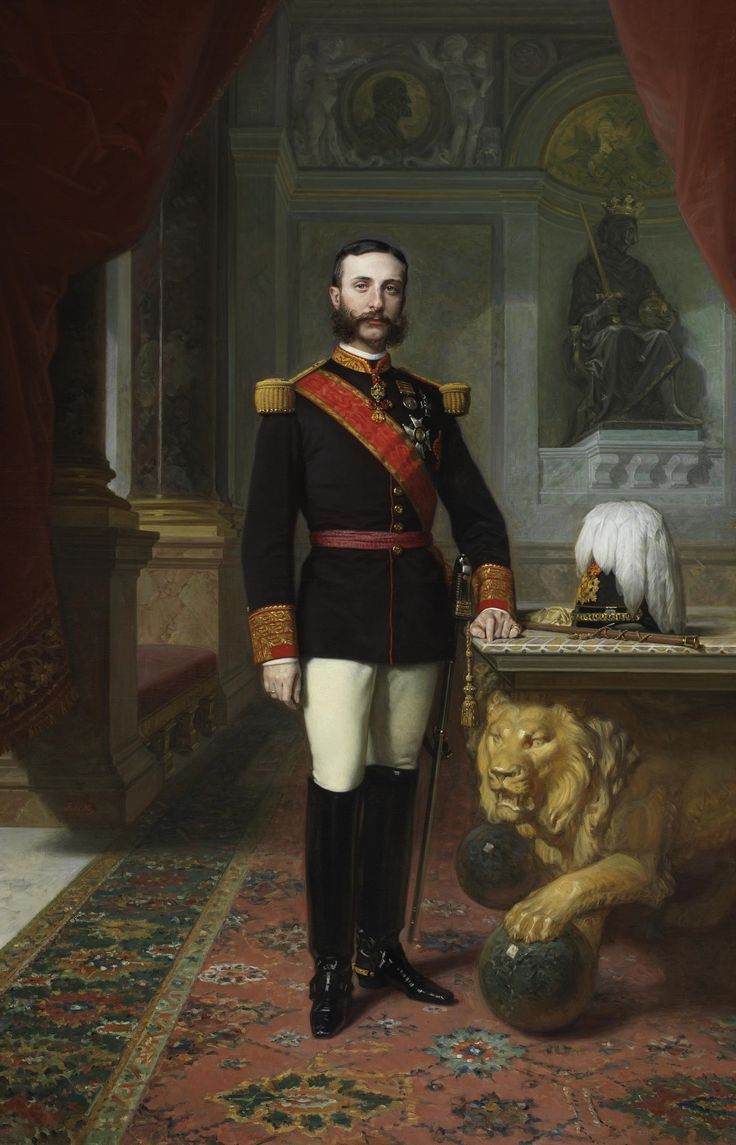
Portrait of King Alfonso XII of Spain. Known as El Pacificador or the Peacemaker, he reigned from December 1874 - November 1885. He died while on the throne at age 27. Portrait by Federico de Madrazo, circa 1886. Courtesy Museo Nacional del Prado. |
|
A recent gift to the museum's collections has shed some new light on Cushing's pleasured pastime of enjoying cigars. The object is a cigar presented to him by the King of Spain. In December 1874, the monarchy was restored when Alfonse XII returned from exile and became King. Imagine, if you can, the dashing 17-year-old ruler presenting the 74-year-old diplomat with one of his favored cigars. It may have been the only one Cushing never smoked. Clearly, he treasured it enough to keep it among his possessions.
When Cushing returned to Washington in 1877, his colleagues tried to lure him into staying in the capitol city and continuing his law practice. His response was "I am ready to leave the scene of activity and retire to the quiet repose of my home in Massachusetts."
Although he did decide to spend winters and springs in Washington, he spent the summer and fall of each year at his home at 63 High Street and took part in community affairs. He gave lectures to the newly founded Antiquarian and Historical Society, read novels ranging from popular pulp fiction to French psychology, went sailing with friends and probably enjoyed a good many cigars.
|
|
To learn more about Caleb Cushing's professional and personal life explore John Belohlavek's biography Broken Glass here.
|
|
Woman on the MOON
A Legacy of Kindness: Dick Johnson (1926-2022)
...a blog by Bethany Groff Dorau
Two weeks ago, I took a picture of myself holding a letter “D.” It was a group effort, spelling out “Happy New Year, Dick,” a token of our affection for Byfield’s Dick Johnson, who died on January 14. Many, many of you will grieve his loss. Today, I am crushed by the weight of it, even though I am a bit player in his extraordinary life. I have never met anyone who knew Dick who did not immediately tell me a story about him, even if it was just a story he had told them about someone else. Everything he said was memorable.
And so, I beg leave to tell you my Dick Johnson story.
It was 2000. I was twenty-five with a new husband and an even newer baby. I had my first out-of-grad-school job as lead guide at the Spencer-Peirce-Little Farm. Maggie, the site manager at the time, was already planning her escape, and so when I offered to take on additional tasks, like attending community meetings in the evenings, she readily agreed.
My first assignment was to represent the farm in CALM, the Cultural Alliance of the Lower Merrimack, long since disbanded. I was a bit of an outlier in that group - the youngest by decades and the only person who did not everyone else in the room.
In 2000, the primary, decidedly not “calm” topic of discussion was who was going to get us a float in the Yankee Homecoming parade. Because it was ABOUT TIME we had a FLOAT in the PARADE.
This was the single greatest wish of Al Moskowitz, representing the Newburyport Art Association, who sat on one side of me at a large round table, while his beatific bride, Rhina Espaillat, representing the Powwow River Poets, beamed at us from the other side.
|
|
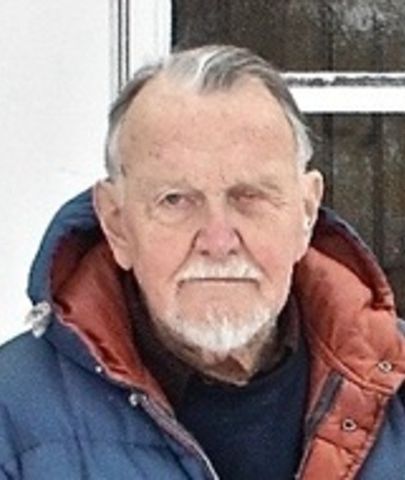
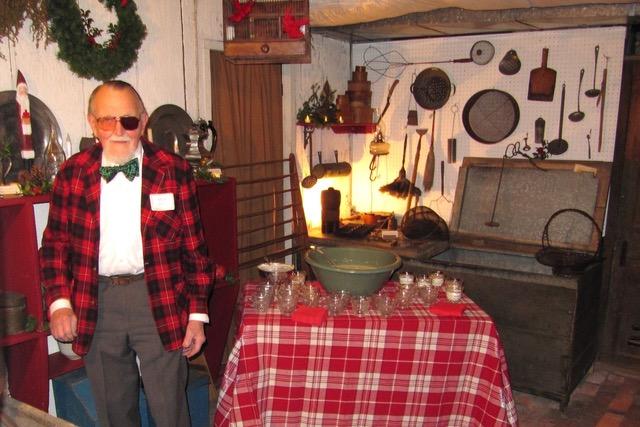
A long-time friend of the Museum of Old Newbury, Dick Johnson was well-known for his potent eggnog, here served at the 2010 Holiday Party. Photo courtesy of Sally Chandler. |
|
Dick Johnson, representing the Historical Society of Old Newbury, occupied the chair next to me, one eye covered with a padded cotton patch. As Al held forth at considerable volume from my left side, Dick decided to interrogate me from the right. It went something like this.
Dick (shout-whispering): So, where are you from?
Me (quiet whispering): I just finished grad school in Amherst.
Dick: What? I mean where are your PEOPLE from?
Me: Um, West Newbury and, um, Byfield. My dad’s from Waltha…
Dick (actually shouting): WHERE IN BYFIELD?
I admitted with some shame that my most recent Byfield relative was my great-grandmother, Mary Dyer Noyes, who married Philip Poore in 1905 and moved to West Newbury. “Oh, I know Mary,” he said. “Can’t be the same Mary,” I said. “She died in 1934.” “I’m older than I look,” said Dick. Then, shouting again, “WHO ELSE DO YOU KNOW FROM BYFIELD?”
It may seem ridiculous to think that one can drop the name of a person one has never met, who died decades before one was born, and claim that you “know” them, but such is life in an old New England town.
“Well,” I said, “there’s my great-great grandfather, Joshua Dummer Noyes.” Dick nodded. “Everyone called him Dumma,” he said. “And there’s his brother, George Washington Noyes…” Dick pushed back his chair and swiveled around to face me, his one eye filling with tears. “You’re George Noyes’ granddaughter?”
“Well,” I said, my newly minted historian’s desire for accuracy trumping the need to stop talking at full volume while Al Moskowitz was explaining his plans to turn an old landscaping trailer into his dream float. “He’s my great-great-great…” Dick waved his hand at me. “He was a lovely man,” he said, a tear falling into his white beard. “He saved my life.”
And then Dick Johnson told me the story of how he lost his eye.
He was plowing (or mowing) behind a team with his brother. He was five, maybe six years old. A rock was kicked up by the plow and flew up into his eye. His brother, terrified that he was dying, sat him down alongside a nearby road and told him to wait while he got help.
|
|
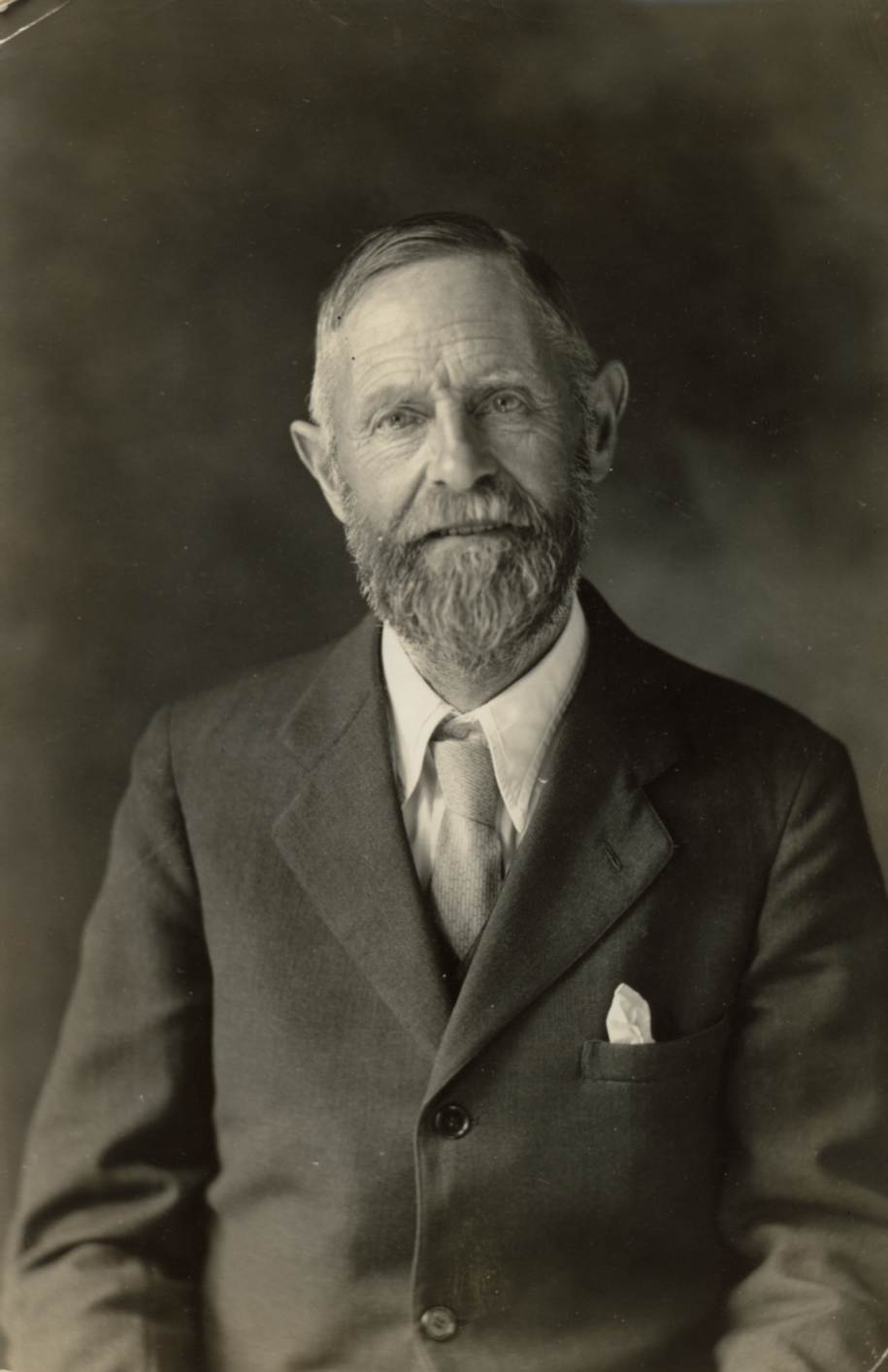
George Washington Noyes (1874-1956). |
|
Dick was bleeding profusely, holding a rag up to his eye, all alone and in shock, when George Washington Noyes, who would have been in his 70’s and had known Dick his whole life, happened to come by. He was not a doctor. As far as I can tell, he didn’t even have a clean rag to offer the child, but he picked him up and held him on his lap and told him that he was going to be alright, that help was on its way, that he was a child of God.
And help did come, and Dick did not die, though of course he lost the eye. When I met him, he was already as old as George Washington Noyes had been when he held him in that field, and Dick still believed that he had saved his life. “I’m glad to meet you,” he said, wiping under the rim of his glasses. I know he meant that he was glad to have thought about George after all these years.
Al was still holding forth about the float. Someone on the other side of Dick suggested that perhaps he should pipe down. He winked at me. “I always sit on his deaf side,” he said. “Which, fortunately, is also my blind side.”
|
|
I would love to hear other recollections of the story of how Dick Johnson lost his eye. I am sure that he has told it to many other people. I tried hunting for details in the Newburyport paper, which ran a lengthy column of accidents and injuries in the 1930s. It is rather stunning how many eyes were grievously injured in Byfield, but I have yet to find a record of Dick Johnson’s accident.
Just as COVID was closing in, I received an envelope in the mail from Dick. After CALM disbanded, we had continued to greet each other joyously at social and community events, but I had not seen him in years. I thought about him often, though, and talked about him a good bit too. It continues to tickle me that I was given so much credit for a kindness done by my great-great-great uncle all those years ago.
|
|
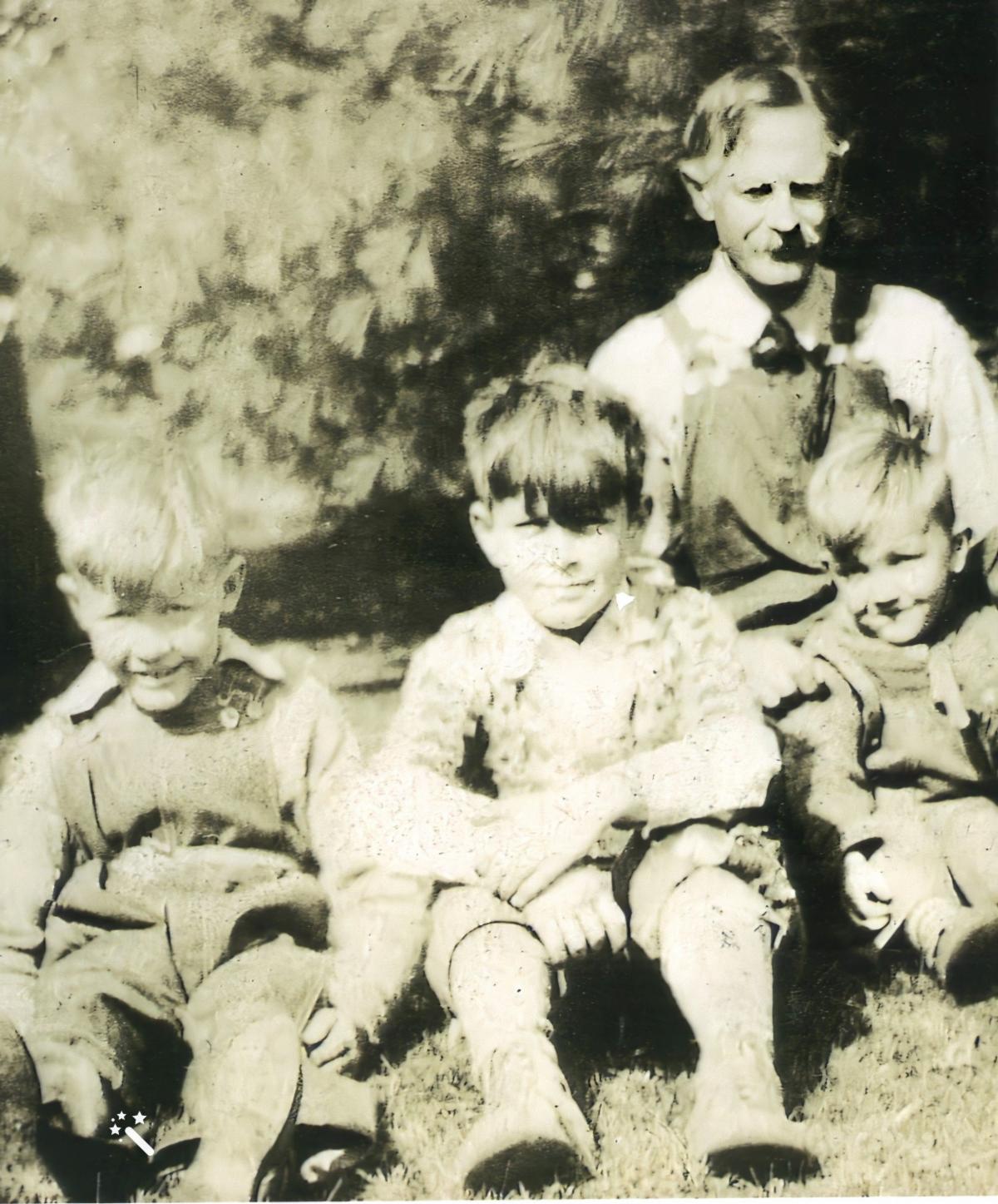
Front row: David, Bud, and Dick Johnson. George Washington Noyes in the rear. Circa 1930. |
|
In the envelope was a note and a picture of Dick Johnson, age four, an impish smile on his sweet face, along with his brothers David and Bud. And behind them in overalls, is George Washington Noyes, his hands resting on Dick’s shoulders. Dick wrote on the bottom of the enclosed note, “86 years ago,” and his name and address in case I had forgotten him. As if anyone could forget him.
The kindness that, by all accounts, was second nature to George Washington Noyes, survived him in stories like these. The wit, generosity of spirit, and stubborn Yankee charm of Dick Johnson will survive him too, while we who knew him keep telling each other these stories.
|
|
The Annex: Girls at The Governor's Academy a Century before Its Embrace of 'Coeducation' in 1971
Thursday, February 17, 2022, 7:00 PM - 8:30 PM (Online). Register here.
|
|
Class of 1901, Dummer Academy. Courtesy Photo. |
|
This year The Governor's Academy celebrates 50 years of "coeducation." Not just one of the oldest boarding schools in the country, the Academy is older than the country itself. Like many other venerable institutions, for most of its long history the Academy was a boys-only school. Not until 1971, more than 200 years after its founding, did it embrace "coeducation."
But this narrative, the most common one about coeducation at the Academy, overlooks two brief periods of early coeducation and an intermittent period defined by one headmaster's determination to return the Academy to its historic "first principles" as a boys' boarding school.
Unpacking these two early periods of coeducation at the Academy reveals a remarkable history that speaks to the controversy surrounding the era's burgeoning women's rights movement. The early female students at the Academy received mixed treatment from their male peers but found constant forward-thinking champions in two headmasters, Ebenezer Parsons and Perley Leonard Horne. What's more, though many of these female students successfully completed the Academy's course of study, they never received diplomas or formally graduated. Nevertheless, several alumnae would go on to pursue full-fledged careers and lead remarkable lives.
This is an online event. The Zoom link will be sent with registration and prior to the event.
|
|
About Imogene Robinson
Imogene Robinson graduated from The Governor's Academy in 2013 only to return as an archival intern two years later. As an intern, she continued her historical research into the Academy's early eras of "coeducation" as part of a grant awarded to her by Centre College's Brown Fellowship program. Since leaving college, Imogene has been a small-town barista, a wildlife journalist, and, most recently, a writer for a global digital agency. Somehow, however, she always seems to find her way back to history and to the village of Byfield.
|
|
Something is Always Cooking at the Museum
The temperature has slipped well below freezing again, but a big bowl of Ruth Yesair's rich soup served with some crusty bread and butter should warm you up in no time.
Pumpkin Soup
6 tablespoons butter, divided
2 pounds onions, thinly sliced
4 cloves of garlic, chopped
2 1/2 pounds pumpkin, diced
6 cups chicken stock
1 large celery stalk, chopped
3 tablespoons flour
Salt to taste
Melt 4 tablespoons butter in large saucepan. Sauté onions and garlic until golden. Add pumpkin, chicken stock, celery and salt. Bring to a boil, then simmer until pumpkin is well cooked and soft, about 30 minutes. Purée mixture in processor until smooth. Return mixture to saucepan. Knead flour with remaining 2 tablespoons of butter and gradually add to mixture, beating with a whisk. Bring to a boil to thicken. Correct seasonings and serve hot or cold. Serves 4 to 6.
|
|
Puzzle Me This...
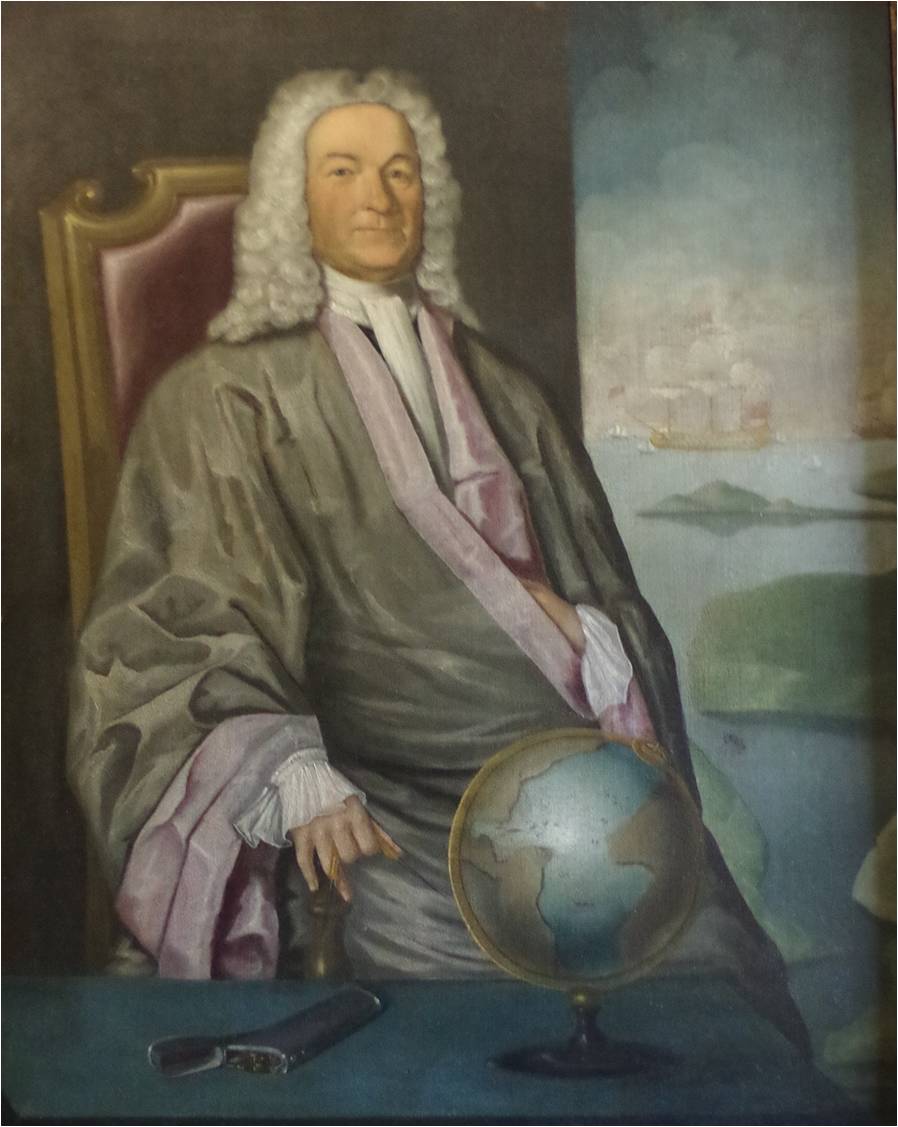
This portrait of Joseph Atkins (1680-1773) was painted about 1750. Atkins served in the British Navy before emigrating with his family to Newbury in 1724. He purchased land on Strong Street where he built a mansion house with extensive gardens stretching to the Merrimack River.
As a wealthy merchant involved in the West Indies trade, he was active in both church and community. In 1738, Atkins began construction on a wharf, distillery and warehouse complex. He, with other merchants and ship masters, raised the money for the building of St. Paul’s Church in 1741 and donated the land on which the church now stands.
Atkins was a moving force behind the petition to separate Newburyport from Newbury. At his death in 1773 (at the age of 92) he was second in wealth in Newburyport after his merchant colleague Patrick Tracy. Note the accessories of his trade and his ships in the background of the painting. From the collections of the Museum of Old Newbury.
Click on image to begin.
|
|
During this difficult period of COVID-19, we rely on your support more than ever. We continue to develop new, online programs for you to enjoy and keep us connected and look forward to in-person events as protocols for safety loosen. We hope, if you are able, that you will consider a donation to the museum. Thank you for your continued support.
|
|
Museum e-Newsletter made possible through the
generosity of our sponsors:
|
|
|
Museum of Old Newbury
98 High Street
Newburyport, MA 01950
978-462-2681
|
|
|
|
|
|
|
|