|
This month, we are acknowledging National Child Abuse Prevention Month, National Minority Health Month, National Stress Awareness Month, and National Volunteer Month.
Please read on to learn about our latest resources and news, as well as other resources and news from around the field.
| | Join Us for Our Upcoming Webinars! | | |
How Family Dynamics are Unique in Kinship Families
2:00 p.m. – 3:30 p.m. ET
In keeping with our practice, the webinar will be one hour, followed immediately by an open Q&A session that will last for half an hour.
This webinar will explain how family dynamics in kinship families differ from those in other families. Kin caregivers who attend this webinar will learn how they can help family members adjust to changing relationships and how they can use coping strategies to adapt to the emotions they experience, such as loss, grief, and resentment. This webinar will also be relevant to the professionals who serve kin caregivers, as they will be able to apply the lessons of the presentation to their work with kin caregivers. Our presenter is Subject Matter Expert Dr. Jospeh Crumbley.
| |
Trauma-Informed Care for Kinship/Grandfamilies
2:00 p.m. – 3:30 p.m. ET
In keeping with our practice, the webinar will be one hour, followed immediately by an open Q&A session that will last for half an hour.
This webinar, co-hosted by Network partner ZERO TO THREE, will address how trauma can present in both kin caregivers and children in their care, and how it impacts relational health. Explore practices associated with trauma-informed care to better support the kin caregivers you serve. Our presenter is Dr. Mike Sherman.
Additionally, this webinar will be supplemented by two learning community sessions, where you can take a deeper dive into this topic and participate in highly interactive conversations with your peers. To support the interactive nature of these sessions, they will both have a 100-person registration cap. Learn more and register for May 11 and one or both of these learning community sessions by clicking the button below.
| | We have even more events on the schedule for May and June! | | |
Kinship news, resources, and events are available throughout the month, not just in our monthly newsletter. Follow our LinkedIn page to keep up with the latest kinship news between monthly issues of this newsletter.
| | What's New From the Network? | | Exemplary Practice Profiles | | |
Looking to level up your services for kinship families? Check out the profiles of our 18 (soon to be 19) newly designated Exemplary kinship practices, which showcase discrete practice innovations in 6 service areas. Each profile offers information and tips to help you replicate this successful work to support kinship families in your community more effectively and efficiently. After a rigorous application and review process, these practices stood out, and we’re pleased to recognize and elevate their work on a national scale.
| | Pathways to Partnerships: Tips for Area Agencies on Aging and Title VI Native American Aging Programs to Improve Support for Kinship/Grandfamilies | | | | This tip sheet, produced with our partners at USAging, provides AAAs and Title VI programs with ideas for initiating community partnerships to support kinship/grandfamilies. It covers a broad range of partnerships, identifies types of providers with whom AAAs and Title VI programs might partner, explains the benefits of these partnerships, furnishes links to provider search tools, and includes quick tips for approaching providers for collaboration. | |
Caring for Those Who Are Caring for Everyone: The Sandwich Generation | | We know about the love and strengths kin caregivers share with their families, as well as many of the challenges they face. But what about those who are doing double duty, raising children while also caring for older relatives? In this two-page resource, we consider how we can better meet their needs. | | | |
|
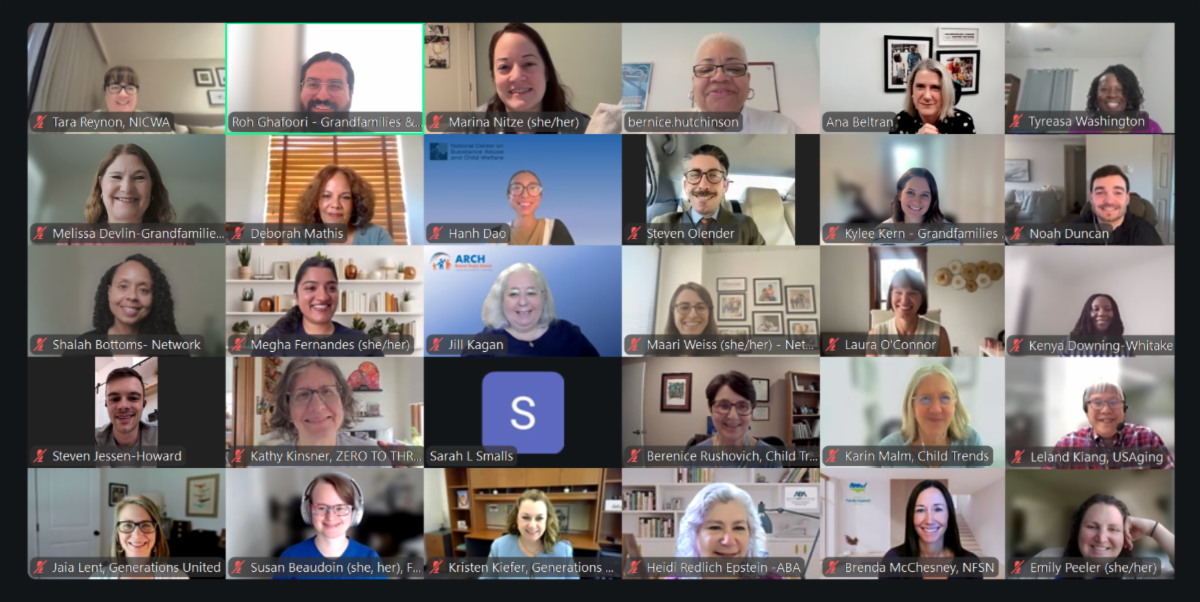
Twice a year, we host a meeting that brings together our partners and our subject matter experts. Our most recent meeting was just last week. It’s always inspiring to gather this amazing group! Check out our LinkedIn post about the meeting, and be sure to reach out to us if there’s anything that the Network can do to help you better serve kinship families. We have such a great team ready to assist you!
| | Individual Assistance Spotlight | | | | The Network is responding free of charge to individual technical assistance (TA) requests from professionals who work in systems and organizations that serve kinship/grandfamilies. To request assistance on the array of issues impacting kinship/grandfamilies, please complete our request assistance form. | | |
We answer questions and respond to requests of all sizes. Some questions focus on a very specific topic and/or location, while others are much broader. Below, we share an example TA request and response. As is typical for this spotlight, the request below only required an email response. Many of our requests benefit from more intensive involvement from our TA team. We often host meetings with peers or other subject matter experts; review data and policies; and provide specific guidance to help enhance programs, implement policies, or otherwise improve services for kin.
Request
Do you know when additional information about federal kinship navigation grant funding is expected to be released?
Response
The Children’s Bureau just released two grant forecasts, one for Kinship Navigator Programs: Replication and Tribal Adaptation and one for Kinship Navigator Programs: Evaluations. The notice of funding opportunity (NOFO) for the Replication and Tribal Adaptation grant is expected in late May, on or around May 25, and the estimated application due date is July 9. The NOFO for the Evaluation grant is expected in mid-June, on or around June 16, and the estimated application due date is August 7. Under the federal law that created these grant opportunities, the Children’s Bureau must award and distribute the funds by September 30. We will share both NOFOs on our LinkedIn page as soon as they are available, and we will continue to share information about them in this newsletter, as well. In the meantime, please see our new Toolkit to Develop and Enhance Kinship Navigator Programs, which provides links to the existing evidence-based Kinship Navigator models and tips that will help programs prepare to compete for funding.
To make an individual request, please complete this form and we will get in touch.
| | |
Soon after stepping into her role as Long-Term Care Division Director at New Mexico Aging Services, Kyra Ochoa reached out to the Grandfamilies & Kinship Support Network for guidance on standing up an effective program that could also measure impact, allow her team to learn from early results, and scale statewide over time.
Rather than offering a “how to” template, the Network engaged in strategic consultation — asking key design questions about eligibility, service duration, outcome measurement, and long-term scalability.
| | Presentations by the Network | | |
Today, Network Director Ana Beltran will be on a kinship plenary panel at the CarePortal Conference in Kansas City, Missouri, alongside Generations United GRAND Voice Mercedes Bristol. Ana and Mercedes are also presenting a breakout session tomorrow, and they will share practical tools to help support kinship families.
| | What's New Around the Network? | | Upcoming Webinars and Events | | Other Upcoming Webinars and Events | | |
- Virtual Symposium – Annual Older Adult Mental Health Awareness Day, presented by the National Council on Aging, the U.S. Administration for Community Living, the U.S. Health Resources and Services Administration, and the U.S. Substance Abuse and Mental Health Services Administration, on Thursday, May 7, from 10:00 a.m. to 5:00 p.m. ET
| |
Notable Funding Opportunities
(listed in order of application deadline)
| | |
As noted above, the Children’s Bureau just released two grant forecasts, one for Kinship Navigator Programs: Replication and Tribal Adaptation and one for Kinship Navigator Programs: Evaluations. The notice of funding opportunity (NOFO) for the Replication and Tribal Adaptation grant is expected in late May, on or around May 25, and the estimated application due date is July 9. The NOFO for the Evaluation grant is expected in mid-June, on or around June 16, and the estimated application due date is August 7.
The Food Justice for Kids Prize will support up to 14 nonprofits, Tribes, schools, and school districts in the United States that are working to ensure all children can access, learn about, and engage with nutritious, culturally relevant food. Applications are due by 1:00 p.m. ET on Tuesday, April 28.
AmeriCorps is accepting applications to its FY 2026 Martin Luther King, Jr., Day of Service grants program. Applications are due by 5:00 p.m. ET on Thursday, April 30.
The Lawrence Foundation makes grants to U.S.-based qualified charitable organizations. It has three areas of interest: environment, human services, and disaster relief. Applications are due by 11:59 p.m. CT on Thursday, April 30.
The Association on American Indian Affairs is accepting applications to its Native Youth Summer Camp Grants program. Applications are due by 11:59 p.m. ET on Friday, May 1.
The Max and Victoria Dreyfus Foundation supports educational, skills-training, and other programs for youth, seniors, and persons with disabilities, among other priority areas. Applications to the Fall Award Round are due by 11:59 p.m. on Monday, May 11.
The Centers for Medicare & Medicaid Services (CMS), through its Centers for Medicare and Medicaid Innovation, is soliciting applications for the Make America Healthy Again: Enhancing Lifestyle & Evaluating Value-based Approaches Through Evidence (MAHA ELEVATE) Model. Applications are due by Friday, May 15.
The Santa Fe Natural Tobacco Company Foundation grants financial assistance to organizations that support the preservation and advancement of American Indian self-sufficiency and culture in the United States. The next application deadline is Friday, May 15.
Journey for Good Foundation has four focus areas: combatting hunger and promoting nutritional wellness, workforce development, education and training, and honoring veterans and their families. Applications are due by 11:59 p.m. ET on Friday, May 15.
AmeriCorps is accepting applications to its Fiscal Year (FY) 2026 AmeriCorps State and National Native Nation Grants program. This is an opportunity for Indian Tribes to apply for funding for AmeriCorps members to serve in their communities. Applications are due by 5:00 p.m. ET on Wednesday, May 20.
Indian Child Welfare Act Title II Grants – Public Safety seek to support Indian organizations in the establishment and operation of off-reservation Indian child and family service programs. Applications are due by 11:59 p.m. ET on Tuesday, June 16.
The Kars4Kids Small Grant Program supports 501(c)(3) organizations across the country that have a central focus on doing original work on behalf of children. Their particular areas of interest are youth development, mentorship, and education. Applications are accepted year-round.
| | |
|
In the piece linked above, Network Subject Matter Expert Steven Olender discusses President Trump's budget request for Fiscal Year 2027 and its implications for programs that support kinship families. The President's budget is not a final decision, but it serves as an important signal to communicate the Administration's priorities to Congress and federal agencies and shapes where those agencies are likely to direct their attention and resources in the year ahead. Several programs that support kinship families (and which are outlined in the Network’s Funding Primer) are directly affected by this request. Click the heading above to learn more.
Drawing on her more than 27 years leading Generations United, Donna M. Butts shares powerful stories in her debut nonfiction book. The book will be officially released on June 9, but it is available for preorder now. All proceeds support Generations United and its work to support grandfamilies nationwide.
Child Trends Blog, April 8, 2026
This blog post, written by Sarah Catherine Williams, shares the results of a recent analysis of federal foster care data. It reveals that, “[i]n fiscal year 2024, 30 percent of children in foster care in the United States were placed with relatives. At the state level, the figure ranges from 2 percent in Massachusetts to 56 percent in Vermont, largely due to differences in state-level kinship care practices and policies.”
KFF Health News, April 2, 2026
This article focuses on the specialized managed care plans that 14 states have implemented as their Medicaid option for children who are involved with the foster care system. Although the plans are “meant to expand coverage,” many states and families are finding that the plans do not provide the same access to medical care as other Medicaid plans.
Council of Large Public Housing Authorities (CLPHA), March 25, 2026
Resident services – which can include activities for youth, health programs, financial counseling, and other programming to support housing stability and community engagement – “are positively associated with property financial performance.” New research shows that the Net Operating Income (NOI) for properties with resident services is 26% higher than it is for similar properties that lack resident services. This means that properties with resident services generate about $1,200 more per year per unit than their peers, and “every $100 per unit invested in resident services generates $259 in additional NOI and nearly $400 in total revenue the following year.”
|
| |
Please follow the Grandfamilies & Kinship Support Network on LinkedIn here! |
|  |
All of our previous newsletters are linked on our website, so you can access them anytime. |
| Did you receive this newsletter as a forwarded email? You can sign up to get it in your inbox every month! | | |
The Grandfamilies & Kinship Support Network is the only national technical assistance center for those who serve grandfamilies and kinship families. It was created to help guide lasting, systemic reforms. The Network is a new way to collaborate, to work across jurisdictional and systemic boundaries, to eliminate silos, and to help one another and be helped in return. Thank you for being part of it.
We'd love to hear from you! Please send any feedback on this newsletter to mweiss@gu.org.
| | |
The Network is supported by the Administration for Community Living (ACL), U.S. Department of Health and Human Services (HHS) as part of a financial assistance award totaling $9,950,000 with 95 percentage funded by ACL/HHS and $523,684 and 5 percentage funded by non-government sources. The contents are those of the authors and do not necessarily represent the official views of, nor an endorsement, by ACL/HHS, or the U.S. Government.
|
| | | |