|
The Amos review has landed.
Another heavyweight report.
Another catalogue of heartbreaking stories.
Another long list of recommendations, and…
Another uncomfortable question…
… what have we learned that we didn't already know?
Another, not much; and that may be the most damning finding of all.
- Women not being listened to.
- Poor communication.
- Staff shortages.
- Weak leadership.
- Fragmented accountability.
- Failure to learn from incidents.
- Unacceptable variation in care.
Read that list and think…
- Morecambe Bay.
- Shrewsbury and Telford.
- East Kent.
- Nottingham.
Different hospitals. Different families. Disturbingly similar conclusions.
Amos makes one eye-catching recommendation…
… appoint a National Maternity Commissioner to co-chair a national maternity committee alongside the Secretary of State.
I understand the thinking. If everyone is responsible, no one is responsible, but…
… it also poses an awkward question.
It's called co-chairing, but the Secretary of State will inevitably have the final say. You can figure the upshot; only decisions that are politically comfortable and nothing to embarrass HMG.
However, that may not be the most interesting development.
Within hours of publication, Donna Ockenden, whose own investigations have shaped much of what we now know about maternity safety, told Times Radio...
'Loading more regulation onto doctors and nurses is not going to wash.'
She's right… regulation has never delivered a healthy baby...
... clinical judgement, teamwork, adequate staffing and the confidence to act when something is wrong, do.
Then there's Dr Bill Kirkup CBE, an member of, and adviser to the Amos review.
Reports suggest he has distanced himself from the review over its treatment of the ‘normal birth’ philosophy. If that is indeed the reason, it matters.
Niall Dickson and I, interviewed Bill Kirkup and his thinking has always been consistent. His investigations repeatedly return to the same conclusion… culture can distort clinical judgement.
No one disputes that natural birth is usually the best outcome, when it's safe. The concern begins when achieving a vaginal birth risks becoming the objective instead of delivering a healthy mother and baby.
Whether Amos or Kirkup ultimately has the stronger argument is almost beside the point...
... the significance lies in the divergence.
Amos says, it’s only words, but words are all we have, so she’d better pick the right ones.
Ockenden appears to be warning against the default answer of more regulation.
Kirkup appears concerned that one of the recurring cultural causes of failure has not been fully acknowledged.
Those are not trivial disagreements.
They suggest we may still be debating the diagnosis rather than agreeing the treatment.
Is there a bigger lesson?
The NHS does not suffer from a shortage of recommendations. It suffers from a shortage of anticipation.
After fifteen major reviews we know, with remarkable precision, the circumstances that repeatedly precede failure.
So, why are we still waiting until tragedy strikes before acting?
We are awash with data…
… what are the indicators that tell a hospital board a maternity unit is beginning to get into trouble…
… before families discover it for themselves?
The NHS is very good at measuring yesterday. Deaths. Serious incidents. Public inquiries… are all important, but…
... management gurus call these lagging indicators. The real challenge is identifying leading indicators that tell us trouble is brewing while there's still time to intervene.
Kirkup called it reading the signals.
We need leading indicators to tell us what is beginning to happen...
... not another inspection regime. Not another committee.
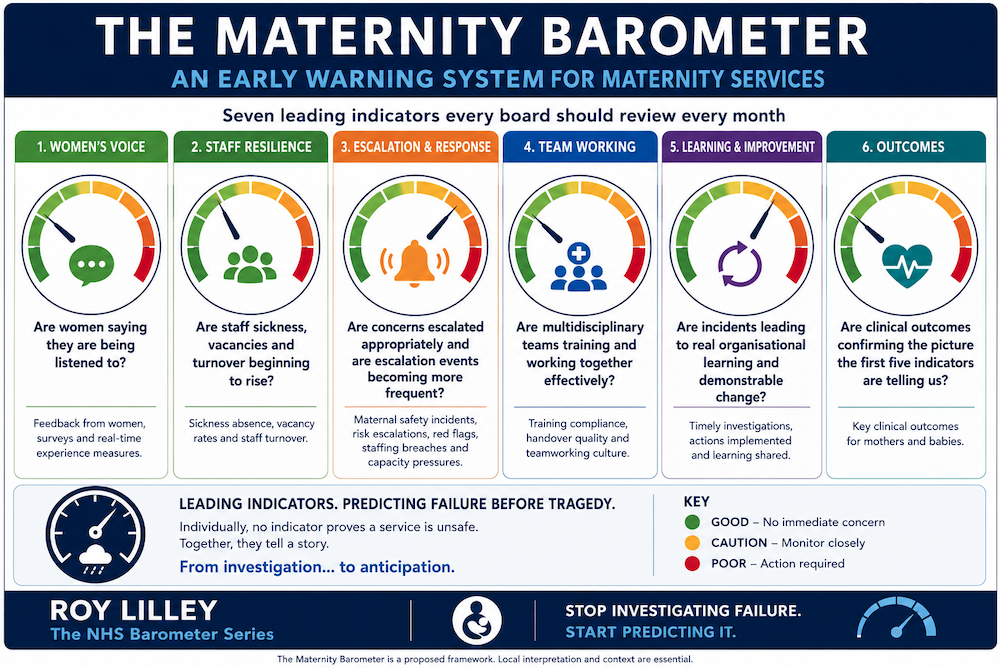
A maternity barometer.
A handful of simple, published measures that every board reviews every month.
- Are women saying they're being listened to?
- Are staff sickness, vacancies and turnover beginning to rise?
- Are staffing and capacity escalation events becoming more frequent or tailing off?
- Are multidisciplinary teams training and working together effectively?
- Are incidents leading to real organisational learning and demonstrable change?
None of these measures, on its own, proves a maternity service is unsafe.
Together they begin to tell a story.
We already have most of the data and now we have the computing power to make it work.
Like a falling barometer doesn't guarantee rain, but warns that the weather is changing.
We've become exceptionally good at investigating failure. The next step is to become good at predicting it.
Because…
... the next great maternity report should not simply explain what went wrong…
…it should tell us how we could have known sooner…
…and why nobody acted, while there was still time.
|