Ohio-ACC Newsletter, December 2022 |
|
Dear Ohio-ACC Colleague,
As we approach the end of the year, I wanted to share some highlights from our recent Annual Meeting held on Saturday, October 22, at the Hilton Columbus at Easton. A special thank you to everyone who was able to participate in person after several years; it was absolutely wonderful to see everyone and be together. We were honored to have Andrea Russo, MD, FACC, deliver the Richard Lewis Memorial Lecture addressing Early Rhythm Control or Prevention: A New Paradigm for Atrial Fibrillation. Other topics included CV disease in South Asians,
the controversy around the ACC/AHA Guidelines on Revascularization, lipid-lowering therapies, and our annual FIT oral competition. If you were unable to attend, you can see all of the highlights here.
We would like to thank our meeting sponsors: Zoll (Platinum), Amryt Pharma (Silver), Cincinnati Children's (Silver), Janssen (Silver), Novo Nordisk (Silver) Octagos Health (Silver), and Rhythmedix (Silver).
|
|
CardiOhio Podcast
Episode 1: Putting the Chest Pain Guidelines into Practice: Practical Tips from Imaging Experts.
Guests: Dennis Calnon, MD, FACC and Paul Cremer, MD
Episode 2: Success with Failure: Practical Perspectives for Heart Failure Management
Guests: Lindsay Castle, DO and Kenneth Varian, MD, PhD
Episode 3: The Symptomatic Athlete: Strategies for Evaluation and Return to Play
Guests: Michael Emery, MD, FACC and Simon Lee, MD, FACC
Episode 4: 2022 Ohio-ACC Spring Summit Re-Cap
Guests: Ben Alencherry, MD, Joseph Pietrolungo, DO, FACC, and Andrea Robinson, MSN, ACNP, AACC
Episode 5: HCM Update, part 1, Diagnosis, Testing, and Patient Perspective
Guests: Milind Desai, MD, MBA, FACC and Mike Papale
Episode 6: HCM Update, part 2 – Management and New Therapies
Guest: Milind Desai, MD, MBA, FACC
Episode 7: Post-PCI Antiplatelets: A Patient-Centered Focus
Guest: Jagadish Khanagavi, MD, FACC
Episode 8: Heart Disease in South Asians
Guest: Santosh Menon, MD, FACC
ACC Legislative Conference
ACC’s 2022 Legislative Conference was Oct. 16-18, in Washington, DC, where Ohio-ACC members joined ACC members across the country to lobby for issues impacting our patients and profession:
Increasing Access to Patient Care: this topic addresses Medicare cuts and expands patient access to cardiovascular care through legislation like the Increasing Access to Quality Cardiac Rehabilitation Act of 2021.
Improving Clinician Well-Being: this issue spans the need to streamline prior authorization practices and addresses workplace violence, where cases have notably increased under the strain of the COVID-19 pandemic.
Developing Public Health Initiatives: this topic centers around two key pieces of ACC-backed legislation that will help to address health inequities and promote preventive care. These bills are the South Asian Heart Health Awareness & Research Act of 2022 and the Cardiovascular Advances in Research and Opportunities Legacy Act.
|
|
Contact Us
Wishing you a very happy holiday season. If Gwen Goldfarb, our chapter executive, or I can be of assistance to you, please let us know.
Sincerely,
Kanny
|
|
Congratulations to Election Winners |
|
Congratulations to Ellen M. Sabik, MD, FACC and Kelly Bartsch, PharmD, BCPS, CLS for being elected as the next Ohio-ACC President and Cardiovascular Team Chapter Representative respectively! They will serve in an "elect" role beginning in March 2023 and assume their new roles in March 2024.
Dr. Ellen Sabik practices at University Hospitals of Cleveland where she is a Senior Attending Physician and Associate Professor of Medicine at Case Western Reserve University School of Medicine, and key faculty for the cardiology training program. She has a busy clinical practice and teaches in the echo lab and precepting fellows' clinic. Her clinical practice includes general cardiology, but she specializes in valvular heart disease, heart disease in women, and advanced cardiac imaging.
Dr. Kelly Bartsch has been a practicing clinical pharmacist in Ohio since 2011. For the last 10 years, she has been a Specialty Practice Pharmacist in the ambulatory care clinics at The Ohio State University Wexner Medical Center. She has been board certified in pharmacotherapy since 2012 and credentialed as a Clinical Lipid Specialist by the National Lipid Association since 2016.
|
|
Ohio-ACC Spring Summit: April 22, 2023
Joseph Pietrolungo, DO, FACC and Andrea Robinson, MSN, ACNP, AACC
Co-chairs
|
|
Saturday, April 22, 2023
Embassy Suites by Hilton Cleveland Rockside
Independence, Ohio
The program will include an exciting selection of topics that will help you in your clinical practice. Additionally, you will not want to miss the Carl J. Wiggers Memorial Lecture featuring Kim A. Williams Sr., MD, MACC, MASNC, FAHA, FESC.
|
|
Fellows in Training News
Ben Alencherry, MD, and Maryam Saleem, MD, Co-Chairs
|
|
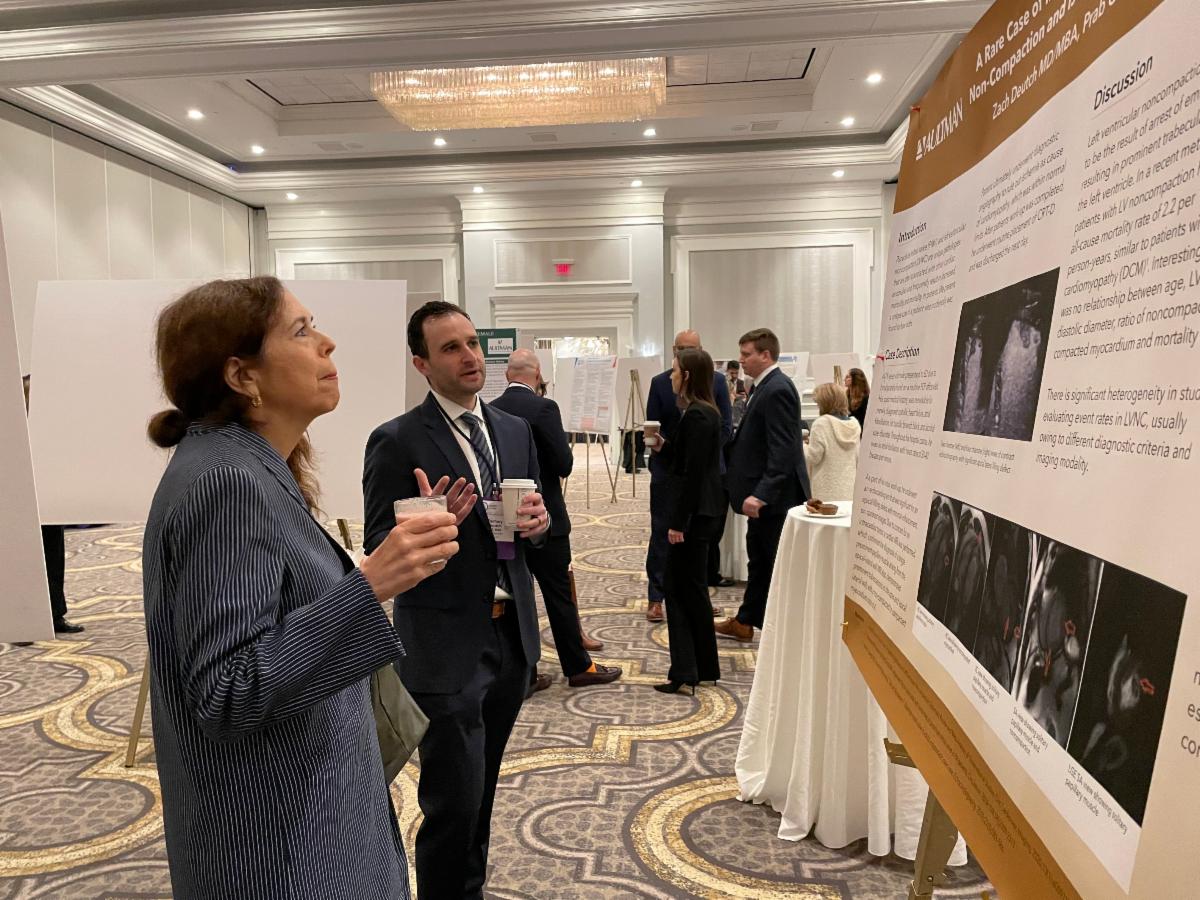
Congratulations to Our Oral Competition/Poster Competition Winners!
We are delighted that the Ohio-ACC FIT Poster Competition had such robust participation at the Ohio-ACC Annual Meeting in October. Please join us in congratulating the following:
Oral competition 1st place: Dr. Akash Goyal, OSUMC
Oral competition 2nd place: Dr. Tiffany Dong, CCF
1st-year case winner: Dr. Rachel Wester, Doctors Hospital/OhioHealth
1st-year research winner: Dr. Bader Alhafez, University of Cincinnati
2nd-year case winner: Dr. Ahmad Said, University of Cincinnati
2nd-year research winner: Dr. Matthew Laubham, Nationwide Children’s Hospital/OSUMC
3rd-year case winner: Dr. Maher Bazzi, Summa Health System/NEOMED
Advanced case winner: Dr. Ranjan Dahal, Summa Health System/NEOMED
Advanced research winner: Dr. Hannah Jacobs, Nationwide Children’s Hospital/OSUMC
CVT case winner: Lindsey Bronstein, Ohio State University Hospital
Resident winner: Dr. Aimee Willett, OhioHealth Riverside Methodist Hospital
Ohio-ACC Fellow Grand Round Series
The Ohio-ACC FIT council conducted its first-ever Fellow Grand Round Series with Dr. Eileen Hsich discussing Sex Differences in Heart Failure Therapies. She reviewed the current state of sex disparities in the treatment of heart failure and explained measures to improve these disparities. Dr. Hsich also shared her journey from fellow to physician investigator in heart failure. You can watch the session here.
The series will present a noon session approximately every two months to highlight the extraordinary work being done to mitigate disparities in cardiology. Each session will rotate between different Ohio fellowship programs. The goal of the grand rounds is to bring a better understanding of the root cause of disparities in cardiology and how our speakers have dedicated their careers to the topic. Participants will learn more about the given topic, the speaker’s career journey, and her/his niche in the field.
Stay tuned for:
January 19, 2023 - UC - Dr. Hanan Kerr will share her plans to create a cardiovascular training program in Rwanda. Register here.
February 22, 2023 - OSU/Kettering/Doctors Hospital - Dr. Lauren Lastinger will highlight Cardio-Obstetrics. Register here. |
|
CHEST 2022: Updated Guidelines on Perioperative Management of Anticoagulation
Kimberly P. Simon, PharmD, BCPS, Specialty Practice Pharmacist
The Ohio State University Wexner Medical Center
|
|
The American College of Chest Physicians recently published an update to their 2012 guideline on the perioperative management of anticoagulation and antiplatelet therapy, seeking to provide more specific and evidence-based recommendations for clinicians considering the need for bridge therapy in patients with mechanical heart valve, atrial fibrillation, or venous thromboembolism (VTE). In broad terms, the recommendations addressed patients on chronic vitamin K antagonist (VKA) therapy, direct oral anticoagulants (DOAC), and antiplatelet medications. Risk categories for periprocedural thromboembolism, as initially introduced in the 2008 guideline, are reviewed along with procedural bleeding risk for various surgeries, as presented in the International Society on Thrombosis and Haemostasis (ISTH) guidance statements from 2019. Overall, this current version of the guidelines seems to advocate for less widespread use of heparin bridging compared to its predecessor.
One of the most widely cited trials as evidence for recommendations in patients on VKA for atrial fibrillation is the BRIDGE Trial. This randomized, double-blind, placebo-controlled trial enrolled 1884 patients, who were assigned to receive either low-molecular-weight heparin (LMWH) bridge or matching placebo both before and after planned surgery. Primary outcomes included arterial embolism (i.e. stroke, systemic embolism, or transient ischemic attack [TIA]) and major bleeding in the 30 days following procedure. Non-inferiority criteria were met for arterial embolism (0.4% in no-bridge group vs 0.3% in bridge group), though this event rate is lower than the 1% rate anticipated by the authors in their calculations for sample size and selection of statistical tests. This may have been related to the study patients being considered low to moderate thromboembolic risk with mean CHADS2 score 2.3 ± 1.03 and 2.4 ± 1.07, respectively. Superiority criteria was met for major bleeding (1.3% in no-bridge group vs 3.2% in bridge group), as would be expected.
The other major trial cited was the more recently published PERIOP-2 trial, which in addition to including atrial fibrillation patients, also enrolled patients with mechanical heart valves. Of the 20.7% of study participants (n=304) with mechanical heart valves, 9% were in the mitral position and 11.7% were in the aortic position. Patients were assigned to administer either dalteparin or placebo around elective surgery to allow researchers to assess for any differences in major thromboembolism (i.e. stroke, TIA, proximal deep vein thrombosis, pulmonary embolism, myocardial infarction, peripheral embolism, or vascular death) and major bleeding (using ISTH criteria). Notable exclusion criteria included higher risk patients, such as those with multiple mechanical valves, Starr-Edwards valve, and mechanical valve with history of stroke/TIA. Through the period of 90 days from surgery, the rate of major thromboembolism was 1% for dalteparin vs 1.2% for placebo for patients with either atrial fibrillation or mechanical heart valve. These results were similar in both the atrial fibrillation and mechanical heart valve groups, as were the rates of major bleeding, which were 1.3% for dalteparin vs 2% for placebo. While there wasn’t a statistically higher rate of bleeding in the LMWH group, this study supports the idea that bridge therapy did not offer any additional benefits to the patients who took it.
Select recommendations from the 2022 guideline:
- In patients receiving VKA therapy for a mechanical heart valve who require VKA interruption for an elective surgery/procedure, we suggest against heparin bridging (Conditional Recommendation, Very Low Certainty of Evidence).
- In patients receiving VKA therapy for atrial fibrillation who require VKA interruption for an elective surgery/procedure, we recommend against heparin bridging (Strong Recommendation, Moderate Certainty of Evidence).
- In patients receiving VKA therapy for VTE as the sole clinical indication who require VKA interruption for an elective surgery/procedure, we suggest against heparin bridging (Conditional Recommendation, Very Low Certainty of Evidence).
- In patients receiving VKA therapy who are classified as high risk for thromboembolism and who require VKA interruption for an elective surgery/procedure, we suggest heparin bridging over no heparin bridging (Conditional Recommendation, Very Low Certainty of Evidence).
- In patients receiving VKA therapy who are classified as low-to-moderate-risk for thromboembolism and who require VKA interruption for an elective surgery/procedure, we suggest against heparin bridging (Conditional Recommendation, Very Low Certainty of Evidence).
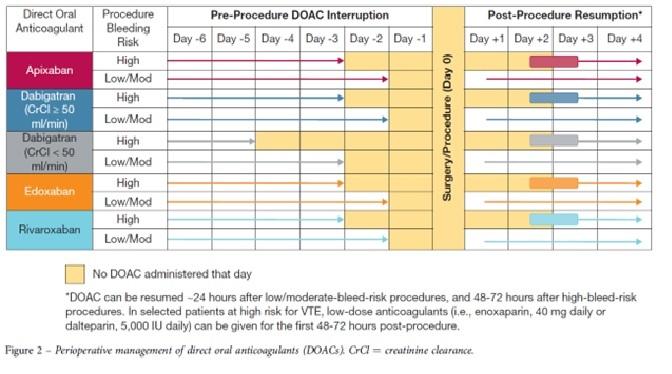
The following figure provides guidance on recommended hold and resumption times for DOACs:
|
|
References:
1. Douketis JD, Spyropoulos AC, Kaatz S, et al. Perioperative bridging anticoagulation in patients with atrial fibrillation. N Engl J Med 2015;373(9):823-833.
2. Douketis JM, Spyropoulos AC, Murad MH, et al. Perioperative Management of Antithrombotic Therapy: An American College of Chest Physicians Clinical Practice Guideline. CHEST 2022; 162(5):e207-e243.
3. Douketis JM, Spyropoulos AC, Spencer FA, et al. Perioperative Management of Antithrombotic Therapy – Antithrombotic Therapy and Prevention of Thrombosis, 9th ed: American College of Chest Physicians Evidence-Based Clinical Practice Guidelines. CHEST 2012; 141(2)(Suppl):e326S–e350S.
4. Kovacs MJ, Wells PS, Anderson DR, et al. Postoperative low molecular weight heparin bridging treatment for patients at high risk of arterial thromboembolism (PERIOP2): double blind randomised controlled trial. BMJ. 2021;373:n1205.
|
|
Take Action on the Supporting Medicare Providers Act of 2022 |
|
On top of already devastating Medicare payment cuts in 2022, clinicians now face an array of significant reductions on January 1, 2023, due to a series of statutory reductions and other cuts to specific services proposed in the CY2023 Medicare Physician Fee Schedule Rule. These cuts ignore continued increases in practice expenses due to rising inflationary pressures, exacerbate financial uncertainty and further threaten patient access to care. Individually, each of these reductions would be painful; together, they are potentially devastating.
- 4.42% reduction in the Medicare Physician Fee Schedule (PFS) conversion factor
- Imposition of a 4% Statutory PAYGO sequester resulting from passage of the American Rescue Plan Act of 2021
In response to these drastic potential cuts, Reps. Larry Bucshon, MD and Ami Bera, MD introduced legislation, the Supporting Medicare Providers Act of 2022 (H.R. 8800), on September 13 that would provide an additional 4.42% to the conversion factor to avoid payment cuts associated with budget neutrality adjustments resulting from Medicare policy changes. Importantly, this legislation also provides an opening for Congress to address systemic issues through long-term reform. With cuts like these appearing at an alarming frequency on an annual basis, the need for reform has never been clearer.
While we work toward sustainable and long-term solutions for reform, the Supporting Medicare Providers Act of 2022 is an important springboard for addressing and providing short-term relief for all anticipated cuts to Medicare services scheduled to take effect in 2023.
|
|
|
Bring Your Team to the Cardiovascular Summit
Bring your colleagues and discover how to align strong leadership with effective business strategies to improve cardiovascular care and patient outcomes at the Cardiovascular Summit! Register today to learn the latest information on physician compensation, emergence of private equity in cardiovascular practice, cardiovascular service line trends, and much more! Network with your colleagues, Feb. 16 – 18, 2023, in Washington, DC, and acquire innovative approaches and best methods for the delivery of care while aligning well-being for the entire team. Don’t miss this transformative educational experience designed for you and the entire cardiovascular team. Groups of two or more qualify for significant discounts on registration. Get the details.
The Centers for Medicare and Medicaid Services (CMS) released the final 2023 Medicare Physician Fee Schedule rule. Of note, the conversion factor has been updated from $34.6062 to $33.06, and the overall reimbursement for cardiovascular services is projected to decrease by 1% compared with 2022, mostly driven by changes in practice expense payments. Individuals and groups will see different impacts depending on patient populations and services offered. The final 2023 Hospital Outpatient Prospective Payment System (OPPS) rule was also posted, indicating a 3.8% payment update for hospitals based on a projected increase in the hospital market basket of 4.1%, reduced by 0.3% for the productivity adjustment. Learn more.
Access a more detailed breakdown on the Medicare Physician Fee Schedule rule here. Your ACC staff will provide a breakdown of the final Hospital OPPS rule in the coming days.
Following intense advocacy efforts from your ACC, the Heart Rhythm Society, and other stakeholders, CMS altered its earlier proposed work relative value units for electrophysiology ablation services as part of the final 2023 Medicare Physician Fee Schedule rule. Access your ACC’s ablation explainer for more details.
|
|
|
|
|
|
|