Rail Workers Weekly News Digest
Number 35 - November 19th, 2019
|
|
Below is a series of articles compiled over the previous week.
They are of interest to railroad workers.
_____________________________________________
|
|
Article 1
Railroad Workers United Issues Critique of the new "Coordinated Bargaining Coalition"
Railroad Workers United (RWU) commends the union officials of the ten rail unions in the U.S. that recently announced their intentions to bargain as a group in this round of national handling with the rail carriers as the “Coordinated Bargaining Coalition.” It is unprecedented for the operating crafts and the shop crafts to come together on such a scale as this. The ten unions - American Train Dispatchers Association (ATDA); Brotherhood of Locomotive Engineers and Trainmen / Teamsters Rail Conference (BLET); Brotherhood of Railroad Signalmen (BRS); International Association of Machinists (IAM); International Brotherhood of Boilermakers (IBB); National Conference of Firemen & Oilers/SEIU (NCFO); International Brotherhood of Electrical Workers (IBEW); Transport Workers Union of America (TWU); Transportation Communications Union / IAM (TCU); Transportation Division of the International Association of Sheet Metal, Air, Rail, and Transportation Workers (SMART-TD) – will no doubt be stronger and more able to win better contracts if they are able to hold this coalition together. A universal coalition of all rail labor has been a major goal of Railroad Workers United since our founding in 2008.
Shortcomings
Just a few short years ago, the operating crafts were at one another’s’ throats, and the shop crafts were hopelessly divided into numerous “coalitions”. The rail unions were hopelessly divided, at best into several, ineffectual, irrational groupings, or at worst, facing off with the carriers independently. In comparison, this near universal coalition represents a drastic improvement for rail labor. While RWU sees this historic coalition as a step forward, it is not without shortcomings. To ensure that rail labor is strong and united at the bargaining table, more work needs to be done.
|
|
Article 2
RWU Ramps Up Campaign to Save the Two Person Train Crew
In early October, the major rail carriers - under the guise of their National Railway Labor Conference (NRLC) - filed suit to enable them to bargain reduced crew size in upcoming national handling. On November 1st, the National Carriers Conference Committee (NCCC) served their Section 6 Notice to the rail unions that makes their intention clear. They will mount a full court press to destroy the 2-person crew!
THEY INTEND TO RUN TRAINS WITH A SINGLE EMPLOYEE ACROSS THE USA!
Brothers & Sisters, it is time to fight back!!
Railroad Workers United has produced a whole new line of supplies - stickers, buttons, T-shirts, yard signs, and bumper stickers - to assist railroad workers to win this crucial fight!
In order to get these materials in the hands of as many railroaders as possible, RWU has chosen to provide them to you for just one-half of their production cost to us. In effect, you will get two-for-the-price-of-one!
|
|
Article 3
Four States, Led by New York, Challenge Trump Administration Over Oil Train Safety Rule
On October 23, New York Attorney General Letitia James, joined by attorneys general from Maryland, New Jersey, and California,
sent a letter
of support to the U.S. Pipeline and Hazardous Materials Safety Administration (PHMSA) over a
Washington state law
that would limit the volatility of oil transported by train through the state.
That oil originates in the Bakken Shale in North Dakota and Montana, where trains help take the place of scarce pipelines in order to move fracked crude oil to Washington's refineries and ports along the coast. North Dakota and Montana have fought back against Washington's law, which was passed in May, and filed
a petition
to PHMSA in protest just two months later.
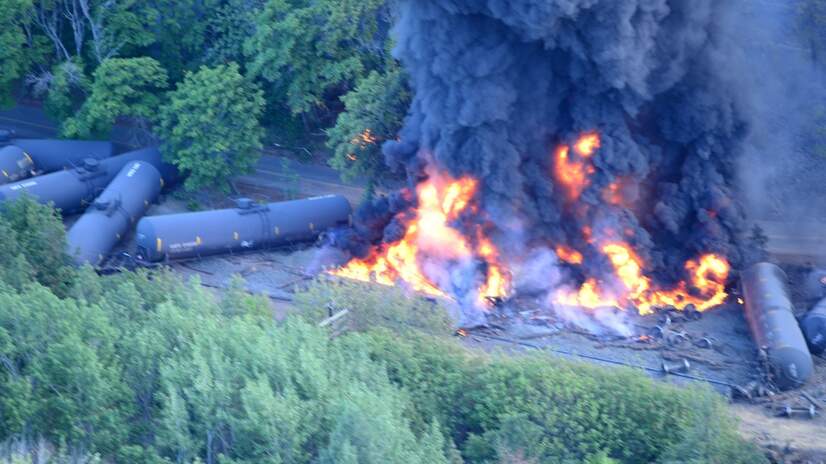
Spurred by safety concerns about oil trains derailing and exploding, the Washington law would cap the vapor pressure of crude oil moved by rail at 9.0 pounds per square inch (psi) and would be triggered by a rise in oil train traffic in the state.
Part of the argument made by North Dakota and Montana is that the Washington regulation should be pre-empted by federal regulation, which is in a state of limbo, on limiting the volatility of oil train cargo. That approach effectively says the federal government has no need to regulate the vapor pressure of oil transported by rail.
As DeSmog
has documented
, federal regulators recently issued just such a pre-emptive order, which they claim invalidates state safety regulations requiring two-person crews to operate freight trains. The Federal Railroad Administration
spelled out this approach
, saying it would focus on removing “unnecessary barriers” (regulations) and instead give “voluntary guidance” on safety improvements to railroads and oil companies.
|
|
Article 4
New Paper Reveals Rail Industry Was Leader in Climate Denial Efforts
A
recent paper
analyzing the major players in the organized efforts to attack climate change science and delay action had a surprising revelation — the biggest contributing industry/sector was not oil and gas but rail/steel/coal with the most active organization in the climate denial movement being the Association of American Railroads (AAR).
And the allied trade association that was most active was the AAR. Why would the rail industry care about climate change and be active in promoting denial?
Coal.
Coal has historically been the biggest business for U.S. rail, and still generates over 16% of
Class 1
rail revenue in 2018,
according to the AAR.
Without coal the U.S. rail industry has a major revenue problem — which explains the decades of climate denial activity documented in this new paper.
Of course, the U.S. coal industry is in serious decline despite all of the climate denialism funded by the rail and coal industries. Moody’s has estimated that the rail industry is facing a loss of
$5 billion
in coal revenues (from current levels of approximately $10 billion) by 2030.
|
|
Article 5
Railroad Shippers Roundtable
Subcommittee: Railroads, Pipelines, and Hazardous Materials
Date: Thursday, July 25, 2019
Time: 10:00 AM
Location: Rayburn House Office Building, Room 2167
(Editors Note: This is long and detailed, but shows the deep concern and displeasure that these major US shipping groups have with the railroad and PSR today).
ROUNDTABLE PARTICIPANTS
Mike Amick, Senior Vice President for Paper the Americas, International Paper
Josh Etzel, Vice President, Kinder Morgan Terminals
Randy Gordon, President and CEO, National Grain and Feed Association
Ross Corthell, Vice President, Transportation, Packaging Corporation of America, On Behalf of
National Industrial Transportation League
Mike Lacey, Chief Executive Officer, Solvay, On Behalf of American Chemistry Council
Steve Seeler, Chief Executive Officer, Seeler Industries
Emily Regis, Fuels Resource Administrator, Arizona Electric Power Cooperative, On Behalf of
Freight Rail Customer Alliance
Gerard McCullough, Associate Professor, Department of Applied Economics, University of
Minnesota
|
|
Article 6
Lawmakers aim to thwart Amtrak forced-arbitration policy
Lawmakers are in the initial stages of determining whether they can prevent Amtrak from implementing a forced arbitration policy that would bar passengers from suing if they’re hurt or killed in crashes.
Rep.
Daniel Lipinski
, D-Ill., chairman of the House Transportation and Infrastructure Subcommittee on Railroads, Pipelines and Hazardous Materials, said Wednesday that he was trying to determine how best to stop the government-supported passenger rail service from imposing the forced arbitration policy on customers. Amtrak began imposing the policy in January.
|
|
Article 7
Rail Passengers Association Argues Amtrak is an essential public service, should be funded as such
The House Rail & Infrastructure Subcommittee on Rail held a hearing the Amtrak reauthorization on November 13, examining current-day challenges and future opportunities for passenger rail in the U.S. Rail Passengers Association President Jim Mathews testified as part of the panel—which also included representatives from Amtrak, railroad labor, and state transportation officials—arguing that Amtrak is an essential engine for economic growth in town across the country, and that we cannot cut our way to a sustainable national rail network.
The hearing, titled “Amtrak Now and Into the Future,” focused on the funding challenges facing this Congress if it’s going to change the transportation status quo in this country, and overcome decades of underinvestment in passenger trains. T&I Committee Chairman Peter DeFazio (D-OR) attacked the anemic funding levels at the root, challenging the idea that Amtrak—alone, out of all the transportation modes—should have to make a profit.
“Amtrak should be one of our Nation’s great success stories, but it remains one of our Nation’s most difficult challenges because of a belief by some in this chamber that our country shouldn’t have a national passenger rail system supported by the Federal Government,” said DeFazio in his opening remarks. “We spend hundreds of billions of dollars to subsidize every form of public transportation – highways, aviation, transit– yet Amtrak gets the short end of the stick, with under $2 billion a year from the Federal Government… To be clear, I don’t subscribe to this notion that Amtrak needs to operate cost-neutral.”
|
|
Article 8
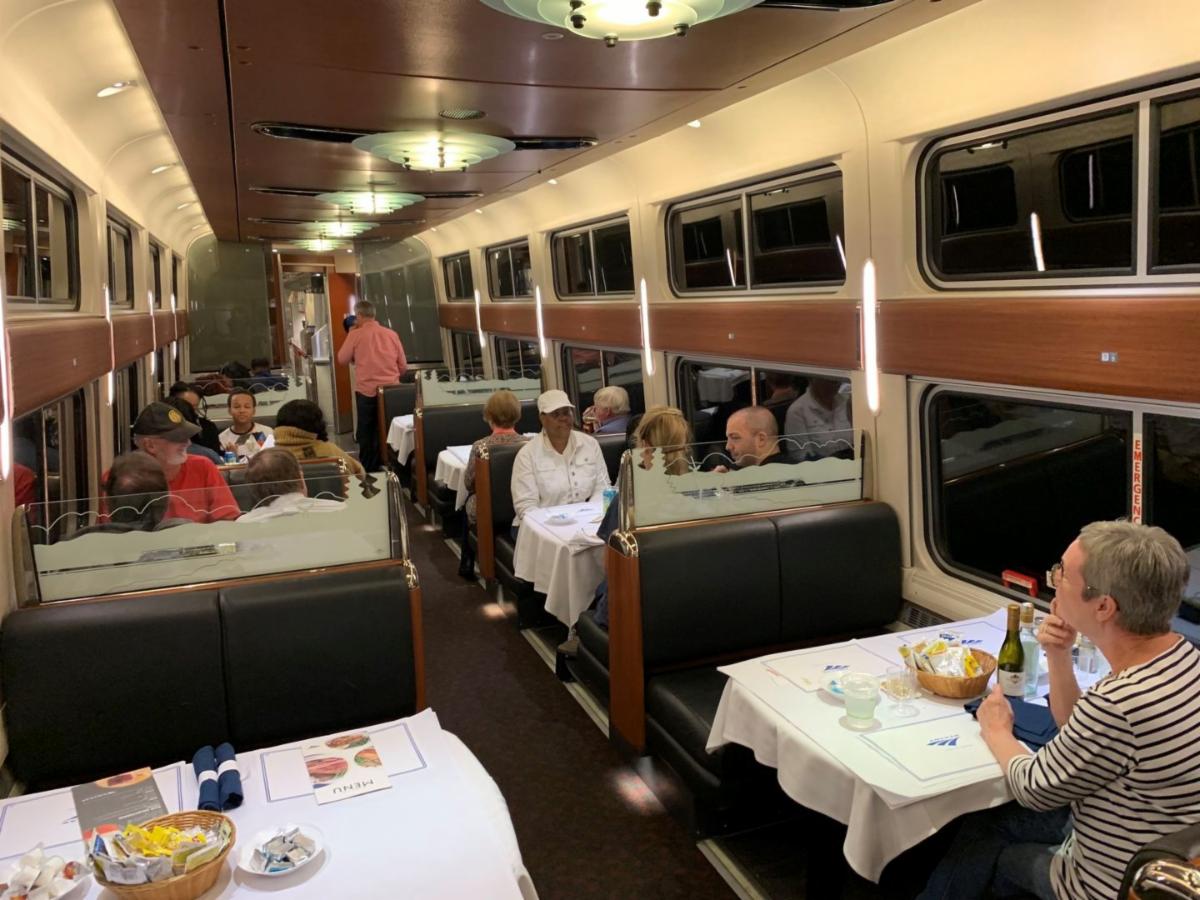
Amtrak chief defends decision to kill the traditional dining car on some long-distance trains
Amtrak president and chief executive Richard Anderson on Wednesday defended the company’s decision to kill the traditional dining car on some long-distance trains, a shift that has ignited a firestorm of complaints from railroad passengers and aficionados.
Anderson acknowledged the transition to more “flexible” and “contemporary” dining options hasn’t been popular but said it has not hurt ticket sales.
“There’s a lot of anecdotes about food, because there are people that love the long-distance service and the halcyon days of sitting in the dining car in your coat and tie, and I appreciate that,” Anderson said while testifying in front of the House Transportation subcommittee on railroads, pipelines and hazardous materials. “But when you make these kinds of changes, you make these kinds of changes based on data, and we have data about what our customers’ preferences are.”
|
|
|
|
|
|
|