The Five W's and Inuit Art | |
|
Journalism students are taught to answer five questions beginning with W when they write a story: Who? What? When? Where? Why? and also How? Applying the same questions to your Inuit art acquisitions can enhance your appreciation and understanding of your collection.
Many experienced collectors take pleasure in understanding the context in which their works were created, the relationships among the artists in their collection, and how the artworks relate to traditional and/or contemporary Inuit culture. This newsletter provides a framework for starting to probe beneath the surface of your artworks. Some of what follows may be familiar to you; I hope that you will discover some new resources in what follows.
Who made this work of art? does not always have an answer. Works on paper are almost always labeled with artist, title, date and community. Sculptures and textiles, however, are not always signed, and signatures are sometimes ambiguous. Let's start with the easiest case: Your carving was signed unambiguously or was accompanied by an igloo tag identifying the artist. Don't stop there. Today, there are Wikipedia entries for many Inuit artists. In addition, the Inuit Art Foundation webpage features profiles of many Inuit artists. You can learn an artist's biography, how widely their work has been exhibited, whether they have received awards for their work, and whether they are related to other artists.
The next easiest case: your carving is signed, either in Roman letters or with an identity disc number beginning E- or W-, or in Inuktitut syllabics. There are online tools to help you identify artists' signatures in any of these three forms. Our artist identification tool is here. Katilivik.com has a more flexible tool, which will search by community as well as by name. Identifying artists' signatures written in syllabics is somewhat like playing pinball, but, like pinball, there is great satisfaction in mastering the art. See our guide to Deciphering Inuktitut Signatures for an introduction. Once you have identified the artist, you can look them up in Wikipedia or online.
The hardest case: your carving is not signed. All is not lost. You may be able to narrow the field by answering the other W questions, discussed below. By identifying the community and approximate date, you may be left with a small number of possibilities, and looking for their work online may allow you to make a reasonable guess at the artist or at least the family that produced your carving. (See Putting it all together, below.)
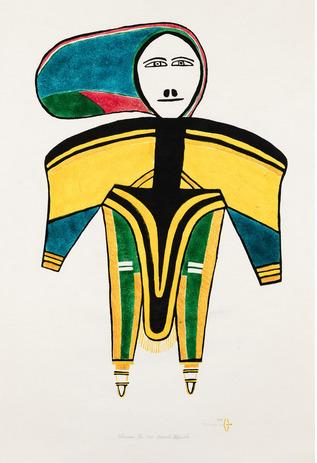
Once you have identified an artist, you will be able to trace family connections. For example, Jessie Oonark, whose Woman is pictured above, had twelve children, eight of whom also became recognized artists. Similarly, Cape Dorset is home to several artistic dynasties, including the Ashevaks, Ashoonas and Pootoogooks. Annie Pootoogook, a brilliant graphic artist, was the daughter of Napachie Pootoogook and the granddaughter of Pitseolak Ashoona and a cousin of Shuvinai Ashoona, one of the current stars among Cape Dorset graphic artists.
| |
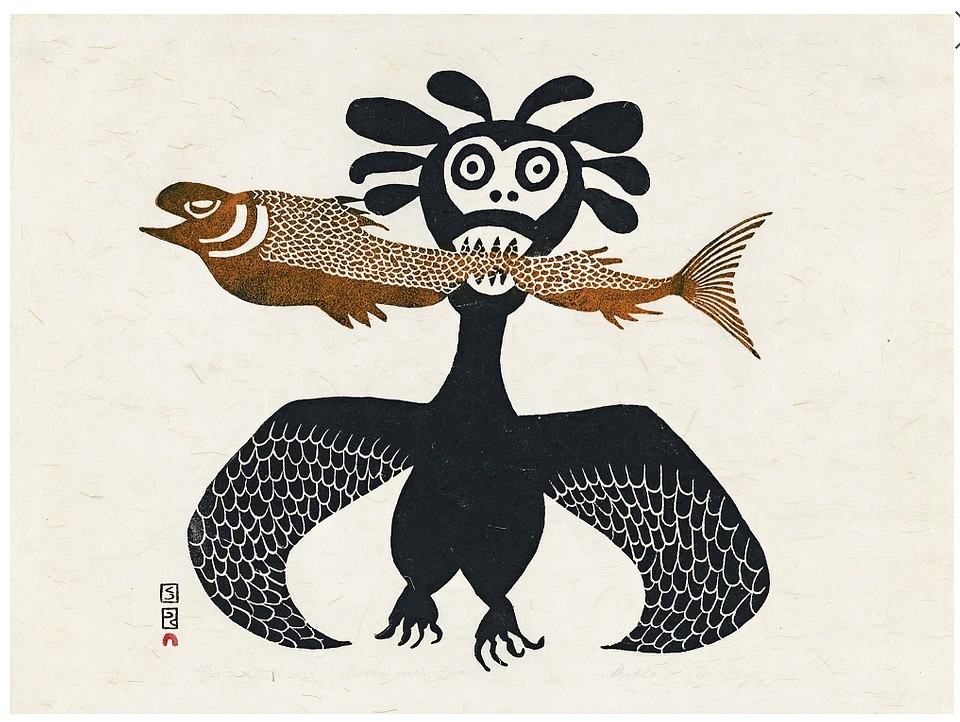
What is the subject? usually has an answer. People and most animals are easy to identify, but landscapes can rarely be pinpointed to a specific location. Pudlo Pudlat's Raven Eating Fish (above) is not obvious, but after reading the title, you understand the image. Shamans have common identifying marks -- one closed eye, an open mouth and protruding tongue, the presence of a helping spirit. See our August 2024 newsletter for more on shamans. Sedna is the most frequently encountered spirit, depicted as half woman, half fish or half woman, half seal or whale. Fantasy creatures are a problem, although some of them are depictions of well-known Inuit myths. The best book on Inuit iconography and legends is The Inuit Imagination: Arctic myth and sculpture by Harold Seidelman and James Turner. | |
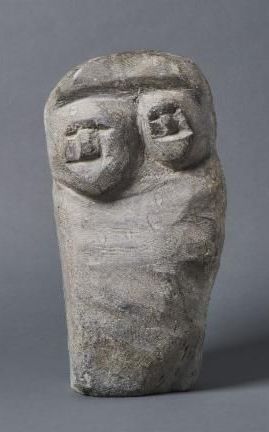
When was it made? Many later sculptures have a date on the bottom, and all limited edition prints have a date in their caption. Undated sculptures, however, are problematic. Sometimes there are other clues -- for example, stone carving flourished in Salluit for only a brief period in the 1950s and 1960s. Sometimes the stone is associated with a specific time period. Sometimes, as with carvings from Keewatin, the tools used to make the carving leave distinctive marks that provide an approximate date. (Handheld chisels and electric drills leave very different traces in the rock. The John Kavik Mother and child above is covered with very fine chisel marks, the sign of an early work.) And, of course, if you have identified the artist, his or her dates will provide a range of possible dates for your carving. But most of the time you will have to rely on the information that accompanies a carving, like an igloo tag, or on the seller's expertise. | |
|
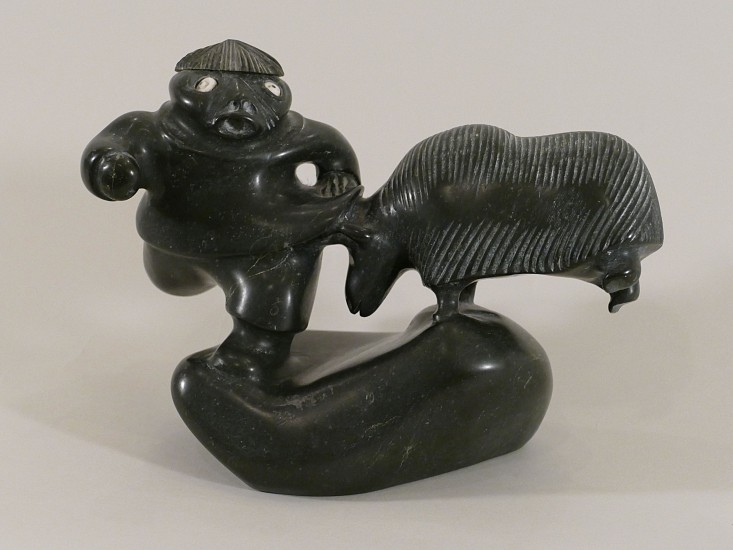
Where was it made? For carvings, if you have identified the artist, either of the artist search tools described above will tell you the artist's home community. If you have not identified the artist, the stone should allow you to identify the general area where it was made. Northern Rock: Contemporary Inuit Stone Sculpture by Susan Gustavison offers an intensive discussion of the kinds of rock found in four regions where Inuit carvings originate. In general, Cape Dorset and Kimmirut share a quarry that has brilliant green serpentine or serpentinite, which is easily carved and takes fine details. Arctic Quebec communities have a darker veined stone. Some, like Povungnituk, have a fine-grained gray stone. Gjoa Haven is known for its very hard basaltic rock, dark grey, frequently with white inclusions (see Muskox Attacking Hunter, above for an example of Gjoa Haven stone). Arviat and Baker Lake also have dark grey, very dense basaltic stone. The stone from these communities west of Hudson's Bay was originally thought to be too hard to carve. Power tools made carving much more feasible. Sanikiluaq artists work with a distinctive gray-on-gray striped sedimentary stone. The far northern communities, like Taloyoak, do not have carveable stone, and local artists learned to carve whalebone or ivory.
As mentioned above, prints will almost always include the community where the print was made; in addition, some communities adopted a distinctive symbol that appears on its limited edition prints (a stylized igloo for Cape Dorset, a stylized bow and arrow for Baker Lake).
| |
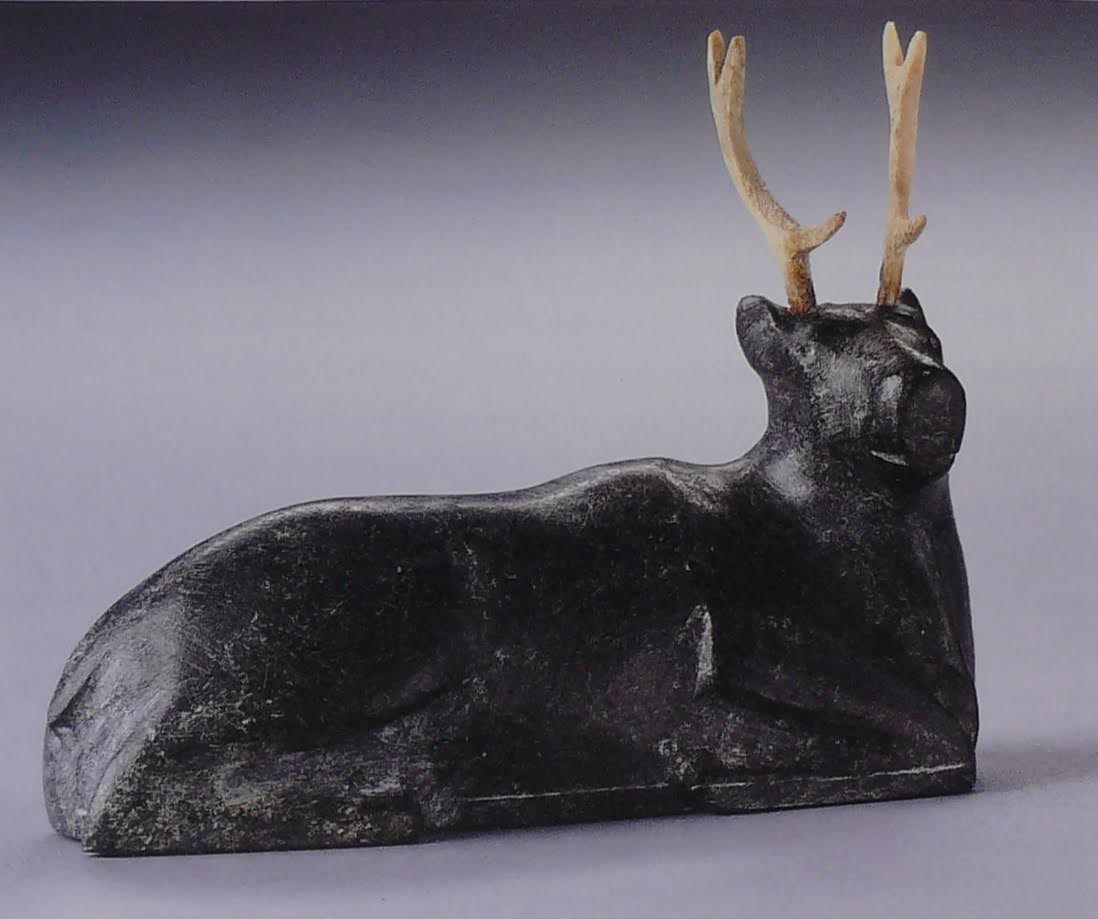
Why was it made? The answer is almost always, "This work of art was made for sale." Some pieces, especially very early works, were made as gifts, to thank someone for some service. James Houston received such a gift -- a very small carving of a caribou, pictured above -- and it inspired him to start a three-cornered trade in which he purchased carvings from Inuit artists, paying them with scrip that they could spend at Hudson's Bay posts, and then giving the carvings to the Canadian Council of Crafts, which sold them and used the proceeds to redeem the scrip from Hudson's Bay. And this was the start of the Inuit art market. | |
|
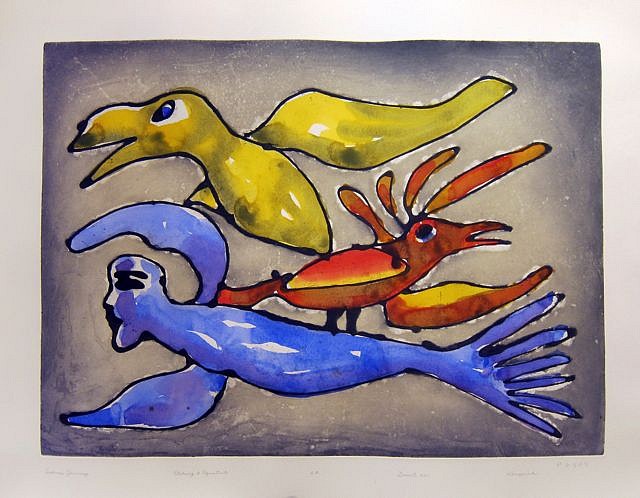
How was it made? Carving techniques are, for the most part, self-evident. The main distinction will be between carvings made with hand tools and those made with power tools. Printmaking is more complicated. The earliest prints were either stonecuts or stencils, and were joined later by lithographs, etchings and other advanced techniques. Sedna's Journey, by Kenojuak Ashevak (pictured above) is an etching and aquatint. For a comprehensive survey, see Cape Dorset Prints, A Retrospective: Fifty Years of Printmaking at theh Kinngait Studios by Leslie Boyd Ryan.
| |
|
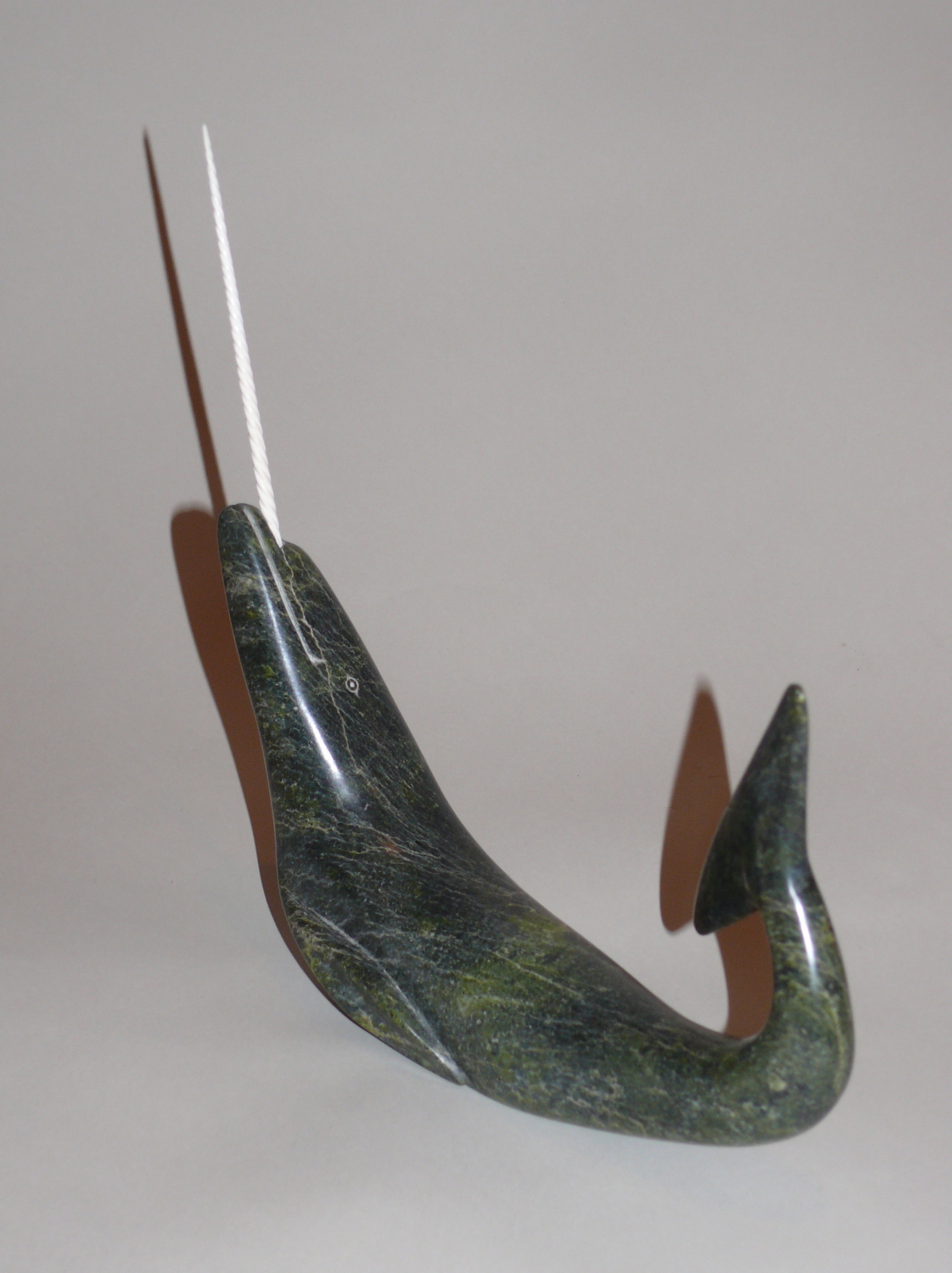
Putting it all together. If you make a habit of asking these questions, you will start to recognize connections. Community characteristics will emerge. Individual artists' idiosyncrasies will help you identify their work. For example, I was able to recognize the beautiful narwhal pictured above (offered in an online auction as an unattributed work) as a carving by Sheokjuk Oqutaq, known for the elegance of his carvings, by the distinctive treatment of the eye (and, when I got it, I found that it was signed, confirming my guess). Qaqaq Ashoona is one of the few Inuit artists who show their subjects' teeth. Pauta Saila's chunky, abstract dancing bears are unmistakable. John Kavik's roughly gouged faces shriek his name. And so on.
I found it helpful just to look at pictures of as much Inuit art as I could. Sculpture of the Inuit, by George Swinton is the starting point for a broad survey of Inuit art. A number of excellent books have appeared, based on individual collections. Auction catalogues -- many of which are now available online -- are also an excellent way to browse a wide range of Inuit art. Enjoy!
| |
|
Once again, the Against the Grain Theatre in Toronto is streaming its Messiah/Complex, produced in cooperation with the Toronto Symphony Orchestra. Let me hasten to say that I am generally a Messiah purist, but I found Messiah/Complex deeply moving. Handel's score is presented by 12 soloists and 4 choirs, using six languages, including Inuktitut. Every province and territory in Canada are represented, and the video includes iconic Canadian landscapes. I hope that you enjoy it.
Click here for more information.
| |
About
Alaska on Madison
In keeping with our self-description as a virtual gallery run by collectors for collectors, we offer a limited number of pieces. Every piece is one that we would be happy to have in our personal collection, and the description of each piece explains why.
We are happy to assist you with inquiries, with searches for particular pieces or artists, with organizing your collections and with buying or selling at auction. Our Inuit artist search tool is available on our website, and we would be delighted to help you use it. If you prefer to puzzle things out for yourself, Deciphering Inuktitut Signatures will help you to identify artists.
We are always pleased to answer questions or just chat. You can contact us by email or by phone at (908) 487-5757.
Our very best wishes to you all.
Ann and Michael Lesk
| |
|
Alaska on Madison | (908) 487-5757 | alaskaonmadison@gmail.com | www,alaskaonmadison.com | | | | |