The RNA Transcript, August 2, 2021 |
|
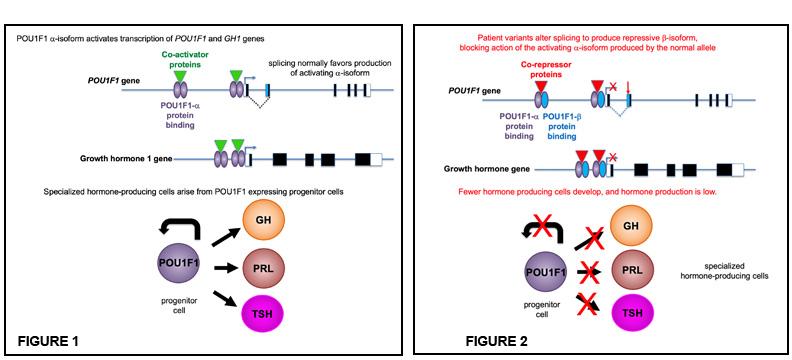
Often overlooked because they might not alter the amino acid production, splicing defects can play an important role in rare genetic pituitary gland diseases.
Several clinical endocrinologists and bioinformaticians, led by Sally Camper and Jacob Kitzman, Professors of Human Genetics at the University of Michigan Medical School, came together to further investigate splicing defects and their roles in rare genetic hormonal diseases. Cathy Smith, a Ph.D. student, established a catalog of predicted variants that could either be tolerated or disease causing.
|
|
Cited publications:
Gergics et al., High-throughput splicing assays identify missense and silent splice-disruptive POU1F1 variants underlying pituitary hormone deficiency, The American Journal of Human Genetics (2021), https://doi.org/10.1016/j.ajhg.2021.06.013.
Vishnopolska et al., Comprehensive identification of pathogenic gene variants in patients with neuroendocrine disorders, Journal of Clinical Endocrinology and Metabolism (2021), doi: 10.1210/clinem/dgab177.
|
|
Thursday, August 5, noon–1:00 pm | University of Michigan, UMOR Research Development
Jill Dividend, Ph.D.
This webinar is a good introduction to research proposals for early career researchers, those who support campus research efforts, or as a refresher for established investigators.
|
|
Friday and Saturday, August 6–7, 3rd International Webinar on Nucleic Acids & CRISPR
"Cracking the code of DNA and RNA: New insights into the structure and functions of nucleic acids"
This event is a broad audience gathering for exploring the advancement in DNA, RNA, epigenetics, and innovative techniques at molecular and chemical levels.
|
|
Monday and Tuesday, August 9–10, 9:00 am–1:00 pm, | University of Michigan | Bioinformatics Core Virtual
2-Day Workshop: "RNA-Seq Demystified"
This virtual, hands-on workshop is targeted toward researchers who would like to be able to understand the analysis of differential gene expression in bulk RNA-Seq data; it assumes a basic familiarity with genetics as well as familiarity with the basics of using BASH and R.
|
|
Wednesday, August 10, 8:00 pm | Institute for Basic Science and Seoul National University
Mini symposium:
David Bartel (MIT), Yuka Iwasaki (Keio University), Ryan Flynn (Boston Children's Hospital and Harvard University), Jin-Hong Kim (Institute for Basic Science and Seoul National University), Demian Cazalla (University of Utah)
|
|
Wednesday, August 11, 4:00 pm ET | RNA Collaborative Seminar Series, hosted by the RiboClub Sherbrook University
“Insights into the subcellular travels of cellular RNAs and RNA binding proteins”
Moderator: Sherif Abou Elela
|
|
For press releases and blog articles about your upcoming top journal publications,
|
|
Our members' publications are available through Altmetric. Five queries are currently available: "RNA," "microRNA," "Transcriptome," "Translation," and "Molecule." Please make sure to have at least one of these key words in your title or abstract. Below are recent highlights.
|
|
Microscopic examination of spatial transcriptome using Seq-Scope, Chun-Seok Cho, Jingyue Xi, Yichen Si, Sung-Rye Park, Jer-En Hsu, Myungjin Kim, Goo Jun, Hyun Min Kang, Jun Hee Lee, Cell, June 10, 2021, doi.org/10.1016/j.cell.2021.05.010
Highlights
- Seq-Scope repurposes Illumina sequencing platform for spatial transcriptomics
- Seq-Scope achieves submicrometer resolution and efficient transcriptome capture
- Seq-Scope enabled spatial single cell and subcellular analysis of liver and colon
|
|
Cotranscriptional splicing efficiencies differ within genes and between cell types, Karan Bedi, Brian Magnuson, Ishwarya Venkata Narayanan, Michelle T. Paulsen, Thomas E. Wilson, and Mats Ljungman, RNA July 2021 27: 829-840; doi:10.1261/rna.078662.120
In this article published in the journal RNA, Karan Bedi, a bioinformatician in Mats Ljungman’s lab, Department of Radiation Oncology at the University of Michigan Medical School, investigated the efficiency of splicing across different human cell types. The results were surprising in that the splicing process appears to be quite inefficient, leaving most intronic sequences untouched as the transcripts are being synthesized. The study also reports variable patterns between the different introns within a gene and across cell lines, and it further highlights the complexity of how newly transcripts are processed into mature mRNAs.
|
|
The RNA Biology Laboratory (RBL) at the National Cancer Institute (NCI) in Frederick, MD, which is part of the National Institutes of Health (NIH), is looking for outstanding young RNA biologists. The RBL, which was formed in 2017, is the equivalent of a small department at an academic institution. We seek candidates who will complement our current group of seven principal investigators (https://ccr.cancer.gov/RNA-Biology-Laboratory).
Areas of interest include, but are not limited to, RNA therapeutics; long noncoding RNAs; RNA modifications; RNA genomics and bioinformatics; RNA transport and visualization; mechanisms of RNA condensation and granule formation; and the ways in which altered RNA homeostasis results in diseases such as cancer.
Candidates for interview will be selected via the NIH Stadtman Tenure Track Investigator program. Our recent hires through this mechanism include Eugene Valkov (Elisa Izaurralde lab), Thomas Gonatopoulos-Pournatzis (Benjamin Blencowe lab), Colin Wu (Rachel Green lab) and Deirdre Tatomer (Jeremy Wilusz
lab). Other NCI RNA biologists who were hired recently via this program include Pedro Batista (Howard Chang lab) and Joana Vidigal (Andrea Ventura lab).
There is a single application for the Stadtman program, which is at: http://tenuretrack.nih.gov/apply/. Applicants are asked to select two areas that best describe their expertise. There will be a dedicated committee that reviews the applications of all applicants choosing “RNA Biology”. The website will open for applications on August 1, 2021, and the application deadline will be September 30, 2021.
These positions come with generous, highly competitive startup packages and stable funding. Please help us publicize these opportunities by forwarding this email to anyone you think may be appropriate. Also, anyone with questions can email me at sandra.wolin@nih.gov.
|
|
The University of Akron, OH has a position for a visiting professor in biochemistry, as well as a Biochemistry tenure track position
That link takes you directly to the Job Search page, and you will have to search in the Keywords box using the phrase Chemistry NTT, which will direct you to the application link.
You can also search: Job ID 12825.
|
|
Share your news
and comments,
|
|
|
|
|
|
|
|