Rail Workers Weekly News Digest
Number 28 - October 1, 2019
|
|
Below is a series of articles compiled over the previous week.
They are of interest to railroad workers.
_____________________________________________
|
|
Article 1
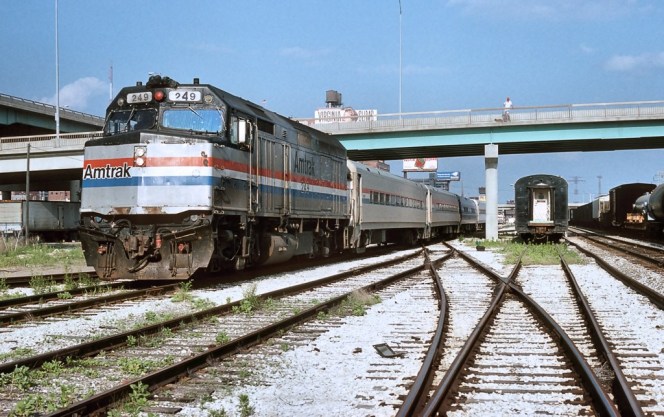
Amtrak crash: Why train rammed into CSX freight cars, killing 2 and injuring 91, per NTSB
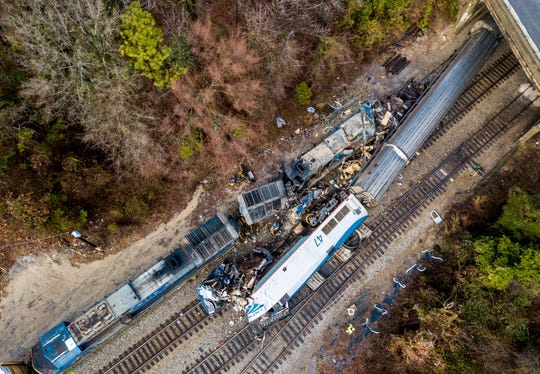
A fatal Amtrak train accident in South Carolina that killed two and injured 91 happened because work on the tracks led to a conductor failing to move a hand-thrown switch that would have prevented the crash, the NTSB said Monday.
The National Transportation Safety Board found that the conductor with freight operator CSX Transportation didn't move the switch to keep the Amtrak train on the main track in Cayce. Instead, the Miami-bound passenger was diverted onto another track as it barreled along at 53 miles per hour at 2:27 a.m. on Feb. 4, 2018 and piled into a parked freight train.
Two of the Silver Star train's seven cars jackknifed. The collision killed the Amtrak train's engineer and conductor, who had tried to apply the emergency brake the train at the last minute. The crash caused more than $25 million in damage.
|
|
Article
2
Train engineer in fatal 2016 Hoboken crash wins his job back with NJ Transit
The engineer at the controls of a NJ Transit train that slammed into the end of a platform in Hoboken three years ago, leaving one woman dead, 100 people injured and the train station seriously damaged, has won his job back in an arbitration proceeding.
In a ruling late last month, arbitrator Erica Tener found that Thomas Gallagher, who suffered from sleep apnea, bore some responsibility for the crash. But NJ Transit had failed to follow its own procedures for screening engineers in his case. Less than three months before the crash, Gallagher had undergone a periodic medical evaluation and the railroad did not produce any evidence that its doctor had performed the specific screening procedure for sleep apnea, according to the ruling.
The decision does not put Gallagher back at the controls of passenger trains. Instead, his immediate future is limited to moving trains within NJ Transit yards, and that is dependent upon him submitting to NJ Transit’s procedures to determine he is fit for duty, including that his sleep apnea is under control. The ruling leaves it up to the mass transit agency to decide in the future whether he can again serve as engineer of a train carrying passengers.
In addition, because of his fault in the crash, the arbitrator denied Gallagher’s bid to receive back pay, although he does retain his seniority.
|
|
Article 3
U.S. freight railroads post traffic decline in Week 38
U.S. freight-rail traffic fell 6.8 percent to 528,670 carloads and intermodal units during the week ending Sept. 21 compared with the same week last year, according to
Association of American Railroads
(AAR) data.
Total carloads for the week declined 8 percent to 250,794 units, while intermodal volume fell 5.7 percent to 277,876 containers and trailers.
Chemicals was the only one of 10 commodity groups that AAR follows on a weekly basis that posted an increase during the week. Chemical carloads rose 532 units to 32,280.
The commodity groups that posted decreases included coal, down 9,194 carloads to 78,881; grain, down 4,300 carloads to 19,018; and metallic ores and metals, down 2,122 carloads to 21,905.
|
|
Article 4
Wabtec has high hopes for battery-electric road unit
MINNEAPOLIS — How can you quickly create a U.S. fleet of hybrid heavy-haul locomotives?
The answer, it Wabtec officials seem to say, is by creating an all-electric unit that can be mixed into a consist with existing conventional diesel-electric power.
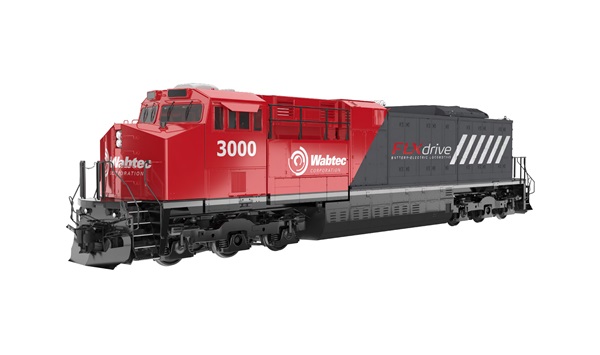
That’s the idea behind the battery-electric locomotive, branded as FLX Drive, that Wabtec is now building for a test on BNSF Railway routes in California. The locomotive is expected to be delivered in late 2020 and begin testing in early 2021 on a 350-mile stretch of the BNSF between Stockton and Barstow, Calif.
“Really what we said is, ‘Hey, we’re interested not in impacting fuel consumption on a single locomotive, but how do we do it in terms of a consist?’” said Wabtec’s Dennis Peters, executive locomotive platform leader. “Because because that’s how, in North America, locomotives are operated. But we don’t want to touch every locomotive in the consist; we’d like to touch just one locomotive. So the concept for the battery-electric locomotive was born.”
The unit is being built on the core of a Tier-2 locomotive that GE Transportation previously used for liquified natural gas testing. It will use lithium-ion batteries already used in automotive applications — although it will take a whole lot more of them to power a 430,000-pound, 4,400-hp locomotive than it does to move your average Prius. Approximately 20,000 battery cells will be mounted in 20 racks of batteries in the back half of the locomotive.
|
|
Article 5
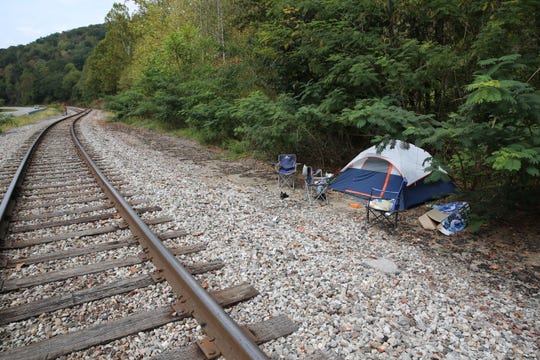
Laid-off Kentucky coal miners end their railroad protest but still seek their back pay
The Harlan County coal miners who drew national attention during a two-month blockade of a coal train to demand back wages from bankrupt coal operator Blackjewel ended their protest Thursday.
They still haven't gotten paid: Negotiations between Blackjewel, creditors and the miners continue and will go to court-supervised mediation if no deal is reached by Oct. 1, said their attorney, Ned Pillersdorf.
But Harlan County Judge-Executive Dan Mosley said the remaining miners who were still protesting had found work and had to leave the tracks and its collection of tents, supplies and protest signs reading "No Pay, We Stay."
"The longer this went on, the tougher it was getting on those miners and their families," Pillersdorf said of a protest that as of early this week had dwindled from more than 100 miners a day to a handful.
Some have left for coal mines in other states. Others are retraining as electricians or linemen. Still more found new jobs or tired of long hot days as bankruptcy proceedings play out.
|
|
Article 6
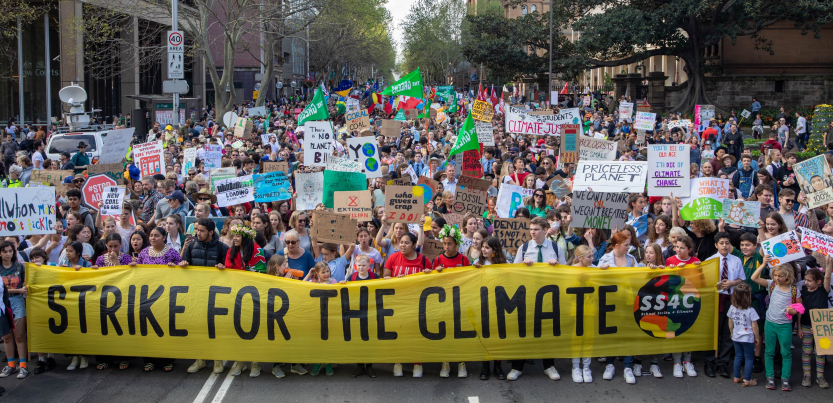
Viewpoint: A Green Transition Is Inevitable, But Justice Is Up to Us
Humans have created an existential crisis. It’s up for grabs who will live, how and where, which species will survive, and how the big decisions are made.
No exaggeration—we are in the eleventh hour.
Fossil fuel companies, banks, and all those who profit from these industries have exacerbated the warming of our planet, creating a climate disaster.
The climate study released by the United Nations this past October brought scientists to a common understanding that time is not on our side. We must act with great urgency, not at the edges of the crisis, but at its center.
Labor has a choice. We can stay in our narrow lane and focus only on the wages, hours, and working conditions of our current members—though climate change is already harming working conditions in many industries and eliminating jobs in others.
Or we can be part of organizing a movement with young people, elders, communities of color, indigenous people, environmentalists, and public health advocates to change the rules of the game for the benefit of all people.
In Washington state, labor joined with these allies to push a ballot initiative that would have been a game-changer. We were defeated by the fossil fuel companies this time, but we believe that our coalition can and must prevail.
|
|
Article 7
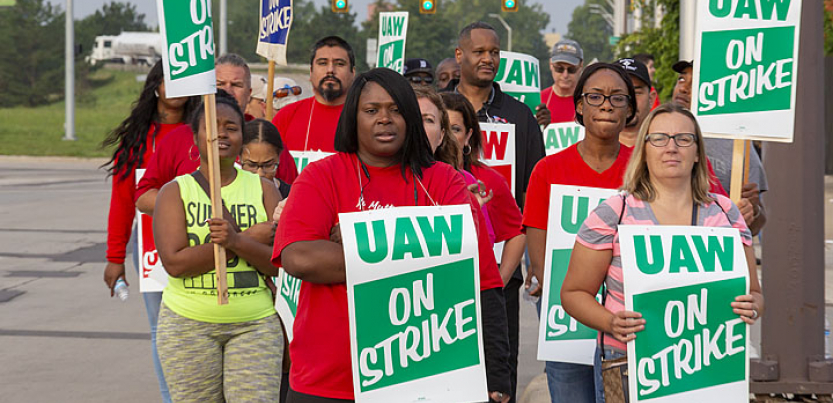
Solidarity: Auto Workers Strike GM Nationwide
Forty-nine thousand auto workers are on strike at General Motors in the largest private sector strike since the last time union and company clashed, in 2007.
Production has stopped at 55 factories and parts centers. According to various analysts, the strike could cost GM $50 million to $100 million per day in profits. Before the strike, the company was expected to make $3.5 billion in this quarter alone.
Walking out was “scary and uplifting at the same time,” said Shawn Edwards, a worker at GM’s Detroit-Hamtramck assembly plant with three years’ seniority. “It’s scary because we have lives to maintain and we don’t know how long we’ll be out. We don’t want it to be too long but we do need to make a statement.
“It’s uplifting because we’re making a stand,” she said. “We’re not accepting concessions from a company posting billions of dollars of profit. And because we’re all together. There’s safety in numbers. We’re standing up for ourselves in solidarity.”
Strikers are hoping to make up ground lost since the United Auto Workers agreed to two-tier wages in 2007, followed by the Great Recession and the auto bailout, when GM got $50 billion from the taxpayers and even more concessions.
The company has since rebounded, making $35 billion in profits over the past three years. GM paid no federal income taxes last year and gifted CEO Mary Barra $22 million.
|
|
Article 8
What if America Took Amtrak Seriously?
If you have the time, I highly recommend riding Amtrak. But even more highly, I recommend that we build a real train system in this country. Of course this can’t happen without federal investment on a grand scale, as was the case with the interstate highway system in the middle of the past century. We’re not going to get that from a president
who wants to pull the plug
on Amtrak and build more roads. But 2020 is near, “Green New Deal” has become a household phrase, and awareness of the climate costs of air travel
is growing
. Here in Washington state, the dream of regional high-speed rail appears to be
gaining some traction
. Perhaps a surge of public enthusiasm for a national high-speed rail network is not too much to hope for. Would riding the train lose much of its charm, its nostalgic appeal, if it became a more viable form of transportation? No doubt it would. But that’s a sacrifice I for one am willing to make.
|
|
|
|
|
|
|