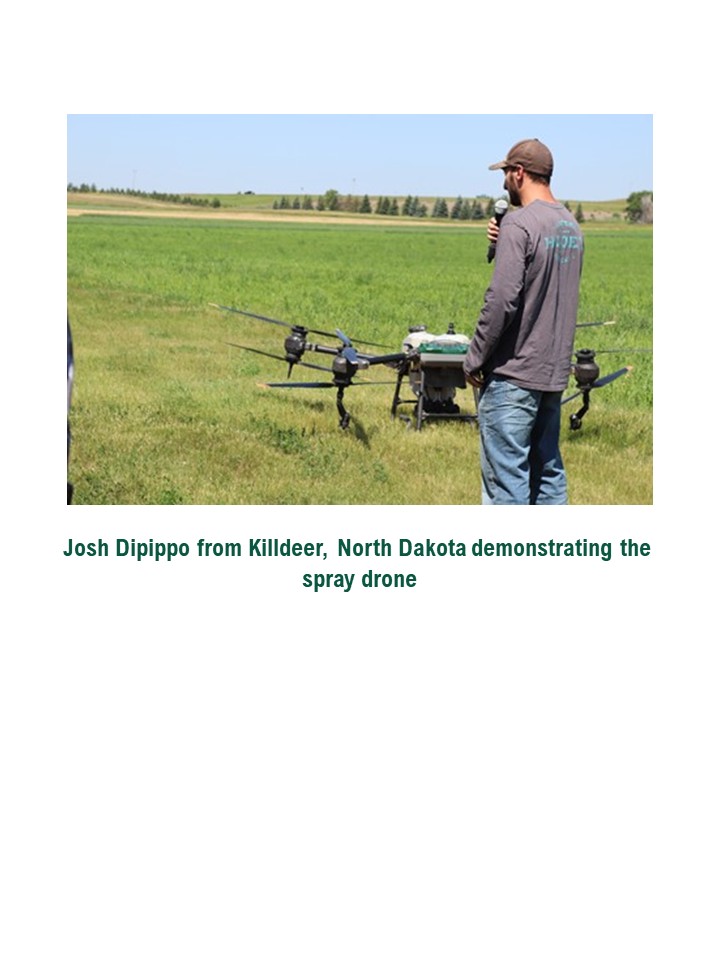
Precision agriculture is getting increasingly popular these days and is expected to become even more important for crop production in western North Dakota, where highly variable soils, limited and erratic precipitation, and rising input costs challenge the profitability of small grains systems. Despite this growing interest and adoption, there is still limited region-specific research evaluating how precision agriculture tools perform under the semi-arid conditions and unique soil constraints of western North Dakota, creating a critical need for locally generated data. Technologies such as GPS-guided equipment, variable-rate application, and remote sensing offer strong potential to improve input-use efficiency by matching management practices to within-field variability. In particular, RGB, multispectral, and hyperspectral imaging from drones and satellites can be used to estimate crop nutrient demand by detecting spatial patterns in canopy vigor, biomass, and stress, enabling timely and precise fertilizer applications. When integrated with soil maps, yield history, and ground-truth measurements, these spectral data can support variable-rate nutrient management strategies that reduce over-application in low-yielding areas while ensuring adequate nutrition in responsive zones. High-resolution RGB imagery also enables early-season weed detection and species differentiation using image analysis and machine-learning approaches, supporting targeted herbicide applications rather than uniform whole-field spraying. Drone-based targeted spraying further enhances precision by delivering fertilizers or crop protection products only where needed, reducing chemical use, minimizing off-target movement, and lowering application costs. Together, these precision agriculture approaches have significant potential to improve the productivity, sustainability, and resilience of small grains production in western North Dakota, while addressing the current lack of research tailored to this region. | |
The NDSU Extension does not endorse commercial products or companies even though reference may be made to tradenames, trademarks or service names. NDSU encourages you to use and share this content, but please do so under the conditions of our Creative Commons license. You may copy, distribute, transmit and adapt this work as long as you give full attribution, don’t use the work for commercial purposes and share your resulting work similarly. For more information, visit www.ag.ndsu.edu/agcomm/creative-commons.
County commissions, North Dakota State University and U.S. Department of Agriculture cooperating. NDSU does not discriminate in its programs and activities on the basis of age, color, gender expression/identity, genetic information, marital status, national origin, participation in lawful off-campus activity, physical or mental disability, pregnancy, public assistance status, race, religion, sex, sexual orientation, spousal relationship to current employee, or veteran status, as applicable. Direct inquiries to Vice Provost for Title IX/ADA Coordinator, Old Main 201, NDSU Main Campus, 701-231-7708, ndsu.eoaa@ndsu.edu. This publication will be made available in alternative formats for people with disabilities upon request, 701-231-7881.
| | | | |