Image Description: Finger Lakes Independence Center (FLIC) logo. FLIC in blue lettering with white background. The I in FLIC is an open door. Below FLIC it reads, "Finger Lakes Independence Center, Opening Doors to Independence." | |
An Update on the NY Budget from FLIC's Systems Advocate | |
|
New York States' budget season continues! In March, both the NYS Senate and Assembly released their one-house budgets. You can find a thorough overview below. Governor Hochul has announced that the final state budget will be delayed until at least April 4th, 2024. The three main priorities at this time are increased funding for both Independent Living Centers (ILCs)/inclusion in the human services Cost of Living Adjustment (COLA), the Access to Home Program, and preventing significant discriminatory cuts to the Consumer Directed Personal Assistance Program (CDPAP).
FLIC staff Teressa Sivers and Andrea Champlin (see pictures below) joined the New York Association of Independent Living and Consumer Directed Personal Assistance New York for a day of budget advocacy in Albany. They joined Chief Policy Officer Todd Vaarwerk from Western NY Independent Living Inc. to complete drop-in meetings with legislators. After the legislative meetings, Andrea and Teressa then attended the Most Integrated Setting Coordination Council monthly meeting, where they heard testimony from a variety of stakeholders speaking about the importance of homecare.
Please contact Andrea@FLIConline.org if you would like to receive additional advocacy updates and action alerts!
Increased Funding for ILCs
- Governor Hochul: no increase for ILCs, leaving the network level-funding at $16 million.
- Senate: included our $2 million ask in their one-house budget, and included language to include ILCs in Cost of LIving Adjustment increases like other human service agencies.
- Assembly: level funds ILCs at $16 million.
Access To Home:
- Governor Hochul: cut $2 million from the program bringing total funding to $1 million statewide.
- Senate: restored $2 million cuts and added an additional $1 million of funding to equal $4 million.
- Assembly: restored $2 million cut.
CDPAP:
- Governor Hochul: eliminates Designated Representatives who assist people with disabilities unable to self-direct their homecare due to disability, language barrier, children under 18, or other reasons. This would be a roughly 40% cut in program users statewide. Also elminates wage parity for downstate homecare workers, and makes changes to how Fiscal Intermediaries (FI)s are authorized to continue operating which could jeopardize the role of Independent Living Centers in the program.
- Senate: rejects Governor Hochul's cuts to program eligibility and wage parity cuts. However, in recent budget negotiations they are rumored to be discussing carving CDPA out of future minimum wage increases.
- Assembly: also rejected the Governor's cuts to eligibility and wage parity. However, in budget negotiations they have discussed a shift to one statewide FI to administer the program. This would eliminate consumer choice by not giving people with disabilities or their Designated Representative options for which agency they want to use to pay their aide. Additionally, the Assembly wants to have a minimum of 20-40 hours authorized care to qualify for CDPA.
| 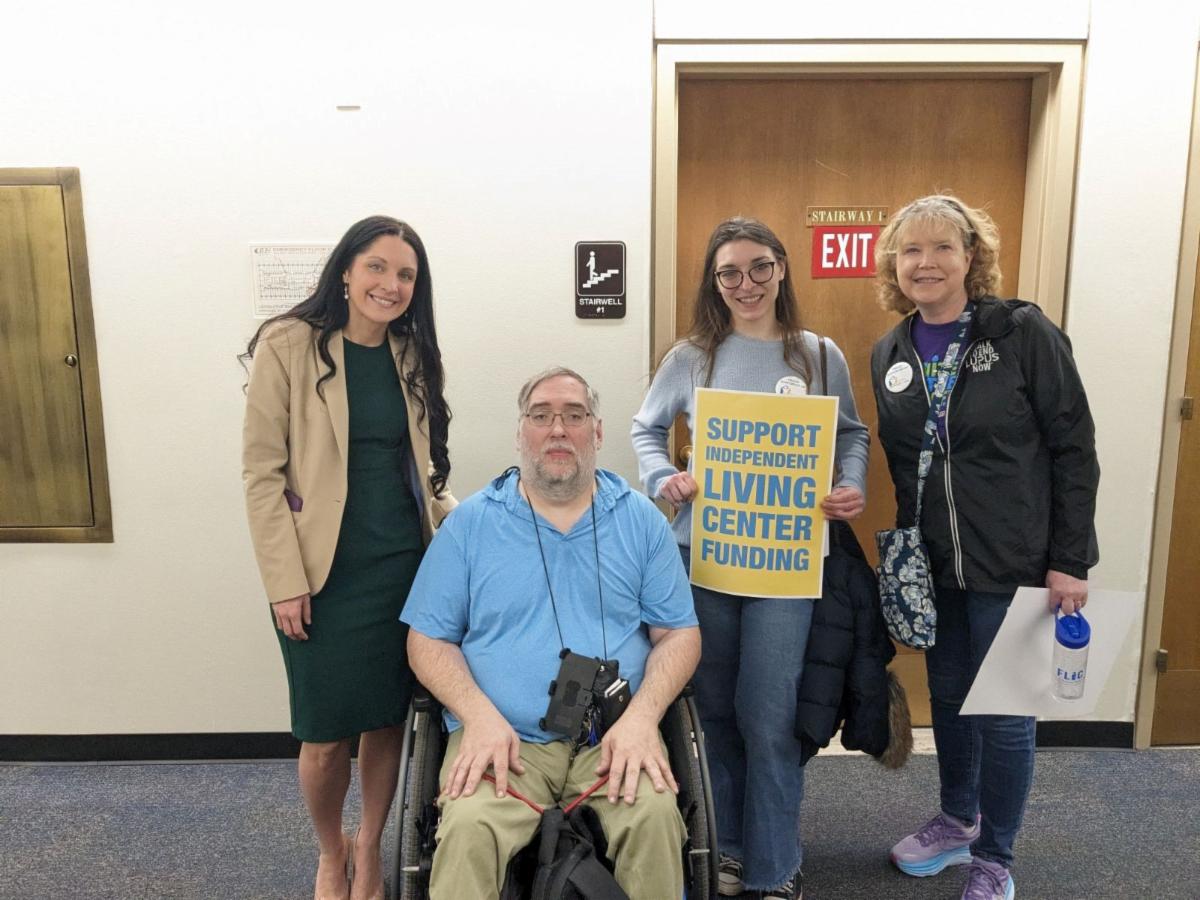 | Image Description: Photo taken in the hallway of the Empire Plaza building in Albany. Pictured from right to left: Teressa Sivers and Andrea Champlin from FLIC, Todd Vaarwerk from Western NY ILC, and Senator Jessica Ramos. | |
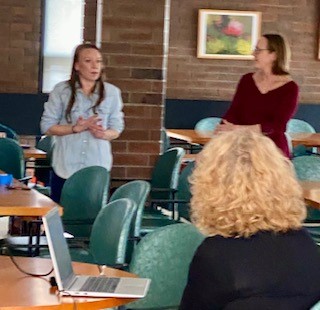
Image Description: Photo taken in the McGraw House common space. Lindsey Smith faces the camera, speaking about FLIC's loan closet and try-it room, while service coordinator, Annie Perry listens. FLIC staff Teressa Sivers sits with her back to the camera in front of a laptop. | |
|
On Tuesday, March 27th, Lindsey Smith and Teressa Sivers visited the McGraw House to speak with residents about FLIC services in general, and the Loan Closet and Try-It room specifically. Teressa Sivers gave a brief overview of all the services FLIC offers, highlighting programs like the three different personal aide programs and NY Connects. Lindsey Smith then spoke in detail about the Loan closet and Try-It room. She brought several items to show to the residents. Both Lindsey and Teressa spent time after the presentation discussing services with all in attendance.
FLIC staff were joined by staff from Cayuga Health System's Medical Depot, located at the shops at Ithaca Mall. Cayuga staff presented about their new store, shared how their store and FLIC are in partnership, and 'tuned-up' any walkers as needed. Cayuga Medical Depot also brought their lightest and newest motorized scooter. It is available for rental at the mall for $20.
If you would like FLIC to offer a presentation on FLIC services, the American's with Disabilities Act, Disability Ettiquette, Customer Services for Persons with Disabilities, or another topic regarding services with persons with disabilities, please contact us at 607-272-2433 or info@fliconline.org.
| |
Image Description: Photo of the nasal swab and test strip from a COVID home test. | |
COVID Home Tests Expiring
FLIC's current supply of COVID home tests will be expiring on Monday, April 9th. When we receive a new supply of tests from Tompkins County Whole Health, we will share with the community.
Thank you!
| | | |
Tompkins County Annual Airport Day & Preparedness and Safety Fair to be Combined into One Event on Saturday, September 14th | |
|
This year, the Ithaca-Tompkins International Airport and the Tompkins County Department of Emergency Response and Whole Health are combining forces to present the annual Tompkins County Airport Day & Preparedness Expo: A Community Celebration. We hope you can join us on Saturday, September 14th from 7 am to 1 pm.
Kicking off with the Runway 5K and the East Hill Flying Club's popular Pancake Breakfast, the Airport Day & Preparedness Expo will include many of the same elements featured in years past, along with displays and participants from the Emergency Preparedness & Safety Fair held at the Shops at Ithaca Mall the last two years, as well as a Tompkins County employee-sponsored Red Cross blood drive. Organizations such as the Salvation Army, Cayuga Medical Center, and the National Weather Service Binghamton Office will aslo be on hand. It is our intent to showcase a large cross-section of our first responder community, along with representatives from a number of health and human service agencies. New this year will be a schedule of demonstrations for the public, including a vehicle extrication exercise, the proper use of fire extinguishers, and hands-on CPR.
FLIC will be present at this event with an information table about emergency planning with people with disabilities.
| |
In honor of April as Autism Awareness-Appreciation Month:
How to navigate adulthood on the autism spectrum
A dearth of research on, and services for, autistic adults compounds social and emotional challenges
By Rachel Fairbank
Date created: November 1, 2023
| |
|
When it comes to what we know about the adult years for autistic people, the research is either minimal or nonexistent. “We know the most about the transition period into young adulthood,” said Gregory Wallace, PhD, an associate professor at The George Washington University, who studies life outcomes of autistic adults. “As you go into middle and older adulthood, we know almost nothing.”
Research has largely focused on understanding and diagnosing autism in children and teenagers, which has led to increased awareness, earlier diagnosis, and better treatment for children and teenagers. In a pair of new reports from the Centers for Disease Control and Prevention, the prevalence of autism diagnoses among children has been estimated to be 1 in 36, a significant increase from previous years (Maenner, M. J., et al., MMWR Surveillance Summary, Vol. 72, No. 2, 2023). These new diagnoses reflect a more diverse group of children, including a larger proportion of autistic children without intellectual disabilities. As these children grow up, they will continue to need various forms of support throughout adulthood.
Continue Reading: https://www.apa.org/monitor/2023/11/adults-autism-spectrum
| |
Image Description: Photo from the air of a housing subdivision. Some houses have the WiFi symbol above them while others do not. | |
A Lifeline for Low-Income Households is Available After the ACP
The lights may be going out on the Affordable Connectivity Program that’s saved millions of American households $30 a month on broadband, but a small flicker of relief remains that many may not know about.
Lifeline, a decades-old federal subsidy program initially designed to make phone — and more recently internet — service more affordable is still a viable option for households earning 135 percent or less of federal poverty guidelines.
Continue Reading: https://www.aarp.org
| | |
Invitations to Become More Aware | |
|
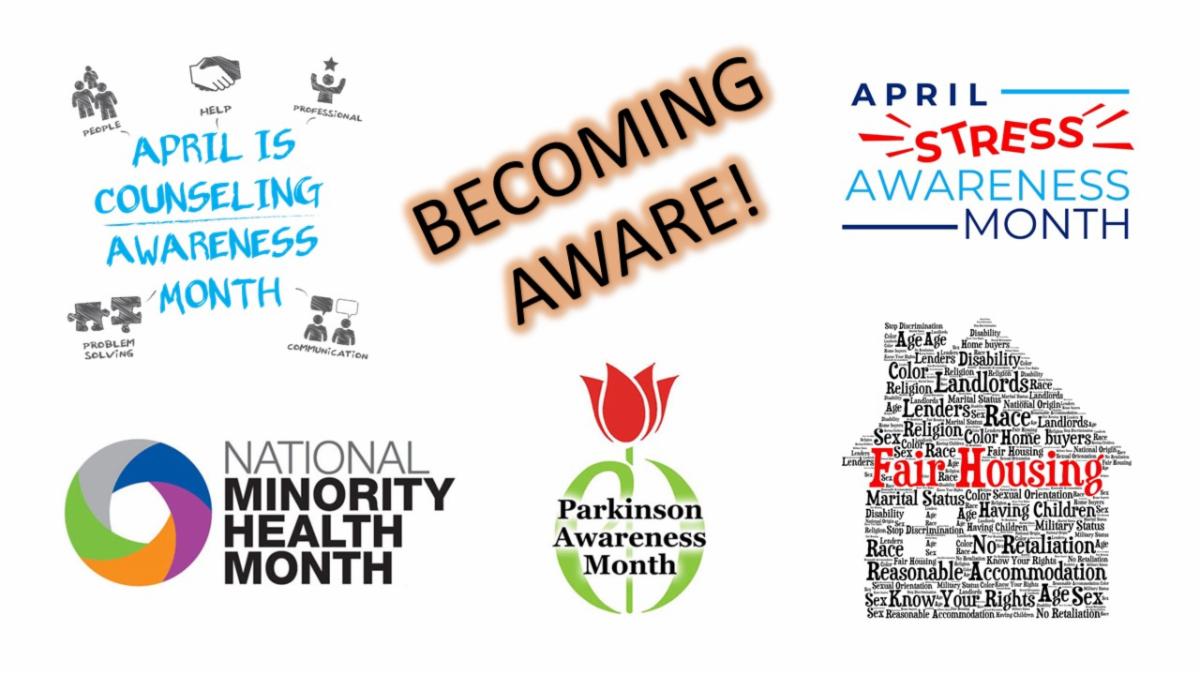
Some month, day and week observances may seem a bit silly--national pizza day, talk-like-a-pirate-day. We do all need a little silliness in our lives from time to time. However, many of these observances are held to bring attention, awareness and action to important issues, needs--and most importantly--people. These awareness, attention and/or appreciation observances were specifically created to focus our nation and our world on individuals and groups who are often overlooked and misunderstood. Here are some of the observances marked in the month of April:
-
Parkinson's Awareness Month: The Parkinson's Foundation is encouraging everyone to take actions to impact the future of Parkinson’s disease (PD). Whether that means learning how to navigate your own future with Parkinson’s or helping the foundation to create a world without PD, together we can make a difference. Visit their website to learn more: Visit the Website.
-
National Minority Health Month: April is National Minority Health Month (NMHM), a time to raise awareness about health disparities that continue to affect racial and ethnic minority populations and encourage action through health education, early detection, and control of disease complications. Learn more here: Learn More.
-
Fair Housing Month: Fair housing is a pressing issue across our nation and in our own county and communities. Visit the US Deparment of Housing and Urban Development to learn more. Be sure to check out their 'press room' page to see their statement about fair housing awareness for April. Click here.
-
National Stress Awareness Month: Stess has an enormous impact on our bodies and on our emotional and mental well-being. Check out this article on ways to lower stress in your life (and check out the next bullet point for more help in stress management): Learn More.
-
Counseling Awareness Month: Speaking of stress reduction, April is National Counseling Awareness Month. This time is set aside to not only honor those professionals who do the work, but to help people understand what counseling is and how it can benefit them. There are lots of benefits to going to counseling and yet some people still do not reach out. So let’s talk some basic facts. What do you know about counseling? Read More.
Let's spend time each month focusing on the observances and the people and situations these observance lift up for awareness, appreciation and action. Let us become more aware.
| |
Five Ways to Make Gyms and Recreation More Accessible | |
Image Description: Photograph of interior of Island Health & Fitness Center in Ithaca. Photo is taken from second floor balcony, looking out over the first floor equipment to the wall of windows and the water channel beyond. | |
|
Physical Space
Physical accessibility is important for everyone. However, for people who have mobility impairment or use mobility devices, physical accessibility is huge. When it comes to making gyms and places of recreation accessible to everyone, one must consider; could a person with a mobility impairment or who uses a mobility device easily navigate? Are all paths of travel clutter free?
Appropriate Programs and Classes
No matter the type of program or class you are offering, instructors should be prepared to cater to a wide range of abilities. When working with people with disabilties, It is important to be aware of their limitations and work with them to figure out ways to best assist them.
Staff Disability Awareness Training
Administrative and program staff should have a level of comfort to effectively interact and serve people with disabilities.
Accessible Materials/Equipment
Do you already have accessible materials/equipment if needed? If not, can you obtain it, or know who to contact to obtain it?
Outreach/Marketing
Are all your outreach/marketing materials accessible to a wide range of people and are they inviting to people with disabilities?
The Finger Lakes Independence Center (FLIC) offers technical assistance and disability awareness training to fitness centers and places of recreation in Tompkins County. For example, FLIC staff toured the Island Health & Fitness Center (pictured above) and discussed the accessible equipment they have available and accessibility of the overall facility. For more information, contact Jeff Boles at jeff@fliconline.org.
| |
Disaster Preparedness: 10 Steps to Safety | |
 |
- Indentify Your Risk: What are the hazards where you live or work?
- Create a Disaster Plan: You need a plan in the event of an emergency.
- Practice Your Disaster Plan: Once you have written your disaster plan, practice it.
- Build a Disaster Supply Kit for Your Home and Car: Always have emergency supplies at home and in your car in case of an emergency. Supply Checklist: https://www.ready.gov/kit.
- Prepare Your Children: Talk to your children about the risk and what to do if disaster strikes. Talking to your children about disaster: https://www.healthychildren.org.
- Prepare Family Members with Disabilities and Other Needs: Tips for those with disabilities: https://www.ready.gov/disability. Tips for older adults: https://www.ready.gov/older-adults.
- Learn CPR and First Aid: Contact your local Red Cross chapter and get trained in basic first aide and CPR. Southern Tier Chapter: https://www.redcross.org/local.
- Eliminate Hazards in Your Home and Workplace: You should secure the contents of your home or office to reduce hazards.
- Understand Post 9/11 Risks: Disaster preparedness now accounts for human-made disasters as well as natural ones.
- Get Involved, Volunteer! Join your local Emergency Response Team, educate your neighbors, and/or volunteer with your local Red Cross.
source: https://mdem.maryland.gov/Pages/10-Things.aspx
| |
|
|
Need a Public Notary?
Contact Cheryl Baker at FLIC at
607-272-2433 to make an appointment.
Services are FREE!
Image Description: gold star seal with Notary Public written in black in the center. In black circles around the center, it reads, Official, Duly Commissioned.
| | | |
The Registry Referral Program | |
The Finger Lakes Independence Center administers the Registry Referral Program. This is a free referral service linking individuals seeking independent employment to people who need care in their home. Individuals directly pay the personal aide for hours worked. Opportunities include: elder companion, housekeeper, run errands, cook, personal care aide, home care aide, LPN, RN. People looking for help can call and receive names of people willing to provide those services. If you either need assistance or if you would be interested in listing your name as a caregiver, pease call FLIC at 272-2433 or email: info@fliconline.org. If you have experience caring for a friend or loved one, please consider sharing your compassion with others. This program is made possible through funding from the Tompkins County Office for the Aging. | | | | |