Weekly Digest Number 52 - December 27th, 2022 |
|
Welcome to the RWU Rail & Labor News! This news bulletin is produced and emailed out each Tuesday morning. We hope you find each week's news and information useful. If so, please share with co-workers, friends, and colleagues. If you like, you can sign them up to get all the news from RWU HERE. Or forward them the link. Note: If you read over this news bulletin each week, you will be sure to never miss the important news of what is going on in the railroad world from a worker's perspective!
|
|
(Editor's Note: Common Dreams has consistently reported on the rail workers' struggle throughout the fall, and provided the workers' perspective on the matter. This Opinion piece appeared just before Christmas.)
|
|
The Real Lessons From the Railway Labor Dispute
The outrage and alarm produced by the mere threat of these workers to withhold their labor reveal that our economy functions because workers ... work
|
|
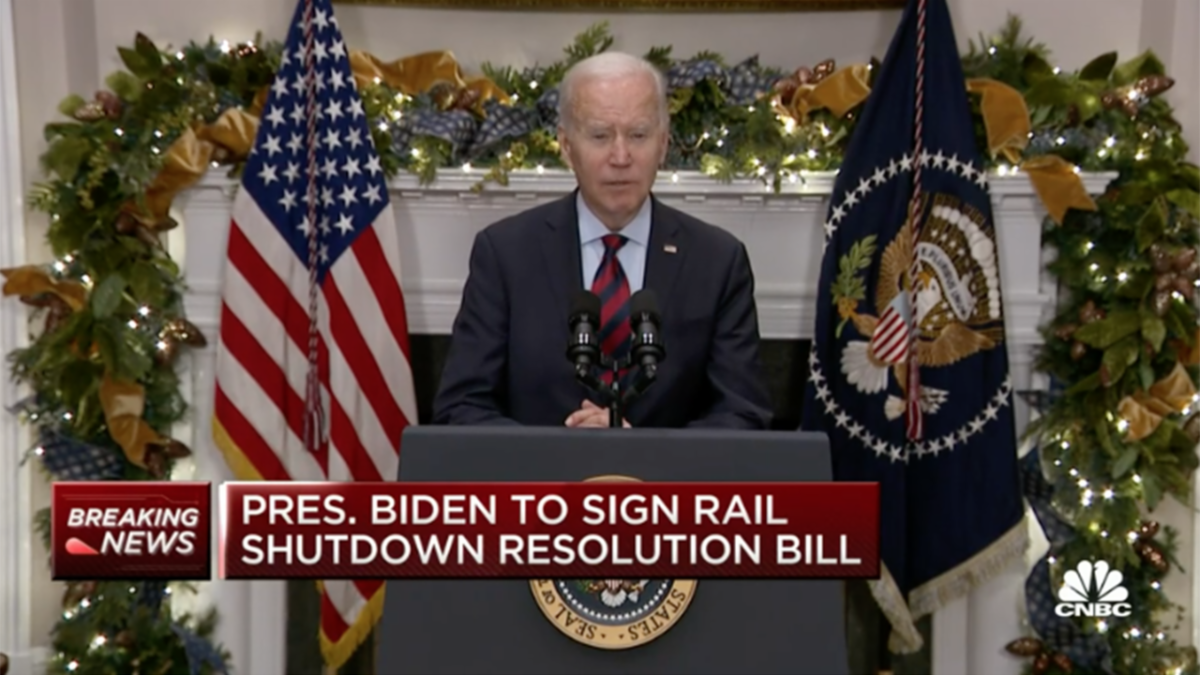
So, the threatened railway workers strike is over. President Joe Biden used his authority over interstate commerce to impose a settlement. As we all watch CNN and FOX News breath a sign of relief, let’s see if there is a lesson to be learned in these events.
Let’s take a brief look at the background to the dispute. The American railway system was deregulated in the 1980s. And, as always seems to happen, consolidation and profit-taking followed close upon the deregulation. What was once over 30 operating railroad companies was reduced to just seven through buyouts and mergers. These seven firms have all worked to increase their profits by reducing staffing, increasing and intensifying the workload of the remaining workers, and drawing back investment in safety equipment and other costly projects while increasing prices and rates.
For example, the companies introduced something called “Precision Scheduled Railroading,” which cut staffing and safety on the rails thereby endangering workers and the surrounding communities. The so-called upside of all these changes was reduced costs and increased profits. And, as usual, the latter were used to make payments to shareholders and investors. Unnoticed by many, these changes also meant that anything that allowed workers unscheduled time off (such as paid sick leave) would seriously disrupt what has become a more or less “bare bones” operation that relies on a minimum of employees to move a lot of stuff crucial to our economy which is built on “just-in-time” production, inventory, and logistics.
These profit-above-all changes made the railroad system especially dependent on a minimized workforce. It could not withstand the paid sick leave system the unions wanted. The new railroad system as a whole relied on the denial of the basic health and safety needs of the workforce. As a result, recent employee surveys showed three of the top five worst employers in the country were rail companies.
|
|
(Editor's Note: Many of these predictions/issues are relevant to rail labor, #6 being the most direct and the most crucial. If rail labor is able to break out of its isolation and parochialism and build bridges with workers and unions along the supply chain (e.g. ILWU/ILA longshore workers, truckers (IBT and otherwise), airline workers (AFA, ALPA, etc.) and others, we can build a formidable coalition of workers that can defeat powerful corporations and lead a renewed labor movement.) |
|
Ten Predictions for Labor in 2023 |
|
Number 6 - A reckoning for transport unions. Biden’s decision to prevent railroad workers from striking and impose a contract on them was by far the worst labor thing the ostensibly pro-labor president has done. But it, and this year’s White House freak out over touchy contract negotiations by longshoremen at West Coast ports, point to the inherent power in all the unions that have a position in the supply chain, and transportation in general. They may be hamstrung by the Railway Labor Act, in legal terms, but a rise in radicalism and coordination between railway, airline, and logistics unions could lead to a real, unassailable demonstration of what strike power looks like. Some of the union leaders in these industries have such vision, and some don’t. The weaker ones should watch their backs. Meanwhile, in Washington…
|
|
(Editor's Note: Long ago, the Republicans declared their hostility to organized labor and the working class. The Democrats however refrain from such open statements of hostility. Rather, they verbalize support, and then all too often when the chips are down, they side - like their counterparts across the isle - with big business, in the this case the rail industry. While the Congressional vote was more lopsided 30 years ago - 400 to 5 - to send us back to work, this time the powers-that-be decided in advance that there would be no strike and no lead up to a strike, no possibility of a strike, nine days in advance of the deadline, a departure from past practice and one hell of a holiday gift to Wall Street and the rail carriers.) |
|
Biden ‘Railroaded’ Workers, and Maybe Himself |
|
The nationwide railroad strike that was threatened for Dec. 9 did not take place. In effect, the Biden Administration and Congress ordered workers to accept the terms of a tentative agreement their unions had reached with the Class I railroads. Members of eight of the twelve unions involved ratified it, prompting two branches of government to collaborate on enforcing the agreement. Labor says the workers who voted to reject the pact were “railroaded” in the traditional sense of the word, but Joe Biden may have “railroaded” himself by alienating one of his party’s most loyal voting blocs—loyal at least until now. It is possible that, even though workers were denied the seven extra days of paid sick leave they wanted, Biden might lose his own job two years from now in the fallout.
March 23, 1932 was a big day in American labor history. It was the day that the Norris-La Guardia Act, which prohibited courts from granting injunctions to end non-violent strikes in the private sector, was passed. Named after its two progressive Republican sponsors (yes, there were such people then), Sen. George W. Norris of Nebraska and Rep. (and future Mayor) Fiorello H. La Guardia of New York, it was the first of several victories that the labor movement would win, especially during Franklin D. Roosevelt’s “New Deal” Administration. Government, in the form of courts, could no longer routinely order workers to end their job actions. Today’s Executive and Legislative government branches can still exercise similar power from time to time, and labor might not take it all that easily.
Capitol Hill Contributing Editor Frank N. Wilner’s comprehensive reporting in Railway Age on Dec. 2 (President Biden Signs H.J. Res. 100 into Law) told the story. Biden and outgoing House Speaker Nancy Pelosi paid lip service to the concept of sick leave and reluctance to send railroaders back to work with only one additional day off per year, but they did it anyway. Wilner also quoted Pelosi as saying, “Going to a proctologist is not a reason why people would take a day off,” a statement that could bring her expressed reluctance into question.
As we also know, the results came out as expected. With the back-to-work resolution considered separately from the one that would mandate seven sick days, it seemed clear before the votes were taken that the former would pass and the latter would not make it past the 60-vote hurdle in the Senate.
|
|
(Editor's Note: Chris Townsend is a life-long union activist with ATU and before that UE. He has spoken at RWU Conventions and is a Solidarity Member of RWU.) |
|
Learning from the Biden Strikebreaking |
|
The Biden regime’s shameful betrayal of the railroad workers unfolded in late November and early December as the possible railroad strike crisis slowly wound to its ending. The gang-up on the railroad workers and their desire to exercise the basic right to strike was practically all-encompassing. Politicians from both political parties – with only a handful of exceptions – all of the media, every single large corporation in the country, and even some liberals and so-called leftists all made the case why the strike must be stopped. Broken even before it had started. This chorus all echoed the same canard, that it was too important to allow a rail strike, no matter that it was in response to the refusal of the company barons to seriously negotiate in the first place. The lack of time off for the workers alone qualified as a serious human rights violation, but of course their human rights had to be sacrificed for the monstrous profits of the railroad companies. All those who supported this shameful act by Biden, all who try to minimize it or even support it, are to be blasted. Thoroughly blasted. This strike breaking is unforgivable. Period. To excuse or forgive or conveniently overlook it is to invite more of this conduct.
The struggle of the railroad workers will continue. It has to. They have no choice. Conditions have become intolerable for a majority of the workforce. The draconian attendance policies of the rail bosses that virtually ban time off for the large operating sections of the workforce, and the fact that most workers are sure to “fire themselves” under these outrageous personnel policies give them no choice to keep up the fight.
From these strikebreaking acts come down several lessons, among others. We need to learn them.
|
|
(Editor's Note: This is all smoke and mirrors of course. The NCCC - which represents the Class One carriers in national bargaining - as early as 2004 was attempting to force a contract with the operating crafts to run trains with a lone worker aboard. And if BNSF, UP and NS were to prevail in their quest for immediate single person ops, the rest of the Class Ones, including CSX, CN and CP would not be far behind.) |
|
Class I Railroads Split on Taking Conductors Out of the Locomotive Cab
BNSF Railway, Norfolk Southern, and Union Pacific back the fundamental change in operations
|
|
The big six Class I railroads are not of one mind regarding taking conductors out of the locomotive cab and redeploying them to pickup trucks.
BNSF Railway tells Trains News Wire that it, too, is on board. “BNSF has been in negotiations with SMART-TD for some time now on a workable transition to ground-based conductors, and could initially include pilot locations,” railroad spokesman Zak Andersen says. “We remain optimistic that we can reach a progressive agreement that creates a better work-life balance for our employees through predictable schedules, enhances service to our customers, and sets BNSF up for future success.”
In 2014 BNSF became the first railroad to propose engineer-only operations on lines protected by positive train control. It reached a tentative agreement with the SMART-TD union covering BNSF routes in the Midwest and Pacific Northwest that would have created a ground-based master conductor position. But the rank and file rejected the deal.
CSX Transportation is not considering using ground-based conductors and is not talking to rail labor about the concept, a spokeswoman says.
Canadian National declined to comment when contacted regarding its interest in ground-based conductor positions.
Canadian Pacific declined to add to comments CEO Keith Creel made during the railway’s earnings call in July.
Creel seemed skeptical of one-person operation anytime soon, given how frequently trains encounter problems on the main line. Until pull-aparts and other mechanical issues become exceptionally rare, Creel says one-person operation doesn’t make much sense.
“When you put a train together there’s a lot of moving parts. And those moving parts historically have created some challenges. So If a train separates and it’s 10,000-foot long and you don’t have a man or a woman to assist the engineer, that can get complicated,” Creel told investors and analysts. “That’s something I’m very sensitive to.”
Once technology and components allow safe, efficient, and reliable service, railroads should be allowed to operate trains with one person in the cab, Creel said.
Any shift to engineer-only operations in the U.S. would require two things: Approval from the FRA and labor unions. Both are obstacles for the Class I’s considering a fundamental change to the way they operate.
|
|
(Editor's Note: This marks the end of an era in the BLET. Pierce was preceded in office by two Presidents who were disgraced in scandal, one serving a prison term. Pierce rose through the ranks from General Chairman of former BN lines to VP to first VP to President all without ever being elected. He has run for President as the incumbent 4 times. While he may have avoided the pitfalls of those who came before him and ran a "clean" union, his failure to confront the rail carriers and aggressively lead the union into battle has led to his demise.) |
|
BLET President Pierce to Retire |
|
Pierce, who’s led BLET for more than a decade, had run for reelection in the union’s national election held earlier this month. The BLET announced this week it would certify the results and publicly announce them on Dec. 19. However, on Dec. 12, the votes cast by eligible members were counted and Edward Hall, a locomotive engineer at Union Pacific Railroad, received 4,331 votes, while Pierce received 3,822 votes.
In today’s statement to BLET members, Pierce outlined issues over the election that meant it would have to be held again. Rather than be a candidate in that revote, he would retire, he said.
Pierce's announcement follows a bitter campaign and comes on the heels of the controversial multiyear contract between the nation’s major freight railroads and 12 rail unions, including BLET.
Although a majority of BLET members approved the tentative agreement, it was ratified by a slim margin. Some members criticized Pierce for signing on to the tentative deal reached with the railroads in September, after the Biden administration got involved in the negotiations. Four other unions refused to approve the deal. To avert a national rail strike, Congress stepped in and earlier this month passed legislation requiring the railroads and all unions to accept the contract.
Pierce said his decision to step down was not easy.
"Whether or not any member agrees or disagrees with the difficult decisions that I have had to make as national president, I have always put the membership and our union as an institution first and foremost. For that very reason, I will not subject this Brotherhood to the further division that would be caused by a rerun election," Pierce said.
Pierce also addressed some of the division and bitterness during the election.
"I leave office with a request of all BLET members. I ask that those who manage social media pages that incite division against other members and officers shut those pages down too," Pierce stated. "If President-Elect Hall
|
|
(Editor's Note: This despicable practice has given UP and the industry a black eye this past year. Amazing how quickly the railroad can switch gears and do an about face when pressure is applied. Note: But don't be surprised that if shipper discontent grows along with congestion and slower train speeds, UP will blame the STB for its "over reach.") |
|
UP Suspends Use of Traffic-Control Embargoes |
|
Fritz’s letter arrived on the heels of an STB hearing held Dec. 13-14 on UP’s use of embargoes to control traffic congestion on its network. The board scheduled the hearing after receiving several complaints from shippers about the practice, alleging it had a negative impact on their companies.
In his brief letter to STB Chairman Martin Oberman, Fritz stated he appreciated the feedback received from customers and the board during the hearing.
"I assure you, we are taking a hard look at our use of congestion-related embargoes," Fritz wrote. “To facilitate that hard look, we are immediately pausing any additional embargoes under the pipeline inventory management program that we began in November.”
UP will provide more information on the subject "in the coming days," the letter states.
To learn more about the STB hearing on the matter, read this story posted on Progressive Railroading's RailPrime, a premium subscription-based service featuring exclusive freight-rail news and information.
|
|
(Editor's Note: This development is no doubt a response to the great work of the Kansas City Star newspaper - see last week's RWU Bulletin - on bringing this issue to light.) |
|
Kansas Attorney General Joins Group Asking Supreme Court to Review Decisions on Grade-Crossing Cases
Amicus brief in Ohio case questions rulings that only federal government can address blocked crossings
|
|
TOPEKA, Kan. — Kansas Attorney General Derek Schmidt has joined a group of officials from other states in asking the U.S. Supreme Court to review decisions that have prevented states from enacting or enforcing laws that limit the amount of time railroads can block grade crossings.
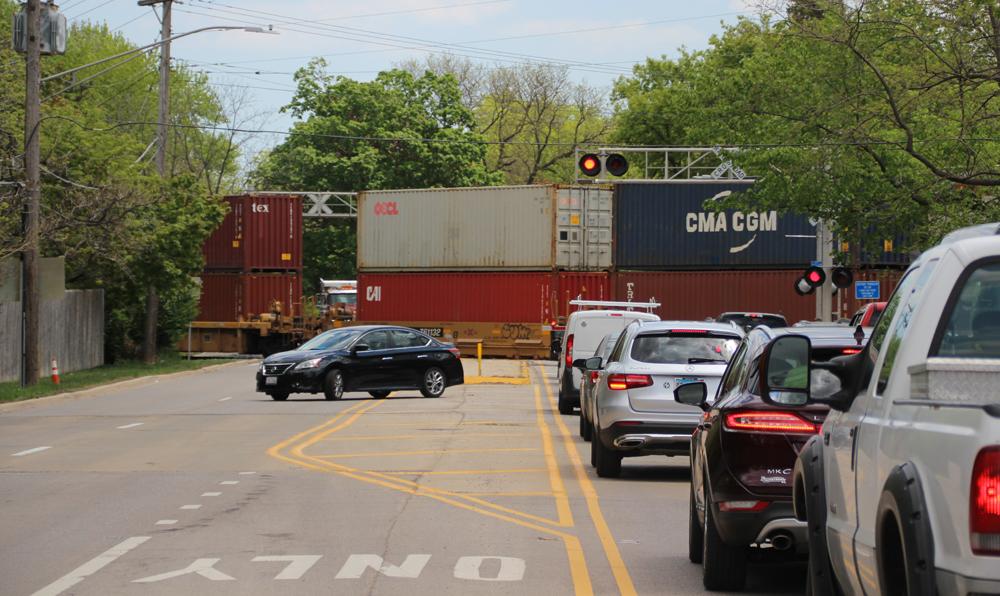
Eighteen other state attorneys general have joined a group led by Indiana Attorney General Theodore E. Rokita in requesting that the court hear an Ohio appeal of a state Supreme Court decision overturning that state’s law allowing fines for railroads that blocked crossings for more than five minutes, the Kansas City Star reports. The Ohio court ruled the law was preempted by federal law, as has been the case with similar rulings in other states.
In a press release, Schmidt said the group is asking the U.S. Supreme Court to clarify if indeed Congress granted the Surface Transportation Board sole jurisdiction over such matters regulating crossings. The states argue that rulings have misinterpreted the law which abolished the Interstate Commerce Commission, saying it established jurisdiction over matters such as rates and practices but is silent on the effort of safety.
|
|
(Editor's Note: Funding from the Bipartisan Infrastructure Bill is starting to flow to a number of important projects.) |
|
FRA Solicits Proposals to Identify New Passenger-Rail Corridors |
|
The Federal Railroad Administration yesterday put out a call for project proposals for intercity passenger-rail corridors as part of the new federal Corridor Identification and Development Program.
Created by the federal Infrastructure Investment and Jobs Act, the corridor ID program will guide the development of new intercity passenger-rail services pegged to help bolster economic growth, FRA officials said in a press release.
The program is part of the Biden-Harris administration's effort to improve the nation's rail networks and "reverse decades of under-investment" in rail infrastructure, they said.
In May, the FRA began soliciting "expressions of interest" in the corridor ID program and received responses from states, transit agencies and stakeholders in every major region of the country.
Going forward, the FRA will use the corridor ID program as the primary means for guiding financial support and technical assistance toward projects that would establish new intercity passenger-rail corridors that improve existing services.
"[We have] received extensive interest from states, local leaders and the public for intercity passenger-rail service in their regions and communities, and the corridor ID program will allow the federal government to help with the long-term planning and delivery of new passenger rail projects nationwide," said FRA Administrator Amit Bose.
Proposals are due March 20, 2023.
|
|
(Editor's Note: This ruling is not unexpected. What is a bit of a surprise however, is the fact that the judge in the case saw fit to lay blame upon the train's engineer, when he had been exonerated of all charges by a Canadian court back in 2018.) |
|
Judge Rules Canadian Pacific is not Liable in Lac-Mégantic Disaster
Families of three victims had sued CP, which had handled oil train prior to its handoff to Montreal, Maine & Atlantic
|
|
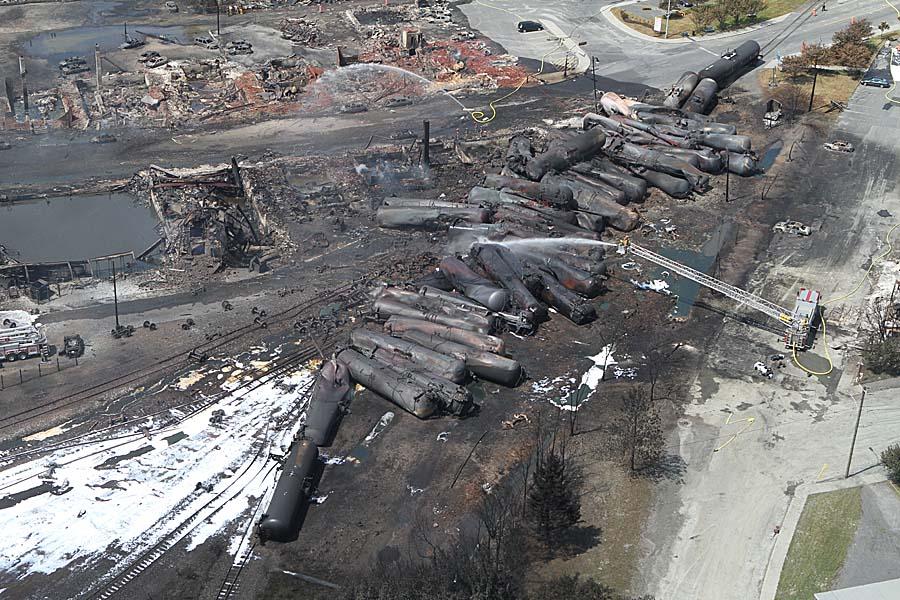
MONTREAL — A Quebec judge has found that Canadian Pacific is not liable in the 2013 runaway-train disaster that killed 47 people in Lac-Mégantic, Quebec.
The Canadian Press reports that Justice Martin Bureau ruled Wednesday that the actions of which Canadian Pacific was accused were not the “direct, immediate and logical cause” of the July 6, 2013, derailment and fire.
CP was sued by three Lac-Mégantic residents who lost family members in the disaster. They argued that CP knew that train operator Montreal, Maine & Atlantic chose unsafe routes, and that CP misclassified crude oil coming from North Dakota. CP had handed off the train of crude oil to the MM&A in Montreal prior to the disaster.
Bureau said responsibility for the accident rested primarily with the train’s engineer, Thomas Harding, and with the Montreal, Maine & Atlantic. Harding and two other MM&A were tried and found not guilty of all charges relating to the accident in 2018.
Canadian Pacific subsequently ended up owning the line through Lac-Mégantic after the Montreal, Maine & Atlantic went bankrupt. A new railroad, the Central Maine & Quebec, eventually was established to operate the line; CP bought the CM&Q in 2020.
|
|
(Editor's Note: While they steadfast refuse to bargain attendance policies with the unions, the carriers now pretend to play nice by "revising" their policies "developed in discussions with labor representatives." Notice the carrier continues to maintain that it is their sole prerogative to do as it pleases. RWU maintains that anytime an attendance policy is to be changed or implemented, it MUST be bargained with the union since this represents a fundamental change in the conditions of employment, period.) |
|
CSX Revamps Employee Attendance Policy |
|
CSX will implement a revised attendance policy for all craft employees effective Jan. 1, 2023.
The revised policy is being implemented in response to concerns raised by craft employees and labor unions, CSX spokeswoman Sheriee Bowman in an email.
The new company-wide policy will replace all prior craft-specific attendance policies. It was developed in discussions with labor representatives and "provides improvements favorable to employees" in most areas, Bowman said.
"Most notably, in contrast to prior policies, points that accrue for accountable absences will expire on a rolling 12-month cycle rather than continue to accumulate indefinitely," she said. "All craft employees will now earn five points of good attendance credits for each calendar year quarter worked without an absence."
Points will not be assessed for documented hospital stays, emergency care or scheduled medical appointments. The new policy will be nondisciplinary and non-punitive, and employees will no longer be subjected to "formal investigations, hearings or disciplinary suspensions," Bowman said.
"Instead, employees who exceed certain point thresholds will receive timely notifications and encouragement to correct their attendance records," Bowman added. "Leadership will also be empowered to exercise discretion in the handling of those with special needs and consider alternative approaches in appropriate circumstances."
CSX's new policy was announced following rail workers' objections to a lack of paid sick days during the unions’ contract negotiations with the nation's major freight railroads. On Dec. 2, President Joe Biden signed legislation that implemented a new contract between the unions and freight railroads that did not include additional paid time off for sickness.
|
|
(Editor's Note: It goes without saying that the AAR will criticize practically any action of the STB. The term they use is "activism". Since the role of the STB is to regulate the rail industry, AAR wants an STB that in effect does nothing.) |
|
STB Adopts, AAR Criticizes New Smaller Rate Dispute Rules |
|
The Surface Transportation Board yesterday adopted two final rules that establish new rate reasonableness procedures providing two streamlined approaches for shippers and railroads to resolve smaller rate disputes.
The board established a voluntary arbitration program and a new procedure for rate challenges known as "final offer rate review" (FORR). Either rate review mechanism will “substantially improve shippers’ access to rate reasonableness reviews for smaller rate disputes," STB officials said in a press release.
Through the new rate reasonableness procedures, the voluntary arbitration program will take effect only if all seven Class Is commit to participating in the program for five years and do so within 50 days of the date of publication of the final rule in the Federal Register. If all do so, they will be exempt from the FORR procedure, board officials said.
In September 2019, the STB proposed a rule and sought public comment on a proposal for the new FORR procedure. Subsequently, five Class Is filed a joint petition urging the board to exempt them from the FORR procedure. In return, the Class Is promised to agree to resolve rate challenges through binding arbitration, a methodology in which the carriers had previously refused to participate for many years.
The STB reviewed that petition and explored whether establishing a voluntary arbitration program would provide a practical alternative dispute resolution mechanism to address smaller rate disputes. In November 2021, the board advanced rulemakings in both FORR and the establishment of a voluntary arbitration program. Yesterday’s decision is the culmination of those actions.
Both review mechanisms are limited to rate disputes worth up to $4 million in relief over two years. Under the new FORR procedure, if the board finds a rate to be unreasonable, it will decide the rate by selecting either the complainant’s or the defendant’s final offer, subject to an expedited procedural schedule that adheres to firm deadlines. The two rules are an attempt to strike a balance between shippers and railroads, said STB Chairman Martin Oberman.
|
|
(Editor's Note: OK, it looks like the hoghead might have screwed it up. But why? Was this worker properly trained? Well rested? Properly qualified on the territory? Had s/he been brow-beaten to use only dynamics, not air? These are the questions that NTSB needs to be asking now.) |
|
Mishandling of Air Brakes Led to Three-Train Minnesota Accident, NTSB Says |
|
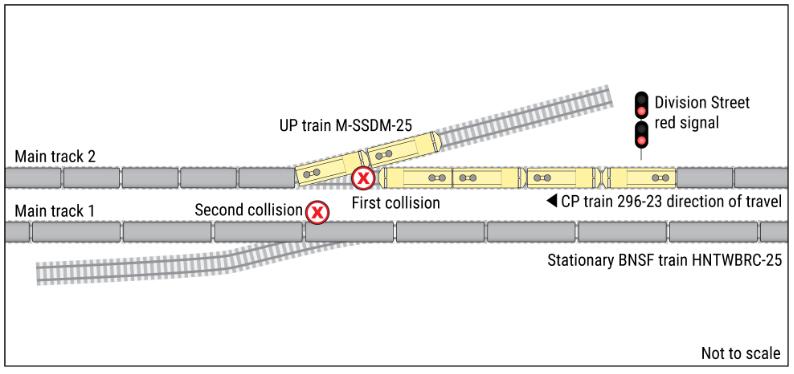
WASHINGTON — Improper handling of train air brakes by the engineer of a Canadian Pacific train was the cause of a three-train accident in St. Paul, Minn., in August 2021, the National Transportation Safety Board has determined.
The accident report, issued Dec. 8, covers an Aug. 25 incident that saw the CP train strike a stopped Union Pacific train, derailing two locomotives on the CP train and one on the UP train. The derailed lead CP locomotive then struck and derailed a car on a BNSF Railway train stopped on an adjacent track [see “NTSB to investigate three-train collision in Minnesota,” Trains News Wire, Aug. 27, 2021]. No injuries were reported. Total damages were estimated at $674,000.
According to the report, CP train 296-23, with four locomotives and 117 caries, was descending a 1.65% grade from a red signal at the Seventh Street control point to a red signal at the Division Street control point, with the engineer using dynamic brakes, which were unsufficient to hold the train. After two air brake applications that proved insufficient to slow the train, the engineer applied emergency braking, but the train passed the red signal at Division street at 19 mph and collided with the other two trains.
The train was not operating under positive train control at the time because of a malfunction aboard the lead locomotive, but was allowed to operate under Federal Railroad Administration rules in effect at the time. Effective Jan. 1, 2023, a train would be prohibited from departing any terminal with a similar malfunction, the report notes.
|
|
(Editor's Note: There have been a number of serious derailments caused by grade crossing collisions with heavy trucks this past year. Ironically, as the Class Ones move less and less freight under PSR, relegating more and more freight to the nation's highways, this type of disaster will probably see an increase. There is an alternative however. Move more freight, not less, thereby removing trucks from the highways; and take the enormous profit that the railroad has been accruing in recent decades and plow it back into the physical plant, including modernizing and securing the thousands of dangerous highway crossings at grade.) |
|
Crew Members Released from Hospital, NS Line Reopened After Bridge-Beam Derailment |
|
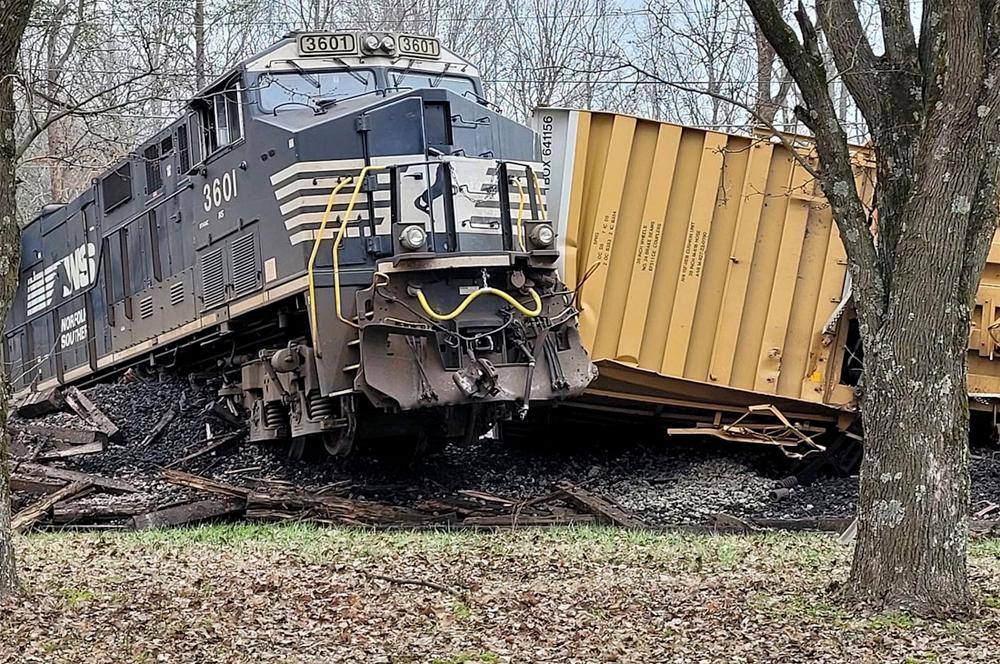
COLLEGEDALE, Tenn. — Injured crew members have been released from the hospital and a Norfolk Southern rail line has been reopened after Tuesday’s derailment of a train that hit a 134-foot concrete bridge beam being transported by truck, WRCB-TV reports.
The rail line reopened Wednesday morning, while the grade crossing that was the site of the accident was expected to reopen Wednesday afternoon. Three locomotives and 10 cars derailed after striking the beam on Tuesday afternoon, injuring two NS crew members [see “NS train derails …,” Trains News Wire, Dec. 20, 2022.]
Collegedale police identified the truck’s driver as 64-year-old Jorge Luis Cruz-Vega of Martinez, Ga., who was driving for Starrette Houston Trucking of Augusta, Ga. Police said they will not comment on possible charges against Cruz-Vega while their investigation continues.
The beam was bound for a nearby road-widening project involving a bridge on State Route 317, WRCB reports. A Tennessee Department of Transportation spokeswoman said that because beams are manufactured specifically for each project, replacement of the one destroyed Tuesday could delay the highway project
|
|
|
|
|
|
|